TARGET: Texas Guide for Effective Teaching
Adaptive Behavior Assessment
ADAPTIVE BEHAVIOR ASSESSMENT
OVERVIEW OF INSTRUMENTS
Adaptive behavior is a critical part of assessing students who have or are suspected of having
autism spectrum disorder (Volkmar, et al., 2014). The use of a formal adaptive behavior
measure allows the assessment team to determine the student’s level of functioning in daily
tasks required to be successful in the home, community, and work place. This type of
assessment will assist in transition planning and ensure the student has the necessary skills to
be productive when he leaves the school environment. Assessing adaptive behavior in both
school and home settings can provide additional valuable information about generalization of
skills across settings. The following are the most commonly used adaptive behavior measures.
ADAPTIVE BEHAVIOR ASSESSMENT SYSTEM—SECOND EDITION
(ABAS-II)
The Adaptive Behavior Assessment System—Second Edition (ABAS-II; Harrison & Oakland,
2003) uses a behavior rating format to assess adaptive behavior and related skills for
individuals 0 through 89 years of age. Information on children may be provided by parents
and/or teachers; information on adults may be provided by significant others, care providers,
supervisors, and/or the client him/herself. ABAS scores help describe a person’s general
adaptive behavior as well as his or her functioning in 10 related adaptive skill areas:
communication, community use, functional academics, school/home living, health and safety,
leisure, self-care, self-direction, social, and work (for older adolescents and adults). These areas
encompass the practical, everyday skills required to function and meet environmental demands,
including those needed to effectively and independently care for oneself and interact with
others.
The ABAS groups adaptive skills into three broad domains: conceptual, social, and practical.
The conceptual domain includes the skill areas of communication, functional academics, self-
direction, and health and safety. The social domain includes social and leisure skill areas.
Finally, the practical domain includes the skill areas of self-care, home living, community use,
health and safety, and work. The motor skills area is supplemental for ages 5 through 89, and
required for ages 0 through 5.
Texas Statewide Leadership for Autism Training | December 2013 1
TARGET: Texas Guide for Effective Teaching
Adaptive Behavior Assessment
The ABAS provides a general adaptive composite; the composite scores for the conceptual,
social, and practical domains; and scaled scores for the 10 skills areas. Report forms include
parent/caregiver, teacher, adult form-self report, and adult form-rated by others.
SCALES OF INDEPENDENT BEHAVIOR—REVISED (SIB-R)
The Scales of Independent Behavior—Revised (SIB-R; Bruininks, Woodcock, Weatherman, &
Hill, 1997) is a comprehensive measure of adaptive and problem behaviors. Administered
individually, the SIB-R assesses functional independence and adaptive functioning across
settings – school, home, employment, and community. The authors note that the SIB-R was
designed for individual evaluation, individualized program planning, selection, and placement,
and to assess service needs. The SIB-R may be administered using the structured interview or
a checklist procedure.
Informaton obtained during the assessment yields two scale scores, the Adaptve Behavior Full
Scale score and the Problem Behavior Scale score. Diferent ratng systems are used for the two
scales. The Adaptve Behavior items are rated based on the extent to which the individual
performs a task completely and independently (no help or supervision). The Problem Behavior
scale is rated based on the frequency and severity of each behavior. Additonally, a Support
Scale score is available. This score, based on the informaton obtained from the other two
scales, indicates an approximate level of support that an individual may need in order to be
independent in diferent areas.
VINELAND ADAPTIVE BEHAVIOR SCALES—SECOND EDITION
(VABS-II)
The Vineland Adaptive Behavior Scales—Second Edition (VABS-II; Sparrow, Cicchetti, & Balla,
2005) is a measure of personal and social skills needed for everyday life. Domains assessed
include Communication, Daily Living, Motor Skills, and Socialization. The Socialization domain
is targeted at measuring impairments associated with autism. A Maladaptive Behavior Index is
optional. Four formats include survey interview (may be administered through a semi-structured
interview); expanded interview (more comprehensive; may be used as follow-up to obtain more
information about skill deficits reported in the survey interview); parent/caregiver rating form
(covers the same content as the survey interview but can be completed by the parents as a
Texas Statewide Leadership for Autism Training | December 2013 2
TARGET: Texas Guide for Effective Teaching
Adaptive Behavior Assessment
rating scale); and teacher rating form (consists of a teacher checklist of adaptive skills that the
student is performing in the classroom setting).
Chapter 5 of the VABS-II manual describes classical score profiles for individuals with different
diagnostic classifications and provides comparisons between high-functioning autism and
Asperger Syndrome, autism and mental retardation, normal development and attention deficit
hyperactive disorder (ADHD), normal development and hearing impaired, and nonspecific
mental retardation and Down Syndrome.
SUMMARY OF ADAPTIVE BEHAVIOR ASSESSMENT INSTRUMENTS
Name of
Tool/
Author
(Year)
Age
Range
(in
years)
Method of
Administration/Format
Approximate
Time to
Administer
Subscales Availability
Adaptive
Behavior
Assessment
System-
Second
Edition
(ABAS-II)
Harrison &
Oakland
(2003)
Birth–80+ Individually administered,
norm-referenced measure
of adaptive behavior
5 forms-Parent/Primary
Caregiver (0-5 yrs.) (S),
Parent (5-21) yrs. (S),
Teacher/Day Care
Provider (2-5 yrs.) (S),
Teacher (5-21 yrs.), Adult
(16-89 yrs.) [S= available
in Spanish]; 10 skill areas,
3 domains; respondent
rates frequency of
specified skills using a 4-
point rubric
Yields composite scores,
skills profile, analysis of
strengths and
weaknesses
Yields standard scores,
percentiles, test-age
equivalents
20 min. General Adaptive
Composite;
Adaptive Domains –
Conceptual
(Communication,
Functional
Academics, Self-
Direction,
Composite); Social
(Leisure, Social,
Composite);
Practical
(Community Use,
Home Living, Health
& Safety, Self-care,
Work, Composite);
Motor
Pearson
Assessments
http://bit.ly/V0
JbGL
Texas Statewide Leadership for Autism Training | December 2013 3
TARGET: Texas Guide for Effective Teaching
Adaptive Behavior Assessment
Name of
Tool/
Author
(Year)
Age
Range
(in
years)
Method of
Administration/Format
Approximate
Time to
Administer
Subscales Availability
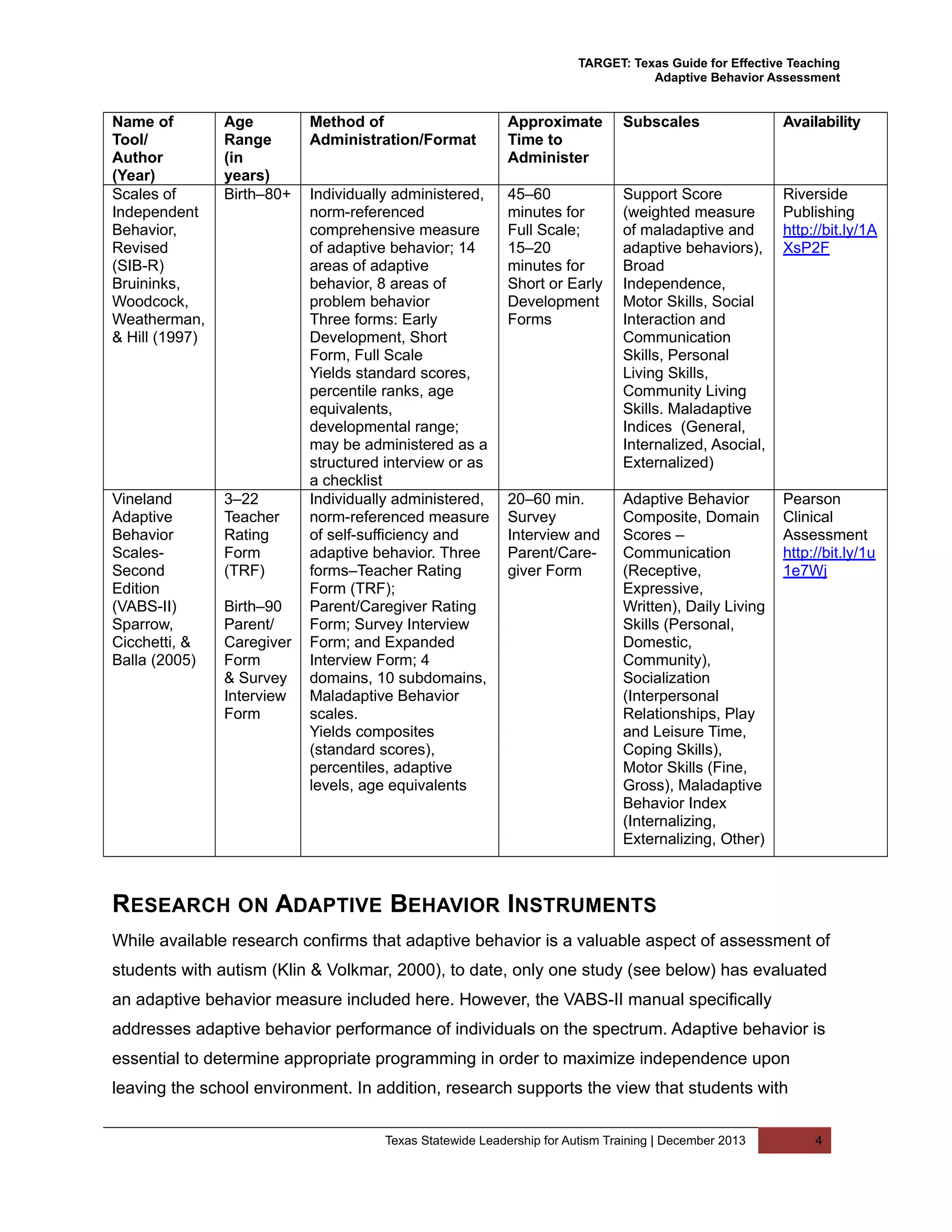
Scales of
Independent
Behavior,
Revised
(SIB-R)
Bruininks,
Woodcock,
Weatherman,
& Hill (1997)
Birth–80+ Individually administered,
norm-referenced
comprehensive measure
of adaptive behavior; 14
areas of adaptive
behavior, 8 areas of
problem behavior
Three forms: Early
Development, Short
Form, Full Scale
Yields standard scores,
percentile ranks, age
equivalents,
developmental range;
may be administered as a
structured interview or as
a checklist
45–60
minutes for
Full Scale;
15–20
minutes for
Short or Early
Development
Forms
Support Score
(weighted measure
of maladaptive and
adaptive behaviors),
Broad
Independence,
Motor Skills, Social
Interaction and
Communication
Skills, Personal
Living Skills,
Community Living
Skills. Maladaptive
Indices (General,
Internalized, Asocial,
Externalized)
Riverside
Publishing
http://bit.ly/1A
XsP2F
Vineland
Adaptive
Behavior
Scales-
Second
Edition
(VABS-II)
Sparrow,
Cicchetti, &
Balla (2005)
3–22
Teacher
Rating
Form
(TRF)
Birth–90
Parent/
Caregiver
Form
& Survey
Interview
Form
Individually administered,
norm-referenced measure
of self-sufficiency and
adaptive behavior. Three
forms–Teacher Rating
Form (TRF);
Parent/Caregiver Rating
Form; Survey Interview
Form; and Expanded
Interview Form; 4
domains, 10 subdomains,
Maladaptive Behavior
scales.
Yields composites
(standard scores),
percentiles, adaptive
levels, age equivalents
20–60 min.
Survey
Interview and
Parent/Care-
giver Form
Adaptive Behavior
Composite, Domain
Scores –
Communication
(Receptive,
Expressive,
Written), Daily Living
Skills (Personal,
Domestic,
Community),
Socialization
(Interpersonal
Relationships, Play
and Leisure Time,
Coping Skills),
Motor Skills (Fine,
Gross), Maladaptive
Behavior Index
(Internalizing,
Externalizing, Other)
Pearson
Clinical
Assessment
http://bit.ly/1u
1e7Wj
RESEARCH ON ADAPTIVE BEHAVIOR INSTRUMENTS
While available research confirms that adaptive behavior is a valuable aspect of assessment of
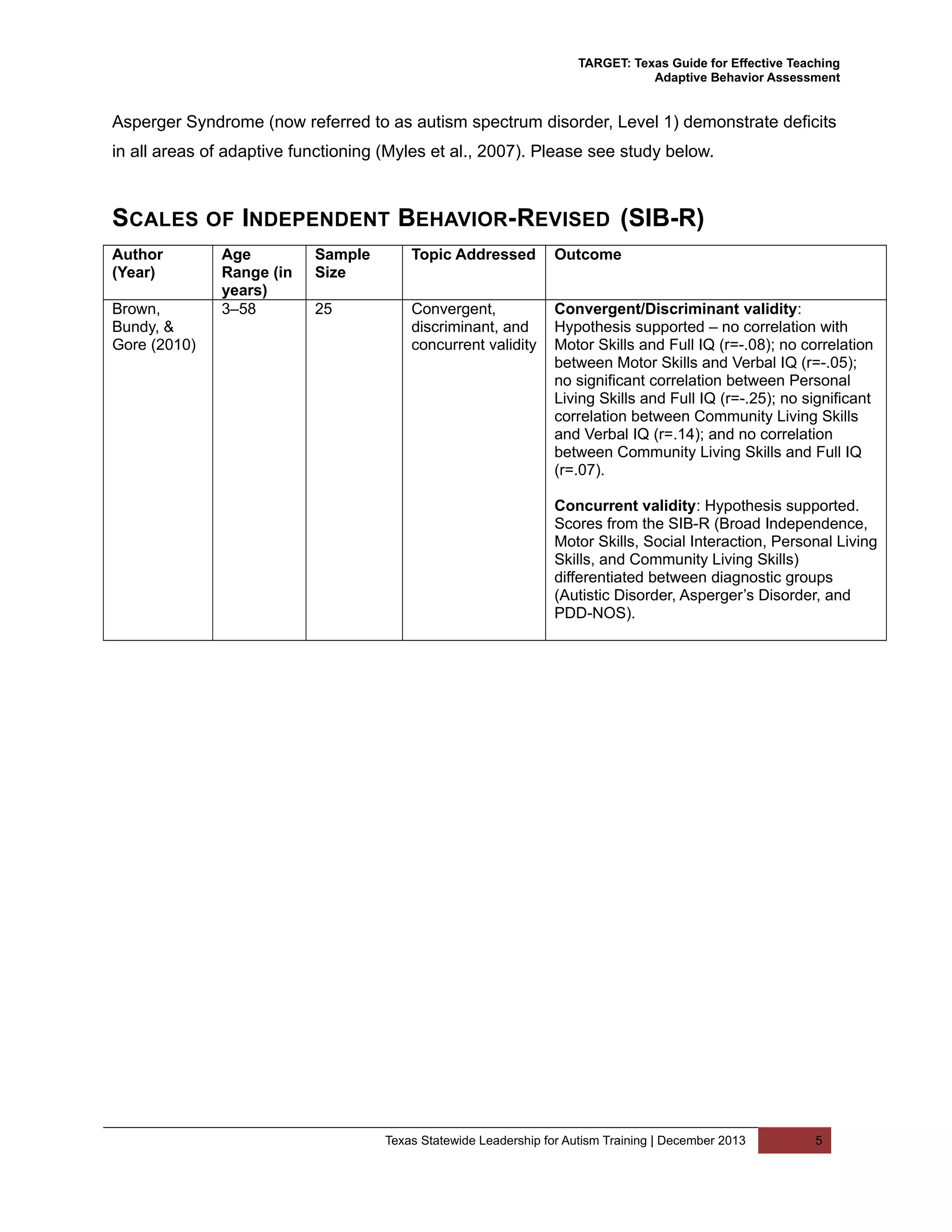
students with autism (Klin & Volkmar, 2000), to date, only one study (see below) has evaluated
an adaptive behavior measure included here. However, the VABS-II manual specifically
addresses adaptive behavior performance of individuals on the spectrum. Adaptive behavior is
essential to determine appropriate programming in order to maximize independence upon
leaving the school environment. In addition, research supports the view that students with
Texas Statewide Leadership for Autism Training | December 2013 4
TARGET: Texas Guide for Effective Teaching
Adaptive Behavior Assessment
Asperger Syndrome (now referred to as autism spectrum disorder, Level 1) demonstrate deficits
in all areas of adaptive functioning (Myles et al., 2007). Please see study below.
SCALES OF INDEPENDENT BEHAVIOR-REVISED (SIB-R)
Author
(Year)
Age
Range (in
years)
Sample
Size
Topic Addressed Outcome
Brown,
Bundy, &
Gore (2010)
3–58 25 Convergent,
discriminant, and
concurrent validity
Convergent/Discriminant validity:
Hypothesis supported – no correlation with
Motor Skills and Full IQ (r=-.08); no correlation
between Motor Skills and Verbal IQ (r=-.05);
no significant correlation between Personal
Living Skills and Full IQ (r=-.25); no significant
correlation between Community Living Skills
and Verbal IQ (r=.14); and no correlation
between Community Living Skills and Full IQ
(r=.07).
Concurrent validity: Hypothesis supported.
Scores from the SIB-R (Broad Independence,
Motor Skills, Social Interaction, Personal Living
Skills, and Community Living Skills)
differentiated between diagnostic groups
(Autistic Disorder, Asperger’s Disorder, and
PDD-NOS).
Texas Statewide Leadership for Autism Training | December 2013 5
TARGET: Texas Guide for Effective Teaching
Adaptive Behavior Assessment
MISCONCEPTIONS
Myth Reality
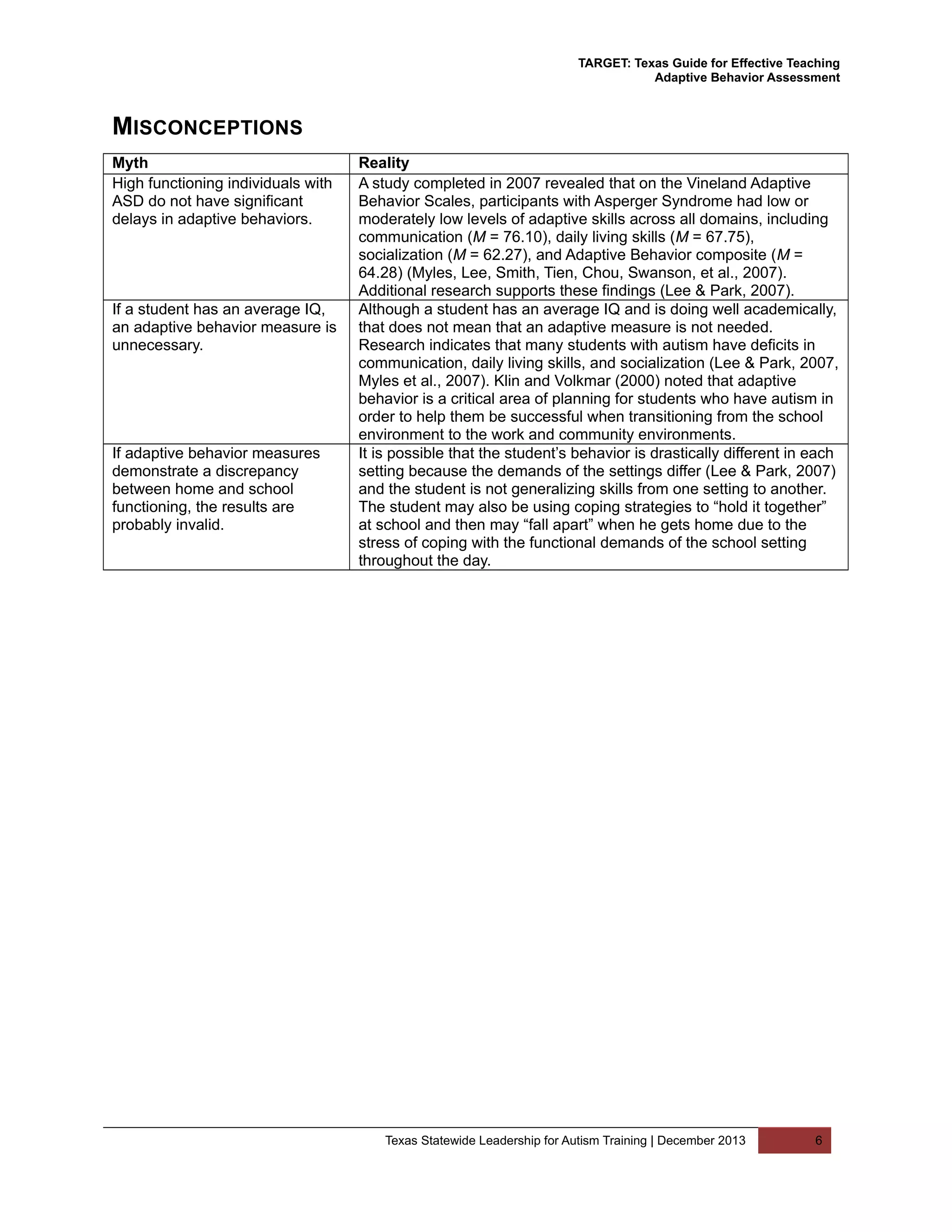
High functioning individuals with
ASD do not have significant
delays in adaptive behaviors.
A study completed in 2007 revealed that on the Vineland Adaptive
Behavior Scales, participants with Asperger Syndrome had low or
moderately low levels of adaptive skills across all domains, including
communication (M = 76.10), daily living skills (M = 67.75),
socialization (M = 62.27), and Adaptive Behavior composite (M =
64.28) (Myles, Lee, Smith, Tien, Chou, Swanson, et al., 2007).
Additional research supports these findings (Lee & Park, 2007).
If a student has an average IQ,
an adaptive behavior measure is
unnecessary.
Although a student has an average IQ and is doing well academically,
that does not mean that an adaptive measure is not needed.
Research indicates that many students with autism have deficits in
communication, daily living skills, and socialization (Lee & Park, 2007,
Myles et al., 2007). Klin and Volkmar (2000) noted that adaptive
behavior is a critical area of planning for students who have autism in
order to help them be successful when transitioning from the school
environment to the work and community environments.
If adaptive behavior measures
demonstrate a discrepancy
between home and school
functioning, the results are
probably invalid.
It is possible that the student’s behavior is drastically different in each
setting because the demands of the settings differ (Lee & Park, 2007)
and the student is not generalizing skills from one setting to another.
The student may also be using coping strategies to “hold it together”
at school and then may “fall apart” when he gets home due to the
stress of coping with the functional demands of the school setting
throughout the day.
Texas Statewide Leadership for Autism Training | December 2013 6
TARGET: Texas Guide for Effective Teaching
Adaptive Behavior Assessment
REFERENCES
Brown, L., Bundy, M.B., & Gore, J.S. (2010). Patterns of adaptive performance by individuals with autism
spectrum disorders on the Scales of Independent Behavior-Revised (SIB-R). International
Journal on Disability and Human Development, 9(4), 315-318.
Bruininks, R., Woodcock, R., Weatherman, R., & Hill, B. (1997). Scales of Independent Behavior-
Revised. Rolling Meadows, IL: Riverside Publishing.
Harrison, P. L., & Oakland, T. (2003). Adaptive Behavior Assessment System (2nd
ed.). Minneapolis, MN:
Pearson Assessment.
Klin, A., & Volkmar, F. (2000). Treatment and intervention guidelines for individuals with Asperger
syndrome. In A. Klin, F. R. Volkmar, & S. S. Sparrow (Eds.), Asperger Syndrome (pp. 340-366).
New York: Guilford.
Volkmar, F., Siegel, M., Woodbury-Smith, M., King, B., McCracken, J., & State, M. (2014). Practice
Parameter for the Assessment and Treatment of Children and Adolescents With Autism Spectrum
Disorder. Journal of the American Academy of Child & Adolescent Psychiatry, 53(2), 237-257.
Lee, H. J., & Park, H. R. (2007). An integrated literature review on the adaptive behavior of individuals
with Asperger Syndrome. Remedial and Special Education, 28(3), 132-139.
Myles, B. S., Lee, H. J., Smith, S. M., Tien, K. C., Chou, Y. C., Swanson, T. C., et al. (2007). A large-scale
study of the characteristics of Asperger Syndrome. Education and Training in Developmental
Disabilities, 42(4), 448-459.
Sparrow, S., Cicchetti, D., & Balla, D. (2005). Vineland Adaptive Behavior Scales (2nd
ed.). Minneapolis,
MN: Pearson Assessment.
RESOURCES AND MATERIALS
Lee, H. J., & Park, H. R. (2007). An integrated literature review on the adaptive behavior of
individuals with Asperger Syndrome. Remedial and Special Education, 28(3), 132-139.
Texas Statewide Leadership for Autism Training | December 2013 7

Adaptive behavior

  • 1.
    TARGET: Texas Guidefor Effective Teaching Adaptive Behavior Assessment ADAPTIVE BEHAVIOR ASSESSMENT OVERVIEW OF INSTRUMENTS Adaptive behavior is a critical part of assessing students who have or are suspected of having autism spectrum disorder (Volkmar, et al., 2014). The use of a formal adaptive behavior measure allows the assessment team to determine the student’s level of functioning in daily tasks required to be successful in the home, community, and work place. This type of assessment will assist in transition planning and ensure the student has the necessary skills to be productive when he leaves the school environment. Assessing adaptive behavior in both school and home settings can provide additional valuable information about generalization of skills across settings. The following are the most commonly used adaptive behavior measures. ADAPTIVE BEHAVIOR ASSESSMENT SYSTEM—SECOND EDITION (ABAS-II) The Adaptive Behavior Assessment System—Second Edition (ABAS-II; Harrison & Oakland, 2003) uses a behavior rating format to assess adaptive behavior and related skills for individuals 0 through 89 years of age. Information on children may be provided by parents and/or teachers; information on adults may be provided by significant others, care providers, supervisors, and/or the client him/herself. ABAS scores help describe a person’s general adaptive behavior as well as his or her functioning in 10 related adaptive skill areas: communication, community use, functional academics, school/home living, health and safety, leisure, self-care, self-direction, social, and work (for older adolescents and adults). These areas encompass the practical, everyday skills required to function and meet environmental demands, including those needed to effectively and independently care for oneself and interact with others. The ABAS groups adaptive skills into three broad domains: conceptual, social, and practical. The conceptual domain includes the skill areas of communication, functional academics, self- direction, and health and safety. The social domain includes social and leisure skill areas. Finally, the practical domain includes the skill areas of self-care, home living, community use, health and safety, and work. The motor skills area is supplemental for ages 5 through 89, and required for ages 0 through 5. Texas Statewide Leadership for Autism Training | December 2013 1
  • 2.
    TARGET: Texas Guidefor Effective Teaching Adaptive Behavior Assessment The ABAS provides a general adaptive composite; the composite scores for the conceptual, social, and practical domains; and scaled scores for the 10 skills areas. Report forms include parent/caregiver, teacher, adult form-self report, and adult form-rated by others. SCALES OF INDEPENDENT BEHAVIOR—REVISED (SIB-R) The Scales of Independent Behavior—Revised (SIB-R; Bruininks, Woodcock, Weatherman, & Hill, 1997) is a comprehensive measure of adaptive and problem behaviors. Administered individually, the SIB-R assesses functional independence and adaptive functioning across settings – school, home, employment, and community. The authors note that the SIB-R was designed for individual evaluation, individualized program planning, selection, and placement, and to assess service needs. The SIB-R may be administered using the structured interview or a checklist procedure. Informaton obtained during the assessment yields two scale scores, the Adaptve Behavior Full Scale score and the Problem Behavior Scale score. Diferent ratng systems are used for the two scales. The Adaptve Behavior items are rated based on the extent to which the individual performs a task completely and independently (no help or supervision). The Problem Behavior scale is rated based on the frequency and severity of each behavior. Additonally, a Support Scale score is available. This score, based on the informaton obtained from the other two scales, indicates an approximate level of support that an individual may need in order to be independent in diferent areas. VINELAND ADAPTIVE BEHAVIOR SCALES—SECOND EDITION (VABS-II) The Vineland Adaptive Behavior Scales—Second Edition (VABS-II; Sparrow, Cicchetti, & Balla, 2005) is a measure of personal and social skills needed for everyday life. Domains assessed include Communication, Daily Living, Motor Skills, and Socialization. The Socialization domain is targeted at measuring impairments associated with autism. A Maladaptive Behavior Index is optional. Four formats include survey interview (may be administered through a semi-structured interview); expanded interview (more comprehensive; may be used as follow-up to obtain more information about skill deficits reported in the survey interview); parent/caregiver rating form (covers the same content as the survey interview but can be completed by the parents as a Texas Statewide Leadership for Autism Training | December 2013 2
  • 3.
    TARGET: Texas Guidefor Effective Teaching Adaptive Behavior Assessment rating scale); and teacher rating form (consists of a teacher checklist of adaptive skills that the student is performing in the classroom setting). Chapter 5 of the VABS-II manual describes classical score profiles for individuals with different diagnostic classifications and provides comparisons between high-functioning autism and Asperger Syndrome, autism and mental retardation, normal development and attention deficit hyperactive disorder (ADHD), normal development and hearing impaired, and nonspecific mental retardation and Down Syndrome. SUMMARY OF ADAPTIVE BEHAVIOR ASSESSMENT INSTRUMENTS Name of Tool/ Author (Year) Age Range (in years) Method of Administration/Format Approximate Time to Administer Subscales Availability Adaptive Behavior Assessment System- Second Edition (ABAS-II) Harrison & Oakland (2003) Birth–80+ Individually administered, norm-referenced measure of adaptive behavior 5 forms-Parent/Primary Caregiver (0-5 yrs.) (S), Parent (5-21) yrs. (S), Teacher/Day Care Provider (2-5 yrs.) (S), Teacher (5-21 yrs.), Adult (16-89 yrs.) [S= available in Spanish]; 10 skill areas, 3 domains; respondent rates frequency of specified skills using a 4- point rubric Yields composite scores, skills profile, analysis of strengths and weaknesses Yields standard scores, percentiles, test-age equivalents 20 min. General Adaptive Composite; Adaptive Domains – Conceptual (Communication, Functional Academics, Self- Direction, Composite); Social (Leisure, Social, Composite); Practical (Community Use, Home Living, Health & Safety, Self-care, Work, Composite); Motor Pearson Assessments http://bit.ly/V0 JbGL Texas Statewide Leadership for Autism Training | December 2013 3
  • 4.
    TARGET: Texas Guidefor Effective Teaching Adaptive Behavior Assessment Name of Tool/ Author (Year) Age Range (in years) Method of Administration/Format Approximate Time to Administer Subscales Availability Scales of Independent Behavior, Revised (SIB-R) Bruininks, Woodcock, Weatherman, & Hill (1997) Birth–80+ Individually administered, norm-referenced comprehensive measure of adaptive behavior; 14 areas of adaptive behavior, 8 areas of problem behavior Three forms: Early Development, Short Form, Full Scale Yields standard scores, percentile ranks, age equivalents, developmental range; may be administered as a structured interview or as a checklist 45–60 minutes for Full Scale; 15–20 minutes for Short or Early Development Forms Support Score (weighted measure of maladaptive and adaptive behaviors), Broad Independence, Motor Skills, Social Interaction and Communication Skills, Personal Living Skills, Community Living Skills. Maladaptive Indices (General, Internalized, Asocial, Externalized) Riverside Publishing http://bit.ly/1A XsP2F Vineland Adaptive Behavior Scales- Second Edition (VABS-II) Sparrow, Cicchetti, & Balla (2005) 3–22 Teacher Rating Form (TRF) Birth–90 Parent/ Caregiver Form & Survey Interview Form Individually administered, norm-referenced measure of self-sufficiency and adaptive behavior. Three forms–Teacher Rating Form (TRF); Parent/Caregiver Rating Form; Survey Interview Form; and Expanded Interview Form; 4 domains, 10 subdomains, Maladaptive Behavior scales. Yields composites (standard scores), percentiles, adaptive levels, age equivalents 20–60 min. Survey Interview and Parent/Care- giver Form Adaptive Behavior Composite, Domain Scores – Communication (Receptive, Expressive, Written), Daily Living Skills (Personal, Domestic, Community), Socialization (Interpersonal Relationships, Play and Leisure Time, Coping Skills), Motor Skills (Fine, Gross), Maladaptive Behavior Index (Internalizing, Externalizing, Other) Pearson Clinical Assessment http://bit.ly/1u 1e7Wj RESEARCH ON ADAPTIVE BEHAVIOR INSTRUMENTS While available research confirms that adaptive behavior is a valuable aspect of assessment of students with autism (Klin & Volkmar, 2000), to date, only one study (see below) has evaluated an adaptive behavior measure included here. However, the VABS-II manual specifically addresses adaptive behavior performance of individuals on the spectrum. Adaptive behavior is essential to determine appropriate programming in order to maximize independence upon leaving the school environment. In addition, research supports the view that students with Texas Statewide Leadership for Autism Training | December 2013 4
  • 5.
    TARGET: Texas Guidefor Effective Teaching Adaptive Behavior Assessment Asperger Syndrome (now referred to as autism spectrum disorder, Level 1) demonstrate deficits in all areas of adaptive functioning (Myles et al., 2007). Please see study below. SCALES OF INDEPENDENT BEHAVIOR-REVISED (SIB-R) Author (Year) Age Range (in years) Sample Size Topic Addressed Outcome Brown, Bundy, & Gore (2010) 3–58 25 Convergent, discriminant, and concurrent validity Convergent/Discriminant validity: Hypothesis supported – no correlation with Motor Skills and Full IQ (r=-.08); no correlation between Motor Skills and Verbal IQ (r=-.05); no significant correlation between Personal Living Skills and Full IQ (r=-.25); no significant correlation between Community Living Skills and Verbal IQ (r=.14); and no correlation between Community Living Skills and Full IQ (r=.07). Concurrent validity: Hypothesis supported. Scores from the SIB-R (Broad Independence, Motor Skills, Social Interaction, Personal Living Skills, and Community Living Skills) differentiated between diagnostic groups (Autistic Disorder, Asperger’s Disorder, and PDD-NOS). Texas Statewide Leadership for Autism Training | December 2013 5
  • 6.
    TARGET: Texas Guidefor Effective Teaching Adaptive Behavior Assessment MISCONCEPTIONS Myth Reality High functioning individuals with ASD do not have significant delays in adaptive behaviors. A study completed in 2007 revealed that on the Vineland Adaptive Behavior Scales, participants with Asperger Syndrome had low or moderately low levels of adaptive skills across all domains, including communication (M = 76.10), daily living skills (M = 67.75), socialization (M = 62.27), and Adaptive Behavior composite (M = 64.28) (Myles, Lee, Smith, Tien, Chou, Swanson, et al., 2007). Additional research supports these findings (Lee & Park, 2007). If a student has an average IQ, an adaptive behavior measure is unnecessary. Although a student has an average IQ and is doing well academically, that does not mean that an adaptive measure is not needed. Research indicates that many students with autism have deficits in communication, daily living skills, and socialization (Lee & Park, 2007, Myles et al., 2007). Klin and Volkmar (2000) noted that adaptive behavior is a critical area of planning for students who have autism in order to help them be successful when transitioning from the school environment to the work and community environments. If adaptive behavior measures demonstrate a discrepancy between home and school functioning, the results are probably invalid. It is possible that the student’s behavior is drastically different in each setting because the demands of the settings differ (Lee & Park, 2007) and the student is not generalizing skills from one setting to another. The student may also be using coping strategies to “hold it together” at school and then may “fall apart” when he gets home due to the stress of coping with the functional demands of the school setting throughout the day. Texas Statewide Leadership for Autism Training | December 2013 6
  • 7.
    TARGET: Texas Guidefor Effective Teaching Adaptive Behavior Assessment REFERENCES Brown, L., Bundy, M.B., & Gore, J.S. (2010). Patterns of adaptive performance by individuals with autism spectrum disorders on the Scales of Independent Behavior-Revised (SIB-R). International Journal on Disability and Human Development, 9(4), 315-318. Bruininks, R., Woodcock, R., Weatherman, R., & Hill, B. (1997). Scales of Independent Behavior- Revised. Rolling Meadows, IL: Riverside Publishing. Harrison, P. L., & Oakland, T. (2003). Adaptive Behavior Assessment System (2nd ed.). Minneapolis, MN: Pearson Assessment. Klin, A., & Volkmar, F. (2000). Treatment and intervention guidelines for individuals with Asperger syndrome. In A. Klin, F. R. Volkmar, & S. S. Sparrow (Eds.), Asperger Syndrome (pp. 340-366). New York: Guilford. Volkmar, F., Siegel, M., Woodbury-Smith, M., King, B., McCracken, J., & State, M. (2014). Practice Parameter for the Assessment and Treatment of Children and Adolescents With Autism Spectrum Disorder. Journal of the American Academy of Child & Adolescent Psychiatry, 53(2), 237-257. Lee, H. J., & Park, H. R. (2007). An integrated literature review on the adaptive behavior of individuals with Asperger Syndrome. Remedial and Special Education, 28(3), 132-139. Myles, B. S., Lee, H. J., Smith, S. M., Tien, K. C., Chou, Y. C., Swanson, T. C., et al. (2007). A large-scale study of the characteristics of Asperger Syndrome. Education and Training in Developmental Disabilities, 42(4), 448-459. Sparrow, S., Cicchetti, D., & Balla, D. (2005). Vineland Adaptive Behavior Scales (2nd ed.). Minneapolis, MN: Pearson Assessment. RESOURCES AND MATERIALS Lee, H. J., & Park, H. R. (2007). An integrated literature review on the adaptive behavior of individuals with Asperger Syndrome. Remedial and Special Education, 28(3), 132-139. Texas Statewide Leadership for Autism Training | December 2013 7