Standards
Certification
Education & Training
Publishing
Conferences & Exhibits
ISA
Certified Automation
Professional®
(CAP®
)
Program
Why a Certification Program?
• Benefits Employers
– Ensures a high level of skill and competency
– Promotes safe practices
– Serves as an objective third-party tool to bring employees to the
same level of accountability
– Qualification tool for new hires and contractors
– Way to establish a pay for performance system
Why a Certification Program?
• Benefits Individuals
– Establishes a professional identity
– Provides documentation and recognition of knowledge,
experience and education
– Opportunities for promotion, pay increases, job portability
– Encourages life long learning and professional development
CAP Definition
• Certified Automation Professionals (CAPs) are
responsible for the direction, definition, design,
development/application, deployment, documentation,
and support of systems, software, and equipment used
in control systems, manufacturing information systems,
systems integration, and operational consulting.
About the CAP Program
• Developed in 2004 by automation professionals
• Eligibility requirements
– 5 years experience, 4 year technical degree OR
– 10 years experience, with 2 years in position of responsible
charge
– Pass multiple-choice exam
• Exam now available electronically or private offerings
– Electronic testing through Prometric network of testing centers
• Renewal required every 3 years
Market Support
• 78% believed certification would enhance recognition
and respect of the automation field
• 72% reported that a certification would be valuable to
them
• 68% thought certification would increase their
competitive edge in the market
• 72% said they expect to seek certification
CAP Performance Domains
• Feasibility Study
• Definition
• System Design
• Development
• Deployment
• Operation and Maintenance
CAP Technical Categories
• Basic Continuous Control
• Discrete, Sequencing, and Manufacturing Control
• Advanced Control
• Reliability, Safety, and Electrical
• Integration and Software
• Deployment & Maintenance
• Work Structure
How Can I Prepare for CAP Exam?
• List of Resources on www.isa.org/cap
• A Guide to the Automation Book of Knowledge
• CAP Review Course
• CAP Study Guide
• CAP Learning System – Self-directed or Instructor-
assisted options
How Do I Apply?
• Apply online or download an application from
www.isa.org/cap
• Complete and return the application to ISA
• You will be notified of your eligibility to take the exam
• Schedule your exam at a Prometric test center near you
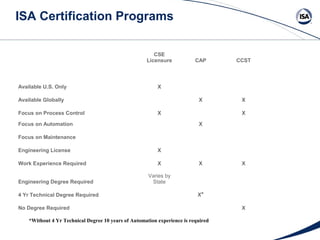
ISA Certification Programs
CSE
Licensure CAP CCST
Available U.S. Only X
Available Globally X X
Focus on Process Control X X
Focus on Automation X
Focus on Maintenance
Engineering License X
Work Experience Required X X X
Engineering Degree Required
Varies by
State
4 Yr Technical Degree Required X*
No Degree Required X
*Without 4 Yr Technical Degree 10 years of Automation experience is required
For More Information
• Certified Automation Professional®
(CAP®
)
– Email: cap@isa.org
– Online: www.isa.org/CAP
– Phone: 919-549-8411

Cap short presentation

  • 1.
    Standards Certification Education & Training Publishing Conferences& Exhibits ISA Certified Automation Professional® (CAP® ) Program
  • 2.
    Why a CertificationProgram? • Benefits Employers – Ensures a high level of skill and competency – Promotes safe practices – Serves as an objective third-party tool to bring employees to the same level of accountability – Qualification tool for new hires and contractors – Way to establish a pay for performance system
  • 3.
    Why a CertificationProgram? • Benefits Individuals – Establishes a professional identity – Provides documentation and recognition of knowledge, experience and education – Opportunities for promotion, pay increases, job portability – Encourages life long learning and professional development
  • 4.
    CAP Definition • CertifiedAutomation Professionals (CAPs) are responsible for the direction, definition, design, development/application, deployment, documentation, and support of systems, software, and equipment used in control systems, manufacturing information systems, systems integration, and operational consulting.
  • 5.
    About the CAPProgram • Developed in 2004 by automation professionals • Eligibility requirements – 5 years experience, 4 year technical degree OR – 10 years experience, with 2 years in position of responsible charge – Pass multiple-choice exam • Exam now available electronically or private offerings – Electronic testing through Prometric network of testing centers • Renewal required every 3 years
  • 6.
    Market Support • 78%believed certification would enhance recognition and respect of the automation field • 72% reported that a certification would be valuable to them • 68% thought certification would increase their competitive edge in the market • 72% said they expect to seek certification
  • 7.
    CAP Performance Domains •Feasibility Study • Definition • System Design • Development • Deployment • Operation and Maintenance
  • 8.
    CAP Technical Categories •Basic Continuous Control • Discrete, Sequencing, and Manufacturing Control • Advanced Control • Reliability, Safety, and Electrical • Integration and Software • Deployment & Maintenance • Work Structure
  • 9.
    How Can IPrepare for CAP Exam? • List of Resources on www.isa.org/cap • A Guide to the Automation Book of Knowledge • CAP Review Course • CAP Study Guide • CAP Learning System – Self-directed or Instructor- assisted options
  • 10.
    How Do IApply? • Apply online or download an application from www.isa.org/cap • Complete and return the application to ISA • You will be notified of your eligibility to take the exam • Schedule your exam at a Prometric test center near you
  • 11.
    ISA Certification Programs CSE LicensureCAP CCST Available U.S. Only X Available Globally X X Focus on Process Control X X Focus on Automation X Focus on Maintenance Engineering License X Work Experience Required X X X Engineering Degree Required Varies by State 4 Yr Technical Degree Required X* No Degree Required X *Without 4 Yr Technical Degree 10 years of Automation experience is required
  • 12.
    For More Information •Certified Automation Professional® (CAP® ) – Email: cap@isa.org – Online: www.isa.org/CAP – Phone: 919-549-8411

Editor's Notes

  • #3 <number> Let’s first answer the question – What’s the Value of a Certification Program to both individuals and industry? Certification programs provide benefits to the employer and to the individual. A certification program provides a mechanism for an employer to ensure a high level of skill and competency of employees and set a standard level of knowledge and skill for employees. Highly skilled employees help ensure that proper safety practices are used in a facility, protecting the workplace and public safety. As you all know, more and more outsourcing of engineering functions has occurred in recent years. A certification program provides a standard tool to qualify new hires and contractors and can be used by industry to establish a pay for performance system. Certification will have a tremendous impact on the entire industry in the years to come, because as competition for market share increases, so does demand for proven, qualified employees.
  • #4 Certification programs also provide benefits to the individual by establishing a professional identity and providing documentation of the individuals knowledge, experience and education to current and prospective employers. A recent survey done by NSPE, the National Society for Professional Engineers, confirmed that the more education and certifications that engineers have, the higher their annual income is. So certification provides the individual a greater opportunity for promotion, pay increases, and job portability. Most individuals study and prepare for certification exams and renewals. So, certification programs encourage life long learning and professional development.
  • #5 The first thing that the team of subject matter experts who worked with ISA on developing the CAP program had to do was to define what automation is and what the automation professional does and then the critical job skills needed to be proficient. CAPs are responsible for direction, definition, design, development/application, deployment, documentation, and support of systems, software, and equipment used in control systems, manufacturing information systems, systems integration, and operational consulting. The CAP program covers the entire field of automation for all industries, not just instrumentation in the process industries. The certification will be available and valuable to automation professionals worldwide.
  • #6 The CAP program was developed in 2004. During the development phase, ISA worked with leading subject matter experts to define the key job tasks and skills of the automation professional. A national survey of automation professionals was completed to validate key job tasks that automation professionals perform. A test item development committee developed questions for the identified job tasks and a test assembly committee selected questions for the exam based on the results of the national survey. The applicant eligibility requirements for the automation certification are: Education/Experience-A combination of Four year technical degree – this degree can be in engineering, or an engineering technology, math, computer science, physics, or other technical areas AND Five years of professional experience in automation OR There will be an introductory period for the first two years of the certification program, where applicants who have at least 10 years experience in automation but do not have a four year degree will be eligible to apply to the program. They must show evidence of being in a position of responsible charge for 2 of their 10 years of experience Knowledge Passing a comprehensive exam that covers key areas of automation CAPs will need to renew their certification every 3 years
  • #7 A survey of potential applicants for the certification program was conducted in May 2003. Almost 2,000 survey responses were received with the following results 78% believed certification would enhance recognition and respect of the automation field 72% reported that a certification would be valuable to them 68% thought certification would increase their competitive edge in the market 72% said they expect to seek certification Market support and interest continues to be high.
  • #8 There are six key job performance domains that CAPs will be tested on. The domains are listed on the slide. The Certified Automation Professional must demonstrate knowledge and skills in Feasibility Study – identify, scope and justify the automation project Definition – identify customer requirements and do high level analysis of the best way to meet those requirements System Design – do the complete conceptual design of the control and information systems including hardware and software specifications Development – software development and coding Deployment – field installation, checkout and startup of the systems Operation and Maintenance – long term support of the system
  • #9 Various automation technologies are covered in the six performance domains. This slide lists the CAP technical categories that the exam covers. They are: Basic Continuous Control – process and continuous control, analytical instrumentation, control valves, control system documentation Discrete, Sequencing, and Manufacturing Control – discrete input and output devices, discrete and sequencing control, motor and drive control, motion control Advanced Control – process modeling, advanced process control, batch control, environmental, building automation Reliability, Safety, and Electrical – alarm management, reliability, process safety, electrical installations, electrical safety Integration and Software – digital communications, industrial networks, MES integration, network security, operator interface, data management, software Deployment & Maintenance – operator training, digital system testing, commissioning, and software management, checkout and startup of field equipment, troubleshooting, maintenance Work Structure – automation benefits and project justification, project management, interpersonal skills
  • #10 Since the CAP program covers a broad range of automation technologies, most professionals will need to spend some time preparing for the exam. You can visit the ISA website to find a list of possible books and resources to study. ISA has several resources that can help with your preparation. ISA recently published a new book, A Guide to the Automation Body of Knowledge. This book provides broad coverage of the key technical categories tested in the CAP program. A three day instructor-led review course, and a study guide with sample questions are also available. And now available --- the CAP Learning System which is an interactive program with 500 online practice questions accompanied by text modules.
  • #11 To apply for the CAP exam: -Download an application from www.isa.org/cap -Complete and return the application to ISA -ISA will be notify you of your eligibility to take the exam -New in 2006, the CAP exam is available through the Prometrics testing network. Over 250 test centers worldwide offer the CAP exam. Once your application is approved for CAP, you are given a registration code that allows you to go online and schedule a test date at a Prometrics test site near you.
  • #12 As many of you know, ISA currently offers a certification program for control systems technicians, the Certified Control Systems Technician Program (CCST). ISA also supports the development of the Control Systems Engineer (CSE) license exam and most recently added the Certified Automation Professional (CAP) and the Certified Industrial Maintenance Mechanic (CIMM) program. Each of these programs address a different audience and market. The Certified Control Systems Technician program is a certification program for control systems technicians. It is not required that CCST applicants hold an educational degree and most applicants to the program work in a process industry. The Control Systems Engineer license is offered through state engineering boards and is a legal license to practice engineering. This engineering license can only be granted by a state engineering board. The degree requirements to sit for the CSE vary by state. Some states require an engineering degree and others do not. Again, the focus is on process control and most of the applicants work in process industries. CAP is a certification, not a legal license to practice engineering. CAP is available globally and focuses not only process control but discrete control, motion control, drive control, systems integration, etc. While CAPs require a 4 year technical degree (except for the initial two years of the program) it must be a technical degree but does not have to be an engineering degree. CIMM is a certification for maintenance mechanics who perform work that is primarily mechanical in nature such as corrective, preventive and predictive maintenance. CIMMs are not required to have a degree. They must have a combination of 5 years work and education experience to be eligible to sit for the certification exam (a minimum of 3 of the 5 years must be work experience as a maintenance mechanic).
  • #13 For more detailed information on the CAP program, the ISA website has detailed information or you can email ISA.