Properties of Sound Wave
         By: Group 4
         IV-St.Angela
properties of Sound Waves

•    Reflection
•    Refraction
•    Diffraction
•    Interference
•
    REFLECTION
Reflection
* The return of sound waves from surfaces on
which they are incident.

 * Reflection of sound waves off of surfaces can
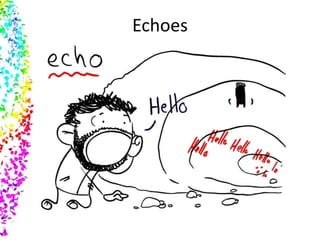
lead to a phenomena called ECHOES

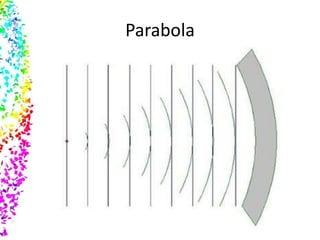
*When sound reflects off a special curved surface
called a parabola, it will bounce out in a straight line
no matter where it originally hits.
Echoes
• Echoes are the sound of your own voice
  reflecting back to your ears.

• A sound wave will continue to bounce around
  a room, or reverberate, until it has lost all its
  energy.

• A wave has some of its energy absorbed by
  the objects it hits.
Parabola
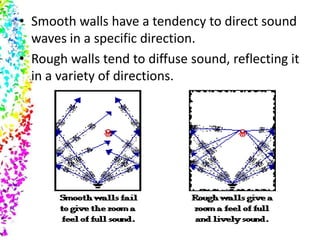
• Smooth walls have a tendency to direct sound
  waves in a specific direction.
• Rough walls tend to diffuse sound, reflecting it
  in a variety of directions.
Refraction
Refraction


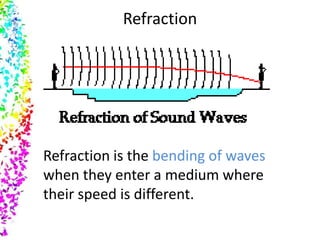
Refraction is the bending of waves
when they enter a medium where
their speed is different.
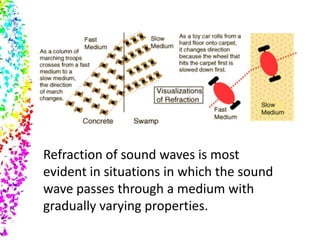
Refraction of sound waves is most
evident in situations in which the sound
wave passes through a medium with
gradually varying properties.
• Sound propagates in all directions from a
  point source. Normally, only that which is
  initially directed toward the listener can be
  heard, but refraction can bend sound
  downward. Normally, only the direct
  sound is received. But refraction can add
  some additional sound, effectively
  amplifying the sound. Natural amplifiers
  can occur over cool lakes.
Diffraction
Diffraction
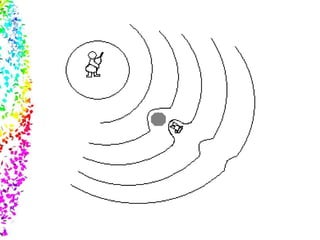
•     The BENDING of waves around small obstacles
     – The sound with longer wavelength compared to
       the obstacle will sound loudest
     – The amount of diffraction that occurs depends on
       both the size of the obstacle and the wavelength
       of the sound.
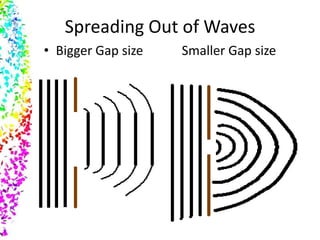
      The SPREADING OUT of waves beyond small
    openings
     - the smaller the gap size then Maximum diffraction
       occurs and the sounds spreads out greatly
Spreading Out of Waves
• Bigger Gap size   Smaller Gap size
Interference
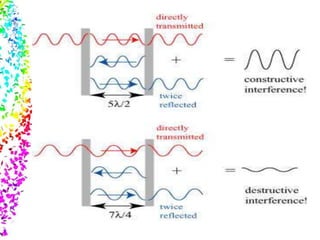
• Is the phenomenon that occurs when two
  waves meet while traveling along the same
  medium.

• The interference of waves causes the medium
  to take on a shape that results from the net
  effect of the two individual waves upon the
  particles of the medium.
Constructive Interferene
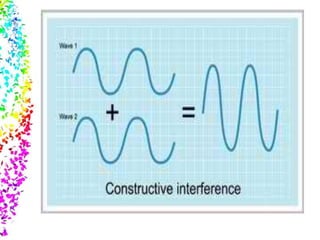
• Occurs at any location along the medium where the two
  interfering waves have a displacement in the same
  direction.

• Both waves have an upward displacement;
  consequently, the medium has an upward displacement
  that is greater than the displacement of the two
  interfering pulses.

• Observed at any location where the two interfering
  waves are displaced upward. But it is also observed when
  both interfering waves are displaced downward.
Principle of superposition
• When two waves interfere, the resulting
  displacement of the medium at any
  location is the algebraic sum of the
  displacements of the individual waves at
  that same location.
RESONANCE
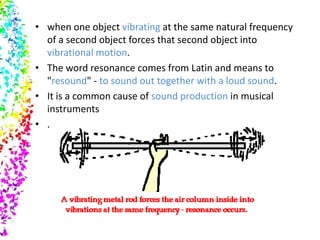
• when one object vibrating at the same natural frequency
  of a second object forces that second object into
  vibrational motion.
• The word resonance comes from Latin and means to
  "resound" - to sound out together with a loud sound.
• It is a common cause of sound production in musical
  instruments
• .
• *Another example are the woodwind instruments
  When air is blown through the reed, the reed
  vibrates producing turbulence with a range of
  vibrational frequencies , the result of resonance is a
  big vibration, the reed and air column sound out
  together to produce a loud sound.
• *Brass instruments involve the blowing of air into a
  mouthpiece. The vibrations of the lips against the
  mouthpiece produce a range of frequencies. One of
  the frequencies in the range of frequencies matches
  one of the natural frequencies of the air column
  inside of the brass instrument. This forces the air
  inside of the column into resonance vibrations. The
  result of resonance is always a big vibration - that
  is, a loud sound.
Doppler Effect
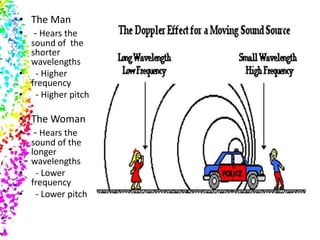
• It is an effect produced by a moving source
  of sound wave

• There is an upward shift in the frequency
  for the observer being approached by the
  source

• There is a downward shift for the observer
  from whom the source is receding
• The Man
• - Hears the
  sound of the
  shorter
  wavelengths
• - Higher
  frequency
• - Higher pitch

• The Woman
• - Hears the
  sound of the
  longer
  wavelengths
• - Lower
  frequency
• - Lower pitch
END

Physics

  • 1.
    Properties of SoundWave By: Group 4 IV-St.Angela
  • 2.
    properties of SoundWaves • Reflection • Refraction • Diffraction • Interference
  • 3.
    REFLECTION
  • 4.
    Reflection * The returnof sound waves from surfaces on which they are incident. * Reflection of sound waves off of surfaces can lead to a phenomena called ECHOES *When sound reflects off a special curved surface called a parabola, it will bounce out in a straight line no matter where it originally hits.
  • 5.
  • 6.
    • Echoes arethe sound of your own voice reflecting back to your ears. • A sound wave will continue to bounce around a room, or reverberate, until it has lost all its energy. • A wave has some of its energy absorbed by the objects it hits.
  • 7.
  • 8.
    • Smooth wallshave a tendency to direct sound waves in a specific direction. • Rough walls tend to diffuse sound, reflecting it in a variety of directions.
  • 9.
  • 10.
    Refraction Refraction is thebending of waves when they enter a medium where their speed is different.
  • 11.
    Refraction of soundwaves is most evident in situations in which the sound wave passes through a medium with gradually varying properties.
  • 12.
    • Sound propagatesin all directions from a point source. Normally, only that which is initially directed toward the listener can be heard, but refraction can bend sound downward. Normally, only the direct sound is received. But refraction can add some additional sound, effectively amplifying the sound. Natural amplifiers can occur over cool lakes.
  • 13.
  • 14.
    Diffraction • The BENDING of waves around small obstacles – The sound with longer wavelength compared to the obstacle will sound loudest – The amount of diffraction that occurs depends on both the size of the obstacle and the wavelength of the sound. The SPREADING OUT of waves beyond small openings - the smaller the gap size then Maximum diffraction occurs and the sounds spreads out greatly
  • 16.
    Spreading Out ofWaves • Bigger Gap size Smaller Gap size
  • 17.
  • 18.
    • Is thephenomenon that occurs when two waves meet while traveling along the same medium. • The interference of waves causes the medium to take on a shape that results from the net effect of the two individual waves upon the particles of the medium.
  • 19.
    Constructive Interferene • Occursat any location along the medium where the two interfering waves have a displacement in the same direction. • Both waves have an upward displacement; consequently, the medium has an upward displacement that is greater than the displacement of the two interfering pulses. • Observed at any location where the two interfering waves are displaced upward. But it is also observed when both interfering waves are displaced downward.
  • 22.
    Principle of superposition •When two waves interfere, the resulting displacement of the medium at any location is the algebraic sum of the displacements of the individual waves at that same location.
  • 23.
  • 24.
    • when oneobject vibrating at the same natural frequency of a second object forces that second object into vibrational motion. • The word resonance comes from Latin and means to "resound" - to sound out together with a loud sound. • It is a common cause of sound production in musical instruments • .
  • 25.
    • *Another exampleare the woodwind instruments When air is blown through the reed, the reed vibrates producing turbulence with a range of vibrational frequencies , the result of resonance is a big vibration, the reed and air column sound out together to produce a loud sound. • *Brass instruments involve the blowing of air into a mouthpiece. The vibrations of the lips against the mouthpiece produce a range of frequencies. One of the frequencies in the range of frequencies matches one of the natural frequencies of the air column inside of the brass instrument. This forces the air inside of the column into resonance vibrations. The result of resonance is always a big vibration - that is, a loud sound.
  • 26.
  • 27.
    • It isan effect produced by a moving source of sound wave • There is an upward shift in the frequency for the observer being approached by the source • There is a downward shift for the observer from whom the source is receding
  • 28.
    • The Man •- Hears the sound of the shorter wavelengths • - Higher frequency • - Higher pitch • The Woman • - Hears the sound of the longer wavelengths • - Lower frequency • - Lower pitch
  • 29.