A Level Photography   at Thomas Tallis School Post 16 Centre
Why choose Photography A level? We promote creativity and independent thinking You will create a portfolio of work which will help you successfully apply to colleges of art and design for Foundation and Degree courses We encourage you to experiment and take risks. We want you to discover how to think creatively and solve your own problems You will learn how to use industry standard software and a mixture of traditional and digital photographic technology, techniques and processes You will learn a host of transferable skills The success rate of our students is very high In 2007, 2 students in Year 13 were placed in the top five highest performing photography students in the  country Photography combines practical, aesthetic and intellectual skills You will learn a critical vocabulary for analysing a variety of works of art
The Course Students can elect to study Photography for one or two years. The one year course leads to an AS qualification. The two year course is a full A level (A2). We follow the  AQA Art and Design: Photography   specification. There are 2 units of work in each year: AS Level Photography ARTF1: Coursework Portfolio 50% of AS, 25% of A Level  No time limit 80 marks  ARTF2: Externally Set Assignment  50% of AS, 25% of A Level  Supervised time 5 hours 80 marks   A2 Level Photography ARTF3: Personal Investigation 25% of A Level  No time limit 80 marks  ARTF4: Externally Set Assignment 25% of A Level  Supervised time 15 hours 80 marks
Resources We have numerous resources in the Photography Department. They include: A dedicated computer room with 15 machines running XP professional Adobe Photoshop on the school network A high specification scanner Colour and black and white laser printers A black and white dark room with 6 enlargers 4 x Canon 400D digital SLR cameras A range of other conventional and specialist cameras A fantastic collection of photography books in the library A web site containing online resources  A level Photography is currently taught by 3 full time members  of staff from the faculty of recreational and creative arts.
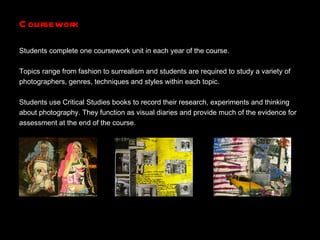
Coursework Students complete one coursework unit in each year of the course. Topics range from fashion to surrealism and students are required to study a variety of photographers, genres, techniques and styles within each topic. Students use Critical Studies books to record their research, experiments and thinking  about photography. They function as visual diaries and provide much of the evidence for assessment at the end of the course.
The Timed Test At the end of each year of the course, students are required to take a timed test. At AS level this is 5 hours long.  At A2 level the test is 15 hours long. Students receive 7 weeks notice of the test in which to develop their thoughts and experiments on a chosen theme in a critical studies book. They then create a finished piece in the timed test. Example: Multiple Imagery Many photographers have sought to challenge the concept of the photograph recording the single decisive moment by assembling and combining photographic images. In this way, David Hockney, Michael Spano and Andreas Gursky have explored both space and time. Develop your own response to this theme.
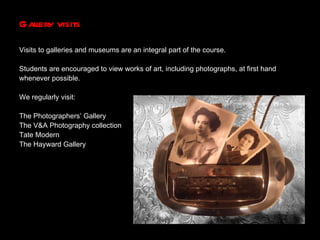
Gallery visits Visits to galleries and museums are an integral part of the course. Students are encouraged to view works of art, including photographs, at first hand  whenever possible. We regularly visit: The Photographers’ Gallery The V&A Photography collection Tate Modern The Hayward Gallery
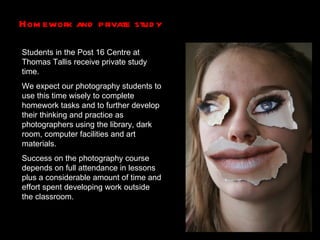
Homework and private study Students in the Post 16 Centre at Thomas Tallis receive private study time. We expect our photography students to use this time wisely to complete homework tasks and to further develop their thinking and practice as photographers using the library, dark room, computer facilities and art materials.  Success on the photography course depends on full attendance in lessons plus a considerable amount of time and effort spent developing work outside the classroom.
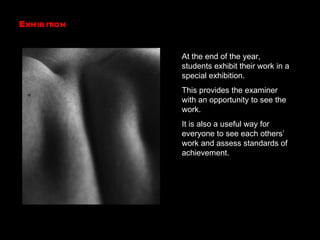
Exhibition  At the end of the year, students exhibit their work in a special exhibition. This provides the examiner with an opportunity to see the work. It is also a useful way for everyone to see each others’ work and assess standards of achievement.
Entry requirements In order to enrol on the Photography A level course, students must have: 5 A* - C grades at GCSE  NB (it is not always necessary to have studied GCSE Art) A portfolio of photographs  (this must be submitted at enrolment)  A genuine interest in visual culture For more information about the course, check out the Photography Dept. web pages in the main school site or speak to Mr Nicholls.

An introduction to photography A level

  • 1.
    A Level Photography at Thomas Tallis School Post 16 Centre
  • 2.
    Why choose PhotographyA level? We promote creativity and independent thinking You will create a portfolio of work which will help you successfully apply to colleges of art and design for Foundation and Degree courses We encourage you to experiment and take risks. We want you to discover how to think creatively and solve your own problems You will learn how to use industry standard software and a mixture of traditional and digital photographic technology, techniques and processes You will learn a host of transferable skills The success rate of our students is very high In 2007, 2 students in Year 13 were placed in the top five highest performing photography students in the country Photography combines practical, aesthetic and intellectual skills You will learn a critical vocabulary for analysing a variety of works of art
  • 3.
    The Course Studentscan elect to study Photography for one or two years. The one year course leads to an AS qualification. The two year course is a full A level (A2). We follow the AQA Art and Design: Photography specification. There are 2 units of work in each year: AS Level Photography ARTF1: Coursework Portfolio 50% of AS, 25% of A Level No time limit 80 marks ARTF2: Externally Set Assignment 50% of AS, 25% of A Level Supervised time 5 hours 80 marks A2 Level Photography ARTF3: Personal Investigation 25% of A Level No time limit 80 marks ARTF4: Externally Set Assignment 25% of A Level Supervised time 15 hours 80 marks
  • 4.
    Resources We havenumerous resources in the Photography Department. They include: A dedicated computer room with 15 machines running XP professional Adobe Photoshop on the school network A high specification scanner Colour and black and white laser printers A black and white dark room with 6 enlargers 4 x Canon 400D digital SLR cameras A range of other conventional and specialist cameras A fantastic collection of photography books in the library A web site containing online resources A level Photography is currently taught by 3 full time members of staff from the faculty of recreational and creative arts.
  • 5.
    Coursework Students completeone coursework unit in each year of the course. Topics range from fashion to surrealism and students are required to study a variety of photographers, genres, techniques and styles within each topic. Students use Critical Studies books to record their research, experiments and thinking about photography. They function as visual diaries and provide much of the evidence for assessment at the end of the course.
  • 6.
    The Timed TestAt the end of each year of the course, students are required to take a timed test. At AS level this is 5 hours long. At A2 level the test is 15 hours long. Students receive 7 weeks notice of the test in which to develop their thoughts and experiments on a chosen theme in a critical studies book. They then create a finished piece in the timed test. Example: Multiple Imagery Many photographers have sought to challenge the concept of the photograph recording the single decisive moment by assembling and combining photographic images. In this way, David Hockney, Michael Spano and Andreas Gursky have explored both space and time. Develop your own response to this theme.
  • 7.
    Gallery visits Visitsto galleries and museums are an integral part of the course. Students are encouraged to view works of art, including photographs, at first hand whenever possible. We regularly visit: The Photographers’ Gallery The V&A Photography collection Tate Modern The Hayward Gallery
  • 8.
    Homework and privatestudy Students in the Post 16 Centre at Thomas Tallis receive private study time. We expect our photography students to use this time wisely to complete homework tasks and to further develop their thinking and practice as photographers using the library, dark room, computer facilities and art materials. Success on the photography course depends on full attendance in lessons plus a considerable amount of time and effort spent developing work outside the classroom.
  • 9.
    Exhibition Atthe end of the year, students exhibit their work in a special exhibition. This provides the examiner with an opportunity to see the work. It is also a useful way for everyone to see each others’ work and assess standards of achievement.
  • 10.
    Entry requirements Inorder to enrol on the Photography A level course, students must have: 5 A* - C grades at GCSE NB (it is not always necessary to have studied GCSE Art) A portfolio of photographs (this must be submitted at enrolment) A genuine interest in visual culture For more information about the course, check out the Photography Dept. web pages in the main school site or speak to Mr Nicholls.