Towards a multidimensional valuation
model of scientists
http://nrobinsongarcia.com
@nrobinsongarcia
Critiques to individual assessment
– DORA – Impact Factor
– Leiden Manifesto – Misuse of indicators
– Metric Tide – Indicators are not adequate
Threats from current research evaluation
1. Evaluation schemes rely heavily on journal publication and citation-based
indicators
2. Invisible profiles are degraded despite growing importance
3. Changes in the scholarly system are ignored
Motivation
Critiques to individual assessment
– DORA – Impact Factor
– Leiden Manifesto – Misuse of indicators
– Metric Tide – Individual assessment
Threats from current research evaluation
1. Evaluation schemes rely heavily on journal publication and citation-based
indicators
2. Invisible profiles are degraded despite growing importance
3. Changes in the scholarly system are ignored
Motivation
Effects of current evaluation schemes
• Effects on the scientific workforce
– Task reduction (de Rijcke et al, 2016)
– Homogeneity of profiles (Milojević et al, 2018)
– Mistrust and conservatism (Abramo et al, 2015)
• Effects on knowledge production
– Quality of research and transparency (Moher et al 2018)
– Research integrity (Naudet et al 2018)
– Short-sighted research agenda (PoP culture)
Conceptual framework
• What is expected of a scientist?
Evaluative dimensions of performativity
• What is their potential to achieve such
expectations?
Constraints and confounding effects
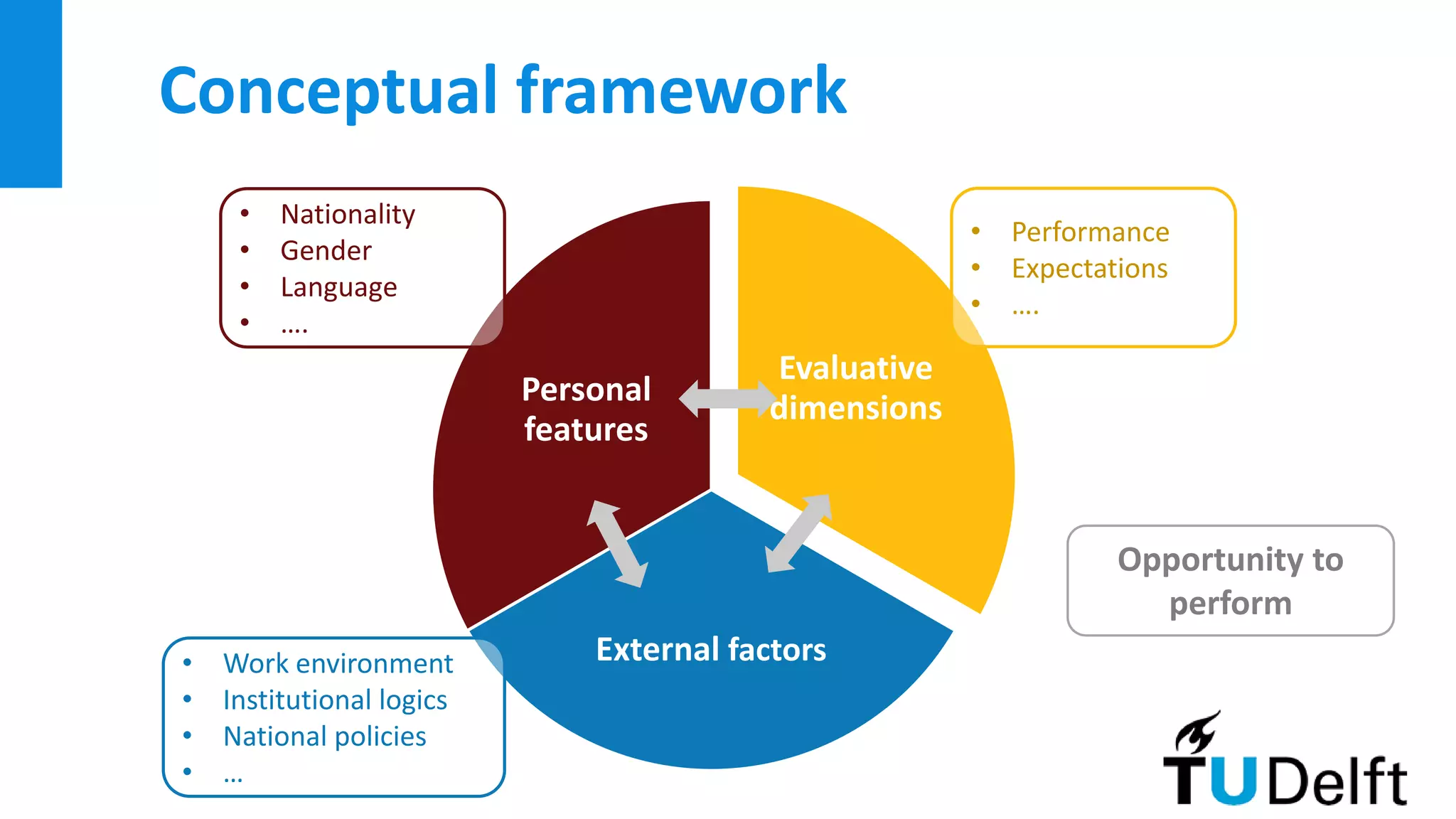
Conceptual framework
Evaluative
dimensions
External factors
Personal
features
• Nationality
• Gender
• Language
• ….
• Performance
• Expectations
• ….
• Work environment
• Institutional logics
• National policies
• …
Opportunity to
perform
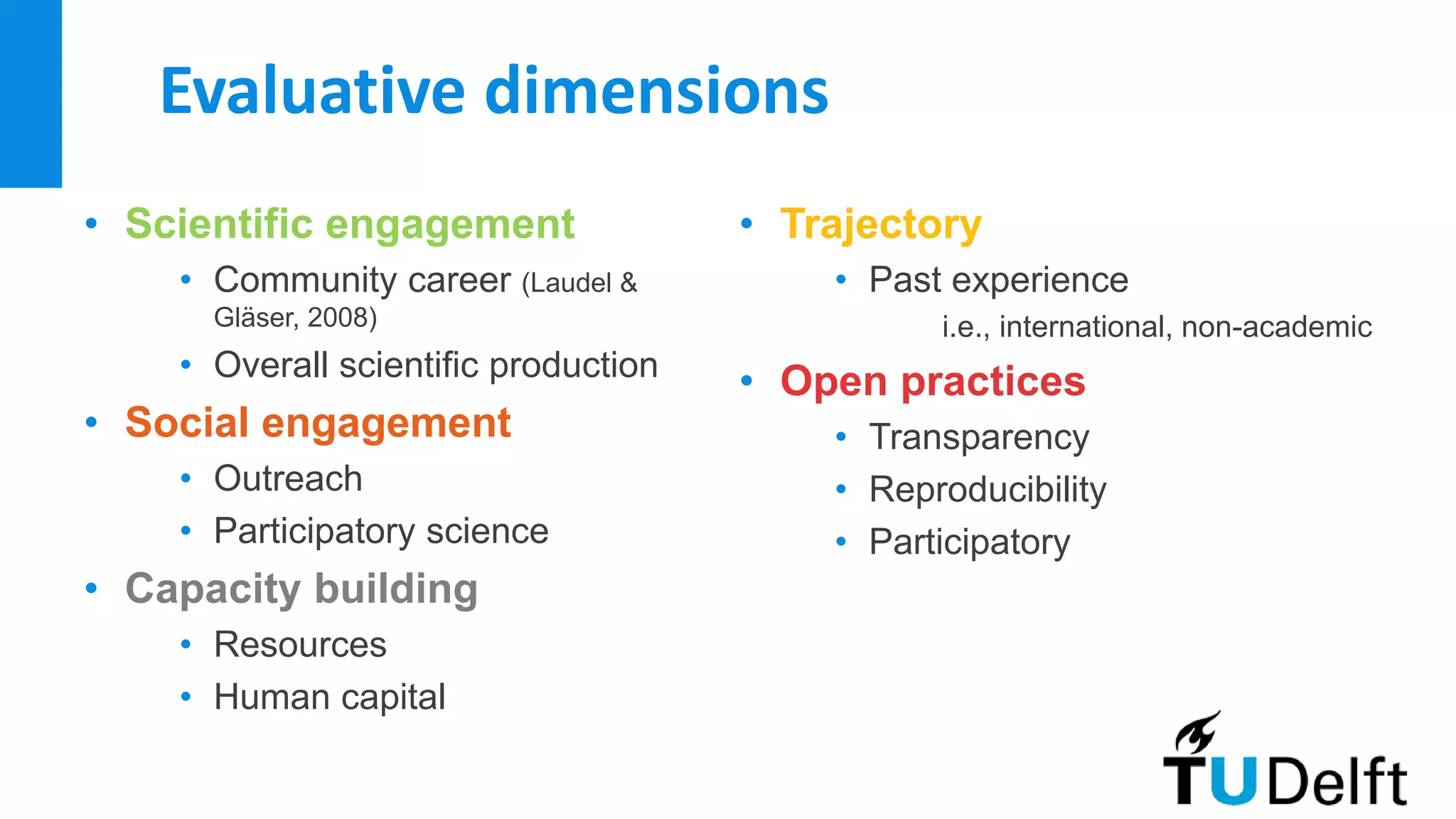
Evaluative dimensions
• Scientific engagement
• Community career (Laudel &
Gläser, 2008)
• Overall scientific production
• Social engagement
• Outreach
• Participatory science
• Capacity building
• Resources
• Human capital
• Trajectory
• Past experience
i.e., international, non-academic
• Open practices
• Transparency
• Reproducibility
• Participatory
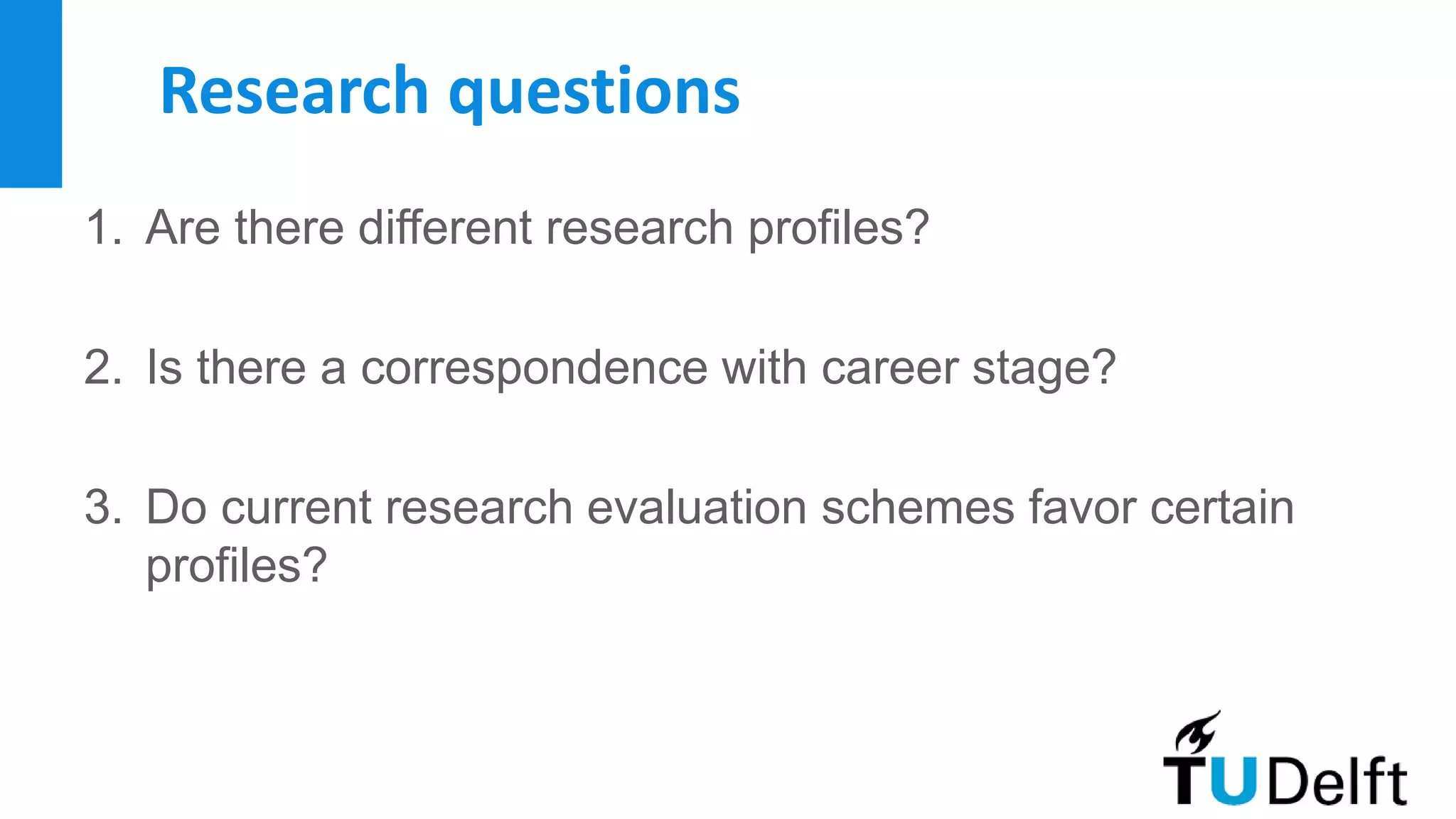
Research questions
1. Are there different research profiles?
2. Is there a correspondence with career stage?
3. Do current research evaluation schemes favor certain
profiles?
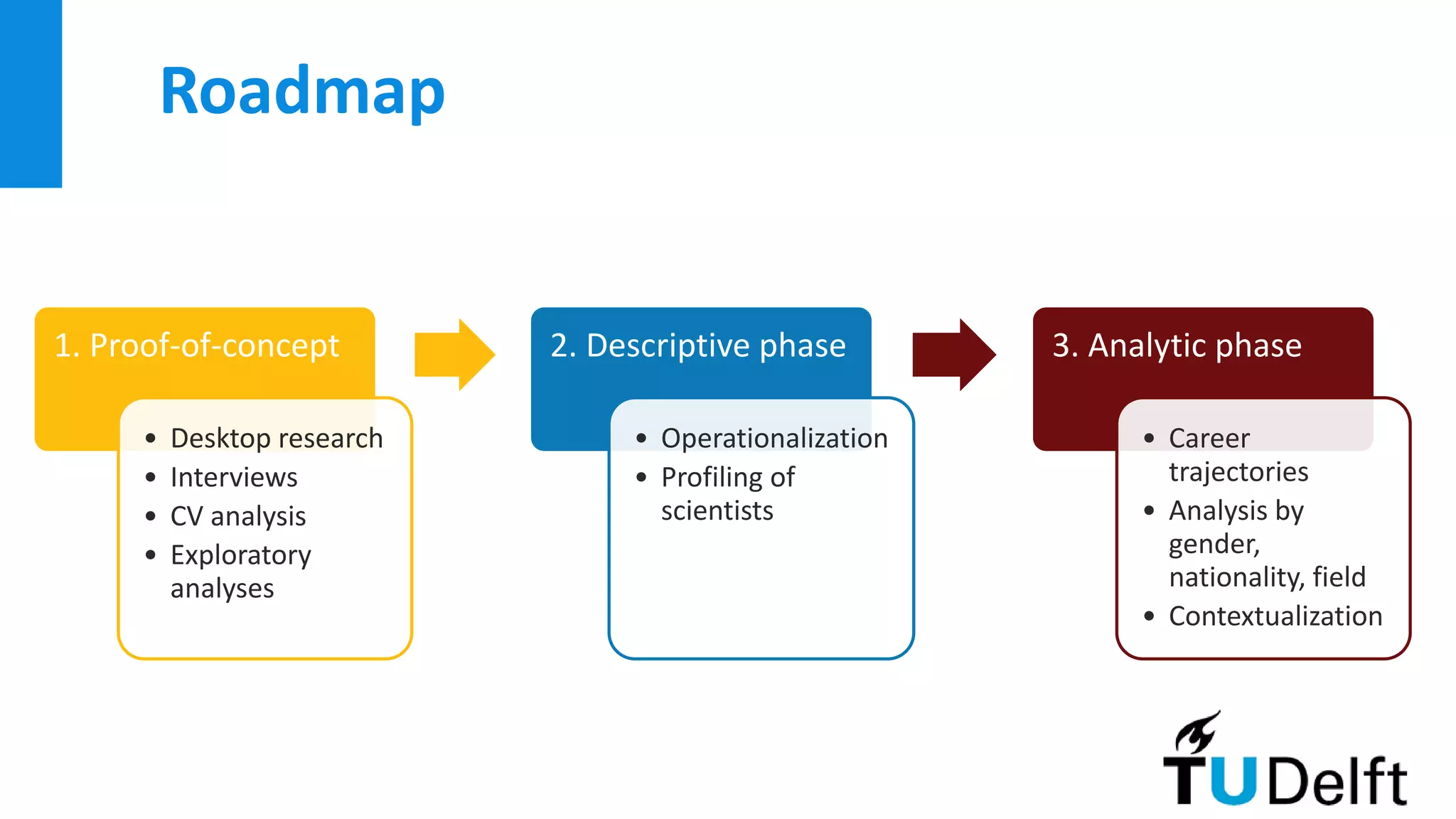
Roadmap
1. Proof-of-concept
• Desktop research
• Interviews
• CV analysis
• Exploratory
analyses
2. Descriptive phase
• Operationalization
• Profiling of
scientists
3. Analytic phase
• Career
trajectories
• Analysis by
gender,
nationality, field
• Contextualization
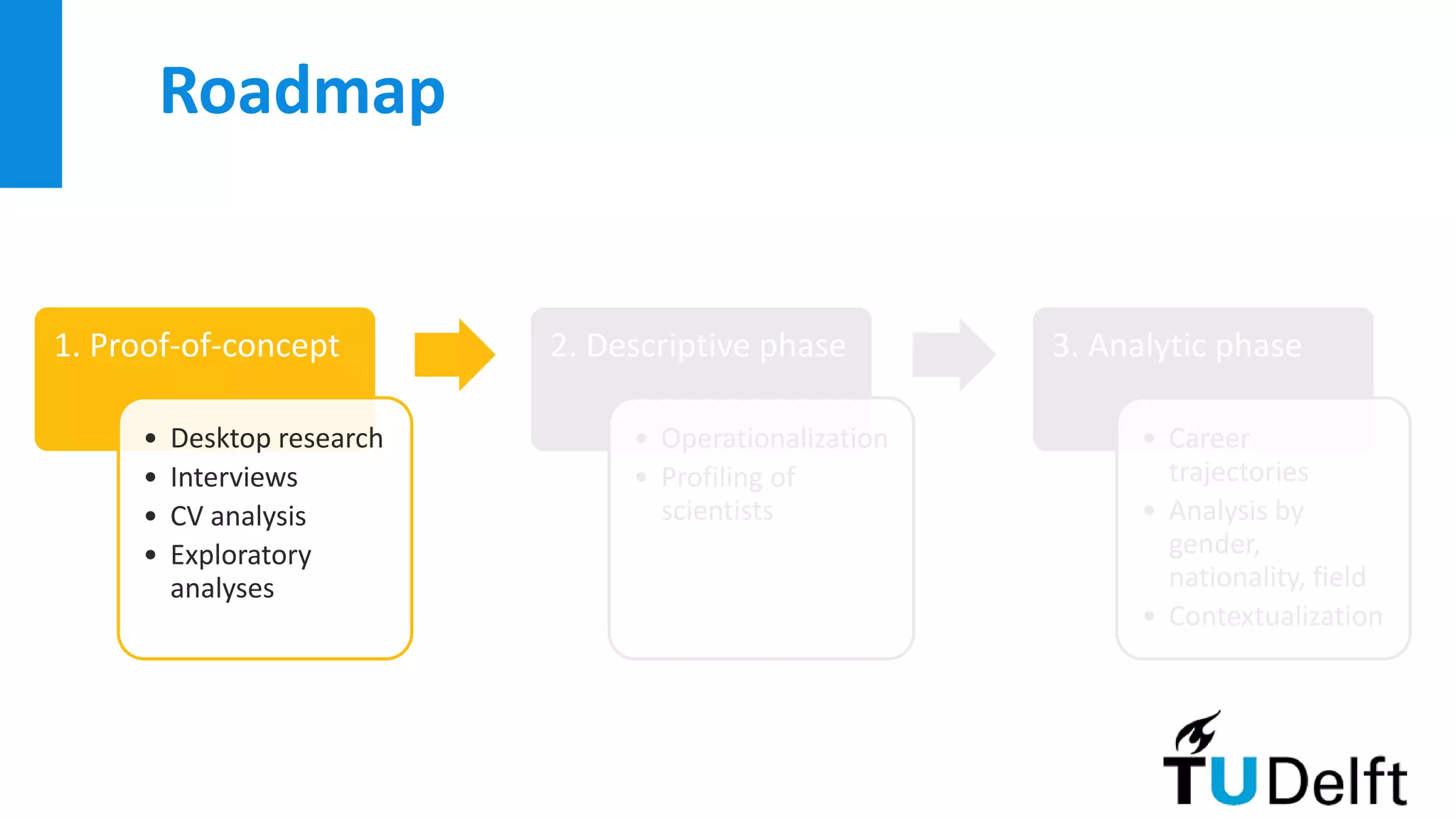
Roadmap
1. Proof-of-concept
• Desktop research
• Interviews
• CV analysis
• Exploratory
analyses
2. Descriptive phase
• Operationalization
• Profiling of
scientists
3. Analytic phase
• Career
trajectories
• Analysis by
gender,
nationality, field
• Contextualization
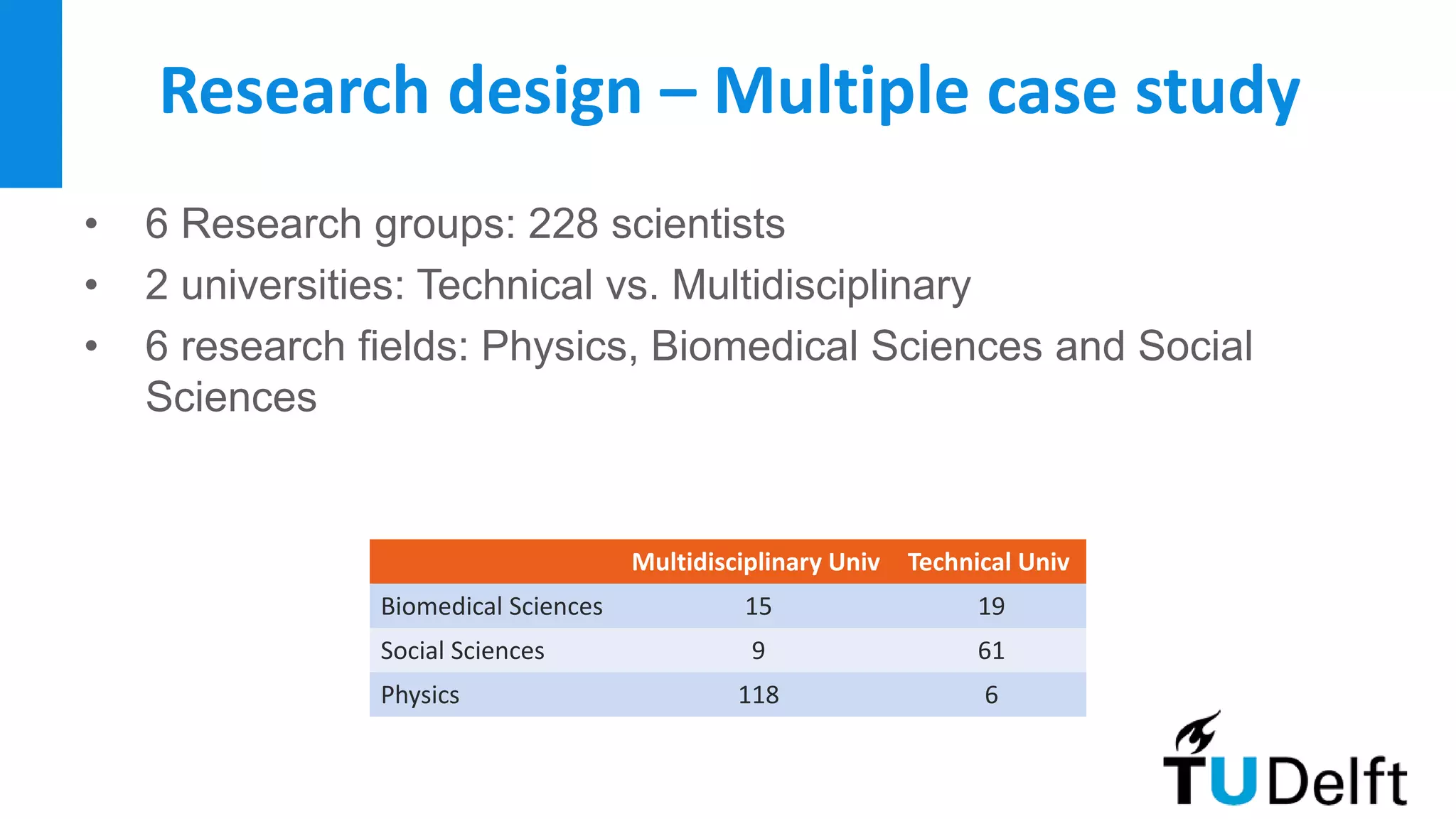
Research design – Multiple case study
• 6 Research groups: 228 scientists
• 2 universities: Technical vs. Multidisciplinary
• 6 research fields: Physics, Biomedical Sciences and Social
Sciences
Multidisciplinary Univ Technical Univ
Biomedical Sciences 15 19
Social Sciences 9 61
Physics 118 6
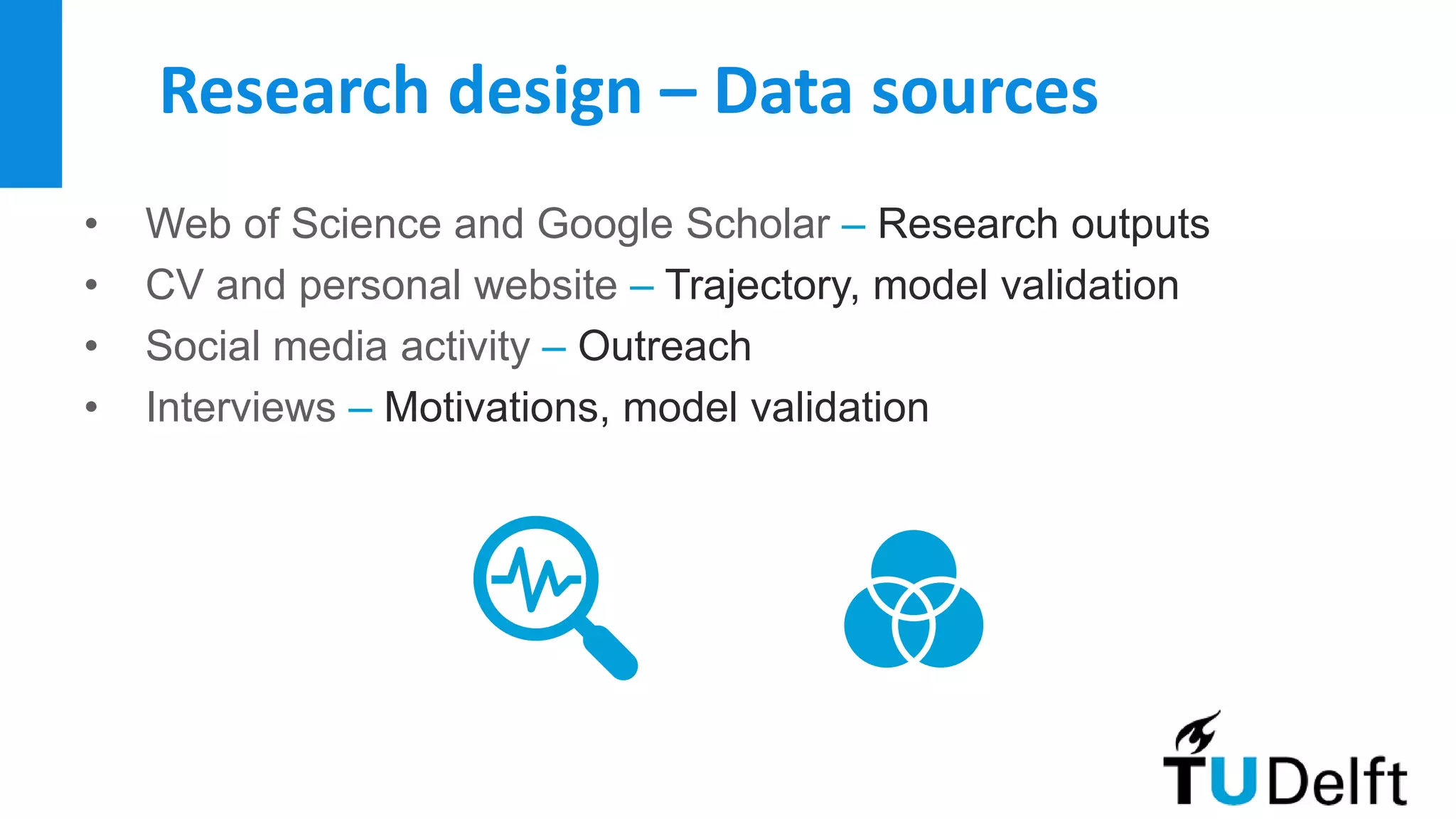
Research design – Data sources
• Web of Science and Google Scholar – Research outputs
• CV and personal website – Trajectory, model validation
• Social media activity – Outreach
• Interviews – Motivations, model validation
Exploratory analysis
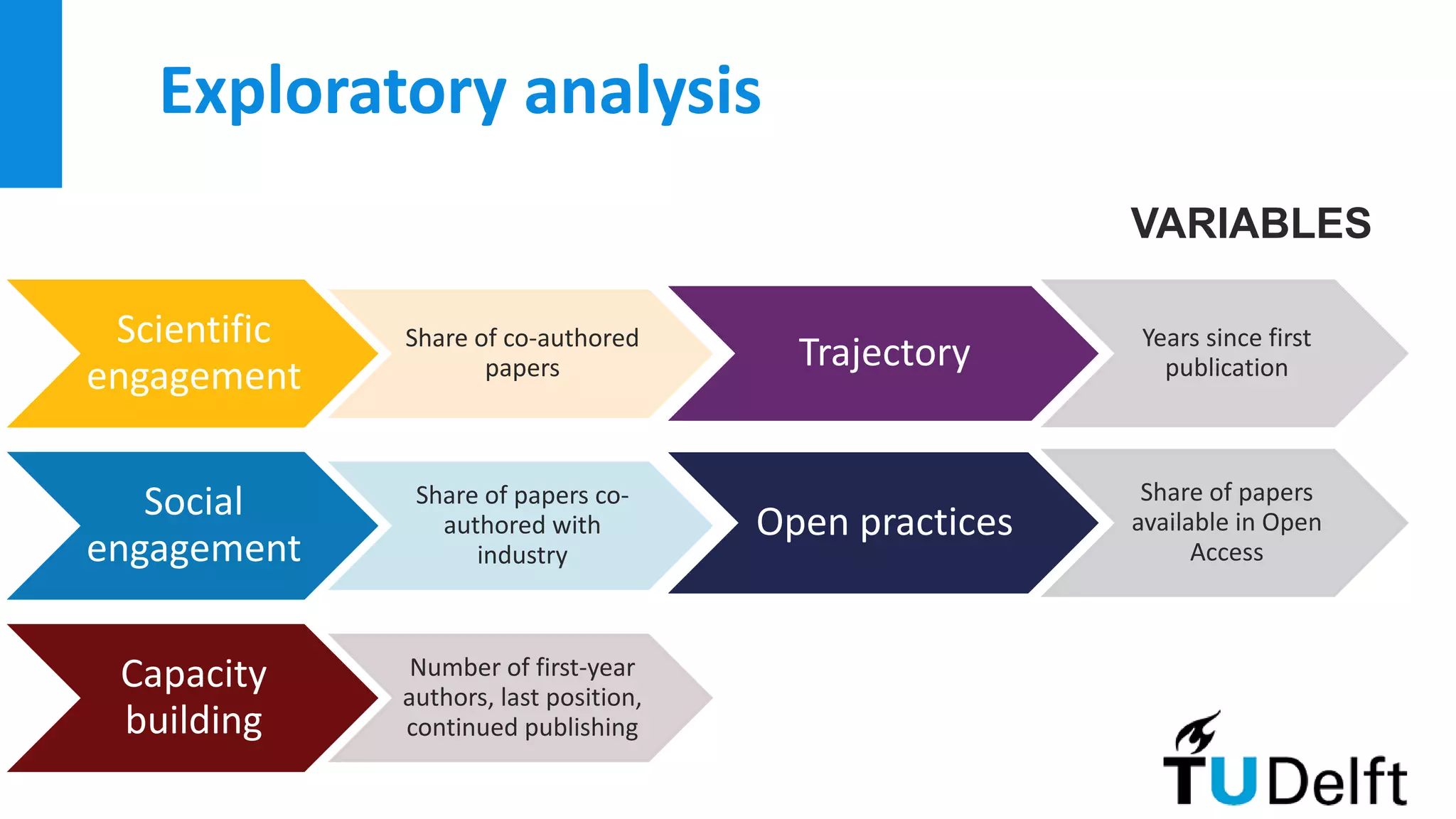
VARIABLES
Scientific
engagement
Share of co-authored
papers
Social
engagement
Share of papers co-
authored with
industry
Capacity
building
Number of first-year
authors, last position,
continued publishing
Trajectory Years since first
publication
Open practices
Share of papers
available in Open
Access
Exploratory analysis
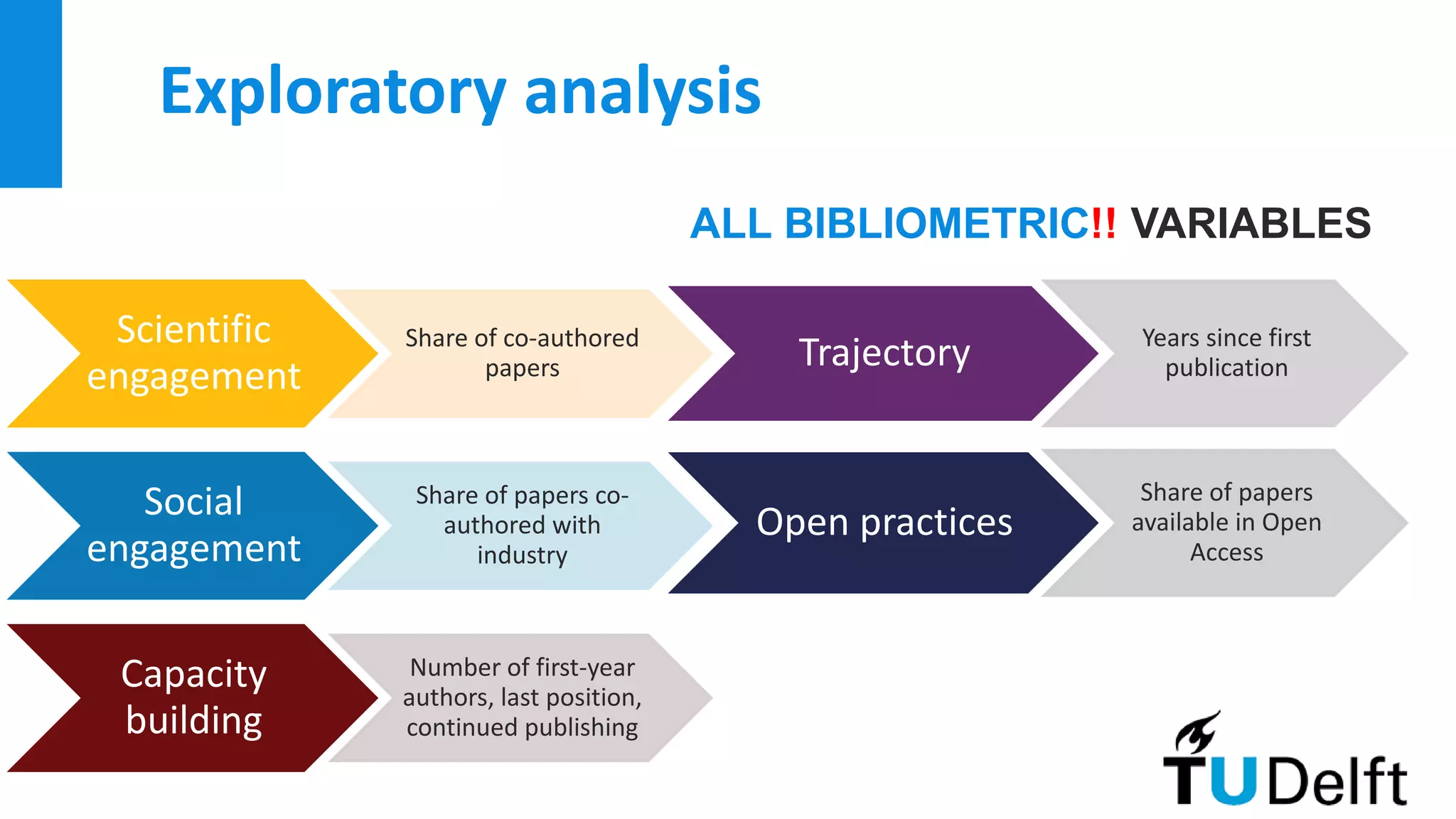
ALL BIBLIOMETRIC!! VARIABLES
Scientific
engagement
Share of co-authored
papers
Social
engagement
Share of papers co-
authored with
industry
Capacity
building
Number of first-year
authors, last position,
continued publishing
Trajectory Years since first
publication
Open practices
Share of papers
available in Open
Access
Exploratory analysis
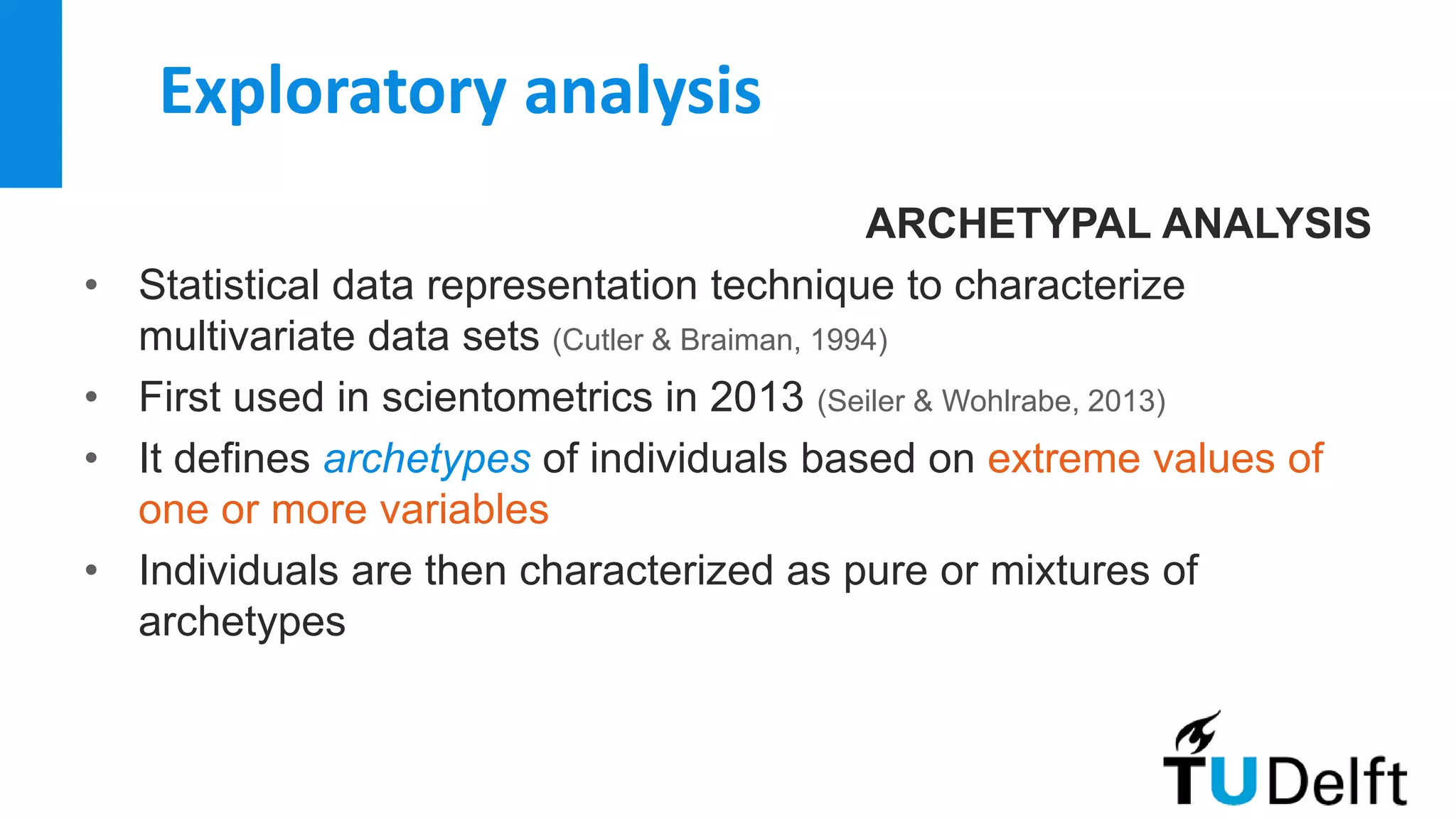
ARCHETYPAL ANALYSIS
• Statistical data representation technique to characterize
multivariate data sets (Cutler & Braiman, 1994)
• First used in scientometrics in 2013 (Seiler & Wohlrabe, 2013)
• It defines archetypes of individuals based on extreme values of
one or more variables
• Individuals are then characterized as pure or mixtures of
archetypes
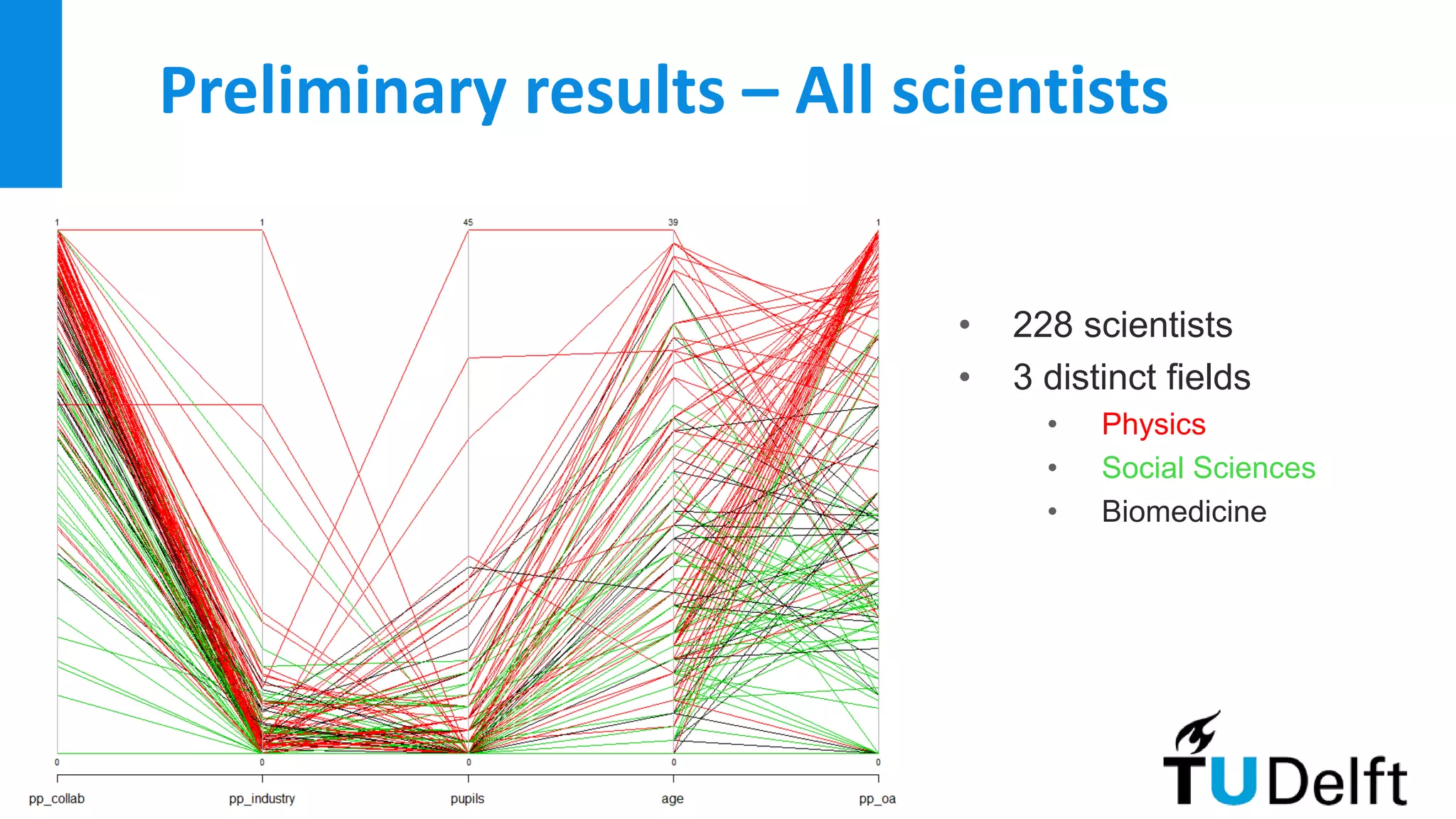
Preliminary results – All scientists
• 228 scientists
• 3 distinct fields
• Physics
• Social Sciences
• Biomedicine
Preliminary results – All scientists
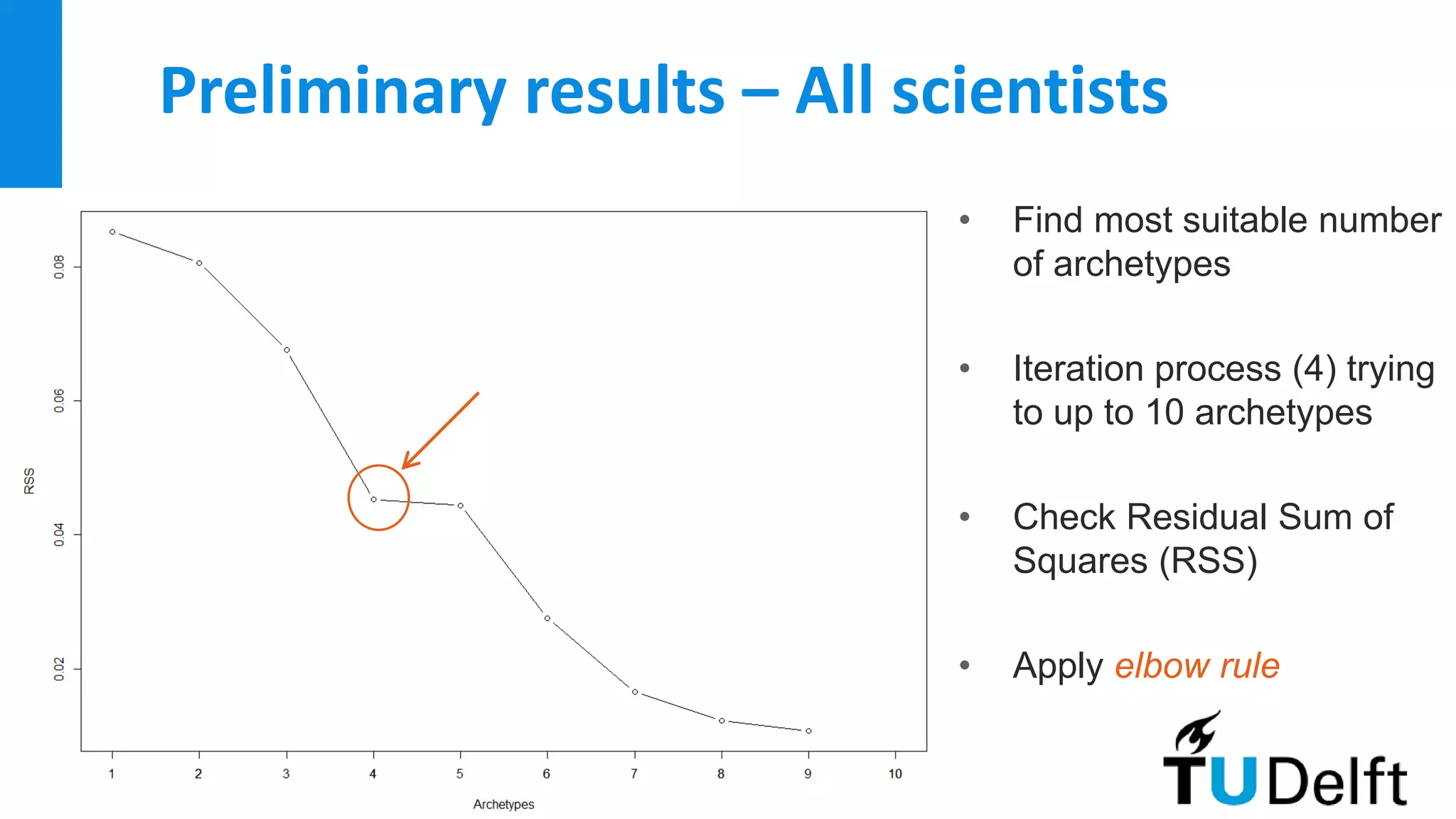
• Find most suitable number
of archetypes
• Iteration process (4) trying
to up to 10 archetypes
• Check Residual Sum of
Squares (RSS)
• Apply elbow rule
Preliminary results – All scientists
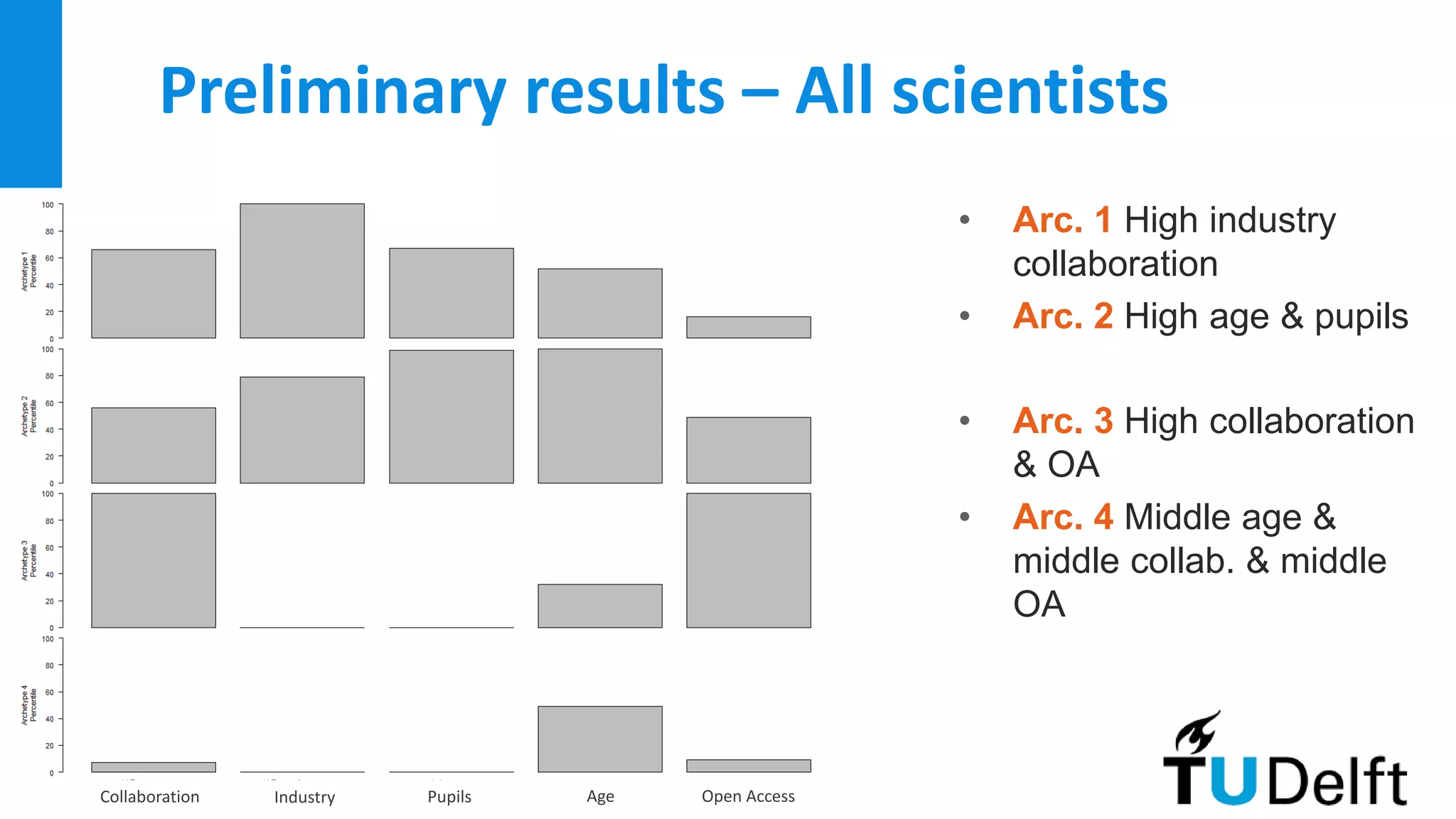
• Arc. 1 High industry
collaboration
• Arc. 2 High age & pupils
• Arc. 3 High collaboration
& OA
• Arc. 4 Middle age &
middle collab. & middle
OA
Collaboration Industry Pupils Age Open Access
Preliminary results – Social Sciences
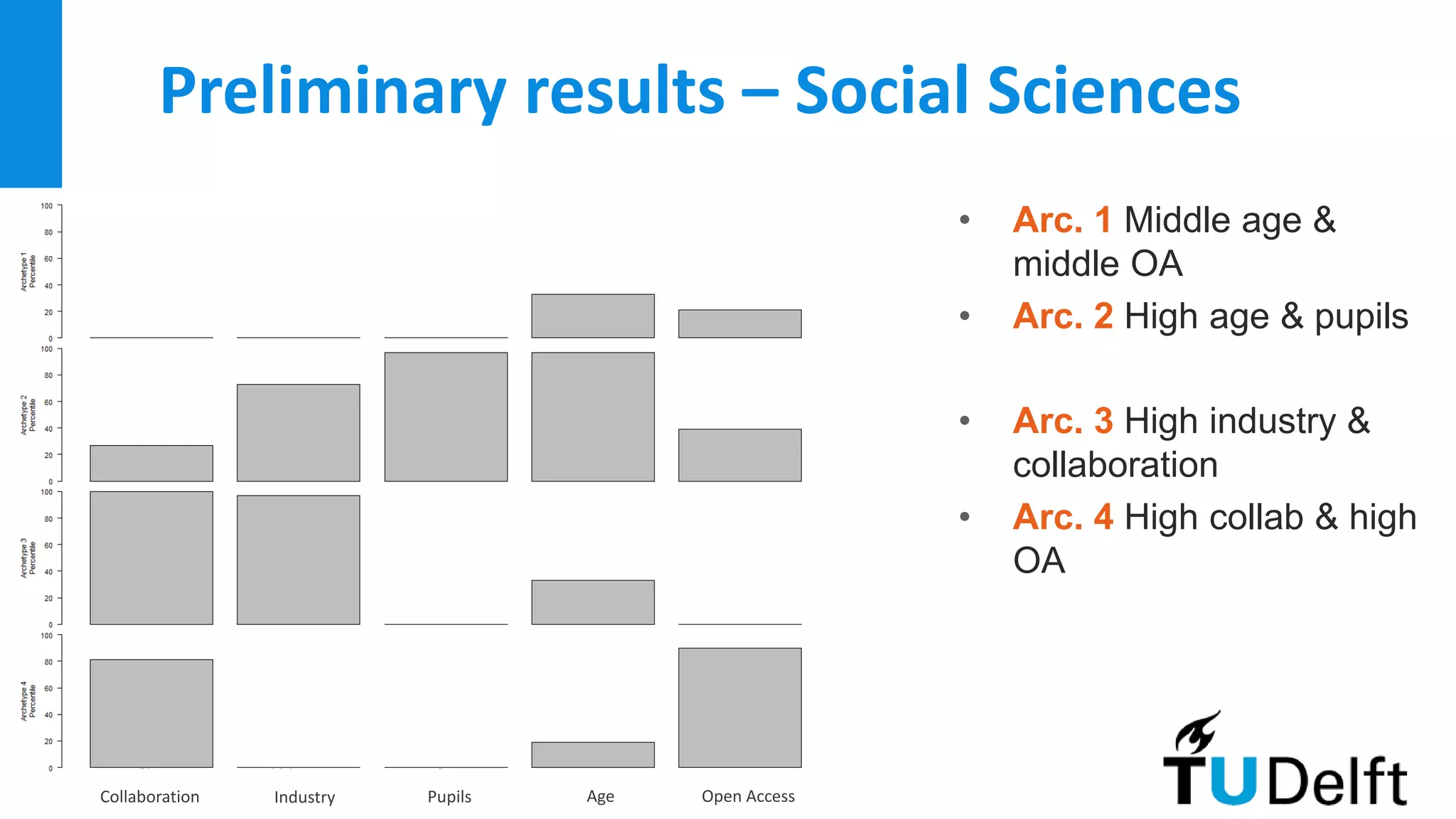
• Arc. 1 Middle age &
middle OA
• Arc. 2 High age & pupils
• Arc. 3 High industry &
collaboration
• Arc. 4 High collab & high
OA
Collaboration Industry Pupils Age Open Access
Preliminary results – Physics
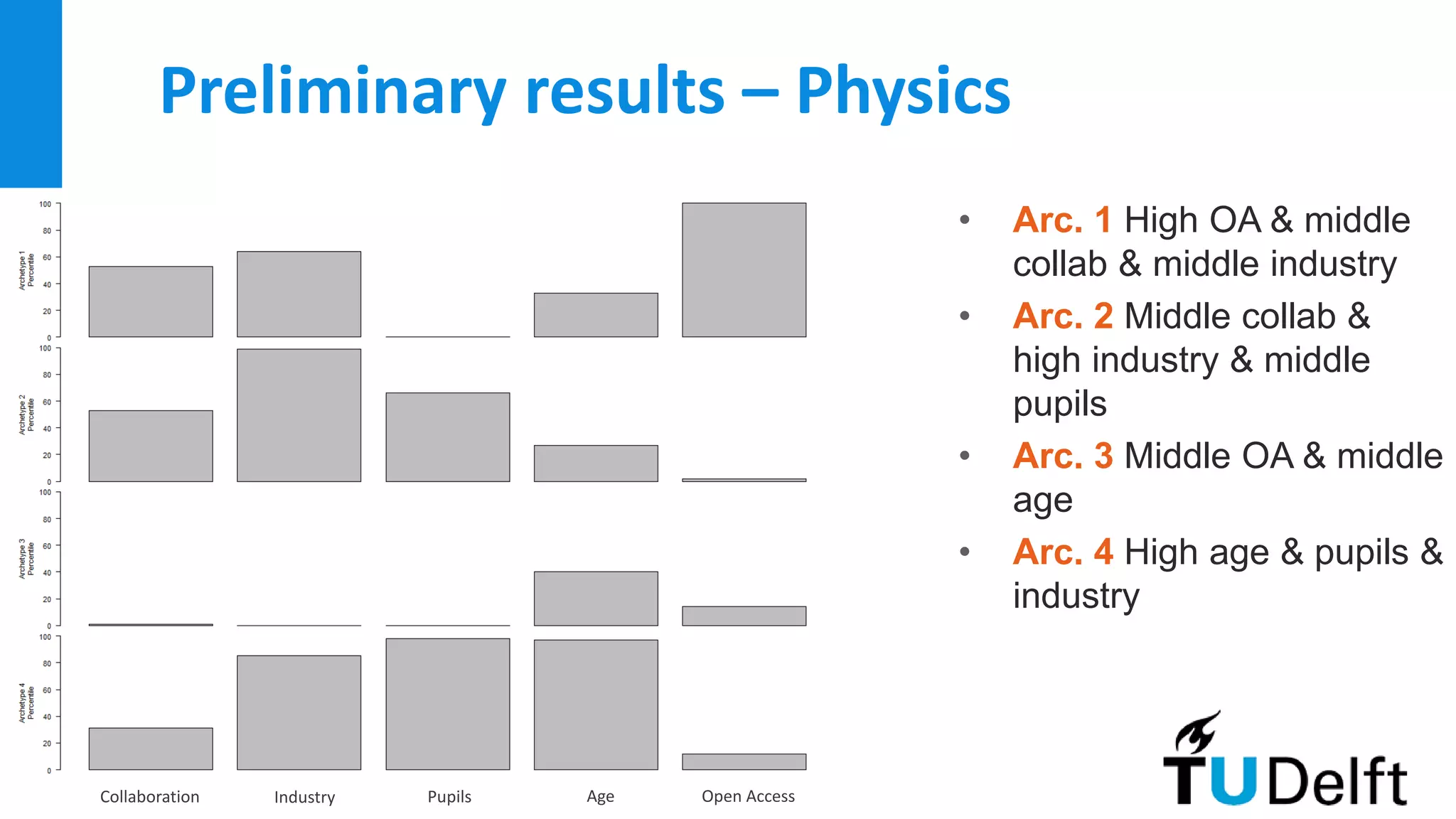
• Arc. 1 High OA & middle
collab & middle industry
• Arc. 2 Middle collab &
high industry & middle
pupils
• Arc. 3 Middle OA & middle
age
• Arc. 4 High age & pupils &
industry
Collaboration Industry Pupils Age Open Access
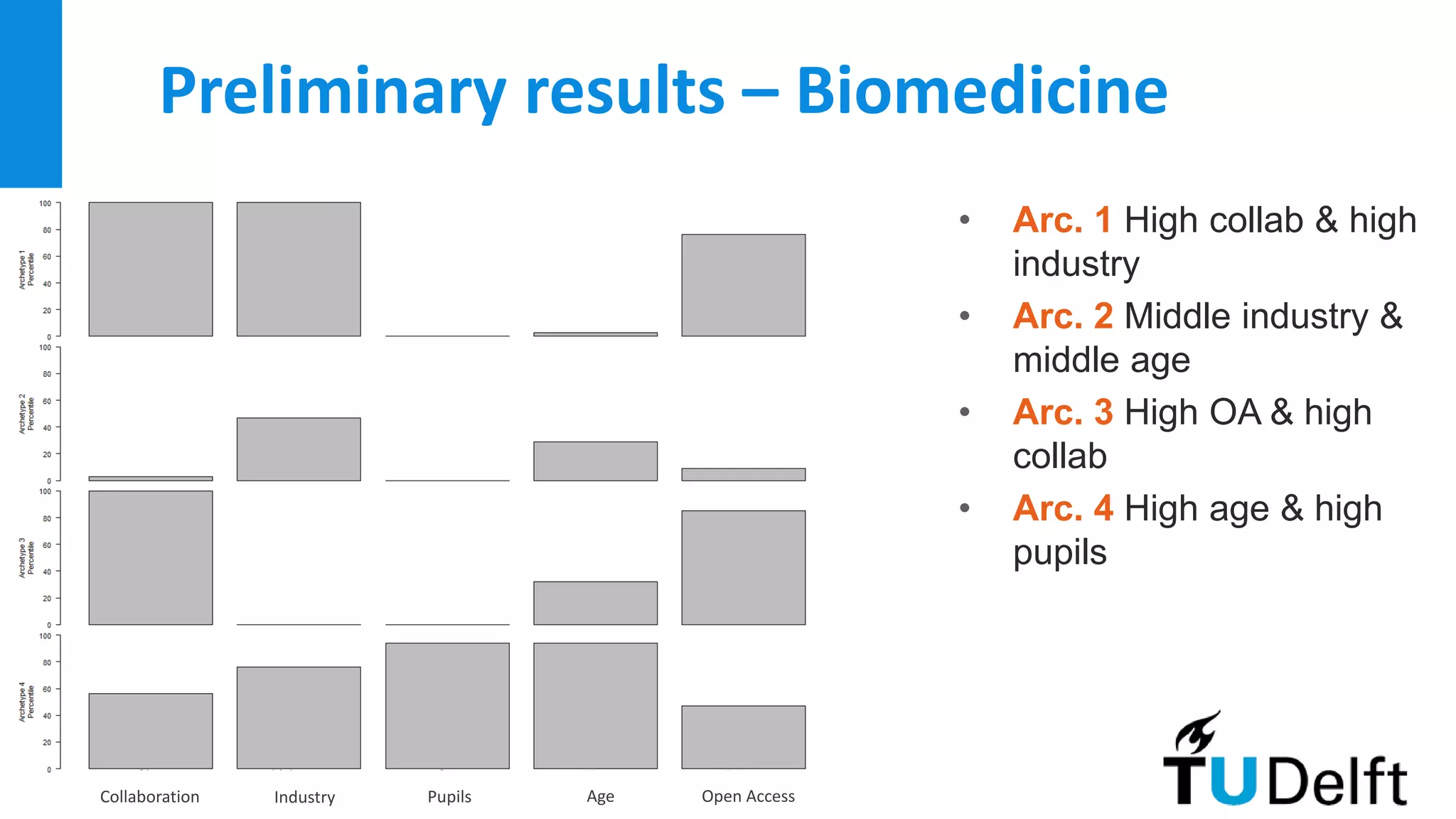
Preliminary results – Biomedicine
• Arc. 1 High collab & high
industry
• Arc. 2 Middle industry &
middle age
• Arc. 3 High OA & high
collab
• Arc. 4 High age & high
pupils
Collaboration Industry Pupils Age Open Access
Preliminary conclusions
• Need for constructive discussions on limitations of current research
assessment schemes of individual
• Expectations from scientists
• Modelling of research career and trajectories
• Stop isolating performance
• Development of balanced valuation models
• What do we value and how can it be observed
• Ambiguity vs. reductionism
Preliminary conclusions
Archetype 1 Archetype 2 Archetype 3 Archetype 4
Soc Sci Traj Cap Op Soc Sci Traj Cap Op Soc Sci Traj Cap Op Soc Sci Traj Cap Op
Social Sciences
Physics
Biomedicine
Overall
Industry-oriented Mentors (Open) collaborators The middle class
• Despite being very different areas and the limitations of the indicators
identified we observe some consistency in the profiles
• OA differences especially for Biomedicine in archetype 1
• Some profiles (e.g. 2) are ridden mostly by career stage
Thank you!!
http://nrobinsongarcia.com
@nrobinsongarcia
References
Abramo, G., D’Angelo, C. A., & Rosati, F. (2015). The determinants of academic career advancement: Evidence from Italy.
Science and Public Policy, 42(6), 761–774. https://doi.org/10.1093/scipol/scu086
Cutler, A., & Breiman, L. (1994). Archetypal Analysis. Technometrics, 36(4), 338–347.
https://doi.org/10.1080/00401706.1994.10485840
Laudel, G., & Gläser, J. (2008). From apprentice to colleague: The metamorphosis of Early Career Researchers. Higher
Education, 55(3), 387–406. https://doi.org/10.1007/s10734-007-9063-7
Milojević, S., Radicchi, F., & Walsh, J. P. (2018). Changing demographics of scientific careers: The rise of the temporary
workforce. Proceedings of the National Academy of Sciences, 115(50), 12616–12623.
https://doi.org/10.1073/pnas.1800478115
Moher, D., Naudet, F., Cristea, I. A., Miedema, F., Ioannidis, J. P. A., & Goodman, S. N. (2018). Assessing scientists for hiring,
promotion, and tenure. PLOS Biology, 16(3), e2004089. https://doi.org/10.1371/journal.pbio.2004089
Naudet, F., Ioannidis, J. P. A., Miedema, F., Cristea, I. A., Goodman, S. N., & Moher, D. (2018, June 4). Six principles for
assessing scientists for hiring, promotion, and tenure. Retrieved 7 June 2018, from Impact of Social Sciences website:
http://blogs.lse.ac.uk/impactofsocialsciences/2018/06/04/six-principles-for-assessing-scientists-for-hiring-promotion-and-
tenure/
Rijcke, S. de, Wouters, P. F., Rushforth, A. D., Franssen, T. P., & Hammarfelt, B. (2016). Evaluation practices and effects of
indicator use—A literature review. Research Evaluation, 25(2), 161–169. https://doi.org/10.1093/reseval/rvv038
Seiler, C., & Wohlrabe, K. (2013). Archetypal scientists. Journal of Informetrics, 7(2), 345–356.
https://doi.org/10.1016/j.joi.2012.11.013

Towards a multidimensional valuation model of scientists

  • 1.
    Towards a multidimensionalvaluation model of scientists http://nrobinsongarcia.com @nrobinsongarcia
  • 2.
    Critiques to individualassessment – DORA – Impact Factor – Leiden Manifesto – Misuse of indicators – Metric Tide – Indicators are not adequate Threats from current research evaluation 1. Evaluation schemes rely heavily on journal publication and citation-based indicators 2. Invisible profiles are degraded despite growing importance 3. Changes in the scholarly system are ignored Motivation
  • 3.
    Critiques to individualassessment – DORA – Impact Factor – Leiden Manifesto – Misuse of indicators – Metric Tide – Individual assessment Threats from current research evaluation 1. Evaluation schemes rely heavily on journal publication and citation-based indicators 2. Invisible profiles are degraded despite growing importance 3. Changes in the scholarly system are ignored Motivation
  • 4.
    Effects of currentevaluation schemes • Effects on the scientific workforce – Task reduction (de Rijcke et al, 2016) – Homogeneity of profiles (Milojević et al, 2018) – Mistrust and conservatism (Abramo et al, 2015) • Effects on knowledge production – Quality of research and transparency (Moher et al 2018) – Research integrity (Naudet et al 2018) – Short-sighted research agenda (PoP culture)
  • 5.
    Conceptual framework • Whatis expected of a scientist? Evaluative dimensions of performativity • What is their potential to achieve such expectations? Constraints and confounding effects
  • 6.
    Conceptual framework Evaluative dimensions External factors Personal features •Nationality • Gender • Language • …. • Performance • Expectations • …. • Work environment • Institutional logics • National policies • … Opportunity to perform
  • 7.
    Evaluative dimensions • Scientificengagement • Community career (Laudel & Gläser, 2008) • Overall scientific production • Social engagement • Outreach • Participatory science • Capacity building • Resources • Human capital • Trajectory • Past experience i.e., international, non-academic • Open practices • Transparency • Reproducibility • Participatory
  • 8.
    Research questions 1. Arethere different research profiles? 2. Is there a correspondence with career stage? 3. Do current research evaluation schemes favor certain profiles?
  • 9.
    Roadmap 1. Proof-of-concept • Desktopresearch • Interviews • CV analysis • Exploratory analyses 2. Descriptive phase • Operationalization • Profiling of scientists 3. Analytic phase • Career trajectories • Analysis by gender, nationality, field • Contextualization
  • 10.
    Roadmap 1. Proof-of-concept • Desktopresearch • Interviews • CV analysis • Exploratory analyses 2. Descriptive phase • Operationalization • Profiling of scientists 3. Analytic phase • Career trajectories • Analysis by gender, nationality, field • Contextualization
  • 11.
    Research design –Multiple case study • 6 Research groups: 228 scientists • 2 universities: Technical vs. Multidisciplinary • 6 research fields: Physics, Biomedical Sciences and Social Sciences Multidisciplinary Univ Technical Univ Biomedical Sciences 15 19 Social Sciences 9 61 Physics 118 6
  • 12.
    Research design –Data sources • Web of Science and Google Scholar – Research outputs • CV and personal website – Trajectory, model validation • Social media activity – Outreach • Interviews – Motivations, model validation
  • 13.
    Exploratory analysis VARIABLES Scientific engagement Share ofco-authored papers Social engagement Share of papers co- authored with industry Capacity building Number of first-year authors, last position, continued publishing Trajectory Years since first publication Open practices Share of papers available in Open Access
  • 14.
    Exploratory analysis ALL BIBLIOMETRIC!!VARIABLES Scientific engagement Share of co-authored papers Social engagement Share of papers co- authored with industry Capacity building Number of first-year authors, last position, continued publishing Trajectory Years since first publication Open practices Share of papers available in Open Access
  • 15.
    Exploratory analysis ARCHETYPAL ANALYSIS •Statistical data representation technique to characterize multivariate data sets (Cutler & Braiman, 1994) • First used in scientometrics in 2013 (Seiler & Wohlrabe, 2013) • It defines archetypes of individuals based on extreme values of one or more variables • Individuals are then characterized as pure or mixtures of archetypes
  • 16.
    Preliminary results –All scientists • 228 scientists • 3 distinct fields • Physics • Social Sciences • Biomedicine
  • 17.
    Preliminary results –All scientists • Find most suitable number of archetypes • Iteration process (4) trying to up to 10 archetypes • Check Residual Sum of Squares (RSS) • Apply elbow rule
  • 18.
    Preliminary results –All scientists • Arc. 1 High industry collaboration • Arc. 2 High age & pupils • Arc. 3 High collaboration & OA • Arc. 4 Middle age & middle collab. & middle OA Collaboration Industry Pupils Age Open Access
  • 19.
    Preliminary results –Social Sciences • Arc. 1 Middle age & middle OA • Arc. 2 High age & pupils • Arc. 3 High industry & collaboration • Arc. 4 High collab & high OA Collaboration Industry Pupils Age Open Access
  • 20.
    Preliminary results –Physics • Arc. 1 High OA & middle collab & middle industry • Arc. 2 Middle collab & high industry & middle pupils • Arc. 3 Middle OA & middle age • Arc. 4 High age & pupils & industry Collaboration Industry Pupils Age Open Access
  • 21.
    Preliminary results –Biomedicine • Arc. 1 High collab & high industry • Arc. 2 Middle industry & middle age • Arc. 3 High OA & high collab • Arc. 4 High age & high pupils Collaboration Industry Pupils Age Open Access
  • 22.
    Preliminary conclusions • Needfor constructive discussions on limitations of current research assessment schemes of individual • Expectations from scientists • Modelling of research career and trajectories • Stop isolating performance • Development of balanced valuation models • What do we value and how can it be observed • Ambiguity vs. reductionism
  • 23.
    Preliminary conclusions Archetype 1Archetype 2 Archetype 3 Archetype 4 Soc Sci Traj Cap Op Soc Sci Traj Cap Op Soc Sci Traj Cap Op Soc Sci Traj Cap Op Social Sciences Physics Biomedicine Overall Industry-oriented Mentors (Open) collaborators The middle class • Despite being very different areas and the limitations of the indicators identified we observe some consistency in the profiles • OA differences especially for Biomedicine in archetype 1 • Some profiles (e.g. 2) are ridden mostly by career stage
  • 24.
  • 25.
    References Abramo, G., D’Angelo,C. A., & Rosati, F. (2015). The determinants of academic career advancement: Evidence from Italy. Science and Public Policy, 42(6), 761–774. https://doi.org/10.1093/scipol/scu086 Cutler, A., & Breiman, L. (1994). Archetypal Analysis. Technometrics, 36(4), 338–347. https://doi.org/10.1080/00401706.1994.10485840 Laudel, G., & Gläser, J. (2008). From apprentice to colleague: The metamorphosis of Early Career Researchers. Higher Education, 55(3), 387–406. https://doi.org/10.1007/s10734-007-9063-7 Milojević, S., Radicchi, F., & Walsh, J. P. (2018). Changing demographics of scientific careers: The rise of the temporary workforce. Proceedings of the National Academy of Sciences, 115(50), 12616–12623. https://doi.org/10.1073/pnas.1800478115 Moher, D., Naudet, F., Cristea, I. A., Miedema, F., Ioannidis, J. P. A., & Goodman, S. N. (2018). Assessing scientists for hiring, promotion, and tenure. PLOS Biology, 16(3), e2004089. https://doi.org/10.1371/journal.pbio.2004089 Naudet, F., Ioannidis, J. P. A., Miedema, F., Cristea, I. A., Goodman, S. N., & Moher, D. (2018, June 4). Six principles for assessing scientists for hiring, promotion, and tenure. Retrieved 7 June 2018, from Impact of Social Sciences website: http://blogs.lse.ac.uk/impactofsocialsciences/2018/06/04/six-principles-for-assessing-scientists-for-hiring-promotion-and- tenure/ Rijcke, S. de, Wouters, P. F., Rushforth, A. D., Franssen, T. P., & Hammarfelt, B. (2016). Evaluation practices and effects of indicator use—A literature review. Research Evaluation, 25(2), 161–169. https://doi.org/10.1093/reseval/rvv038 Seiler, C., & Wohlrabe, K. (2013). Archetypal scientists. Journal of Informetrics, 7(2), 345–356. https://doi.org/10.1016/j.joi.2012.11.013