Which technique is more reliable for
cleaning shaping of a canal? Step-back OR
Crown-down. Also highlight difference
between the two.
Presented by Dr. Faryal Afzal.
STEP-BACK TECHNIQUE
• Traditional Technique
• Telescopic Technique
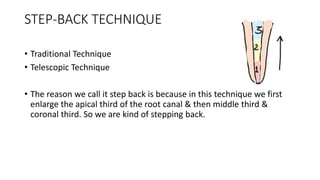
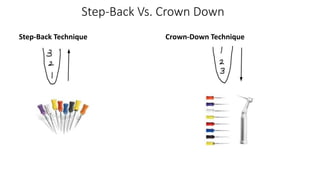
• The reason we call it step back is because in this technique we first
enlarge the apical third of the root canal & then middle third &
coronal third. So we are kind of stepping back.
STEP-BACK TECHNIQUE
• Maxillary Central Incisor
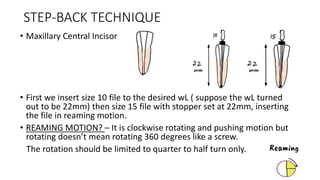
• First we insert size 10 file to the desired wL ( suppose the wL turned
out to be 22mm) then size 15 file with stopper set at 22mm, inserting
the file in reaming motion.
• REAMING MOTION? – It is clockwise rotating and pushing motion but
rotating doesn’t mean rotating 360 degrees like a screw.
The rotation should be limited to quarter to half turn only.
STEP-BACK TECHNIQUE
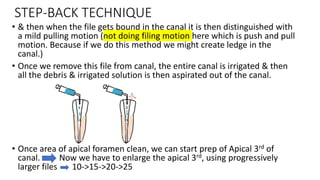
• & then when the file gets bound in the canal it is then distinguished with
a mild pulling motion (not doing filing motion here which is push and pull
motion. Because if we do this method we might create ledge in the
canal.)
• Once we remove this file from canal, the entire canal is irrigated & then
all the debris & irrigated solution is then aspirated out of the canal.
• Once area of apical foramen clean, we can start prep of Apical 3rd of
canal. Now we have to enlarge the apical 3rd, using progressively
larger files 10->15->20->25
STEP-BACK TECHNIQUE
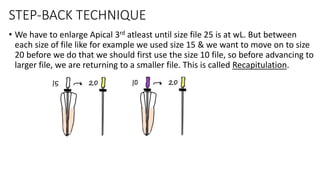
• We have to enlarge Apical 3rd atleast until size file 25 is at wL. But between
each size of file like for example we used size 15 & we want to move on to size
20 before we do that we should first use the size 10 file, so before advancing to
larger file, we are returning to a smaller file. This is called Recapitulation.
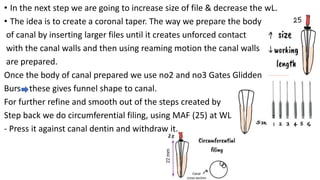
• In the next step we are going to increase size of file & decrease the wL.
• The idea is to create a coronal taper. The way we prepare the body
of canal by inserting larger files until it creates unforced contact
with the canal walls and then using reaming motion the canal walls
are prepared.
Once the body of canal prepared we use no2 and no3 Gates Glidden
Burs these gives funnel shape to canal.
For further refine and smooth out of the steps created by
Step back we do circumferential filing, using MAF (25) at WL
- Press it against canal dentin and withdraw it.
CROWN DOWN TECHNIQUE
• Georig at el.
• Main Concept- first prepare the coronal 3rd of the canal & then do the Apical
shaping.
• So its sequence is exact opposite of the step-back prep.
• WHY DO WE NEED TO KNOW THIS TECHNIQUE IF WE HAVE
STEP-BACK?- For most ROTARY Ni-Ti Systems we have to use
Crown Down Technique.
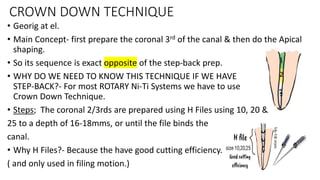
• Steps; The coronal 2/3rds are prepared using H Files using 10, 20 &
25 to a depth of 16-18mms, or until the file binds the
canal.
• Why H Files?- Because the have good cutting efficiency.
( and only used in filing motion.)
• After this we need to flare coronal segment of the canal For this we use GG
drills No.2,3,4.
• Next Phase- Prepare Apical third & for that we need to know wL so
that we don’t accidently go beyond Apex. We use size 10 or 15 K file.
• Next we are going to use size 60 file until it binds in
the canal (in watch winding motion)
Crown Down Technique
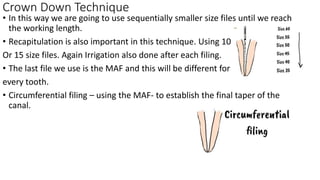
• In this way we are going to use sequentially smaller size files until we reach
the working length.
• Recapitulation is also important in this technique. Using 10
Or 15 size files. Again Irrigation also done after each filing.
• The last file we use is the MAF and this will be different for
every tooth.
• Circumferential filing – using the MAF- to establish the final taper of the
canal.
Step-Back Vs. Crown Down
Step-Back Technique Crown-Down Technique
Step-Back Vs. Crown Down
• Advantage with step back is that
we are able to prepare proper
apical stop before preparing
middle and coronal thirds.
• Several advantages;
• risk of extrusion of debris
beyond apex
• Also there is less friction & stress
on instrument ( which reduces
risk of instrument fracture)
• As the coronal 3rd is prepared
first it gives better access for
apical prep and better control
over it.
Thankyou!

StepBackVsCrownDown.pptx

  • 1.
    Which technique ismore reliable for cleaning shaping of a canal? Step-back OR Crown-down. Also highlight difference between the two. Presented by Dr. Faryal Afzal.
  • 2.
    STEP-BACK TECHNIQUE • TraditionalTechnique • Telescopic Technique • The reason we call it step back is because in this technique we first enlarge the apical third of the root canal & then middle third & coronal third. So we are kind of stepping back.
  • 3.
    STEP-BACK TECHNIQUE • MaxillaryCentral Incisor • First we insert size 10 file to the desired wL ( suppose the wL turned out to be 22mm) then size 15 file with stopper set at 22mm, inserting the file in reaming motion. • REAMING MOTION? – It is clockwise rotating and pushing motion but rotating doesn’t mean rotating 360 degrees like a screw. The rotation should be limited to quarter to half turn only.
  • 4.
    STEP-BACK TECHNIQUE • &then when the file gets bound in the canal it is then distinguished with a mild pulling motion (not doing filing motion here which is push and pull motion. Because if we do this method we might create ledge in the canal.) • Once we remove this file from canal, the entire canal is irrigated & then all the debris & irrigated solution is then aspirated out of the canal. • Once area of apical foramen clean, we can start prep of Apical 3rd of canal. Now we have to enlarge the apical 3rd, using progressively larger files 10->15->20->25
  • 5.
    STEP-BACK TECHNIQUE • Wehave to enlarge Apical 3rd atleast until size file 25 is at wL. But between each size of file like for example we used size 15 & we want to move on to size 20 before we do that we should first use the size 10 file, so before advancing to larger file, we are returning to a smaller file. This is called Recapitulation.
  • 6.
    • In thenext step we are going to increase size of file & decrease the wL. • The idea is to create a coronal taper. The way we prepare the body of canal by inserting larger files until it creates unforced contact with the canal walls and then using reaming motion the canal walls are prepared. Once the body of canal prepared we use no2 and no3 Gates Glidden Burs these gives funnel shape to canal. For further refine and smooth out of the steps created by Step back we do circumferential filing, using MAF (25) at WL - Press it against canal dentin and withdraw it.
  • 7.
    CROWN DOWN TECHNIQUE •Georig at el. • Main Concept- first prepare the coronal 3rd of the canal & then do the Apical shaping. • So its sequence is exact opposite of the step-back prep. • WHY DO WE NEED TO KNOW THIS TECHNIQUE IF WE HAVE STEP-BACK?- For most ROTARY Ni-Ti Systems we have to use Crown Down Technique. • Steps; The coronal 2/3rds are prepared using H Files using 10, 20 & 25 to a depth of 16-18mms, or until the file binds the canal. • Why H Files?- Because the have good cutting efficiency. ( and only used in filing motion.)
  • 8.
    • After thiswe need to flare coronal segment of the canal For this we use GG drills No.2,3,4. • Next Phase- Prepare Apical third & for that we need to know wL so that we don’t accidently go beyond Apex. We use size 10 or 15 K file. • Next we are going to use size 60 file until it binds in the canal (in watch winding motion)
  • 9.
    Crown Down Technique •In this way we are going to use sequentially smaller size files until we reach the working length. • Recapitulation is also important in this technique. Using 10 Or 15 size files. Again Irrigation also done after each filing. • The last file we use is the MAF and this will be different for every tooth. • Circumferential filing – using the MAF- to establish the final taper of the canal.
  • 10.
    Step-Back Vs. CrownDown Step-Back Technique Crown-Down Technique
  • 11.
    Step-Back Vs. CrownDown • Advantage with step back is that we are able to prepare proper apical stop before preparing middle and coronal thirds. • Several advantages; • risk of extrusion of debris beyond apex • Also there is less friction & stress on instrument ( which reduces risk of instrument fracture) • As the coronal 3rd is prepared first it gives better access for apical prep and better control over it.
  • 12.