Faris K
Department of MLT
MCH Trivandrum
KNIFE PROFILEKNIFE PROFILE
Knives are modelled according to the tissue to be
sectioned and the embedding medium.
KNIFE PROFILESKNIFE PROFILES
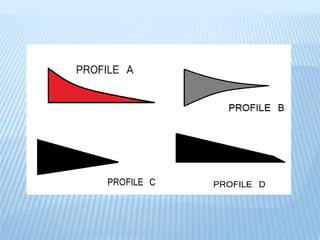
 Many knife profiles
 profile A, B, C & D (Histotechnology)
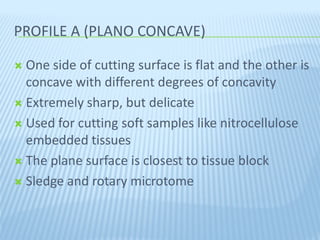
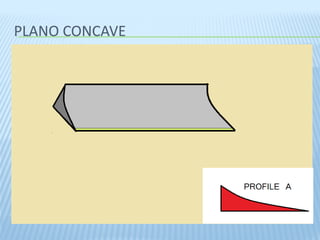
PROFILE A (PLANO CONCAVE)PROFILE A (PLANO CONCAVE)
 One side of cutting surface is flat and the other is
concave with different degrees of concavity
 Extremely sharp, but delicate
 Used for cutting soft samples like nitrocellulose
embedded tissues
 The plane surface is closest to tissue block
 Sledge and rotary microtome
PLANO CONCAVEPLANO CONCAVE
PROFILE B (BICONCAVE)PROFILE B (BICONCAVE)
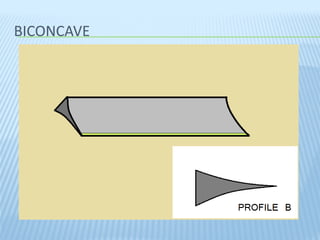
 It is the classical knife shape with concavity on
both sides
 Introduced by Heiffor
 Rocking microtome and sledge microtome
 Length 100-250mm
 Less rigid
 Prone to vibration
BICONCAVEBICONCAVE
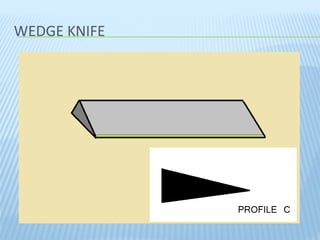
PROFILE C (WEDGE)PROFILE C (WEDGE)
 Use in all type of microtome to cut all type of
materials
 Both cutting surface are plane
 Known as standard profile
 Size 100-350mm
WEDGE KNIFEWEDGE KNIFE
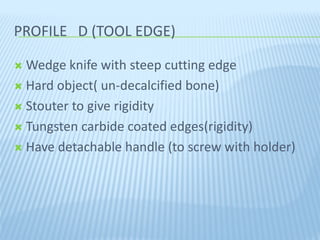
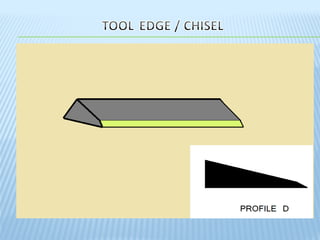
PROFILE D (TOOL EDGE)PROFILE D (TOOL EDGE)
 Wedge knife with steep cutting edge
 Hard object( un-decalcified bone)
 Stouter to give rigidity
 Tungsten carbide coated edges(rigidity)
 Have detachable handle (to screw with holder)
CONTI..….CONTI..….
 Wedge knife is stable for long time
 Need more force to achieve the cut
 Varying length available
80mm --freezing microtome
240mm-- base sledge microtome
Microtome knife profile

Microtome knife profile

  • 1.
    Faris K Department ofMLT MCH Trivandrum
  • 2.
    KNIFE PROFILEKNIFE PROFILE Knivesare modelled according to the tissue to be sectioned and the embedding medium.
  • 3.
    KNIFE PROFILESKNIFE PROFILES Many knife profiles  profile A, B, C & D (Histotechnology)
  • 4.
    PROFILE A (PLANOCONCAVE)PROFILE A (PLANO CONCAVE)  One side of cutting surface is flat and the other is concave with different degrees of concavity  Extremely sharp, but delicate  Used for cutting soft samples like nitrocellulose embedded tissues  The plane surface is closest to tissue block  Sledge and rotary microtome
  • 5.
  • 6.
    PROFILE B (BICONCAVE)PROFILEB (BICONCAVE)  It is the classical knife shape with concavity on both sides  Introduced by Heiffor  Rocking microtome and sledge microtome  Length 100-250mm  Less rigid  Prone to vibration
  • 7.
  • 8.
    PROFILE C (WEDGE)PROFILEC (WEDGE)  Use in all type of microtome to cut all type of materials  Both cutting surface are plane  Known as standard profile  Size 100-350mm
  • 9.
  • 10.
    PROFILE D (TOOLEDGE)PROFILE D (TOOL EDGE)  Wedge knife with steep cutting edge  Hard object( un-decalcified bone)  Stouter to give rigidity  Tungsten carbide coated edges(rigidity)  Have detachable handle (to screw with holder)
  • 11.
    CONTI..….CONTI..….  Wedge knifeis stable for long time  Need more force to achieve the cut  Varying length available 80mm --freezing microtome 240mm-- base sledge microtome