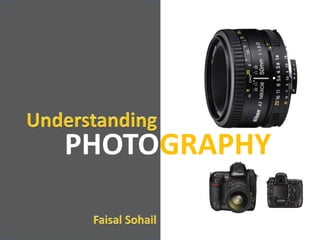
UnderstandingPHOTOGRAPHYFaisal Sohail
There are no rules for good photographs, there areonly good photographs.               ~Ansel Adams
FIRST STEPSelect the ideal camera to suit your requirement.Common options areDigital CameraSLR(Single Lens Reflex)cameraDSLR camera(Digital Single Lens Reflex)Other options are : point-and-shoot,rangefinder, viewfinder etc.
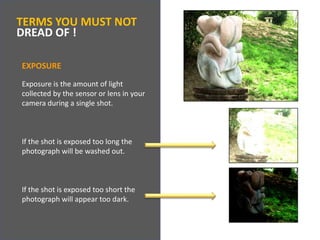
TERMS YOU MUST NOTDREAD OF !EXPOSUREExposure is the amount of light collected by the sensor or lens in your camera during a single shot.  If the shot is exposed too long the photograph will be washed out.  If the shot is exposed too short the photograph will appear too dark.
TERMS YOU MUST NOTDREAD OF !SHUTTER SPEED AND APERTUREThe two primary controls your camera uses for exposure are shutter speedand aperture.SHUTTER SPEED - the amount of time the sensor is exposed to light. Shutter speeds are measured in seconds and more commonly fractions of a second. (1/2000 of a second is very fast and 8' seconds is extremely slow)
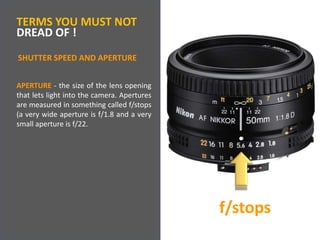
TERMS YOU MUST NOTDREAD OF !SHUTTER SPEED AND APERTUREAPERTURE - the size of the lens opening that lets light into the camera. Apertures are measured in something called f/stops (a very wide aperture is f/1.8 and a very small aperture is f/22.f/stops
TERMS YOU MUST NOTDREAD OF !APERTURE SCALE
TERMS YOU MUST NOTDREAD OF !SHUTTER SCALE
COMPOSITIONBASICSDepth of Field- Depth Of Field refers to the range of distance from the camera at which the objects will appear to be in acceptable focus. Anything outside this range will start to appear blurred. Golden Ratio- Architects use the "divine ratio" or the "golden ratio" which has a value of 1:(1+√5)/2 or 1:1.618034 as a basis for making naturally appealing structures as it has been proven that anything in nature that we find beautiful, uses this ratio. It seems to flow naturally and is always appealing to the human eye. Placing your subject along any of these lines, specially on the intersections, makes it more naturally attractive to the viewer. These intersections are sometimes called "Power Points".
COMPOSITIONBASICSGolden Triangle- Golden Triangle uses the same golden ratio used in a Golden Ratio.Some photographers find it also effective to remove one of the small triangles forming three triangular sections, a large triangle, a medium triangle and a small triangle, and fitting the three most significant parts of a scene inside these triangles.
COMPOSITIONBASICSThe Rule of Thirds - The rule of thirds is a compositional rule of thumb in visual arts such as painting, photography and design. The rule states that an image should be imagined as divided into nine equal parts by two equally-spaced horizontal lines and two equally-spaced vertical lines, and that important compositional elements should be placed along these lines or theirintersections.
CHOOSING THE RIGHTFILM SPEEDMedium film speeds (64 to 125 ASA) are probably the most used and can cope with a great range of subjects and conditions, though they may not be the perfect choice for the job in hand. They give good colour, fairly fine grain and have a good latitude to exposure error. They are really only inadequate in very dim lightingconditions.Slow films (25-50 ASA) being less sensitive to light require wider apertures or longer shutter speeds to give more exposure. They give the best sharpness and detail, the finest grain and are the most suitable for making enlargements. However, because of the increased exposure they require, there is more risk of camera shake and less potential for action shots in poor light. In low light you may prefer to use a slow film and a tripod rather than a fast film.Fast films (200-400 ASA and over) Pictures which cannot be taken with slow or medium film are often possible with fast film, which can be used in low lighting conditions. The fast shutter speeds used are good for stopping action.
Understanding photography - Part 1

Understanding photography - Part 1

  • 1.
  • 2.
    There are norules for good photographs, there areonly good photographs.  ~Ansel Adams
  • 3.
    FIRST STEPSelect theideal camera to suit your requirement.Common options areDigital CameraSLR(Single Lens Reflex)cameraDSLR camera(Digital Single Lens Reflex)Other options are : point-and-shoot,rangefinder, viewfinder etc.
  • 4.
    TERMS YOU MUSTNOTDREAD OF !EXPOSUREExposure is the amount of light collected by the sensor or lens in your camera during a single shot.  If the shot is exposed too long the photograph will be washed out.  If the shot is exposed too short the photograph will appear too dark.
  • 5.
    TERMS YOU MUSTNOTDREAD OF !SHUTTER SPEED AND APERTUREThe two primary controls your camera uses for exposure are shutter speedand aperture.SHUTTER SPEED - the amount of time the sensor is exposed to light. Shutter speeds are measured in seconds and more commonly fractions of a second. (1/2000 of a second is very fast and 8' seconds is extremely slow)
  • 6.
    TERMS YOU MUSTNOTDREAD OF !SHUTTER SPEED AND APERTUREAPERTURE - the size of the lens opening that lets light into the camera. Apertures are measured in something called f/stops (a very wide aperture is f/1.8 and a very small aperture is f/22.f/stops
  • 7.
    TERMS YOU MUSTNOTDREAD OF !APERTURE SCALE
  • 8.
    TERMS YOU MUSTNOTDREAD OF !SHUTTER SCALE
  • 9.
    COMPOSITIONBASICSDepth of Field-Depth Of Field refers to the range of distance from the camera at which the objects will appear to be in acceptable focus. Anything outside this range will start to appear blurred. Golden Ratio- Architects use the "divine ratio" or the "golden ratio" which has a value of 1:(1+√5)/2 or 1:1.618034 as a basis for making naturally appealing structures as it has been proven that anything in nature that we find beautiful, uses this ratio. It seems to flow naturally and is always appealing to the human eye. Placing your subject along any of these lines, specially on the intersections, makes it more naturally attractive to the viewer. These intersections are sometimes called "Power Points".
  • 10.
    COMPOSITIONBASICSGolden Triangle- GoldenTriangle uses the same golden ratio used in a Golden Ratio.Some photographers find it also effective to remove one of the small triangles forming three triangular sections, a large triangle, a medium triangle and a small triangle, and fitting the three most significant parts of a scene inside these triangles.
  • 11.
    COMPOSITIONBASICSThe Rule ofThirds - The rule of thirds is a compositional rule of thumb in visual arts such as painting, photography and design. The rule states that an image should be imagined as divided into nine equal parts by two equally-spaced horizontal lines and two equally-spaced vertical lines, and that important compositional elements should be placed along these lines or theirintersections.
  • 12.
    CHOOSING THE RIGHTFILMSPEEDMedium film speeds (64 to 125 ASA) are probably the most used and can cope with a great range of subjects and conditions, though they may not be the perfect choice for the job in hand. They give good colour, fairly fine grain and have a good latitude to exposure error. They are really only inadequate in very dim lightingconditions.Slow films (25-50 ASA) being less sensitive to light require wider apertures or longer shutter speeds to give more exposure. They give the best sharpness and detail, the finest grain and are the most suitable for making enlargements. However, because of the increased exposure they require, there is more risk of camera shake and less potential for action shots in poor light. In low light you may prefer to use a slow film and a tripod rather than a fast film.Fast films (200-400 ASA and over) Pictures which cannot be taken with slow or medium film are often possible with fast film, which can be used in low lighting conditions. The fast shutter speeds used are good for stopping action.