Film Camera Single Lens Reflex (Analogue SLR) By KC Tan
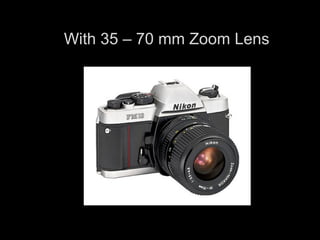
With 35 – 70 mm Zoom Lens
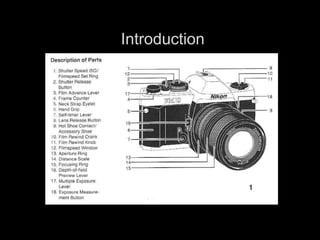
Introduction
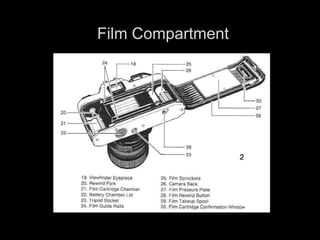
Film Compartment
Exposure It is one of the most important manipulations in photography done by user who set the  aperture  and  shutter speed  of the camera that allows a light image, which is formed by a lens, strikes the film.  Over-exposure refers to the light image formed is too bright during the process of exposure. Under-exposure refers to the light image formed is too dim during the process of exposure. Normal-exposure refers to the light image formed is appropriate in term of brightness (just right) during the process of exposure. Film sensitivity, which is rated in ISO will affect the exposure too. A built-in exposure meter helps user to set exposure correctly in an average scene.
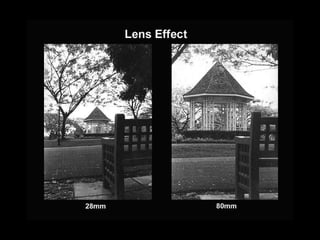
Lens A lens is used to focus a sharp image onto the recording material It comes in different focal length Different focal length of a lens creates perspective differently Short focal length of a lens has a wide angle of coverage Therefore short focal length of a lens is called wide angle lens Wide angle lens has exaggerated perspective that increases depth Long focal length of a lens has a narrow angle of coverage Therefore long focal length of a lens is called telephoto lens Telephoto lens has compressed perspective that decreases depth The standard lens is called normal lens Normal lens has the same perspective as the eyes see
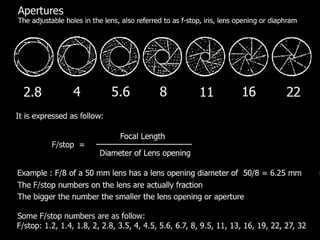
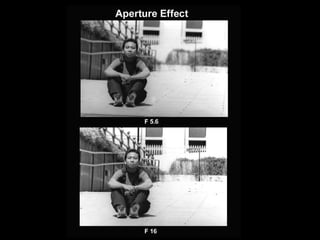
Aperture Aperture is designed to control the amount of light reaching the recording medium Aperture size is represented by a constant number calls F/stop F/stop is a measure of light passing power of a lens F/stop number is actually a denominator of a fraction number Therefore small number represents large aperture and vice versa
 
 
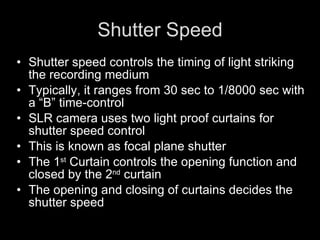
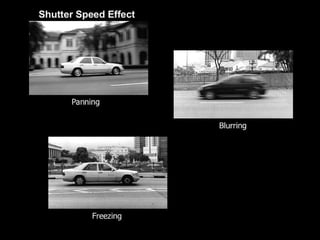
Shutter Speed Shutter speed controls the timing of light striking the recording medium Typically, it ranges from 30 sec to 1/8000 sec with a “B” time-control SLR camera uses two light proof curtains for shutter speed control This is known as focal plane shutter The 1 st  Curtain controls the opening function and closed by the 2 nd  curtain  The opening and closing of curtains decides the shutter speed
 
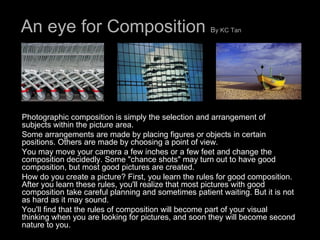
An eye for Composition  B y KC Tan   Photographic composition is simply the selection and arrangement of subjects within the picture area.  Some arrangements are made by placing figures or objects in certain positions. Others are made by choosing a point of view.  You may move your camera a few inches or a few feet and change the composition decidedly. Some "chance shots" may turn out to have good composition, but most good pictures are created.  How do you create a picture? First, you learn the rules for good composition. After you learn these rules, you'll realize that most pictures with good composition take careful planning and sometimes patient waiting. But it is not as hard as it may sound.  You'll find that the rules of composition will become part of your visual thinking when you are looking for pictures, and soon they will become second nature to you.
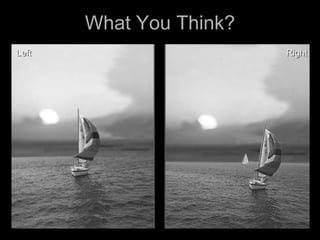
What You Think? Left Right
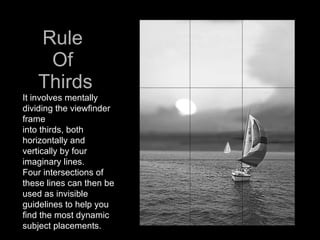
Rule  Of  Thirds It involves mentally dividing the viewfinder frame  into thirds, both horizontally and vertically by four imaginary lines.  Four intersections of these lines can then be used as invisible guidelines to help you find the most dynamic subject placements.
A Good Photograph Is Simplicity Trying to pack too much information into a photograph  is like cramming too much into your suitcase.  It only makes the thing you're looking for much harder to find.  A good photograph should reveal a single subject  or idea with as little clutter as possible.  Try asking yourself what it is you're photographing.  Then begin to eliminate all but the essential visual elements.  Experiment it with different angles of view and focal length.
Design Elements Lines Patterns Shapes Forms Textures Framing
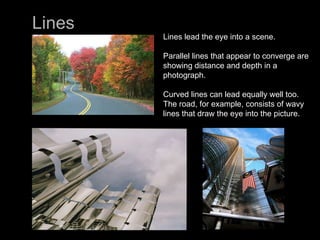
Lines Lines lead the eye into a scene. Parallel lines that appear to converge are showing distance and depth in a photograph.  Curved lines can lead equally well too. The road, for example, consists of wavy lines that draw the eye into the picture.
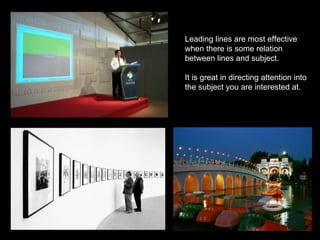
Leading lines are most effective when there is some relation  between lines and subject. It is great in directing attention into  the subject you are interested at.
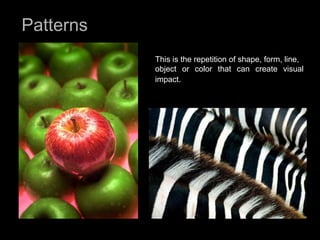
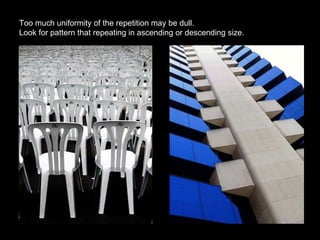
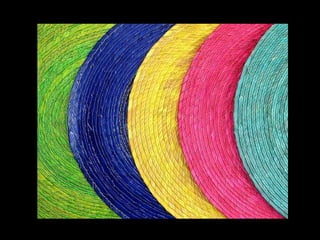
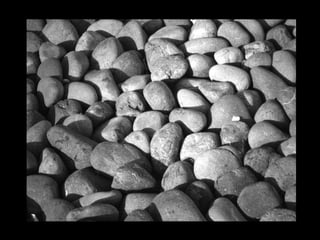
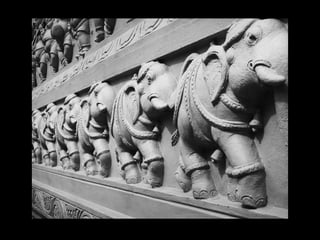
Patterns This is the repetition of shape, form, line,  object or color that can create visual impact .
Too much uniformity of the repetition may be dull.  Look for pattern that repeating in ascending or descending size.
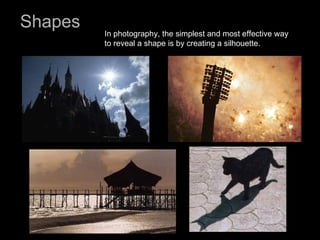
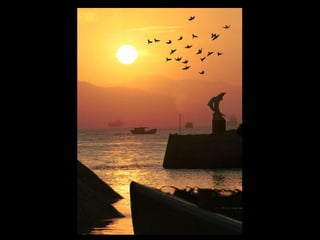
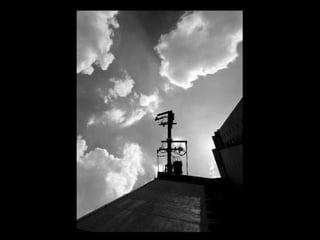
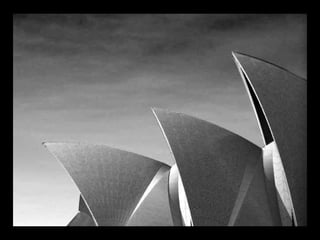
In photography, the simplest and most effective way  to reveal a shape is by creating a silhouette.  Shapes
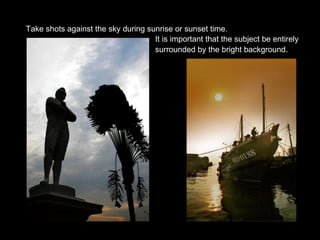
Take shots against the sky during sunrise or sunset time. It is important that the subject be entirely  surrounded by the bright background .
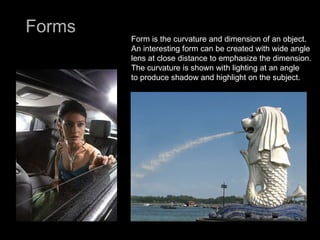
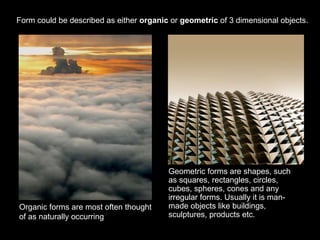
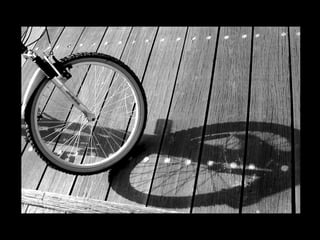
Forms Form is the curvature and dimension of an object.  An interesting form can be created with wide angle lens at close distance to emphasize the dimension.  The curvature is shown with lighting at an angle  to produce shadow and highlight on the subject.
Geometric forms are shapes, such as squares, rectangles, circles, cubes, spheres, cones and any irregular forms. Usually it is man-made objects like buildings, sculptures, products etc. Form could be described as either  organic  or  geometric  of 3 dimensional objects.  Organic forms are most often thought  of as naturally occurring
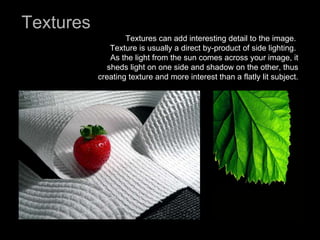
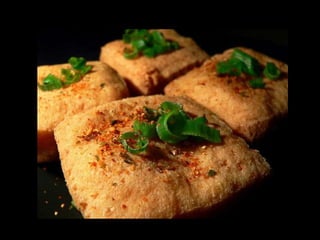
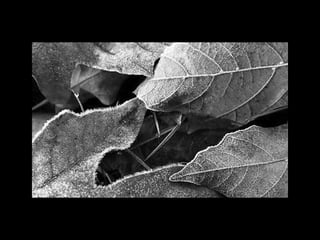
Textures Textures can add interesting detail to the image.  Texture is usually a direct by-product of side lighting.  As the light from the sun comes across your image, it sheds light on one side and shadow on the other, thus creating texture and more interest than a flatly lit subject.
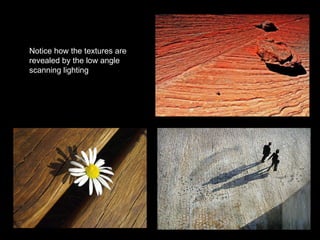
Notice how the textures are revealed by the low angle scanning lighting
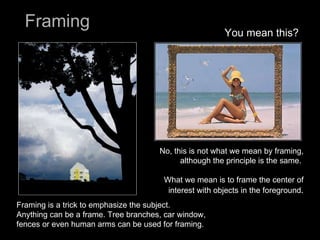
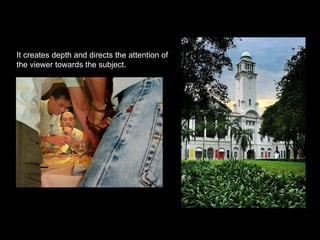
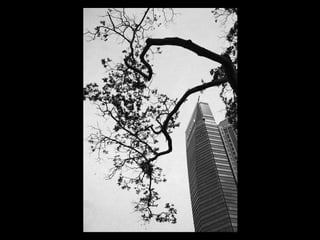
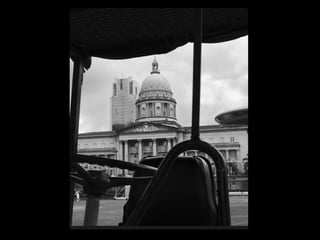
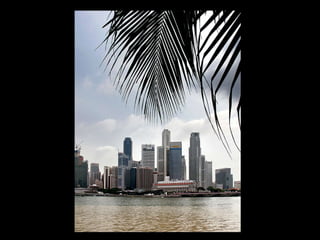
Framing Framing is a trick to emphasize the subject.  Anything can be a frame. Tree branches, car window, fences or even human arms can be used for framing.  No, this is not what we mean by framing, although the principle is the same.  What we mean is to frame the center of interest with objects in the foreground . You mean this?
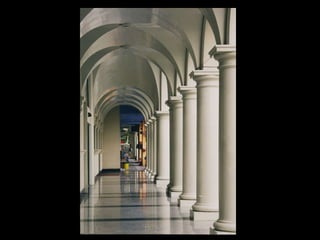
It creates depth and directs the attention of the viewer towards the subject.


Understanding design  elements and how they can affect our emotions help us make our photographic images more effective.  Nevertheless no rule or guideline can ever guarantee success.  A successful image depends on interacting factors like  timing, lighting, color, composition, and the viewers’ sensitivity to the visual message that you are trying to communicate.  Just like artists carry out design and arrange elements until they "feel right" in expressing their feelings to others. There is no other guiding principle may be required.  Imitating of other works is one way to begin in developing your skills. Learning the styles of certain professionals is a stepping stone towards developing your own style, although many may not agree and admit to it. Evaluate and compare your work both technically and aesthetically against those of other photographers.  Be realistic and critical when you evaluate your own images and edit your images ruthlessly.  Listen to what others have to say when they view your images, what they like, what they don't like but always be true to yourself and what your vision is.  Conclusion
Thank You

photography.slr

  • 1.
    Film Camera SingleLens Reflex (Analogue SLR) By KC Tan
  • 2.
    With 35 –70 mm Zoom Lens
  • 3.
  • 4.
  • 5.
    Exposure It isone of the most important manipulations in photography done by user who set the aperture and shutter speed of the camera that allows a light image, which is formed by a lens, strikes the film. Over-exposure refers to the light image formed is too bright during the process of exposure. Under-exposure refers to the light image formed is too dim during the process of exposure. Normal-exposure refers to the light image formed is appropriate in term of brightness (just right) during the process of exposure. Film sensitivity, which is rated in ISO will affect the exposure too. A built-in exposure meter helps user to set exposure correctly in an average scene.
  • 6.
    Lens A lensis used to focus a sharp image onto the recording material It comes in different focal length Different focal length of a lens creates perspective differently Short focal length of a lens has a wide angle of coverage Therefore short focal length of a lens is called wide angle lens Wide angle lens has exaggerated perspective that increases depth Long focal length of a lens has a narrow angle of coverage Therefore long focal length of a lens is called telephoto lens Telephoto lens has compressed perspective that decreases depth The standard lens is called normal lens Normal lens has the same perspective as the eyes see
  • 7.
    Aperture Aperture isdesigned to control the amount of light reaching the recording medium Aperture size is represented by a constant number calls F/stop F/stop is a measure of light passing power of a lens F/stop number is actually a denominator of a fraction number Therefore small number represents large aperture and vice versa
  • 8.
  • 9.
  • 10.
    Shutter Speed Shutterspeed controls the timing of light striking the recording medium Typically, it ranges from 30 sec to 1/8000 sec with a “B” time-control SLR camera uses two light proof curtains for shutter speed control This is known as focal plane shutter The 1 st Curtain controls the opening function and closed by the 2 nd curtain The opening and closing of curtains decides the shutter speed
  • 11.
  • 12.
    An eye forComposition B y KC Tan Photographic composition is simply the selection and arrangement of subjects within the picture area. Some arrangements are made by placing figures or objects in certain positions. Others are made by choosing a point of view. You may move your camera a few inches or a few feet and change the composition decidedly. Some "chance shots" may turn out to have good composition, but most good pictures are created. How do you create a picture? First, you learn the rules for good composition. After you learn these rules, you'll realize that most pictures with good composition take careful planning and sometimes patient waiting. But it is not as hard as it may sound. You'll find that the rules of composition will become part of your visual thinking when you are looking for pictures, and soon they will become second nature to you.
  • 13.
    What You Think?Left Right
  • 14.
    Rule Of Thirds It involves mentally dividing the viewfinder frame into thirds, both horizontally and vertically by four imaginary lines. Four intersections of these lines can then be used as invisible guidelines to help you find the most dynamic subject placements.
  • 15.
    A Good PhotographIs Simplicity Trying to pack too much information into a photograph is like cramming too much into your suitcase. It only makes the thing you're looking for much harder to find. A good photograph should reveal a single subject or idea with as little clutter as possible. Try asking yourself what it is you're photographing. Then begin to eliminate all but the essential visual elements. Experiment it with different angles of view and focal length.
  • 16.
    Design Elements LinesPatterns Shapes Forms Textures Framing
  • 17.
    Lines Lines leadthe eye into a scene. Parallel lines that appear to converge are showing distance and depth in a photograph. Curved lines can lead equally well too. The road, for example, consists of wavy lines that draw the eye into the picture.
  • 18.
    Leading lines aremost effective when there is some relation between lines and subject. It is great in directing attention into the subject you are interested at.
  • 19.
    Patterns This isthe repetition of shape, form, line, object or color that can create visual impact .
  • 20.
    Too much uniformityof the repetition may be dull. Look for pattern that repeating in ascending or descending size.
  • 21.
    In photography, thesimplest and most effective way to reveal a shape is by creating a silhouette. Shapes
  • 22.
    Take shots againstthe sky during sunrise or sunset time. It is important that the subject be entirely surrounded by the bright background .
  • 23.
    Forms Form isthe curvature and dimension of an object. An interesting form can be created with wide angle lens at close distance to emphasize the dimension. The curvature is shown with lighting at an angle to produce shadow and highlight on the subject.
  • 24.
    Geometric forms areshapes, such as squares, rectangles, circles, cubes, spheres, cones and any irregular forms. Usually it is man-made objects like buildings, sculptures, products etc. Form could be described as either organic or geometric of 3 dimensional objects. Organic forms are most often thought of as naturally occurring
  • 25.
    Textures Textures canadd interesting detail to the image. Texture is usually a direct by-product of side lighting. As the light from the sun comes across your image, it sheds light on one side and shadow on the other, thus creating texture and more interest than a flatly lit subject.
  • 26.
    Notice how thetextures are revealed by the low angle scanning lighting
  • 27.
    Framing Framing isa trick to emphasize the subject. Anything can be a frame. Tree branches, car window, fences or even human arms can be used for framing. No, this is not what we mean by framing, although the principle is the same. What we mean is to frame the center of interest with objects in the foreground . You mean this?
  • 28.
    It creates depthand directs the attention of the viewer towards the subject.
  • 29.
  • 30.
  • 31.
  • 32.
  • 33.
  • 34.
  • 35.
  • 36.
  • 37.
  • 38.
  • 39.
  • 40.
  • 41.
  • 42.
  • 43.
  • 44.
  • 45.
  • 46.
  • 47.
  • 48.
  • 49.
  • 50.
  • 51.
  • 52.
  • 53.
  • 54.
    Understanding design elements and how they can affect our emotions help us make our photographic images more effective. Nevertheless no rule or guideline can ever guarantee success. A successful image depends on interacting factors like timing, lighting, color, composition, and the viewers’ sensitivity to the visual message that you are trying to communicate. Just like artists carry out design and arrange elements until they "feel right" in expressing their feelings to others. There is no other guiding principle may be required. Imitating of other works is one way to begin in developing your skills. Learning the styles of certain professionals is a stepping stone towards developing your own style, although many may not agree and admit to it. Evaluate and compare your work both technically and aesthetically against those of other photographers. Be realistic and critical when you evaluate your own images and edit your images ruthlessly. Listen to what others have to say when they view your images, what they like, what they don't like but always be true to yourself and what your vision is. Conclusion
  • 55.