History of MT LAWS
Ephraimeen F. Guadalquiver,RMT
At the End of the Discussion, Students
are expected to:
• Define What Is Medical Technology
• Trace the History of Medical Technology
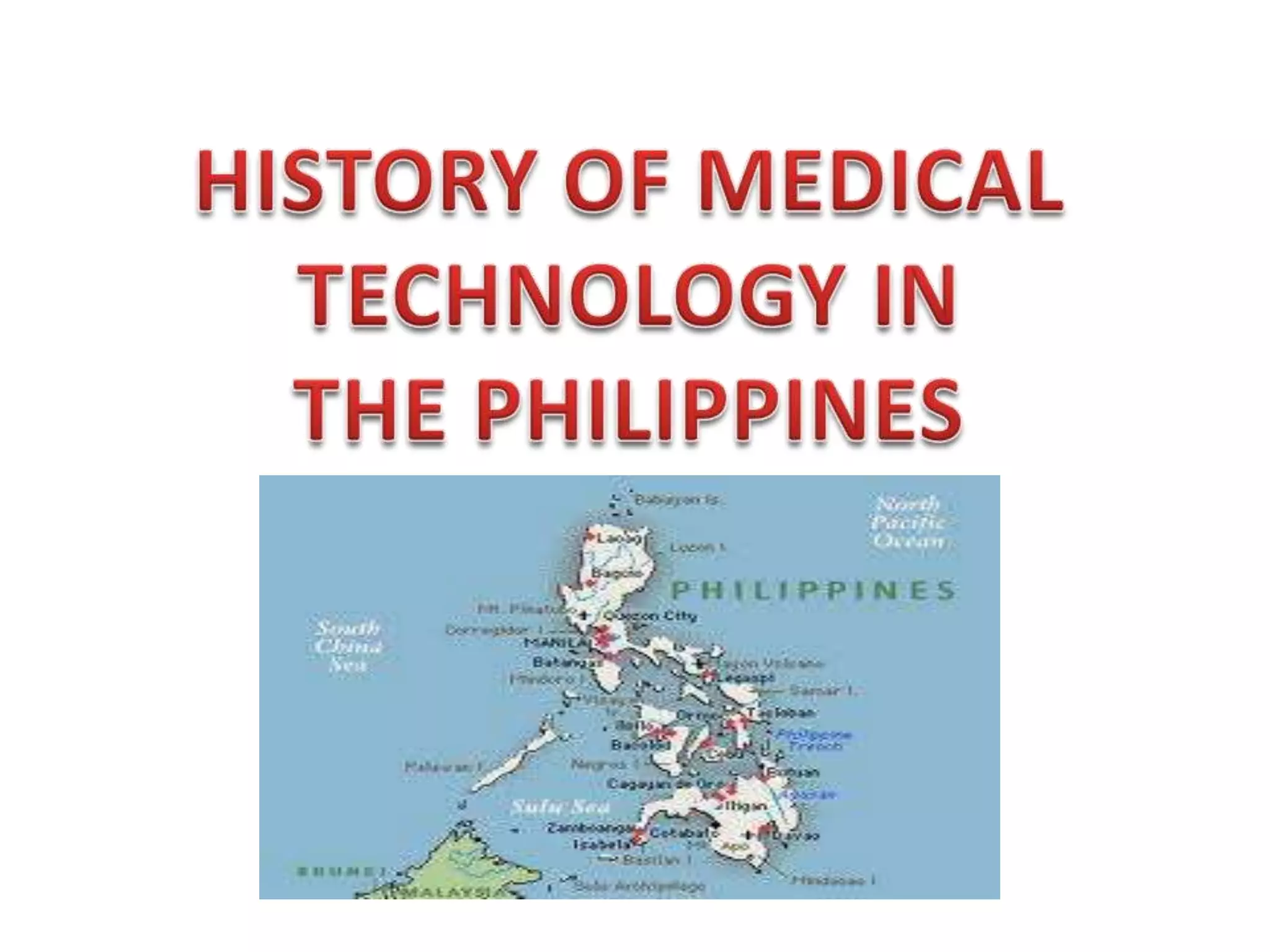
• Trace the history of Medical technology in the Philippines
• Identify the Different PAMET PRESIDENTS and their
accomplishments or Legacy
• Cite the different provisions in the various laws affecting the
practice of Medical Technology
• Describe the Medical Technology Ethics and its application
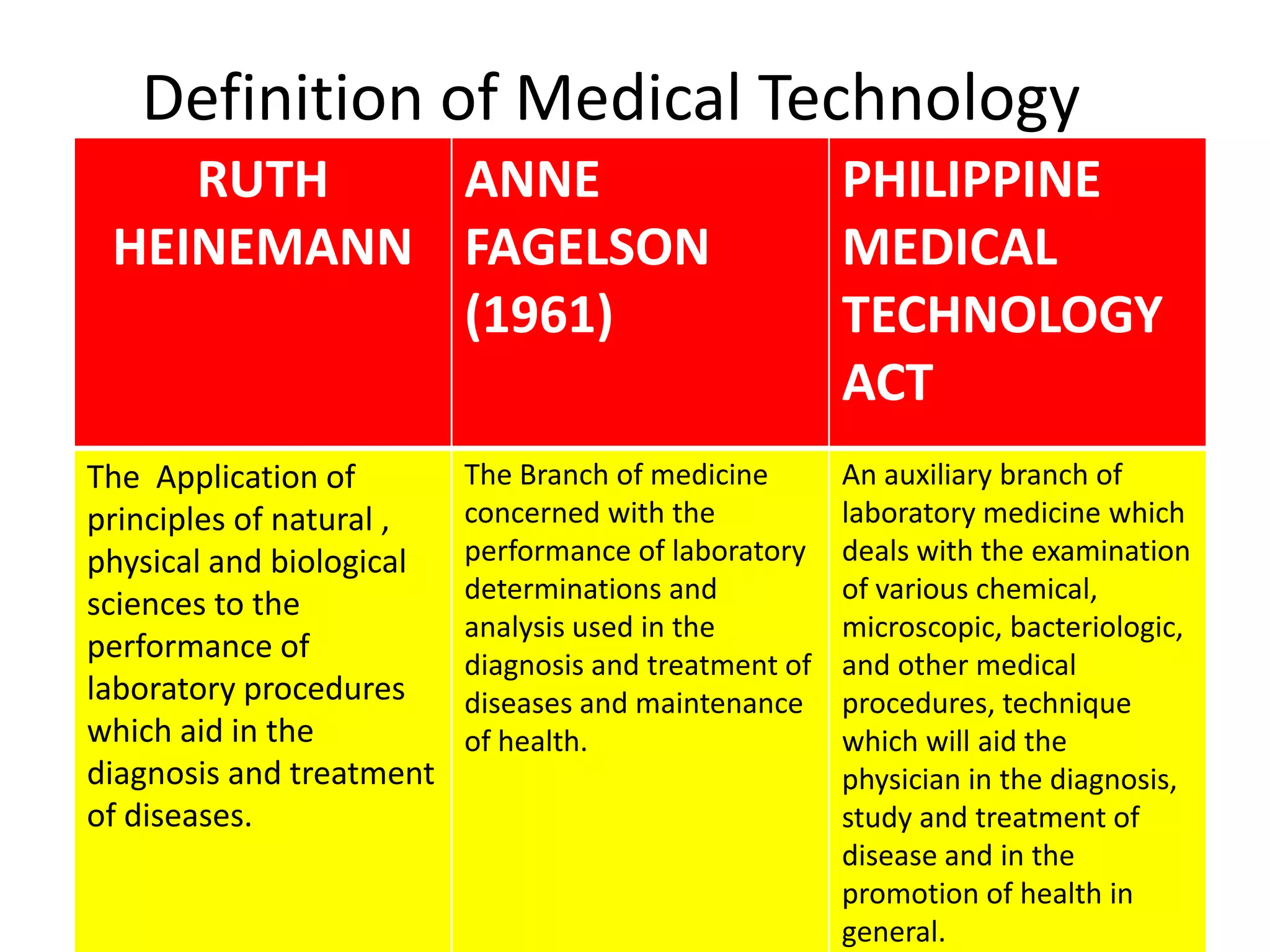
Definition of Medical Technology
RUTH
HEINEMANN
ANNE
FAGELSON
(1961)
PHILIPPINE
MEDICAL
TECHNOLOGY
ACT
The Application of
principles of natural ,
physical and biological
sciences to the
performance of
laboratory procedures
which aid in the
diagnosis and treatment
of diseases.
The Branch of medicine
concerned with the
performance of laboratory
determinations and
analysis used in the
diagnosis and treatment of
diseases and maintenance
of health.
An auxiliary branch of
laboratory medicine which
deals with the examination
of various chemical,
microscopic, bacteriologic,
and other medical
procedures, technique
which will aid the
physician in the diagnosis,
study and treatment of
disease and in the
promotion of health in
general.
HISTORY OF MEDICAL TECHNOLOGY
• In the year 460 B.C. when the Greek, physician
Hippocrates also known as thefather of
medicine formulated the famous Hippocratic
Oath, the code of ethics for practicing
physicians. Hippocrates described four "humors"
or body fluids in man
• namely- the blood, phlegm, yellow bile and
black bile.
• These four humors or body fluids were felt to be
the source of a person's disposition and disease
in ancient times.
VIVIAN HERRICK
Traces the beginning of medical technology
back to 1500 BC when instestinal parasites
such as TAENIA and ASCARIS were mentioned
in early writings.
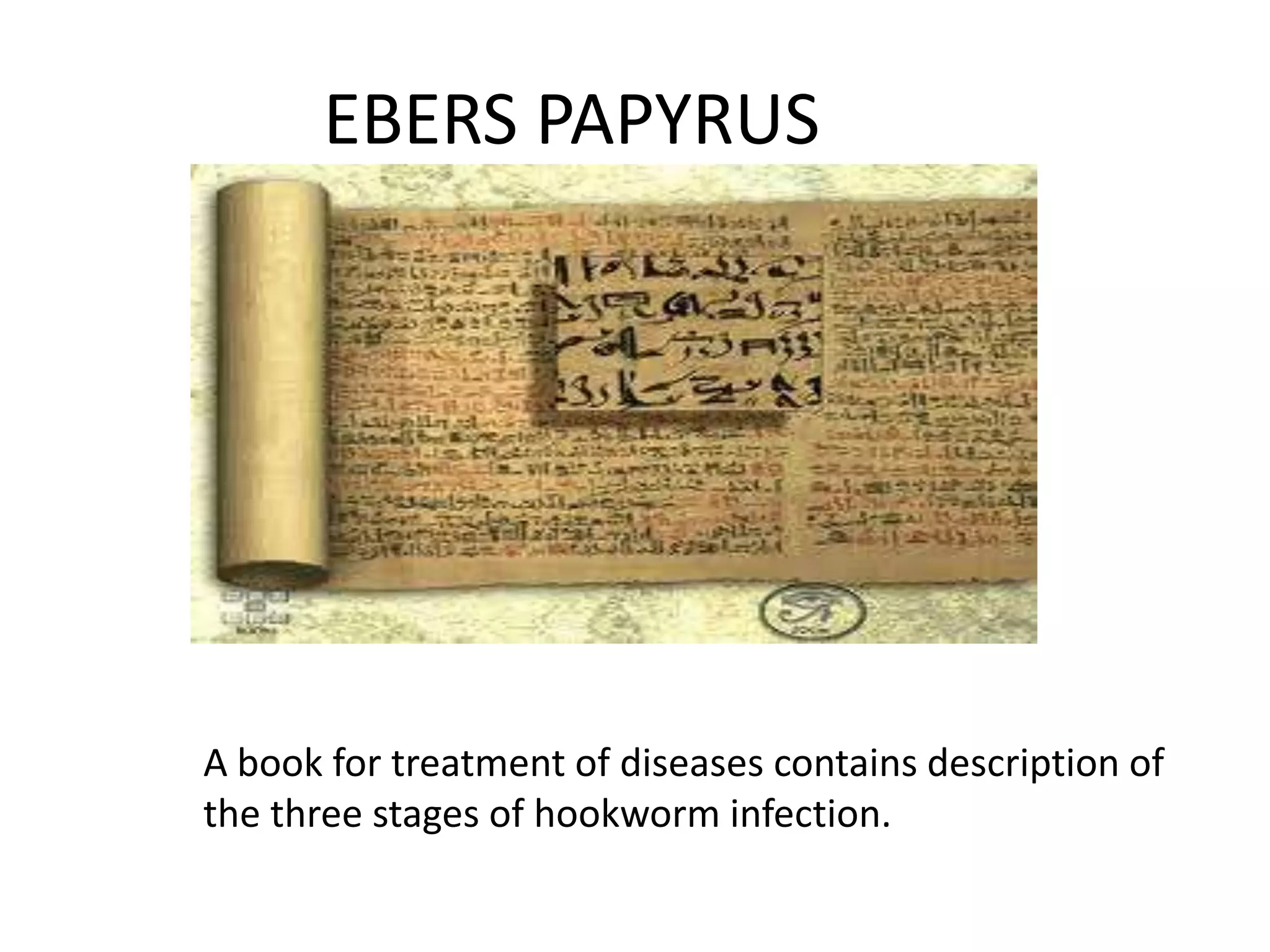
EBERS PAPYRUS
A book for treatment of diseases contains description of
the three stages of hookworm infection.
RUTH WILLIAMS
 A medical Technologist
 Believes that medical technology began
from the MEDIEVAL PERIOD (1096-1438) as
supported by the fact that urinalysis was a
fad.
 Early Hindu doctors made the “SCIENTIFIC
OBSERVATION” that the urine of certain
individuals attract ants, and that such urine
has a sweetish taste.
 QUACKS, calling themselves doctors
reaped fortunes from diagnosing diseases
by the appearance of the urine.
ANNE FAGELSON
 Prefers to date medical technology from
the 14th Century when a prominent Italian
physician at the University of Bologna
employed one, ALESSANDRA GILIANI to
perform tasks now under the domain of
the medical technology.
 Unfortunately, this young lady died from a
laboratory acquired infection.
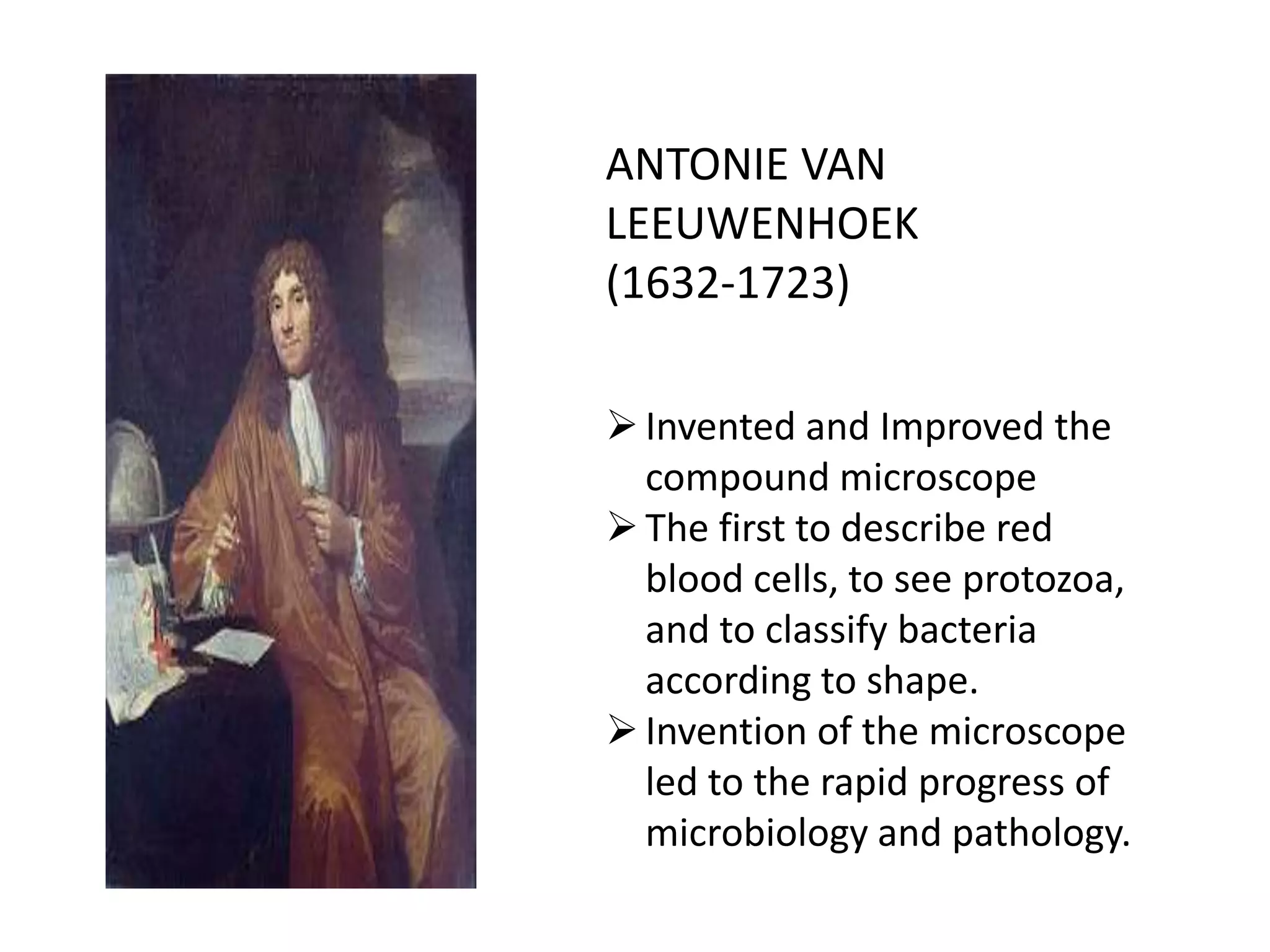
ANTONIE VAN
LEEUWENHOEK
(1632-1723)
Invented and Improved the
compound microscope
The first to describe red
blood cells, to see protozoa,
and to classify bacteria
according to shape.
Invention of the microscope
led to the rapid progress of
microbiology and pathology.
MALPHIGI
( 1628-1694)
 Desribed as the “GREATEST” of the early
microscopist.
 His work on embryology and anatomy definitely
marked him as “THE FOUNDER OF PATHOLOGY”
.
RUDOLPH VIRCHOW
 One of the youngest medical specialists
 Founded the ARCHIVES OF PATHOLOGY in
BERLIN in 1847.
HERMANN FEHLING
> Performed the FIRST QUANTITATIVE
TEST in URINE SUGAR in 1848.
MIDDLE OF 15th CENTURY
Aniline Dyes were used in staining
microorganisms
Bacterial staining and microscopic
study on bacteria were made
possible.
ESTABLISHMENT OF LABORATORIES
FIRST CHEMICAL LABORATORY
 Established at the University of Michigan by Dr.Douglas
(not identified)
 Dr.Douglas pioneered laboratory instruction in this well-
equipped laboratory.
1878
Dr. William H. Welch
 established another laboratory at the BELLEVUE
HOSPITAL MEDICAL COLLEGE.
 He gave the first laboratory course in pathology offered in
an American Medical School.
1885
Dr. Welch became the first professor of pathology at John
Hopkins University.
FIRST CLINICAL LABORATORY
Opened in 1896 at JOHN HOPKINS
HOSPITAL by DR. WILLIAM OSLER.
In this laboratory, routine examinations
were carried out, special attention being
given to the search for malarial parasites
in the blood.
A clinical laboratory was also opened at
the UNIVERSITY OF PENNSYLVANIA in
1896 (WILLIAM PEPPER LABORATORY).
1908
DR. JAMES C. TODD
wrote the book : A MANUAL OF CLINICAL
DIAGNOSIS
Retitled “ CLINICAL DIAGNOSIS BY
LABORATORY METHODS” , in its 6th Edition by
Dr. Todd and Dr. Arthur Sanford.
The book became the standard reference for
laboratories
1919 census
• 100 technicians, all male were employed in the UNITED
STATES.
• This increased to 3500 in 1920. In 1922, 3035 hospitals
had CLINICAL LABORATORIES.
1915
The state legislature of Pennsylvania enacted
a law requiring all hospitals and institutions
to have an adequate laboratory and to
employ a full time laboratory technician
WORLD WAR 1
 It was an impact factor in the growth of
clinical laboratory and produced a great
demand for technicians.
 The demand for technicians in clinical
laboratories continued, so practicing
physicians with knowledge on laboratory
works began to teach their assistants to
do some of the tests for them.
UNIVERSITY OF MINNESOTA
 One of the First schools for training laboratory
workers was established here.
 A course bulletin titled : “COURSES IN MEDICAL
TECHNOLOGY FOR CLINICAL AND LABORATORY
TECHNICIANS” was issued in 1922.
 They were the FIRST to offer a DEGREE LEVEL
PROGRAM in 1923.
1931
DENVER SOCIETY OF CLINICAL PATHOLOGISTS were
organized.
1936
AMERICAN BOARD OF PATHOLOGY ESTABLISHED
WORLD WAR 2
Marked effects in laboratory medicine
The use of blood increased and the “closed
system” of bloo d collection was widely used.
Instrumentation advanced and these
instruments paved the measurement of the
intensity of color produced.
Automated equipment appeared and quality
control programs became common
MEDICAL TECHNOLOGY
PRACTICE WAS INTRODUCED
BY
THE 26TH MEDICAL
INFANTRY OF THE 6TH US
ARMY.
First Clinical Laboratory in the Philippines
QUIRICADA ST., Sta. CRUZ, MANILA
(MANILA PUBLIC HEALTH)
> The lab offered traning programs to high school
graduates as early as FEBRUARY,1944.
1943
• THE US ARMY LEFT in JUNE
• Endorsed it to the
NATIONAL DEPARTMENT
OF HEALTH
• The Department rendered
the laboratory non-
functional for sometime.
DR. PIO DE RODA
• ORGANIZED MANILA PUBLIC
HEALTH LABORATORY from
the remnants of the deserted
laboratory.
• OCTOBER 1,1945
With Dr. Mariano Icasiano
as his assistant and who was
then the MANILA CITY HEALTH
OFFICER.
One of the staffs of the Clinical
Laboratory
1947
Training of high school
graduates to work as medical
technicians
No period of training was set
and No certificates were
given.
By:
Dr. Pio De Roda
Dr. Prudencia Sta. Ana
1954
A 6 months laboratory
training with certificate upon
completion was given to the
trainees.
Dr. Sta. Ana prepared the
syllabus for the training
program.
Medical Technology
Education in the
Philippines
• S.Y. 1957-1958
• Dr. Antonio Gabriel and Dr.
Gustavo Reyes of the
FACULTY of Pharmacy,
University of Sto. Tomas
offered medical technology
as an elective subject to 4th
and 5th year B.S. Pharmacy
students.
The Training program offered by
Dr. Pio De Roda did not last long.
The FIRST B.S. Degree course in
Medical Technology was offered
by the PHILIPPINE UNION
COLLEGE and MANILA
SANITARIUM.
After 2 years, PUC produced its
first graduate, Dr. Jesse Umali,
now a successful OB-
Gynecologist.
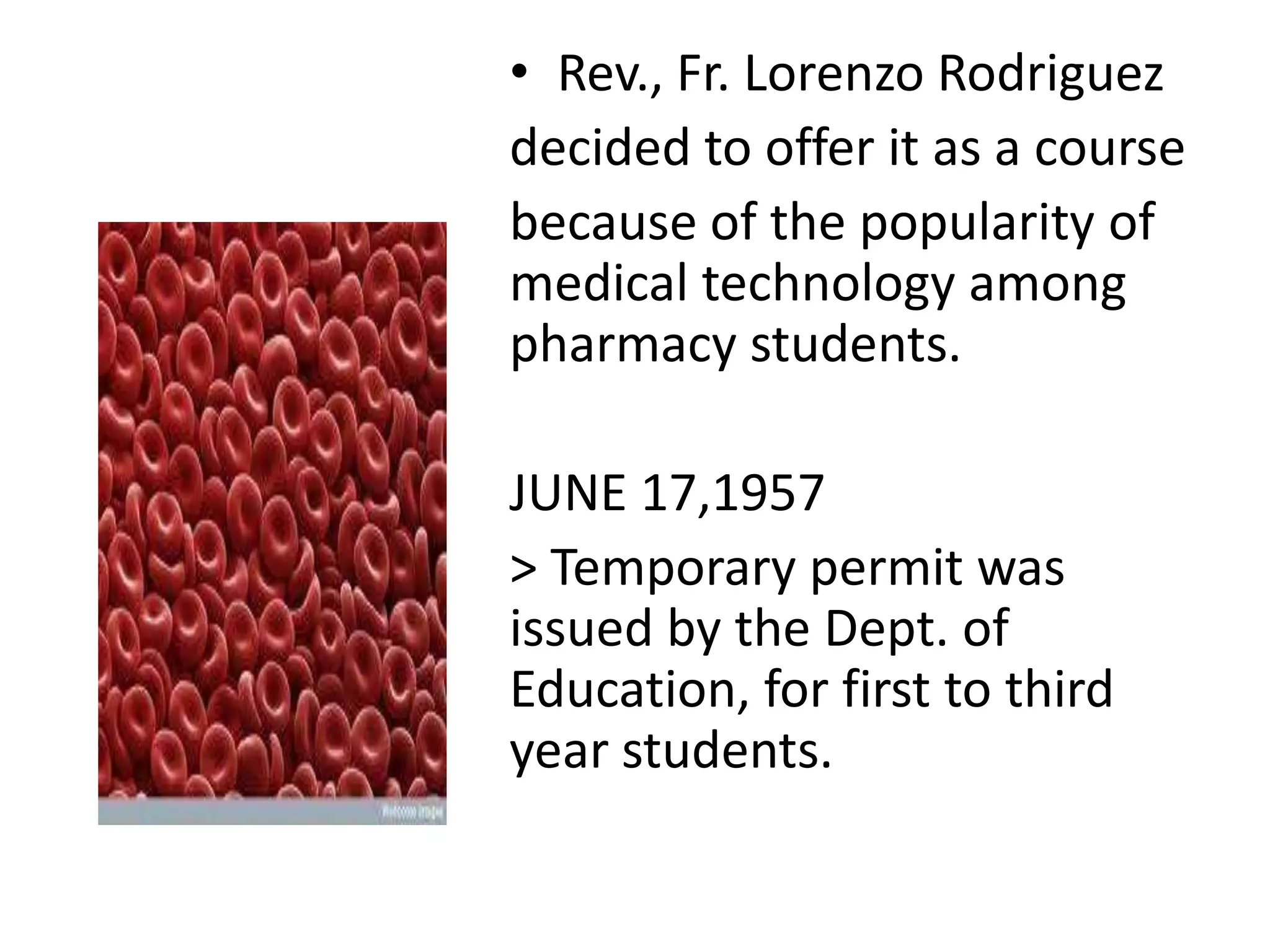
• Rev., Fr. Lorenzo Rodriguez
decided to offer it as a course
because of the popularity of
medical technology among
pharmacy students.
JUNE 17,1957
> Temporary permit was
issued by the Dept. of
Education, for first to third
year students.
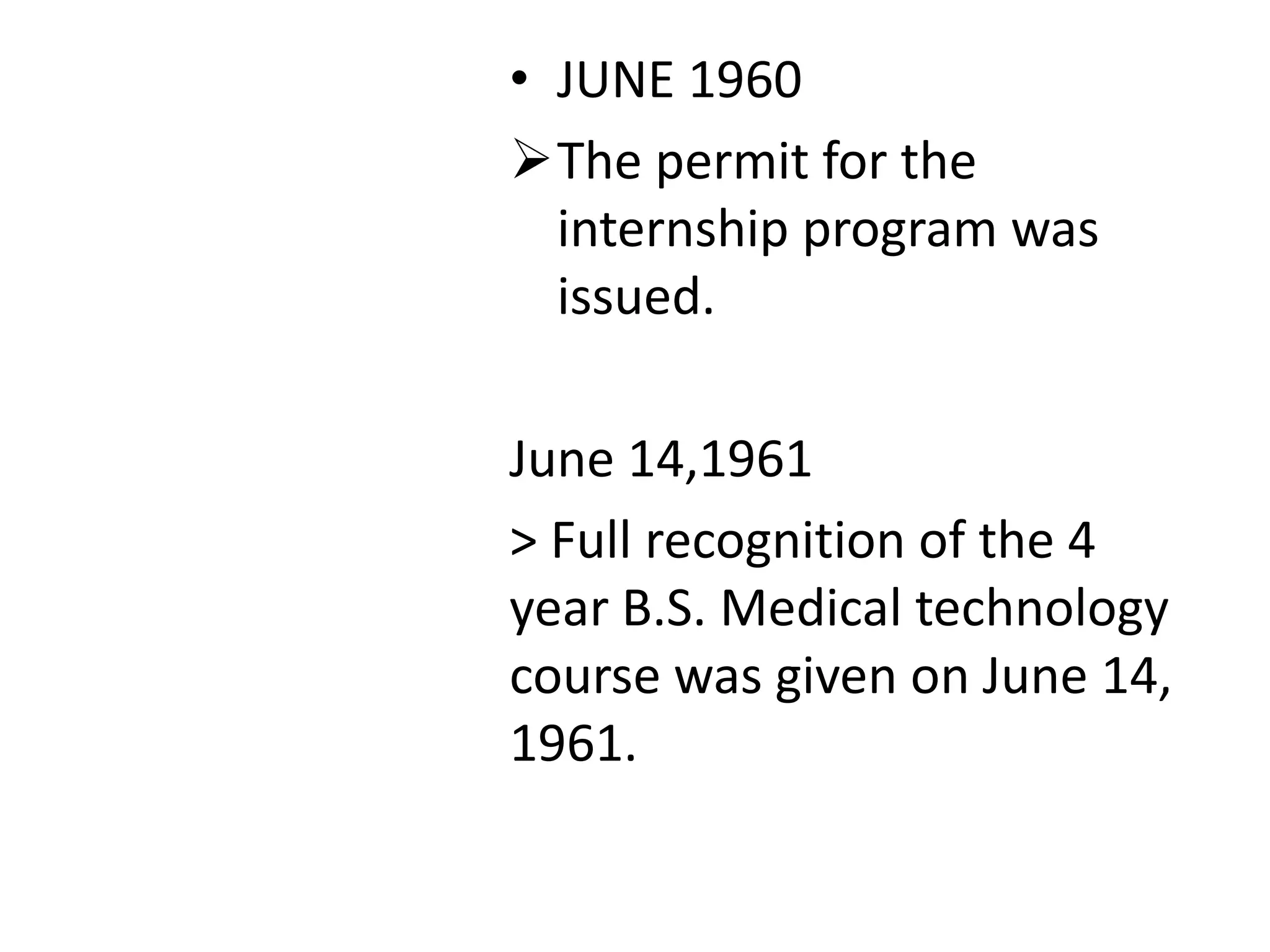
• JUNE 1960
The permit for the
internship program was
issued.
June 14,1961
> Full recognition of the 4
year B.S. Medical technology
course was given on June 14,
1961.
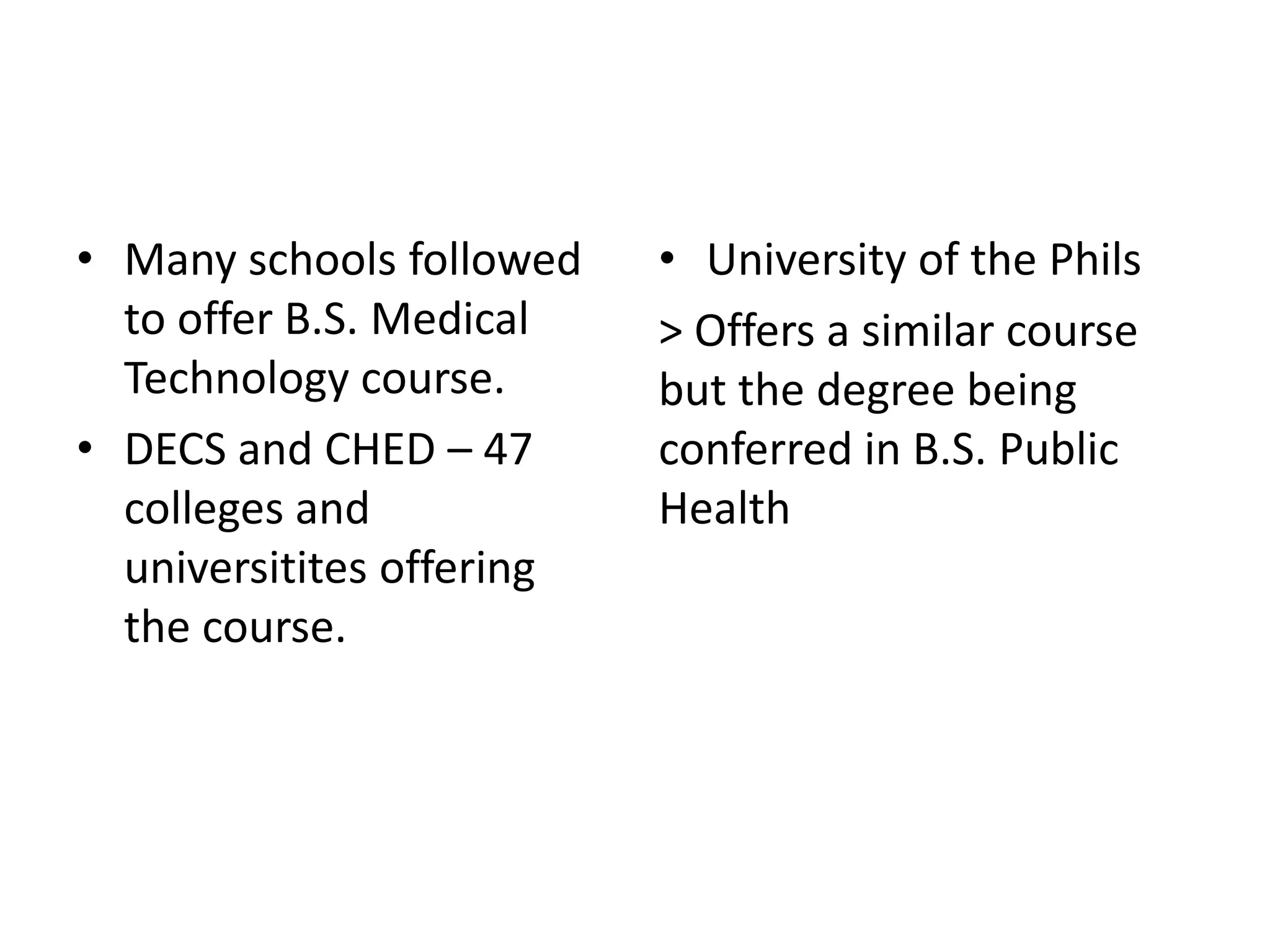
• Many schools followed
to offer B.S. Medical
Technology course.
• DECS and CHED – 47
colleges and
universitites offering
the course.
• University of the Phils
> Offers a similar course
but the degree being
conferred in B.S. Public
Health
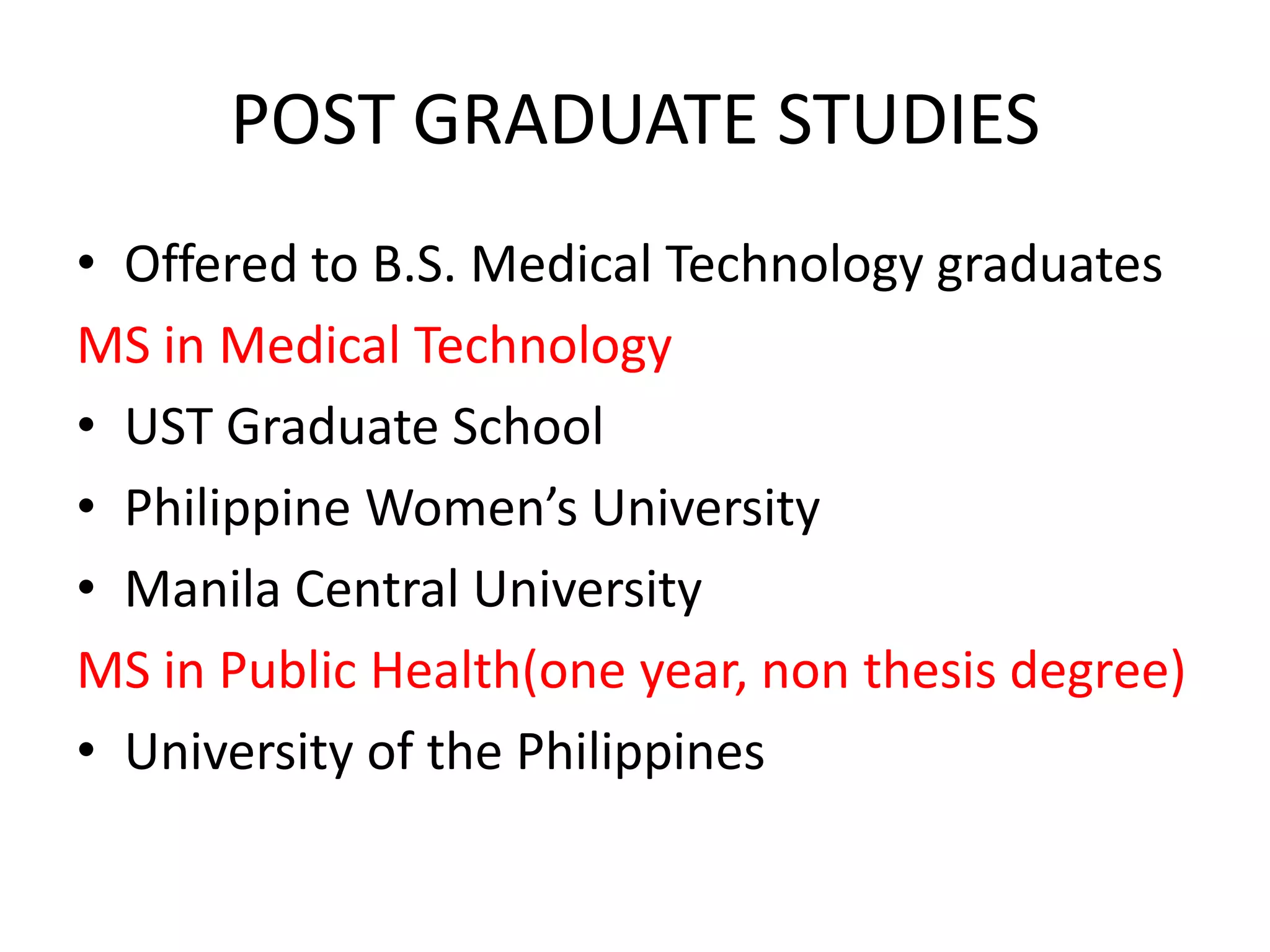
POST GRADUATE STUDIES
• Offered to B.S. Medical Technology graduates
MS in Medical Technology
• UST Graduate School
• Philippine Women’s University
• Manila Central University
MS in Public Health(one year, non thesis degree)
• University of the Philippines

History of mt laws and code of ethics

  • 1.
    History of MTLAWS Ephraimeen F. Guadalquiver,RMT
  • 2.
    At the Endof the Discussion, Students are expected to: • Define What Is Medical Technology • Trace the History of Medical Technology • Trace the history of Medical technology in the Philippines • Identify the Different PAMET PRESIDENTS and their accomplishments or Legacy • Cite the different provisions in the various laws affecting the practice of Medical Technology • Describe the Medical Technology Ethics and its application
  • 3.
    Definition of MedicalTechnology RUTH HEINEMANN ANNE FAGELSON (1961) PHILIPPINE MEDICAL TECHNOLOGY ACT The Application of principles of natural , physical and biological sciences to the performance of laboratory procedures which aid in the diagnosis and treatment of diseases. The Branch of medicine concerned with the performance of laboratory determinations and analysis used in the diagnosis and treatment of diseases and maintenance of health. An auxiliary branch of laboratory medicine which deals with the examination of various chemical, microscopic, bacteriologic, and other medical procedures, technique which will aid the physician in the diagnosis, study and treatment of disease and in the promotion of health in general.
  • 4.
  • 5.
    • In theyear 460 B.C. when the Greek, physician Hippocrates also known as thefather of medicine formulated the famous Hippocratic Oath, the code of ethics for practicing physicians. Hippocrates described four "humors" or body fluids in man • namely- the blood, phlegm, yellow bile and black bile. • These four humors or body fluids were felt to be the source of a person's disposition and disease in ancient times.
  • 6.
    VIVIAN HERRICK Traces thebeginning of medical technology back to 1500 BC when instestinal parasites such as TAENIA and ASCARIS were mentioned in early writings.
  • 7.
    EBERS PAPYRUS A bookfor treatment of diseases contains description of the three stages of hookworm infection.
  • 8.
    RUTH WILLIAMS  Amedical Technologist  Believes that medical technology began from the MEDIEVAL PERIOD (1096-1438) as supported by the fact that urinalysis was a fad.  Early Hindu doctors made the “SCIENTIFIC OBSERVATION” that the urine of certain individuals attract ants, and that such urine has a sweetish taste.  QUACKS, calling themselves doctors reaped fortunes from diagnosing diseases by the appearance of the urine.
  • 9.
    ANNE FAGELSON  Prefersto date medical technology from the 14th Century when a prominent Italian physician at the University of Bologna employed one, ALESSANDRA GILIANI to perform tasks now under the domain of the medical technology.  Unfortunately, this young lady died from a laboratory acquired infection.
  • 10.
    ANTONIE VAN LEEUWENHOEK (1632-1723) Invented andImproved the compound microscope The first to describe red blood cells, to see protozoa, and to classify bacteria according to shape. Invention of the microscope led to the rapid progress of microbiology and pathology.
  • 11.
    MALPHIGI ( 1628-1694)  Desribedas the “GREATEST” of the early microscopist.  His work on embryology and anatomy definitely marked him as “THE FOUNDER OF PATHOLOGY” . RUDOLPH VIRCHOW  One of the youngest medical specialists  Founded the ARCHIVES OF PATHOLOGY in BERLIN in 1847.
  • 12.
    HERMANN FEHLING > Performedthe FIRST QUANTITATIVE TEST in URINE SUGAR in 1848. MIDDLE OF 15th CENTURY Aniline Dyes were used in staining microorganisms Bacterial staining and microscopic study on bacteria were made possible.
  • 13.
    ESTABLISHMENT OF LABORATORIES FIRSTCHEMICAL LABORATORY  Established at the University of Michigan by Dr.Douglas (not identified)  Dr.Douglas pioneered laboratory instruction in this well- equipped laboratory. 1878 Dr. William H. Welch  established another laboratory at the BELLEVUE HOSPITAL MEDICAL COLLEGE.  He gave the first laboratory course in pathology offered in an American Medical School. 1885 Dr. Welch became the first professor of pathology at John Hopkins University.
  • 14.
    FIRST CLINICAL LABORATORY Openedin 1896 at JOHN HOPKINS HOSPITAL by DR. WILLIAM OSLER. In this laboratory, routine examinations were carried out, special attention being given to the search for malarial parasites in the blood. A clinical laboratory was also opened at the UNIVERSITY OF PENNSYLVANIA in 1896 (WILLIAM PEPPER LABORATORY).
  • 15.
    1908 DR. JAMES C.TODD wrote the book : A MANUAL OF CLINICAL DIAGNOSIS Retitled “ CLINICAL DIAGNOSIS BY LABORATORY METHODS” , in its 6th Edition by Dr. Todd and Dr. Arthur Sanford. The book became the standard reference for laboratories
  • 16.
    1919 census • 100technicians, all male were employed in the UNITED STATES. • This increased to 3500 in 1920. In 1922, 3035 hospitals had CLINICAL LABORATORIES.
  • 17.
    1915 The state legislatureof Pennsylvania enacted a law requiring all hospitals and institutions to have an adequate laboratory and to employ a full time laboratory technician WORLD WAR 1  It was an impact factor in the growth of clinical laboratory and produced a great demand for technicians.  The demand for technicians in clinical laboratories continued, so practicing physicians with knowledge on laboratory works began to teach their assistants to do some of the tests for them.
  • 18.
    UNIVERSITY OF MINNESOTA One of the First schools for training laboratory workers was established here.  A course bulletin titled : “COURSES IN MEDICAL TECHNOLOGY FOR CLINICAL AND LABORATORY TECHNICIANS” was issued in 1922.  They were the FIRST to offer a DEGREE LEVEL PROGRAM in 1923. 1931 DENVER SOCIETY OF CLINICAL PATHOLOGISTS were organized. 1936 AMERICAN BOARD OF PATHOLOGY ESTABLISHED
  • 19.
    WORLD WAR 2 Markedeffects in laboratory medicine The use of blood increased and the “closed system” of bloo d collection was widely used. Instrumentation advanced and these instruments paved the measurement of the intensity of color produced. Automated equipment appeared and quality control programs became common
  • 22.
    MEDICAL TECHNOLOGY PRACTICE WASINTRODUCED BY THE 26TH MEDICAL INFANTRY OF THE 6TH US ARMY. First Clinical Laboratory in the Philippines QUIRICADA ST., Sta. CRUZ, MANILA (MANILA PUBLIC HEALTH) > The lab offered traning programs to high school graduates as early as FEBRUARY,1944.
  • 23.
    1943 • THE USARMY LEFT in JUNE • Endorsed it to the NATIONAL DEPARTMENT OF HEALTH • The Department rendered the laboratory non- functional for sometime.
  • 24.
    DR. PIO DERODA • ORGANIZED MANILA PUBLIC HEALTH LABORATORY from the remnants of the deserted laboratory. • OCTOBER 1,1945 With Dr. Mariano Icasiano as his assistant and who was then the MANILA CITY HEALTH OFFICER. One of the staffs of the Clinical Laboratory
  • 25.
    1947 Training of highschool graduates to work as medical technicians No period of training was set and No certificates were given. By: Dr. Pio De Roda Dr. Prudencia Sta. Ana
  • 26.
    1954 A 6 monthslaboratory training with certificate upon completion was given to the trainees. Dr. Sta. Ana prepared the syllabus for the training program.
  • 27.
    Medical Technology Education inthe Philippines • S.Y. 1957-1958 • Dr. Antonio Gabriel and Dr. Gustavo Reyes of the FACULTY of Pharmacy, University of Sto. Tomas offered medical technology as an elective subject to 4th and 5th year B.S. Pharmacy students. The Training program offered by Dr. Pio De Roda did not last long. The FIRST B.S. Degree course in Medical Technology was offered by the PHILIPPINE UNION COLLEGE and MANILA SANITARIUM. After 2 years, PUC produced its first graduate, Dr. Jesse Umali, now a successful OB- Gynecologist.
  • 28.
    • Rev., Fr.Lorenzo Rodriguez decided to offer it as a course because of the popularity of medical technology among pharmacy students. JUNE 17,1957 > Temporary permit was issued by the Dept. of Education, for first to third year students.
  • 29.
    • JUNE 1960 Thepermit for the internship program was issued. June 14,1961 > Full recognition of the 4 year B.S. Medical technology course was given on June 14, 1961.
  • 30.
    • Many schoolsfollowed to offer B.S. Medical Technology course. • DECS and CHED – 47 colleges and universitites offering the course. • University of the Phils > Offers a similar course but the degree being conferred in B.S. Public Health
  • 31.
    POST GRADUATE STUDIES •Offered to B.S. Medical Technology graduates MS in Medical Technology • UST Graduate School • Philippine Women’s University • Manila Central University MS in Public Health(one year, non thesis degree) • University of the Philippines