NEWBORN SCREENING
LABORATORY LAWS
DAYLE DANIEL G. SORVETO
Introduction
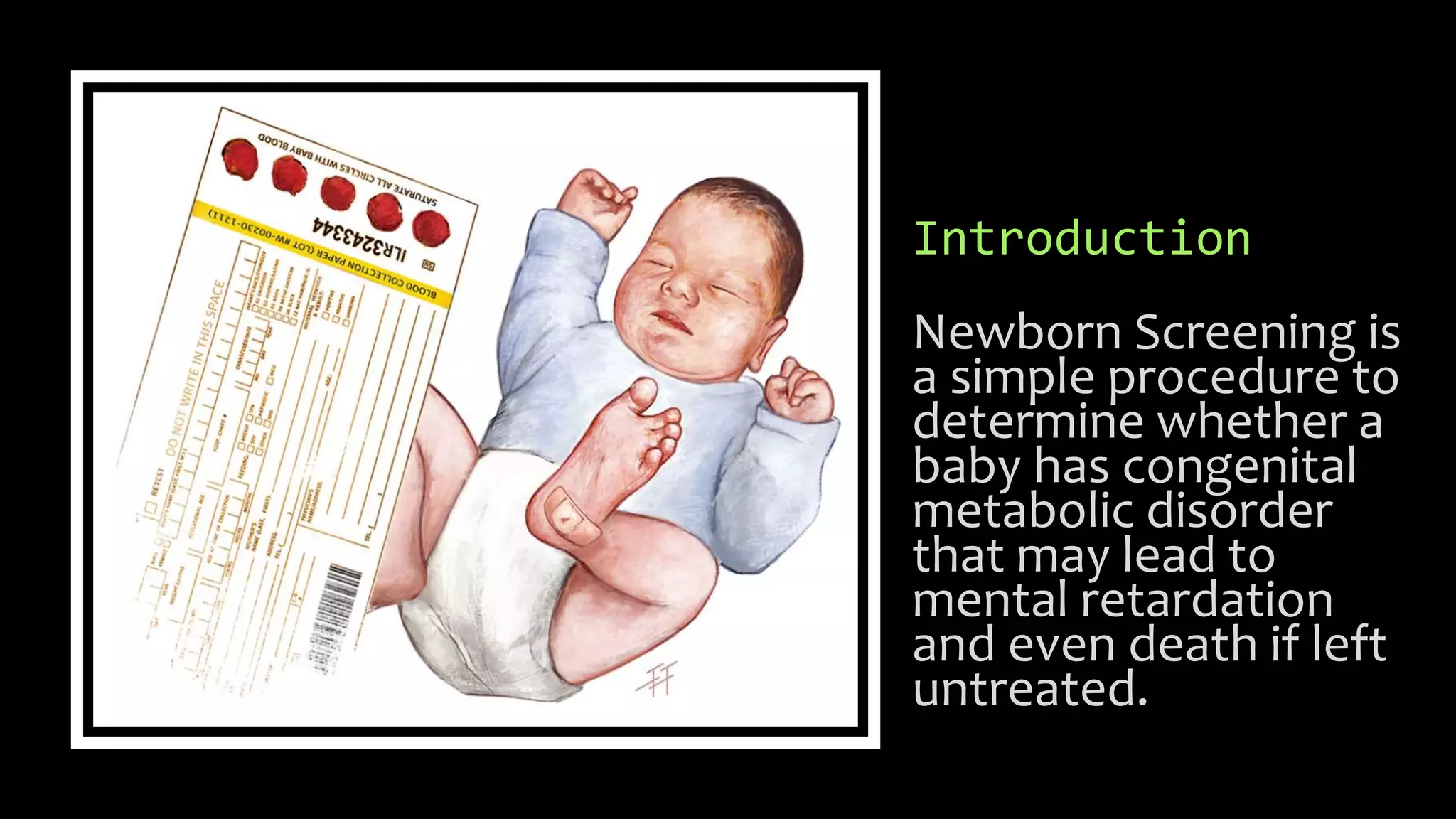
Newborn Screening is
a simple procedure to
determine whether a
baby has congenital
metabolic disorder
that may lead to
mental retardation
and even death if left
untreated.
Disorders included
• Congenital hypothyroidism (CH)
• Congenital adrenal hyperplasia (CAH)
• Galactosemia (GA)
• Phenylketonuria (PKA)
• Glucose-6-phosphate dehydrogenase deficiency (G6PD
def)
Congenital hypothyroidism
• Deficiency in the production of thyroid hormone
• Prevalence: 1:3,350
• Poor growth, mental retardation, deafness and
neurological abnormalities can result without prompt
identification and treatment.
• Early diagnosis and adequate treatment with
thyroxine within the first weeks of life results in
normal growth and intelligence.
Congenital adrenal
hyperplasia
A group of inherited disorders caused
by abnormalities in specific enzymes of
the adrenal gland
Ninety percent of congenital adrenal
hyperplasia cases are caused by the
lack of the enzyme steroid 21-
hydroxylase
Prevalence: 1:13,500
Babies with untreated congenital
adrenal hyperplasia may develop
vomiting and severe dehydration
(aldosterone deficient, salt-wasting
CAH), which can be life threatening
Increased production of androgens can
result in ambiguous genitalia in infants
Phenylketonuria
Autosomal recessive disorder caused by the lack
of phenylalanine hydroxylase, the enzyme that
converts the amino acid phenylalanine to tyrosine
Prevalence: 1:20,000
Without early diagnosis and strict adherence to a
special diet, brain damage and mental retardation
can occur
Phenylalanine is present in almost all foods
Galactosemia
Autosomal recessive disorder
Primary form is a deficiency of GALT
galactose-1-phosphate uridyl
transferase
enzyme needed to break down
the milk sugar lactose
Prevalence: 1:60,000
Life-threatening galactosemia, mental
retardation,and blindness can occur
Clinical symptoms may present as early as
the first week of life.
G6PD: GLUCOSE-6-
PHOSPHATE
DEHYDROGENASE
G6PD deficiency is a genetic disorder that most often
affects males. It happens when the body doesn't have
enough of an enzyme called glucose-6-phosphate
dehydrogenase (G6PD).
G6PD helps red blood cells work. It also protects them
from substances in the blood that could harm them.
In people with G6PD deficiency, either the red blood
cells do not make enough G6PD or what they do make
doesn't work as it should. Without enough G6PD to
protect them, the red blood cells break apart. This is
called hemolysis (hih-MOL-ih-sis). When many red
blood cells are destroyed, a person can
develop hemolytic (hee-meh-LIH-tik) anemia.
This can cause tiredness, dizziness, and other
symptoms.
Red blood cells that don't have enough G6PD are
sensitive to some medicines, foods, and infections.
When these things trigger a quick loss of red blood
cells over a short time, it's called a hemolytic crisis. In
these cases, the symptoms stop when the cause is
gone. In rare cases, G6PD deficiency leads
to chronic anemia regardless of exposure to triggers.
• Newborn screening is done on the 48 hours or at least 24 hours from
birth.
• The baby must be screened again after 2 weeks for more accurate
result.
• A physician, medical technologist, nurse, a midwife can collect sample
for newborn screening.
• A few drops of blood are obtained from the baby’s heel and blotted on a
special absorbent filter card.
Republic Act no. 9288
•An Act promulgating a
comprehensive policy and a
national system for ensuring
newborn screening.
Article 1: General Provision
• Section 1: Short Title:
• “Newborn Screening Act of 2004”
• Section 2: Declaration of Policy
• The state shall protect and promote the right to health of the
people, including the rights of children to survival and full and
healthy development as normal individuals.
• The state shall institutionalize a national newborn screening
system that is comprehensive, integrative, and sustainable and
will facilitate collaboration among government and non-
government agencies at the national and local levels, the
private sector, families and communities, professional health
organizations, academic institutions, and NGOs
• The national newborn screening shall ensure that every baby born in the
Philippines is offered the opportunity to undergo newborn screening
and thus be spared from heritable conditions that can lead to mental
retardation and death if undetected and untreated.
Article 1: General Provisions
• Section 3: Objectives:
• Ensure that every newborn has access to newborn screening for certain
heritable conditions that can result in mental retardation, serious health
complications or death if left undetected and untreated.
• Establish and integrate a sustainable newborn screening system within the
public health delivery system.
• Ensure that all health practitioners are aware of the advantages of newborn
screening and of their respective responsibilities in offering newborns the
opportunity to undergo newborn screening.
Article 1: General Provision
• Section 3: Objectives:
• Ensure that parents recognize their responsibility in promoting their child’s
right to health and full development, within the context of responsible
parenthood, by protecting their child from preventable causes of disability
and death through newborn screening.
Article 2: Definition of Terms
• Comprehensive Newborn Screening System:
• Education of relevant stakeholders
• Collection and biochemical screening of blood
• Tracking and confirmatory testing
• Clinical evaluation and biochemical/medical confirmation of test results
• Drugs and medical/surgical management and dietary supplementation to
address the heritable conditions
• Evaluation of activities to assess long term outcome
• Patient outcome and quality assurance.
Article 2: Definition of Terms
• Follow-up:
• Monitoring of a newborn
• Health Institutions:
• Hospital, health infirmaries, health centers, lying-in centers, puericulture
centers (public or private)
• Health care practitioners:
• Physicians, nurses, midwives, nursing aides, and traditional birth attendants.
• Heritable condition:
• Condition that can result in mental retardation, physical deformity or death.
Article 2: Definition of Terms
• NIH: National Institute of Health
• Newborn:
• Means a child from the time of complete delivery to 30 days old.
• Newborn screening:
• Process of collecting a few drops of blood from the newborn onto an
appropriate collection card and performing biochemical testing for
determining if the newborn has a heritable condition.
Article 2: Definition of Terms
• Newborn Screening Center:
• Facility equipped with a newborn screening laboratory that complies with
the standards.
• Newborn Screening Reference Center:
• Central facility at the NIH that defines testing and follow up protocols,
maintains an external laboratory proficiencies and national database.
• Parent Education:
• Various means of providing parents or legal guardians information
• Recall:
• Procedure of locating a newborn
Article 2: Definition of Terms
• Treatment:
• The provision of prompt, appropriate and adequate medicine, medical and
surgical management or dietary prescription to a newborn for purposes of
treating or mitigating the adverse health consequences.
Article 3: Newborn screening
• Section 5: Obligation to inform
• Health practitioner informs the parents or legal guardian of the newborn of
the availability, nature and benefits of newborn screening.
• Education and notification – responsibility of the DOH.
• Section 6: Performance of Newborn Screening
• Shall be performed after 24 hours of life but not later than 3 days from
complete delivery of the newborn
Article 3: Newborn screening
• Section 6: Performance. . . (cont.)
• Newborn in the ICU – may be exempted from the 3-day requirement but
must be tested by 7 days of age.
• Shall be the joint responsibility of the parent(s) and the practitioner or other
person delivering the newborn to ensure that newborn screening is
performed.
• Section 7: Refusal to be Tested
• A parent or legal guardian may refuse testing on the grounds of religious
beliefs, but shall acknowledge in writing their newborn at risk for
undiagnosed heritable conditions.
Article 3: Newborn Screening
• Section 7: (Refusal . . . Cont.)
• A copy of this refusal documentation shall be made part of the newborn’s
medical record and refusal shall be indicated in the national newborn
screening database.
• Section 8: Continuing Education, Re-education and Training Health
Personnel
• DOH with the assistance of the NIH
• conduct continuing information, education, re-education, and training
programs for health personnel on the rationale, benefits, procedures of
newborn screening.
Article 3: Newborn Screening
• Section 8: Continuing Education, Re-education and Training Health
Personnel (cont.)
• Disseminate information materials on newborn screening at least annually to
all health personnel involved in maternal and pediatric care.
• Section 9: Licensing and Accreditation
• DOH and the Phil Health Insurance Corporation (PHIC) shall require health
institutions to provide newborn screening services as a condition for
licensure or accreditation.
Article 4: Implementation
• Section 10: Lead Agency
• DOH
• Establish the advisory committee on newborn screening
• Develop the implementing rules and regulations for the immediate
implementation of a nationwide newborn screening program within one
hundred eight (108) days from the enactment of this Act.
• Coordinate with the department of the interior and local government (DILG)
for the implementation of the NBS programs.
Article 4: Implementation
• Section 10: Lead Agency
• Lead Agency: DOH
• Advisory Committee on Newborn Screening
• Coordinate with the NIH NBS Reference Center for the accreditation of
Newborn screening centers and preparation of defined testing protocols
and quality assurance programs.
• Coordinate with DILG for implementation of the NBS program.
Article 4: Implementation
• Section 11: Advisory Committee on Newborn Screening
• Ensure sustained inter-agency collaboration
• Integral part of the office of the secretary of the DOH
• Review annually and recommend conditions to be included in the newborn
screening panel of disorders
• Review and recommend the newborn screening fee.
Article 4: Implementation
• Section 11:
• Committee: 8 members:
• Chairman: Secretary of the DOH
• Executive director of the NIH, who shall act as Vice Chairman
• Undersecretary of the DILG
• Executive Director of the Council for the Welfare of Children
• Director of the Newborn Screening Reference Centers
• 3 representatives appointed by the Secretary of Health (pediatrician, obstetrician,
endrocrinologist, family physician, nurse or midwife) – term: 3 years subject for
reappointment for another 3 years.
• NIH: secretariat of the committee
Article 4: Implementation
• Section 12: Establishment and Accreditation of Newborn Screening
Centers
• Strategically located and accessible
• Certified laboratory performing all tests included in the newborn screening
program
• recall/follow up programs for infants found positive for any and all of the
heritable conditions.
• Be supervised and staffed by trained personnel who have been duly qualified
by the NIH
• Submit to periodic announced and unannounced inspections by the
Reference center.
Article 4: Implementation
• Section 13: Establishment of a Newborn Screening Reference Center
• NIH shall establish a NBS Reference Center
• National testing database
• Case registries, training, technical assistance
• Continuing education for laboratory staff
Section 4: Implementation
• Section 14: Quality Assurance
• NIH:
• Responsible for drafting and ensuring good laboratory practice standards for
newborn screening centers
• Establish an external laboratory proficiency testing and certification program
• Principal repository of technical information relating to newborn screening
standards and practices
• Technical assistance to newborn screening centers needing such assistance.
Article 4: Implementation
• Section 15: Database
• NBS Reference center shall maintain a national database of patients tested
and a registry for each condition.
• NBS Reference center shall submit reports annually to the committee and to
the DOH on the status of an relevant information derived from the database
Article 4: Implementation
• Section 16: Newborn Screening Fees
• Testing costs
• Education
• Sample transport
• Follow-up cost
• Reasonable overhead expenses
Article 5: Final Provisions
• Section 17: Repealing Clause
• Section 18: Separability Clause
• Section 19: Effectivity

Newborn screening laboratory laws

  • 1.
  • 2.
    Introduction Newborn Screening is asimple procedure to determine whether a baby has congenital metabolic disorder that may lead to mental retardation and even death if left untreated.
  • 3.
    Disorders included • Congenitalhypothyroidism (CH) • Congenital adrenal hyperplasia (CAH) • Galactosemia (GA) • Phenylketonuria (PKA) • Glucose-6-phosphate dehydrogenase deficiency (G6PD def)
  • 4.
    Congenital hypothyroidism • Deficiencyin the production of thyroid hormone • Prevalence: 1:3,350 • Poor growth, mental retardation, deafness and neurological abnormalities can result without prompt identification and treatment. • Early diagnosis and adequate treatment with thyroxine within the first weeks of life results in normal growth and intelligence.
  • 5.
    Congenital adrenal hyperplasia A groupof inherited disorders caused by abnormalities in specific enzymes of the adrenal gland Ninety percent of congenital adrenal hyperplasia cases are caused by the lack of the enzyme steroid 21- hydroxylase Prevalence: 1:13,500 Babies with untreated congenital adrenal hyperplasia may develop vomiting and severe dehydration (aldosterone deficient, salt-wasting CAH), which can be life threatening Increased production of androgens can result in ambiguous genitalia in infants
  • 7.
    Phenylketonuria Autosomal recessive disordercaused by the lack of phenylalanine hydroxylase, the enzyme that converts the amino acid phenylalanine to tyrosine Prevalence: 1:20,000 Without early diagnosis and strict adherence to a special diet, brain damage and mental retardation can occur Phenylalanine is present in almost all foods
  • 8.
    Galactosemia Autosomal recessive disorder Primaryform is a deficiency of GALT galactose-1-phosphate uridyl transferase enzyme needed to break down the milk sugar lactose Prevalence: 1:60,000 Life-threatening galactosemia, mental retardation,and blindness can occur Clinical symptoms may present as early as the first week of life.
  • 10.
    G6PD: GLUCOSE-6- PHOSPHATE DEHYDROGENASE G6PD deficiencyis a genetic disorder that most often affects males. It happens when the body doesn't have enough of an enzyme called glucose-6-phosphate dehydrogenase (G6PD). G6PD helps red blood cells work. It also protects them from substances in the blood that could harm them. In people with G6PD deficiency, either the red blood cells do not make enough G6PD or what they do make doesn't work as it should. Without enough G6PD to protect them, the red blood cells break apart. This is called hemolysis (hih-MOL-ih-sis). When many red blood cells are destroyed, a person can develop hemolytic (hee-meh-LIH-tik) anemia. This can cause tiredness, dizziness, and other symptoms. Red blood cells that don't have enough G6PD are sensitive to some medicines, foods, and infections. When these things trigger a quick loss of red blood cells over a short time, it's called a hemolytic crisis. In these cases, the symptoms stop when the cause is gone. In rare cases, G6PD deficiency leads to chronic anemia regardless of exposure to triggers.
  • 12.
    • Newborn screeningis done on the 48 hours or at least 24 hours from birth. • The baby must be screened again after 2 weeks for more accurate result. • A physician, medical technologist, nurse, a midwife can collect sample for newborn screening. • A few drops of blood are obtained from the baby’s heel and blotted on a special absorbent filter card.
  • 13.
    Republic Act no.9288 •An Act promulgating a comprehensive policy and a national system for ensuring newborn screening.
  • 14.
    Article 1: GeneralProvision • Section 1: Short Title: • “Newborn Screening Act of 2004” • Section 2: Declaration of Policy • The state shall protect and promote the right to health of the people, including the rights of children to survival and full and healthy development as normal individuals. • The state shall institutionalize a national newborn screening system that is comprehensive, integrative, and sustainable and will facilitate collaboration among government and non- government agencies at the national and local levels, the private sector, families and communities, professional health organizations, academic institutions, and NGOs
  • 15.
    • The nationalnewborn screening shall ensure that every baby born in the Philippines is offered the opportunity to undergo newborn screening and thus be spared from heritable conditions that can lead to mental retardation and death if undetected and untreated.
  • 16.
    Article 1: GeneralProvisions • Section 3: Objectives: • Ensure that every newborn has access to newborn screening for certain heritable conditions that can result in mental retardation, serious health complications or death if left undetected and untreated. • Establish and integrate a sustainable newborn screening system within the public health delivery system. • Ensure that all health practitioners are aware of the advantages of newborn screening and of their respective responsibilities in offering newborns the opportunity to undergo newborn screening.
  • 17.
    Article 1: GeneralProvision • Section 3: Objectives: • Ensure that parents recognize their responsibility in promoting their child’s right to health and full development, within the context of responsible parenthood, by protecting their child from preventable causes of disability and death through newborn screening.
  • 18.
    Article 2: Definitionof Terms • Comprehensive Newborn Screening System: • Education of relevant stakeholders • Collection and biochemical screening of blood • Tracking and confirmatory testing • Clinical evaluation and biochemical/medical confirmation of test results • Drugs and medical/surgical management and dietary supplementation to address the heritable conditions • Evaluation of activities to assess long term outcome • Patient outcome and quality assurance.
  • 19.
    Article 2: Definitionof Terms • Follow-up: • Monitoring of a newborn • Health Institutions: • Hospital, health infirmaries, health centers, lying-in centers, puericulture centers (public or private) • Health care practitioners: • Physicians, nurses, midwives, nursing aides, and traditional birth attendants. • Heritable condition: • Condition that can result in mental retardation, physical deformity or death.
  • 20.
    Article 2: Definitionof Terms • NIH: National Institute of Health • Newborn: • Means a child from the time of complete delivery to 30 days old. • Newborn screening: • Process of collecting a few drops of blood from the newborn onto an appropriate collection card and performing biochemical testing for determining if the newborn has a heritable condition.
  • 21.
    Article 2: Definitionof Terms • Newborn Screening Center: • Facility equipped with a newborn screening laboratory that complies with the standards. • Newborn Screening Reference Center: • Central facility at the NIH that defines testing and follow up protocols, maintains an external laboratory proficiencies and national database. • Parent Education: • Various means of providing parents or legal guardians information • Recall: • Procedure of locating a newborn
  • 22.
    Article 2: Definitionof Terms • Treatment: • The provision of prompt, appropriate and adequate medicine, medical and surgical management or dietary prescription to a newborn for purposes of treating or mitigating the adverse health consequences.
  • 23.
    Article 3: Newbornscreening • Section 5: Obligation to inform • Health practitioner informs the parents or legal guardian of the newborn of the availability, nature and benefits of newborn screening. • Education and notification – responsibility of the DOH. • Section 6: Performance of Newborn Screening • Shall be performed after 24 hours of life but not later than 3 days from complete delivery of the newborn
  • 24.
    Article 3: Newbornscreening • Section 6: Performance. . . (cont.) • Newborn in the ICU – may be exempted from the 3-day requirement but must be tested by 7 days of age. • Shall be the joint responsibility of the parent(s) and the practitioner or other person delivering the newborn to ensure that newborn screening is performed. • Section 7: Refusal to be Tested • A parent or legal guardian may refuse testing on the grounds of religious beliefs, but shall acknowledge in writing their newborn at risk for undiagnosed heritable conditions.
  • 25.
    Article 3: NewbornScreening • Section 7: (Refusal . . . Cont.) • A copy of this refusal documentation shall be made part of the newborn’s medical record and refusal shall be indicated in the national newborn screening database. • Section 8: Continuing Education, Re-education and Training Health Personnel • DOH with the assistance of the NIH • conduct continuing information, education, re-education, and training programs for health personnel on the rationale, benefits, procedures of newborn screening.
  • 26.
    Article 3: NewbornScreening • Section 8: Continuing Education, Re-education and Training Health Personnel (cont.) • Disseminate information materials on newborn screening at least annually to all health personnel involved in maternal and pediatric care. • Section 9: Licensing and Accreditation • DOH and the Phil Health Insurance Corporation (PHIC) shall require health institutions to provide newborn screening services as a condition for licensure or accreditation.
  • 27.
    Article 4: Implementation •Section 10: Lead Agency • DOH • Establish the advisory committee on newborn screening • Develop the implementing rules and regulations for the immediate implementation of a nationwide newborn screening program within one hundred eight (108) days from the enactment of this Act. • Coordinate with the department of the interior and local government (DILG) for the implementation of the NBS programs.
  • 28.
    Article 4: Implementation •Section 10: Lead Agency • Lead Agency: DOH • Advisory Committee on Newborn Screening • Coordinate with the NIH NBS Reference Center for the accreditation of Newborn screening centers and preparation of defined testing protocols and quality assurance programs. • Coordinate with DILG for implementation of the NBS program.
  • 29.
    Article 4: Implementation •Section 11: Advisory Committee on Newborn Screening • Ensure sustained inter-agency collaboration • Integral part of the office of the secretary of the DOH • Review annually and recommend conditions to be included in the newborn screening panel of disorders • Review and recommend the newborn screening fee.
  • 30.
    Article 4: Implementation •Section 11: • Committee: 8 members: • Chairman: Secretary of the DOH • Executive director of the NIH, who shall act as Vice Chairman • Undersecretary of the DILG • Executive Director of the Council for the Welfare of Children • Director of the Newborn Screening Reference Centers • 3 representatives appointed by the Secretary of Health (pediatrician, obstetrician, endrocrinologist, family physician, nurse or midwife) – term: 3 years subject for reappointment for another 3 years. • NIH: secretariat of the committee
  • 31.
    Article 4: Implementation •Section 12: Establishment and Accreditation of Newborn Screening Centers • Strategically located and accessible • Certified laboratory performing all tests included in the newborn screening program • recall/follow up programs for infants found positive for any and all of the heritable conditions. • Be supervised and staffed by trained personnel who have been duly qualified by the NIH • Submit to periodic announced and unannounced inspections by the Reference center.
  • 32.
    Article 4: Implementation •Section 13: Establishment of a Newborn Screening Reference Center • NIH shall establish a NBS Reference Center • National testing database • Case registries, training, technical assistance • Continuing education for laboratory staff
  • 33.
    Section 4: Implementation •Section 14: Quality Assurance • NIH: • Responsible for drafting and ensuring good laboratory practice standards for newborn screening centers • Establish an external laboratory proficiency testing and certification program • Principal repository of technical information relating to newborn screening standards and practices • Technical assistance to newborn screening centers needing such assistance.
  • 34.
    Article 4: Implementation •Section 15: Database • NBS Reference center shall maintain a national database of patients tested and a registry for each condition. • NBS Reference center shall submit reports annually to the committee and to the DOH on the status of an relevant information derived from the database
  • 35.
    Article 4: Implementation •Section 16: Newborn Screening Fees • Testing costs • Education • Sample transport • Follow-up cost • Reasonable overhead expenses
  • 36.
    Article 5: FinalProvisions • Section 17: Repealing Clause • Section 18: Separability Clause • Section 19: Effectivity

Editor's Notes

  • #8 9. What congenital disorder have the highest incident rate among filipino newborn
  • #9 9. What congenital disorder have the highest incident rate among filipino newborn 10. Enzyme deficient to galactosemia
  • #14 11. Ra of newborn screening
  • #15 12. Title of RA 9288
  • #24 13. When to performed the newborn screening
  • #27 14. Government agency responsible for the licensing and accreditation for health institution who provide newborn screeening
  • #31 15 who is the chairman of committee for NBS