The Philippines
of Rizal's Times
Prepared by:
Cherry Claire Allocod
During the times of Rizal, the

sinister shadows of Spain’s
decadence darkened the Philippine
Skies.
11 Evil Colonial Power
EVILS OF SPANISH RULES IN THE PHILIPPINES
1. Instability of Colonial Administration
King Ferdinand VIII (1808 – 1833) Frequent shift of
policies owing to struggle between Liberalism and
Despotism; From 1835- 1897 there were 50 Governors
General.
1. Corrupt Colonial Officials
a.Gen. Rafael de Isquerdo (1875-1883)
incompetent and cruel, boastful, ruthless, executed
GOMBURZA in 1872.
b.Gen. Primo de Rivera – accepted bribes from gambling
casino which he permitted to operate.
2. Corrupt Colonial Officials
 Gen. Rafael de Isquerdo - incompetent and
cruel, boastful, ruthless, executed GOMBURZA
in 1872.
 Admiral Jose Malcampo - successor of
Izquierdo who was a good Moro fighter but was
an inept and weak administrator.
1874
•Admiral Jose
Malcampo
becomes
governor-general
TIMELINE: The Philippines of Rizal’s Times
1880
• General
Fernando Primo
de Rivera
becomes
Governor
General
TIMELINE: The Philippines of Rizal’s Times
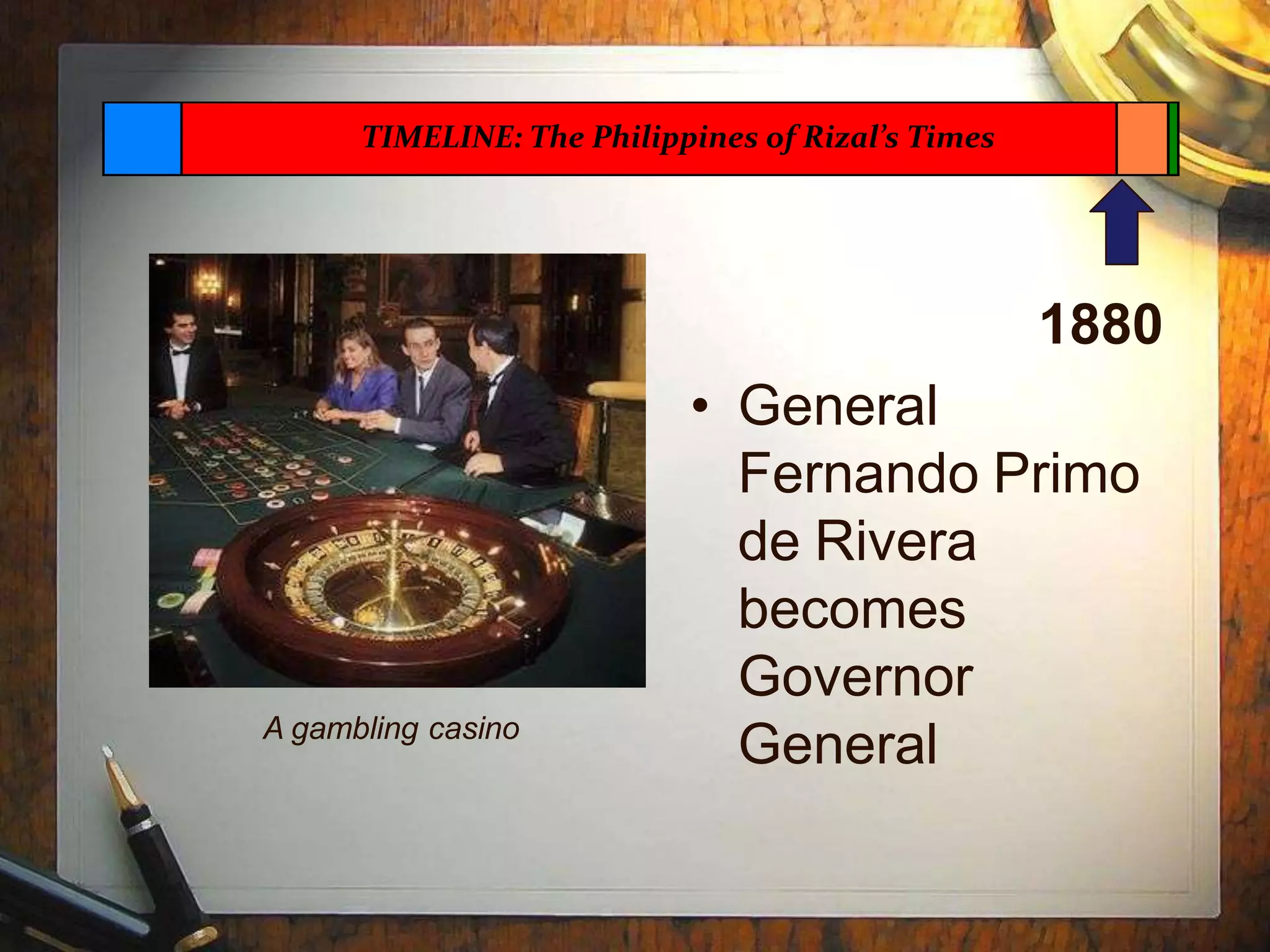
A gambling casino
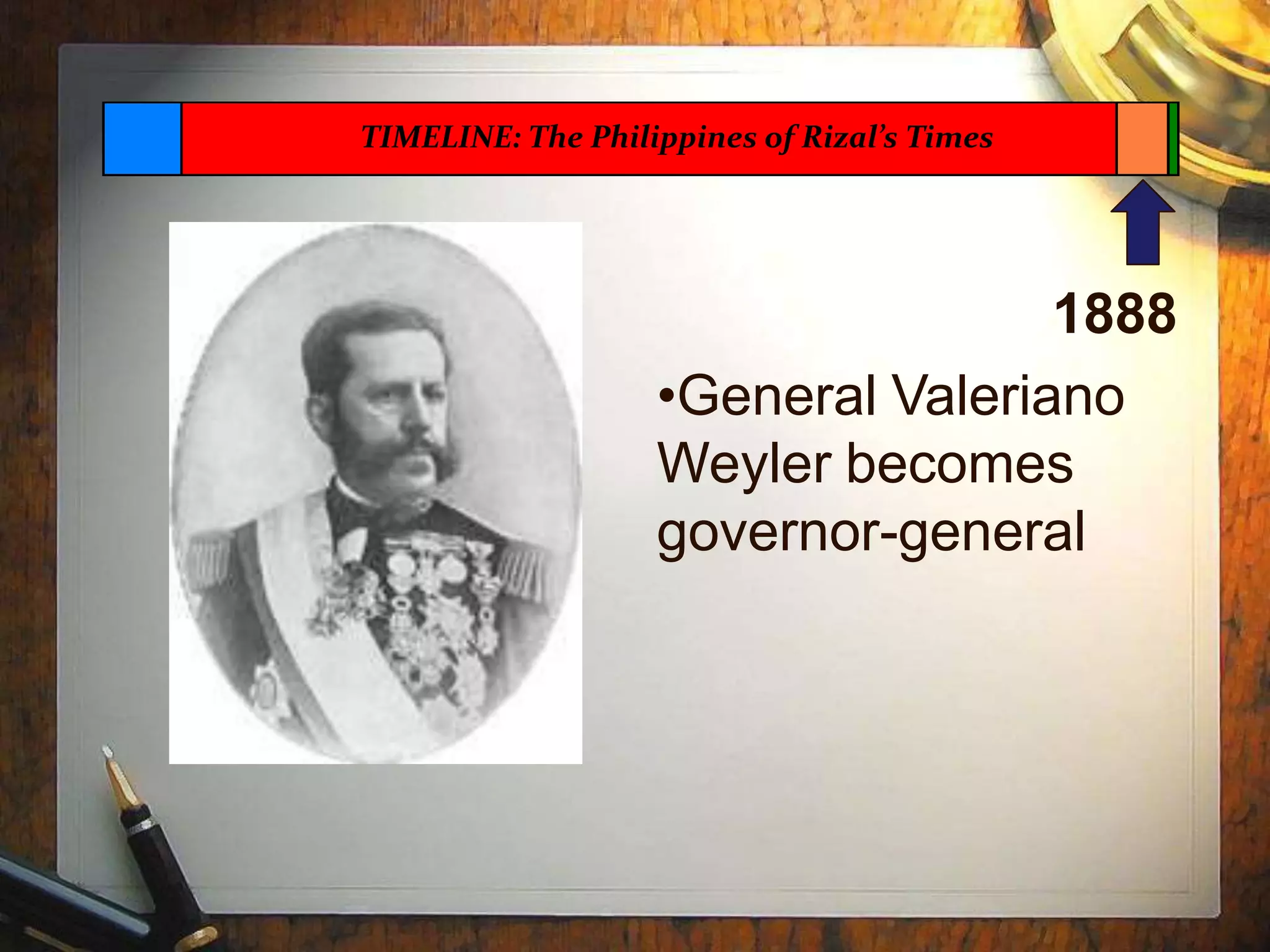
1888
•General Valeriano
Weyler becomes
governor-general
TIMELINE: The Philippines of Rizal’s Times
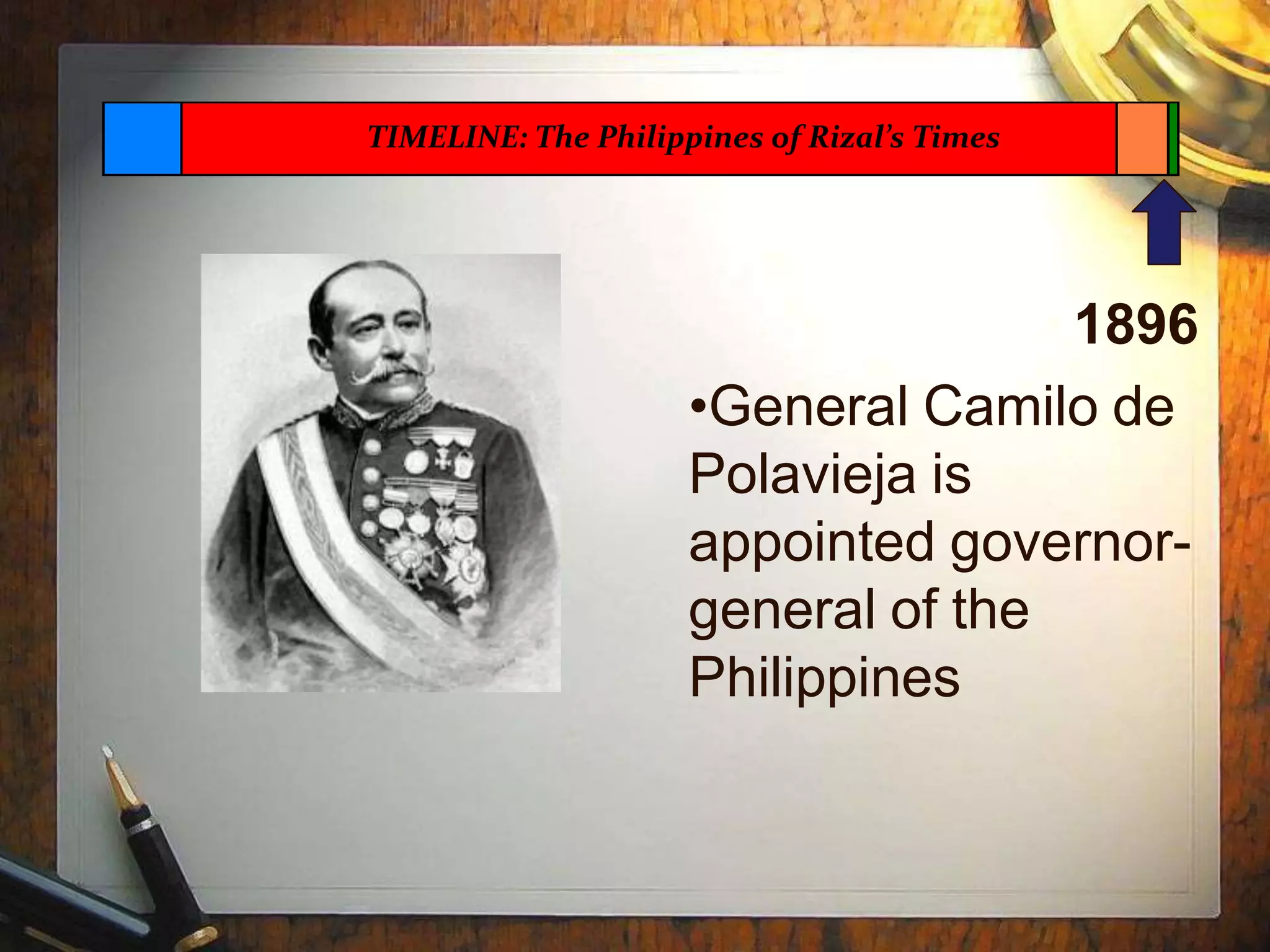
1896
•General Camilo de
Polavieja is
appointed governor-
general of the
Philippines
TIMELINE: The Philippines of Rizal’s Times
1897
•General Primo de
Rivera begins his
second term as
governor-general
TIMELINE: The Philippines of Rizal’s Times
 Gen. Primo de Rivera – accepted bribes from
gambling casino which he permitted to
operate.
 Gen. Valeriano Weyler (1888-1891) – cruel
and corrupt; received huge bribes, gifts and
diamonds from wealthy Chinese who evaded
anti-Chinese law; persecuted Calamba
tenants particularly the family of Dr. Jose
Rizal.
 Gen. Camilo de Polavieja – heartless
givernor; executed Dr. Jose Rizal.
3. No Philippine Representation in Spanish Cortes
The representation of the overseas colonies in the
Spanish Cortes was abolished in 1837. Since then the
Philippines condition worsened because there was no
means by which the Filipino people could expose the
anomalies perpetrated by the colonial officials.
Philippine representation in the Cortes was never
restored.
1810
• Filipinos gain
representation in the
Spanish Cortes
Delegate Ventura de Los Reyes
TIMELINE: The Philippines of Rizal’s Times
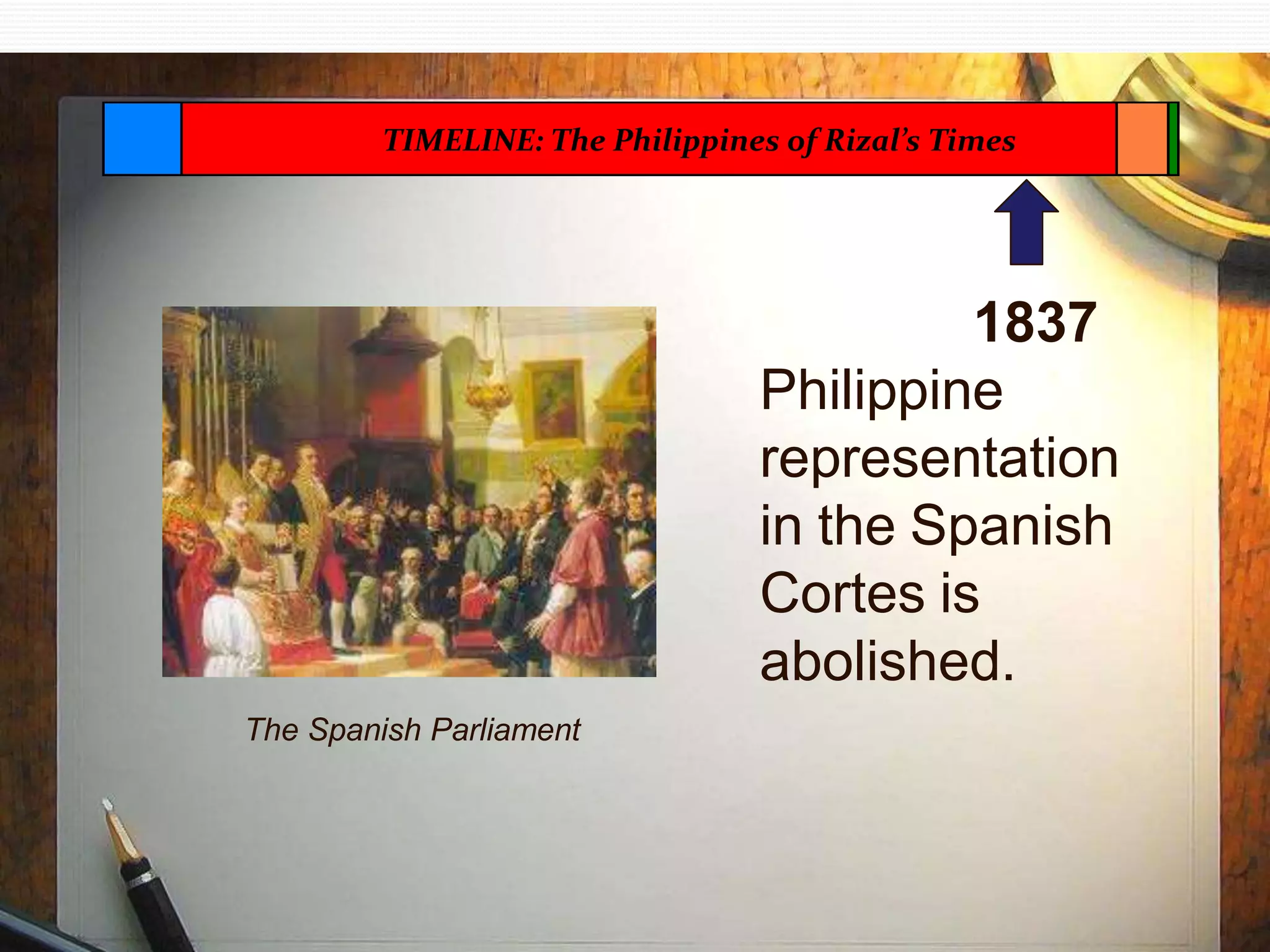
1837
Philippine
representation
in the Spanish
Cortes is
abolished.
TIMELINE: The Philippines of Rizal’s Times
The Spanish Parliament
1876
•Puerto Rico and
Cuba regain
representation in
the Spanish Cortes
TIMELINE: The Philippines of Rizal’s Times
4. Human Rights Denied to Filipinos
 The people of Spain enjoyed freedom of speech,
freedom of the press, freedom of the association
and other human rights (except freedom of
religion). The Spanish authorities who
cherished these human rights or constitutional
liberties in Spain denied them to the Filipinos in
Asia.
4. HUMAN RIGHTS denied the Filipinos
- No freedom of expression
5. No Equality Before the Law
Filipinos were abused, brutalized, persecuted and slandered.
 Spanish missionaries thought that ALL MEN irrespective of
color and race are children of God and as such they are
brothers, equal before God and not before the law… not in
practice.
 Leyes de Indias (Laws of the Indies) rarely enforced.
 Spanish Civil Code imposed light penalties on Spaniards but
heavier penalties to native Filipinos.
6. Maladministration of Justice
 The courts of justice were notoriously corrupt.
Judges, fiscals and court officials were inept,
venal and oftentimes ignorant of law.
 Justice was costly, partial and slow. Poor
Filipinos has no access to the courts. To the
Filipino masses, litigation in court was a
calamity.
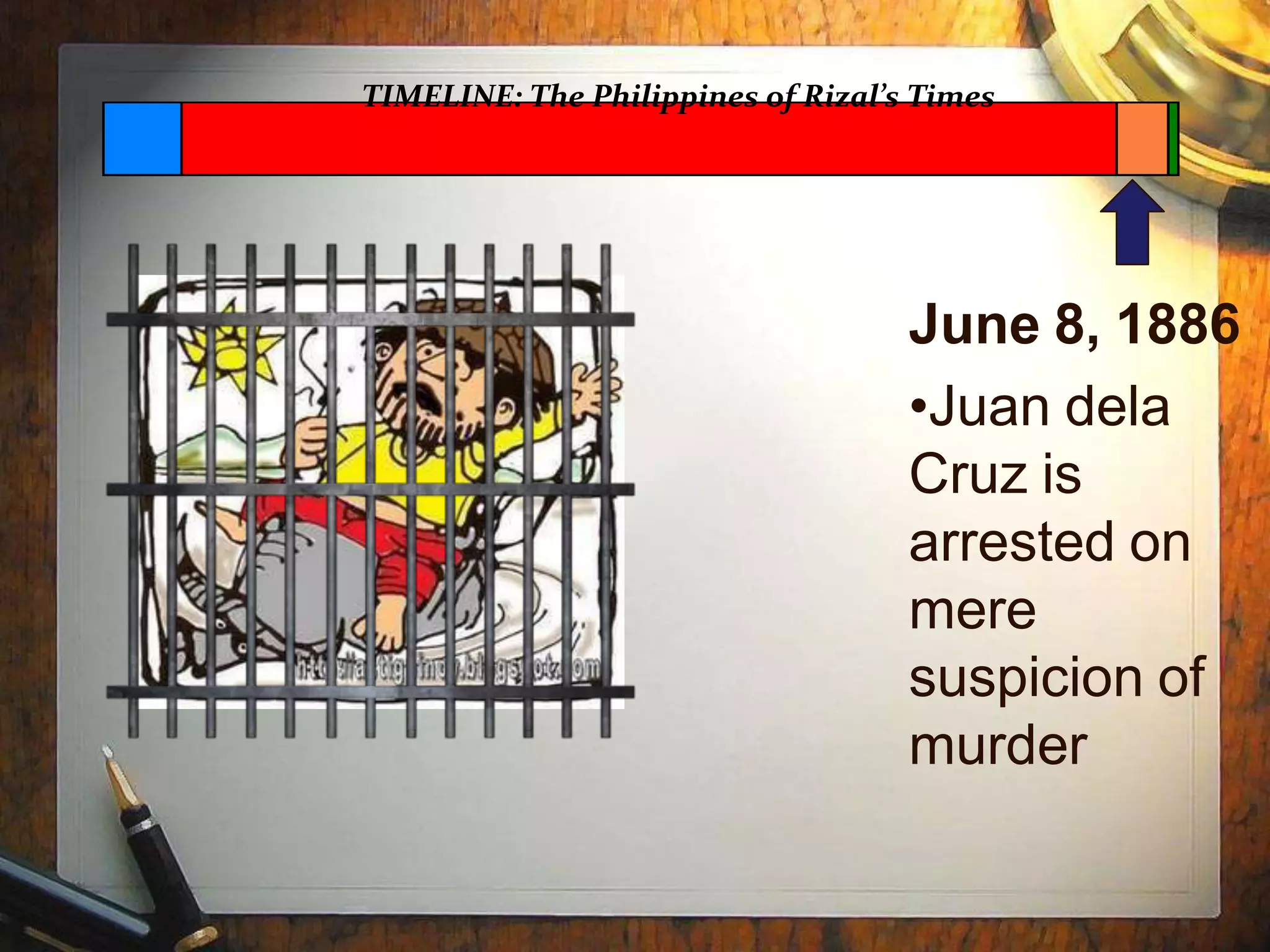
June 8, 1886
•Juan dela
Cruz is
arrested on
mere
suspicion of
murder
TIMELINE: The Philippines of Rizal’s Times
1872
•Execution of
GOMBURZA
TIMELINE: The Philippines of Rizal’s Times
December 30, 1896
Dr. Jose Rizal is
executed
TIMELINE: The Philippines of Rizal’s Times
“Listo!
Apuntar!
Fuego!”
7. Racial Discrimination
 Spain introduced Christianity’s egalitarian concept of
the BROTHERHOOD OF ALL MEN under GOD THE
FATHER, but Filipinos were regarded as inferior
beings undeserving of rights enjoyed by the
Spaniards.
 Spaniards derisively called brown-skinned and flat
nosed Filipinos “Indios” (Indians).
 Lack of opportunities for educated young Filipinos to
rise in the service of God and Country
8. Frailocracy
 Union of Church and state
 Friars (Augustinians, Dominicans and Franciscans) –
controlled the religious and educational life of the
Philippines and later in the 19th century they came to
acquire tremendous political power, influence and riches.
 Friars controlled government from governor general down
to alcaldes mayores;
 Friars exercise priestly duties, supervise elections,
inspector of books and taxes, arbiter of morals,
censor of books and comedias, superintendent of
public works and guardian of peace and order.
 Rizal, del Pilar, Jaena and other Filipino reformists
blamed frailocracy/friars for obscurantism,
fanaticism, and oppression in the country.
Three friars served as
governors-general:
Archbishops Francisco dela Cuesta, Manuel
Rojo del Rio and Juan Arrechedera
 Frailocracy had two faces.
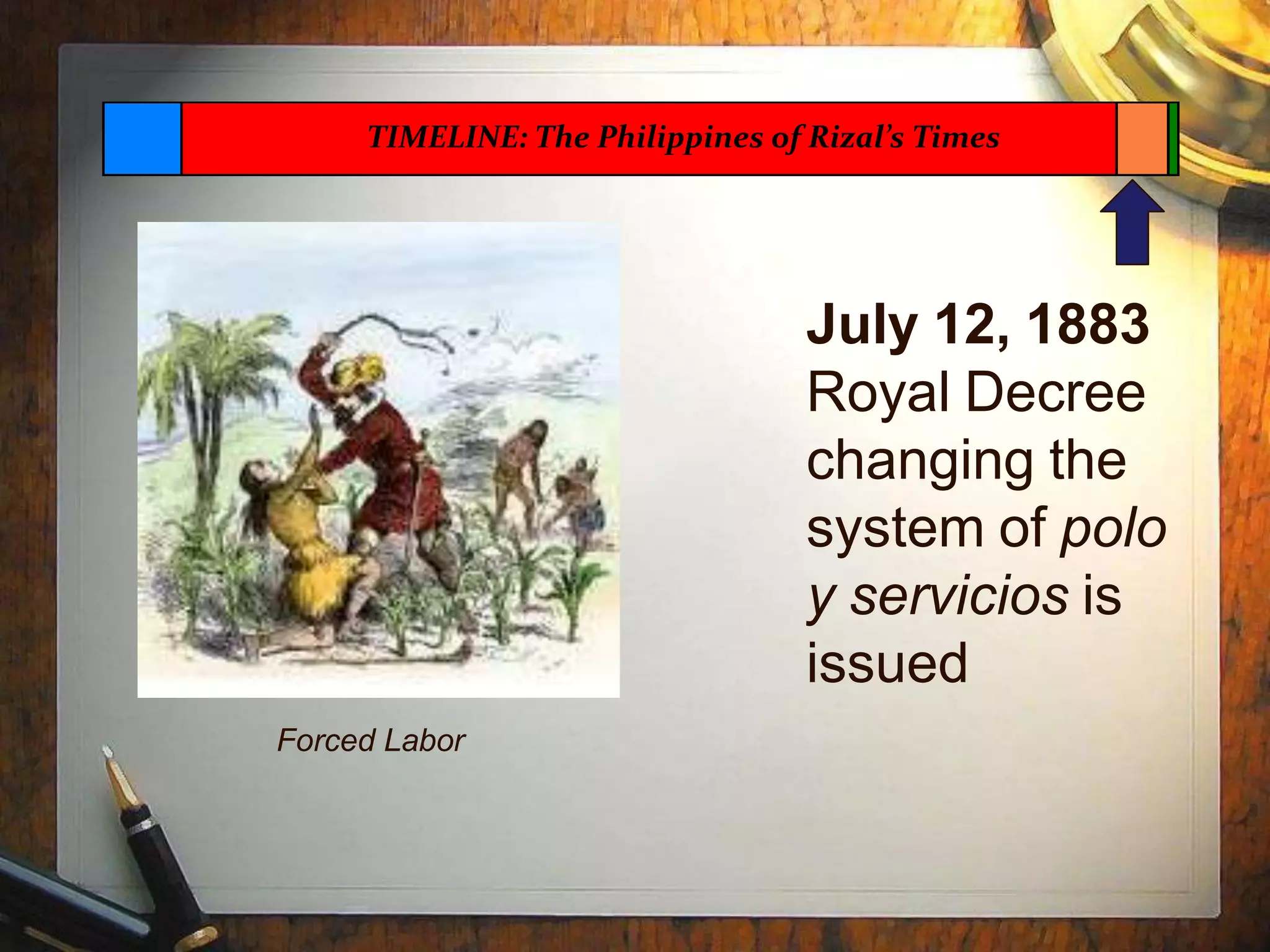
9. Forced Labor
(Polo y servicio) compulsory labor imposed by
the Spanish colonial authorities on adult Filipino
males in the construction of churches, schools,
hospitals, buildings, roads and bridges, ships etc.
Filipino males from 16 to 60 years old were
obliged to render forced labor for 40 days a year.
July 12, 1883
Royal Decree
changing the
system of polo
y servicios is
issued
TIMELINE: The Philippines of Rizal’s Times
Forced Labor
 Wealthy ones were able to evade forced labor by
paying falla, a sum of money.
 Spaniards were not drafted to forced labor,
contrary to law, while the Filipino polistas
received only a part of two pesetas (50 centavos)
or worse nothing at all.
 Disturbed the Indios’ work in the farm and
shops and separate them from their families.
10. Hacienda Owned by Friars
 Friars owned the best haciendas and the folks filling these
lands even before the coming of the Spaniards became tenants
– resulted in bloody agrarian upheaval in 1745-1746.
 Rizal tried to initiate agrarian reform in 1887 but in vain,
ignited the wrath of the Dominican Friars who retaliated by
raising land rentals.
 Rizal in his “Indolence of the Filipinos” in substance opined
that Friars ownership of best agricultural tract of land
contribute to the stagnation of economy
1768
•Governor Anda
recommends to
the Madrid
government the
sale of the friar
estates
TIMELINE: The Philippines of Rizal’s Times
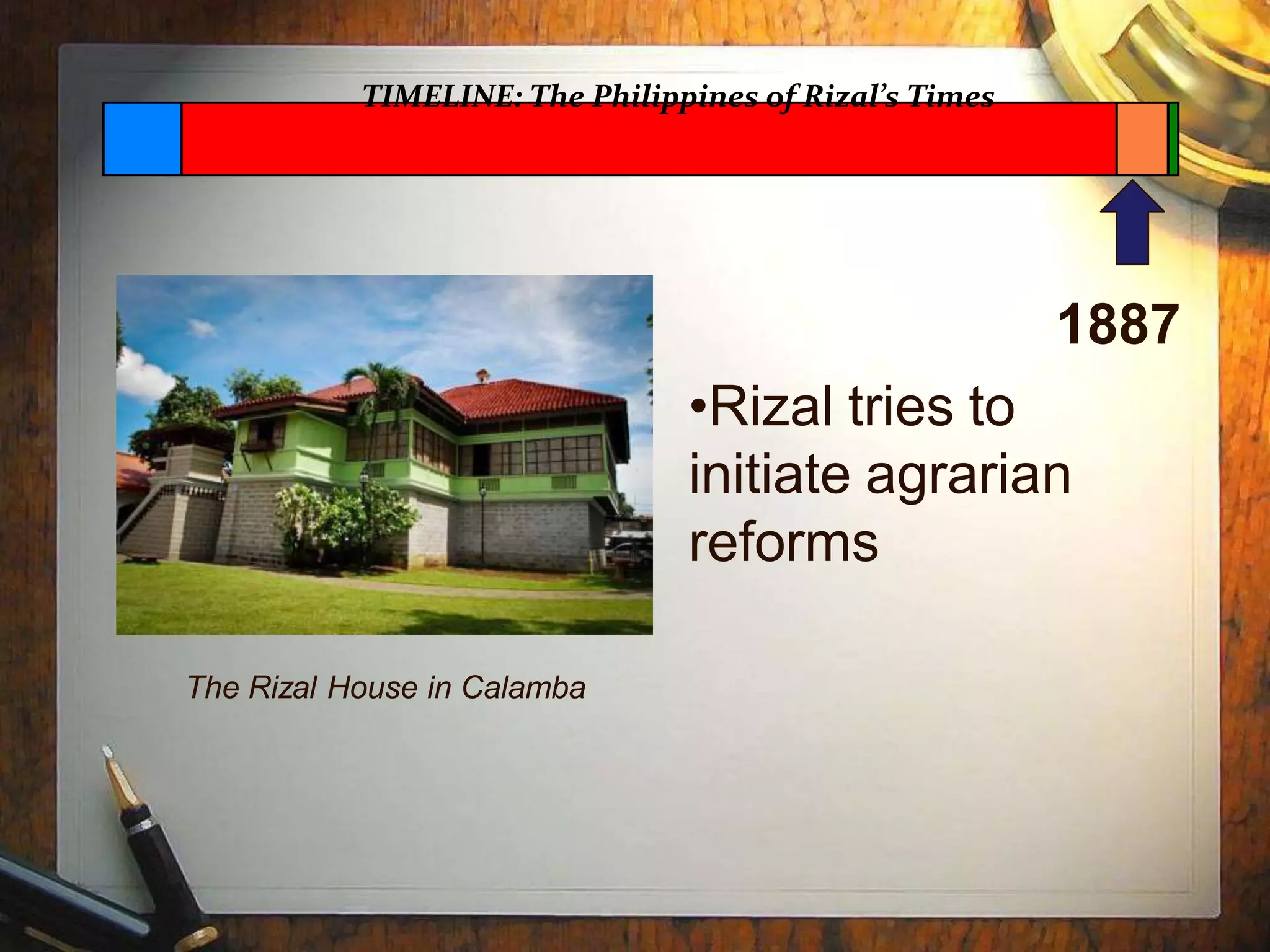
1887
•Rizal tries to
initiate agrarian
reforms
TIMELINE: The Philippines of Rizal’s Times
The Rizal House in Calamba
11. Guardia Civil – created by Royal Decree of February
12, 1852; Maltreatment, abuse, robbers, rapists.
 The purpose of maintaining internal peace and order in
the Philippines but later became infamous for their
rampant abuses.
 Both officers and men were ill-trained and
undisciplined.
 Rizal’s Noli exposed the guardia civil through Elias as
bunch of ruthless ruffians, good only for
disturbing the peace and persecuting
honest men.
February 12, 1852
Royal Decree
creating the
Guardia Civil is
promulgated
The Modern Guardia Civil
TIMELINE: The Philippines of Rizal’s Times
GE Rizal: The Philippines of Rizal's Time (11 Evil Colonial Power)

GE Rizal: The Philippines of Rizal's Time (11 Evil Colonial Power)

  • 1.
    The Philippines of Rizal'sTimes Prepared by: Cherry Claire Allocod
  • 2.
    During the timesof Rizal, the sinister shadows of Spain’s decadence darkened the Philippine Skies. 11 Evil Colonial Power
  • 3.
    EVILS OF SPANISHRULES IN THE PHILIPPINES 1. Instability of Colonial Administration King Ferdinand VIII (1808 – 1833) Frequent shift of policies owing to struggle between Liberalism and Despotism; From 1835- 1897 there were 50 Governors General.
  • 4.
    1. Corrupt ColonialOfficials a.Gen. Rafael de Isquerdo (1875-1883) incompetent and cruel, boastful, ruthless, executed GOMBURZA in 1872. b.Gen. Primo de Rivera – accepted bribes from gambling casino which he permitted to operate. 2. Corrupt Colonial Officials  Gen. Rafael de Isquerdo - incompetent and cruel, boastful, ruthless, executed GOMBURZA in 1872.  Admiral Jose Malcampo - successor of Izquierdo who was a good Moro fighter but was an inept and weak administrator.
  • 5.
  • 6.
    1880 • General Fernando Primo deRivera becomes Governor General TIMELINE: The Philippines of Rizal’s Times A gambling casino
  • 7.
  • 8.
    1896 •General Camilo de Polaviejais appointed governor- general of the Philippines TIMELINE: The Philippines of Rizal’s Times
  • 9.
    1897 •General Primo de Riverabegins his second term as governor-general TIMELINE: The Philippines of Rizal’s Times
  • 10.
     Gen. Primode Rivera – accepted bribes from gambling casino which he permitted to operate.  Gen. Valeriano Weyler (1888-1891) – cruel and corrupt; received huge bribes, gifts and diamonds from wealthy Chinese who evaded anti-Chinese law; persecuted Calamba tenants particularly the family of Dr. Jose Rizal.  Gen. Camilo de Polavieja – heartless givernor; executed Dr. Jose Rizal.
  • 11.
    3. No PhilippineRepresentation in Spanish Cortes The representation of the overseas colonies in the Spanish Cortes was abolished in 1837. Since then the Philippines condition worsened because there was no means by which the Filipino people could expose the anomalies perpetrated by the colonial officials. Philippine representation in the Cortes was never restored.
  • 12.
    1810 • Filipinos gain representationin the Spanish Cortes Delegate Ventura de Los Reyes TIMELINE: The Philippines of Rizal’s Times
  • 13.
    1837 Philippine representation in the Spanish Cortesis abolished. TIMELINE: The Philippines of Rizal’s Times The Spanish Parliament
  • 14.
    1876 •Puerto Rico and Cubaregain representation in the Spanish Cortes TIMELINE: The Philippines of Rizal’s Times
  • 15.
    4. Human RightsDenied to Filipinos  The people of Spain enjoyed freedom of speech, freedom of the press, freedom of the association and other human rights (except freedom of religion). The Spanish authorities who cherished these human rights or constitutional liberties in Spain denied them to the Filipinos in Asia.
  • 16.
    4. HUMAN RIGHTSdenied the Filipinos - No freedom of expression 5. No Equality Before the Law Filipinos were abused, brutalized, persecuted and slandered.  Spanish missionaries thought that ALL MEN irrespective of color and race are children of God and as such they are brothers, equal before God and not before the law… not in practice.  Leyes de Indias (Laws of the Indies) rarely enforced.  Spanish Civil Code imposed light penalties on Spaniards but heavier penalties to native Filipinos.
  • 17.
    6. Maladministration ofJustice  The courts of justice were notoriously corrupt. Judges, fiscals and court officials were inept, venal and oftentimes ignorant of law.  Justice was costly, partial and slow. Poor Filipinos has no access to the courts. To the Filipino masses, litigation in court was a calamity.
  • 18.
    June 8, 1886 •Juandela Cruz is arrested on mere suspicion of murder TIMELINE: The Philippines of Rizal’s Times
  • 19.
    1872 •Execution of GOMBURZA TIMELINE: ThePhilippines of Rizal’s Times
  • 20.
    December 30, 1896 Dr.Jose Rizal is executed TIMELINE: The Philippines of Rizal’s Times “Listo! Apuntar! Fuego!”
  • 21.
    7. Racial Discrimination Spain introduced Christianity’s egalitarian concept of the BROTHERHOOD OF ALL MEN under GOD THE FATHER, but Filipinos were regarded as inferior beings undeserving of rights enjoyed by the Spaniards.  Spaniards derisively called brown-skinned and flat nosed Filipinos “Indios” (Indians).  Lack of opportunities for educated young Filipinos to rise in the service of God and Country
  • 22.
    8. Frailocracy  Unionof Church and state  Friars (Augustinians, Dominicans and Franciscans) – controlled the religious and educational life of the Philippines and later in the 19th century they came to acquire tremendous political power, influence and riches.  Friars controlled government from governor general down to alcaldes mayores;
  • 23.
     Friars exercisepriestly duties, supervise elections, inspector of books and taxes, arbiter of morals, censor of books and comedias, superintendent of public works and guardian of peace and order.  Rizal, del Pilar, Jaena and other Filipino reformists blamed frailocracy/friars for obscurantism, fanaticism, and oppression in the country.
  • 24.
    Three friars servedas governors-general: Archbishops Francisco dela Cuesta, Manuel Rojo del Rio and Juan Arrechedera
  • 25.
  • 26.
    9. Forced Labor (Poloy servicio) compulsory labor imposed by the Spanish colonial authorities on adult Filipino males in the construction of churches, schools, hospitals, buildings, roads and bridges, ships etc. Filipino males from 16 to 60 years old were obliged to render forced labor for 40 days a year.
  • 27.
    July 12, 1883 RoyalDecree changing the system of polo y servicios is issued TIMELINE: The Philippines of Rizal’s Times Forced Labor
  • 28.
     Wealthy oneswere able to evade forced labor by paying falla, a sum of money.  Spaniards were not drafted to forced labor, contrary to law, while the Filipino polistas received only a part of two pesetas (50 centavos) or worse nothing at all.  Disturbed the Indios’ work in the farm and shops and separate them from their families.
  • 29.
    10. Hacienda Ownedby Friars  Friars owned the best haciendas and the folks filling these lands even before the coming of the Spaniards became tenants – resulted in bloody agrarian upheaval in 1745-1746.  Rizal tried to initiate agrarian reform in 1887 but in vain, ignited the wrath of the Dominican Friars who retaliated by raising land rentals.  Rizal in his “Indolence of the Filipinos” in substance opined that Friars ownership of best agricultural tract of land contribute to the stagnation of economy
  • 30.
    1768 •Governor Anda recommends to theMadrid government the sale of the friar estates TIMELINE: The Philippines of Rizal’s Times
  • 31.
    1887 •Rizal tries to initiateagrarian reforms TIMELINE: The Philippines of Rizal’s Times The Rizal House in Calamba
  • 32.
    11. Guardia Civil– created by Royal Decree of February 12, 1852; Maltreatment, abuse, robbers, rapists.  The purpose of maintaining internal peace and order in the Philippines but later became infamous for their rampant abuses.  Both officers and men were ill-trained and undisciplined.  Rizal’s Noli exposed the guardia civil through Elias as bunch of ruthless ruffians, good only for disturbing the peace and persecuting honest men.
  • 33.
    February 12, 1852 RoyalDecree creating the Guardia Civil is promulgated The Modern Guardia Civil TIMELINE: The Philippines of Rizal’s Times