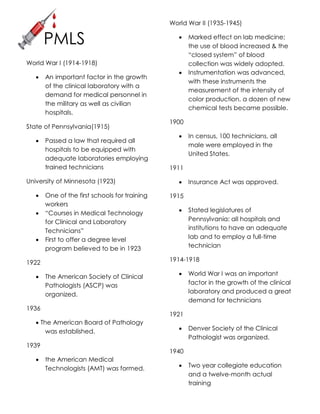
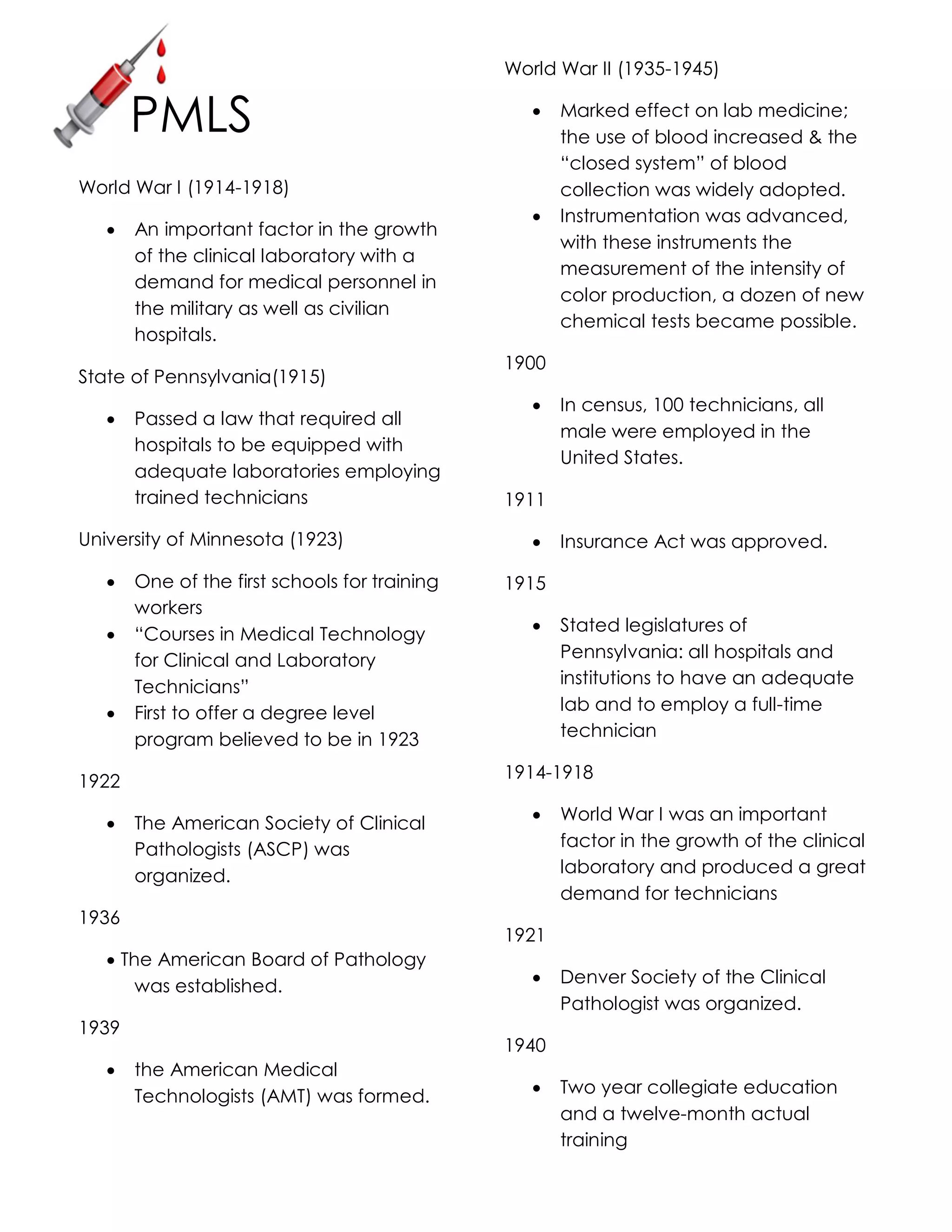
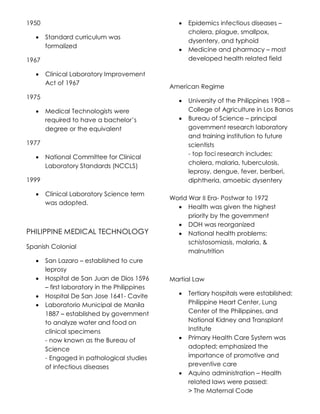
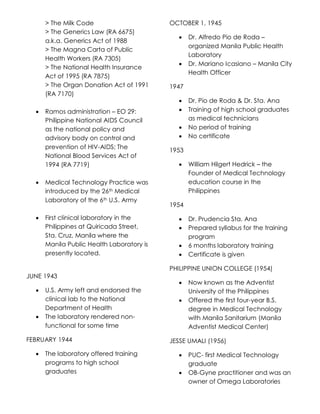
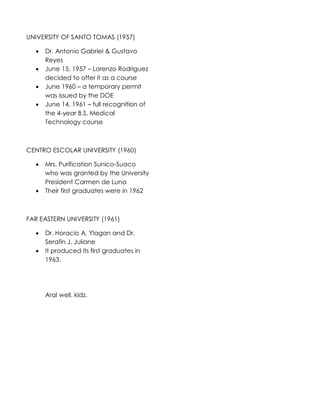
World War I increased demand for medical personnel and laboratories, spurring growth in clinical laboratory science. In the early 20th century, laws required hospitals to employ trained technicians, and the first schools were established to train medical technologists. The field continued to professionalize with the founding of organizations like ASCP and AMT to set standards and oversee certification. Major developments included establishing degree programs, standardizing curricula, and advancing instrumentation and testing capabilities. In the Philippines, the first clinical laboratory was established by the U.S. Army in 1943, and training programs emerged in the late 1940s, with the first degree programs starting in the 1950s at institutions like PUC, UST, CEU, and FEU


![03 [chapter 3 the cellular level of organization]](https://cdn.slidesharecdn.com/ss_thumbnails/03chapter3thecellularleveloforganization-170828035521-thumbnail.jpg?width=640&height=640&fit=bounds)


