The Default Mode Network

What is it and What Does it Mean for
              Coaches?
Evelyn McKelvie & Coach
“Harold”


         Evelyn McKelvie, CEC, ACC
         Internal Coach, University of British
         Columbia
         Founder, The Equine Coach
         www.equinecoach.ca
A map of the brain‟s Default Mode Network

http://www.sciencenews.org/view/access/id/45263/title/Wandering_and_wonderin
g_
DMN - A Definition
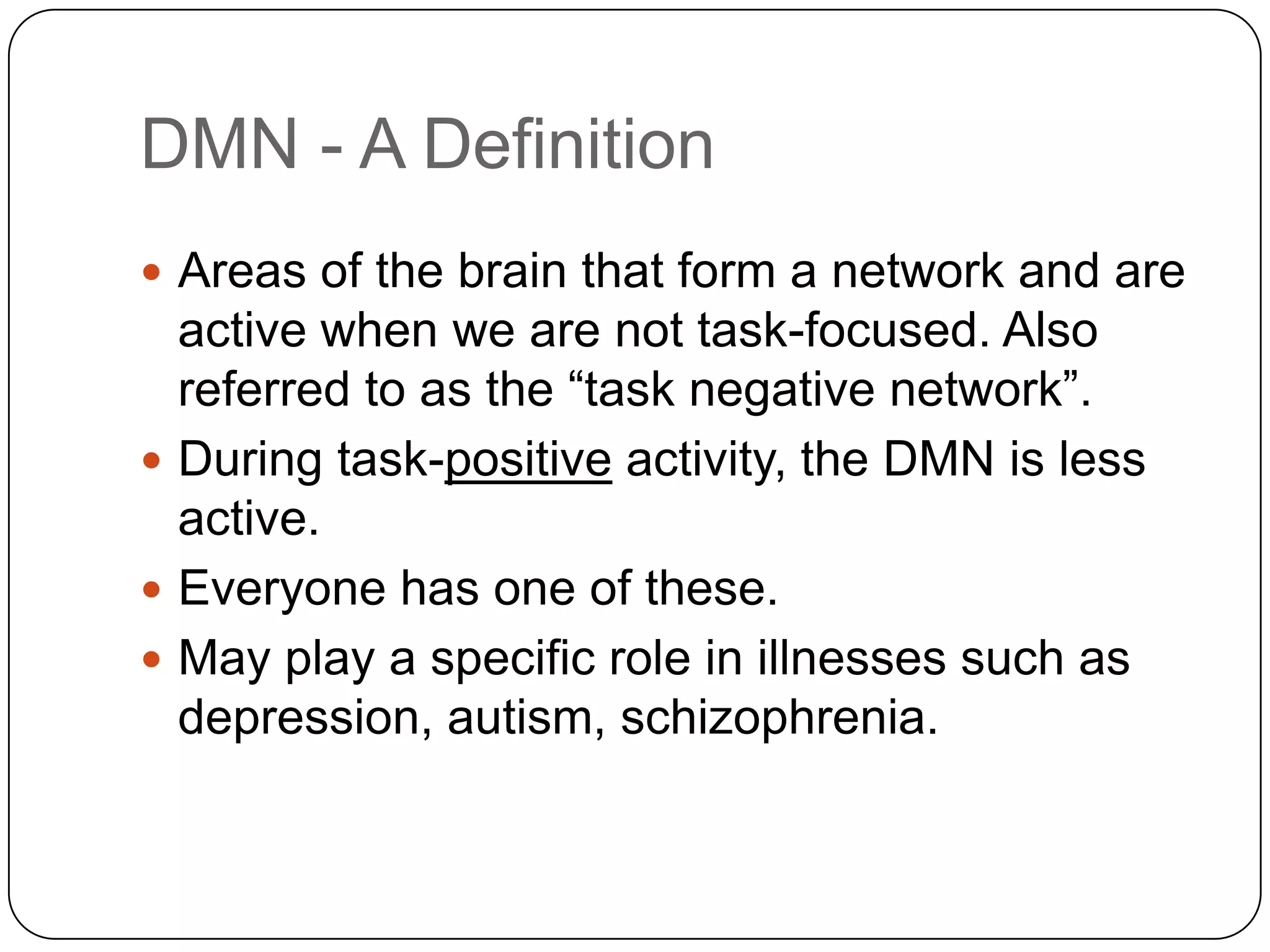
 Areas of the brain that form a network and are
  active when we are not task-focused. Also
  referred to as the “task negative network”.
 During task-positive activity, the DMN is less
  active.
 Everyone has one of these.
 May play a specific role in illnesses such as
  depression, autism, schizophrenia.
DMN – Very Complicated!
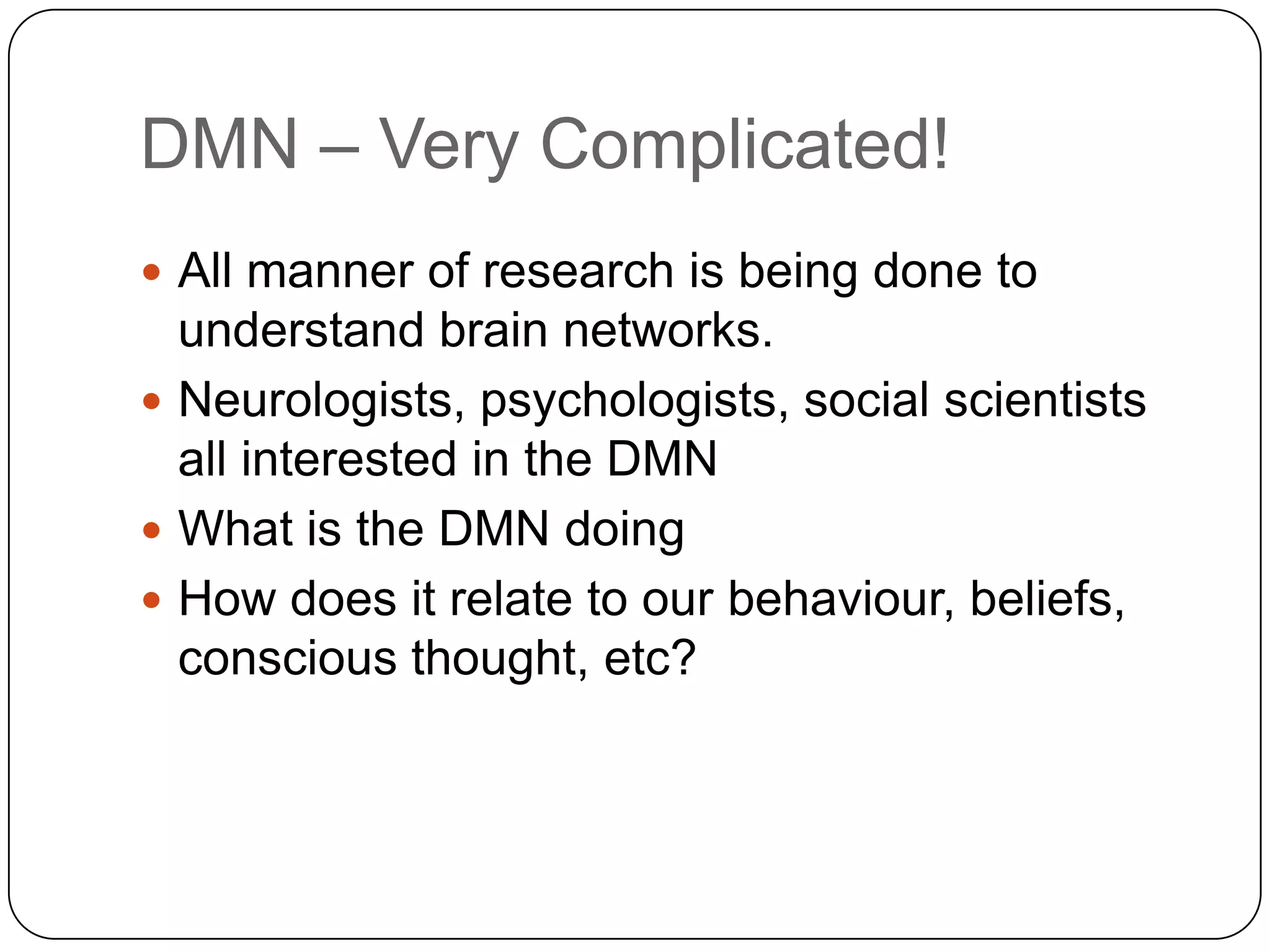
 All manner of research is being done to
  understand brain networks.
 Neurologists, psychologists, social scientists
  all interested in the DMN
 What is the DMN doing
 How does it relate to our behaviour, beliefs,
  conscious thought, etc?
DMN – Very Complicated!
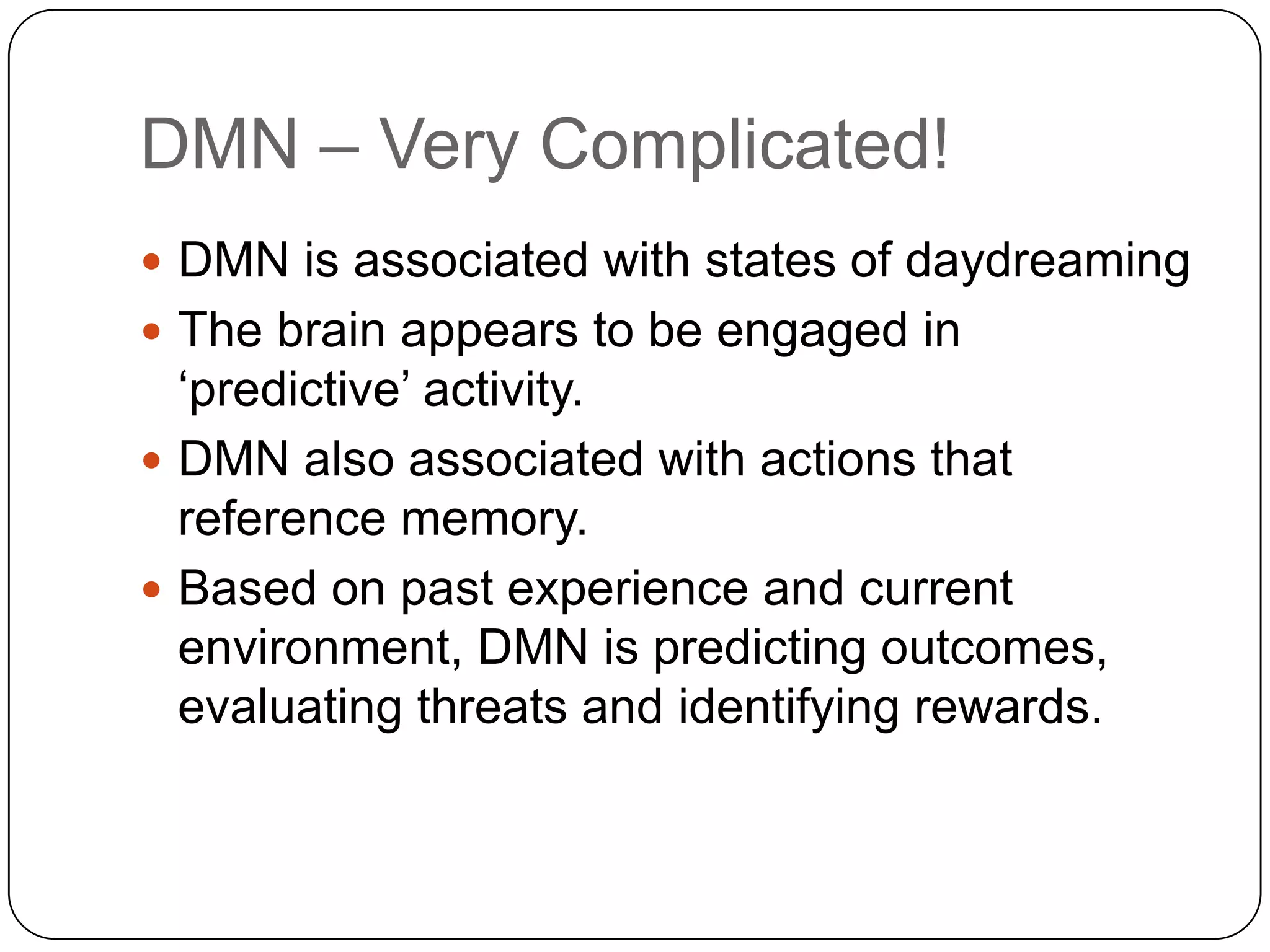
 DMN is associated with states of daydreaming
 The brain appears to be engaged in
  „predictive‟ activity.
 DMN also associated with actions that
  reference memory.
 Based on past experience and current
  environment, DMN is predicting outcomes,
  evaluating threats and identifying rewards.
DMN and Learning
 What role does the DMN play in the ability to
    learn?
    What role does it play in our self-talk?
   What actions can coaches take to identify the
    DMN at work?
   How can we leverage the DMN to achieve
    coaching goals?
   What feelings, thoughts, fears, assessments
    are made in the DMN?
   What patterns of thinking may be getting in
    the way of coaching goals?
Strategies to defeat Negative
DMN.
 Paying attention
 Using humour
 Noticing and employng “free won‟t”
 Meditation
 Journalling
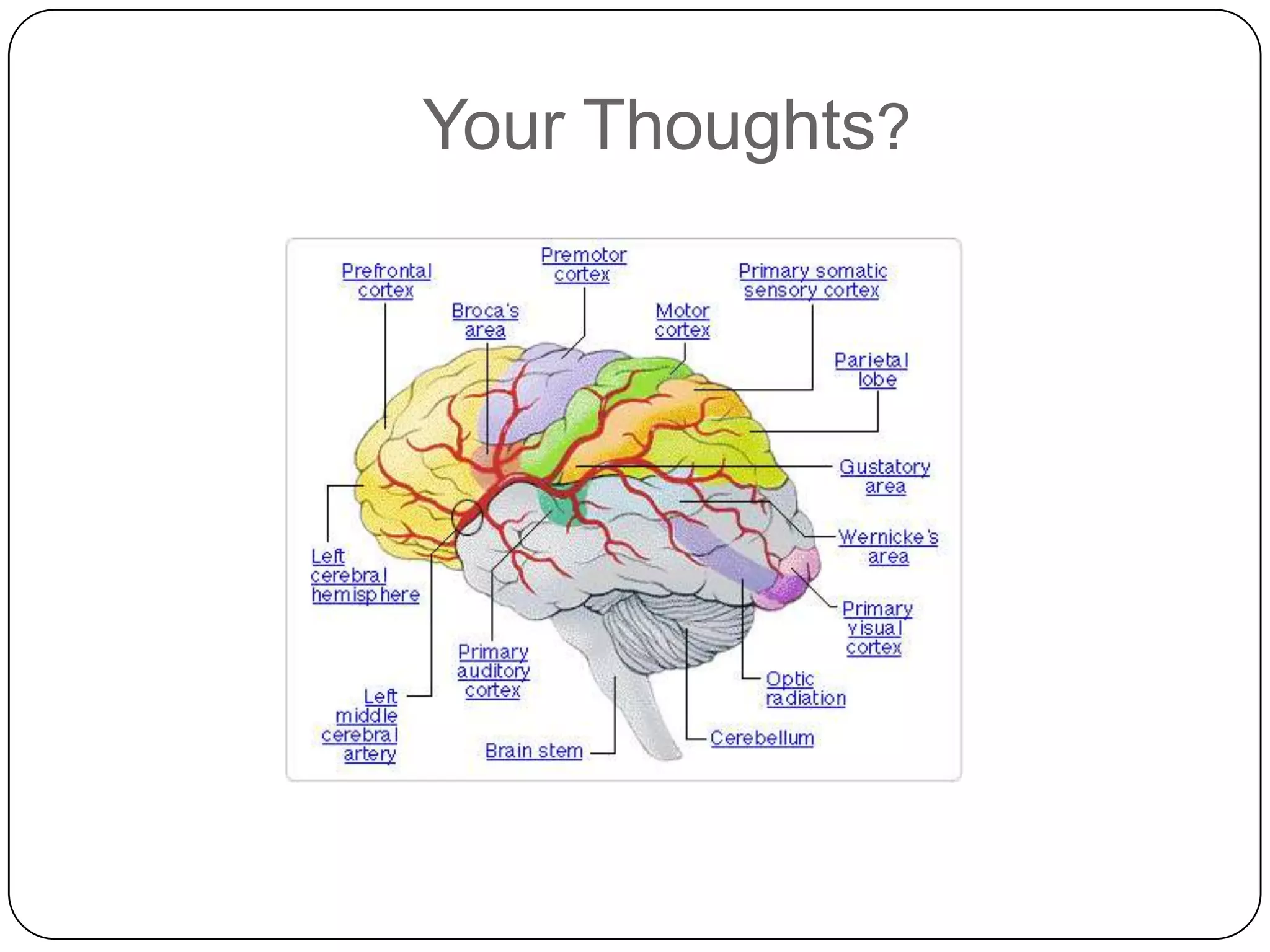
Your Thoughts?
Bibliography
 Morcom, Alexa M., and Paul C. Fletcher. "Does the brain have a
    baseline? Why we should be resisting a rest." Neuroimage 2007:
    1037-1082. Web. 10 Mar. 2012.
   Raichlea, Marcus E., and Abraham Z. Snyder. "A default mode of
    brain function: A brief history of an evolving idea." Neuroimage
    2007: 1083-1090. Web. 9 Mar. 2012.
   Raichlea, Marcus E. "The default mode network and self-
    referential processes in depression." PNAS 12 Dec. 2008: 1083-
    1090. Web. 1 Mar. 2012.
   Bar, Moshe. "Th e proactive brain: using analogies and
    associations to generate predictions." Trends in Cognitive
    Sciences Web. 7 Mar. 2012.
   Rock, David, and Linda J. Page. Coaching with the Brain in
    Mind: Foundations for Practice. Wiley, 2009. Print.
   Posner, Michael I., and Mary K. Rothbart. "Toward a physical

The Default Mode Network

  • 1.
    The Default ModeNetwork What is it and What Does it Mean for Coaches?
  • 2.
    Evelyn McKelvie &Coach “Harold” Evelyn McKelvie, CEC, ACC Internal Coach, University of British Columbia Founder, The Equine Coach www.equinecoach.ca
  • 3.
    A map ofthe brain‟s Default Mode Network http://www.sciencenews.org/view/access/id/45263/title/Wandering_and_wonderin g_
  • 4.
    DMN - ADefinition  Areas of the brain that form a network and are active when we are not task-focused. Also referred to as the “task negative network”.  During task-positive activity, the DMN is less active.  Everyone has one of these.  May play a specific role in illnesses such as depression, autism, schizophrenia.
  • 5.
    DMN – VeryComplicated!  All manner of research is being done to understand brain networks.  Neurologists, psychologists, social scientists all interested in the DMN  What is the DMN doing  How does it relate to our behaviour, beliefs, conscious thought, etc?
  • 6.
    DMN – VeryComplicated!  DMN is associated with states of daydreaming  The brain appears to be engaged in „predictive‟ activity.  DMN also associated with actions that reference memory.  Based on past experience and current environment, DMN is predicting outcomes, evaluating threats and identifying rewards.
  • 7.
    DMN and Learning What role does the DMN play in the ability to learn?  What role does it play in our self-talk?  What actions can coaches take to identify the DMN at work?  How can we leverage the DMN to achieve coaching goals?  What feelings, thoughts, fears, assessments are made in the DMN?  What patterns of thinking may be getting in the way of coaching goals?
  • 8.
    Strategies to defeatNegative DMN.  Paying attention  Using humour  Noticing and employng “free won‟t”  Meditation  Journalling
  • 9.
  • 10.
    Bibliography  Morcom, AlexaM., and Paul C. Fletcher. "Does the brain have a baseline? Why we should be resisting a rest." Neuroimage 2007: 1037-1082. Web. 10 Mar. 2012.  Raichlea, Marcus E., and Abraham Z. Snyder. "A default mode of brain function: A brief history of an evolving idea." Neuroimage 2007: 1083-1090. Web. 9 Mar. 2012.  Raichlea, Marcus E. "The default mode network and self- referential processes in depression." PNAS 12 Dec. 2008: 1083- 1090. Web. 1 Mar. 2012.  Bar, Moshe. "Th e proactive brain: using analogies and associations to generate predictions." Trends in Cognitive Sciences Web. 7 Mar. 2012.  Rock, David, and Linda J. Page. Coaching with the Brain in Mind: Foundations for Practice. Wiley, 2009. Print.  Posner, Michael I., and Mary K. Rothbart. "Toward a physical