






Introduction to
CSSD
Dr. Mohamed Eleraky
Infection Control Board
Hospital Management Diploma
Project Management Diploma
ESIC / APIC member
KFH-MED
Dr. Moh Eleraky 30-July-19
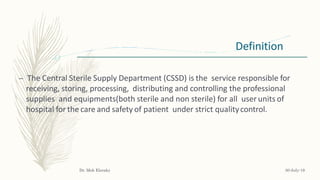
Definition
– The Central Sterile Supply Department (CSSD) is the service responsible for
receiving, storing, processing, distributing and controlling the professional
supplies and equipments(both sterile and non sterile) for all user units of
hospital for the care and safety of patient under strict qualitycontrol.
Dr. Moh Eleraky 30-July-19
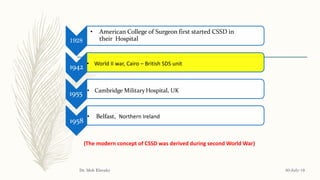
History & Development
Dr. Moh Eleraky 30-July-19
1928
• American College of Surgeon first started CSSD in
their Hospital
1942 • World II war, Cairo – British SDS unit
1955 • Cambridge Military Hospital, UK
1958
• Belfast, Northern Ireland
Dr. Moh Eleraky 30-July-19
(The modern concept of CSSD was derived during second World War)
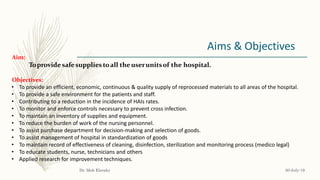
Aims & Objectives
Aim:
Toprovide safesupplies toall the userunitsof the hospital.
Objectives:
• To provide an efficient, economic, continuous & quality supply of reprocessed materials to all areas of the hospital.
• To provide a safe environment for the patients and staff.
• Contributing to a reduction in the incidence of HAIs rates.
• To monitor and enforce controls necessary to prevent cross infection.
• To maintain an inventory of supplies and equipment.
• To reduce the burden of work of the nursing personnel.
• To assist purchase department for decision-making and selection of goods.
• To assist management of hospital in standardization of goods
• To maintain record of effectiveness of cleaning, disinfection, sterilization and monitoring process (medico legal)
• To educate students, nurse, technicians and others
• Applied research for improvement techniques.
Dr. Moh Eleraky 30-July-19
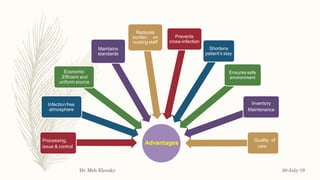
AdvantagesProcessing,
issue & control
Infection free
atmosphere
Economic
,Efficient and
uniform source
Maintains
standards
Reduces
burden on
nursing staff
Prevents
cross-infection
Shortens
patient’s stay
Ensures safe
environment
Inventory
Maintenance
Quality of
care
Dr. Moh Eleraky 30-July-19
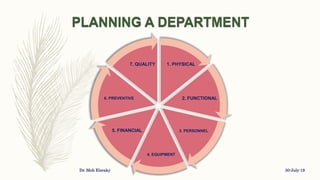
1. PHYSICAL
2. FUNCTIONAL
3. PERSONNEL
4. EQUIPMENT
5. FINANCIAL
6. PREVENTIVE
7. QUALITY
Dr. Moh Eleraky 30-July-19
1. PHYSICAL
30-July-19Dr. Moh Eleraky
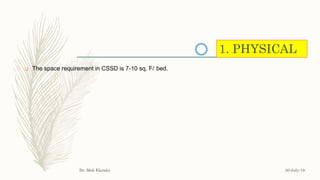
 The space requirement in CSSD is 7-10 sq. F/ bed.
Dr. Moh Eleraky 30-July-19
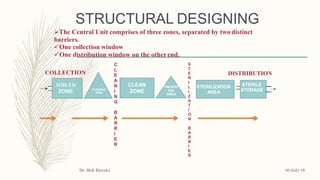
STRUCTURAL DESIGNING
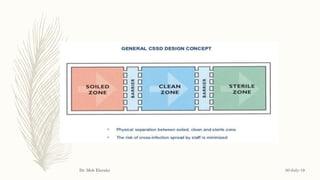
The Central Unit comprises of three zones, separated by two distinct
barriers.
One collection window
One distribution window on the otherend.
SOILED
ZONE CLEANING
AREA
CLEAN
ZONE
PACKAG
ING
AREA
STERILIZATION
AREA
C
L
E
A
N
I
N
G
B
A
R
R
I
E
R
S
T
E
R
I
L
I
Z
A
T
I
O
N
B
A
R
R
I
E
R
STERILE
STORAGE
COLLECTION DISTRIBUTION
LOW HIGH
Dr. Moh Eleraky 30-July-19
Receiving
Disassembling
Area
Issuing
counter>>
Distribution
Storage
Condemnation
Cleaning
Sterilization
ICU,Labor
Room,OT
Reprocessing
Assembling
(Dryingand
Packing)
All Wards,
Emergency,
OPD &other
units
soiled (Contaminated) Zone
CleanZone
SterileZone
Dr. Moh Eleraky 30-July-19
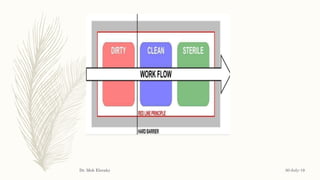
CSSD- Work Flow
Dr. Moh Eleraky 30-July-19
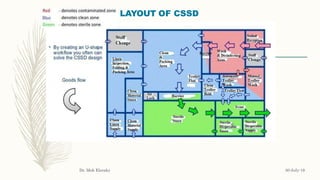
LAYOUT OF CSSD
Dr. Moh Eleraky 30-July-19
2. FUNCTIONAL
Dr. Moh Eleraky 30-July-19
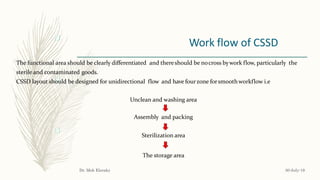
Work flow of CSSD
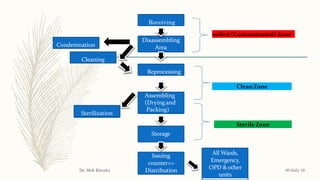
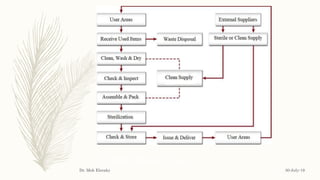
The functional area should be clearly differentiated and thereshould be nocross bywork flow, particularly the
sterile and contaminated goods.
CSSD layout should be designed for unidirectional flow and have fourzone forsmoothworkflow i.e
Unclean and washing area
Assembly and packing
Sterilization area
The storage area
Dr. Moh Eleraky 30-July-19
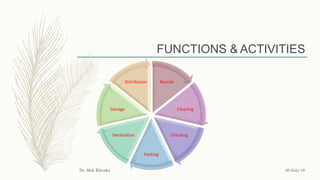
Receipt
Cleaning
Checking
Packing
Sterilization
Storage
Distribution
30-July-19Dr. Moh Eleraky
FUNCTIONS & ACTIVITIES
3. PERSONNEL
30-July-19Dr. Moh Eleraky
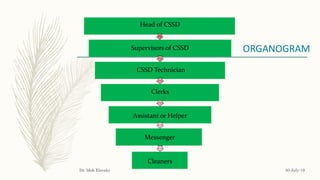
ORGANOGRAM
Head of CSSD
Supervisors of CSSD
CSSD Technician
Clerks
Assistant or Helper
Messenger
Cleaners
Dr. Moh Eleraky 30-July-19
4. FINANCIAL
30-July-19Dr. Moh Eleraky
 Infra structure
 Equipments & Machines
 Human resources
 Supplies
 Maintenance
 Operating coast
5. PREVENTIVE
30-July-19Dr. Moh Eleraky
 Safety measures should be applied to prevent occupational hazards in CSSD:
 Biological Agents: Infection e.g. Legionnaires' disease, CJD & Blood Borne Viral diseases.
 Chemical Agents: Fire, Explosion & Health effects such as respiratory problems, allergies or dermatitis.
 Electricity: Fire, Electrocution & Burns.
 Equipments: Burns, Cuts, Explosion, Physical injury & Death.
 Ergonomic Hazards: Pain in back, hands or arms.
 Manual Handling: Musculoskeletal disorders.
 Noise: Hearing damage or loss, Physiological effects, Work related stress & Increased risk of accidents.
 Non Ionizing Radiation: Heating / skin burns & Eye damage - cataracts.
 Sharps: Cuts & Infection.
 Slips & Falls: Minor injuries such as cuts to major injuries such as broken bones, concussion and even death.
 Temperature: Heat stress & Burns.
 Wet Work: Dermatitis
6. EQUIPMENT
Examples for some equipments in CSSD:
• Cleaning and decontamination machines
•Ultrasonic Washer
•Steam Boiler
•Hot air ovens
•Autoclaves.
•Ethylene oxide sterilizer.
•Plasma sterilizer
•Testing material to check effectiveness of sterilization.
•Sealing machine
•Material :labels, packaging rolls, chemicals, ……….
•Others : trolleys, work surface, telephones, ………
7. QUALITY
 Quality management of services in CSSD is extremely important in view of its role
- In hospital infection control
-The catastrophic effects the poor quality service may have on patients.
 However, quality of services can be judged from level of satisfaction of the clients.
 The clients in case of CSSD are all internal (Consumer departments/clinicians).
 High quality CSSD services to them means:
 100% reliability of sterility of stores supplied by CSSD.
 Timely supplies in right time.
 Contents of the trays/ sets are as per the standard list provided by users & all
the contents are in full operational order.
 Trays/ Sets are labeled correctly.
 The sterile items supplied remain sterile up to their pre-determined shelf life.
 Quality of the items does not deteriorate by the sterilization technique used.
 (The quality of outcome, however, depends upon the quality of infrastructure &
process used in CSSD.)
THANK YOU
30-July-19Dr. Moh Eleraky

Introduction to CSSD

  • 1.
    Introduction to CSSD Dr. MohamedEleraky Infection Control Board Hospital Management Diploma Project Management Diploma ESIC / APIC member KFH-MED Dr. Moh Eleraky 30-July-19
  • 2.
    Definition – The CentralSterile Supply Department (CSSD) is the service responsible for receiving, storing, processing, distributing and controlling the professional supplies and equipments(both sterile and non sterile) for all user units of hospital for the care and safety of patient under strict qualitycontrol. Dr. Moh Eleraky 30-July-19
  • 3.
    History & Development Dr.Moh Eleraky 30-July-19
  • 4.
    1928 • American Collegeof Surgeon first started CSSD in their Hospital 1942 • World II war, Cairo – British SDS unit 1955 • Cambridge Military Hospital, UK 1958 • Belfast, Northern Ireland Dr. Moh Eleraky 30-July-19 (The modern concept of CSSD was derived during second World War)
  • 5.
    Aims & Objectives Aim: Toprovidesafesupplies toall the userunitsof the hospital. Objectives: • To provide an efficient, economic, continuous & quality supply of reprocessed materials to all areas of the hospital. • To provide a safe environment for the patients and staff. • Contributing to a reduction in the incidence of HAIs rates. • To monitor and enforce controls necessary to prevent cross infection. • To maintain an inventory of supplies and equipment. • To reduce the burden of work of the nursing personnel. • To assist purchase department for decision-making and selection of goods. • To assist management of hospital in standardization of goods • To maintain record of effectiveness of cleaning, disinfection, sterilization and monitoring process (medico legal) • To educate students, nurse, technicians and others • Applied research for improvement techniques. Dr. Moh Eleraky 30-July-19
  • 6.
    AdvantagesProcessing, issue & control Infectionfree atmosphere Economic ,Efficient and uniform source Maintains standards Reduces burden on nursing staff Prevents cross-infection Shortens patient’s stay Ensures safe environment Inventory Maintenance Quality of care Dr. Moh Eleraky 30-July-19
  • 7.
    1. PHYSICAL 2. FUNCTIONAL 3.PERSONNEL 4. EQUIPMENT 5. FINANCIAL 6. PREVENTIVE 7. QUALITY Dr. Moh Eleraky 30-July-19
  • 8.
    1. PHYSICAL 30-July-19Dr. MohEleraky  The space requirement in CSSD is 7-10 sq. F/ bed.
  • 9.
    Dr. Moh Eleraky30-July-19
  • 10.
    Dr. Moh Eleraky30-July-19
  • 11.
    STRUCTURAL DESIGNING The CentralUnit comprises of three zones, separated by two distinct barriers. One collection window One distribution window on the otherend. SOILED ZONE CLEANING AREA CLEAN ZONE PACKAG ING AREA STERILIZATION AREA C L E A N I N G B A R R I E R S T E R I L I Z A T I O N B A R R I E R STERILE STORAGE COLLECTION DISTRIBUTION LOW HIGH Dr. Moh Eleraky 30-July-19
  • 12.
  • 13.
    CSSD- Work Flow Dr.Moh Eleraky 30-July-19
  • 14.
    LAYOUT OF CSSD Dr.Moh Eleraky 30-July-19
  • 15.
    2. FUNCTIONAL Dr. MohEleraky 30-July-19
  • 16.
    Work flow ofCSSD The functional area should be clearly differentiated and thereshould be nocross bywork flow, particularly the sterile and contaminated goods. CSSD layout should be designed for unidirectional flow and have fourzone forsmoothworkflow i.e Unclean and washing area Assembly and packing Sterilization area The storage area Dr. Moh Eleraky 30-July-19
  • 17.
  • 18.
  • 19.
    ORGANOGRAM Head of CSSD Supervisorsof CSSD CSSD Technician Clerks Assistant or Helper Messenger Cleaners Dr. Moh Eleraky 30-July-19
  • 20.
    Dr. Moh Eleraky30-July-19
  • 21.
    4. FINANCIAL 30-July-19Dr. MohEleraky  Infra structure  Equipments & Machines  Human resources  Supplies  Maintenance  Operating coast
  • 22.
    5. PREVENTIVE 30-July-19Dr. MohEleraky  Safety measures should be applied to prevent occupational hazards in CSSD:  Biological Agents: Infection e.g. Legionnaires' disease, CJD & Blood Borne Viral diseases.  Chemical Agents: Fire, Explosion & Health effects such as respiratory problems, allergies or dermatitis.  Electricity: Fire, Electrocution & Burns.  Equipments: Burns, Cuts, Explosion, Physical injury & Death.  Ergonomic Hazards: Pain in back, hands or arms.  Manual Handling: Musculoskeletal disorders.  Noise: Hearing damage or loss, Physiological effects, Work related stress & Increased risk of accidents.  Non Ionizing Radiation: Heating / skin burns & Eye damage - cataracts.  Sharps: Cuts & Infection.  Slips & Falls: Minor injuries such as cuts to major injuries such as broken bones, concussion and even death.  Temperature: Heat stress & Burns.  Wet Work: Dermatitis
  • 23.
    6. EQUIPMENT Examples forsome equipments in CSSD: • Cleaning and decontamination machines •Ultrasonic Washer •Steam Boiler •Hot air ovens •Autoclaves. •Ethylene oxide sterilizer. •Plasma sterilizer •Testing material to check effectiveness of sterilization. •Sealing machine •Material :labels, packaging rolls, chemicals, ………. •Others : trolleys, work surface, telephones, ………
  • 24.
    7. QUALITY  Qualitymanagement of services in CSSD is extremely important in view of its role - In hospital infection control -The catastrophic effects the poor quality service may have on patients.  However, quality of services can be judged from level of satisfaction of the clients.  The clients in case of CSSD are all internal (Consumer departments/clinicians).
  • 25.
     High qualityCSSD services to them means:  100% reliability of sterility of stores supplied by CSSD.  Timely supplies in right time.  Contents of the trays/ sets are as per the standard list provided by users & all the contents are in full operational order.  Trays/ Sets are labeled correctly.  The sterile items supplied remain sterile up to their pre-determined shelf life.  Quality of the items does not deteriorate by the sterilization technique used.  (The quality of outcome, however, depends upon the quality of infrastructure & process used in CSSD.)
  • 26.