Computer Assisted Language Learning(CALL)Ujang Edi Brata, Nurul Fajriyah,EkaWahyuSetianingsih, AamMaryamahPost Graduate Program UHAMKA Jakarta
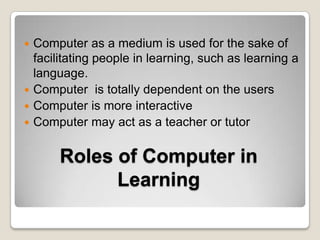
Computer as a medium is used for the sake of facilitating people in learning, such as learning a language.Computer  is totally dependent on the usersComputer is more interactiveComputer may act as a teacher or tutorRoles of Computer in Learning
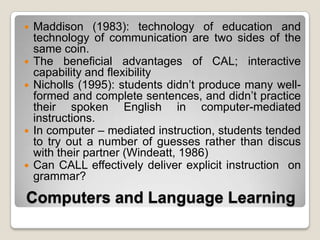
Maddison (1983): technology of education and technology of communication are two sides of the same coin.The beneficial advantages of CAL; interactive capability and flexibilityNicholls (1995): students didn’t produce many well-formed and complete sentences, and didn’t practice their spoken English in computer-mediated instructions.In computer – mediated instruction, students tended to try out a number of guesses rather than discus with their partner (Windeatt, 1986)Can CALL effectively deliver explicit instruction  on grammar?Computers and Language Learning
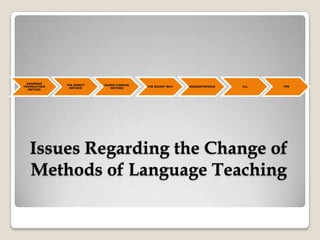
Issues Regarding the Change of Methods of Language Teaching
 - CAL: the learning involving the utilization of the computer - CALL: means CAL which is implemented to language.CAL and CALL
CALL: Underlying Consideration Ahmad, et al, (1985:4): the computer is   flexible.Hiltzand Turrof (1985) and Hiltz (1994): the   flexibility supports collaborative learning  among students. Computer based language instruction is   ability to interact with learners. The more powerful the technology  becomes, the more ‘human’ functions the  machine is able to take on.
Advantages of CALLDevelop a non-sequential reading habit.
  Offer freedom for users to choose any   topic available.  Can be used in pairs.
  Allow the students to determine what    particular topics and how long he wants   to learn.

Computer assisted language learning

  • 1.
    Computer Assisted LanguageLearning(CALL)Ujang Edi Brata, Nurul Fajriyah,EkaWahyuSetianingsih, AamMaryamahPost Graduate Program UHAMKA Jakarta
  • 2.
    Computer as amedium is used for the sake of facilitating people in learning, such as learning a language.Computer is totally dependent on the usersComputer is more interactiveComputer may act as a teacher or tutorRoles of Computer in Learning
  • 3.
    Maddison (1983): technologyof education and technology of communication are two sides of the same coin.The beneficial advantages of CAL; interactive capability and flexibilityNicholls (1995): students didn’t produce many well-formed and complete sentences, and didn’t practice their spoken English in computer-mediated instructions.In computer – mediated instruction, students tended to try out a number of guesses rather than discus with their partner (Windeatt, 1986)Can CALL effectively deliver explicit instruction on grammar?Computers and Language Learning
  • 4.
    Issues Regarding theChange of Methods of Language Teaching
  • 5.
    - CAL:the learning involving the utilization of the computer - CALL: means CAL which is implemented to language.CAL and CALL
  • 6.
    CALL: Underlying ConsiderationAhmad, et al, (1985:4): the computer is flexible.Hiltzand Turrof (1985) and Hiltz (1994): the flexibility supports collaborative learning among students. Computer based language instruction is ability to interact with learners. The more powerful the technology becomes, the more ‘human’ functions the machine is able to take on.
  • 7.
    Advantages of CALLDevelopa non-sequential reading habit.
  • 8.
    Offerfreedom for users to choose any topic available. Can be used in pairs.
  • 9.
    Allowthe students to determine what particular topics and how long he wants to learn.