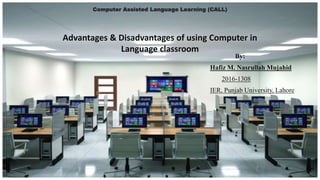
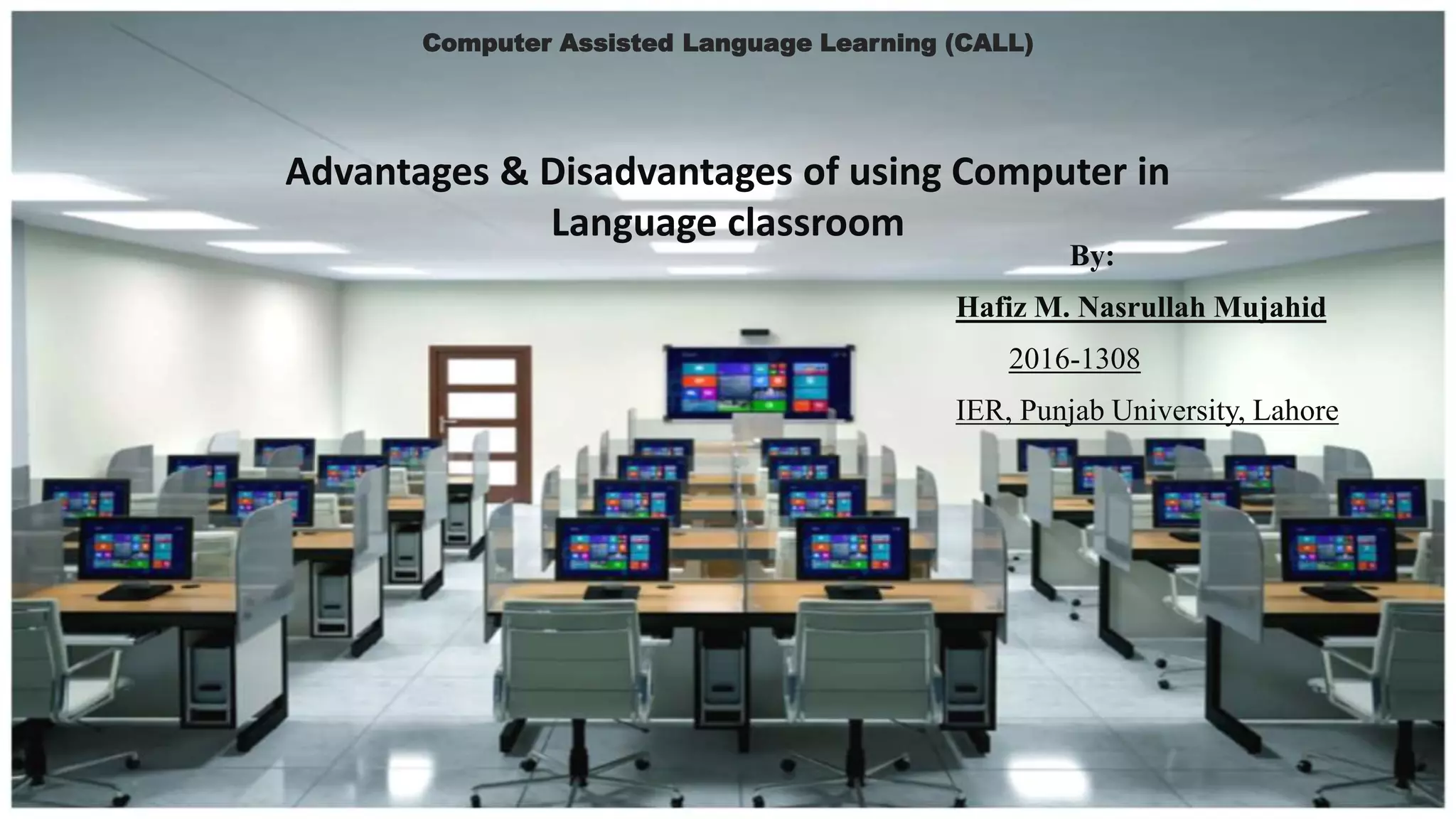
Computer Assisted Language Learning (CALL)
Advantages & Disadvantages of using Computer in
Language classroom
By:
Hafiz M. Nasrullah Mujahid
2016-1308
IER, Punjab University, Lahore
Introduction
Communication and technology have been part of our live,
especially in the area of education. In all educational
system, the use communication and technology has certain
place; therefore, computers play significant role in the
learning process. Teaching English for a second-language
learner can take benefit from using a computer. Indeed,
a computer is a tool and medium that facilitates people
in learning a language, although the effectiveness of
learning depends totally on the users (Hartoyo 2006, 11).
Advantages
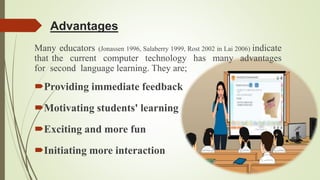
Many educators (Jonassen 1996, Salaberry 1999, Rost 2002 in Lai 2006) indicate
that the current computer technology has many advantages
for second language learning. They are;
Providing immediate feedback
Motivating students' learning
Exciting and more fun
Initiating more interaction
Advantages (Continue)
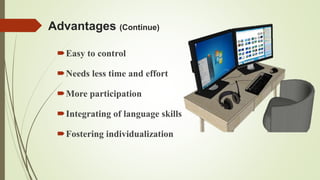
Easy to control
Needs less time and effort
More participation
Integrating of language skills
Fostering individualization
Advantages (Continue)
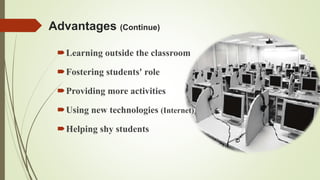
Learning outside the classroom
Fostering students' role
Providing more activities
Using new technologies (Internet)
Helping shy students
Advantages (Continue)
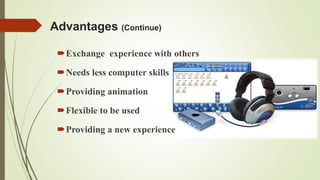
Exchange experience with others
Needs less computer skills
Providing animation
Flexible to be used
Providing a new experience
Disadvantages
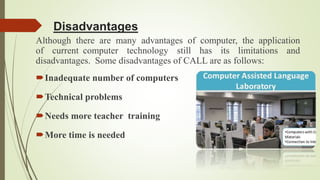
Although there are many advantages of computer, the application
of current computer technology still has its limitations and
disadvantages. Some disadvantages of CALL are as follows:
Inadequate number of computers
Technical problems
Needs more teacher training
More time is needed
Disadvantages (Continue)
The cost is high
Lack of experience in computer
Slow computers
Difficult to prepare the lesson
It may replace the teacher
Disadvantages (Continue)
Lack of well-designed software
The need for continuous updating
Students deem computer a game
Large number of students in class
The inability to control the class
Disadvantages (Continue)
Cause physical problems
Blind students will not benefit
Lack of students' computer skills
The instructions may not be clear
 Less chances for weak students
Conclusion
CALL has certain advantages and disadvantages and
teachers should know the strengths and weaknesses in
applying CALL in ESL classrooms. we must first realize the
advantages and disadvantages of current CALL programs
before applying them to improve our teaching or to help
student learning. It is agreeable that technological
advancement and development has enabled the application
of CALL programs in language learning and instruction,
and it has become a new trend recently.

Computer assisted language learning (call)

  • 1.
    Computer Assisted LanguageLearning (CALL) Advantages & Disadvantages of using Computer in Language classroom By: Hafiz M. Nasrullah Mujahid 2016-1308 IER, Punjab University, Lahore
  • 2.
    Introduction Communication and technologyhave been part of our live, especially in the area of education. In all educational system, the use communication and technology has certain place; therefore, computers play significant role in the learning process. Teaching English for a second-language learner can take benefit from using a computer. Indeed, a computer is a tool and medium that facilitates people in learning a language, although the effectiveness of learning depends totally on the users (Hartoyo 2006, 11).
  • 3.
    Advantages Many educators (Jonassen1996, Salaberry 1999, Rost 2002 in Lai 2006) indicate that the current computer technology has many advantages for second language learning. They are; Providing immediate feedback Motivating students' learning Exciting and more fun Initiating more interaction
  • 4.
    Advantages (Continue) Easy tocontrol Needs less time and effort More participation Integrating of language skills Fostering individualization
  • 5.
    Advantages (Continue) Learning outsidethe classroom Fostering students' role Providing more activities Using new technologies (Internet) Helping shy students
  • 6.
    Advantages (Continue) Exchange experiencewith others Needs less computer skills Providing animation Flexible to be used Providing a new experience
  • 7.
    Disadvantages Although there aremany advantages of computer, the application of current computer technology still has its limitations and disadvantages. Some disadvantages of CALL are as follows: Inadequate number of computers Technical problems Needs more teacher training More time is needed
  • 8.
    Disadvantages (Continue) The costis high Lack of experience in computer Slow computers Difficult to prepare the lesson It may replace the teacher
  • 9.
    Disadvantages (Continue) Lack ofwell-designed software The need for continuous updating Students deem computer a game Large number of students in class The inability to control the class
  • 10.
    Disadvantages (Continue) Cause physicalproblems Blind students will not benefit Lack of students' computer skills The instructions may not be clear  Less chances for weak students
  • 11.
    Conclusion CALL has certainadvantages and disadvantages and teachers should know the strengths and weaknesses in applying CALL in ESL classrooms. we must first realize the advantages and disadvantages of current CALL programs before applying them to improve our teaching or to help student learning. It is agreeable that technological advancement and development has enabled the application of CALL programs in language learning and instruction, and it has become a new trend recently.