Challenge the future
Delft
University of
Technology
Course IN4303
Compiler Construction
Eduardo Souza, Guido Wachsmuth, Eelco Visser
LL Parsing
Traditional Parsing Algorithms
lessons learned
LL Parsing
Recap: Lexical Analysis
What are the formalisms to describe regular languages?
• regular grammars
• regular expressions
• finite state automata
Why are these formalisms equivalent?
• constructive proofs
How can we generate compiler tools from that?
• implement DFAs
• generate transition tables
2
today’s lecture
LL Parsing
Overview
3
today’s lecture
LL Parsing
Overview
efficient parsing algorithms
• predictive/recursive descent parsing
• LL parsing
3
today’s lecture
LL Parsing
Overview
efficient parsing algorithms
• predictive/recursive descent parsing
• LL parsing
grammar classes
• LL(k) grammars
• LR(k) grammars
3
today’s lecture
LL Parsing
Overview
efficient parsing algorithms
• predictive/recursive descent parsing
• LL parsing
grammar classes
• LL(k) grammars
• LR(k) grammars
more top-down parsing algorithms
• Parser Combinators
• Parsing Expression Grammars
• ALL(*)
3
LL Parsing
Predictive (Recursive Descent)
Parsing
I
4
formal languages
LL Parsing 5
Recap: A Theory of Language
formal languages
LL Parsing
vocabulary Σ
finite, nonempty set of elements (words, letters)
alphabet
5
Recap: A Theory of Language
formal languages
LL Parsing
vocabulary Σ
finite, nonempty set of elements (words, letters)
alphabet
string over Σ
finite sequence of elements chosen from Σ
word, sentence, utterance
5
Recap: A Theory of Language
formal languages
LL Parsing
vocabulary Σ
finite, nonempty set of elements (words, letters)
alphabet
string over Σ
finite sequence of elements chosen from Σ
word, sentence, utterance
formal language λ
set of strings over a vocabulary Σ
λ ⊆ Σ*
5
Recap: A Theory of Language
formal grammars
LL Parsing 6
Recap: A Theory of Language
formal grammars
LL Parsing
formal grammar G = (N, Σ, P, S)
nonterminal symbols N
terminal symbols Σ
production rules P ⊆ (N∪Σ)*
N (N∪Σ)*
× (N∪Σ)*
start symbol S∈N
6
Recap: A Theory of Language
formal grammars
LL Parsing
formal grammar G = (N, Σ, P, S)
nonterminal symbols N
terminal symbols Σ
production rules P ⊆ (N∪Σ)*
N (N∪Σ)*
× (N∪Σ)*
start symbol S∈N
6
Recap: A Theory of Language
nonterminal symbol
formal grammars
LL Parsing
formal grammar G = (N, Σ, P, S)
nonterminal symbols N
terminal symbols Σ
production rules P ⊆ (N∪Σ)*
N (N∪Σ)*
× (N∪Σ)*
start symbol S∈N
6
Recap: A Theory of Language
context
formal grammars
LL Parsing
formal grammar G = (N, Σ, P, S)
nonterminal symbols N
terminal symbols Σ
production rules P ⊆ (N∪Σ)*
N (N∪Σ)*
× (N∪Σ)*
start symbol S∈N
6
Recap: A Theory of Language
replacement
formal grammars
LL Parsing
formal grammar G = (N, Σ, P, S)
nonterminal symbols N
terminal symbols Σ
production rules P ⊆ (N∪Σ)*
N (N∪Σ)*
× (N∪Σ)*
start symbol S∈N
grammar classes
type-0, unrestricted
type-1, context-sensitive: (a A c, a b c)
type-2, context-free: P ⊆ N × (N∪Σ)*
type-3, regular: (A, x) or (A, xB)
6
Recap: A Theory of Language
formal languages
LL Parsing 7
Recap: A Theory of Language
formal languages
LL Parsing
formal grammar G = (N, Σ, P, S)
7
Recap: A Theory of Language
formal languages
LL Parsing
formal grammar G = (N, Σ, P, S)
derivation relation G ⊆ (N∪Σ)*
× (N∪Σ)*
w G w’
∃(p, q)∈P: ∃u,v∈(N∪Σ)*
:
w=u p v ∧ w’=u q v
7
Recap: A Theory of Language
formal languages
LL Parsing
formal grammar G = (N, Σ, P, S)
derivation relation G ⊆ (N∪Σ)*
× (N∪Σ)*
w G w’
∃(p, q)∈P: ∃u,v∈(N∪Σ)*
:
w=u p v ∧ w’=u q v
formal language L(G) ⊆ Σ*
L(G) = {w∈Σ*
| S G
*
w}
7
Recap: A Theory of Language
formal languages
LL Parsing
formal grammar G = (N, Σ, P, S)
derivation relation G ⊆ (N∪Σ)*
× (N∪Σ)*
w G w’
∃(p, q)∈P: ∃u,v∈(N∪Σ)*
:
w=u p v ∧ w’=u q v
formal language L(G) ⊆ Σ*
L(G) = {w∈Σ*
| S G
*
w}
classes of formal languages
7
Recap: A Theory of Language
recursive descent
LL Parsing 8
Exp → “while” Exp “do” Exp
Predictive parsing
public void parseExp() {
consume(WHILE);
parseExp();
consume(DO);
parseExp();
}
look ahead
LL Parsing 9
Exp → “while” Exp “do” Exp
Exp → “if” Exp “then” Exp “else” Exp
Predictive parsing
public void parseExp() {
switch current() {
case WHILE: consume(WHILE); parseExp(); ...; break;
case IF : consume(IF); parseExp(); ...; break;
default : error();
}
}
parse table
LL Parsing 10
rows
• nonterminal symbols N
• symbol to parse
columns
• terminal symbols Σk
• look ahead k
entries
• production rules P
• possible conflicts
Predictive parsing
T1 T2 T3 ...
N1 N1 →... N1 →...
N2 N2 →...
N3 N3 →... N3 →...
N4 N4 →...
N5 N5 →...
N6 N6 →... N6 →...
N7 N7 →...
N8 N8 →... N8 →... N8 →...
...
automaton
LL Parsing
Predictive parsing
11
… tn $t1
$
S
input
parse table
stack
automaton
LL Parsing
Predictive parsing
12
x … $
$
x
…
automaton
LL Parsing
Predictive parsing
12
… $
$
…
automaton
LL Parsing
Predictive parsing
13
x … $
$
Xi
x
Xi
Xi → Y1... Yk
…
automaton
LL Parsing
Predictive parsing
13
x … $
$
x
Xi
Xi → Y1... Yk
…
Yk
…
Y1
LL Parsing
LL Parse Tables
II
14
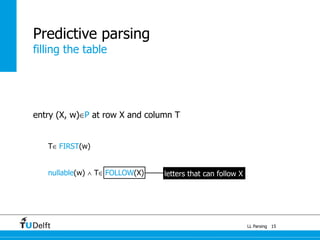
entry (X, w)∈P at row X and column T
T∈ FIRST(w)
nullable(w) ∧ T∈ FOLLOW(X)
filling the table
LL Parsing 15
Predictive parsing
entry (X, w)∈P at row X and column T
T∈ FIRST(w)
nullable(w) ∧ T∈ FOLLOW(X)
filling the table
LL Parsing 15
Predictive parsing
letters that w can start with
entry (X, w)∈P at row X and column T
T∈ FIRST(w)
nullable(w) ∧ T∈ FOLLOW(X)
filling the table
LL Parsing 15
Predictive parsing
w G
*
ε
entry (X, w)∈P at row X and column T
T∈ FIRST(w)
nullable(w) ∧ T∈ FOLLOW(X)
filling the table
LL Parsing 15
Predictive parsing
letters that can follow X
nullable
LL Parsing
nullable(X)
(X, ε) ∈ P nullable(X)
(X0, X1 … Xk)∈P ∧ nullable(X1) ∧ … ∧ nullable(Xk) nullable(X0)
nullable(w)
nullable(ε)
nullable(X1 … Xk) = nullable(X1) ∧ … ∧ nullable(Xk)
16
Predictive parsing
first sets
LL Parsing
FIRST(X)
X∈Σ : FIRST(X) = {X}
(X0, X1 … Xi … Xk)∈P ∧ nullable(X1 … Xi) FIRST(X0) ⊇ FIRST(Xi+1)
FIRST(w)
FIRST(ε) = {}
¬nullable(X) FIRST(Xw) = FIRST(X)
nullable(X) FIRST(Xw) = FIRST(X) ∪ FIRST(w)
17
Predictive parsing
follow sets
LL Parsing
FOLLOW(X)
(X0, X1 … Xi … Xk)∈P ∧ nullable(Xi+1 … Xk) FOLLOW(Xi) ⊇ FOLLOW(X0)
(X0, X1 … Xi … Xk)∈P FOLLOW(Xi) ⊇ FIRST(Xi+1 … Xk)
18
Predictive parsing
LL Parsing 19
Example
nullable FIRST FOLLOW
Start
Exp
Exp’
Term
Term’
Fact
p0: Start → Exp EOF
p1: Exp → Term Exp’
p2: Exp’ → “+” Term Exp’
p3: Exp’ →
p4: Term → Fact Term’
p5: Term’ → “*” Fact Term’
p6: Term’ →
p7: Fact → Num
p8: Fact → “(” Exp “)”
nullable
LL Parsing 20
Example
(X, ε) ∈ P nullable(X)
(X0, X1 … Xk)∈P ∧
nullable(X1) ∧ … ∧ nullable(Xk) nullable(X0)
nullable FIRST FOLLOW
Start
Exp
Exp’
Term
Term’
Fact
p0: Start → Exp EOF
p1: Exp → Term Exp’
p2: Exp’ → “+” Term Exp’
p3: Exp’ →
p4: Term → Fact Term’
p5: Term’ → “*” Fact Term’
p6: Term’ →
p7: Fact → Num
p8: Fact → “(” Exp “)”
nullable
LL Parsing 21
Example
(X, ε) ∈ P nullable(X)
(X0, X1 … Xk)∈P ∧
nullable(X1) ∧ … ∧ nullable(Xk) nullable(X0)
p0: Start → Exp EOF
p1: Exp → Term Exp’
p2: Exp’ → “+” Term Exp’
p3: Exp’ →
p4: Term → Fact Term’
p5: Term’ → “*” Fact Term’
p6: Term’ →
p7: Fact → Num
p8: Fact → “(” Exp “)”
nullable FIRST FOLLOW
Start no
Exp no
Exp’ yes
Term no
Term’ yes
Fact no
FIRST sets
LL Parsing 22
Example (X0, X1 … Xi … Xk)∈P ∧
nullable(X1 … Xi) FIRST(X0) ⊇ FIRST(Xi+1)
p0: Start → Exp EOF
p1: Exp → Term Exp’
p2: Exp’ → “+” Term Exp’
p3: Exp’ →
p4: Term → Fact Term’
p5: Term’ → “*” Fact Term’
p6: Term’ →
p7: Fact → Num
p8: Fact → “(” Exp “)”
nullable FIRST FOLLOW
Start no
Exp no
Exp’ yes
Term no
Term’ yes
Fact no
FIRST sets
LL Parsing 23
Example (X0, X1 … Xi … Xk)∈P ∧
nullable(X1 … Xi) FIRST(X0) ⊇ FIRST(Xi+1)
p0: Start → Exp EOF
p1: Exp → Term Exp’
p2: Exp’ → “+” Term Exp’
p3: Exp’ →
p4: Term → Fact Term’
p5: Term’ → “*” Fact Term’
p6: Term’ →
p7: Fact → Num
p8: Fact → “(” Exp “)”
nullable FIRST FOLLOW
Start no Num (
Exp no Num (
Exp’ yes +
Term no Num (
Term’ yes *
Fact no Num (
FOLLOW sets
LL Parsing 24
Example
(X0, X1 … Xi … Xk)∈P ∧
nullable(Xi+1 … Xk) FOLLOW(Xi) ⊇ FOLLOW(X0)
(X0, X1 … Xi … Xk)∈P FOLLOW(Xi) ⊇ FIRST(Xi+1 … Xk)
nullable FIRST FOLLOW
Start no Num (
Exp no Num (
Exp’ yes +
Term no Num (
Term’ yes *
Fact no Num (
p0: Start → Exp EOF
p1: Exp → Term Exp’
p2: Exp’ → “+” Term Exp’
p3: Exp’ →
p4: Term → Fact Term’
p5: Term’ → “*” Fact Term’
p6: Term’ →
p7: Fact → Num
p8: Fact → “(” Exp “)”
FOLLOW sets
LL Parsing 25
Example
(X0, X1 … Xi … Xk)∈P ∧
nullable(Xi+1 … Xk) FOLLOW(Xi) ⊇ FOLLOW(X0)
(X0, X1 … Xi … Xk)∈P FOLLOW(Xi) ⊇ FIRST(Xi+1 … Xk)
p0: Start → Exp EOF
p1: Exp → Term Exp’
p2: Exp’ → “+” Term Exp’
p3: Exp’ →
p4: Term → Fact Term’
p5: Term’ → “*” Fact Term’
p6: Term’ →
p7: Fact → Num
p8: Fact → “(” Exp “)”
nullable FIRST FOLLOW
Start no Num (
Exp no Num ( ) EOF
Exp’ yes + ) EOF
Term no Num ( + ) EOF
Term’ yes * + ) EOF
Fact no Num ( * + ) EOF
LL parse table
LL Parsing 26
Example
entry (X, w)∈P at row X and column T
T∈ FIRST(w)
nullable(w) ∧ T∈ FOLLOW(X)
+ * Num ( ) EOF
Start
Exp
Exp’
Term
Term’
Fact
p0: Start → Exp EOF
p1: Exp → Term Exp’
p2: Exp’ → “+” Term Exp’
p3: Exp’ →
p4: Term → Fact Term’
p5: Term’ → “*” Fact Term’
p6: Term’ →
p7: Fact → Num
p8: Fact → “(” Exp “)”
LL parse table
LL Parsing 27
Example
entry (X, w)∈P at row X and column T
T∈ FIRST(w)
nullable(w) ∧ T∈ FOLLOW(X)
p0: Start → Exp EOF
p1: Exp → Term Exp’
p2: Exp’ → “+” Term Exp’
p3: Exp’ →
p4: Term → Fact Term’
p5: Term’ → “*” Fact Term’
p6: Term’ →
p7: Fact → Num
p8: Fact → “(” Exp “)”
+ * Num ( ) EOF
Start p0 p0
Exp p1 p1
Exp’ p2 p3 p3
Term p4 p4
Term’ p6 p5 p6 p6
Fact p7 p8
parsing (4+3)*6 EOF
LL Parsing 28
Example
p0: Start → Exp EOF
p1: Exp → Term Exp’
p2: Exp’ → “+” Term Exp’
p3: Exp’ →
p4: Term → Fact Term’
p5: Term’ → “*” Fact Term’
p6: Term’ →
p7: Fact → Num
p8: Fact → “(” Exp “)”
+ * Num ( ) EOF
Start p0 p0
Exp p1 p1
Exp’ p2 p3 p3
Term p4 p4
Term’ p6 p5 p6 p6
Fact p7 p8
LL Parsing
Grammar classes
29
context-free grammars
LL Parsing
Grammar classes
29
context-free grammars
LL(0)
LL Parsing
Grammar classes
29
context-free grammars
LL(1)
LL(0)
LL Parsing
Grammar classes
29
context-free grammars
LL(k)
LL(1)
LL(0)
encoding precedence
LL Parsing 30
Exp → Num
Exp → “(” Exp “)”
Exp → Exp “*” Exp
Exp → Exp “+” Exp
Predictive parsing
Fact → Num
Fact → “(” Exp “)”
Term → Term “*” Fact
Term → Fact
Exp → Exp “+” Term
Exp → Term
eliminating left recursion
LL Parsing 31
Term → Term “*” Fact
Term → Fact
Exp → Exp “+” Term
Exp → Term
Predictive parsing
Term’ → “*” Fact Term’
Term’ →
Term → Fact Term’
Exp’ → “+” Term Exp’
Exp’ →
Exp → Term Exp’
left factoring
LL Parsing 32
Exp → “if” Exp “then” Exp “else” Exp
Exp → “if” Exp “then” Exp
Predictive parsing
Exp → “if” Exp “then” Exp Else
Else → “else” Exp
Else →
LL Parsing
Parser Combinators
III
33
LL Parsing
Parser Combinators
34
• Parsers are modeled as functions, and larger parsers are built
from smaller ones using higher-order functions.
• Can be implemented in any lazy functional language with
higher-order style type system (e.g. Haskell, Scala).
• Parser combinators enable a recursive descent parsing strategy
that facilitates modular piecewise construction and testing.
LL Parsing
Parser Combinators
35
type Parser = String -> Tree
LL Parsing
Parser Combinators
36
type Parser = String -> Tree
What about intermediate parsers?
LL Parsing
Parser Combinators
37
type Parser = String -> (Tree, String)
type Parser = String -> Tree
Return the remainder of the input!
LL Parsing
Parser Combinators
38
type Parser = String -> (Tree, String)
type Parser = String -> Tree
WWhat about parsers that fail?
LL Parsing
Parser Combinators
39
type Parser = String -> Tree
type Parser = String -> [(Tree, String)]
type Parser = String -> (Tree, String)
Returns either a singleton or 

an empty list!
LL Parsing
Parser Combinators
40
type Parser = String -> Tree
type Parser = String -> [(Tree, String)]
A parser p returns either a singleton list [(a, String)] indicating
success, or an empty list [] indicating failure. Returning a list of
results, also allow to express ambiguities.
type Parser = String -> (Tree, String)
type Parser a = String -> [(a, String)]
LL Parsing
Primitive Parsers
41
success success :: a -> Parser a
success v = inp -> [(v, inp)]
success :: a String -> [(a, String)]
success v inp -> [(v, inp)]
fail
match
match :: Parser Char
match = inp -> case inp of
[] -> []
(x:xs) -> [(x,xs)]
fail :: Parser a
fail = inp -> []
or
LL Parsing
Parser Combinators
42
alternation
sequencing
alt :: Parser a -> Parser a -> Parser a
p 'alt' q = inp -> (p inp ++ q inp)
seq :: Parser a -> Parser b -> Parser (a, b)
p ‘seq‘ q = inp -> [((v,w), inp’’) | (v, inp’) <- p inp
, (w, inp’’) <- q inp’]
LL Parsing
Parser Combinators
43
• Parser combinators can use semantic actions to manipulate
intermediate results, being able to produce values rather than
trees.
• More powerful combinators can be build to allow parsing
context-sensitive languages (by passing the context together
with parsing results).
• Parser Combinators in Scala:
A. Moors, F. Piessens, Martin Odersky. Parser combinators in
Scala. Technical Report Department of Computer Science,
K.U. Leuven, February 2008.
LL Parsing
Parsing Expression Grammars
IV
44
LL Parsing
Parsing Expression Grammars (PEGs)
45
A ← e
Rules are of the form:
where A is a non-terminal and e is a parsing expression.
LL Parsing
PEG operators
46
LL Parsing
Syntactic Predicates
47
&e and !e : preserves the knowledge whether e fails or not.
Comment ← '//' (!EndOfLine .)* EndOfLine
LL Parsing
Parsing Expression Grammars
48
S ← a b / a S ← a / a b
• Prioritized choice '/'.
LL Parsing
Parsing Expression Grammars
49
S ← a b / a ≠ S ← a / a b
• Prioritized choice '/'.
• Backtracks when parsing an alternative fails.
• Uses memoization of intermediate results to parse in linear time,
called packrat parsing.
• Does not allow left-recursion.
LL Parsing
ANTLR / ALL(*)
V
50
LL Parsing
LL(*)
51
• Parses LL-regular grammars: for any given non-terminal,
parsers can use the entire remaining of the input to
differentiate the alternative productions.
• Statically builds a DFA from the grammar productions to
recognize lookahead.
• When in conflict, chooses the first alternative and backtracks
when DFA lookahead recognition fails.
LL Parsing
LL(*) Grammar Analysis
52
S : ID
| ID = E
| unsigned* int ID
| unsigned* ID ID
LL Parsing
LL(*) Grammar Analysis
53
S : ID
| ID = E
| unsigned* int ID
| unsigned* ID ID
(1)
(2)
(3)
(4)
augmented recursive 

transition network (ATN)
s11
s
s1
s3
ε
s7
ε
ε
ε
s2
s4
s’
s8
s5
s10s9
s12 s14s13
ID
ID ID
IDint
unsigned
unsigned
ε
ε
ID =
s6
E
ε
ε
ε
ε
terminals: ID, =, int, unsigned
LL Parsing
LL(*) Grammar Analysis
54
S : ID
| ID = E
| unsigned* int ID
| unsigned* ID ID
(1)
(2)
(3)
(4)
terminals: ID, =, int, unsigned
converts ATN to DFA
s11
s
s1
s3
ε
s7
ε
ε
ε
s2
s4
s’
s8
s5
s10s9
s12 s14s13
ID
ID ID
IDint
unsigned
unsigned
ε
ε
ID =
s6
E
ε
ε
ε
ε
(i) Initial state = closure(s);
(ii) Create a final state for each
production;
(iii) While DFA state contains ATN states
from multiple paths, create transitions
with terminals (or EOF if DFA contains s’);
(iv) If DFA state contain ATN states from
a single path, add transition to
corresponding final DFA state;
s0’
s1’
s2’
s3’
=> 2
s4’
=> 1
s5’
=> 4
s6’
=> 3
ID
=
EOF
ID
ID
int
unsigned
unsigned
int
LL Parsing
LL(*) Grammar Analysis
55
(1)
(2)
(3)
(4)
S : ID
| ID = E
| unsigned* int ID
| unsigned* ID ID
s11
s
s1
s3
ε
s7
ε
ε
ε
s2
s4
s’
s8
s5
s10s9
s12 s14s13
ID
ID ID
IDint
unsigned
unsigned
ε
ε
ID =
s6
E
ε
ε
ε
ε
terminals: ID, =, int, unsigned
LL Parsing
Adaptive LL(*)
56
S : E = E ;
| E ;
E : E * E
| E + E
| E ( E )
| ID
void S() {
switch (adaptivePredict("S", callStack)){
case 1 :
E(); match('='); E();
match(‘;'); break;
case 2:
E(); match(';'); break;
}
}
LL Parsing
Adaptive LL(*)
57
Dynamically builds the lookahead DFA.
S : E = E ;
| E ;
E : E * E
| E + E
| E ( E )
| ID
terminals: =, ;, *, +, (, ), ID
s6 s8
E
s
s1
ε
ε
s2
s’
s3
E =
s4
E
ε
ε
s5
;
s7
;
LL Parsing
Adaptive LL(*)
58
D0 s1
ID
:1
=
s2 s4s3 :2
(
ID ) ;
D0 s1
ID
:1
=
After parsing:
x = y;
f(x);
Dynamically builds the lookahead DFA.
LL Parsing
Adaptive LL(*)
59
S : x B
| y C
B : A a
C : A b a
A : b
| ε
parse: yba
LL Parsing
Adaptive LL(*)
60
S : x B
| y C
B : A a
C : A b a
A : b
| ε
input: yba
stack: S
LL Parsing
Adaptive LL(*)
61
S : x B
| y C
B : A a
C : A b a
A : b
| ε
input: yba
stack: yC
LL Parsing
Adaptive LL(*)
62
S : x B
| y C
B : A a
C : A b a
A : b
| ε
input: ba
stack: C
LL Parsing
Adaptive LL(*)
63
S : x B
| y C
B : A a
C : A b a
A : b
| ε
input: ba
stack: A ba
LL Parsing
Adaptive LL(*)
64
S : x B
| y C
B : A a
C : A b a
A : b
| ε
input: ba
stack: A ba
b in First(A)
b in Follow(A)
A1 or A2?
A1
A2
LL Parsing
Adaptive LL(*)
65
• Tries to parse using strong LL (without looking at the call
stack), when there are multiple alternatives, splits the parser to
try all possibilities. 

• Parsing continues with a graph, handling multiple stacks in
paralell to explore all alternatives.
• Eventually, if the grammar is unambiguous, only one stack
"survives". If multiple stacks survive, an ambiguty has been
found and the parser picks the production with lower value.
LL Parsing
ANTLR 4
66
• Accepts as input any context-free grammar that does not
contain indirect or hidden left-recursion.
• Generates ALL(*) parses in Java or C#.
• Grammars contain lexical and syntactic rules and generate a
lexer and a parser.
• ANTLR4 grammars can be scannerless and composable by
using individual characters as input symbols.
LL Parsing
Summary
VI
67
lessons learned
LL Parsing
Summary
68
lessons learned
LL Parsing
Summary
How can we parse context-free languages effectively?
• predictive parsing algorithms
68
lessons learned
LL Parsing
Summary
How can we parse context-free languages effectively?
• predictive parsing algorithms
Which grammar classes are supported by these algorithms?
• LL(k) grammars, LL(k) languages
68
lessons learned
LL Parsing
Summary
How can we parse context-free languages effectively?
• predictive parsing algorithms
Which grammar classes are supported by these algorithms?
• LL(k) grammars, LL(k) languages
How can we generate compiler tools from that?
• implement automaton
• generate parse tables
68
lessons learned
LL Parsing
Summary
How can we parse context-free languages effectively?
• predictive parsing algorithms
Which grammar classes are supported by these algorithms?
• LL(k) grammars, LL(k) languages
How can we generate compiler tools from that?
• implement automaton
• generate parse tables
What are other techniques for implementing top-down parsers?
• Parser Combinators
• PEGs
• ALL(*)
68
learn more
LL Parsing
Literature
69
learn more
LL Parsing
Literature
formal languages
Noam Chomsky: Three models for the description of language. 1956
J. E. Hopcroft, R. Motwani, J. D. Ullman: Introduction to Automata
Theory, Languages, and Computation. 2006
69
learn more
LL Parsing
Literature
formal languages
Noam Chomsky: Three models for the description of language. 1956
J. E. Hopcroft, R. Motwani, J. D. Ullman: Introduction to Automata
Theory, Languages, and Computation. 2006
syntactical analysis
Andrew W. Appel, Jens Palsberg: Modern Compiler Implementation in
Java, 2nd edition. 2002
Alfred V. Aho, Ravi Sethi, Jeffrey D. Ullman, Monica S. Lam: Compilers:
Principles, Techniques, and Tools, 2nd edition. 2006
69
learn more
LL Parsing
Literature
70
learn more
LL Parsing
Literature
ALL(*)
Terence John Parr, Sam Harwell, Kathleen Fisher. Adaptive LL(*) parsing: the
power of dynamic analysis. In OOPSLA 2014.
70
learn more
LL Parsing
Literature
ALL(*)
Terence John Parr, Sam Harwell, Kathleen Fisher. Adaptive LL(*) parsing: the
power of dynamic analysis. In OOPSLA 2014.
Parsing Expression Grammars
Bryan Ford. Parsing Expression Grammars: a recognition-based syntactic
foundation. In POPL 2004.
70
learn more
LL Parsing
Literature
ALL(*)
Terence John Parr, Sam Harwell, Kathleen Fisher. Adaptive LL(*) parsing: the
power of dynamic analysis. In OOPSLA 2014.
Parsing Expression Grammars
Bryan Ford. Parsing Expression Grammars: a recognition-based syntactic
foundation. In POPL 2004.
Parser Combinators
Graham Hutton. Higher-Order Functions for Parsing. Journal of Functional
Programming, 1992.
A. Moors, F. Piessens, Martin Odersky. Parser combinators in Scala. Technical
Report Department of Computer Science, K.U. Leuven, February 2008.
70
LL Parsing
copyrights
71
LL Parsing 72
copyrights
LL Parsing
Pictures
Slide 1: Book Scanner by Ben Woosley, some rights reserved
Slides 5-7: Noam Chomsky by Fellowsisters, some rights reserved
Slide 8, 9, 26-28: Tiger by Bernard Landgraf, some rights reserved
Slide 32: Ostsee by Mario Thiel, some rights reserved
73

LL Parsing

  • 1.
    Challenge the future Delft Universityof Technology Course IN4303 Compiler Construction Eduardo Souza, Guido Wachsmuth, Eelco Visser LL Parsing Traditional Parsing Algorithms
  • 2.
    lessons learned LL Parsing Recap:Lexical Analysis What are the formalisms to describe regular languages? • regular grammars • regular expressions • finite state automata Why are these formalisms equivalent? • constructive proofs How can we generate compiler tools from that? • implement DFAs • generate transition tables 2
  • 3.
  • 4.
    today’s lecture LL Parsing Overview efficientparsing algorithms • predictive/recursive descent parsing • LL parsing 3
  • 5.
    today’s lecture LL Parsing Overview efficientparsing algorithms • predictive/recursive descent parsing • LL parsing grammar classes • LL(k) grammars • LR(k) grammars 3
  • 6.
    today’s lecture LL Parsing Overview efficientparsing algorithms • predictive/recursive descent parsing • LL parsing grammar classes • LL(k) grammars • LR(k) grammars more top-down parsing algorithms • Parser Combinators • Parsing Expression Grammars • ALL(*) 3
  • 7.
  • 8.
    formal languages LL Parsing5 Recap: A Theory of Language
  • 9.
    formal languages LL Parsing vocabularyΣ finite, nonempty set of elements (words, letters) alphabet 5 Recap: A Theory of Language
  • 10.
    formal languages LL Parsing vocabularyΣ finite, nonempty set of elements (words, letters) alphabet string over Σ finite sequence of elements chosen from Σ word, sentence, utterance 5 Recap: A Theory of Language
  • 11.
    formal languages LL Parsing vocabularyΣ finite, nonempty set of elements (words, letters) alphabet string over Σ finite sequence of elements chosen from Σ word, sentence, utterance formal language λ set of strings over a vocabulary Σ λ ⊆ Σ* 5 Recap: A Theory of Language
  • 12.
    formal grammars LL Parsing6 Recap: A Theory of Language
  • 13.
    formal grammars LL Parsing formalgrammar G = (N, Σ, P, S) nonterminal symbols N terminal symbols Σ production rules P ⊆ (N∪Σ)* N (N∪Σ)* × (N∪Σ)* start symbol S∈N 6 Recap: A Theory of Language
  • 14.
    formal grammars LL Parsing formalgrammar G = (N, Σ, P, S) nonterminal symbols N terminal symbols Σ production rules P ⊆ (N∪Σ)* N (N∪Σ)* × (N∪Σ)* start symbol S∈N 6 Recap: A Theory of Language nonterminal symbol
  • 15.
    formal grammars LL Parsing formalgrammar G = (N, Σ, P, S) nonterminal symbols N terminal symbols Σ production rules P ⊆ (N∪Σ)* N (N∪Σ)* × (N∪Σ)* start symbol S∈N 6 Recap: A Theory of Language context
  • 16.
    formal grammars LL Parsing formalgrammar G = (N, Σ, P, S) nonterminal symbols N terminal symbols Σ production rules P ⊆ (N∪Σ)* N (N∪Σ)* × (N∪Σ)* start symbol S∈N 6 Recap: A Theory of Language replacement
  • 17.
    formal grammars LL Parsing formalgrammar G = (N, Σ, P, S) nonterminal symbols N terminal symbols Σ production rules P ⊆ (N∪Σ)* N (N∪Σ)* × (N∪Σ)* start symbol S∈N grammar classes type-0, unrestricted type-1, context-sensitive: (a A c, a b c) type-2, context-free: P ⊆ N × (N∪Σ)* type-3, regular: (A, x) or (A, xB) 6 Recap: A Theory of Language
  • 18.
    formal languages LL Parsing7 Recap: A Theory of Language
  • 19.
    formal languages LL Parsing formalgrammar G = (N, Σ, P, S) 7 Recap: A Theory of Language
  • 20.
    formal languages LL Parsing formalgrammar G = (N, Σ, P, S) derivation relation G ⊆ (N∪Σ)* × (N∪Σ)* w G w’ ∃(p, q)∈P: ∃u,v∈(N∪Σ)* : w=u p v ∧ w’=u q v 7 Recap: A Theory of Language
  • 21.
    formal languages LL Parsing formalgrammar G = (N, Σ, P, S) derivation relation G ⊆ (N∪Σ)* × (N∪Σ)* w G w’ ∃(p, q)∈P: ∃u,v∈(N∪Σ)* : w=u p v ∧ w’=u q v formal language L(G) ⊆ Σ* L(G) = {w∈Σ* | S G * w} 7 Recap: A Theory of Language
  • 22.
    formal languages LL Parsing formalgrammar G = (N, Σ, P, S) derivation relation G ⊆ (N∪Σ)* × (N∪Σ)* w G w’ ∃(p, q)∈P: ∃u,v∈(N∪Σ)* : w=u p v ∧ w’=u q v formal language L(G) ⊆ Σ* L(G) = {w∈Σ* | S G * w} classes of formal languages 7 Recap: A Theory of Language
  • 23.
    recursive descent LL Parsing8 Exp → “while” Exp “do” Exp Predictive parsing public void parseExp() { consume(WHILE); parseExp(); consume(DO); parseExp(); }
  • 24.
    look ahead LL Parsing9 Exp → “while” Exp “do” Exp Exp → “if” Exp “then” Exp “else” Exp Predictive parsing public void parseExp() { switch current() { case WHILE: consume(WHILE); parseExp(); ...; break; case IF : consume(IF); parseExp(); ...; break; default : error(); } }
  • 25.
    parse table LL Parsing10 rows • nonterminal symbols N • symbol to parse columns • terminal symbols Σk • look ahead k entries • production rules P • possible conflicts Predictive parsing T1 T2 T3 ... N1 N1 →... N1 →... N2 N2 →... N3 N3 →... N3 →... N4 N4 →... N5 N5 →... N6 N6 →... N6 →... N7 N7 →... N8 N8 →... N8 →... N8 →... ...
  • 26.
    automaton LL Parsing Predictive parsing 11 …tn $t1 $ S input parse table stack
  • 27.
  • 28.
  • 29.
    automaton LL Parsing Predictive parsing 13 x… $ $ Xi x Xi Xi → Y1... Yk …
  • 30.
    automaton LL Parsing Predictive parsing 13 x… $ $ x Xi Xi → Y1... Yk … Yk … Y1
  • 31.
    LL Parsing LL ParseTables II 14
  • 32.
    entry (X, w)∈Pat row X and column T T∈ FIRST(w) nullable(w) ∧ T∈ FOLLOW(X) filling the table LL Parsing 15 Predictive parsing
  • 33.
    entry (X, w)∈Pat row X and column T T∈ FIRST(w) nullable(w) ∧ T∈ FOLLOW(X) filling the table LL Parsing 15 Predictive parsing letters that w can start with
  • 34.
    entry (X, w)∈Pat row X and column T T∈ FIRST(w) nullable(w) ∧ T∈ FOLLOW(X) filling the table LL Parsing 15 Predictive parsing w G * ε
  • 35.
    entry (X, w)∈Pat row X and column T T∈ FIRST(w) nullable(w) ∧ T∈ FOLLOW(X) filling the table LL Parsing 15 Predictive parsing letters that can follow X
  • 36.
    nullable LL Parsing nullable(X) (X, ε)∈ P nullable(X) (X0, X1 … Xk)∈P ∧ nullable(X1) ∧ … ∧ nullable(Xk) nullable(X0) nullable(w) nullable(ε) nullable(X1 … Xk) = nullable(X1) ∧ … ∧ nullable(Xk) 16 Predictive parsing
  • 37.
    first sets LL Parsing FIRST(X) X∈Σ: FIRST(X) = {X} (X0, X1 … Xi … Xk)∈P ∧ nullable(X1 … Xi) FIRST(X0) ⊇ FIRST(Xi+1) FIRST(w) FIRST(ε) = {} ¬nullable(X) FIRST(Xw) = FIRST(X) nullable(X) FIRST(Xw) = FIRST(X) ∪ FIRST(w) 17 Predictive parsing
  • 38.
    follow sets LL Parsing FOLLOW(X) (X0,X1 … Xi … Xk)∈P ∧ nullable(Xi+1 … Xk) FOLLOW(Xi) ⊇ FOLLOW(X0) (X0, X1 … Xi … Xk)∈P FOLLOW(Xi) ⊇ FIRST(Xi+1 … Xk) 18 Predictive parsing
  • 39.
    LL Parsing 19 Example nullableFIRST FOLLOW Start Exp Exp’ Term Term’ Fact p0: Start → Exp EOF p1: Exp → Term Exp’ p2: Exp’ → “+” Term Exp’ p3: Exp’ → p4: Term → Fact Term’ p5: Term’ → “*” Fact Term’ p6: Term’ → p7: Fact → Num p8: Fact → “(” Exp “)”
  • 40.
    nullable LL Parsing 20 Example (X,ε) ∈ P nullable(X) (X0, X1 … Xk)∈P ∧ nullable(X1) ∧ … ∧ nullable(Xk) nullable(X0) nullable FIRST FOLLOW Start Exp Exp’ Term Term’ Fact p0: Start → Exp EOF p1: Exp → Term Exp’ p2: Exp’ → “+” Term Exp’ p3: Exp’ → p4: Term → Fact Term’ p5: Term’ → “*” Fact Term’ p6: Term’ → p7: Fact → Num p8: Fact → “(” Exp “)”
  • 41.
    nullable LL Parsing 21 Example (X,ε) ∈ P nullable(X) (X0, X1 … Xk)∈P ∧ nullable(X1) ∧ … ∧ nullable(Xk) nullable(X0) p0: Start → Exp EOF p1: Exp → Term Exp’ p2: Exp’ → “+” Term Exp’ p3: Exp’ → p4: Term → Fact Term’ p5: Term’ → “*” Fact Term’ p6: Term’ → p7: Fact → Num p8: Fact → “(” Exp “)” nullable FIRST FOLLOW Start no Exp no Exp’ yes Term no Term’ yes Fact no
  • 42.
    FIRST sets LL Parsing22 Example (X0, X1 … Xi … Xk)∈P ∧ nullable(X1 … Xi) FIRST(X0) ⊇ FIRST(Xi+1) p0: Start → Exp EOF p1: Exp → Term Exp’ p2: Exp’ → “+” Term Exp’ p3: Exp’ → p4: Term → Fact Term’ p5: Term’ → “*” Fact Term’ p6: Term’ → p7: Fact → Num p8: Fact → “(” Exp “)” nullable FIRST FOLLOW Start no Exp no Exp’ yes Term no Term’ yes Fact no
  • 43.
    FIRST sets LL Parsing23 Example (X0, X1 … Xi … Xk)∈P ∧ nullable(X1 … Xi) FIRST(X0) ⊇ FIRST(Xi+1) p0: Start → Exp EOF p1: Exp → Term Exp’ p2: Exp’ → “+” Term Exp’ p3: Exp’ → p4: Term → Fact Term’ p5: Term’ → “*” Fact Term’ p6: Term’ → p7: Fact → Num p8: Fact → “(” Exp “)” nullable FIRST FOLLOW Start no Num ( Exp no Num ( Exp’ yes + Term no Num ( Term’ yes * Fact no Num (
  • 44.
    FOLLOW sets LL Parsing24 Example (X0, X1 … Xi … Xk)∈P ∧ nullable(Xi+1 … Xk) FOLLOW(Xi) ⊇ FOLLOW(X0) (X0, X1 … Xi … Xk)∈P FOLLOW(Xi) ⊇ FIRST(Xi+1 … Xk) nullable FIRST FOLLOW Start no Num ( Exp no Num ( Exp’ yes + Term no Num ( Term’ yes * Fact no Num ( p0: Start → Exp EOF p1: Exp → Term Exp’ p2: Exp’ → “+” Term Exp’ p3: Exp’ → p4: Term → Fact Term’ p5: Term’ → “*” Fact Term’ p6: Term’ → p7: Fact → Num p8: Fact → “(” Exp “)”
  • 45.
    FOLLOW sets LL Parsing25 Example (X0, X1 … Xi … Xk)∈P ∧ nullable(Xi+1 … Xk) FOLLOW(Xi) ⊇ FOLLOW(X0) (X0, X1 … Xi … Xk)∈P FOLLOW(Xi) ⊇ FIRST(Xi+1 … Xk) p0: Start → Exp EOF p1: Exp → Term Exp’ p2: Exp’ → “+” Term Exp’ p3: Exp’ → p4: Term → Fact Term’ p5: Term’ → “*” Fact Term’ p6: Term’ → p7: Fact → Num p8: Fact → “(” Exp “)” nullable FIRST FOLLOW Start no Num ( Exp no Num ( ) EOF Exp’ yes + ) EOF Term no Num ( + ) EOF Term’ yes * + ) EOF Fact no Num ( * + ) EOF
  • 46.
    LL parse table LLParsing 26 Example entry (X, w)∈P at row X and column T T∈ FIRST(w) nullable(w) ∧ T∈ FOLLOW(X) + * Num ( ) EOF Start Exp Exp’ Term Term’ Fact p0: Start → Exp EOF p1: Exp → Term Exp’ p2: Exp’ → “+” Term Exp’ p3: Exp’ → p4: Term → Fact Term’ p5: Term’ → “*” Fact Term’ p6: Term’ → p7: Fact → Num p8: Fact → “(” Exp “)”
  • 47.
    LL parse table LLParsing 27 Example entry (X, w)∈P at row X and column T T∈ FIRST(w) nullable(w) ∧ T∈ FOLLOW(X) p0: Start → Exp EOF p1: Exp → Term Exp’ p2: Exp’ → “+” Term Exp’ p3: Exp’ → p4: Term → Fact Term’ p5: Term’ → “*” Fact Term’ p6: Term’ → p7: Fact → Num p8: Fact → “(” Exp “)” + * Num ( ) EOF Start p0 p0 Exp p1 p1 Exp’ p2 p3 p3 Term p4 p4 Term’ p6 p5 p6 p6 Fact p7 p8
  • 48.
    parsing (4+3)*6 EOF LLParsing 28 Example p0: Start → Exp EOF p1: Exp → Term Exp’ p2: Exp’ → “+” Term Exp’ p3: Exp’ → p4: Term → Fact Term’ p5: Term’ → “*” Fact Term’ p6: Term’ → p7: Fact → Num p8: Fact → “(” Exp “)” + * Num ( ) EOF Start p0 p0 Exp p1 p1 Exp’ p2 p3 p3 Term p4 p4 Term’ p6 p5 p6 p6 Fact p7 p8
  • 49.
  • 50.
  • 51.
  • 52.
  • 53.
    encoding precedence LL Parsing30 Exp → Num Exp → “(” Exp “)” Exp → Exp “*” Exp Exp → Exp “+” Exp Predictive parsing Fact → Num Fact → “(” Exp “)” Term → Term “*” Fact Term → Fact Exp → Exp “+” Term Exp → Term
  • 54.
    eliminating left recursion LLParsing 31 Term → Term “*” Fact Term → Fact Exp → Exp “+” Term Exp → Term Predictive parsing Term’ → “*” Fact Term’ Term’ → Term → Fact Term’ Exp’ → “+” Term Exp’ Exp’ → Exp → Term Exp’
  • 55.
    left factoring LL Parsing32 Exp → “if” Exp “then” Exp “else” Exp Exp → “if” Exp “then” Exp Predictive parsing Exp → “if” Exp “then” Exp Else Else → “else” Exp Else →
  • 56.
  • 57.
    LL Parsing Parser Combinators 34 •Parsers are modeled as functions, and larger parsers are built from smaller ones using higher-order functions. • Can be implemented in any lazy functional language with higher-order style type system (e.g. Haskell, Scala). • Parser combinators enable a recursive descent parsing strategy that facilitates modular piecewise construction and testing.
  • 58.
  • 59.
    LL Parsing Parser Combinators 36 typeParser = String -> Tree What about intermediate parsers?
  • 60.
    LL Parsing Parser Combinators 37 typeParser = String -> (Tree, String) type Parser = String -> Tree Return the remainder of the input!
  • 61.
    LL Parsing Parser Combinators 38 typeParser = String -> (Tree, String) type Parser = String -> Tree WWhat about parsers that fail?
  • 62.
    LL Parsing Parser Combinators 39 typeParser = String -> Tree type Parser = String -> [(Tree, String)] type Parser = String -> (Tree, String) Returns either a singleton or 
 an empty list!
  • 63.
    LL Parsing Parser Combinators 40 typeParser = String -> Tree type Parser = String -> [(Tree, String)] A parser p returns either a singleton list [(a, String)] indicating success, or an empty list [] indicating failure. Returning a list of results, also allow to express ambiguities. type Parser = String -> (Tree, String) type Parser a = String -> [(a, String)]
  • 64.
    LL Parsing Primitive Parsers 41 successsuccess :: a -> Parser a success v = inp -> [(v, inp)] success :: a String -> [(a, String)] success v inp -> [(v, inp)] fail match match :: Parser Char match = inp -> case inp of [] -> [] (x:xs) -> [(x,xs)] fail :: Parser a fail = inp -> [] or
  • 65.
    LL Parsing Parser Combinators 42 alternation sequencing alt:: Parser a -> Parser a -> Parser a p 'alt' q = inp -> (p inp ++ q inp) seq :: Parser a -> Parser b -> Parser (a, b) p ‘seq‘ q = inp -> [((v,w), inp’’) | (v, inp’) <- p inp , (w, inp’’) <- q inp’]
  • 66.
    LL Parsing Parser Combinators 43 •Parser combinators can use semantic actions to manipulate intermediate results, being able to produce values rather than trees. • More powerful combinators can be build to allow parsing context-sensitive languages (by passing the context together with parsing results). • Parser Combinators in Scala: A. Moors, F. Piessens, Martin Odersky. Parser combinators in Scala. Technical Report Department of Computer Science, K.U. Leuven, February 2008.
  • 67.
  • 68.
    LL Parsing Parsing ExpressionGrammars (PEGs) 45 A ← e Rules are of the form: where A is a non-terminal and e is a parsing expression.
  • 69.
  • 70.
    LL Parsing Syntactic Predicates 47 &eand !e : preserves the knowledge whether e fails or not. Comment ← '//' (!EndOfLine .)* EndOfLine
  • 71.
    LL Parsing Parsing ExpressionGrammars 48 S ← a b / a S ← a / a b • Prioritized choice '/'.
  • 72.
    LL Parsing Parsing ExpressionGrammars 49 S ← a b / a ≠ S ← a / a b • Prioritized choice '/'. • Backtracks when parsing an alternative fails. • Uses memoization of intermediate results to parse in linear time, called packrat parsing. • Does not allow left-recursion.
  • 73.
    LL Parsing ANTLR /ALL(*) V 50
  • 74.
    LL Parsing LL(*) 51 • ParsesLL-regular grammars: for any given non-terminal, parsers can use the entire remaining of the input to differentiate the alternative productions. • Statically builds a DFA from the grammar productions to recognize lookahead. • When in conflict, chooses the first alternative and backtracks when DFA lookahead recognition fails.
  • 75.
    LL Parsing LL(*) GrammarAnalysis 52 S : ID | ID = E | unsigned* int ID | unsigned* ID ID
  • 76.
    LL Parsing LL(*) GrammarAnalysis 53 S : ID | ID = E | unsigned* int ID | unsigned* ID ID (1) (2) (3) (4) augmented recursive 
 transition network (ATN) s11 s s1 s3 ε s7 ε ε ε s2 s4 s’ s8 s5 s10s9 s12 s14s13 ID ID ID IDint unsigned unsigned ε ε ID = s6 E ε ε ε ε terminals: ID, =, int, unsigned
  • 77.
    LL Parsing LL(*) GrammarAnalysis 54 S : ID | ID = E | unsigned* int ID | unsigned* ID ID (1) (2) (3) (4) terminals: ID, =, int, unsigned converts ATN to DFA s11 s s1 s3 ε s7 ε ε ε s2 s4 s’ s8 s5 s10s9 s12 s14s13 ID ID ID IDint unsigned unsigned ε ε ID = s6 E ε ε ε ε (i) Initial state = closure(s); (ii) Create a final state for each production; (iii) While DFA state contains ATN states from multiple paths, create transitions with terminals (or EOF if DFA contains s’); (iv) If DFA state contain ATN states from a single path, add transition to corresponding final DFA state;
  • 78.
    s0’ s1’ s2’ s3’ => 2 s4’ => 1 s5’ =>4 s6’ => 3 ID = EOF ID ID int unsigned unsigned int LL Parsing LL(*) Grammar Analysis 55 (1) (2) (3) (4) S : ID | ID = E | unsigned* int ID | unsigned* ID ID s11 s s1 s3 ε s7 ε ε ε s2 s4 s’ s8 s5 s10s9 s12 s14s13 ID ID ID IDint unsigned unsigned ε ε ID = s6 E ε ε ε ε terminals: ID, =, int, unsigned
  • 79.
    LL Parsing Adaptive LL(*) 56 S: E = E ; | E ; E : E * E | E + E | E ( E ) | ID void S() { switch (adaptivePredict("S", callStack)){ case 1 : E(); match('='); E(); match(‘;'); break; case 2: E(); match(';'); break; } }
  • 80.
    LL Parsing Adaptive LL(*) 57 Dynamicallybuilds the lookahead DFA. S : E = E ; | E ; E : E * E | E + E | E ( E ) | ID terminals: =, ;, *, +, (, ), ID s6 s8 E s s1 ε ε s2 s’ s3 E = s4 E ε ε s5 ; s7 ;
  • 81.
    LL Parsing Adaptive LL(*) 58 D0s1 ID :1 = s2 s4s3 :2 ( ID ) ; D0 s1 ID :1 = After parsing: x = y; f(x); Dynamically builds the lookahead DFA.
  • 82.
    LL Parsing Adaptive LL(*) 59 S: x B | y C B : A a C : A b a A : b | ε parse: yba
  • 83.
    LL Parsing Adaptive LL(*) 60 S: x B | y C B : A a C : A b a A : b | ε input: yba stack: S
  • 84.
    LL Parsing Adaptive LL(*) 61 S: x B | y C B : A a C : A b a A : b | ε input: yba stack: yC
  • 85.
    LL Parsing Adaptive LL(*) 62 S: x B | y C B : A a C : A b a A : b | ε input: ba stack: C
  • 86.
    LL Parsing Adaptive LL(*) 63 S: x B | y C B : A a C : A b a A : b | ε input: ba stack: A ba
  • 87.
    LL Parsing Adaptive LL(*) 64 S: x B | y C B : A a C : A b a A : b | ε input: ba stack: A ba b in First(A) b in Follow(A) A1 or A2? A1 A2
  • 88.
    LL Parsing Adaptive LL(*) 65 •Tries to parse using strong LL (without looking at the call stack), when there are multiple alternatives, splits the parser to try all possibilities. 
 • Parsing continues with a graph, handling multiple stacks in paralell to explore all alternatives. • Eventually, if the grammar is unambiguous, only one stack "survives". If multiple stacks survive, an ambiguty has been found and the parser picks the production with lower value.
  • 89.
    LL Parsing ANTLR 4 66 •Accepts as input any context-free grammar that does not contain indirect or hidden left-recursion. • Generates ALL(*) parses in Java or C#. • Grammars contain lexical and syntactic rules and generate a lexer and a parser. • ANTLR4 grammars can be scannerless and composable by using individual characters as input symbols.
  • 90.
  • 91.
  • 92.
    lessons learned LL Parsing Summary Howcan we parse context-free languages effectively? • predictive parsing algorithms 68
  • 93.
    lessons learned LL Parsing Summary Howcan we parse context-free languages effectively? • predictive parsing algorithms Which grammar classes are supported by these algorithms? • LL(k) grammars, LL(k) languages 68
  • 94.
    lessons learned LL Parsing Summary Howcan we parse context-free languages effectively? • predictive parsing algorithms Which grammar classes are supported by these algorithms? • LL(k) grammars, LL(k) languages How can we generate compiler tools from that? • implement automaton • generate parse tables 68
  • 95.
    lessons learned LL Parsing Summary Howcan we parse context-free languages effectively? • predictive parsing algorithms Which grammar classes are supported by these algorithms? • LL(k) grammars, LL(k) languages How can we generate compiler tools from that? • implement automaton • generate parse tables What are other techniques for implementing top-down parsers? • Parser Combinators • PEGs • ALL(*) 68
  • 96.
  • 97.
    learn more LL Parsing Literature formallanguages Noam Chomsky: Three models for the description of language. 1956 J. E. Hopcroft, R. Motwani, J. D. Ullman: Introduction to Automata Theory, Languages, and Computation. 2006 69
  • 98.
    learn more LL Parsing Literature formallanguages Noam Chomsky: Three models for the description of language. 1956 J. E. Hopcroft, R. Motwani, J. D. Ullman: Introduction to Automata Theory, Languages, and Computation. 2006 syntactical analysis Andrew W. Appel, Jens Palsberg: Modern Compiler Implementation in Java, 2nd edition. 2002 Alfred V. Aho, Ravi Sethi, Jeffrey D. Ullman, Monica S. Lam: Compilers: Principles, Techniques, and Tools, 2nd edition. 2006 69
  • 99.
  • 100.
    learn more LL Parsing Literature ALL(*) TerenceJohn Parr, Sam Harwell, Kathleen Fisher. Adaptive LL(*) parsing: the power of dynamic analysis. In OOPSLA 2014. 70
  • 101.
    learn more LL Parsing Literature ALL(*) TerenceJohn Parr, Sam Harwell, Kathleen Fisher. Adaptive LL(*) parsing: the power of dynamic analysis. In OOPSLA 2014. Parsing Expression Grammars Bryan Ford. Parsing Expression Grammars: a recognition-based syntactic foundation. In POPL 2004. 70
  • 102.
    learn more LL Parsing Literature ALL(*) TerenceJohn Parr, Sam Harwell, Kathleen Fisher. Adaptive LL(*) parsing: the power of dynamic analysis. In OOPSLA 2014. Parsing Expression Grammars Bryan Ford. Parsing Expression Grammars: a recognition-based syntactic foundation. In POPL 2004. Parser Combinators Graham Hutton. Higher-Order Functions for Parsing. Journal of Functional Programming, 1992. A. Moors, F. Piessens, Martin Odersky. Parser combinators in Scala. Technical Report Department of Computer Science, K.U. Leuven, February 2008. 70
  • 103.
  • 104.
  • 105.
    copyrights LL Parsing Pictures Slide 1:Book Scanner by Ben Woosley, some rights reserved Slides 5-7: Noam Chomsky by Fellowsisters, some rights reserved Slide 8, 9, 26-28: Tiger by Bernard Landgraf, some rights reserved Slide 32: Ostsee by Mario Thiel, some rights reserved 73