Process Maturity

        Assessing your readiness to
        progress to the next level


        Danie du Toit
        Internal Business Improvement Consultant
        Telkom SA LTD
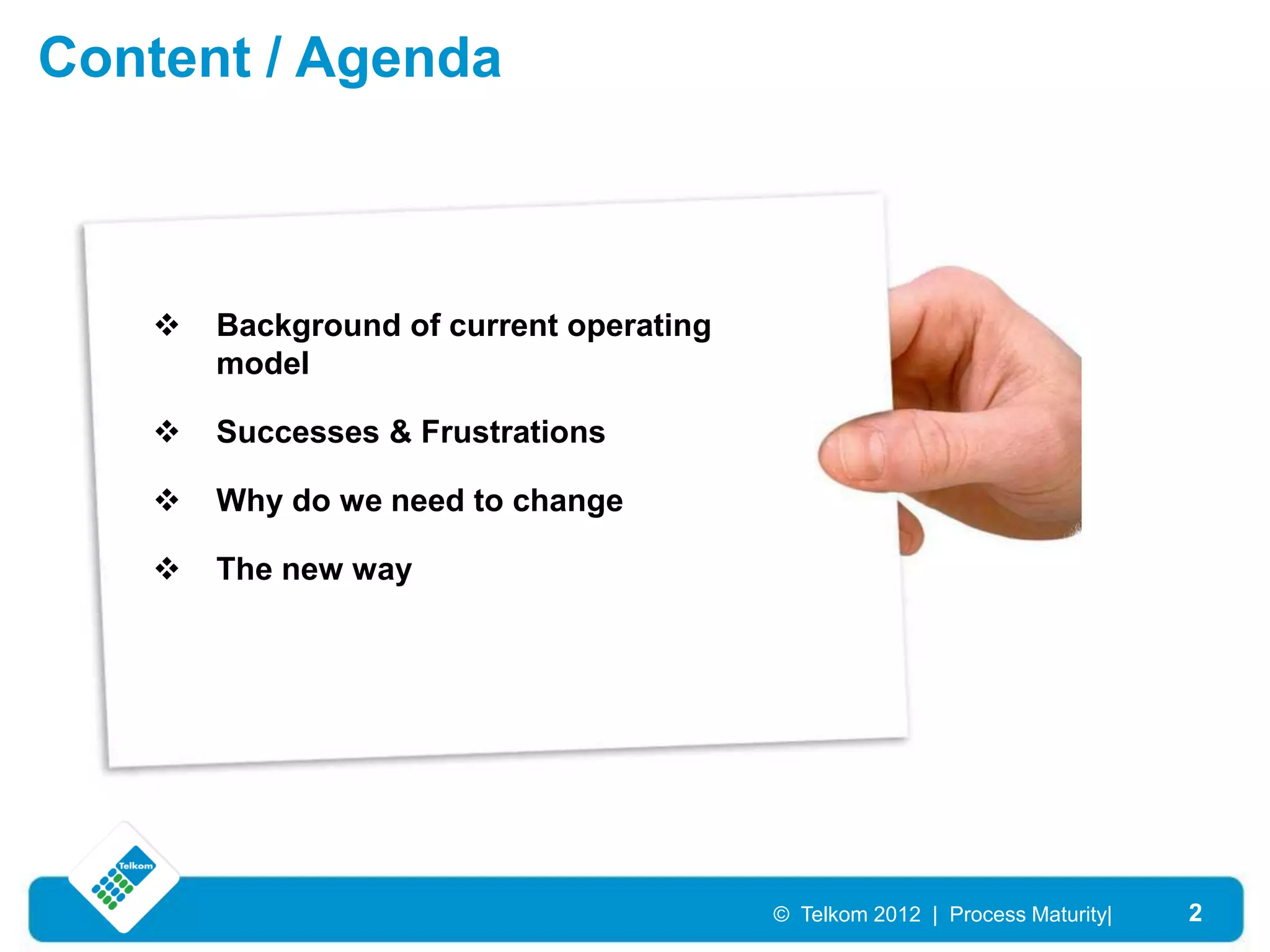
Content / Agenda


      Background of current operating
       model

      Successes & Frustrations

      Why do we need to change

      The new way


                                         © Telkom 2012 | Process Maturity|   2
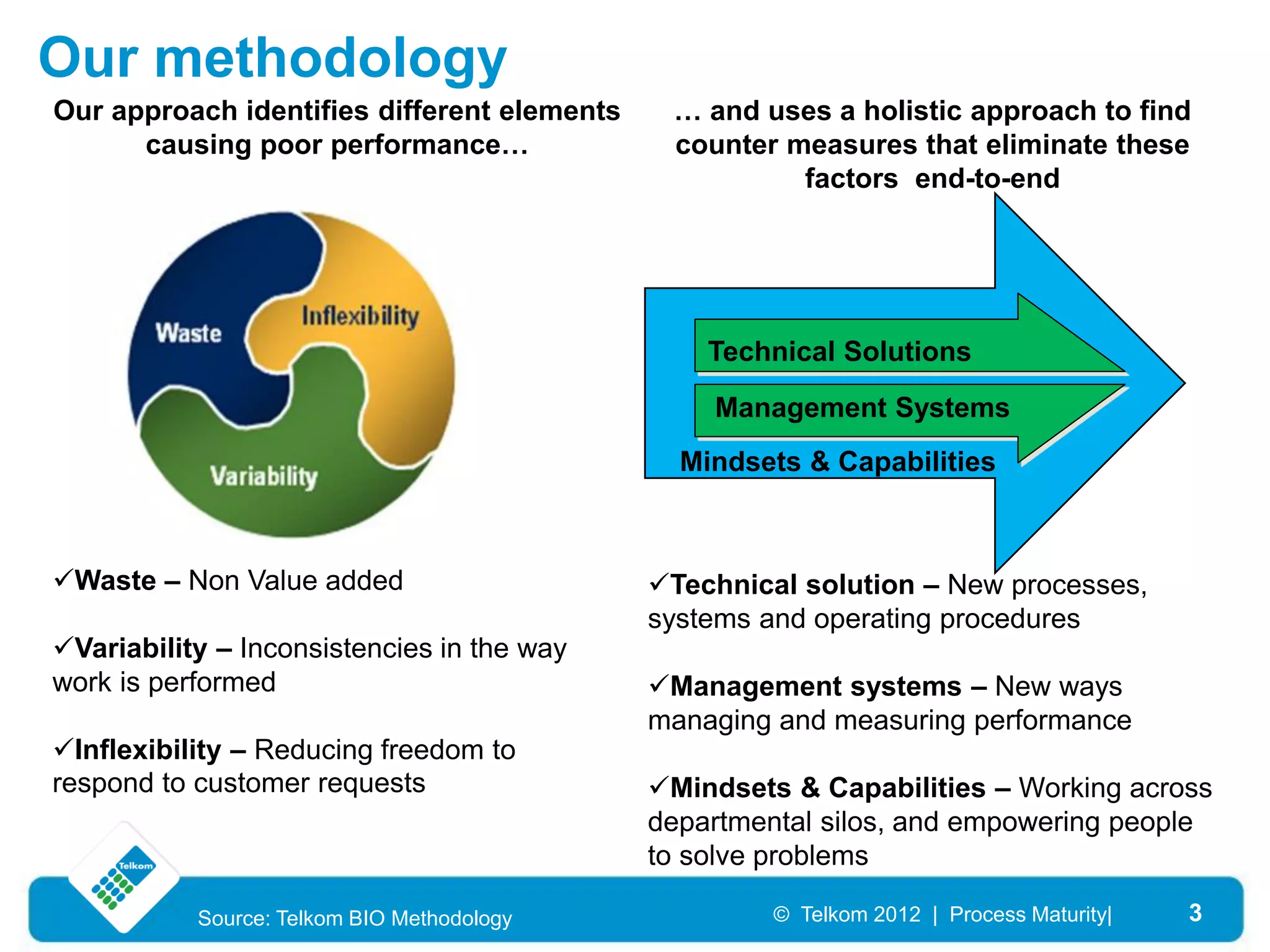
Our methodology
Our approach identifies different elements    … and uses a holistic approach to find
      causing poor performance…               counter measures that eliminate these
                                                       factors end-to-end


                                                 Technical Solutions
                                                 Management Systems
                                               Mindsets & Capabilities


Waste – Non Value added                     Technical solution – New processes,
                                             systems and operating procedures
Variability – Inconsistencies in the way
work is performed                            Management systems – New ways
                                             managing and measuring performance
Inflexibility – Reducing freedom to
respond to customer requests                 Mindsets & Capabilities – Working across
                                             departmental silos, and empowering people
                                             to solve problems

           Source: Telkom BIO Methodology             © Telkom 2012 | Process Maturity|   3
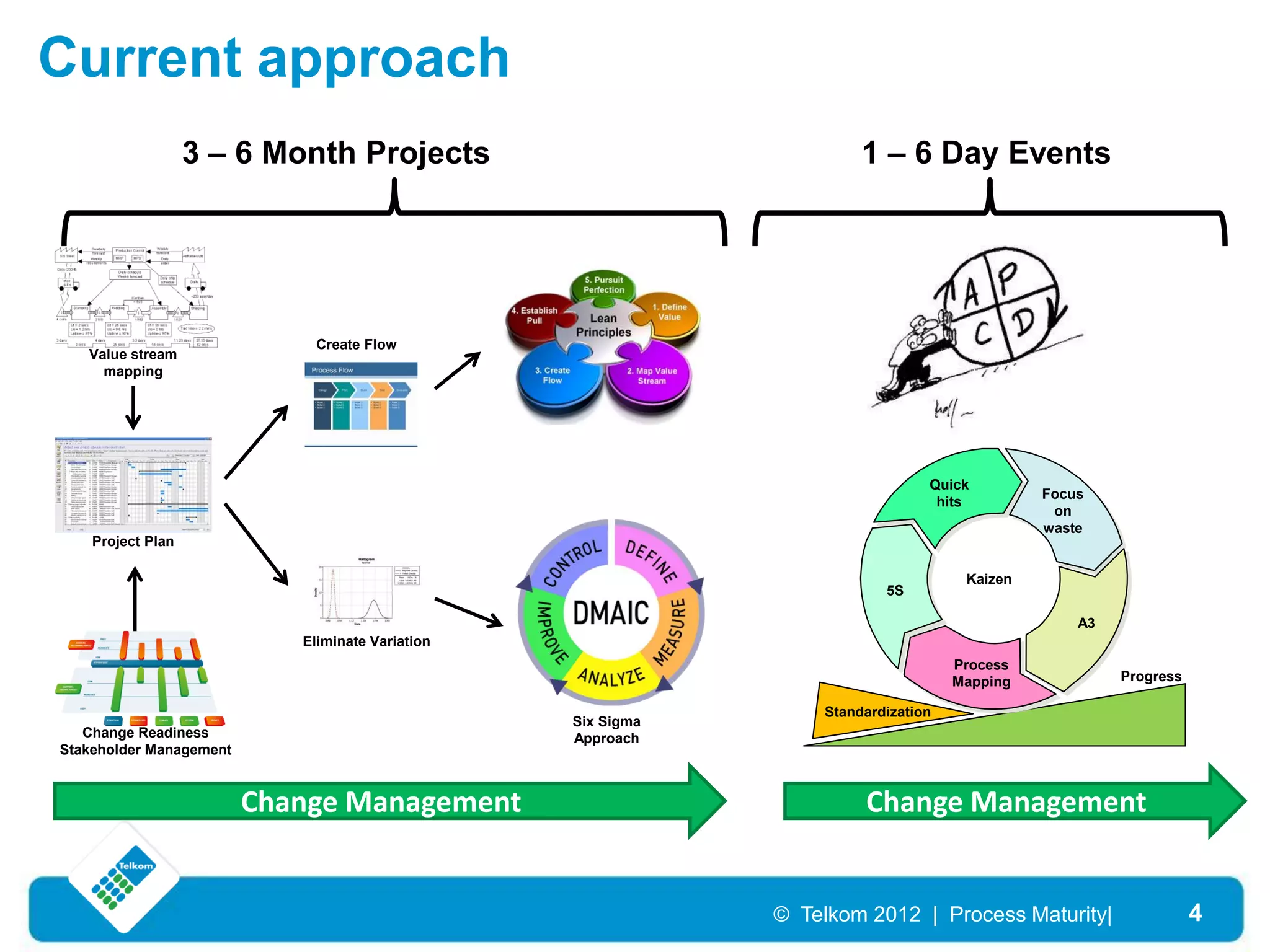
Current approach
                   3 – 6 Month Projects                                1 – 6 Day Events


                              Create Flow
   Value stream
     mapping


                                                                                Quick
                                                                                              Focus
                                                                                 hits
                                                                                               on
                                                                                              waste
    Project Plan

                                                                                     Kaizen
                                                                          5S

                                                                                                  A3
                            Eliminate Variation
                                                                                    Process
                                                                                    Mapping            Progress

                                                                  Standardization
                                                  Six Sigma
   Change Readiness                               Approach
Stakeholder Management


                         Change Management                             Change Management


                                                              © Telkom 2012 | Process Maturity|                   4
Successes
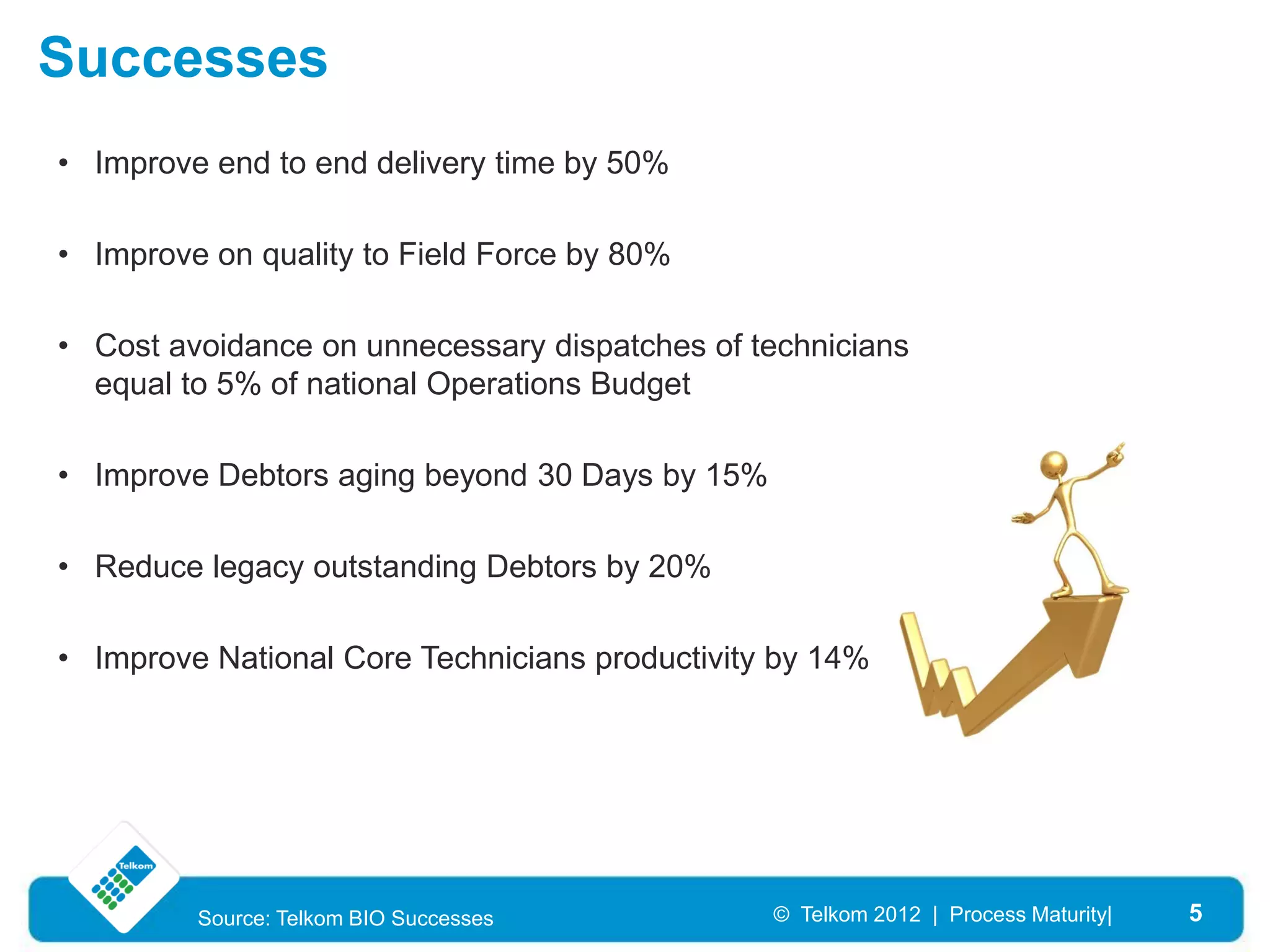
• Improve end to end delivery time by 50%

• Improve on quality to Field Force by 80%

• Cost avoidance on unnecessary dispatches of technicians
  equal to 5% of national Operations Budget

• Improve Debtors aging beyond 30 Days by 15%

• Reduce legacy outstanding Debtors by 20%

• Improve National Core Technicians productivity by 14%


         Source: Telkom BIO Successes           © Telkom 2012 | Process Maturity|   5
The frustration
• Bureaucracy hinder adoption

• Lack of sponsor involvement

• Little long-term sustainability

• Ownership

• Lack of Urgency (Currency of process improvement)

• Capability building on Continuous Improvement takes time and planning


                                               © Telkom 2012 | Process Maturity|   6
Why do we need to do things differently?
• Are you frustrated and feel you are not moving forward as fast as you
  need to?

• Is your organization ready for the challenges of a slower economy?

• Is your management asking you to control costs, avoid increasing staff
  size, and ensure that you are adding value?

• Do you need to keep metrics that demonstrate, without a doubt, that you are
  running a "tight ship"?

• At the same time, are you concerned about the quality of the work you
  are delivering to customers?

Combining Process Maturity with Process Improvement Methodologies provides
you with the tools you need to advance your organization.


                                                 © Telkom 2012 | Process Maturity|   7
What is a maturity model
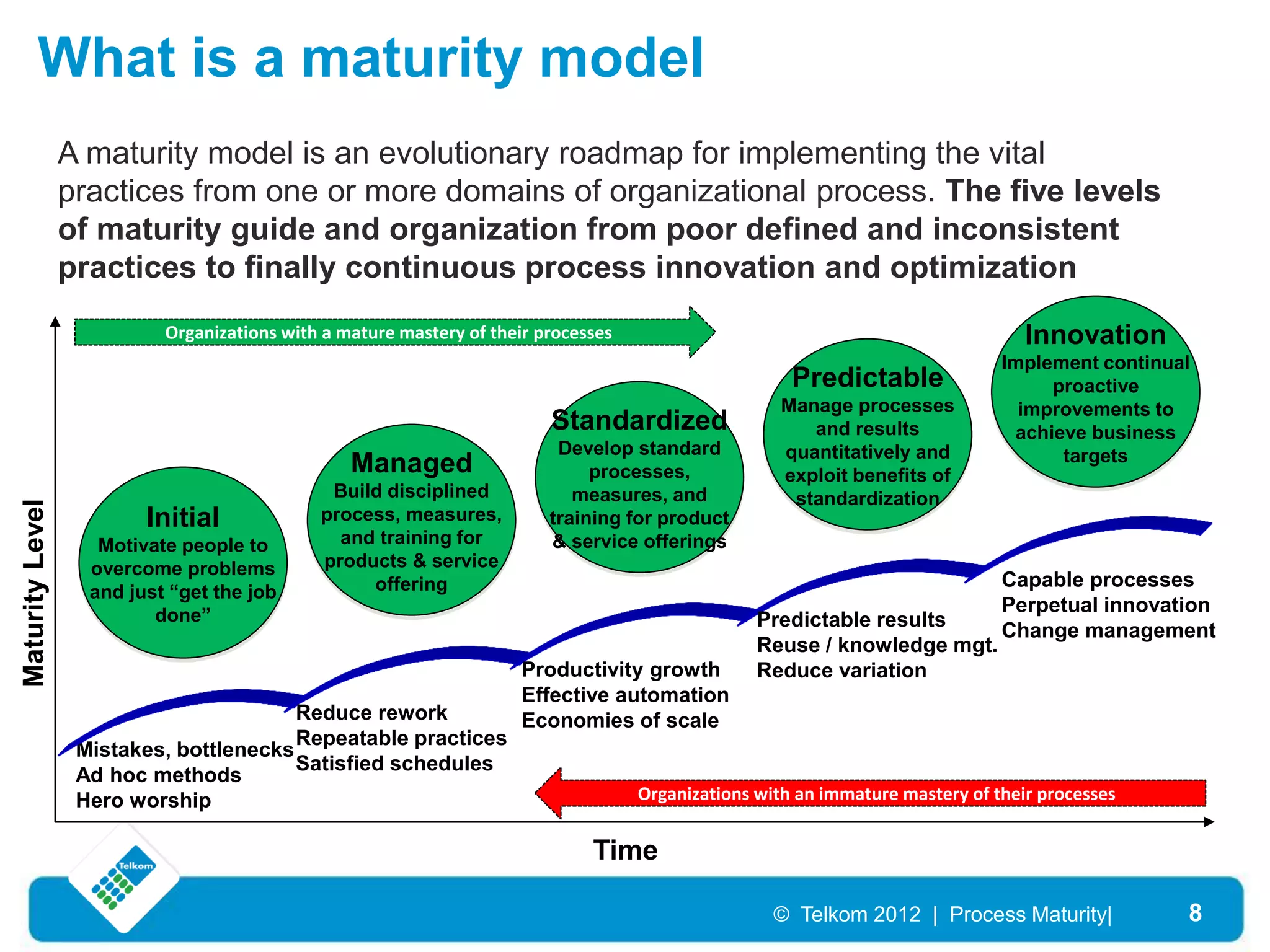
                 A maturity model is an evolutionary roadmap for implementing the vital
                 practices from one or more domains of organizational process. The five levels
                 of maturity guide and organization from poor defined and inconsistent
                 practices to finally continuous process innovation and optimization
                           Organizations with a mature mastery of their processes                                                 Innovation
                                                                                                                               Implement continual
                                                                                                      Predictable                   proactive
                                                                                                     Manage processes            improvements to
                                                                         Standardized                   and results             achieve business
                                                                          Develop standard           quantitatively and              targets
                                                 Managed                      processes,             exploit benefits of
                                              Build disciplined             measures, and             standardization
Maturity Level


                         Initial             process, measures,          training for product
                    Motivate people to         and training for          & service offerings
                   overcome problems         products & service
                                                  offering                                                                     Capable processes
                   and just “get the job
                          done”                                                                                                Perpetual innovation
                                                                                                  Predictable results
                                                                                                                               Change management
                                                                                                  Reuse / knowledge mgt.
                                                                      Productivity growth         Reduce variation
                                                                      Effective automation
                                        Reduce rework                 Economies of scale
                                        Repeatable practices
                  Mistakes, bottlenecks
                                        Satisfied schedules
                  Ad hoc methods
                  Hero worship                                                      Organizations with an immature mastery of their processes


                                                                              Time

                                                                                                    © Telkom 2012 | Process Maturity|            8
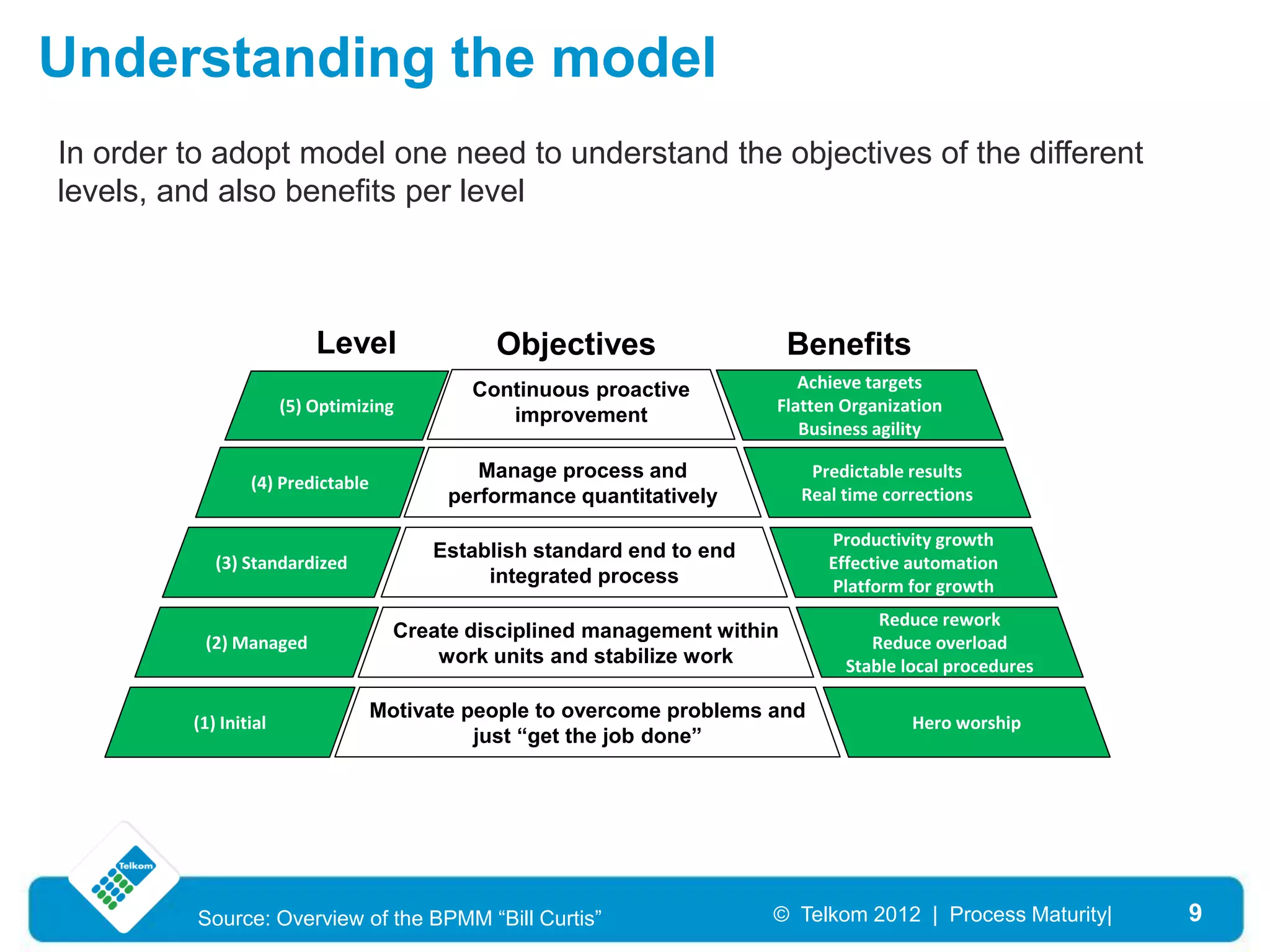
Understanding the model
In order to adopt model one need to understand the objectives of the different
levels, and also benefits per level


                           Level              Objectives                    Benefits
                                            Continuous proactive           Achieve targets
                       (5) Optimizing                                   Flatten Organization
                                               improvement
                                                                           Business agility

                                             Manage process and              Predictable results
                 (4) Predictable
                                          performance quantitatively        Real time corrections

                                                                               Productivity growth
                                        Establish standard end to end
            (3) Standardized                                                   Effective automation
                                             integrated process                Platform for growth
                                                                                     Reduce rework
                                     Create disciplined management within
          (2) Managed                                                               Reduce overload
                                         work units and stabilize work           Stable local procedures

                                   Motivate people to overcome problems and
         (1) Initial                                                                     Hero worship
                                             just “get the job done”


          Source: Overview of the BPMM “Bill Curtis”                    © Telkom 2012 | Process Maturity|   9
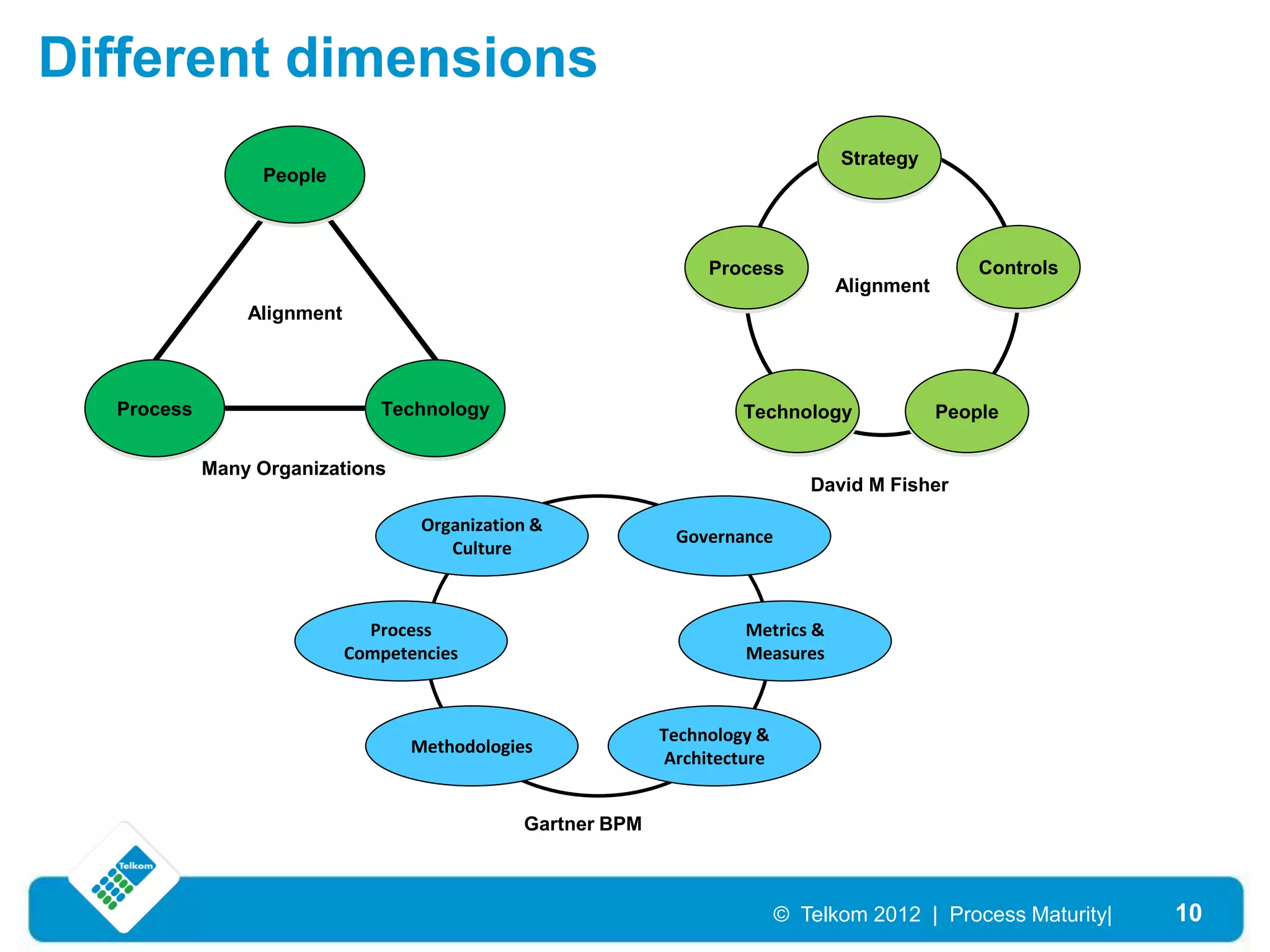
Different dimensions
                                                                                   Strategy
                  People


                                                                  Process                          Controls
                                                                                   Alignment
                Alignment


  Process                      Technology                             Technology               People

            Many Organizations
                                                                                David M Fisher

                                    Organization &
                                                              Governance
                                       Culture


                              Process                                  Metrics &
                            Competencies                               Measures


                                                             Technology &
                                   Methodologies
                                                              Architecture


                                               Gartner BPM


                                                                             © Telkom 2012 | Process Maturity|   10
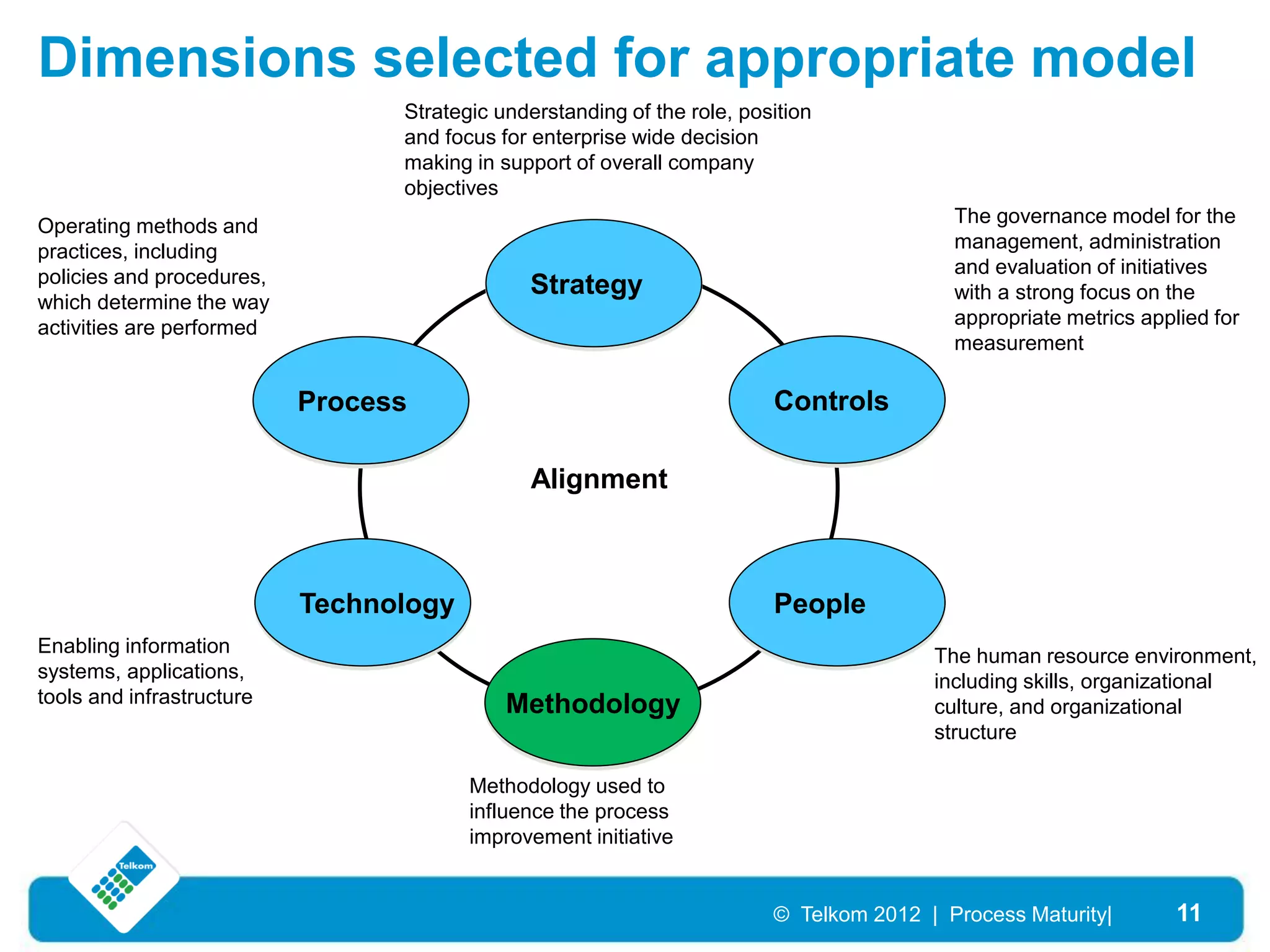
Dimensions selected for appropriate model
                                 Strategic understanding of the role, position
                                 and focus for enterprise wide decision
                                 making in support of overall company
                                 objectives
Operating methods and                                                                     The governance model for the
practices, including                                                                      management, administration
policies and procedures,                                                                  and evaluation of initiatives
                                              Strategy                                    with a strong focus on the
which determine the way
activities are performed                                                                  appropriate metrics applied for
                                                                                          measurement

                           Process                                       Controls

                                              Alignment


                           Technology                                    People
Enabling information                                                                    The human resource environment,
systems, applications,                                                                  including skills, organizational
tools and infrastructure                    Methodology                                 culture, and organizational
                                                                                        structure

                                        Methodology used to
                                        influence the process
                                        improvement initiative


                                                                         © Telkom 2012 | Process Maturity|        11
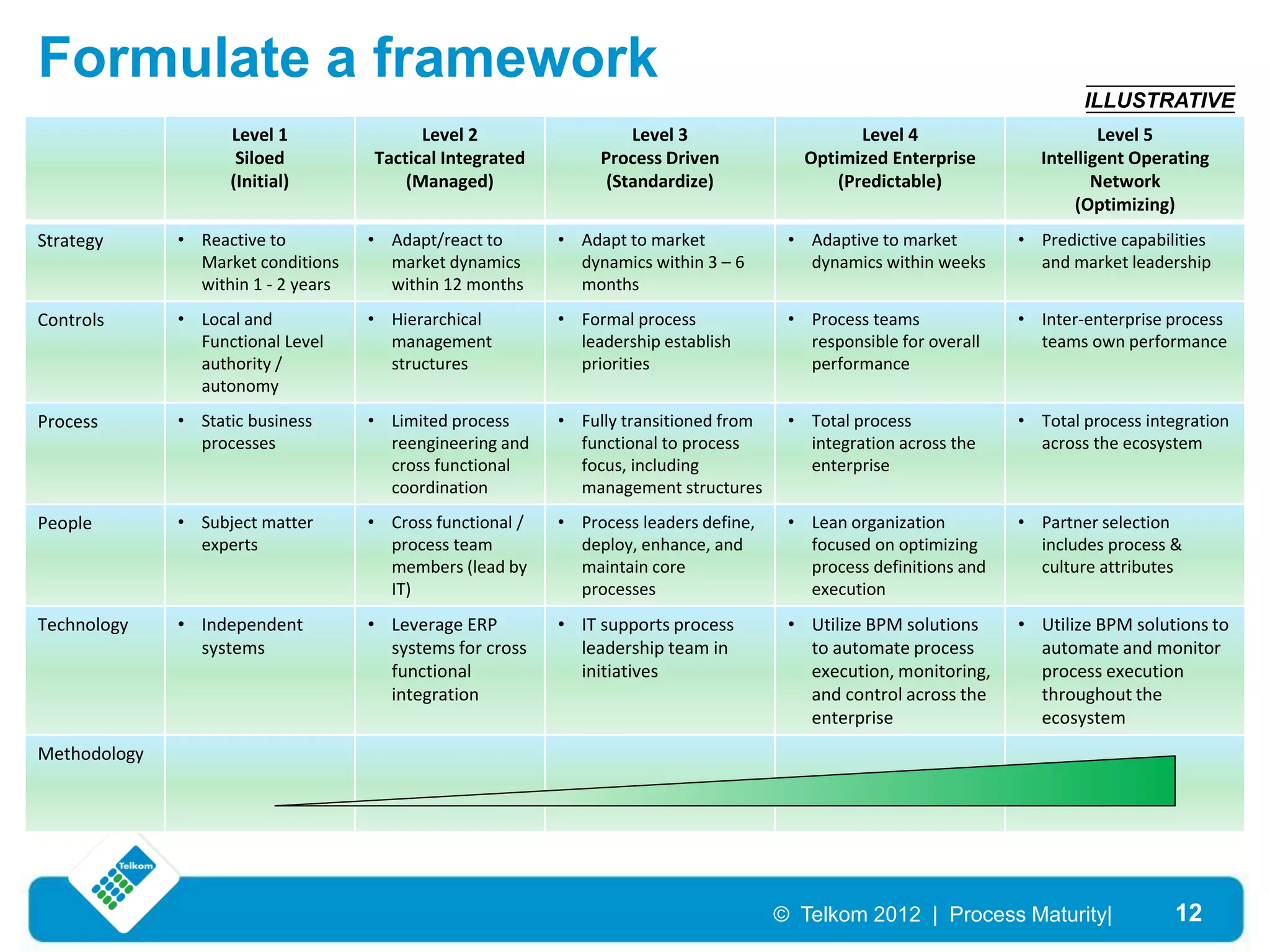
Formulate a framework
                                                                                                                             ILLUSTRATIVE
                    Level 1                Level 2                   Level 3                      Level 4                       Level 5
                     Siloed          Tactical Integrated         Process Driven            Optimized Enterprise         Intelligent Operating
                    (Initial)            (Managed)                (Standardize)                (Predictable)                   Network
                                                                                                                            (Optimizing)
Strategy      • Reactive to          • Adapt/react to       • Adapt to market            • Adaptive to market        • Predictive capabilities
                Market conditions      market dynamics        dynamics within 3 – 6        dynamics within weeks       and market leadership
                within 1 - 2 years     within 12 months       months
Controls      • Local and            • Hierarchical         • Formal process             • Process teams             • Inter-enterprise process
                Functional Level       management             leadership establish         responsible for overall     teams own performance
                authority /            structures             priorities                   performance
                autonomy
Process       • Static business      • Limited process      • Fully transitioned from    • Total process             • Total process integration
                processes              reengineering and      functional to process        integration across the      across the ecosystem
                                       cross functional       focus, including             enterprise
                                       coordination           management structures
People        • Subject matter       • Cross functional /   • Process leaders define,    • Lean organization         • Partner selection
                experts                process team           deploy, enhance, and         focused on optimizing       includes process &
                                       members (lead by       maintain core                process definitions and     culture attributes
                                       IT)                    processes                    execution
Technology    • Independent          • Leverage ERP         • IT supports process        • Utilize BPM solutions     • Utilize BPM solutions to
                systems                systems for cross      leadership team in           to automate process         automate and monitor
                                       functional             initiatives                  execution, monitoring,      process execution
                                       integration                                         and control across the      throughout the
                                                                                           enterprise                  ecosystem
Methodology


                                                                                        © Telkom 2012 | Process Maturity|                12
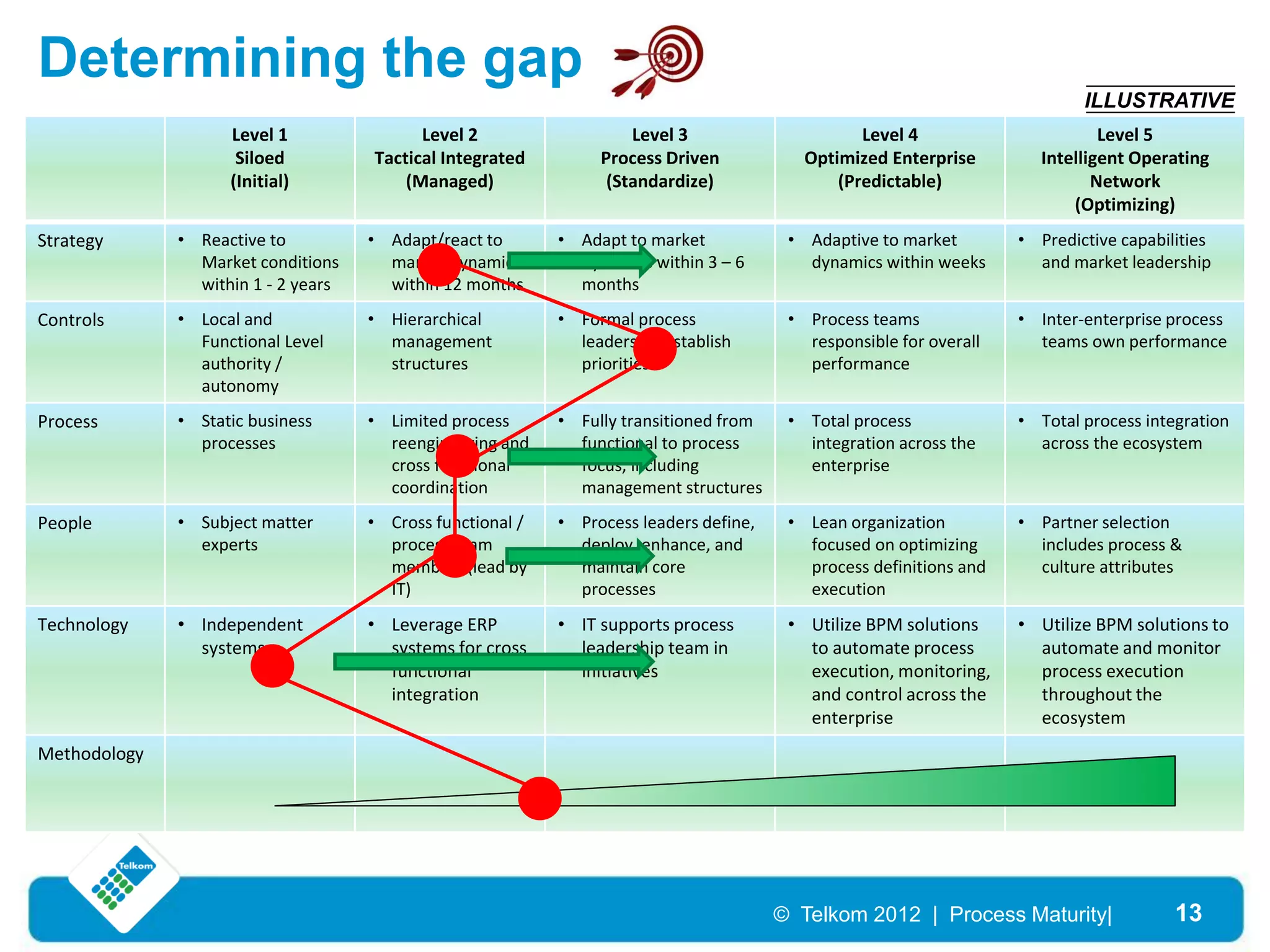
Determining the gap
                                                                                                                             ILLUSTRATIVE
                    Level 1                Level 2                   Level 3                      Level 4                       Level 5
                     Siloed          Tactical Integrated         Process Driven            Optimized Enterprise         Intelligent Operating
                    (Initial)            (Managed)                (Standardize)                (Predictable)                   Network
                                                                                                                            (Optimizing)
Strategy      • Reactive to          • Adapt/react to       • Adapt to market            • Adaptive to market        • Predictive capabilities
                Market conditions      market dynamics        dynamics within 3 – 6        dynamics within weeks       and market leadership
                within 1 - 2 years     within 12 months       months
Controls      • Local and            • Hierarchical         • Formal process             • Process teams             • Inter-enterprise process
                Functional Level       management             leadership establish         responsible for overall     teams own performance
                authority /            structures             priorities                   performance
                autonomy
Process       • Static business      • Limited process      • Fully transitioned from    • Total process             • Total process integration
                processes              reengineering and      functional to process        integration across the      across the ecosystem
                                       cross functional       focus, including             enterprise
                                       coordination           management structures
People        • Subject matter       • Cross functional /   • Process leaders define,    • Lean organization         • Partner selection
                experts                process team           deploy, enhance, and         focused on optimizing       includes process &
                                       members (lead by       maintain core                process definitions and     culture attributes
                                       IT)                    processes                    execution
Technology    • Independent          • Leverage ERP         • IT supports process        • Utilize BPM solutions     • Utilize BPM solutions to
                systems                systems for cross      leadership team in           to automate process         automate and monitor
                                       functional             initiatives                  execution, monitoring,      process execution
                                       integration                                         and control across the      throughout the
                                                                                           enterprise                  ecosystem
Methodology


                                                                                        © Telkom 2012 | Process Maturity|                13
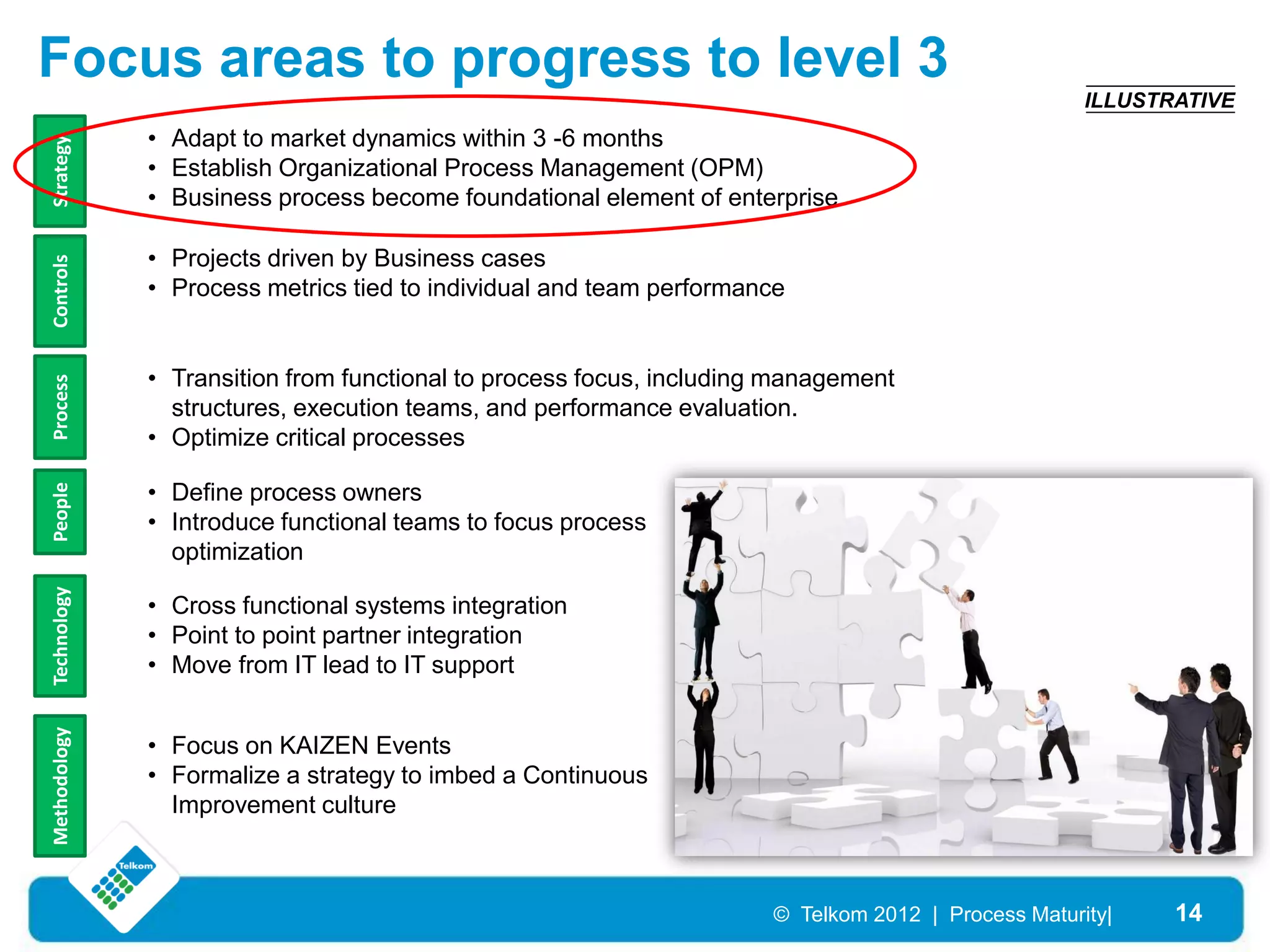
Focus areas to progress to level 3
                                                                                                    ILLUSTRATIVE
              • Adapt to market dynamics within 3 -6 months
Strategy


              • Establish Organizational Process Management (OPM)
              • Business process become foundational element of enterprise

              • Projects driven by Business cases
Controls


              • Process metrics tied to individual and team performance


              • Transition from functional to process focus, including management
Process


                structures, execution teams, and performance evaluation.
              • Optimize critical processes

              • Define process owners
People


              • Introduce functional teams to focus process
                optimization
Technology


              • Cross functional systems integration
              • Point to point partner integration
              • Move from IT lead to IT support
Methodology


              • Focus on KAIZEN Events
              • Formalize a strategy to imbed a Continuous
                Improvement culture


                                                                      © Telkom 2012 | Process Maturity|    14
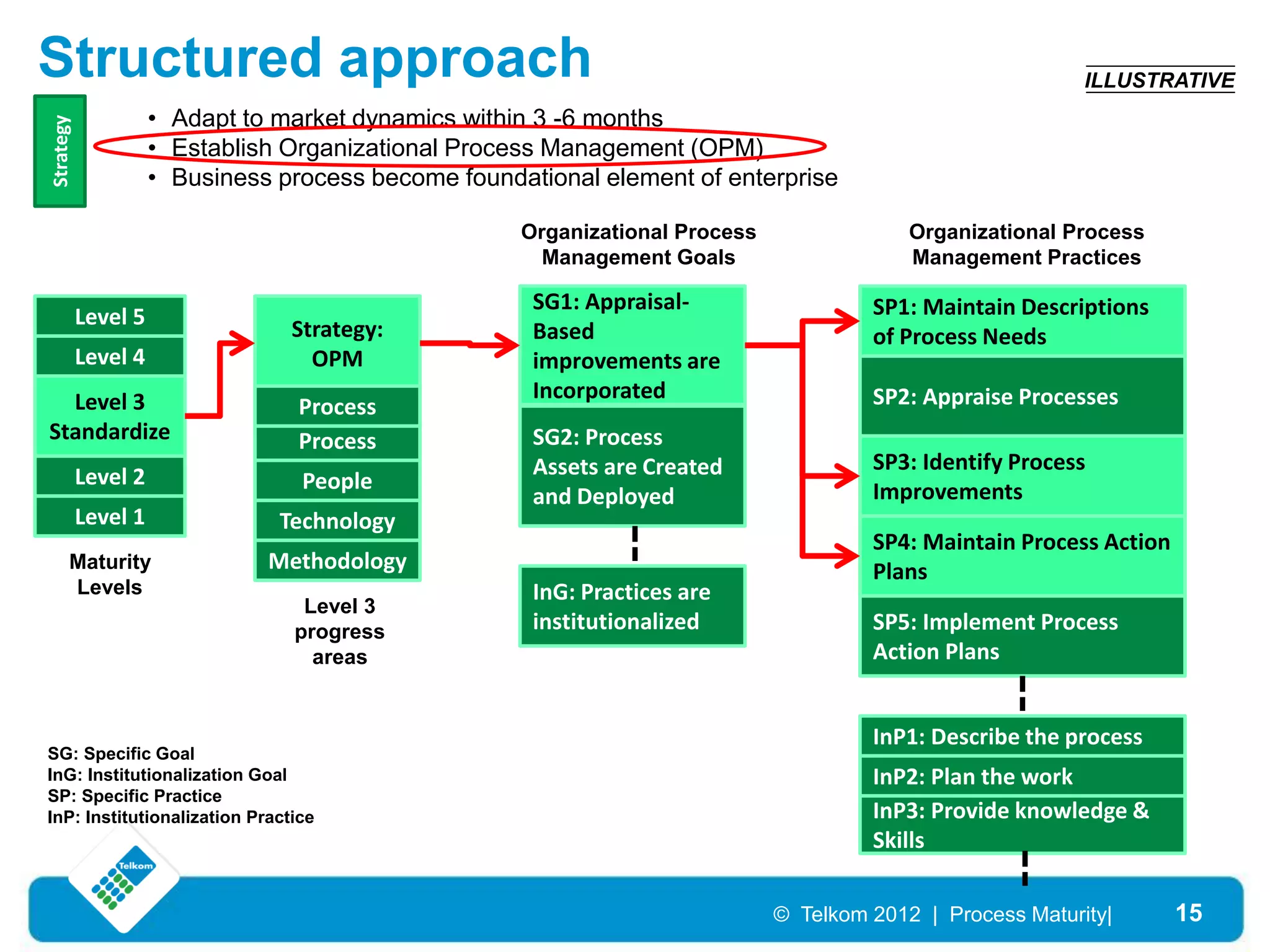
Structured approach                                                                                         ILLUSTRATIVE
                     • Adapt to market dynamics within 3 -6 months
Strategy


                     • Establish Organizational Process Management (OPM)
                     • Business process become foundational element of enterprise

                                                     Organizational Process                Organizational Process
                                                       Management Goals                    Management Practices

                                                      SG1: Appraisal-                  SP1: Maintain Descriptions
           Level 5               Strategy:            Based                            of Process Needs
           Level 4                 OPM                improvements are
  Level 3                                             Incorporated                     SP2: Appraise Processes
                                  Process
Standardize                       Process             SG2: Process
                                                      Assets are Created               SP3: Identify Process
           Level 2                People
                                                      and Deployed                     Improvements
           Level 1              Technology
                                                                                       SP4: Maintain Process Action
      Maturity                 Methodology                                             Plans
      Levels                                          InG: Practices are
                                  Level 3
                                 progress             institutionalized                SP5: Implement Process
                                   areas                                               Action Plans


                                                                                       InP1: Describe the process
SG: Specific Goal
InG: Institutionalization Goal                                                         InP2: Plan the work
SP: Specific Practice
InP: Institutionalization Practice                                                     InP3: Provide knowledge &
                                                                                       Skills

                                                                              © Telkom 2012 | Process Maturity|       15
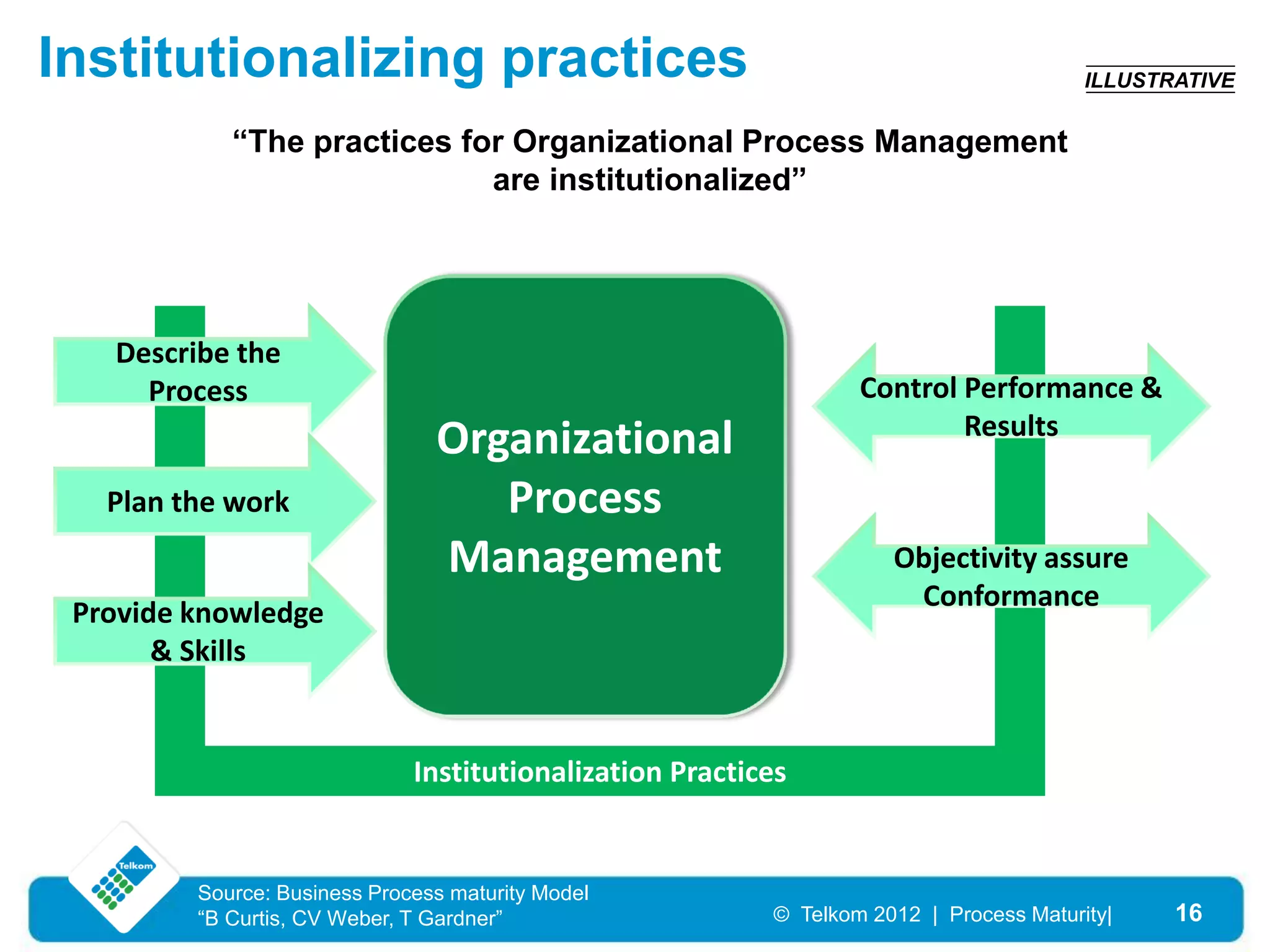
Institutionalizing practices                                                            ILLUSTRATIVE


            “The practices for Organizational Process Management
                             are institutionalized”


   Describe the
     Process                                                      Control Performance &
                                                                          Results
                                Organizational
   Plan the work                   Process
                                Management                           Objectivity assure
                                                                      Conformance
 Provide knowledge
       & Skills


                              Institutionalization Practices


         Source: Business Process maturity Model
         “B Curtis, CV Weber, T Gardner”                  © Telkom 2012 | Process Maturity|    16
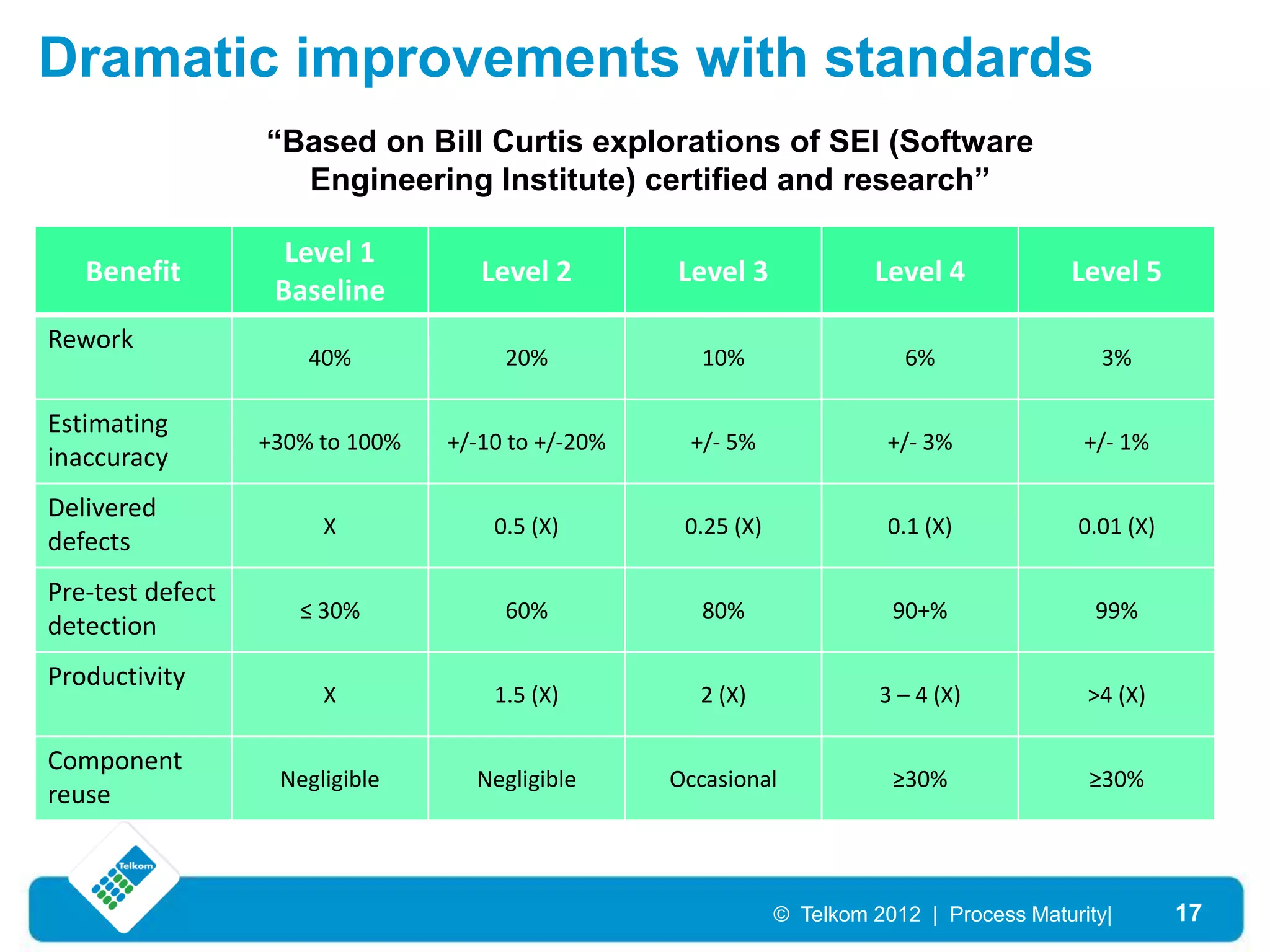
Dramatic improvements with standards
                  “Based on Bill Curtis explorations of SEI (Software
                    Engineering Institute) certified and research”

                    Level 1
   Benefit                          Level 2        Level 3              Level 4             Level 5
                   Baseline
Rework
                      40%             20%             10%                  6%                 3%

Estimating
                  +30% to 100%   +/-10 to +/-20%    +/- 5%                +/- 3%             +/- 1%
inaccuracy
Delivered
                       X             0.5 (X)        0.25 (X)              0.1 (X)           0.01 (X)
defects
Pre-test defect
                     ≤ 30%            60%             80%                 90+%                99%
detection
Productivity
                       X             1.5 (X)         2 (X)               3 – 4 (X)           >4 (X)

Component
                   Negligible      Negligible      Occasional             ≥30%               ≥30%
reuse


                                                               © Telkom 2012 | Process Maturity|       17
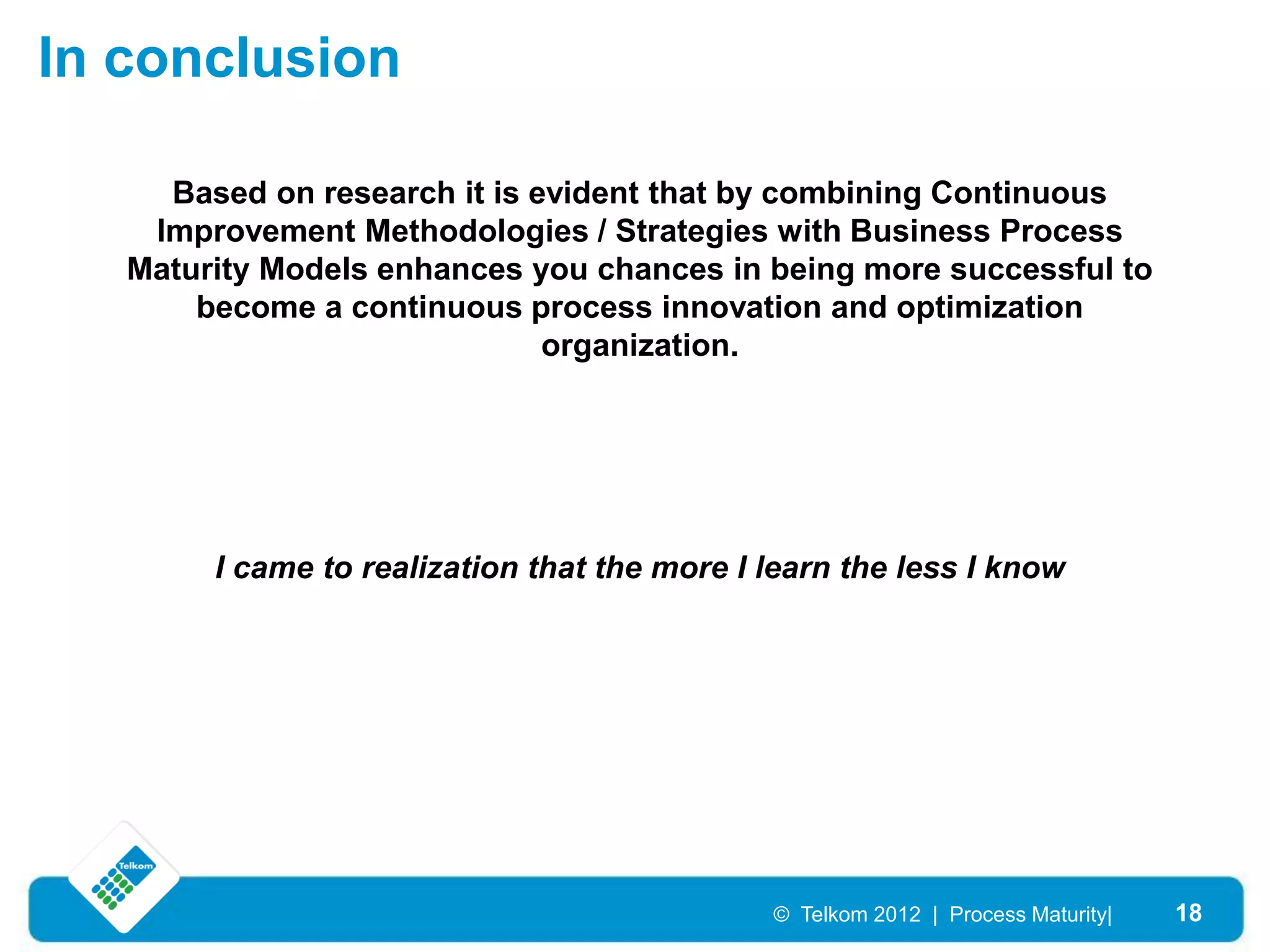
In conclusion

     Based on research it is evident that by combining Continuous
    Improvement Methodologies / Strategies with Business Process
   Maturity Models enhances you chances in being more successful to
       become a continuous process innovation and optimization
                              organization.


        I came to realization that the more I learn the less I know


                                              © Telkom 2012 | Process Maturity|   18
Acknowledgements


     TeraQuets “Bill Curtis”

     BearingPoint “David M Fisher”

     BPTrends “Paul Harmon”

     McAfee “ Bill Curtis”

     Capability Measurement “ John Alden”

     Gartner “Janelle Hill”

     Stevens Institute of Technology “Danny Ho”

     Capability Measurement, LLC “ Dr. John W Alden”

     Business Process Maturity Model “Charles V
      Weber, Bill Curtis, Tony Gardner”


                                                   © Telkom 2012 | Process Maturity|   19
Thank You!

Process maturity

  • 1.
    Process Maturity Assessing your readiness to progress to the next level Danie du Toit Internal Business Improvement Consultant Telkom SA LTD
  • 2.
    Content / Agenda  Background of current operating model  Successes & Frustrations  Why do we need to change  The new way © Telkom 2012 | Process Maturity| 2
  • 3.
    Our methodology Our approachidentifies different elements … and uses a holistic approach to find causing poor performance… counter measures that eliminate these factors end-to-end Technical Solutions Management Systems Mindsets & Capabilities Waste – Non Value added Technical solution – New processes, systems and operating procedures Variability – Inconsistencies in the way work is performed Management systems – New ways managing and measuring performance Inflexibility – Reducing freedom to respond to customer requests Mindsets & Capabilities – Working across departmental silos, and empowering people to solve problems Source: Telkom BIO Methodology © Telkom 2012 | Process Maturity| 3
  • 4.
    Current approach 3 – 6 Month Projects 1 – 6 Day Events Create Flow Value stream mapping Quick Focus hits on waste Project Plan Kaizen 5S A3 Eliminate Variation Process Mapping Progress Standardization Six Sigma Change Readiness Approach Stakeholder Management Change Management Change Management © Telkom 2012 | Process Maturity| 4
  • 5.
    Successes • Improve endto end delivery time by 50% • Improve on quality to Field Force by 80% • Cost avoidance on unnecessary dispatches of technicians equal to 5% of national Operations Budget • Improve Debtors aging beyond 30 Days by 15% • Reduce legacy outstanding Debtors by 20% • Improve National Core Technicians productivity by 14% Source: Telkom BIO Successes © Telkom 2012 | Process Maturity| 5
  • 6.
    The frustration • Bureaucracyhinder adoption • Lack of sponsor involvement • Little long-term sustainability • Ownership • Lack of Urgency (Currency of process improvement) • Capability building on Continuous Improvement takes time and planning © Telkom 2012 | Process Maturity| 6
  • 7.
    Why do weneed to do things differently? • Are you frustrated and feel you are not moving forward as fast as you need to? • Is your organization ready for the challenges of a slower economy? • Is your management asking you to control costs, avoid increasing staff size, and ensure that you are adding value? • Do you need to keep metrics that demonstrate, without a doubt, that you are running a "tight ship"? • At the same time, are you concerned about the quality of the work you are delivering to customers? Combining Process Maturity with Process Improvement Methodologies provides you with the tools you need to advance your organization. © Telkom 2012 | Process Maturity| 7
  • 8.
    What is amaturity model A maturity model is an evolutionary roadmap for implementing the vital practices from one or more domains of organizational process. The five levels of maturity guide and organization from poor defined and inconsistent practices to finally continuous process innovation and optimization Organizations with a mature mastery of their processes Innovation Implement continual Predictable proactive Manage processes improvements to Standardized and results achieve business Develop standard quantitatively and targets Managed processes, exploit benefits of Build disciplined measures, and standardization Maturity Level Initial process, measures, training for product Motivate people to and training for & service offerings overcome problems products & service offering Capable processes and just “get the job done” Perpetual innovation Predictable results Change management Reuse / knowledge mgt. Productivity growth Reduce variation Effective automation Reduce rework Economies of scale Repeatable practices Mistakes, bottlenecks Satisfied schedules Ad hoc methods Hero worship Organizations with an immature mastery of their processes Time © Telkom 2012 | Process Maturity| 8
  • 9.
    Understanding the model Inorder to adopt model one need to understand the objectives of the different levels, and also benefits per level Level Objectives Benefits Continuous proactive Achieve targets (5) Optimizing Flatten Organization improvement Business agility Manage process and Predictable results (4) Predictable performance quantitatively Real time corrections Productivity growth Establish standard end to end (3) Standardized Effective automation integrated process Platform for growth Reduce rework Create disciplined management within (2) Managed Reduce overload work units and stabilize work Stable local procedures Motivate people to overcome problems and (1) Initial Hero worship just “get the job done” Source: Overview of the BPMM “Bill Curtis” © Telkom 2012 | Process Maturity| 9
  • 10.
    Different dimensions Strategy People Process Controls Alignment Alignment Process Technology Technology People Many Organizations David M Fisher Organization & Governance Culture Process Metrics & Competencies Measures Technology & Methodologies Architecture Gartner BPM © Telkom 2012 | Process Maturity| 10
  • 11.
    Dimensions selected forappropriate model Strategic understanding of the role, position and focus for enterprise wide decision making in support of overall company objectives Operating methods and The governance model for the practices, including management, administration policies and procedures, and evaluation of initiatives Strategy with a strong focus on the which determine the way activities are performed appropriate metrics applied for measurement Process Controls Alignment Technology People Enabling information The human resource environment, systems, applications, including skills, organizational tools and infrastructure Methodology culture, and organizational structure Methodology used to influence the process improvement initiative © Telkom 2012 | Process Maturity| 11
  • 12.
    Formulate a framework ILLUSTRATIVE Level 1 Level 2 Level 3 Level 4 Level 5 Siloed Tactical Integrated Process Driven Optimized Enterprise Intelligent Operating (Initial) (Managed) (Standardize) (Predictable) Network (Optimizing) Strategy • Reactive to • Adapt/react to • Adapt to market • Adaptive to market • Predictive capabilities Market conditions market dynamics dynamics within 3 – 6 dynamics within weeks and market leadership within 1 - 2 years within 12 months months Controls • Local and • Hierarchical • Formal process • Process teams • Inter-enterprise process Functional Level management leadership establish responsible for overall teams own performance authority / structures priorities performance autonomy Process • Static business • Limited process • Fully transitioned from • Total process • Total process integration processes reengineering and functional to process integration across the across the ecosystem cross functional focus, including enterprise coordination management structures People • Subject matter • Cross functional / • Process leaders define, • Lean organization • Partner selection experts process team deploy, enhance, and focused on optimizing includes process & members (lead by maintain core process definitions and culture attributes IT) processes execution Technology • Independent • Leverage ERP • IT supports process • Utilize BPM solutions • Utilize BPM solutions to systems systems for cross leadership team in to automate process automate and monitor functional initiatives execution, monitoring, process execution integration and control across the throughout the enterprise ecosystem Methodology © Telkom 2012 | Process Maturity| 12
  • 13.
    Determining the gap ILLUSTRATIVE Level 1 Level 2 Level 3 Level 4 Level 5 Siloed Tactical Integrated Process Driven Optimized Enterprise Intelligent Operating (Initial) (Managed) (Standardize) (Predictable) Network (Optimizing) Strategy • Reactive to • Adapt/react to • Adapt to market • Adaptive to market • Predictive capabilities Market conditions market dynamics dynamics within 3 – 6 dynamics within weeks and market leadership within 1 - 2 years within 12 months months Controls • Local and • Hierarchical • Formal process • Process teams • Inter-enterprise process Functional Level management leadership establish responsible for overall teams own performance authority / structures priorities performance autonomy Process • Static business • Limited process • Fully transitioned from • Total process • Total process integration processes reengineering and functional to process integration across the across the ecosystem cross functional focus, including enterprise coordination management structures People • Subject matter • Cross functional / • Process leaders define, • Lean organization • Partner selection experts process team deploy, enhance, and focused on optimizing includes process & members (lead by maintain core process definitions and culture attributes IT) processes execution Technology • Independent • Leverage ERP • IT supports process • Utilize BPM solutions • Utilize BPM solutions to systems systems for cross leadership team in to automate process automate and monitor functional initiatives execution, monitoring, process execution integration and control across the throughout the enterprise ecosystem Methodology © Telkom 2012 | Process Maturity| 13
  • 14.
    Focus areas toprogress to level 3 ILLUSTRATIVE • Adapt to market dynamics within 3 -6 months Strategy • Establish Organizational Process Management (OPM) • Business process become foundational element of enterprise • Projects driven by Business cases Controls • Process metrics tied to individual and team performance • Transition from functional to process focus, including management Process structures, execution teams, and performance evaluation. • Optimize critical processes • Define process owners People • Introduce functional teams to focus process optimization Technology • Cross functional systems integration • Point to point partner integration • Move from IT lead to IT support Methodology • Focus on KAIZEN Events • Formalize a strategy to imbed a Continuous Improvement culture © Telkom 2012 | Process Maturity| 14
  • 15.
    Structured approach ILLUSTRATIVE • Adapt to market dynamics within 3 -6 months Strategy • Establish Organizational Process Management (OPM) • Business process become foundational element of enterprise Organizational Process Organizational Process Management Goals Management Practices SG1: Appraisal- SP1: Maintain Descriptions Level 5 Strategy: Based of Process Needs Level 4 OPM improvements are Level 3 Incorporated SP2: Appraise Processes Process Standardize Process SG2: Process Assets are Created SP3: Identify Process Level 2 People and Deployed Improvements Level 1 Technology SP4: Maintain Process Action Maturity Methodology Plans Levels InG: Practices are Level 3 progress institutionalized SP5: Implement Process areas Action Plans InP1: Describe the process SG: Specific Goal InG: Institutionalization Goal InP2: Plan the work SP: Specific Practice InP: Institutionalization Practice InP3: Provide knowledge & Skills © Telkom 2012 | Process Maturity| 15
  • 16.
    Institutionalizing practices ILLUSTRATIVE “The practices for Organizational Process Management are institutionalized” Describe the Process Control Performance & Results Organizational Plan the work Process Management Objectivity assure Conformance Provide knowledge & Skills Institutionalization Practices Source: Business Process maturity Model “B Curtis, CV Weber, T Gardner” © Telkom 2012 | Process Maturity| 16
  • 17.
    Dramatic improvements withstandards “Based on Bill Curtis explorations of SEI (Software Engineering Institute) certified and research” Level 1 Benefit Level 2 Level 3 Level 4 Level 5 Baseline Rework 40% 20% 10% 6% 3% Estimating +30% to 100% +/-10 to +/-20% +/- 5% +/- 3% +/- 1% inaccuracy Delivered X 0.5 (X) 0.25 (X) 0.1 (X) 0.01 (X) defects Pre-test defect ≤ 30% 60% 80% 90+% 99% detection Productivity X 1.5 (X) 2 (X) 3 – 4 (X) >4 (X) Component Negligible Negligible Occasional ≥30% ≥30% reuse © Telkom 2012 | Process Maturity| 17
  • 18.
    In conclusion Based on research it is evident that by combining Continuous Improvement Methodologies / Strategies with Business Process Maturity Models enhances you chances in being more successful to become a continuous process innovation and optimization organization. I came to realization that the more I learn the less I know © Telkom 2012 | Process Maturity| 18
  • 19.
    Acknowledgements  TeraQuets “Bill Curtis”  BearingPoint “David M Fisher”  BPTrends “Paul Harmon”  McAfee “ Bill Curtis”  Capability Measurement “ John Alden”  Gartner “Janelle Hill”  Stevens Institute of Technology “Danny Ho”  Capability Measurement, LLC “ Dr. John W Alden”  Business Process Maturity Model “Charles V Weber, Bill Curtis, Tony Gardner” © Telkom 2012 | Process Maturity| 19
  • 20.