Lean and Six Sigma for Project
Management
   Differences between traditional PM versus Lean PM
                      October 11th 2010
                     Arunima Soni Thakur
                             for


 (C) Arunima Thakur
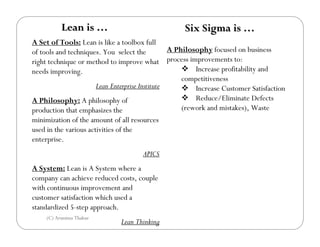
Lean is …                                 Six Sigma is …
A Set of Tools: Lean is like a toolbox full
of tools and techniques. You select the          A Philosophy focused on business
right technique or method to improve what process improvements to:
needs improving.                                         Increase profitability and
                                                     competitiveness
                       Lean Enterprise Institute         Increase Customer Satisfaction
A Philosophy: A philosophy of                            Reduce/Eliminate Defects
production that emphasizes the                       (rework and mistakes), Waste
minimization of the amount of all resources
used in the various activities of the
enterprise.
                                      APICS
A System: Lean is A System where a
company can achieve reduced costs, couple
with continuous improvement and
customer satisfaction which used a
standardized 5-step approach.
    (C) Arunima Thakur
                              Lean Thinking
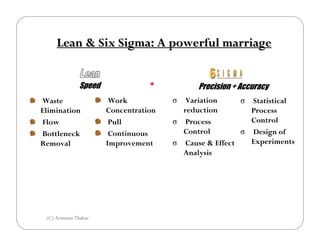
Lean & Six Sigma: A powerful marriage


              Speed              +          Precision + Accuracy
Waste                  Work           σ  Variation     σ Statistical
Elimination           Concentration     reduction        Process
Flow                   Pull           σ Process          Control
Bottleneck             Continuous       Control        σ Design of
Removal               Improvement     σ Cause & Effect   Experiments
                                        Analysis


 (C) Arunima Thakur
Lean Six Sigma Project transactions

 A suite of business solutions that have higher level of predictability; and
 lowered waste; as the foundation of their project management methodology
 It is a management system which:
        – Pursues optimum streamlining

        – Thoroughly eliminates waste

        – Builds quality into the process; with lowered variation

        – Recognizes the principle of cost reduction

        – Embraces time-based and mass customization competition

 …….throughout the entire project lifecycle.


Bottom line: Lean Six Sigma Projects are streamlined with higher predictability and lower variations
 Bottom line: Lean Six Sigma Projects are streamlined with higher predictability and lower variations

      (C) Arunima Thakur
What Lean Six sigma Projects are Not
Lean six sigma projects are not:
     n   A “bolt-on” technique…but more a way of life
     n   A cure all…but rather a better system
     n   A “Final Destination”…but more of a journey
     n   A new project management “software”/“program”…but a new way of thinking
     n   A new marketing concept…but rather the outcome of 50 years of effort by
         several generations of practitioners
     n   A manufacturing only solution…but rather a total business solution
     n   Easy to implement…but requires hard work, creative thinking and persistence.,

Lean Six Sigma Project Management isisaaprocess of identifying what adds value to the project from
 Lean Six Sigma Project Management        process of identifying what adds value to the project from
end state perspective and then eliminating non-value-added steps, as well as variability.
 end state perspective and then eliminating non-value-added steps, as well as variability.

    (C) Arunima Thakur
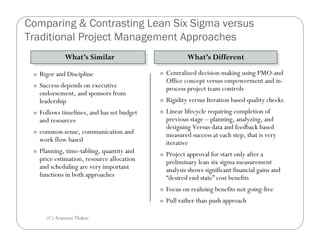
Comparing & Contrasting Lean Six Sigma versus
Traditional Project Management Approaches
              What’s Similar
              What’s Similar                             What’s Different
                                                         What’s Different
 n   Rigor and Discipline                    n   Centralized decision making using PMO-and
                                                 Office concept versus empowerment and in-
 n   Success depends on executive                process project team controls
     endorsement, and sponsors from
     leadership                              n   Rigidity versus Iteration based quality checks
 n   Follows timelines, and has set budget   n   Linear lifecycle requiring completion of
     and resources                               previous stage – planning, analyzing, and
                                                 designing Versus data and feedback based
 n   common sense, communication and             measured success at each step, that is very
     work flow based                             iterative
 n   Planning, time-tabling, quantity and    n   Project approval for start only after a
     price estimation, resource allocation       preliminary lean six sigma measurement
     and scheduling are very important           analysis shows significant financial gains and
     functions in both approaches                “desired end state” cost benefits
                                             n   Focus on realizing benefits not going-live
                                             n   Pull rather than push approach

       (C) Arunima Thakur
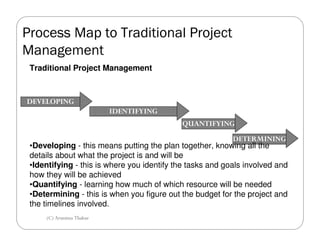
Process Map to Traditional Project
Management
 Traditional Project Management


DEVELOPING
                          IDENTIFYING
                                            QUANTIFYING
                                                            DETERMINING
 •Developing - this means putting the plan together, knowing all the
 details about what the project is and will be
 •Identifying - this is where you identify the tasks and goals involved and
 how they will be achieved
 •Quantifying - learning how much of which resource will be needed
 •Determining - this is when you figure out the budget for the project and
 the timelines involved.
     (C) Arunima Thakur
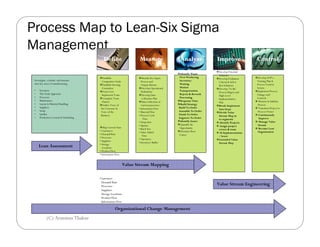
Process Map to Lean-Six Sigma
Management
                                          Define                      Measure                   Analyze            Improve              Control
                                                                                                                   Develop Potential
                                                                                                 Identify Waste
                                                                                                                   Solutions
                                          Establish                      Identify Key Input,    Over Producing                          Develop SOP’s,
                                                                                                                   Develop Evaluation
 Investigate, evaluate, and measure      Competitive Goals              Process and             Inventory                               Training Plan &
                                                                                                                   Criteria & Select
 nine key areas of manufacturing.         Establish Steering            Output Metrics          Waiting                                 Process Control
                                                                                                                   Best Solutions
                                         Committee                       Develop Operational    Motion                                  System
                                                                                                                   Develop ‘To-Be’
 •   Inventory                            Form Core                     Definitions             Transportation                          Implement Process
                                                                                                                   Process Map(s) and
 •   The Team Approach                   Implement Team                  Develop Data           Rejects & Rework                        Changes and
                                                                                                                   High-Level
 •   Processes                            Complete Team                  Collection Plan        Processing                              Controls
                                                                                                                   Implementation
 •   Maintenance                         Charter                         Data Collection of      Response Time                           Monitor & Stabilize
                                                                                                                   Plan
 •   Layout & Material Handling           Gather Voice of               Current processes        Build Strategy                          Process
                                                                                                                   Break Implement
 •   Suppliers                          the Customer &                • Information Flow       Build To Order                            Transition Project to
                                                                                                                   Into Steps
 •   Setup                              Voice of the                  • Material Flow          Assemble To Order                         Process Owner
                                                                                                                   Divide Value
 •   Quality                            Business                      • Process Cycle          Finish To Order                           Continuously
                                                                                                                   Stream Map in
 •   Production Control & Scheduling                                      Time                 Engineer To Order                          Improve
                                                                                                                   to segments
                                                                      • Setup time               Identify Issues                         Manage Value
                                                                                                                    Identify Projects
                                                                      • Uptime                   Quantify the                            Stream
                                          Map Current State                                                         Assign project
                                                                      • Batch Size              Opportunity                              Become Lean
                                                                                                                   owner & team
                                       • Customers                                               Prioritize Root                         Organization
                                                                      • Value Added                                 5S Implementation
                                       • Demand Rate                                            Causes
                                                                         Time                                      / Score
                                       • Processes
                                                                      • Operators                                  Extended Value
                                       • Suppliers
                                                                      • Inventory/Buffer                           Stream Map
                                       • Storage
     Lean Assessment                     Locations
                                       • Product Flow
                                       • Information Flow


                                                               Value Stream Mapping

                                       Customers
                                        Demand Rate
                                        Processes
                                                                                                                   Value Stream Engineering
                                        Suppliers
                                        Storage Locations
                                        Product Flow
                                        Information Flow

                                                      Organizational Change Management
            (C) Arunima Thakur
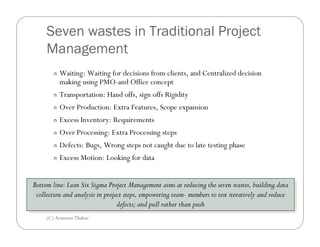
Seven wastes in Traditional Project
     Management
        n   Waiting: Waiting for decisions from clients, and Centralized decision
            making using PMO-and Office concept
        n   Transportation: Hand offs, sign offs Rigidity
        n   Over Production: Extra Features, Scope expansion
        n   Excess Inventory: Requirements
        n   Over Processing: Extra Processing steps
        n   Defects: Bugs, Wrong steps not caught due to late testing phase
        n   Excess Motion: Looking for data


Bottom line: Lean Six Sigma Project Management aims at reducing the seven wastes, building data
 Bottom line: Lean Six Sigma Project Management aims at reducing the seven wastes, building data
 collection and analysis in project steps, empowering team- members to test iteratively and reduce
  collection and analysis in project steps, empowering team- members to test iteratively and reduce
                                 defects; and pull rather than push
                                  defects; and pull rather than push
     (C) Arunima Thakur
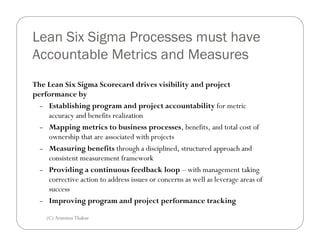
Lean Six Sigma Processes must have
Accountable Metrics and Measures
The Lean Six Sigma Scorecard drives visibility and project
performance by
  – Establishing program and project accountability for metric
    accuracy and benefits realization
  – Mapping metrics to business processes, benefits, and total cost of
    ownership that are associated with projects
  – Measuring benefits through a disciplined, structured approach and
    consistent measurement framework
  – Providing a continuous feedback loop – with management taking
    corrective action to address issues or concerns as well as leverage areas of
    success
  – Improving program and project performance tracking


    (C) Arunima Thakur
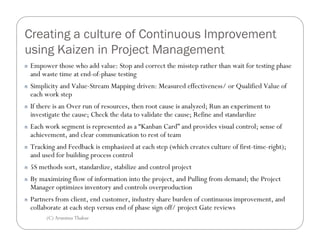
Creating a culture of Continuous Improvement
using Kaizen in Project Management
n   Empower those who add value: Stop and correct the misstep rather than wait for testing phase
    and waste time at end-of-phase testing
n   Simplicity and Value-Stream Mapping driven: Measured effectiveness/ or Qualified Value of
    each work step
n   If there is an Over run of resources, then root cause is analyzed; Run an experiment to
    investigate the cause; Check the data to validate the cause; Refine and standardize
n   Each work segment is represented as a “Kanban Card” and provides visual control; sense of
    achievement, and clear communication to rest of team
n   Tracking and Feedback is emphasized at each step (which creates culture of first-time-right);
    and used for building process control
n   5S methods sort, standardize, stabilize and control project
n   By maximizing flow of information into the project, and Pulling from demand; the Project
    Manager optimizes inventory and controls overproduction
n   Partners from client, end customer, industry share burden of continuous improvement, and
    collaborate at each step versus end of phase sign off/ project Gate reviews
         (C) Arunima Thakur
In summary

Lean Six Sigma Projects aim at providing highest value to the customer
Focus on iterative process of Plan-Do-Check at each step; versus linear
flow
Empower the team to create value at each step
Measure effectiveness, and Data driven


Thank you !                                       Arunima Thakur
                                                  athakur@innoengg.com
                                                  Phone 248 275 5786/
 (C) Arunima Thakur                                     248 879 0977

Lean sixsigmaproject managementoct11th2010[ (1)

  • 1.
    Lean and SixSigma for Project Management Differences between traditional PM versus Lean PM October 11th 2010 Arunima Soni Thakur for (C) Arunima Thakur
  • 2.
    Lean is … Six Sigma is … A Set of Tools: Lean is like a toolbox full of tools and techniques. You select the A Philosophy focused on business right technique or method to improve what process improvements to: needs improving. Increase profitability and competitiveness Lean Enterprise Institute Increase Customer Satisfaction A Philosophy: A philosophy of Reduce/Eliminate Defects production that emphasizes the (rework and mistakes), Waste minimization of the amount of all resources used in the various activities of the enterprise. APICS A System: Lean is A System where a company can achieve reduced costs, couple with continuous improvement and customer satisfaction which used a standardized 5-step approach. (C) Arunima Thakur Lean Thinking
  • 3.
    Lean & SixSigma: A powerful marriage Speed + Precision + Accuracy Waste Work σ Variation σ Statistical Elimination Concentration reduction Process Flow Pull σ Process Control Bottleneck Continuous Control σ Design of Removal Improvement σ Cause & Effect Experiments Analysis (C) Arunima Thakur
  • 4.
    Lean Six SigmaProject transactions A suite of business solutions that have higher level of predictability; and lowered waste; as the foundation of their project management methodology It is a management system which: – Pursues optimum streamlining – Thoroughly eliminates waste – Builds quality into the process; with lowered variation – Recognizes the principle of cost reduction – Embraces time-based and mass customization competition …….throughout the entire project lifecycle. Bottom line: Lean Six Sigma Projects are streamlined with higher predictability and lower variations Bottom line: Lean Six Sigma Projects are streamlined with higher predictability and lower variations (C) Arunima Thakur
  • 5.
    What Lean Sixsigma Projects are Not Lean six sigma projects are not: n A “bolt-on” technique…but more a way of life n A cure all…but rather a better system n A “Final Destination”…but more of a journey n A new project management “software”/“program”…but a new way of thinking n A new marketing concept…but rather the outcome of 50 years of effort by several generations of practitioners n A manufacturing only solution…but rather a total business solution n Easy to implement…but requires hard work, creative thinking and persistence., Lean Six Sigma Project Management isisaaprocess of identifying what adds value to the project from Lean Six Sigma Project Management process of identifying what adds value to the project from end state perspective and then eliminating non-value-added steps, as well as variability. end state perspective and then eliminating non-value-added steps, as well as variability. (C) Arunima Thakur
  • 6.
    Comparing & ContrastingLean Six Sigma versus Traditional Project Management Approaches What’s Similar What’s Similar What’s Different What’s Different n Rigor and Discipline n Centralized decision making using PMO-and Office concept versus empowerment and in- n Success depends on executive process project team controls endorsement, and sponsors from leadership n Rigidity versus Iteration based quality checks n Follows timelines, and has set budget n Linear lifecycle requiring completion of and resources previous stage – planning, analyzing, and designing Versus data and feedback based n common sense, communication and measured success at each step, that is very work flow based iterative n Planning, time-tabling, quantity and n Project approval for start only after a price estimation, resource allocation preliminary lean six sigma measurement and scheduling are very important analysis shows significant financial gains and functions in both approaches “desired end state” cost benefits n Focus on realizing benefits not going-live n Pull rather than push approach (C) Arunima Thakur
  • 7.
    Process Map toTraditional Project Management Traditional Project Management DEVELOPING IDENTIFYING QUANTIFYING DETERMINING •Developing - this means putting the plan together, knowing all the details about what the project is and will be •Identifying - this is where you identify the tasks and goals involved and how they will be achieved •Quantifying - learning how much of which resource will be needed •Determining - this is when you figure out the budget for the project and the timelines involved. (C) Arunima Thakur
  • 8.
    Process Map toLean-Six Sigma Management Define Measure Analyze Improve Control Develop Potential Identify Waste Solutions Establish Identify Key Input, Over Producing Develop SOP’s, Develop Evaluation Investigate, evaluate, and measure Competitive Goals Process and Inventory Training Plan & Criteria & Select nine key areas of manufacturing. Establish Steering Output Metrics Waiting Process Control Best Solutions Committee Develop Operational Motion System Develop ‘To-Be’ • Inventory Form Core Definitions Transportation Implement Process Process Map(s) and • The Team Approach Implement Team Develop Data Rejects & Rework Changes and High-Level • Processes Complete Team Collection Plan Processing Controls Implementation • Maintenance Charter Data Collection of Response Time Monitor & Stabilize Plan • Layout & Material Handling Gather Voice of Current processes Build Strategy Process Break Implement • Suppliers the Customer & • Information Flow Build To Order Transition Project to Into Steps • Setup Voice of the • Material Flow Assemble To Order Process Owner Divide Value • Quality Business • Process Cycle Finish To Order Continuously Stream Map in • Production Control & Scheduling Time Engineer To Order Improve to segments • Setup time Identify Issues Manage Value Identify Projects • Uptime Quantify the Stream Map Current State Assign project • Batch Size Opportunity Become Lean owner & team • Customers Prioritize Root Organization • Value Added 5S Implementation • Demand Rate Causes Time / Score • Processes • Operators Extended Value • Suppliers • Inventory/Buffer Stream Map • Storage Lean Assessment Locations • Product Flow • Information Flow Value Stream Mapping Customers Demand Rate Processes Value Stream Engineering Suppliers Storage Locations Product Flow Information Flow Organizational Change Management (C) Arunima Thakur
  • 9.
    Seven wastes inTraditional Project Management n Waiting: Waiting for decisions from clients, and Centralized decision making using PMO-and Office concept n Transportation: Hand offs, sign offs Rigidity n Over Production: Extra Features, Scope expansion n Excess Inventory: Requirements n Over Processing: Extra Processing steps n Defects: Bugs, Wrong steps not caught due to late testing phase n Excess Motion: Looking for data Bottom line: Lean Six Sigma Project Management aims at reducing the seven wastes, building data Bottom line: Lean Six Sigma Project Management aims at reducing the seven wastes, building data collection and analysis in project steps, empowering team- members to test iteratively and reduce collection and analysis in project steps, empowering team- members to test iteratively and reduce defects; and pull rather than push defects; and pull rather than push (C) Arunima Thakur
  • 10.
    Lean Six SigmaProcesses must have Accountable Metrics and Measures The Lean Six Sigma Scorecard drives visibility and project performance by – Establishing program and project accountability for metric accuracy and benefits realization – Mapping metrics to business processes, benefits, and total cost of ownership that are associated with projects – Measuring benefits through a disciplined, structured approach and consistent measurement framework – Providing a continuous feedback loop – with management taking corrective action to address issues or concerns as well as leverage areas of success – Improving program and project performance tracking (C) Arunima Thakur
  • 11.
    Creating a cultureof Continuous Improvement using Kaizen in Project Management n Empower those who add value: Stop and correct the misstep rather than wait for testing phase and waste time at end-of-phase testing n Simplicity and Value-Stream Mapping driven: Measured effectiveness/ or Qualified Value of each work step n If there is an Over run of resources, then root cause is analyzed; Run an experiment to investigate the cause; Check the data to validate the cause; Refine and standardize n Each work segment is represented as a “Kanban Card” and provides visual control; sense of achievement, and clear communication to rest of team n Tracking and Feedback is emphasized at each step (which creates culture of first-time-right); and used for building process control n 5S methods sort, standardize, stabilize and control project n By maximizing flow of information into the project, and Pulling from demand; the Project Manager optimizes inventory and controls overproduction n Partners from client, end customer, industry share burden of continuous improvement, and collaborate at each step versus end of phase sign off/ project Gate reviews (C) Arunima Thakur
  • 12.
    In summary Lean SixSigma Projects aim at providing highest value to the customer Focus on iterative process of Plan-Do-Check at each step; versus linear flow Empower the team to create value at each step Measure effectiveness, and Data driven Thank you ! Arunima Thakur athakur@innoengg.com Phone 248 275 5786/ (C) Arunima Thakur 248 879 0977