Dr. RAM S. MATORIA
JEAN PIAGET’S
constructivist structuralism:
A DYNAMIC CONCEPTION
PSYCHIATRIC CENTRE, SMS MEDICAL COLLEGE, JAIPUR
PIAGET’S ASSUMPTIONS………..
 Knowledge can be described in terms of structures that
change with development.
 As children develop, new schemes emerge, and are
sometimes integrated with each other into cognitive
structures.
 Piaget defined cognitive development more than the
addition of new facts and ideas into existing store of
information.
 He propounded that Cognitive development results from
the interactions that children have with their physical and
social environments.
PIAGET’S ASSUMPTIONS………..
 Piaget's approach was “constructivist structuralism,”
according to which mental structures are built through the
interaction of the child and the world.
 Mental structures originate through the actions of the child
on objects as the child strives to adapt to the environment.
 His view of the child as an active constructor of her or his
knowledge rather than a passive recipient of information,
on one hand, or a genetically predetermined knower, on the
other.
PIAGET’S ASSUMPTIONS………..
 What Piaget deemed innate was only an intelligent
functioning that makes possible the construction of
progressively more adequate structures of knowledge.
 This improvement of structures is based on abstractions
from actions performed over time, and qualitative
improvements makes more comprehensive & more
adaptive to next stage
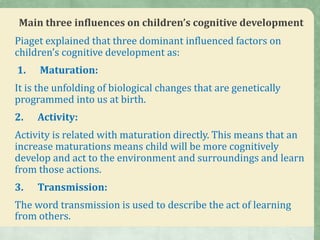
Main three influences on children’s cognitive development
Piaget explained that three dominant influenced factors on
children’s cognitive development as:
1. Maturation:
It is the unfolding of biological changes that are genetically
programmed into us at birth.
2. Activity:
Activity is related with maturation directly. This means that an
increase maturations means child will be more cognitively
develop and act to the environment and surroundings and learn
from those actions.
3. Transmission:
The word transmission is used to describe the act of learning
from others.
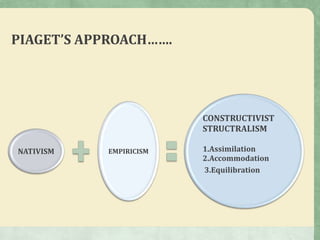
PIAGET’S APPROACH…….
NATIVISM EMPIRICISM
CONSTRUCTIVIST
STRUCTRALISM
1.Assimilation
2.Accommodation
3.Equilibration
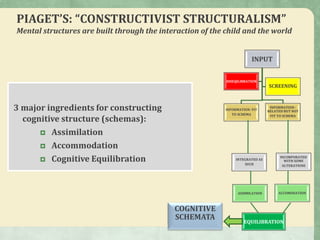
PIAGET’S: “CONSTRUCTIVIST STRUCTURALISM”
Mental structures are built through the interaction of the child and the world
INPUT
INFORMATION- FIT
TO SCHEMA
INFORMATION -
RELATED BUT NOT
FIT TO SCHEMA
DISEQILIBRATION
SCREENING
EQUILIBRATION
ASSIMILATION
INTEGRATED AS
SUCH
INCORPORATED
WITH SOME
ALTERATIONS
ACCOMODATION
COGNITIVE
SCHEMATA
3 major ingredients for constructing
cognitive structure (schemas):
 Assimilation
 Accommodation
 Cognitive Equilibration
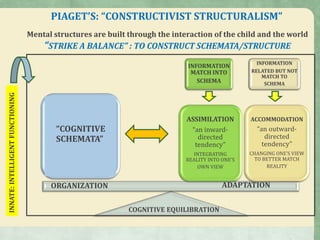
INFORMATION
MATCH INTO
SCHEMA
INFORMATION
RELATED BUT NOT
MATCH TO
SCHEMA
ASSIMILATION
“an inward-
directed
tendency”
INTEGRATING
REALITY INTO ONE’S
OWN VIEW
ACCOMMODATION
“an outward-
directed
tendency”
CHANGING ONE’S VIEW
TO BETTER MATCH
REALITY
COGNITIVE EQUILIBRATION
PIAGET’S: “CONSTRUCTIVIST STRUCTURALISM”
Mental structures are built through the interaction of the child and the world
“STRIKE A BALANCE” : TO CONSTRUCT SCHEMATA/STRUCTURE
CC
ADAPTATION
“COGNITIVE
SCHEMATA”
ORGANIZATION
INNATE:INTELLIGENTFUNCTIONING
THANKS

Piaget's concept-constructivist structuralism

  • 1.
    Dr. RAM S.MATORIA JEAN PIAGET’S constructivist structuralism: A DYNAMIC CONCEPTION PSYCHIATRIC CENTRE, SMS MEDICAL COLLEGE, JAIPUR
  • 2.
    PIAGET’S ASSUMPTIONS………..  Knowledgecan be described in terms of structures that change with development.  As children develop, new schemes emerge, and are sometimes integrated with each other into cognitive structures.  Piaget defined cognitive development more than the addition of new facts and ideas into existing store of information.  He propounded that Cognitive development results from the interactions that children have with their physical and social environments.
  • 3.
    PIAGET’S ASSUMPTIONS………..  Piaget'sapproach was “constructivist structuralism,” according to which mental structures are built through the interaction of the child and the world.  Mental structures originate through the actions of the child on objects as the child strives to adapt to the environment.  His view of the child as an active constructor of her or his knowledge rather than a passive recipient of information, on one hand, or a genetically predetermined knower, on the other.
  • 4.
    PIAGET’S ASSUMPTIONS………..  WhatPiaget deemed innate was only an intelligent functioning that makes possible the construction of progressively more adequate structures of knowledge.  This improvement of structures is based on abstractions from actions performed over time, and qualitative improvements makes more comprehensive & more adaptive to next stage
  • 5.
    Main three influenceson children’s cognitive development Piaget explained that three dominant influenced factors on children’s cognitive development as: 1. Maturation: It is the unfolding of biological changes that are genetically programmed into us at birth. 2. Activity: Activity is related with maturation directly. This means that an increase maturations means child will be more cognitively develop and act to the environment and surroundings and learn from those actions. 3. Transmission: The word transmission is used to describe the act of learning from others.
  • 6.
  • 7.
    PIAGET’S: “CONSTRUCTIVIST STRUCTURALISM” Mentalstructures are built through the interaction of the child and the world INPUT INFORMATION- FIT TO SCHEMA INFORMATION - RELATED BUT NOT FIT TO SCHEMA DISEQILIBRATION SCREENING EQUILIBRATION ASSIMILATION INTEGRATED AS SUCH INCORPORATED WITH SOME ALTERATIONS ACCOMODATION COGNITIVE SCHEMATA 3 major ingredients for constructing cognitive structure (schemas):  Assimilation  Accommodation  Cognitive Equilibration
  • 8.
    INFORMATION MATCH INTO SCHEMA INFORMATION RELATED BUTNOT MATCH TO SCHEMA ASSIMILATION “an inward- directed tendency” INTEGRATING REALITY INTO ONE’S OWN VIEW ACCOMMODATION “an outward- directed tendency” CHANGING ONE’S VIEW TO BETTER MATCH REALITY COGNITIVE EQUILIBRATION PIAGET’S: “CONSTRUCTIVIST STRUCTURALISM” Mental structures are built through the interaction of the child and the world “STRIKE A BALANCE” : TO CONSTRUCT SCHEMATA/STRUCTURE CC ADAPTATION “COGNITIVE SCHEMATA” ORGANIZATION INNATE:INTELLIGENTFUNCTIONING
  • 9.