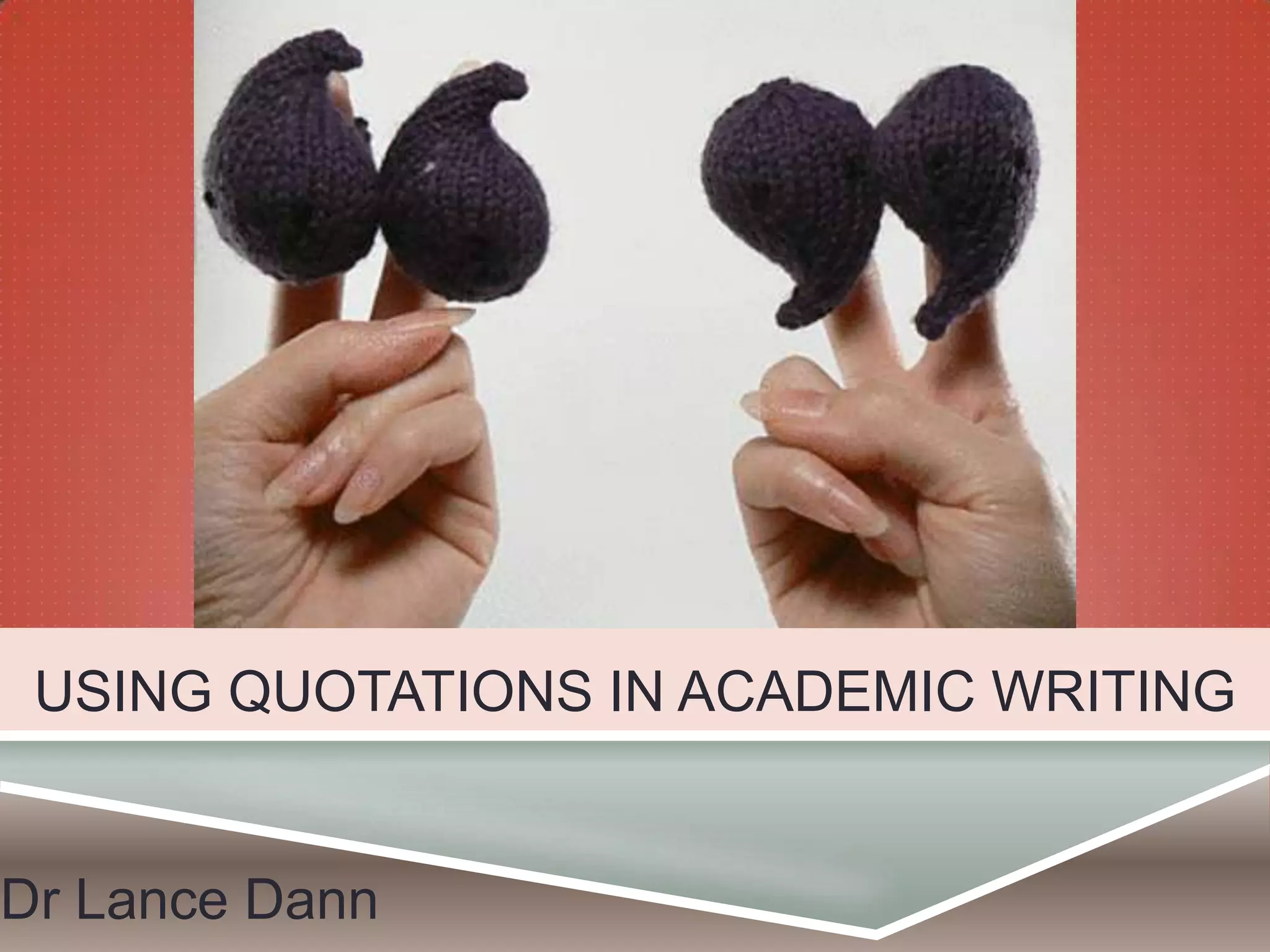
USING QUOTATIONS IN ACADEMIC WRITING

Dr Lance Dann
TWO USES
REFERENCE

EVIDENCE
REFERENCE
 Used for discussion of a text

 Used illustrating or

summarising an argument or
discussion
 Bringing attention to an idea

that is uniquely expressed in
text
 You can also summarise the

idea and write a precise of it.
EXAMPLE – OF A QUOTATION
The concept of Transmedial story telling is
born of the work in the early part of the 21st
Century by Henry Jenkin, who in his 2006
book Convergence Culture refers to a new
form of digital storytelling, one in which „all
media forms are created equal and together
share the narrative load‟ (Jenkins, 2006:
132).
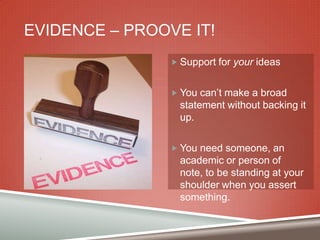
EVIDENCE – PROOVE IT!
 Support for your ideas
 You can‟t make a broad

statement without backing it
up.
 You need someone, an

academic or person of
note, to be standing at your
shoulder when you assert
something.
EXAMPLE 1
Apocalypse Now is the most significant and
important film in the early history of sound
design
How does the examiner respond?
“SAYS WHO? LANCE DANN? Who the „F‟ are you
to say that ya limey mofo. Man you ain‟t no
acdemic, you ain‟t no one! No one I tell you and to
proove it I‟m going to wipe out your punk-ass grade!”
EXAMPLE II
William Whittington, in his 2007 text Science
Fiction and Sound Design, describes Apocalypse
Now as, „the most significant and important film the
history of sound design‟ (Whittington, 2007: 132).
How does the examiner respond?
“Oh yes of course, I am aware of Whittington‟s seminal work
on this subject and respect his views. This must be a, as you
say, very important film. Here have an extra higher grade for
your excellent citing of an academic reference.”
THIS IS ONE WHAT I WROTE
David Mamet praises Esslin for
helping to „re-create a national
theatre by enfranchising creative
talent.... By encouraging freedom of
thought – by hiring the writers and
letting them be free‟ (Mamet, 1986:
17).
PARAPHRASING
You can introduce
studies that agree with
you (Smith, 2001;
Jones and Chin, 2003)
and those that
disagree with you
(Mohan and
Corbett, 2007) without
interrupting your own
argument.
TRY TO PARAPHRASE WHENEVER
POSSIBLE
It makes you text

easier to read.
It demonstrates that
you have grasped
the core ideas.
It makes synthesis
of ideas easier.
EVIDENCE – PRIMARY RESEARCH
 Quotations can also be

drawn from your primary
research.
 If you interview someone you

reference their PoV or ideas
to illustrate a point.
 Use them as a vox-pop or a

way of showing movements
and trends in opinion.
AN EXAMPLE FROM MY BRILLIANT PHD
Katie Hims details how a single, poetic image
(for instance „a woman sitting at a train station in
a wedding dress‟) can speak to her imagination
and serve as the catalyst for her creative
process: „To begin creating a story with an
issue initially makes my heart sink. I can find an
issue working from a beautiful image much more
easily than I can find a beautiful image working
from an issue‟ (Hims, interview 2008).
OR YOU CAN SUMMARISE SOMEONE‟S
IDEAS
There is perhaps still a place for the intensely
personal monologue, the character-led play or a
piece of poetic musing, as long as it is felt to
resonate with the audience either through
personal issues or events and concerns covered
in the mass media (Dromgoole, interview 2009).
SOME RULES
 Do not use italics to indicate

quotes.
 If you include a long quotation

(of four lines or more) you
should indent it from the lefthand margin (in which case
you should drop the inverted
commas).
 In the main part of your

research you should avoid
using too many quotations –
leave room for your own ideas
USE QUOTES TO LAUNCH
DISCUSSION… NOT SILENCE IT.

Find ways of introducing quotes that go
against you ideas.
Find ways of interjecting quotes that you
can use to fire up discussion.
Find ways of doing more than just
answering questions with quotes.

Try and avoid
ending every
paragraph with
a quote.
TRY NOT TO DO
THIS…
Introduction to concept or idea X.

Summary and ideas from Source A.
Summary and ideas from Source B.
Summary and ideas from Source C.

Conclusion: “Therefore, this paper has shown

presented ideas A, B, and C help to prove
point X.”
THIS LEADS TO THIS RESPONSE FROM
THE EXAMINER…
Because you are not making an
argument you are just telling us
what books you have read.
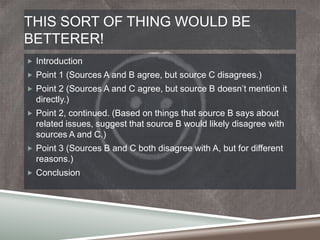
THIS SORT OF THING WOULD BE
BETTERER!
 Introduction
 Point 1 (Sources A and B agree, but source C disagrees.)

 Point 2 (Sources A and C agree, but source B doesn‟t mention it

directly.)
 Point 2, continued. (Based on things that source B says about

related issues, suggest that source B would likely disagree with
sources A and C.)
 Point 3 (Sources B and C both disagree with A, but for different

reasons.)
 Conclusion
LEADING TO THIS RESPONSE FROM
THE EXAMINERS
 Because it is about

ideas.
 Because it is not a set
formula
 Because it shows you
taken the reading on
board, thought about
and then kind of
remixed it when you
give it back to us!
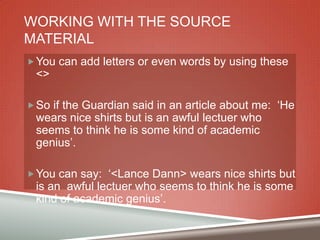
WORKING WITH THE SOURCE
MATERIAL
 You can add letters or even words by using these

<>
 So if the Guardian said in an article about me: „He

wears nice shirts but is an awful lectuer who
seems to think he is some kind of academic
genius‟.
 You can say: „<Lance Dann> wears nice shirts but

is an awful lectuer who seems to think he is some
kind of academic genius‟.
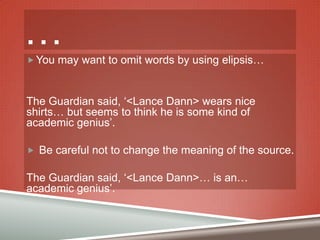
…
 You may want to omit words by using elipsis…

The Guardian said, „<Lance Dann> wears nice
shirts… but seems to think he is some kind of
academic genius‟.
 Be careful not to change the meaning of the source.

The Guardian said, „<Lance Dann>… is an…
academic genius‟.
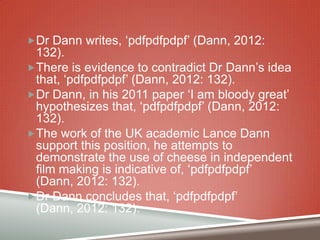
BED IN YOUR QUOTES
Dr Dann writes, „pdfpdfpdpf‟ (Dann, 2012:

132).
There is evidence to contradict Dr Dann‟s idea
that, „pdfpdfpdpf‟ (Dann, 2012: 132).
Dr Dann, in his 2011 paper „I am bloody great‟
hypothesizes that, „pdfpdfpdpf‟ (Dann, 2012:
132).
The work of the UK academic Lance Dann
support this position, he attempts to
demonstrate the use of cheese in independent
film making is indicative of, „pdfpdfpdpf‟
(Dann, 2012: 132).
Dr Dann concludes that, „pdfpdfpdpf‟
(Dann, 2012: 132).
FINAL TIP - PUNCTUATION
 COMMA
 THEN SINGLE QUOTATION






MARK
THEN QUOTE
THEN SINGLE QUOTATION
MARK
THEN BRACKET AND
CITATION DETAIL THEN
CLOSE BRACKET
THEN FULL STOP – IF AT
END OF SENTENCE

Using Quotations in Academic Writing

  • 1.
    USING QUOTATIONS INACADEMIC WRITING Dr Lance Dann
  • 2.
  • 3.
    REFERENCE  Used fordiscussion of a text  Used illustrating or summarising an argument or discussion  Bringing attention to an idea that is uniquely expressed in text  You can also summarise the idea and write a precise of it.
  • 4.
    EXAMPLE – OFA QUOTATION The concept of Transmedial story telling is born of the work in the early part of the 21st Century by Henry Jenkin, who in his 2006 book Convergence Culture refers to a new form of digital storytelling, one in which „all media forms are created equal and together share the narrative load‟ (Jenkins, 2006: 132).
  • 5.
    EVIDENCE – PROOVEIT!  Support for your ideas  You can‟t make a broad statement without backing it up.  You need someone, an academic or person of note, to be standing at your shoulder when you assert something.
  • 6.
    EXAMPLE 1 Apocalypse Nowis the most significant and important film in the early history of sound design How does the examiner respond? “SAYS WHO? LANCE DANN? Who the „F‟ are you to say that ya limey mofo. Man you ain‟t no acdemic, you ain‟t no one! No one I tell you and to proove it I‟m going to wipe out your punk-ass grade!”
  • 7.
    EXAMPLE II William Whittington,in his 2007 text Science Fiction and Sound Design, describes Apocalypse Now as, „the most significant and important film the history of sound design‟ (Whittington, 2007: 132). How does the examiner respond? “Oh yes of course, I am aware of Whittington‟s seminal work on this subject and respect his views. This must be a, as you say, very important film. Here have an extra higher grade for your excellent citing of an academic reference.”
  • 8.
    THIS IS ONEWHAT I WROTE David Mamet praises Esslin for helping to „re-create a national theatre by enfranchising creative talent.... By encouraging freedom of thought – by hiring the writers and letting them be free‟ (Mamet, 1986: 17).
  • 9.
    PARAPHRASING You can introduce studiesthat agree with you (Smith, 2001; Jones and Chin, 2003) and those that disagree with you (Mohan and Corbett, 2007) without interrupting your own argument.
  • 10.
    TRY TO PARAPHRASEWHENEVER POSSIBLE It makes you text easier to read. It demonstrates that you have grasped the core ideas. It makes synthesis of ideas easier.
  • 11.
    EVIDENCE – PRIMARYRESEARCH  Quotations can also be drawn from your primary research.  If you interview someone you reference their PoV or ideas to illustrate a point.  Use them as a vox-pop or a way of showing movements and trends in opinion.
  • 12.
    AN EXAMPLE FROMMY BRILLIANT PHD Katie Hims details how a single, poetic image (for instance „a woman sitting at a train station in a wedding dress‟) can speak to her imagination and serve as the catalyst for her creative process: „To begin creating a story with an issue initially makes my heart sink. I can find an issue working from a beautiful image much more easily than I can find a beautiful image working from an issue‟ (Hims, interview 2008).
  • 13.
    OR YOU CANSUMMARISE SOMEONE‟S IDEAS There is perhaps still a place for the intensely personal monologue, the character-led play or a piece of poetic musing, as long as it is felt to resonate with the audience either through personal issues or events and concerns covered in the mass media (Dromgoole, interview 2009).
  • 14.
    SOME RULES  Donot use italics to indicate quotes.  If you include a long quotation (of four lines or more) you should indent it from the lefthand margin (in which case you should drop the inverted commas).  In the main part of your research you should avoid using too many quotations – leave room for your own ideas
  • 15.
    USE QUOTES TOLAUNCH DISCUSSION… NOT SILENCE IT. Find ways of introducing quotes that go against you ideas. Find ways of interjecting quotes that you can use to fire up discussion. Find ways of doing more than just answering questions with quotes. Try and avoid ending every paragraph with a quote.
  • 16.
    TRY NOT TODO THIS… Introduction to concept or idea X. Summary and ideas from Source A. Summary and ideas from Source B. Summary and ideas from Source C. Conclusion: “Therefore, this paper has shown presented ideas A, B, and C help to prove point X.”
  • 17.
    THIS LEADS TOTHIS RESPONSE FROM THE EXAMINER… Because you are not making an argument you are just telling us what books you have read.
  • 18.
    THIS SORT OFTHING WOULD BE BETTERER!  Introduction  Point 1 (Sources A and B agree, but source C disagrees.)  Point 2 (Sources A and C agree, but source B doesn‟t mention it directly.)  Point 2, continued. (Based on things that source B says about related issues, suggest that source B would likely disagree with sources A and C.)  Point 3 (Sources B and C both disagree with A, but for different reasons.)  Conclusion
  • 19.
    LEADING TO THISRESPONSE FROM THE EXAMINERS  Because it is about ideas.  Because it is not a set formula  Because it shows you taken the reading on board, thought about and then kind of remixed it when you give it back to us!
  • 20.
    WORKING WITH THESOURCE MATERIAL  You can add letters or even words by using these <>  So if the Guardian said in an article about me: „He wears nice shirts but is an awful lectuer who seems to think he is some kind of academic genius‟.  You can say: „<Lance Dann> wears nice shirts but is an awful lectuer who seems to think he is some kind of academic genius‟.
  • 21.
    …  You maywant to omit words by using elipsis… The Guardian said, „<Lance Dann> wears nice shirts… but seems to think he is some kind of academic genius‟.  Be careful not to change the meaning of the source. The Guardian said, „<Lance Dann>… is an… academic genius‟.
  • 22.
  • 23.
    Dr Dann writes,„pdfpdfpdpf‟ (Dann, 2012: 132). There is evidence to contradict Dr Dann‟s idea that, „pdfpdfpdpf‟ (Dann, 2012: 132). Dr Dann, in his 2011 paper „I am bloody great‟ hypothesizes that, „pdfpdfpdpf‟ (Dann, 2012: 132). The work of the UK academic Lance Dann support this position, he attempts to demonstrate the use of cheese in independent film making is indicative of, „pdfpdfpdpf‟ (Dann, 2012: 132). Dr Dann concludes that, „pdfpdfpdpf‟ (Dann, 2012: 132).
  • 24.
    FINAL TIP -PUNCTUATION  COMMA  THEN SINGLE QUOTATION     MARK THEN QUOTE THEN SINGLE QUOTATION MARK THEN BRACKET AND CITATION DETAIL THEN CLOSE BRACKET THEN FULL STOP – IF AT END OF SENTENCE