Themes of To Kill a Mockingbird   by Harper Lee
To Kill a Mockingbird
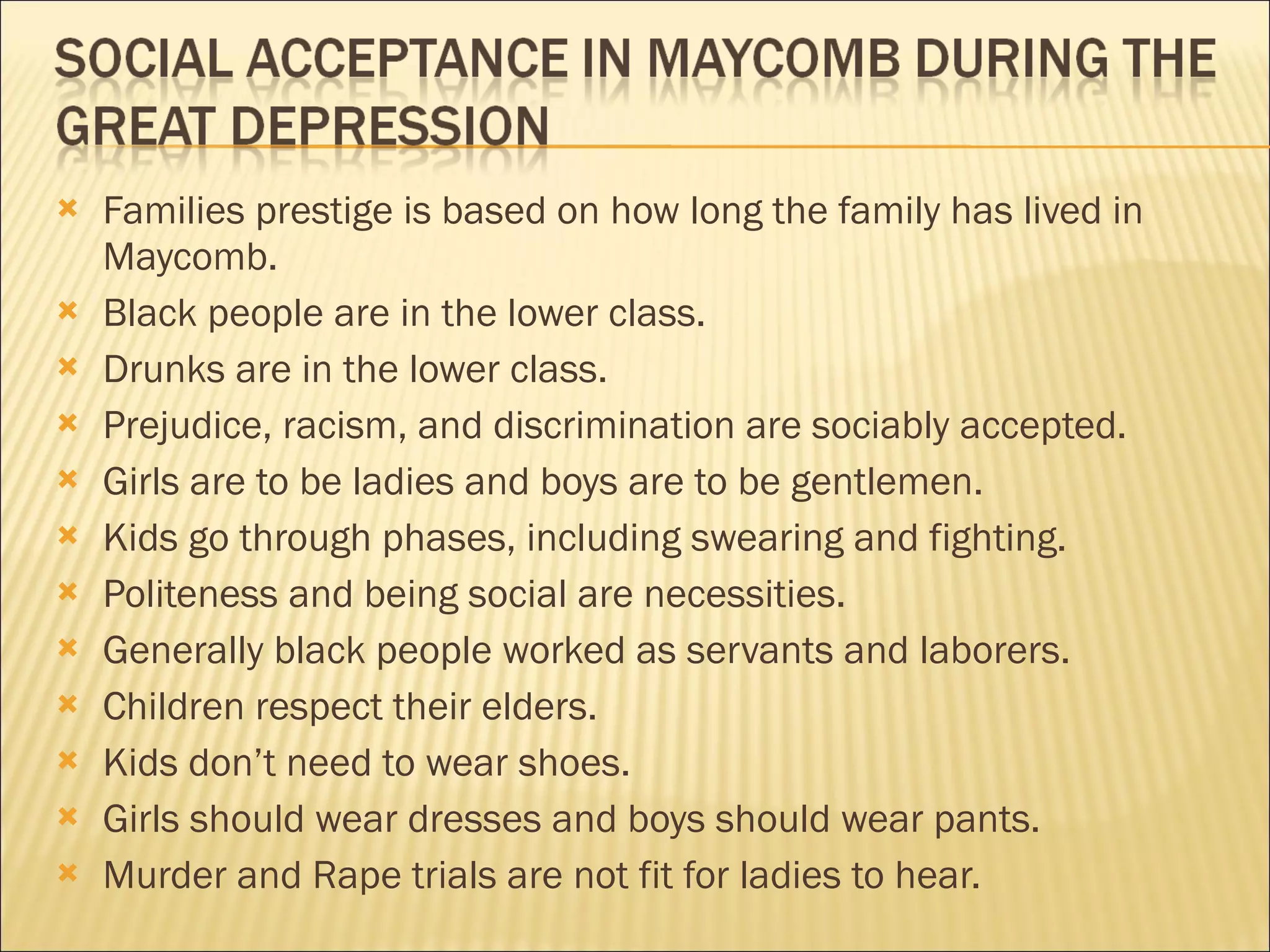
   Families prestige is based on how long the family has lived in
    Maycomb.
   Black people are in the lower class.
   Drunks are in the lower class.
   Prejudice, racism, and discrimination are sociably accepted.
   Girls are to be ladies and boys are to be gentlemen.
   Kids go through phases, including swearing and fighting.
   Politeness and being social are necessities.
   Generally black people worked as servants and laborers.
   Children respect their elders.
   Kids don’t need to wear shoes.
   Girls should wear dresses and boys should wear pants.
   Murder and Rape trials are not fit for ladies to hear.
To Kill a Mockingbird
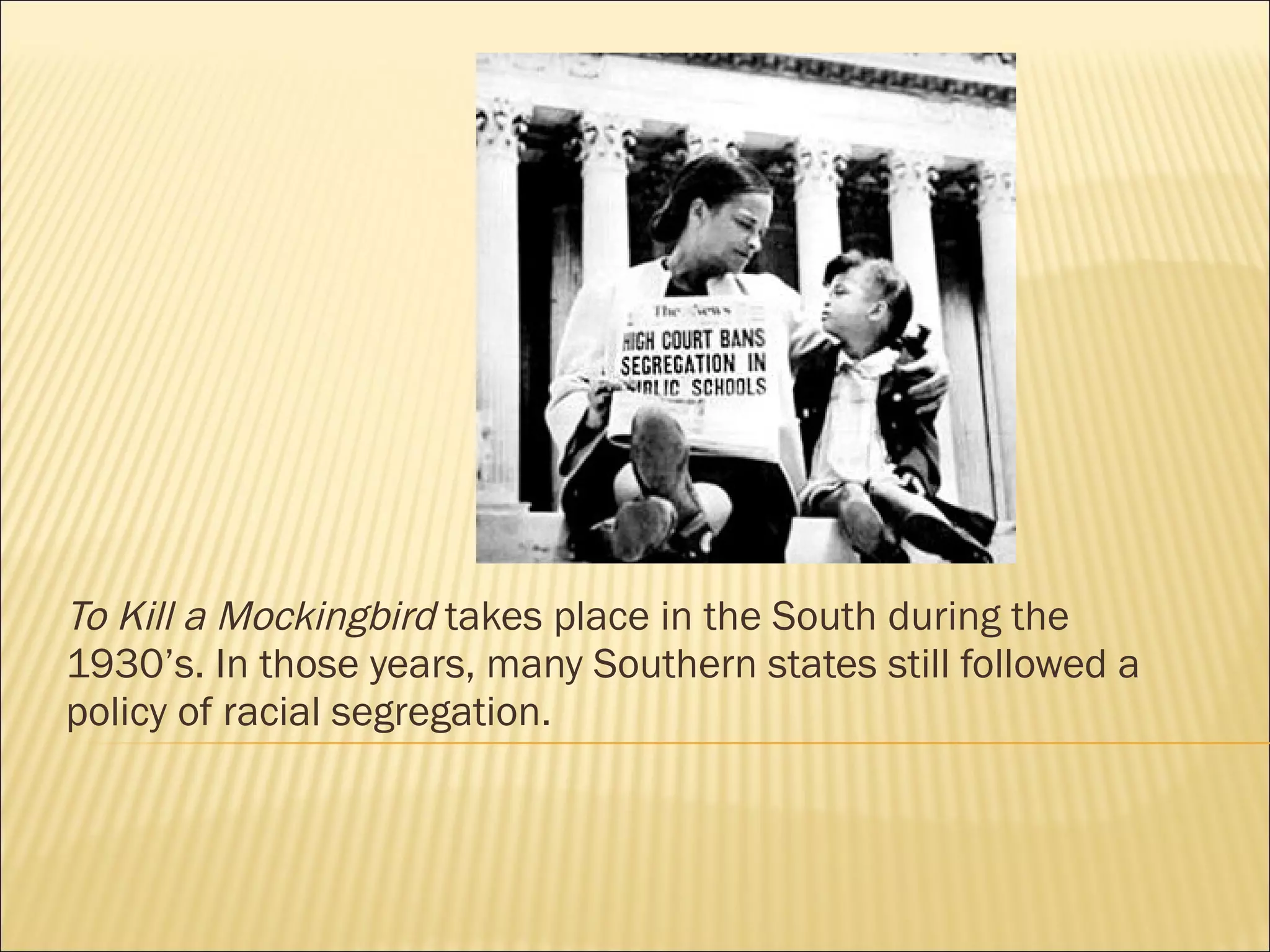
To Kill a Mockingbird takes place in the South during the
1930’s. In those years, many Southern states still followed a
policy of racial segregation.
   Black people during the 1930’s could not
    speak to white people on the street.

     TRUE:  Although there was no law stating this; it was
      not socially accepted. White people would often
      walk right passed as if not seeing anyone.
   Blacks and whites attended separate schools
    during the Great Depression.
     TRUE:  School segregation wasn’t legally abolished
      until 1954 with the Supreme Court’s decision that
      schools could no longer be segregated in Brown v.
      Board of Education.
     For more information on segregation in Alabama
      schools click here.
   Blacks and whites lived in separate parts of
    town.

     TRUE:  Although in the novel Calpurnia spends the
      night at the Finches to help out, the Finches had no
      black neighbors in the part of Maycomb that they
      resided. Blacks lived on the outskirts of town.
   Even though segregation was practiced, it was
    never considered legal by the courts.
       FALSE: Jim Crowe laws were state and local laws in the United States
        enacted between 1876 and 1965 that mandated segregation in all
        public facilities, with a supposedly "separate but equal" status for black
        Americans. The reality was that Jim Crowe laws led to treatment and
        accommodations that were usually inferior to those provided for white
        Americans.
     For    more information on Jim Crowe Laws click here.
   Segregation was a matter of wealth. Well-to-do
    blacks enjoyed the same legal rights and
    privileges as well-to-do whites.

     FALSE: Socially the poorest white person still had a
      higher social status than the wealthiest black
      person. In Maycomb, Mr. Ewell, the town drunk, has
      a higher social status than Tom Robinson.
To Kill a Mockingbird
   the quality of righteousness, equitableness, or
    moral rightness. (dictionary.com)

   In other words, the act of being fair and
    unbiased.
 Atticus Finch, one of the major characters of
  the novel, is a lawyer.
 Atticus must understand what justice means.
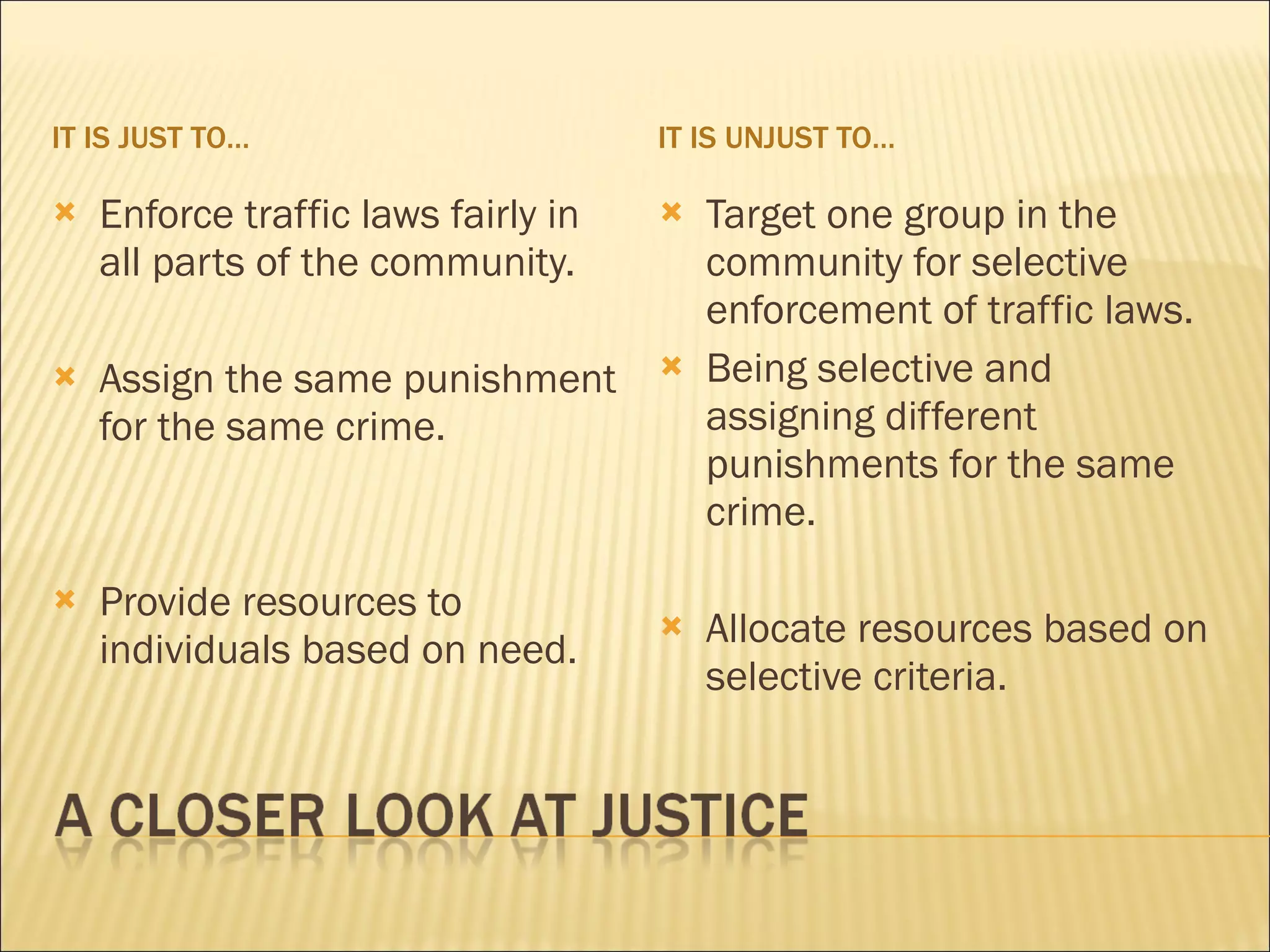
IT IS JUST TO…                       IT IS UNJUST TO…

   Enforce traffic laws fairly in      Target one group in the
    all parts of the community.          community for selective
                                         enforcement of traffic laws.
   Assign the same punishment          Being selective and
    for the same crime.                  assigning different
                                         punishments for the same
                                         crime.

   Provide resources to
                                        Allocate resources based on
    individuals based on need.
                                         selective criteria.
Themes in To Kill a Mockingbird

Themes in To Kill a Mockingbird

  • 1.
    Themes of ToKill a Mockingbird by Harper Lee
  • 2.
    To Kill aMockingbird
  • 3.
    Families prestige is based on how long the family has lived in Maycomb.  Black people are in the lower class.  Drunks are in the lower class.  Prejudice, racism, and discrimination are sociably accepted.  Girls are to be ladies and boys are to be gentlemen.  Kids go through phases, including swearing and fighting.  Politeness and being social are necessities.  Generally black people worked as servants and laborers.  Children respect their elders.  Kids don’t need to wear shoes.  Girls should wear dresses and boys should wear pants.  Murder and Rape trials are not fit for ladies to hear.
  • 4.
    To Kill aMockingbird
  • 5.
    To Kill aMockingbird takes place in the South during the 1930’s. In those years, many Southern states still followed a policy of racial segregation.
  • 6.
    Black people during the 1930’s could not speak to white people on the street.  TRUE: Although there was no law stating this; it was not socially accepted. White people would often walk right passed as if not seeing anyone.
  • 7.
    Blacks and whites attended separate schools during the Great Depression.  TRUE: School segregation wasn’t legally abolished until 1954 with the Supreme Court’s decision that schools could no longer be segregated in Brown v. Board of Education.  For more information on segregation in Alabama schools click here.
  • 8.
    Blacks and whites lived in separate parts of town.  TRUE: Although in the novel Calpurnia spends the night at the Finches to help out, the Finches had no black neighbors in the part of Maycomb that they resided. Blacks lived on the outskirts of town.
  • 9.
    Even though segregation was practiced, it was never considered legal by the courts.  FALSE: Jim Crowe laws were state and local laws in the United States enacted between 1876 and 1965 that mandated segregation in all public facilities, with a supposedly "separate but equal" status for black Americans. The reality was that Jim Crowe laws led to treatment and accommodations that were usually inferior to those provided for white Americans.  For more information on Jim Crowe Laws click here.
  • 10.
    Segregation was a matter of wealth. Well-to-do blacks enjoyed the same legal rights and privileges as well-to-do whites.  FALSE: Socially the poorest white person still had a higher social status than the wealthiest black person. In Maycomb, Mr. Ewell, the town drunk, has a higher social status than Tom Robinson.
  • 11.
    To Kill aMockingbird
  • 12.
    the quality of righteousness, equitableness, or moral rightness. (dictionary.com)  In other words, the act of being fair and unbiased.
  • 13.
     Atticus Finch,one of the major characters of the novel, is a lawyer.  Atticus must understand what justice means.
  • 14.
    IT IS JUSTTO… IT IS UNJUST TO…  Enforce traffic laws fairly in  Target one group in the all parts of the community. community for selective enforcement of traffic laws.  Assign the same punishment  Being selective and for the same crime. assigning different punishments for the same crime.  Provide resources to  Allocate resources based on individuals based on need. selective criteria.