
Neck & Its Triangles
Dr. Haydar Muneer salih
• Neck is that part of the body which
connects the head to the upper part
of trunk.
• Boundaries
Superior: Lower border of body of
mandible
Inferior: Suprasternal notch & Upper
surface of clavicle
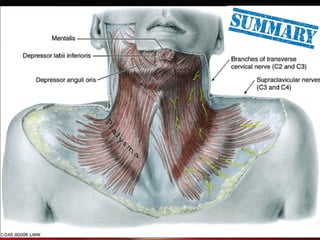
Skin & Cutaneous Nerves
• The natural lines of cleavage of the
skin run almost horizontally around
the neck.
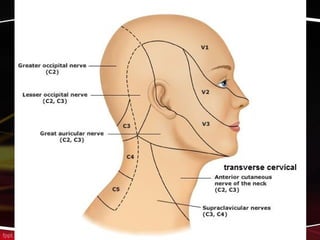
• The skin overlying the back of the
neck and on the back of the scalp as
high as the vertex is supplied
segmentally by posterior rami of
cervical nerves 2 to 5.
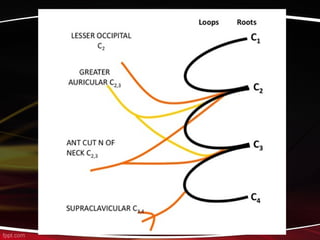
1. The greater occipital nerve (C2)
2. Cervical plexus branches (C2-C4)
A. The lesser occipital nerve (C2)
B. great auricular nerve (C2 and C3)
C.Transverse cutaneous nerve (C2 and
C3)
D.Supraclavicular nerves (C3 and C4)
Superficial Fascia
• The superficial fascia of the neck forms a
thin layer that encloses the platysma
muscle. Also embedded in it are the
cutaneous nerves, the superficial veins,
and the superficial lymph nodes.
• The platysma muscle is a thin but clinically
important muscular sheet embedded in the
superficial fascia.
DEEP FASCIA OF NECK (DEEP
CERVICAL FASCIA)
It is well developed in the neck and consists
of three layers. These are, from exterior to
interior:
1. Investing layer: deep to the subcutaneous
tissue and platysma and surrounds the neck
completely like a collar
2. Pre-tracheal layer: lies over the trachea
3. Prevertebral layer: anterior to the
prevertebral muscles
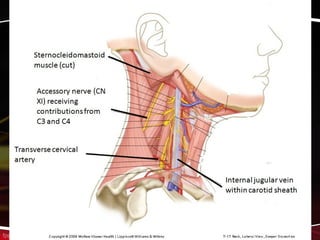
Carotid Sheath
• The deep cervical fascia forms a tubular
sheath around the major vessels of the
neck, named the carotid sheath on each
side. It extends from the base of skull
above to the arch of aorta below, on each
side.
• Contents of Carotid Sheath
1. Common carotid artery in lower part and
internal carotid artery in upper part.
2. Internal jugular vein.
3. Vagus nerve.
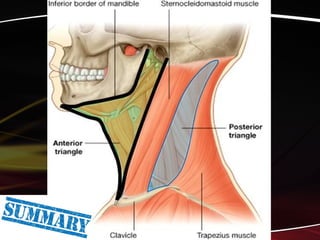
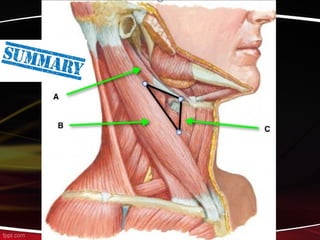
Neck Triangles
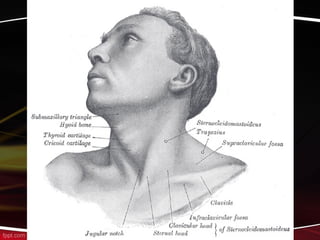
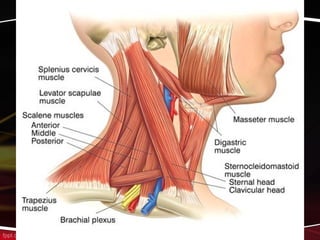
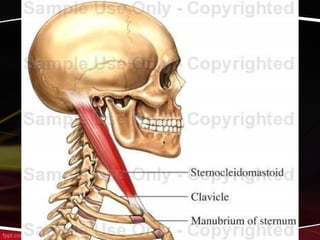
STERNOCLEIDOMASTOID MUSCLE
It is an important, superficially placed
muscle on each side of neck and is seen as
a prominent band passing from above
downwards in the neck, when the neck is
turned to one side.
It divides The side of neck into anterior and
posterior triangles
Origin: It arises from two heads:
1.Sternal head
2.Clavicular head
Insertion: The fibers run upwards and
backwards and insert in two parts:
1. Lateral surface of mastoid, as a thick
tendon.
2. Lateral half of occipital bone, as a
thin aponeurosis
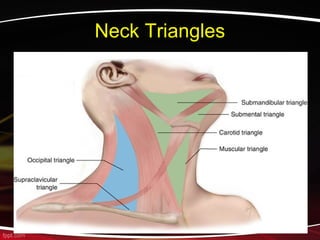
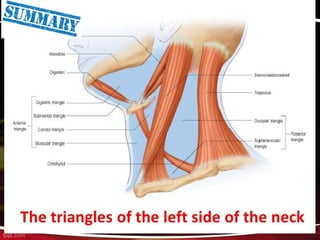
Neck Triangles
1. Anterior triangles
A. Submental triangle
B. Submandibular triangle
C. Carotid triangle
D. muscular triangle
2. Posterior triangles
A.Supraclavicular triangle
B.Occipital triangle
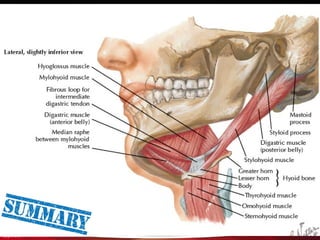
Submental triangle
On each side: Anterior belly of
digastric
Base: Body of hyoid bone
Apex: Chin or symphysis menti
Floor: It is formed by the mylohyoid
Submandibular Triangles
Antero-inferior : Anterior belly of digastric
muscle.
Postero-inferior : Posterior belly of
digastric muscle.
Base : Base of the mandible
Apex : Intermediate tendon of digastric m.
Floor: mylohyoid m., hyoglossus m. and
middle constrictor m.
Roof: It is formed by the investing layer of
deep cervical
Carotid Triangle
Superior : Posterior belly of digastric
Anterio-inferior : Superior belly of omohyoid
Posterior : Anterior border of
sternocleidomastoid m.
Roof : It is formed by investing layer of deep
cervical fascia.
Floor: It is formed by four muscles:
Thyrohyoid m., Hyoglossus m., Middle
constrictor of pharynx m., Inferior constrictor
of pharynx m.
Muscular Triangle
Anterior : Anterior midline of the neck
Antero-superior : Superior belly of the
omohyoid.
Posterio-inferior : Anterior border of
sternocleidomastoid.
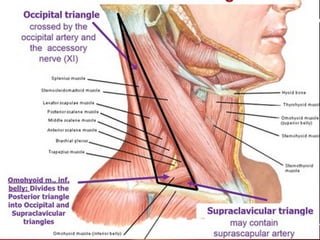
Posterior Triangle
Anteriorly: Posterior border of the
sternocleidomastoid
Inferiorly: Middle third of the clavicle
Posteriorly: Anterior border of the
trapezius
•Is subdivided into 2 triangles by the
omohyoid:
•Supraclavicular triangle
•Occipital triangle
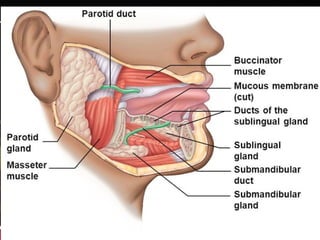
Salivary Gland
Submandibular Salivary Gland
It is about half the size of the parotid gland
and lies below the mandible in the anterior
part of the digastric triangle.
• It consists of two parts, a large superficial
part and a smaller deep part, which lie
superficial and deep to the mylohyoid
muscle respectively.
• The two parts are continuous with each
other at the posterior border of mylohyoid
muscle.
SUBLINGUAL SALIVARY GLAND
• This is the smallest of the 3 pairs of
salivary glands.
• It lies immediately below the mucosa of the
floor of the mouth.
• it is rests in the sublingual fossa on the
inner aspect of the body of mandible.
• The gland pours its secretion by a series of
ducts, about 10 to 15 in number into the oral
cavity on the sublingual fold. Few ducts may
also open into the submandibular duct.
Neck and its triangles

Neck and its triangles

  • 1.
    Neck & ItsTriangles Dr. Haydar Muneer salih
  • 2.
    • Neck isthat part of the body which connects the head to the upper part of trunk. • Boundaries Superior: Lower border of body of mandible Inferior: Suprasternal notch & Upper surface of clavicle
  • 4.
    Skin & CutaneousNerves • The natural lines of cleavage of the skin run almost horizontally around the neck. • The skin overlying the back of the neck and on the back of the scalp as high as the vertex is supplied segmentally by posterior rami of cervical nerves 2 to 5.
  • 5.
    1. The greateroccipital nerve (C2) 2. Cervical plexus branches (C2-C4) A. The lesser occipital nerve (C2) B. great auricular nerve (C2 and C3) C.Transverse cutaneous nerve (C2 and C3) D.Supraclavicular nerves (C3 and C4)
  • 8.
    Superficial Fascia • Thesuperficial fascia of the neck forms a thin layer that encloses the platysma muscle. Also embedded in it are the cutaneous nerves, the superficial veins, and the superficial lymph nodes. • The platysma muscle is a thin but clinically important muscular sheet embedded in the superficial fascia.
  • 10.
    DEEP FASCIA OFNECK (DEEP CERVICAL FASCIA) It is well developed in the neck and consists of three layers. These are, from exterior to interior: 1. Investing layer: deep to the subcutaneous tissue and platysma and surrounds the neck completely like a collar 2. Pre-tracheal layer: lies over the trachea 3. Prevertebral layer: anterior to the prevertebral muscles
  • 13.
    Carotid Sheath • Thedeep cervical fascia forms a tubular sheath around the major vessels of the neck, named the carotid sheath on each side. It extends from the base of skull above to the arch of aorta below, on each side. • Contents of Carotid Sheath 1. Common carotid artery in lower part and internal carotid artery in upper part. 2. Internal jugular vein. 3. Vagus nerve.
  • 16.
  • 17.
    STERNOCLEIDOMASTOID MUSCLE It isan important, superficially placed muscle on each side of neck and is seen as a prominent band passing from above downwards in the neck, when the neck is turned to one side. It divides The side of neck into anterior and posterior triangles
  • 19.
    Origin: It arisesfrom two heads: 1.Sternal head 2.Clavicular head Insertion: The fibers run upwards and backwards and insert in two parts: 1. Lateral surface of mastoid, as a thick tendon. 2. Lateral half of occipital bone, as a thin aponeurosis
  • 21.
    Neck Triangles 1. Anteriortriangles A. Submental triangle B. Submandibular triangle C. Carotid triangle D. muscular triangle 2. Posterior triangles A.Supraclavicular triangle B.Occipital triangle
  • 24.
    Submental triangle On eachside: Anterior belly of digastric Base: Body of hyoid bone Apex: Chin or symphysis menti Floor: It is formed by the mylohyoid
  • 26.
    Submandibular Triangles Antero-inferior :Anterior belly of digastric muscle. Postero-inferior : Posterior belly of digastric muscle. Base : Base of the mandible Apex : Intermediate tendon of digastric m. Floor: mylohyoid m., hyoglossus m. and middle constrictor m. Roof: It is formed by the investing layer of deep cervical
  • 28.
    Carotid Triangle Superior :Posterior belly of digastric Anterio-inferior : Superior belly of omohyoid Posterior : Anterior border of sternocleidomastoid m. Roof : It is formed by investing layer of deep cervical fascia. Floor: It is formed by four muscles: Thyrohyoid m., Hyoglossus m., Middle constrictor of pharynx m., Inferior constrictor of pharynx m.
  • 30.
    Muscular Triangle Anterior :Anterior midline of the neck Antero-superior : Superior belly of the omohyoid. Posterio-inferior : Anterior border of sternocleidomastoid.
  • 32.
    Posterior Triangle Anteriorly: Posteriorborder of the sternocleidomastoid Inferiorly: Middle third of the clavicle Posteriorly: Anterior border of the trapezius •Is subdivided into 2 triangles by the omohyoid: •Supraclavicular triangle •Occipital triangle
  • 33.
  • 34.
    Submandibular Salivary Gland Itis about half the size of the parotid gland and lies below the mandible in the anterior part of the digastric triangle. • It consists of two parts, a large superficial part and a smaller deep part, which lie superficial and deep to the mylohyoid muscle respectively. • The two parts are continuous with each other at the posterior border of mylohyoid muscle.
  • 37.
    SUBLINGUAL SALIVARY GLAND •This is the smallest of the 3 pairs of salivary glands. • It lies immediately below the mucosa of the floor of the mouth. • it is rests in the sublingual fossa on the inner aspect of the body of mandible. • The gland pours its secretion by a series of ducts, about 10 to 15 in number into the oral cavity on the sublingual fold. Few ducts may also open into the submandibular duct.