Poultry Sector in Kerala:  Current Scenario and Policy Options
Supply and Demand of Poultry Products in Kerala Demand for Eggs: 5063 million per yr Production :  1196  million  per  yr 90% are non vegs Demand for meat: 1.2 lakh tonnes  per  yr Production : 32,704  tonnes  per  yr
Per-Capita Consumption Recommended Egg Consumption: 180 eggs/year Actual consumption: 72 eggs/year Recommended meat consumption (NIN): 11 kg/year (total meat) Actual consumption of Poultry meat : 0.9 kg/year
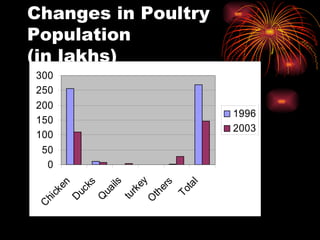
Changes in Poultry Population  (in lakhs)
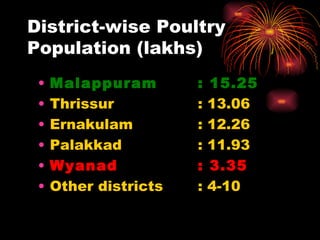
District-wise Poultry Population (lakhs) Malappuram  : 15.25 Thrissur : 13.06 Ernakulam : 12.26 Palakkad : 11.93 Wyanad : 3.35 Other districts : 4-10
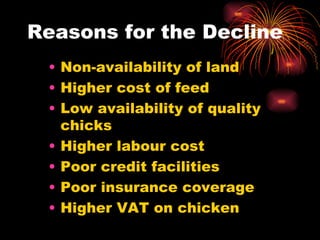
Reasons for the Decline Non-availability of land Higher cost of feed Low availability of quality chicks Higher labour cost Poor credit facilities Poor insurance coverage Higher VAT on chicken
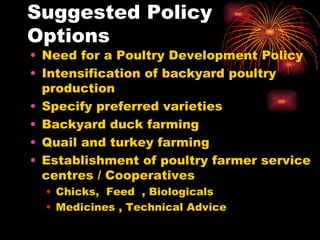
Suggested Policy Options Need for a Poultry Development Policy Intensification of backyard poultry production Specify preferred varieties Backyard duck farming Quail and turkey farming Establishment of poultry farmer service centres / Cooperatives Chicks,  Feed  , Biologicals Medicines , Technical Advice
Policy Options… GOVT Strengthening of disease surveillance centres Establishment of marketing network Establishment of broiler processing units Starting poultry waste processing units Exemption of VAT on poultry Better insurance coverage Increased R&D efforts Conservation of indigenous germplasm
    PROJECT PLANNING  Before starting a project, four important points should be considered:  Capital    Land    Management    Marketing
Choosing of  area     Sufficient area of land    Good irrigation    ventilation    Far from human activities,    good road connection,  electricity,  clean water supply and  free from wild / other animals   Do not mix with other kinds of poultry such as duck and village chicken    
Good Management practices Start with quality chicks from reliable sources Keep houses and equipments clean. Keep the litter clean, dry and free from moulds. Brood chicks carefully with good sanitation. Ensure adequate ventilation. Provide adequate floor space, feeder space and water space.
Provide light at night. Adopt vaccination schedule to suit local conditions. Promptly dispose off dead birds. Discourage visitors. Provide good quality feed.  Disinfect in between batches Adequate care of broilers during hot weather is essential.
Record Management     To correct the weakness of management    To make sure the breed chosen are good    To make sure the feed is good    To minimize the mortality rate    Use suitable medication.
Source of vaccine Institute of Animal Health and Veterinary Biologicals, Palode, Thiruvananthapuram, District. Phone: 0472-2840262 E-mail: dirvbi@kerala.nic.in I.V.P.M. Ranipet, Tamil Nadu. I.V.R.I. Izatnagar, Bareilly, U.P. I.A.H.V.B.I. Hebbal, Bangalore, Karnataka, PIN: 560024. Ventri biologicals, Vaccine division, 3/303, Sharda Centre, Erandwave, Pune, 411004. E-mail: ventribiologicals@venkys.com Intervet India Pvt. Ltd. Intervet House 33, Pune-Nagar Road, (Behind Eden Garden) Pune - 411 014 Phone  +91 20 6605 0400-01 Indovax, Corporate Heights, SCO - 24, Sector - 14, Gurgaon - 122001 (INDIA) Phone: 0091-124-2315044 / 45 / 46  E-mail: mail@indovax.com
TURKEY FARMING Turkey meat is low in fat i.e 95% fat free lowest of all avian species, rich in unsaturated fatty acids, essential amino acids especially tryptophan and vitamins like niacin, Vit-B6 and Vit B12.  . Although body weight increases with advancement of age, feed efficiency is adversely affected.  .
Attain 4 kg body weight at about 12-14 weeks of age At 20-24 weeks of age = 8 to 9 kg.  Dressing percentage is 75-82%.  Feed efficiency is comparatively poor in small turkeys than large turkeys
FIXED COST:   Shed= ( Area for 1 bird = 1 -2 square foot)   Water tank    Heater (1 small hover = 500 day old chick)  Waterers for chicks ( 4 units = 100 birds)     Feed troughs for chick ( linear feeders: 3 units = 100 birds) Automatic drinkers ( 2 unit = 100 birds) Feed troughs - hanging  (2 unit = 100 birds)     Store for keeping apparatus and feed    Other expenditures (unexpected)
RECURRENT COST   Day old chicks   Poultry feed - starter and finisher   Electrica/ / kerosene or coal /water- for brooding    Vaccine and medicine    Building depreciation    Equipments depreciation    Bank loan interest    Others expenditures (unexpected)
Housing Design and System  Good air ventilation -  Suggested dimension of the shed: 25 feet x 200 feet (1 shed) or 25 feet x 100 feet (2 sheds)   Location -East - West direction,  floor space = 1 m2 per bird for large varieties  0.81 m2 for small varieties.
Housing System Raised Floor System Deep Litter System Cage Slat Slat cum wire
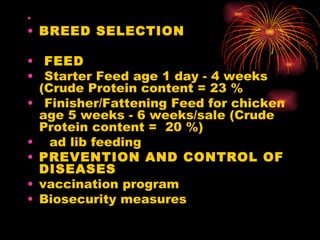
   BREED SELECTION      FEED    Starter Feed age 1 day - 4 weeks (Crude Protein content = 23 % Finisher/Fattening Feed for chicken age 5 weeks - 6 weeks/sale (Crude Protein content =  20 %)   ad lib feeding        PREVENTION AND CONTROL OF DISEASES  vaccination program  Biosecurity measures
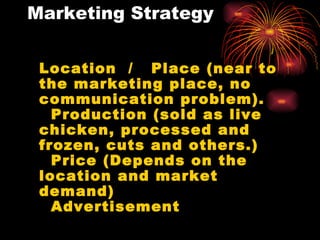
Marketing Strategy Location  /  Place (near to the marketing place, no communication problem).   Production (sold as live chicken, processed and frozen, cuts and others.)   Price (Depends on the location and market demand)   Advertisement
To know the profit/loss level  To minimize wastage cost  As a guide in preparing paper work for expanding project in future
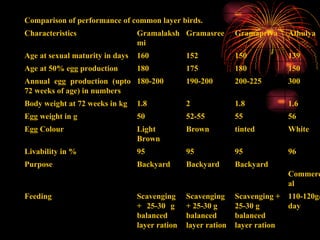
110-120g/day Scavenging + 25-30 g  balanced layer ration Scavenging + 25-30 g  balanced layer ration Scavenging + 25-30 g  balanced layer ration  Feeding Commercial Backyard Backyard Backyard Purpose 96 95 95 95 Livability in % White tinted Brown Light Brown Egg Colour 56 55 52-55 50 Egg weight in g 1.6 1.8 2 1.8 Body weight at 72 weeks in kg 300 200-225 190-200 180-200 Annual egg production (upto 72 weeks of age) in numbers 150 180 175 180 Age at 50% egg production 139 150 152 160 Age at sexual maturity in days Athulya Gramapriya Gramasree Gramalakshmi Characteristics Comparison of performance of common layer birds.
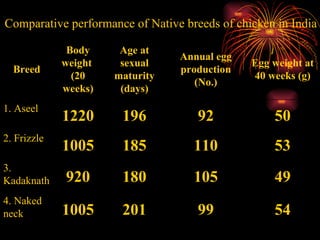
Comparative performance of Native breeds of chicken in India 54 99 201 1005 4. Naked neck 49 105 180 920 3. Kadaknath 53 110 185 1005 2. Frizzle 50 92 196 1220 1. Aseel Egg weight at 40 weeks (g) Annual egg production (No.) Age at sexual maturity (days) Body weight  (20 weeks) Breed
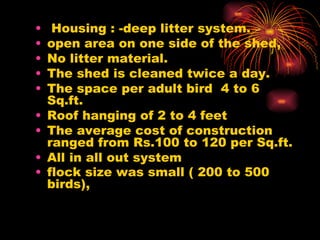
  Housing : -deep litter system.  open area on one side of the shed,  No litter material.  The shed is cleaned twice a day. The space per adult bird  4 to 6 Sq.ft. Roof hanging of 2 to 4 feet  The average cost of construction ranged from Rs.100 to 120 per Sq.ft. All in all out system  flock size was small ( 200 to 500 birds),
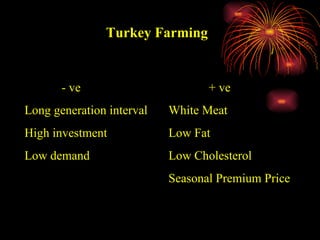
Turkey Farming  - ve Long generation interval High investment  Low demand  + ve White Meat Low Fat Low Cholesterol Seasonal Premium Price
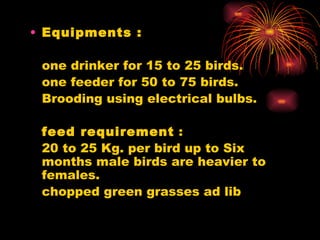
Equipments : one drinker for 15 to 25 birds. one feeder for 50 to 75 birds. Brooding using electrical bulbs. feed requirement  : 20 to 25 Kg. per bird up to Six months male birds are heavier to females.  chopped green grasses ad lib
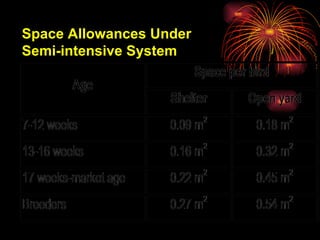
Space Allowances Under  Semi-intensive System
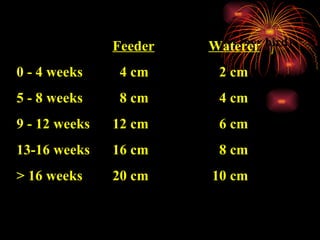
Space Allowance in Feeders and Waters (per bird) Feeder Waterer 0 - 4 weeks   4 cm   2 cm  5 - 8 weeks   8 cm    4 cm  9 - 12 weeks 12 cm    6 cm 13-16 weeks 16 cm   8 cm  > 16 weeks 20 cm   10 cm
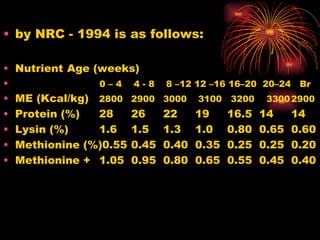
by NRC - 1994 is as follows: Nutrient Age (weeks)     0 – 4  4 - 8  8 –12 12 –16 16–20  20–24  Br ME (Kcal/kg) 2800 2900 3000  3100  3200  3300 2900 Protein (%) 28 26 22 19 16.5 14 14 Lysin (%) 1.6 1.5 1.3 1.0 0.80 0.65 0.60 Methionine (%)0.55 0.45 0.40 0.35 0.25 0.25 0.20 Methionine + 1.05 0.95 0.80 0.65 0.55 0.45 0.40
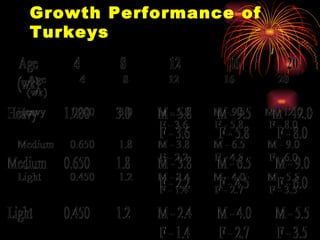
Growth Performance of Turkeys
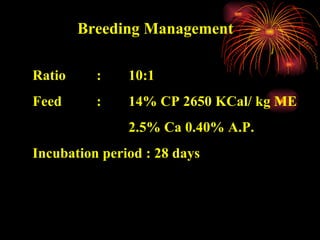
Breeding Management   Ratio  : 10:1 Feed : 14% CP 2650 KCal/ kg ME 2.5% Ca 0.40% A.P. Incubation period : 28 days
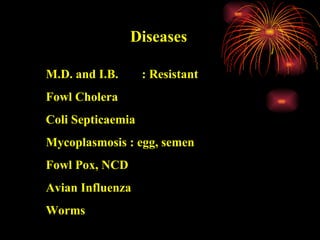
Diseases M.D. and I.B.  : Resistant  Fowl Cholera Coli Septicaemia  Mycoplasmosis : egg, semen Fowl Pox, NCD Avian Influenza  Worms
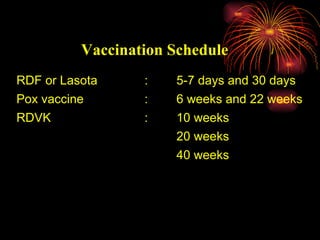
RDF or Lasota : 5-7 days and 30 days Pox vaccine : 6 weeks and 22 weeks RDVK : 10 weeks 20 weeks 40 weeks Vaccination Schedule
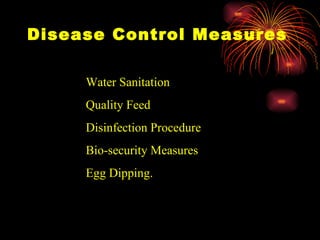
Disease Control Measures Water Sanitation  Quality Feed Disinfection Procedure Bio-security Measures Egg Dipping.
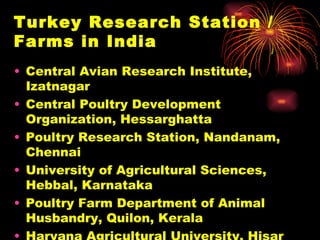
Turkey Research Station / Farms in India Central Avian Research Institute, Izatnagar Central Poultry Development Organization, Hessarghatta Poultry Research Station, Nandanam, Chennai University of Agricultural Sciences, Hebbal, Karnataka Poultry Farm Department of Animal Husbandry, Quilon, Kerala Haryana Agricultural University, Hisar
5 to 20%.  mortality vaccination done - RD and Pasturellosis  Sex determination is not easy --Vent Sexing at the time of hatching By weight - Males are heavier  Matured male - conspicuous black bearing attached to the skin of the upper region. Dewbill or snood, - relatively large, plump and elastic in males and small , thin and elastic in females. Male sturt even at day-old age and continue to do so throughout their life- Sturting is not seen in females.
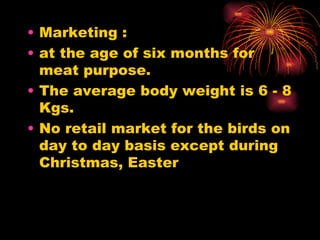
Marketing : at the age of six months for meat purpose.  The average body weight is 6 - 8 Kgs.  No retail market for the birds on day to day basis except during Christmas, Easter
Reproductive parameters Age of laying - 24 - 28 weeks No. of eggs produced  70 – 100   per year - Egg weight - 85 gm Incubation Period - 28 days Male female Ratio - 1 : 5 No.of chicks /female - 43 - 63
Marketing : The demand for turkey poult is mostly seasonal  The demand is slowly picking up  There is no established market for the turkey High average weight (6 to 8 Kg.) it is not finding a place in the diet of middle class families
Duck farming has following advantages:-  more egg s  Wt= 70g Ducks require lesser attention and thrive well in scavenging conditions.  Ducks supplements their feed by foraging.  They eat fallen grains in paddy fields, insects, snails, earthworms, small fishes and other aquatic materials.  From commercial point of view, ducks have a longer profitable life. They lay well even in second year.  Ducks do not require any elaborate housing like chicken  Ducks are quite hardy, more easily brooded and more resistant to common avian diseases.  Marshy river side, wet land and barren moors upon which chicken or no other type of stock will flourish, are excellent quarters for duck farming.
Ducks lay 95 – 98% of their eggs in the morning before 9.00 AM. Thus saving lot of time and labour.  Ducks are suitable for integrated farming systems such as duck-cum-fish farming, duck farming with rice cultivation. In duck-cum-fish farming the droppings of ducks serve as feed for the fishes and no other feed or manuring of the pond is necessary for fishes (200-300 ducks per hectare of waste area). Under integrated duck farming with rice cultivation, the ducks perform four essential functions viz., intertillage as they search for food, their bills loosen up the soil around the rice plants-weeding, insect control and manuring.  Ducks are good exterminators of potato beetles, grasshoppers, snails and slugs. In areas plagued with liver flukes, ducks can help correct the problem (2 to 6 ducks per 0.405 hectare of land). Ducks can be used to control mosquito pupae and larvae (6 to 10 ducks per 0.405 hectare of water surface)  Ducks are quite intelligent, can be tamed easily, and trained to go to ponds and come back in the evening of their own. Water for swimming is not essential at any stage of  duck rearing Ducks should never have access to feed without water.
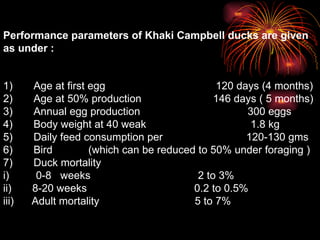
1)       Age at first egg                                     120 days (4 months) 2)       Age at 50% production                        146 days ( 5 months) 3)       Annual egg production                                    300 eggs 4)       Body weight at 40 weak                                   1.8 kg 5)       Daily feed consumption per                            120-130 gms 6)       Bird            (which can be reduced to 50% under foraging ) 7)       Duck mortality i)         0-8   weeks                                    2 to 3% ii)       8-20 weeks                                    0.2 to 0.5% iii)      Adult mortality                                5 to 7%   Performance parameters of Khaki Campbell ducks are given as under :
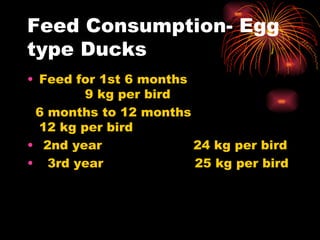
Feed Consumption- Egg type Ducks Feed for 1st 6 months                           9 kg per bird    6 months to 12 months                         12 kg per bird 2nd year                      24 kg per bird    3rd year                      25 kg per bird
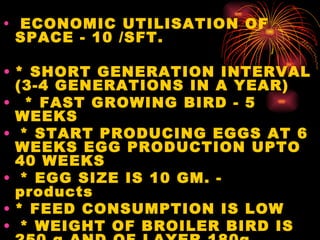
  ECONOMIC UTILISATION OF SPACE - 10 /SFT.     * SHORT GENERATION INTERVAL (3-4 GENERATIONS IN A YEAR)      * FAST GROWING BIRD - 5 WEEKS        * START PRODUCING EGGS AT 6 WEEKS EGG PRODUCTION UPTO 40 WEEKS    * EGG SIZE IS 10 GM. - products     * FEED CONSUMPTION IS LOW      * WEIGHT OF BROILER BIRD IS 250 g AND OF LAYER 180g
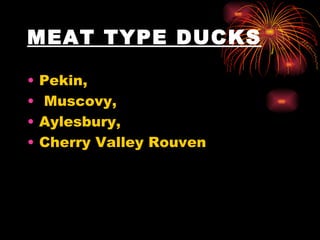
MEAT TYPE DUCKS Pekin, Muscovy,  Aylesbury,  Cherry Valley Rouven
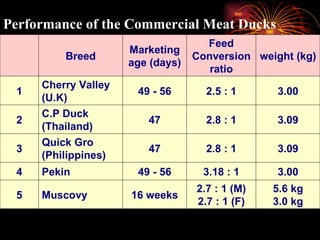
Performance of the Commercial Meat Ducks 5.6 kg 3.0 kg 2.7 : 1 (M) 2.7 : 1 (F) 16 weeks Muscovy 5 3.00 3.18 : 1 49 - 56 Pekin 4 3.09 2.8 : 1 47 Quick Gro (Philippines) 3 3.09 2.8 : 1 47 C.P Duck (Thailand) 2 3.00 2.5 : 1 49 - 56 Cherry Valley (U.K) 1 weight (kg) Feed Conversion ratio Marketing age (days) Breed  
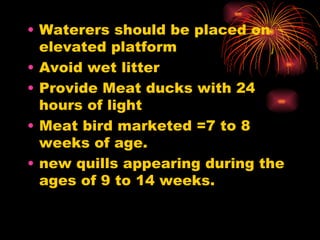
Waterers should be placed on elevated platform Avoid wet litter Provide Meat ducks with 24 hours of light Meat bird marketed =7 to 8 weeks of age.   new quills appearing during the ages of 9 to 14 weeks.
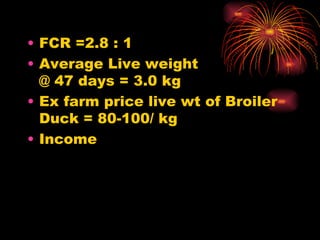
FCR =2.8 : 1 Average Live weight @ 47 days = 3.0 kg Ex farm price live wt of Broiler Duck = 80-100/ kg Income  

Poultry Industry Kerala Scenario

  • 1.
    Poultry Sector inKerala: Current Scenario and Policy Options
  • 2.
    Supply and Demandof Poultry Products in Kerala Demand for Eggs: 5063 million per yr Production : 1196 million per yr 90% are non vegs Demand for meat: 1.2 lakh tonnes per yr Production : 32,704 tonnes per yr
  • 3.
    Per-Capita Consumption RecommendedEgg Consumption: 180 eggs/year Actual consumption: 72 eggs/year Recommended meat consumption (NIN): 11 kg/year (total meat) Actual consumption of Poultry meat : 0.9 kg/year
  • 4.
    Changes in PoultryPopulation (in lakhs)
  • 5.
    District-wise Poultry Population(lakhs) Malappuram : 15.25 Thrissur : 13.06 Ernakulam : 12.26 Palakkad : 11.93 Wyanad : 3.35 Other districts : 4-10
  • 6.
    Reasons for theDecline Non-availability of land Higher cost of feed Low availability of quality chicks Higher labour cost Poor credit facilities Poor insurance coverage Higher VAT on chicken
  • 7.
    Suggested Policy OptionsNeed for a Poultry Development Policy Intensification of backyard poultry production Specify preferred varieties Backyard duck farming Quail and turkey farming Establishment of poultry farmer service centres / Cooperatives Chicks, Feed , Biologicals Medicines , Technical Advice
  • 8.
    Policy Options… GOVTStrengthening of disease surveillance centres Establishment of marketing network Establishment of broiler processing units Starting poultry waste processing units Exemption of VAT on poultry Better insurance coverage Increased R&D efforts Conservation of indigenous germplasm
  • 9.
        PROJECT PLANNING Before starting a project, four important points should be considered:  Capital   Land  Management  Marketing
  • 10.
    Choosing of  area    Sufficient area of land  Good irrigation   ventilation   Far from human activities, good road connection, electricity, clean water supply and free from wild / other animals   Do not mix with other kinds of poultry such as duck and village chicken  
  • 11.
    Good Management practicesStart with quality chicks from reliable sources Keep houses and equipments clean. Keep the litter clean, dry and free from moulds. Brood chicks carefully with good sanitation. Ensure adequate ventilation. Provide adequate floor space, feeder space and water space.
  • 12.
    Provide light atnight. Adopt vaccination schedule to suit local conditions. Promptly dispose off dead birds. Discourage visitors. Provide good quality feed. Disinfect in between batches Adequate care of broilers during hot weather is essential.
  • 13.
    Record Management    To correct the weakness of management   To make sure the breed chosen are good   To make sure the feed is good   To minimize the mortality rate   Use suitable medication.
  • 14.
    Source of vaccineInstitute of Animal Health and Veterinary Biologicals, Palode, Thiruvananthapuram, District. Phone: 0472-2840262 E-mail: dirvbi@kerala.nic.in I.V.P.M. Ranipet, Tamil Nadu. I.V.R.I. Izatnagar, Bareilly, U.P. I.A.H.V.B.I. Hebbal, Bangalore, Karnataka, PIN: 560024. Ventri biologicals, Vaccine division, 3/303, Sharda Centre, Erandwave, Pune, 411004. E-mail: ventribiologicals@venkys.com Intervet India Pvt. Ltd. Intervet House 33, Pune-Nagar Road, (Behind Eden Garden) Pune - 411 014 Phone +91 20 6605 0400-01 Indovax, Corporate Heights, SCO - 24, Sector - 14, Gurgaon - 122001 (INDIA) Phone: 0091-124-2315044 / 45 / 46 E-mail: mail@indovax.com
  • 15.
    TURKEY FARMING Turkeymeat is low in fat i.e 95% fat free lowest of all avian species, rich in unsaturated fatty acids, essential amino acids especially tryptophan and vitamins like niacin, Vit-B6 and Vit B12. . Although body weight increases with advancement of age, feed efficiency is adversely affected. .
  • 16.
    Attain 4 kgbody weight at about 12-14 weeks of age At 20-24 weeks of age = 8 to 9 kg. Dressing percentage is 75-82%. Feed efficiency is comparatively poor in small turkeys than large turkeys
  • 17.
    FIXED COST:  Shed= ( Area for 1 bird = 1 -2 square foot)   Water tank   Heater (1 small hover = 500 day old chick) Waterers for chicks ( 4 units = 100 birds)   Feed troughs for chick ( linear feeders: 3 units = 100 birds) Automatic drinkers ( 2 unit = 100 birds) Feed troughs - hanging  (2 unit = 100 birds)   Store for keeping apparatus and feed  Other expenditures (unexpected)
  • 18.
    RECURRENT COST  Day old chicks   Poultry feed - starter and finisher   Electrica/ / kerosene or coal /water- for brooding   Vaccine and medicine   Building depreciation   Equipments depreciation   Bank loan interest  Others expenditures (unexpected)
  • 19.
    Housing Design andSystem  Good air ventilation -  Suggested dimension of the shed: 25 feet x 200 feet (1 shed) or 25 feet x 100 feet (2 sheds)   Location -East - West direction,  floor space = 1 m2 per bird for large varieties 0.81 m2 for small varieties.
  • 20.
    Housing System RaisedFloor System Deep Litter System Cage Slat Slat cum wire
  • 21.
       BREED SELECTION     FEED    Starter Feed age 1 day - 4 weeks (Crude Protein content = 23 % Finisher/Fattening Feed for chicken age 5 weeks - 6 weeks/sale (Crude Protein content = 20 %)   ad lib feeding       PREVENTION AND CONTROL OF DISEASES  vaccination program Biosecurity measures
  • 22.
    Marketing Strategy Location / Place (near to the marketing place, no communication problem).  Production (sold as live chicken, processed and frozen, cuts and others.)  Price (Depends on the location and market demand)  Advertisement
  • 23.
    To know theprofit/loss level  To minimize wastage cost  As a guide in preparing paper work for expanding project in future
  • 24.
    110-120g/day Scavenging +25-30 g balanced layer ration Scavenging + 25-30 g balanced layer ration Scavenging + 25-30 g balanced layer ration Feeding Commercial Backyard Backyard Backyard Purpose 96 95 95 95 Livability in % White tinted Brown Light Brown Egg Colour 56 55 52-55 50 Egg weight in g 1.6 1.8 2 1.8 Body weight at 72 weeks in kg 300 200-225 190-200 180-200 Annual egg production (upto 72 weeks of age) in numbers 150 180 175 180 Age at 50% egg production 139 150 152 160 Age at sexual maturity in days Athulya Gramapriya Gramasree Gramalakshmi Characteristics Comparison of performance of common layer birds.
  • 25.
    Comparative performance ofNative breeds of chicken in India 54 99 201 1005 4. Naked neck 49 105 180 920 3. Kadaknath 53 110 185 1005 2. Frizzle 50 92 196 1220 1. Aseel Egg weight at 40 weeks (g) Annual egg production (No.) Age at sexual maturity (days) Body weight (20 weeks) Breed
  • 26.
      Housing :-deep litter system. open area on one side of the shed, No litter material. The shed is cleaned twice a day. The space per adult bird 4 to 6 Sq.ft. Roof hanging of 2 to 4 feet The average cost of construction ranged from Rs.100 to 120 per Sq.ft. All in all out system flock size was small ( 200 to 500 birds),
  • 27.
    Turkey Farming - ve Long generation interval High investment Low demand + ve White Meat Low Fat Low Cholesterol Seasonal Premium Price
  • 28.
    Equipments : onedrinker for 15 to 25 birds. one feeder for 50 to 75 birds. Brooding using electrical bulbs. feed requirement : 20 to 25 Kg. per bird up to Six months male birds are heavier to females. chopped green grasses ad lib
  • 29.
    Space Allowances Under Semi-intensive System
  • 30.
    Space Allowance inFeeders and Waters (per bird) Feeder Waterer 0 - 4 weeks 4 cm 2 cm 5 - 8 weeks 8 cm 4 cm 9 - 12 weeks 12 cm 6 cm 13-16 weeks 16 cm 8 cm > 16 weeks 20 cm 10 cm
  • 31.
    by NRC -1994 is as follows: Nutrient Age (weeks) 0 – 4 4 - 8 8 –12 12 –16 16–20 20–24 Br ME (Kcal/kg) 2800 2900 3000 3100 3200 3300 2900 Protein (%) 28 26 22 19 16.5 14 14 Lysin (%) 1.6 1.5 1.3 1.0 0.80 0.65 0.60 Methionine (%)0.55 0.45 0.40 0.35 0.25 0.25 0.20 Methionine + 1.05 0.95 0.80 0.65 0.55 0.45 0.40
  • 32.
  • 33.
    Breeding Management Ratio : 10:1 Feed : 14% CP 2650 KCal/ kg ME 2.5% Ca 0.40% A.P. Incubation period : 28 days
  • 34.
    Diseases M.D. andI.B. : Resistant Fowl Cholera Coli Septicaemia Mycoplasmosis : egg, semen Fowl Pox, NCD Avian Influenza Worms
  • 35.
    RDF or Lasota: 5-7 days and 30 days Pox vaccine : 6 weeks and 22 weeks RDVK : 10 weeks 20 weeks 40 weeks Vaccination Schedule
  • 36.
    Disease Control MeasuresWater Sanitation Quality Feed Disinfection Procedure Bio-security Measures Egg Dipping.
  • 37.
    Turkey Research Station/ Farms in India Central Avian Research Institute, Izatnagar Central Poultry Development Organization, Hessarghatta Poultry Research Station, Nandanam, Chennai University of Agricultural Sciences, Hebbal, Karnataka Poultry Farm Department of Animal Husbandry, Quilon, Kerala Haryana Agricultural University, Hisar
  • 38.
    5 to 20%. mortality vaccination done - RD and Pasturellosis Sex determination is not easy --Vent Sexing at the time of hatching By weight - Males are heavier Matured male - conspicuous black bearing attached to the skin of the upper region. Dewbill or snood, - relatively large, plump and elastic in males and small , thin and elastic in females. Male sturt even at day-old age and continue to do so throughout their life- Sturting is not seen in females.
  • 39.
    Marketing : atthe age of six months for meat purpose. The average body weight is 6 - 8 Kgs. No retail market for the birds on day to day basis except during Christmas, Easter
  • 40.
    Reproductive parameters Ageof laying - 24 - 28 weeks No. of eggs produced 70 – 100 per year - Egg weight - 85 gm Incubation Period - 28 days Male female Ratio - 1 : 5 No.of chicks /female - 43 - 63
  • 41.
    Marketing : Thedemand for turkey poult is mostly seasonal The demand is slowly picking up There is no established market for the turkey High average weight (6 to 8 Kg.) it is not finding a place in the diet of middle class families
  • 42.
    Duck farming hasfollowing advantages:- more egg s Wt= 70g Ducks require lesser attention and thrive well in scavenging conditions. Ducks supplements their feed by foraging. They eat fallen grains in paddy fields, insects, snails, earthworms, small fishes and other aquatic materials. From commercial point of view, ducks have a longer profitable life. They lay well even in second year. Ducks do not require any elaborate housing like chicken Ducks are quite hardy, more easily brooded and more resistant to common avian diseases. Marshy river side, wet land and barren moors upon which chicken or no other type of stock will flourish, are excellent quarters for duck farming.
  • 43.
    Ducks lay 95– 98% of their eggs in the morning before 9.00 AM. Thus saving lot of time and labour. Ducks are suitable for integrated farming systems such as duck-cum-fish farming, duck farming with rice cultivation. In duck-cum-fish farming the droppings of ducks serve as feed for the fishes and no other feed or manuring of the pond is necessary for fishes (200-300 ducks per hectare of waste area). Under integrated duck farming with rice cultivation, the ducks perform four essential functions viz., intertillage as they search for food, their bills loosen up the soil around the rice plants-weeding, insect control and manuring. Ducks are good exterminators of potato beetles, grasshoppers, snails and slugs. In areas plagued with liver flukes, ducks can help correct the problem (2 to 6 ducks per 0.405 hectare of land). Ducks can be used to control mosquito pupae and larvae (6 to 10 ducks per 0.405 hectare of water surface) Ducks are quite intelligent, can be tamed easily, and trained to go to ponds and come back in the evening of their own. Water for swimming is not essential at any stage of duck rearing Ducks should never have access to feed without water.
  • 44.
    1)       Age atfirst egg                                     120 days (4 months) 2)       Age at 50% production                        146 days ( 5 months) 3)       Annual egg production                                    300 eggs 4)       Body weight at 40 weak                                   1.8 kg 5)       Daily feed consumption per                            120-130 gms 6)       Bird            (which can be reduced to 50% under foraging ) 7)       Duck mortality i)         0-8   weeks                                    2 to 3% ii)       8-20 weeks                                    0.2 to 0.5% iii)      Adult mortality                                5 to 7%   Performance parameters of Khaki Campbell ducks are given as under :
  • 45.
    Feed Consumption- Eggtype Ducks Feed for 1st 6 months                           9 kg per bird   6 months to 12 months                         12 kg per bird 2nd year                      24 kg per bird   3rd year                      25 kg per bird
  • 46.
      ECONOMIC UTILISATIONOF SPACE - 10 /SFT.     * SHORT GENERATION INTERVAL (3-4 GENERATIONS IN A YEAR)      * FAST GROWING BIRD - 5 WEEKS        * START PRODUCING EGGS AT 6 WEEKS EGG PRODUCTION UPTO 40 WEEKS   * EGG SIZE IS 10 GM. - products     * FEED CONSUMPTION IS LOW      * WEIGHT OF BROILER BIRD IS 250 g AND OF LAYER 180g
  • 47.
    MEAT TYPE DUCKSPekin, Muscovy, Aylesbury, Cherry Valley Rouven
  • 48.
    Performance of theCommercial Meat Ducks 5.6 kg 3.0 kg 2.7 : 1 (M) 2.7 : 1 (F) 16 weeks Muscovy 5 3.00 3.18 : 1 49 - 56 Pekin 4 3.09 2.8 : 1 47 Quick Gro (Philippines) 3 3.09 2.8 : 1 47 C.P Duck (Thailand) 2 3.00 2.5 : 1 49 - 56 Cherry Valley (U.K) 1 weight (kg) Feed Conversion ratio Marketing age (days) Breed  
  • 49.
    Waterers should beplaced on elevated platform Avoid wet litter Provide Meat ducks with 24 hours of light Meat bird marketed =7 to 8 weeks of age.  new quills appearing during the ages of 9 to 14 weeks.
  • 50.
    FCR =2.8 :1 Average Live weight @ 47 days = 3.0 kg Ex farm price live wt of Broiler Duck = 80-100/ kg Income  

Editor's Notes

  • #3 As per the reports of animal Husbandry Department, Govt of Kerala (2006) , a market demand of 5063 million eggs in the state against the availability of a meagre 1197 million eggs. The demand for poultry meat is estimated to be 1.2 lakh tonnes/year against a production of 32704 Tonnes.
  • #4 The per capita availability of egg in Kerala is very low at 72 eggs/ year and that of poultry meat is at 0.9 kg/year against the world average of 147 eggs and 11 kg poultry meat /year, which is the level recommended by the National Institute of Nutrition..
  • #5 The Census figures indicated that the chicken and duck population in Kerala reduced to half over a period from 1996 to 2003. However, there has been a significant improvement in the population of other species of poultry especially quail and turkeys. An overall 47% reduction in the poultry population was observed during the period.
  • #6 Among the districts of Kerala, Malappuram registered the highest number of poultry (15.25 lakhs) followed by Thrissur (3.06), Ernakulam (12.26) and Palakkad (11.93) whereas Wyanad recorded the lowest (3.35 lakhs). Other districts recorded a population between 4-10 lakhs.
  • #7 There are various reasons for the decline in poultry population in Kerala. One of the primary reasons is the non-availability of land. Kerala is already placed in India among the most thickly populated states. The agricultural land is also on the decline, which translates to a higher cost of feed ingredients. There are no feed companies in Kerala which make specific poultry feeds. Therefore, many a times, feed has to be procured from other states. The availability of quality chicks is another problem in Kerala. Moreover, the cost of labour compared to neighbouring states is another constraint. For poultry farmers, loan/credit facilities are far from satisfactory. Furthermore, small poultry units lack insurance coverage. Over and above, Government has imposed a 12.5% Value Added Tax.
  • #8 Low production potential in the stocks maintained by the backyard farmers and small holders. However, the up gradation has to be gradual as the birds need to retain their hardiness, required for their scavenging nature and survivability in harsh rural conditions Proper feeding and other managemental aspects will also help improve the productivity of the birds. Duck production is a feasible choice for ensuring the food security of the rural poor. This improves the nutritive status via egg and meat and improves economic activity by giving supplementary income. Strengthening of other species like quail and turkey for eggs and meat will enable us to ensure food security. Poultry Farmers Service Centres may be established on Regional basis to provide need based service to farmers be it Quality chicks, Feed, Biologicals, Medicines on subsidised rates and Technical Advice.
  • #9 Health coverage to the birds in the rural areas needs to be strengthened. Timely vaccinations and medication, coupled with strict biosecurity measures are needed. Availability of vaccines and drugs, as also their safety in terms of acceptable levels in end products for human consumption are other issues needed to be tackled. Special emphasis is needed for creating a marketing network of rural poultry produce. There is a need to improve processing, preservation and marketing of eggs and poultry products. It needs to be supported by providing infrastructure for meat processing, packaging, preservation and marketing with value addition of products and maintaining a cold chain till the product reaches the consumer. With intensive production, environmental pollution abatement and bio-waste management strategies have to be worked out . Exemption of VAT on poultry and Better insurance coverage to poultry units to mitigate natural disasters and disease incidences will help to promote poultry farming.