Boise
State
Timothy Newby
Purdue University
Daniel L. Randall
Richard E. West
Brigham Young University
BYU Purdue
Implementing Open Badges in Three
Preservice Teacher Education Programs:
Challenges, Lessons, and Opportunities
Chris Haskell
Boise State University
AECT 2015
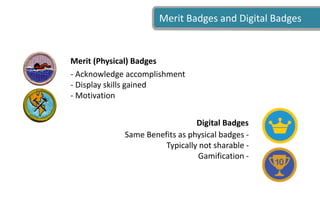
Merit Badges and Digital Badges
Merit (Physical) Badges
Digital Badges
- Acknowledge accomplishment
- Display skills gained
- Motivation
Same Benefits as physical badges -
Typically not sharable -
Gamification -
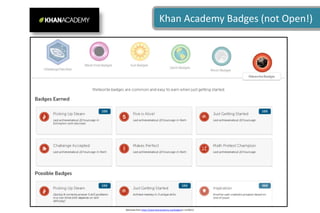
Khan Academy Badges (not Open!)
Retrieved from https://www.khanacademy.org/badgeson 11/30/13.
Open Badges
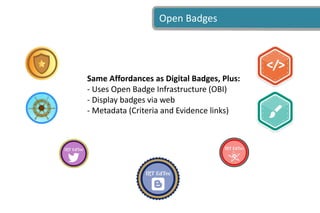
Open Badges
Same Affordances as Digital Badges, Plus:
- Uses Open Badge Infrastructure (OBI)
- Display badges via web
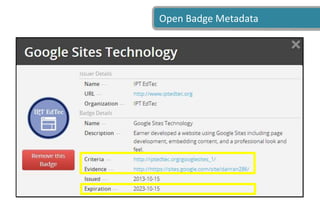
- Metadata (Criteria and Evidence links)
Open Badge Metadata
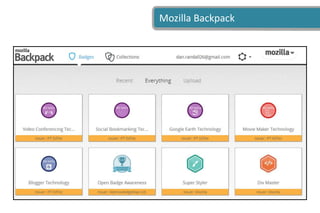
Mozilla Backpack
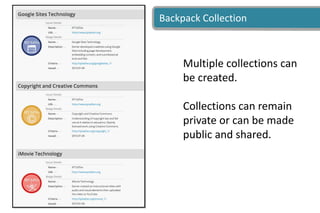
Backpack Collection
Multiple collections can
be created.
Collections can remain
private or can be made
public and shared.
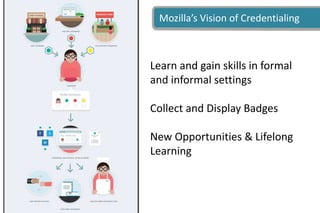
Mozilla’s Vision of Credentialing
Learn and gain skills in formal
and informal settings
Collect and Display Badges
New Opportunities & Lifelong
Learning
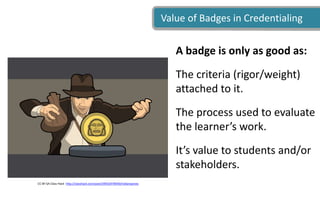
Value of Badges in Credentialing
CC BY-SA Class Hack http://classhack.com/post/39932478440/indianajones
A badge is only as good as:
The criteria (rigor/weight)
attached to it.
The process used to evaluate
the learner’s work.
It’s value to students and/or
stakeholders.
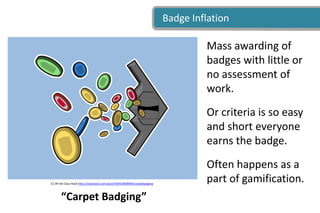
Badge Inflation
CC BY-SA Class Hack http://classhack.com/post/50915858999/carpetbadging
Mass awarding of
badges with little or
no assessment of
work.
Or criteria is so easy
and short everyone
earns the badge.
Often happens as a
part of gamification.
“Carpet Badging”
Purdue: Tim Newby
Evolving with badges…
• Background from Fall 2014
– EDCI 270 (Intro to Ed Tech)
– Passport
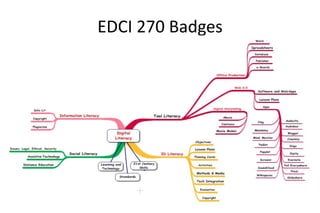
EDCI 270 Badges
Fall 2014 Lessons Learned
• Designer’s viewpoint
– Passport
• Ease of design and integration
– Instructional (scenario-based) badges
– Timely feedback challenges
• Student’s viewpoint
– Overwhelmed
• New badges constantly introduced
• Poor skills with scheduling their time on badges
– Difficulty with concept of mastery
Spring 2015 – 1st Evolution
2014 Lessons learned
• Overwhelmed
– New badges constantly
introduced
– Poor skills with scheduling their
time on badges
• Difficulty with concept of
mastery
2015 updates
• Badges set and scheduled
– Feedback deadlines
– Bulk due dates
• Discussions about benefits of
feedback and mastery
learning
Spring 2015 – Research
• Research study
– Traditional vs. Badge sections
• Pre-post course survey on perceived effectiveness
• Comparison of project grades
• Focus group analysis
• Research questions
1. Are the badges perceived to be as effective as the
traditional projects for learning the key course concepts
and skills?
2. Is the overall quality of the course projects similar for
both the traditional and the badge sections?
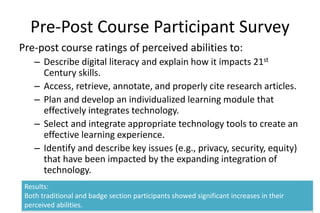
Pre-Post Course Participant Survey
Pre-post course ratings of perceived abilities to:
– Describe digital literacy and explain how it impacts 21st
Century skills.
– Access, retrieve, annotate, and properly cite research articles.
– Plan and develop an individualized learning module that
effectively integrates technology.
– Select and integrate appropriate technology tools to create an
effective learning experience.
– Identify and describe key issues (e.g., privacy, security, equity)
that have been impacted by the expanding integration of
technology.
Results:
Both traditional and badge section participants showed significant increases in their
perceived abilities.
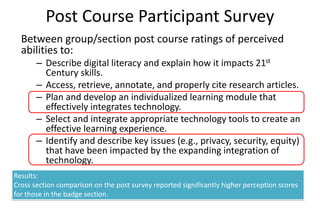
Post Course Participant Survey
Between group/section post course ratings of perceived
abilities to:
– Describe digital literacy and explain how it impacts 21st
Century skills.
– Access, retrieve, annotate, and properly cite research articles.
– Plan and develop an individualized learning module that
effectively integrates technology.
– Select and integrate appropriate technology tools to create an
effective learning experience.
– Identify and describe key issues (e.g., privacy, security, equity)
that have been impacted by the expanding integration of
technology.
Results:
Cross section comparison on the post survey reported significantly higher perception scores
for those in the badge section.
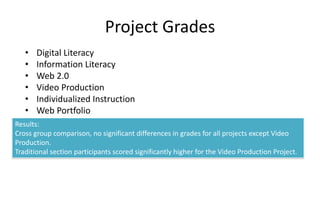
Project Grades
• Digital Literacy
• Information Literacy
• Web 2.0
• Video Production
• Individualized Instruction
• Web Portfolio
Results:
Cross group comparison, no significant differences in grades for all projects except Video
Production.
Traditional section participants scored significantly higher for the Video Production Project.
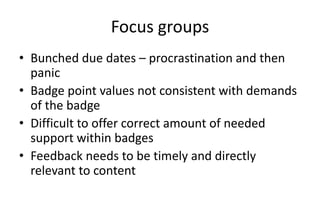
Focus groups
• Bunched due dates – procrastination and then
panic
• Badge point values not consistent with demands
of the badge
• Difficult to offer correct amount of needed
support within badges
• Feedback needs to be timely and directly
relevant to content
Spring 2015 – Lessons Learned
• Overwhelming feelings better, but not gone
– Desire for due dates – conflict with mastery learning
• Timely, content related feedback essential
• Number of badge challenges is overwhelming –
just too many
Fall 2015 – 2nd Evolution
• Badge reconfiguration
– More comprehensive, less basic badges
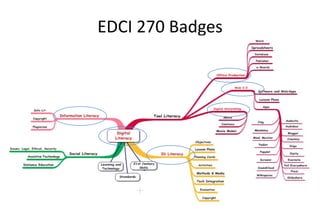
EDCI 270 Badges
Fall 2015 – 2nd Evolution
• Badge reconfiguration
– More comprehensive, less basic badges
• Mastery learning vs. due dates
– Set “final feedback” due date, then one final revision
prior to specific date
• Feedback rubrics
Boise State: Chris Haskell
Follow the link below to watch Chris
describe what he’s done at Boise
State.
http://youtu.be/1bCZkhdrn0k
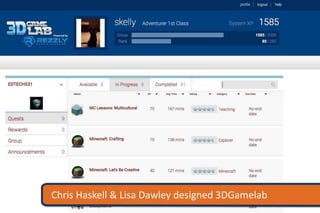
Chris Haskell & Lisa Dawley designed 3DGamelab
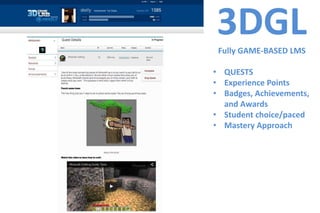
3DGLFully GAME-BASED LMS
• QUESTS
• Experience Points
• Badges, Achievements,
and Awards
• Student choice/paced
• Mastery Approach
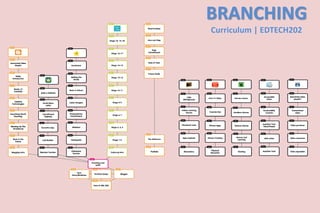
BRANCHING
Curriculum | EDTECH202
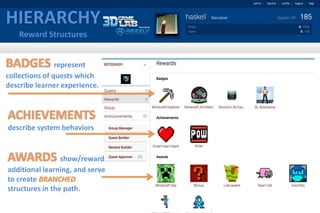
HIERARCHY
Reward Structures
BADGES represent
collections of quests which
describe learner experience.
ACHIEVEMENTS
describe system behaviors
AWARDS show/reward
additional learning, and serve
to create BRANCHED
structures in the path.
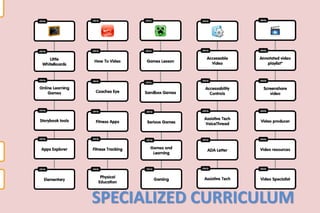
SPECIALIZED CURRICULUM
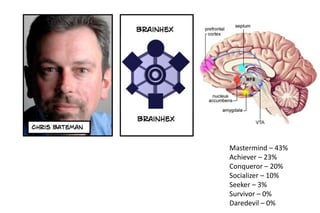
Mastermind – 43%
Achiever – 23%
Conqueror – 20%
Socializer – 10%
Seeker – 3%
Survivor – 0%
Daredevil – 0%
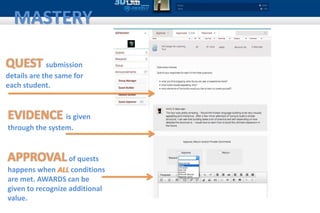
MASTERY
QUEST submission
details are the same for
each student.
EVIDENCE is given
through the system.
APPROVALof quests
happens when ALL conditions
are met. AWARDS can be
given to recognize additional
value.
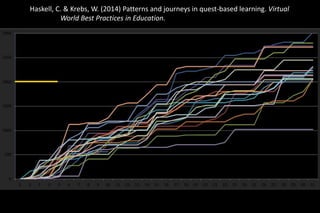
Haskell, C. & Krebs, W. (2014) Patterns and journeys in quest-based learning. Virtual
World Best Practices in Education.
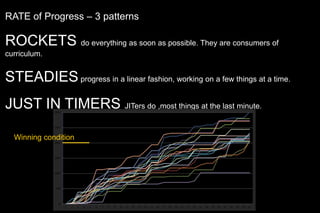
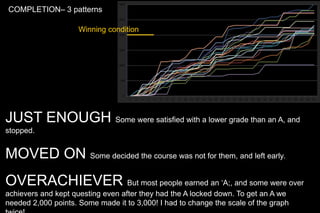
RATE of Progress – 3 patterns
ROCKETS do everything as soon as possible. They are consumers of
curriculum.
STEADIESprogress in a linear fashion, working on a few things at a time.
JUST IN TIMERS JITers do ,most things at the last minute.
Winning condition
JUST ENOUGH Some were satisfied with a lower grade than an A, and
stopped.
MOVED ON Some decided the course was not for them, and left early.
OVERACHIEVER But most people earned an ‘A;, and some were over
achievers and kept questing even after they had the A locked down. To get an A we
needed 2,000 points. Some made it to 3,000! I had to change the scale of the graph
Winning condition
COMPLETION– 3 patterns
QBL/Badges Whitepaper Attractive Quest/Badge Design
Links to Badge Research
BYU: Dan Randall & Rick West
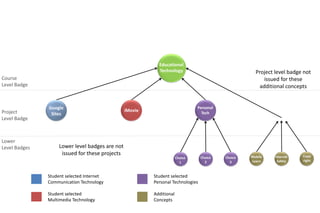
Marrying Formal and Informal Learning Through Open Badges
Grateful
acknowledgement
of the team!
Google
Sites
Personal
Tech
Choice
1
Choice
2
Choice
3
Student selected Internet
Communication Technology
Student selected
Multimedia Technology
Student selected
Personal Technologies
Additional
Concepts
Mobile
Learn
Internet
Safety
Copy
right
iMovie
Lower level badges are not
issued for these projects
Project level badge not
issued for these
additional concepts
Educational
Technology
Course
Level Badge
Project
Level Badge
Lower
Level Badges
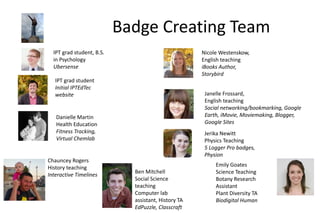
Badge Creating Team
Nicole Westenskow,
English teaching
iBooks Author,
Storybird
IPT grad student, B.S.
in Psychology
Ubersense
IPT grad student
Initial IPTEdTec
website
Danielle Martin
Health Education
Fitness Tracking,
Virtual Chemlab
Janelle Frossard,
English teaching
Social networking/bookmarking, Google
Earth, iMovie, Moviemaking, Blogger,
Google Sites
Jerika Newitt
Physics Teaching
5 Logger Pro badges,
Physion
Emily Goates
Science Teaching
Botany Research
Assistant
Plant Diversity TA
Biodigital Human
Ben Mitchell
Social Science
teaching
Computer lab
assistant, History TA
EdPuzzle, Classcraft
Chauncey Rogers
History teaching
Interactive Timelines
Student Perception of Badges:
An Evaluation
• Selected four former preservice teachers
– Used extreme (or deviant) case sampling (Patton, 1990) to
capture full spectrum of student perceptions.
– Selection was based on post-course survey data (2013-
15).
• Asked students
– “Are badges working?”
– “What future potential do they have for you?”
What’s Working
• Learner self-confidence increased (having
earned a badge).
• Natural inclination to earn higher-level badges.
• Students appreciated having more than a report
card to prove proficiency.
• Badges stand out on a resumé.
• Badges serve as unique talking points for school
interviews.
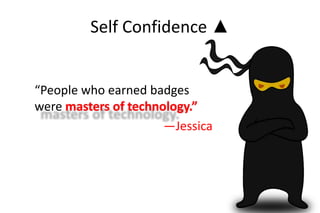
Self Confidence ▲
“People who earned badges
were masters of technology.”
—Jessica
Higher Achievement
“I’ve even thought about going back to
Dr. West [now that the class is over] and
seeing if I can upgrade my badges to the
next level.” —J.
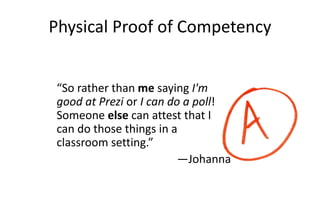
Physical Proof of Competency
“So rather than me saying I'm
good at Prezi or I can do a poll!
Someone else can attest that I
can do those things in a
classroom setting.”
—Johanna
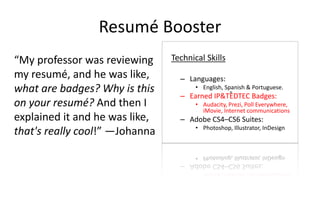
Resumé Booster
“My professor was reviewing
my resumé, and he was like,
what are badges? Why is this
on your resumé? And then I
explained it and he was like,
that's really cool!” —Johanna
Technical Skills
– Languages:
• English, Spanish & Portuguese.
– Earned IP&TEDTEC Badges:
• Audacity, Prezi, Poll Everywhere,
iMovie, Internet communications
– Adobe CS4–CS6 Suites:
• Photoshop, Illustrator, InDesign
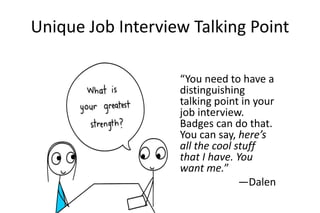
Unique Job Interview Talking Point
“You need to have a
distinguishing
talking point in your
job interview.
Badges can do that.
You can say, here’s
all the cool stuff
that I have. You
want me.”
—Dalen
1. Any better than traditional
rubrics?
2. A badge website, in addition
to normal class assignments,
caused confusion.
3. Most learners selected the
easiest badges to fulfill course
requirements.
4. People (principals) outside of
the class didn’t know/appreciate
badges and their rigor.
What’s Not Working
Please, Make It A Thing! 
• “Hopefully—eventually—people will know what
[Badges] are. As for right now, maybe not, but I
can explain it until it catches on. [Dr. West]
talked about badges like they were going to be a
thing. And I really hope it is, so when I go to
apply for a job, they'll be like, oh, you have
badges; that's cool!” —Joanna
We’ll Wait ‘Till It’s a Thing…
• “Badges just aren't there yet. If you could get it to the point
where it was something that administrators were asking for, or
if people knew about badges in the professional community,
then I could see them being useful.” —Lindsey
• “There's no place on a teaching application that says, hey,
what badges do you have? So until then, it's going to be hard
for me to be, like, yes, I really do need badges.” —Dalen
• “On the first day, I remember our instructor saying that we're
hoping that this becomes something in the future. So since it
wasn't really established yet, I was like, I don't really care.” —
Jessica
Badges = Professional Development?
• “If there were breakout session at conferences where badges
were taught and graded, I'd do it.” —Lindsey
• “If it counted toward my PD hours, I would definitely be more
motivated to earn badges.” —Joanna
• “That would be great! Some teachers at PD meetings don’t
even know how to use computers…[implying a waste of his
time.]” —Dalen
• “Traditional PD is just a bunch of people chatting and no one
actually learns anything. So if I had a choice to earn a badge or
attend a professional development meeting, I'd much rather
earn a badge; I might be able to actually use it in my
classroom.” —Jessica
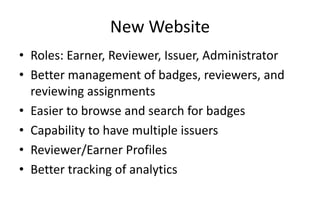
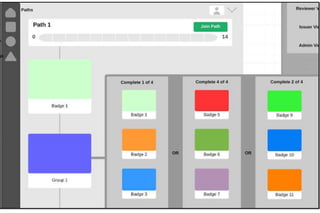
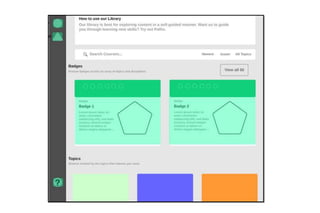
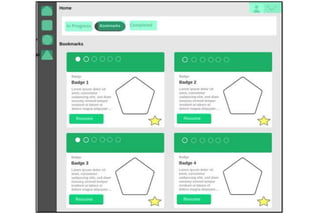
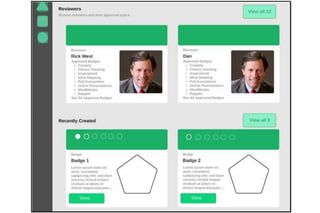
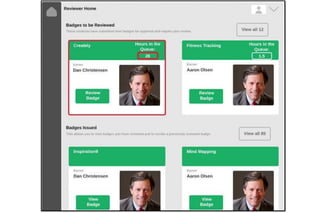
New Website
• Roles: Earner, Reviewer, Issuer, Administrator
• Better management of badges, reviewers, and
reviewing assignments
• Easier to browse and search for badges
• Capability to have multiple issuers
• Reviewer/Earner Profiles
• Better tracking of analytics
New Directions
• Challenge: Providing more credits without
hindering graduation
• Badges are the criteria; classes are labs designed to
support
• Multiple options (face to face/online) for earning
• Challenge: Make badges respectable
• Could like-minded institutions collaborate to endorse
badges, lending credibility?
• Challenge: Scale beyond preservice
• Partner with DOEs, schools, and professional
development?
Davies, R., Randall, D., & West, R. E. (2015). Using Open Badges to Certify
Practicing Evaluators. American Journal of Evaluation, 36(2), 151–163.
doi:10.1177/1098214014565505
Available Now!
Recent Articles
West, R. E., & Randall, D. L. (in-press). The Case for Rigor in Badges. In L.
Muilenburg & Z. Berge (Eds.), Digital Badges in Education: Trends,
Issues, and Cases. Routledge.
Coming Soon!
Questions?
Please Feel Free to Contact Us
Thank You
Rick West
RickWest@gmail.com
Chris Haskell
chrishaskell@boisestate.edu
Dan Randall
Dan.Randall26@gmail.com
Tim Newby
newby@purdue.edu

Implementing Open Badges in Three Preservice Teacher Education Programs 2015

  • 1.
    Boise State Timothy Newby Purdue University DanielL. Randall Richard E. West Brigham Young University BYU Purdue Implementing Open Badges in Three Preservice Teacher Education Programs: Challenges, Lessons, and Opportunities Chris Haskell Boise State University AECT 2015
  • 2.
    Merit Badges andDigital Badges Merit (Physical) Badges Digital Badges - Acknowledge accomplishment - Display skills gained - Motivation Same Benefits as physical badges - Typically not sharable - Gamification -
  • 3.
    Khan Academy Badges(not Open!) Retrieved from https://www.khanacademy.org/badgeson 11/30/13.
  • 4.
    Open Badges Open Badges SameAffordances as Digital Badges, Plus: - Uses Open Badge Infrastructure (OBI) - Display badges via web - Metadata (Criteria and Evidence links)
  • 5.
  • 6.
  • 7.
    Backpack Collection Multiple collectionscan be created. Collections can remain private or can be made public and shared.
  • 8.
    Mozilla’s Vision ofCredentialing Learn and gain skills in formal and informal settings Collect and Display Badges New Opportunities & Lifelong Learning
  • 9.
    Value of Badgesin Credentialing CC BY-SA Class Hack http://classhack.com/post/39932478440/indianajones A badge is only as good as: The criteria (rigor/weight) attached to it. The process used to evaluate the learner’s work. It’s value to students and/or stakeholders.
  • 10.
    Badge Inflation CC BY-SAClass Hack http://classhack.com/post/50915858999/carpetbadging Mass awarding of badges with little or no assessment of work. Or criteria is so easy and short everyone earns the badge. Often happens as a part of gamification. “Carpet Badging”
  • 11.
  • 12.
    Evolving with badges… •Background from Fall 2014 – EDCI 270 (Intro to Ed Tech) – Passport
  • 13.
  • 14.
    Fall 2014 LessonsLearned • Designer’s viewpoint – Passport • Ease of design and integration – Instructional (scenario-based) badges – Timely feedback challenges • Student’s viewpoint – Overwhelmed • New badges constantly introduced • Poor skills with scheduling their time on badges – Difficulty with concept of mastery
  • 15.
    Spring 2015 –1st Evolution 2014 Lessons learned • Overwhelmed – New badges constantly introduced – Poor skills with scheduling their time on badges • Difficulty with concept of mastery 2015 updates • Badges set and scheduled – Feedback deadlines – Bulk due dates • Discussions about benefits of feedback and mastery learning
  • 16.
    Spring 2015 –Research • Research study – Traditional vs. Badge sections • Pre-post course survey on perceived effectiveness • Comparison of project grades • Focus group analysis • Research questions 1. Are the badges perceived to be as effective as the traditional projects for learning the key course concepts and skills? 2. Is the overall quality of the course projects similar for both the traditional and the badge sections?
  • 17.
    Pre-Post Course ParticipantSurvey Pre-post course ratings of perceived abilities to: – Describe digital literacy and explain how it impacts 21st Century skills. – Access, retrieve, annotate, and properly cite research articles. – Plan and develop an individualized learning module that effectively integrates technology. – Select and integrate appropriate technology tools to create an effective learning experience. – Identify and describe key issues (e.g., privacy, security, equity) that have been impacted by the expanding integration of technology. Results: Both traditional and badge section participants showed significant increases in their perceived abilities.
  • 18.
    Post Course ParticipantSurvey Between group/section post course ratings of perceived abilities to: – Describe digital literacy and explain how it impacts 21st Century skills. – Access, retrieve, annotate, and properly cite research articles. – Plan and develop an individualized learning module that effectively integrates technology. – Select and integrate appropriate technology tools to create an effective learning experience. – Identify and describe key issues (e.g., privacy, security, equity) that have been impacted by the expanding integration of technology. Results: Cross section comparison on the post survey reported significantly higher perception scores for those in the badge section.
  • 19.
    Project Grades • DigitalLiteracy • Information Literacy • Web 2.0 • Video Production • Individualized Instruction • Web Portfolio Results: Cross group comparison, no significant differences in grades for all projects except Video Production. Traditional section participants scored significantly higher for the Video Production Project.
  • 20.
    Focus groups • Buncheddue dates – procrastination and then panic • Badge point values not consistent with demands of the badge • Difficult to offer correct amount of needed support within badges • Feedback needs to be timely and directly relevant to content
  • 21.
    Spring 2015 –Lessons Learned • Overwhelming feelings better, but not gone – Desire for due dates – conflict with mastery learning • Timely, content related feedback essential • Number of badge challenges is overwhelming – just too many
  • 22.
    Fall 2015 –2nd Evolution • Badge reconfiguration – More comprehensive, less basic badges
  • 23.
  • 24.
    Fall 2015 –2nd Evolution • Badge reconfiguration – More comprehensive, less basic badges • Mastery learning vs. due dates – Set “final feedback” due date, then one final revision prior to specific date • Feedback rubrics
  • 25.
  • 26.
    Follow the linkbelow to watch Chris describe what he’s done at Boise State. http://youtu.be/1bCZkhdrn0k
  • 27.
    Chris Haskell &Lisa Dawley designed 3DGamelab
  • 28.
    3DGLFully GAME-BASED LMS •QUESTS • Experience Points • Badges, Achievements, and Awards • Student choice/paced • Mastery Approach
  • 30.
  • 31.
    HIERARCHY Reward Structures BADGES represent collectionsof quests which describe learner experience. ACHIEVEMENTS describe system behaviors AWARDS show/reward additional learning, and serve to create BRANCHED structures in the path.
  • 33.
  • 34.
    Mastermind – 43% Achiever– 23% Conqueror – 20% Socializer – 10% Seeker – 3% Survivor – 0% Daredevil – 0%
  • 35.
    MASTERY QUEST submission details arethe same for each student. EVIDENCE is given through the system. APPROVALof quests happens when ALL conditions are met. AWARDS can be given to recognize additional value.
  • 36.
    Haskell, C. &Krebs, W. (2014) Patterns and journeys in quest-based learning. Virtual World Best Practices in Education.
  • 37.
    RATE of Progress– 3 patterns ROCKETS do everything as soon as possible. They are consumers of curriculum. STEADIESprogress in a linear fashion, working on a few things at a time. JUST IN TIMERS JITers do ,most things at the last minute. Winning condition
  • 38.
    JUST ENOUGH Somewere satisfied with a lower grade than an A, and stopped. MOVED ON Some decided the course was not for them, and left early. OVERACHIEVER But most people earned an ‘A;, and some were over achievers and kept questing even after they had the A locked down. To get an A we needed 2,000 points. Some made it to 3,000! I had to change the scale of the graph Winning condition COMPLETION– 3 patterns
  • 43.
    QBL/Badges Whitepaper AttractiveQuest/Badge Design Links to Badge Research
  • 44.
    BYU: Dan Randall& Rick West
  • 45.
    Marrying Formal andInformal Learning Through Open Badges Grateful acknowledgement of the team!
  • 46.
    Google Sites Personal Tech Choice 1 Choice 2 Choice 3 Student selected Internet CommunicationTechnology Student selected Multimedia Technology Student selected Personal Technologies Additional Concepts Mobile Learn Internet Safety Copy right iMovie Lower level badges are not issued for these projects Project level badge not issued for these additional concepts Educational Technology Course Level Badge Project Level Badge Lower Level Badges
  • 47.
    Badge Creating Team NicoleWestenskow, English teaching iBooks Author, Storybird IPT grad student, B.S. in Psychology Ubersense IPT grad student Initial IPTEdTec website Danielle Martin Health Education Fitness Tracking, Virtual Chemlab Janelle Frossard, English teaching Social networking/bookmarking, Google Earth, iMovie, Moviemaking, Blogger, Google Sites Jerika Newitt Physics Teaching 5 Logger Pro badges, Physion Emily Goates Science Teaching Botany Research Assistant Plant Diversity TA Biodigital Human Ben Mitchell Social Science teaching Computer lab assistant, History TA EdPuzzle, Classcraft Chauncey Rogers History teaching Interactive Timelines
  • 48.
    Student Perception ofBadges: An Evaluation • Selected four former preservice teachers – Used extreme (or deviant) case sampling (Patton, 1990) to capture full spectrum of student perceptions. – Selection was based on post-course survey data (2013- 15). • Asked students – “Are badges working?” – “What future potential do they have for you?”
  • 49.
    What’s Working • Learnerself-confidence increased (having earned a badge). • Natural inclination to earn higher-level badges. • Students appreciated having more than a report card to prove proficiency. • Badges stand out on a resumé. • Badges serve as unique talking points for school interviews.
  • 50.
    Self Confidence ▲ “Peoplewho earned badges were masters of technology.” —Jessica
  • 51.
    Higher Achievement “I’ve eventhought about going back to Dr. West [now that the class is over] and seeing if I can upgrade my badges to the next level.” —J.
  • 52.
    Physical Proof ofCompetency “So rather than me saying I'm good at Prezi or I can do a poll! Someone else can attest that I can do those things in a classroom setting.” —Johanna
  • 53.
    Resumé Booster “My professorwas reviewing my resumé, and he was like, what are badges? Why is this on your resumé? And then I explained it and he was like, that's really cool!” —Johanna Technical Skills – Languages: • English, Spanish & Portuguese. – Earned IP&TEDTEC Badges: • Audacity, Prezi, Poll Everywhere, iMovie, Internet communications – Adobe CS4–CS6 Suites: • Photoshop, Illustrator, InDesign
  • 54.
    Unique Job InterviewTalking Point “You need to have a distinguishing talking point in your job interview. Badges can do that. You can say, here’s all the cool stuff that I have. You want me.” —Dalen
  • 55.
    1. Any betterthan traditional rubrics? 2. A badge website, in addition to normal class assignments, caused confusion. 3. Most learners selected the easiest badges to fulfill course requirements. 4. People (principals) outside of the class didn’t know/appreciate badges and their rigor. What’s Not Working
  • 56.
    Please, Make ItA Thing!  • “Hopefully—eventually—people will know what [Badges] are. As for right now, maybe not, but I can explain it until it catches on. [Dr. West] talked about badges like they were going to be a thing. And I really hope it is, so when I go to apply for a job, they'll be like, oh, you have badges; that's cool!” —Joanna
  • 57.
    We’ll Wait ‘TillIt’s a Thing… • “Badges just aren't there yet. If you could get it to the point where it was something that administrators were asking for, or if people knew about badges in the professional community, then I could see them being useful.” —Lindsey • “There's no place on a teaching application that says, hey, what badges do you have? So until then, it's going to be hard for me to be, like, yes, I really do need badges.” —Dalen • “On the first day, I remember our instructor saying that we're hoping that this becomes something in the future. So since it wasn't really established yet, I was like, I don't really care.” — Jessica
  • 58.
    Badges = ProfessionalDevelopment? • “If there were breakout session at conferences where badges were taught and graded, I'd do it.” —Lindsey • “If it counted toward my PD hours, I would definitely be more motivated to earn badges.” —Joanna • “That would be great! Some teachers at PD meetings don’t even know how to use computers…[implying a waste of his time.]” —Dalen • “Traditional PD is just a bunch of people chatting and no one actually learns anything. So if I had a choice to earn a badge or attend a professional development meeting, I'd much rather earn a badge; I might be able to actually use it in my classroom.” —Jessica
  • 59.
    New Website • Roles:Earner, Reviewer, Issuer, Administrator • Better management of badges, reviewers, and reviewing assignments • Easier to browse and search for badges • Capability to have multiple issuers • Reviewer/Earner Profiles • Better tracking of analytics
  • 65.
    New Directions • Challenge:Providing more credits without hindering graduation • Badges are the criteria; classes are labs designed to support • Multiple options (face to face/online) for earning • Challenge: Make badges respectable • Could like-minded institutions collaborate to endorse badges, lending credibility? • Challenge: Scale beyond preservice • Partner with DOEs, schools, and professional development?
  • 66.
    Davies, R., Randall,D., & West, R. E. (2015). Using Open Badges to Certify Practicing Evaluators. American Journal of Evaluation, 36(2), 151–163. doi:10.1177/1098214014565505 Available Now! Recent Articles West, R. E., & Randall, D. L. (in-press). The Case for Rigor in Badges. In L. Muilenburg & Z. Berge (Eds.), Digital Badges in Education: Trends, Issues, and Cases. Routledge. Coming Soon!
  • 67.
    Questions? Please Feel Freeto Contact Us Thank You Rick West RickWest@gmail.com Chris Haskell chrishaskell@boisestate.edu Dan Randall Dan.Randall26@gmail.com Tim Newby newby@purdue.edu

Editor's Notes

  • #12 Add the badge paths to the presentation,
  • #50 Here’s what they said was working
  • #51 Jessica was an online student in Fall 2013 under Dan Randall. He was a stickler back then. To earn a badge you not only had to get 100% on the assignment, but you had to meet his personal assessment for aesthetics. Unfortunately, doesn’t feel like a master. Most of this feeling is derived from the fact that she always had to email Dan to ask him questions. (In the interview, I tried to help her realize that reaching out for help, after you’ve tried to figure it out on your own first, is part of the flowchart tech masters follow.) CC Google Image, reuse with mod: https://pixabay.com/p-152415
  • #52 Image modified from http://iptedtec.org/wix_1/
  • #53 Created image.
  • #55 Flickr Image CC some rights reserved: https://www.flickr.com/photos/thedailyenglishshow/17338151141
  • #60 wireframes
  • #66 Collaboration picture??