Enough with Weak Sauce Badges!
BYU
Image by Shutterstock
Daniel L. Randall & Richard E. West
Badges as Legitimate Credentials
“When you first said badges, I had
such a bad impression of what
that would mean.”
BYU
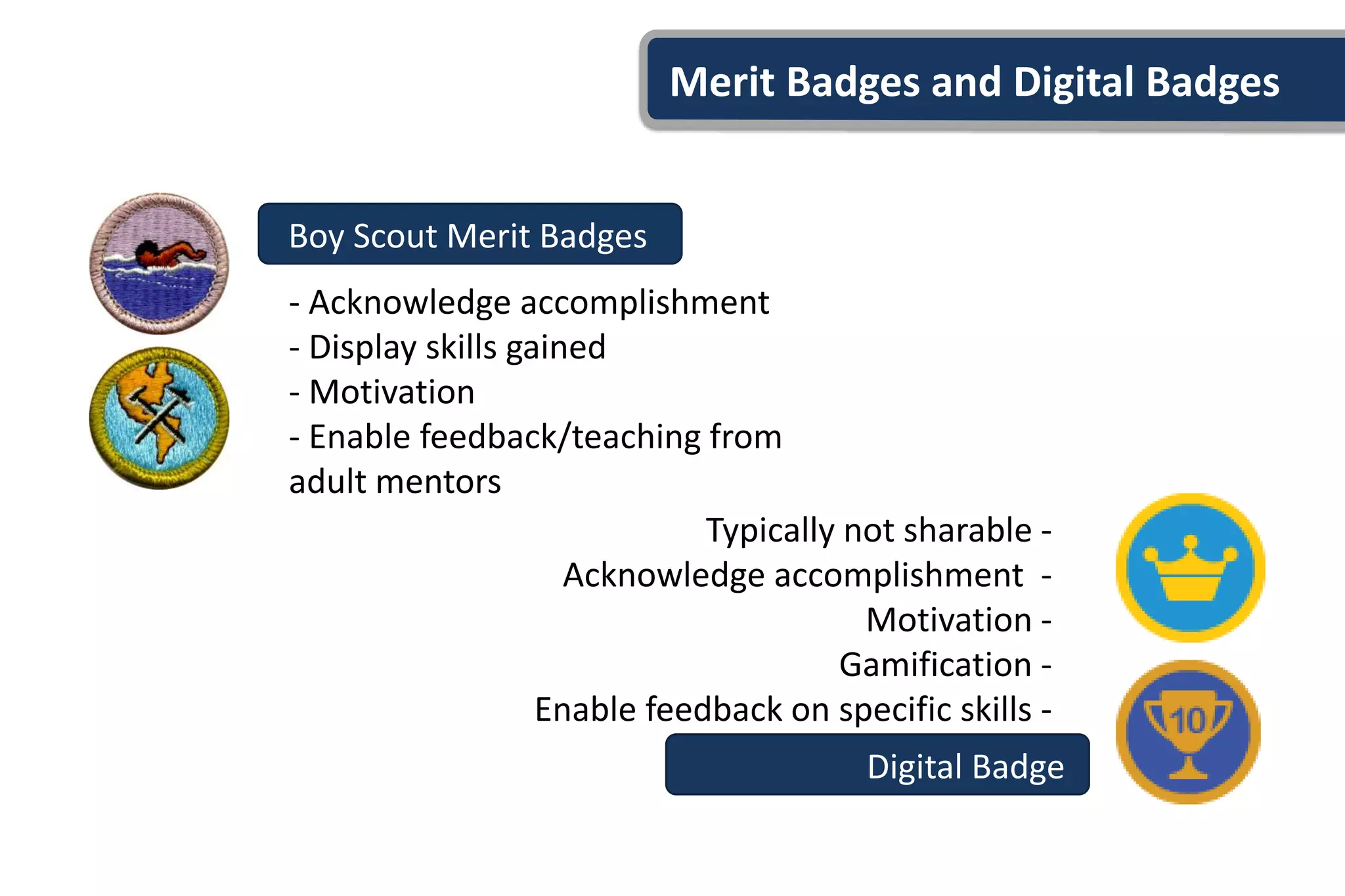
Merit Badges and Digital Badges
Boy Scout Merit Badges
Digital Badge
- Acknowledge accomplishment
- Display skills gained
- Motivation
- Enable feedback/teaching from
adult mentors
Typically not sharable -
Acknowledge accomplishment -
Motivation -
Gamification -
Enable feedback on specific skills -
Open Badges
Open Badges
Same Affordances as Digital Badges, Plus:
- Uses Open Badge Infrastructure (OBI)
- Display badges via web
- Metadata (Criteria and Evidence links)
Open Badge Information
Mozilla Backpack
Backpack Collection
Multiple collections can
be created.
Collections can remain
private or can be made
public and shared.
Badgers Talking with Badgers
Joseph (2014) argued the
badging community needs to
talk less with skeptics and
more with each other—
talking about how to improve
the badging movement.
BYU
Svenwerk on flickr
Value of Badges
CC BY-SA Class Hack http://classhack.com/post/39932478440/indianajones
A badge is only as good as:
The Rigor attached to it.
The process used to evaluate
the learner’s work.
It’s usefulness to students
and/or stakeholders.
How can we increase Badge Value?
Badge Types
Global vs. Local Systems
Badge “weight”
BYU
Badge Systems
Local badge ecosystem - intended only for the person’s learning
space
Global Badge ecosystem - stretches beyond learning space; allows
badges to be used as a credential
“Badging systems can be designed to offer both types of values—
value within an organization and value to those outside it—but,
the required features and networks are different” (Joseph, para 6).
BYU
Notthesame!
Badge Weight
BYU
By Flickr user winnifredxoxo
Lightweight Badges
Badges issued for:
• attendance
• creating a login
• simply existing as a learner.
BYU
Argument for Lightweight badges
• Casilli (2014) argued that accretion, or the
layering effect of badges over time, produces
value.
• Value to emerge in unexpected ways from the
accumulated effect of many different lightweight
badges.
• Thus, lightweight badges may not be as
meaningful individually, but taken together
they paint a fuller picture of the individual’s
interests and activities (Knight, 2014).
BYU
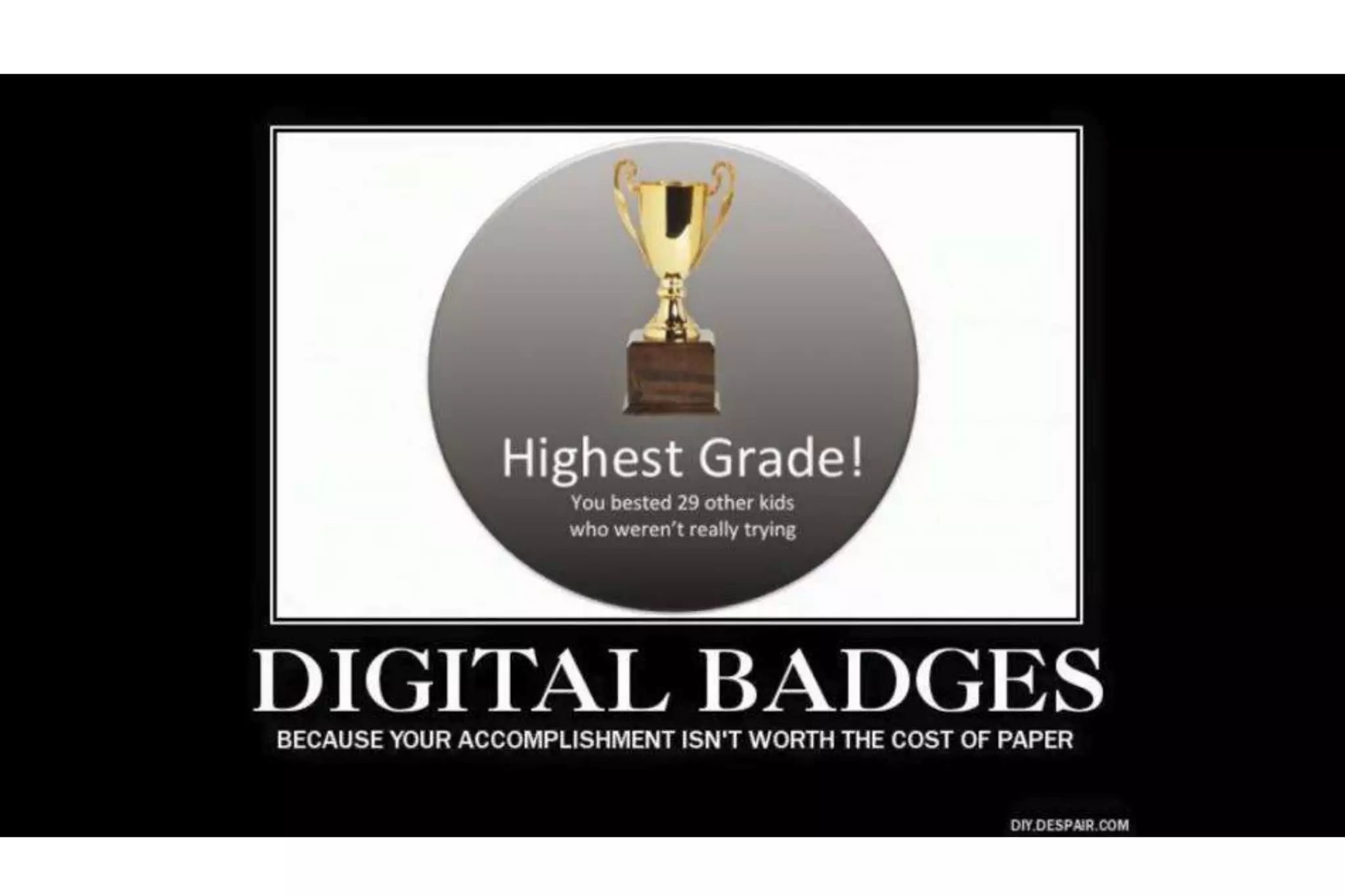
Badge Inflation
CC BY-SA Class Hack http://classhack.com/post/50915858999/carpetbadging
Mass awarding of
badges with little or
no assessment of
work.
Or criteria so easy
and short everyone
earns the badge.
“Carpet Badging”
Counter Argument: The Challenge of Lightweight
BYU
Accretion? Who’s got time for that?
Demotivating
Focusing on the wrong thing
Accretion
BYU
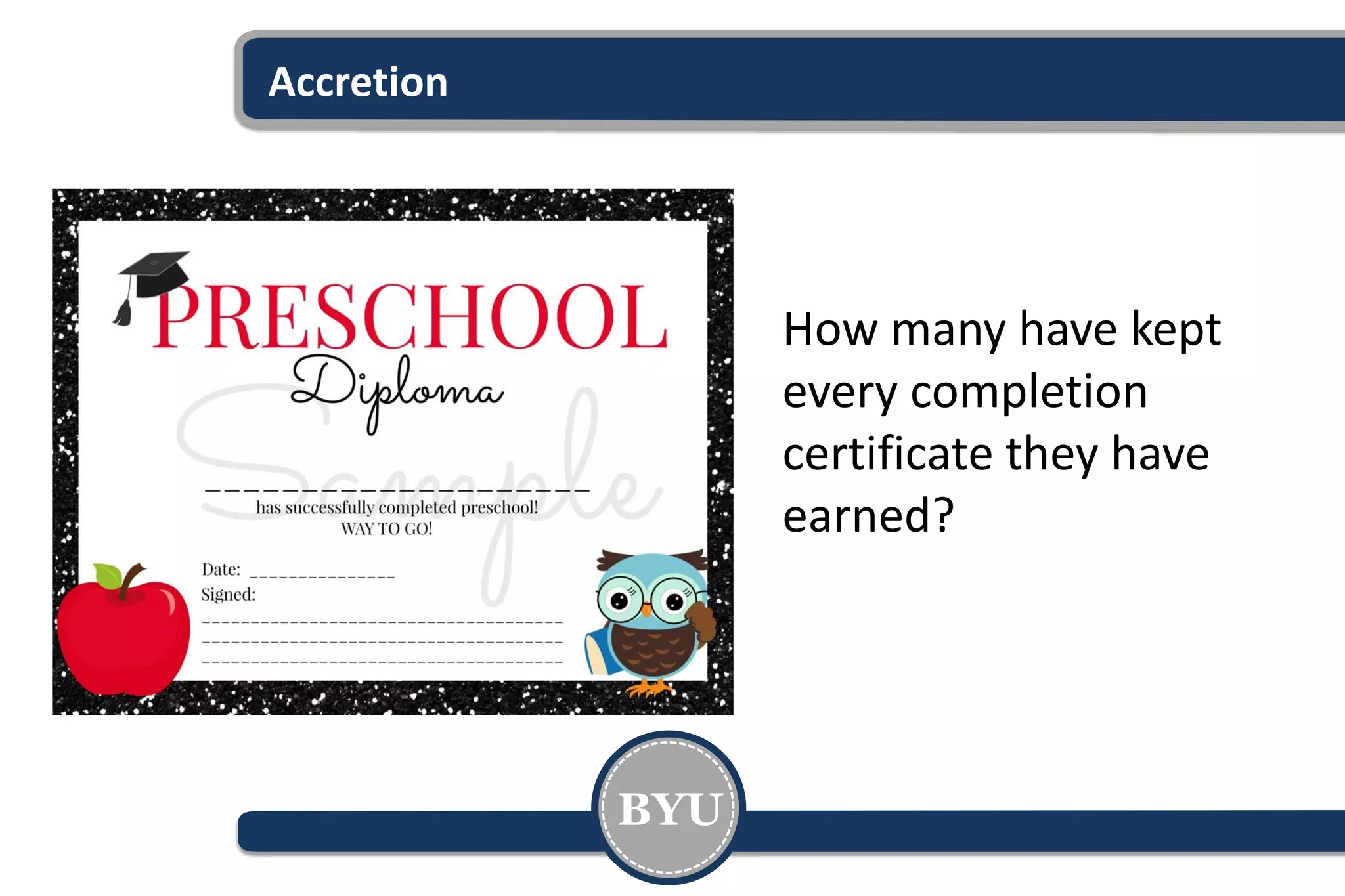
How many have kept
every completion
certificate they have
earned?
Accretion
BYU
Jordan Crowe on flickr
DeMotivating
BYU
Misplaced Focus
BYU
The Problem with Lightweight Badges
Poor Public impression of badges
If the badging community does not show how open
badges and their assessment processes can be
rigorous and meaningful, then the badging
movement may fade away.
BYU
“Weightier” Badges
• Digital Promise
• Supporter to Reporter
“Substantial motivational power for students”
(Tran, Schenke, & Hickey, 2014)
Badges as Legitimate Credentials BYU
Lots of Credentials in Formal Education
• Degrees only awarded after a long period of
time or a great deal of experience
• Transcripts have lots of information, but how
useful is that information?
BYU
How Valuable are Transcripts?
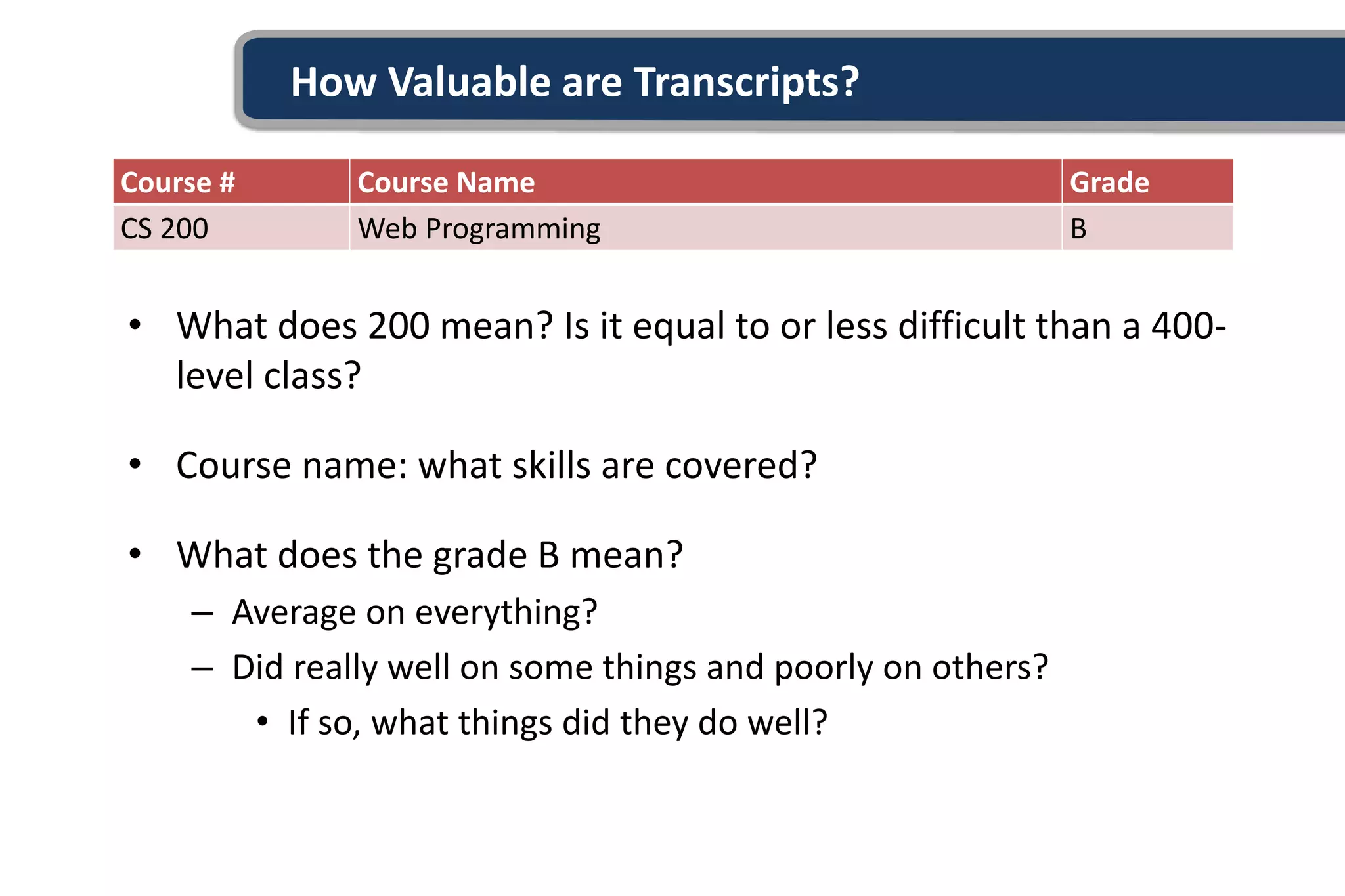
• What does 200 mean? Is it equal to or less difficult than a 400-
level class?
• Course name: what skills are covered?
• What does the grade B mean?
– Average on everything?
– Did really well on some things and poorly on others?
• If so, what things did they do well?
Course # Course Name Grade
CS 200 Web Programming B
Badges as Micro-credentials
• Receive recognition for smaller chunks of learning
• Easier to communicate skills to employers and other
interested parties
• Metadata makes data open, providing greater insights
into person’s skills (viewer could even re-grade the
submitted project if they wanted to)
• Removing metadata weakens the potential of badges
BYU
Badges and Informal Learning
• Receive recognition skills gained in informal and non-traditional
settings
• Combined with badges issued in formal education, badges
provide a fuller picture of a person’s skills
• Vetted badges issued by others could be accepted by a professor
or university, allowing the student to spend more time of topics
they do not know, or provide a shorter path to graduation
BYU
Proposed Solutions to Bolster Badging BYU
Badges and Gamification
• Use something other than badges to gamify
learning (points, levels, ranks, upgrades,
etc.)
• Reserve badges for achievements and skills
that have value outside of the learning
environment
BYU
http://www.iamprogrez.com/wp-
content/uploads/2015/09/infographic_The_business_
of_gamification.png
Badges and Gamification – 2 Types of Badges
• First type of badges (lightweight) is only used in the learning
environment; are not exportable
• Second type (weightier badges) recognize significant work and
learning; these are exportable
• Less desirable option, because
– 2 Badge types could create confusion
– Continues to proliferate lightweight badges
BYU
Rigor of Badge Creation
• Criteria for earning the badge must
have weight.
• Number of criteria and difficulty of
each criterion.
BYU
Rigor of Badge Assessment
• Assessment process should provide learners with specific,
formative feedback that allows learners to reach the level of
mastery.
• This is not only important for learning, but also gives the
badge more credibility as a legitimate credential.
• If the criteria are rigorous, but the assessment process is not,
it can still result in lightweight badges.
BYU
Badge Consortiums
• Universities, professional organizations, and other trusted
groups could join together to issue badges
• Could ensure badges issued through consortium had weight
• Greater number of badges issued, increasing brand
Recognition
BYU
Randall, D. L., Harrison, J. B., & West, R. E. (2013). Giving credit where credit
is due: Designing Open Badges for a technology integration course.
TechTrends, 57(6), 88–95.
Davies, R., Randall, D., & West, R. E. (2015). Using Open Badges to Certify
Practicing Evaluators. American Journal of Evaluation, 36(2), 151–163.
doi:10.1177/1098214014565505
West, R. E., & Randall, D. L. (in-press). The Case for Rigor in Badges. In L.
Muilenburg & Z. Berge (Eds.), Digital Badges in Education: Trends,
Issues, and Cases. Routledge.
Daniel L. Randall
dan.randall26@gmail.com
Richard E. West
rickwest@byu.edu
?
Contact us with Questions
Thank You
Daniel L. Randall
dan.randall26@gmail.com
www.danrandall.com
@dan2randall
Richard E. West
rickwest@byu.edu
www.richardewest.com
@richardewest

Enough with Weak Sauce Badges

  • 1.
    Enough with WeakSauce Badges! BYU Image by Shutterstock Daniel L. Randall & Richard E. West
  • 2.
    Badges as LegitimateCredentials “When you first said badges, I had such a bad impression of what that would mean.” BYU
  • 3.
    Merit Badges andDigital Badges Boy Scout Merit Badges Digital Badge - Acknowledge accomplishment - Display skills gained - Motivation - Enable feedback/teaching from adult mentors Typically not sharable - Acknowledge accomplishment - Motivation - Gamification - Enable feedback on specific skills -
  • 4.
    Open Badges Open Badges SameAffordances as Digital Badges, Plus: - Uses Open Badge Infrastructure (OBI) - Display badges via web - Metadata (Criteria and Evidence links)
  • 6.
  • 7.
  • 8.
    Backpack Collection Multiple collectionscan be created. Collections can remain private or can be made public and shared.
  • 9.
    Badgers Talking withBadgers Joseph (2014) argued the badging community needs to talk less with skeptics and more with each other— talking about how to improve the badging movement. BYU Svenwerk on flickr
  • 10.
    Value of Badges CCBY-SA Class Hack http://classhack.com/post/39932478440/indianajones A badge is only as good as: The Rigor attached to it. The process used to evaluate the learner’s work. It’s usefulness to students and/or stakeholders. How can we increase Badge Value?
  • 11.
    Badge Types Global vs.Local Systems Badge “weight” BYU
  • 12.
    Badge Systems Local badgeecosystem - intended only for the person’s learning space Global Badge ecosystem - stretches beyond learning space; allows badges to be used as a credential “Badging systems can be designed to offer both types of values— value within an organization and value to those outside it—but, the required features and networks are different” (Joseph, para 6). BYU Notthesame!
  • 13.
    Badge Weight BYU By Flickruser winnifredxoxo
  • 14.
    Lightweight Badges Badges issuedfor: • attendance • creating a login • simply existing as a learner. BYU
  • 16.
    Argument for Lightweightbadges • Casilli (2014) argued that accretion, or the layering effect of badges over time, produces value. • Value to emerge in unexpected ways from the accumulated effect of many different lightweight badges. • Thus, lightweight badges may not be as meaningful individually, but taken together they paint a fuller picture of the individual’s interests and activities (Knight, 2014). BYU
  • 17.
    Badge Inflation CC BY-SAClass Hack http://classhack.com/post/50915858999/carpetbadging Mass awarding of badges with little or no assessment of work. Or criteria so easy and short everyone earns the badge. “Carpet Badging”
  • 18.
    Counter Argument: TheChallenge of Lightweight BYU Accretion? Who’s got time for that? Demotivating Focusing on the wrong thing
  • 19.
    Accretion BYU How many havekept every completion certificate they have earned?
  • 20.
  • 21.
  • 22.
  • 23.
    The Problem withLightweight Badges Poor Public impression of badges If the badging community does not show how open badges and their assessment processes can be rigorous and meaningful, then the badging movement may fade away. BYU
  • 24.
    “Weightier” Badges • DigitalPromise • Supporter to Reporter “Substantial motivational power for students” (Tran, Schenke, & Hickey, 2014)
  • 25.
    Badges as LegitimateCredentials BYU
  • 26.
    Lots of Credentialsin Formal Education • Degrees only awarded after a long period of time or a great deal of experience • Transcripts have lots of information, but how useful is that information? BYU
  • 27.
    How Valuable areTranscripts? • What does 200 mean? Is it equal to or less difficult than a 400- level class? • Course name: what skills are covered? • What does the grade B mean? – Average on everything? – Did really well on some things and poorly on others? • If so, what things did they do well? Course # Course Name Grade CS 200 Web Programming B
  • 28.
    Badges as Micro-credentials •Receive recognition for smaller chunks of learning • Easier to communicate skills to employers and other interested parties • Metadata makes data open, providing greater insights into person’s skills (viewer could even re-grade the submitted project if they wanted to) • Removing metadata weakens the potential of badges BYU
  • 29.
    Badges and InformalLearning • Receive recognition skills gained in informal and non-traditional settings • Combined with badges issued in formal education, badges provide a fuller picture of a person’s skills • Vetted badges issued by others could be accepted by a professor or university, allowing the student to spend more time of topics they do not know, or provide a shorter path to graduation BYU
  • 30.
    Proposed Solutions toBolster Badging BYU
  • 31.
    Badges and Gamification •Use something other than badges to gamify learning (points, levels, ranks, upgrades, etc.) • Reserve badges for achievements and skills that have value outside of the learning environment BYU http://www.iamprogrez.com/wp- content/uploads/2015/09/infographic_The_business_ of_gamification.png
  • 32.
    Badges and Gamification– 2 Types of Badges • First type of badges (lightweight) is only used in the learning environment; are not exportable • Second type (weightier badges) recognize significant work and learning; these are exportable • Less desirable option, because – 2 Badge types could create confusion – Continues to proliferate lightweight badges BYU
  • 33.
    Rigor of BadgeCreation • Criteria for earning the badge must have weight. • Number of criteria and difficulty of each criterion. BYU
  • 34.
    Rigor of BadgeAssessment • Assessment process should provide learners with specific, formative feedback that allows learners to reach the level of mastery. • This is not only important for learning, but also gives the badge more credibility as a legitimate credential. • If the criteria are rigorous, but the assessment process is not, it can still result in lightweight badges. BYU
  • 35.
    Badge Consortiums • Universities,professional organizations, and other trusted groups could join together to issue badges • Could ensure badges issued through consortium had weight • Greater number of badges issued, increasing brand Recognition BYU
  • 36.
    Randall, D. L.,Harrison, J. B., & West, R. E. (2013). Giving credit where credit is due: Designing Open Badges for a technology integration course. TechTrends, 57(6), 88–95. Davies, R., Randall, D., & West, R. E. (2015). Using Open Badges to Certify Practicing Evaluators. American Journal of Evaluation, 36(2), 151–163. doi:10.1177/1098214014565505 West, R. E., & Randall, D. L. (in-press). The Case for Rigor in Badges. In L. Muilenburg & Z. Berge (Eds.), Digital Badges in Education: Trends, Issues, and Cases. Routledge. Daniel L. Randall dan.randall26@gmail.com Richard E. West rickwest@byu.edu
  • 37.
    ? Contact us withQuestions Thank You Daniel L. Randall dan.randall26@gmail.com www.danrandall.com @dan2randall Richard E. West rickwest@byu.edu www.richardewest.com @richardewest

Editor's Notes

  • #2 We should talk about “signaling” power Digital Promise as a good example.
  • #3 Pic of gamification, points/leveling up, etc., you’re a winner! Trophy.
  • #15 Funny picture: congratulations! You’re alive.
  • #17 Increase number with new ones
  • #19 Increase number with new ones Typo top of page 11 in article – too late?
  • #20 Increase number with new ones Typo top of page 11 in article – too late?
  • #21 Increase number with new ones Typo top of page 11 in article – too late?
  • #22 Increase number with new ones Typo top of page 11 in article – too late?
  • #23 Increase number with new ones Typo top of page 11 in article – too late?
  • #24 Any examples of similar things that have faded away?
  • #27 Increase number with new ones
  • #28 Increase number with new ones
  • #29 Increase number with new ones
  • #30 Increase number with new ones
  • #32 Increase number with new ones
  • #33 Increase number with new ones