Learning Affordances ofLearning Affordances of
BadgesBadges
(or: Can we afford(or: Can we afford
not tonot to badge?)badge?)
Barry FishmanBarry Fishman
The University ofThe University of
MichiganMichigan
@barryfishman@barryfishman
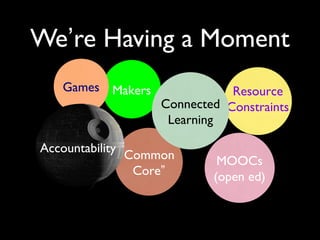
“Common
Core”
We’re Having a Moment
Resource
Constraints
MOOCs
(open ed)
Makers
Connected
Learning
Games
Accountability
The Great Unbundling
• The unbundling of education is underway
• OBI-like infrastructure is catalyzing the change:
• Increases the transparency of accomplishments
• Gives learners control over self-presentation
• Opens up access to “deep” evidence behind
claims of accomplishment
• But perhaps most importantly...
No Course is an Island
• Without the infrastructure of OBI (or something like it),
it is nearly impossible to realize the potential of badges in
instruction
• Badges depend on individual instructors to employ
them in specific leaning contexts, but...
• Education functions as a system and if the badges earned
in one context don’t have value in others, we get no
traction
• We require ubiquitous (or at least shared) ways to
communicate across contexts, both geographic and
temporal
No Learner is an Island
• Without the infrastructure of OBI (or something like it),
it is nearly impossible to realize the potential of badges in
instruction
• Badges depend on individual instructors to employ
them in specific leaning contexts, but...
• Education functions as a system and if the badges earned
in one context don’t have value in others, we get no
traction
• We require ubiquitous (or at least shared) ways to
communicate across contexts, both geographic and
temporal
Badges are Not New
• The A-F grading system is literally an “old school”
badging system
• But it is a lousy badge system that emphasizes extrinsic
motivation, privileges too few learning goals, and has
narrow communications bandwidth
• Instructors can’t rely on prior grades as reliable
indicators of prerequisite knowledge
• We know nothing of what students bring in from
outside formal education
• Transcripts are essentially exercises in branding
So What Is New?
• This cannot be a conversation about “adding”
badges to education; it must be a conversation
about improving education to create engagement
• The current crop of badge thinking is built upon
improved motivational design:
• Emphasize mastery over performance
• Encourage progress towards goals
• Support autonomy, belonging, competence
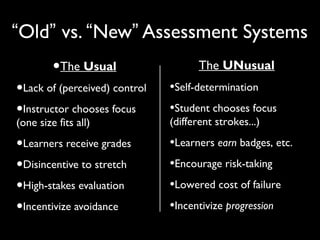
•The Usual
•Lack of (perceived) control
•Instructor chooses focus
(one size fits all)
•Learners receive grades
•Disincentive to stretch
•High-stakes evaluation
•Incentivize avoidance
“Old” vs. “New” Assessment Systems
TheThe UNusualUNusual
•Self-determinationSelf-determination
•Student chooses focusStudent chooses focus
(different strokes...)(different strokes...)
•LearnersLearners earnearn badges, etc.badges, etc.
•Encourage risk-takingEncourage risk-taking
•Lowered cost of failureLowered cost of failure
•IncentivizeIncentivize progressionprogression
Isn’t this just “Gamification”?
• Badges are strongly associated with gaming
• Many people think
games in education = gamification
• Mere “gamification” leads to weak designs
• If we just use badges as grades or resort to
purely extrinsic motivations, we’re doing it
wrong - putting new wine in old bottles
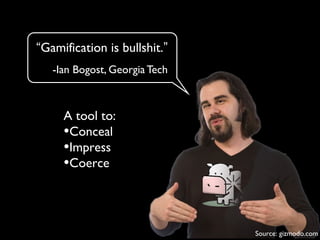
“Gamification is bullshit.”
-Ian Bogost, Georgia Tech
A tool to:
•Conceal
•Impress
•Coerce
Source: gizmodo.com
Affordances of Badges
Amplified by Technology
• As Assessments
• As Instructional Tools
• As Instruments for Personal Growth
• As Signals
Badges as Assessments
• Formative assessments
• Communicate progress towards goals
• Feedback and guidance
• Indicate what has been accomplished so far,
against the backdrop of possibilities
• Summative assessment
• Provide an overview of accomplishments related
to a particular project/assignment/course
Badges as Instructional Tools
• Manage instructor expectations
• Better info. about what students know and can do
• Communicate detailed goals to students
• Set expectations about potential outcomes
• Scaffold complex learning
• Provide indicators of steps along a pathway
• Motivate student action
• Help orient student energy and reward progress
(and maybe even lighten things up a bit)
Badges as Instruments
for Personal Growth
• Agency & Goal Setting
• Support multiple pathways toward goals
• Identity formation
• Try out different paths
• Self-determination
• Support self re/presentations of accomplishment
Badges as Signals
• Recognizing learning/Credentialing
• As a replacement for “thin” transcripts
• Communicating social status
• “Nerd cred,” like “lettermen” jackets of yore
• Coordinating collaboration & teamwork
• To promote skills to others who might need
them, or to aid search for needed skills
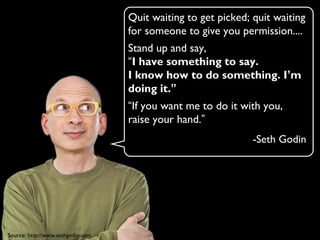
Quit waiting to get picked; quit waiting
for someone to give you permission....
Stand up and say,
“I have something to say.
I know how to do something. I’m
doing it.”
“If you want me to do it with you,
raise your hand.”
-Seth Godin
Source: http://www.sethgodin.com

Learning Affordances of Badges (or.. Can We Afford Not to Badge?

  • 1.
    Learning Affordances ofLearningAffordances of BadgesBadges (or: Can we afford(or: Can we afford not tonot to badge?)badge?) Barry FishmanBarry Fishman The University ofThe University of MichiganMichigan @barryfishman@barryfishman
  • 2.
    “Common Core” We’re Having aMoment Resource Constraints MOOCs (open ed) Makers Connected Learning Games Accountability
  • 4.
    The Great Unbundling •The unbundling of education is underway • OBI-like infrastructure is catalyzing the change: • Increases the transparency of accomplishments • Gives learners control over self-presentation • Opens up access to “deep” evidence behind claims of accomplishment • But perhaps most importantly...
  • 5.
    No Course isan Island • Without the infrastructure of OBI (or something like it), it is nearly impossible to realize the potential of badges in instruction • Badges depend on individual instructors to employ them in specific leaning contexts, but... • Education functions as a system and if the badges earned in one context don’t have value in others, we get no traction • We require ubiquitous (or at least shared) ways to communicate across contexts, both geographic and temporal
  • 6.
    No Learner isan Island • Without the infrastructure of OBI (or something like it), it is nearly impossible to realize the potential of badges in instruction • Badges depend on individual instructors to employ them in specific leaning contexts, but... • Education functions as a system and if the badges earned in one context don’t have value in others, we get no traction • We require ubiquitous (or at least shared) ways to communicate across contexts, both geographic and temporal
  • 7.
    Badges are NotNew • The A-F grading system is literally an “old school” badging system • But it is a lousy badge system that emphasizes extrinsic motivation, privileges too few learning goals, and has narrow communications bandwidth • Instructors can’t rely on prior grades as reliable indicators of prerequisite knowledge • We know nothing of what students bring in from outside formal education • Transcripts are essentially exercises in branding
  • 8.
    So What IsNew? • This cannot be a conversation about “adding” badges to education; it must be a conversation about improving education to create engagement • The current crop of badge thinking is built upon improved motivational design: • Emphasize mastery over performance • Encourage progress towards goals • Support autonomy, belonging, competence
  • 9.
    •The Usual •Lack of(perceived) control •Instructor chooses focus (one size fits all) •Learners receive grades •Disincentive to stretch •High-stakes evaluation •Incentivize avoidance “Old” vs. “New” Assessment Systems TheThe UNusualUNusual •Self-determinationSelf-determination •Student chooses focusStudent chooses focus (different strokes...)(different strokes...) •LearnersLearners earnearn badges, etc.badges, etc. •Encourage risk-takingEncourage risk-taking •Lowered cost of failureLowered cost of failure •IncentivizeIncentivize progressionprogression
  • 10.
    Isn’t this just“Gamification”? • Badges are strongly associated with gaming • Many people think games in education = gamification • Mere “gamification” leads to weak designs • If we just use badges as grades or resort to purely extrinsic motivations, we’re doing it wrong - putting new wine in old bottles
  • 11.
    “Gamification is bullshit.” -IanBogost, Georgia Tech A tool to: •Conceal •Impress •Coerce Source: gizmodo.com
  • 12.
    Affordances of Badges Amplifiedby Technology • As Assessments • As Instructional Tools • As Instruments for Personal Growth • As Signals
  • 13.
    Badges as Assessments •Formative assessments • Communicate progress towards goals • Feedback and guidance • Indicate what has been accomplished so far, against the backdrop of possibilities • Summative assessment • Provide an overview of accomplishments related to a particular project/assignment/course
  • 14.
    Badges as InstructionalTools • Manage instructor expectations • Better info. about what students know and can do • Communicate detailed goals to students • Set expectations about potential outcomes • Scaffold complex learning • Provide indicators of steps along a pathway • Motivate student action • Help orient student energy and reward progress (and maybe even lighten things up a bit)
  • 15.
    Badges as Instruments forPersonal Growth • Agency & Goal Setting • Support multiple pathways toward goals • Identity formation • Try out different paths • Self-determination • Support self re/presentations of accomplishment
  • 16.
    Badges as Signals •Recognizing learning/Credentialing • As a replacement for “thin” transcripts • Communicating social status • “Nerd cred,” like “lettermen” jackets of yore • Coordinating collaboration & teamwork • To promote skills to others who might need them, or to aid search for needed skills
  • 17.
    Quit waiting toget picked; quit waiting for someone to give you permission.... Stand up and say, “I have something to say. I know how to do something. I’m doing it.” “If you want me to do it with you, raise your hand.” -Seth Godin Source: http://www.sethgodin.com

Editor's Notes

  • #2 Thanks to Michelle and Margaret for inviting me to speak with you. My goal is to offer some comments that lend grist to the mill for our conversations throughout the day.
  • #3 MOOCs are like a Roschach - but at least they ’ ve got my colleagues talking about teaching for a change, which is welcome. AND THEN THIS HAPPENED...
  • #4 This moves away from time as a proxy for learning. University of Southern New Hampshire - the cost of a college degree is now related to how quickly students can demonstrate their competency on a range of exams. This is the start of educational “ unbundling ”
  • #5 Allan Collins and Rich Halverson made this argument in “ Rethinking Education in an Age of Technology ” ..
  • #8 Badges are not new IN EDUCATION
  • #9 Goal theory, Self-determination theory... While you can “ earn ” a bad grade, you can ’ t earn a “ bad badge ” or a badge for “ poor performance ” ... that ’ s just not how it works
  • #11 When I talk about the learning affordances of games, I have to emphasize that I am talking about “ GOOD ” games... there are plenty of terrible games with terrible learning designs, even games that are intentionally designed to be “ Educational ”
  • #12 In the sense that Princeton philosopher Harry Frankfurt meant it - “ as a way to conceal, impress, or coerce. ” And that is the way people too often use gamification
  • #13 I don ’ t expect that all of the affordances I will highlight are news to everyone here, but some of them will be new for each of you. As we think about research agendas later today, you might select one or more of these to think about the interrelationship of MECHANISM and DESIGN
  • #15 Lighten things up: for instance, I experimented with an “ Office Hours ” badge - if you didn ’ t earn this, I wouldn ’ t write you a letter of recommendation. COURAGEOUS FAILURE badge
  • #17 or helmet stickers - they are meant to communicate to the opponent, I think, as much as to the player and teammates
  • #18 Said in response to seeing a student at graduation with “ Hire Me ” written on their mortarboard.