Creating Killer Business Models
           By David Keener
Introduction


 Why am I doing a talk on business models?
 My background with startups
 Introduce the “Business Model Canvas”
    - A technique for designing business models
   Discuss business model patterns
    - Using real-world examples
   Some final thoughts
But First, a Warning


SURGEON GENERAL’S WARNING: This
talk contains no Ruby code. At all. If Ruby
code examples are required for your
continued health and well-being…this is
not the talk for you.
Why?


Why on Earth Would I Give a Talk on
Business Models to a Bunch of Ruby
Developers at a Ruby Conference?
Because…


   We‟re not JUST Ruby developers…
Because…


 We‟re not JUST Ruby developers…
 We‟re not JUST “polyglot programmers”…
    - a term coined by Neal Ford, by the way
Because…


 We‟re not JUST Ruby developers…
 We‟re not JUST “polyglot programmers”…
    - a term coined by Neal Ford, by the way
We Are Advisors…

 Working with clients to understand their
  business needs
 Helping clients to identify and prioritize
  business objectives
 Advising clients on how to use technology
  to accomplish their business objectives

Understanding business models can help us
We Are Entrepreneurs…

 Many of us have worked for startups…
 Or are working for a startup right now…
 Or are considering creating our own start-
  up


Understanding business models can help us
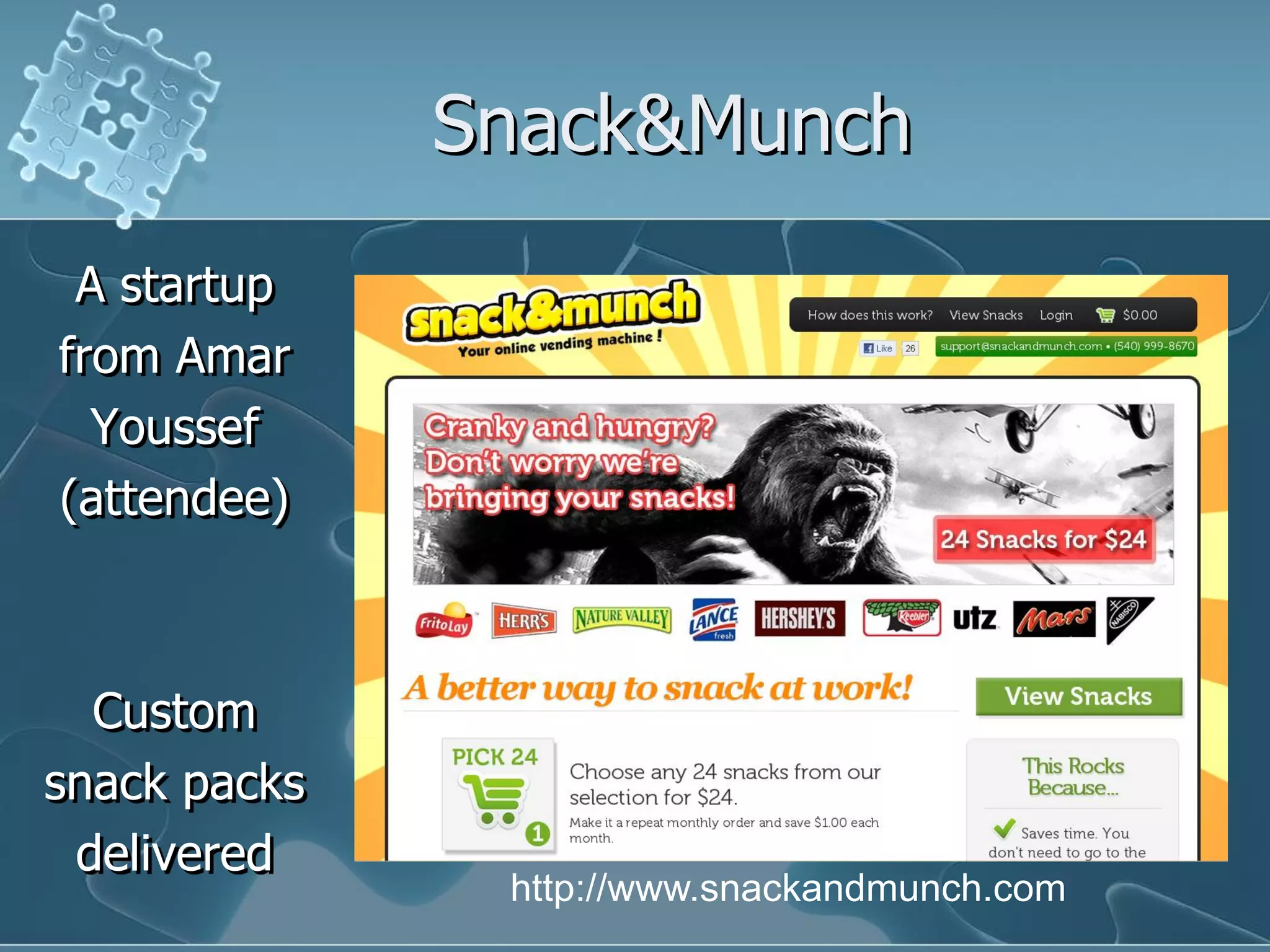
Snack&Munch
 A startup
from Amar
  Youssef
(attendee)


  Custom
snack packs
 delivered
               http://www.snackandmunch.com
My Entrepreneurial Background

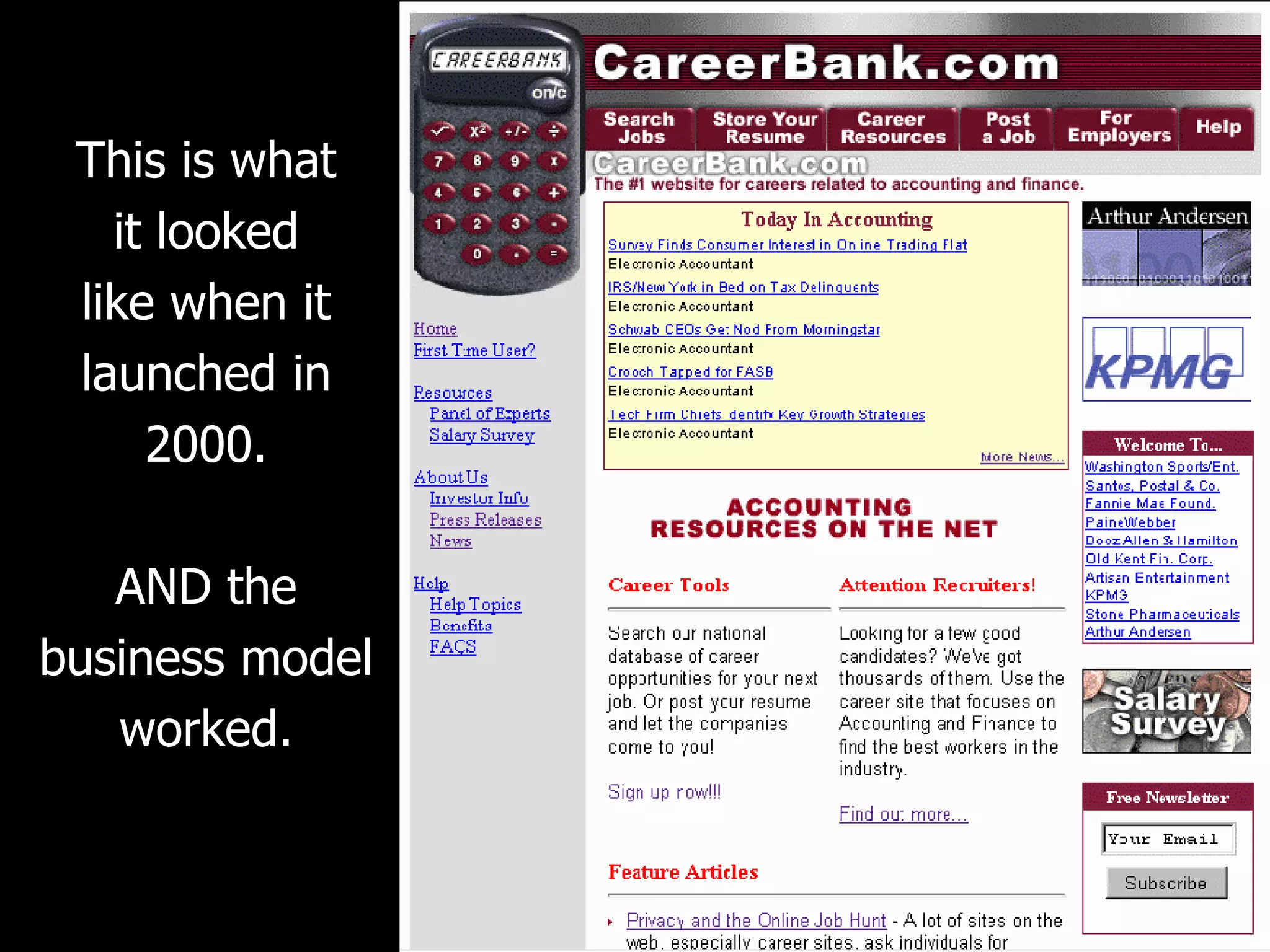
   Co-Founded CareerBank.com
    - Moderately successful; sold to OnTarget Jobs
   Co-Founded RubyNation Conference
    - Successful non-profit initiative
   Co-Founded DevIgnition Conference
    - Successful non-profit initiative


 I‟ve worked for startups
 I‟ve helped “incubate” potential startups
This is what
   it looked
 like when it
 launched in
     2000.

   AND the
business model
   worked.
A video
         Votridea Contest Platform
  contest
fielded with
  Votridea


Incubated
    By
MetroStar
 Systems
What Is a Business Model?

“A business model describes the
rationale of how an organization
creates, delivers and captures value.”

       - Alexander Osterwalder & Yves Pineur,
            from “Business Model Generation”
Some Background

   Alexander Osterwalder & Yves Pineur
    - Did a dissertation on business model innovation in 2004
   Formed an online community
    - The Business Model Hub (costs $ to join)
    - Solicited ideas from around the world


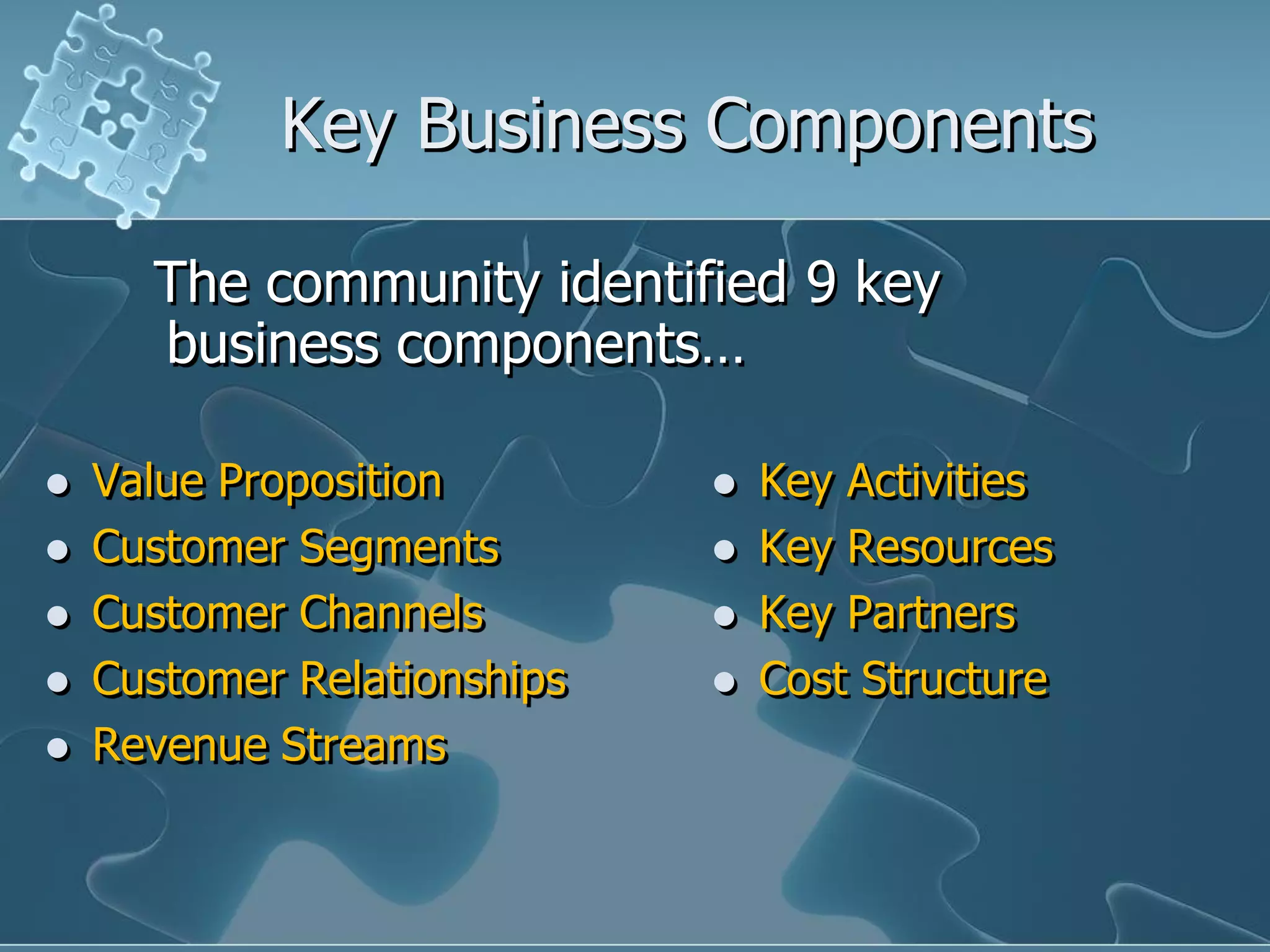
          1. Identified 9 key business components
          2. Developed the “Business Model Canvas”
Key Business Components

      The community identified 9 key
      business components…

   Value Proposition           Key Activities
   Customer Segments           Key Resources
   Customer Channels           Key Partners
   Customer Relationships      Cost Structure
   Revenue Streams
Business Model Canvas

                Key                       Customer
              Activities                 Relationships
  Key                        Value                       Customer
Partners                   Proposition                   Segments
               Key                        Customer
             Resources                    Channels


             Cost                            Revenue
           Structure                         Streams
Value Proposition (VP)

  Products or services…

        That create value for customers
        Solve customer problems
        Fulfill a customer need


* This is the component techies are usually most familiar with…
  we often build the applications that provide value
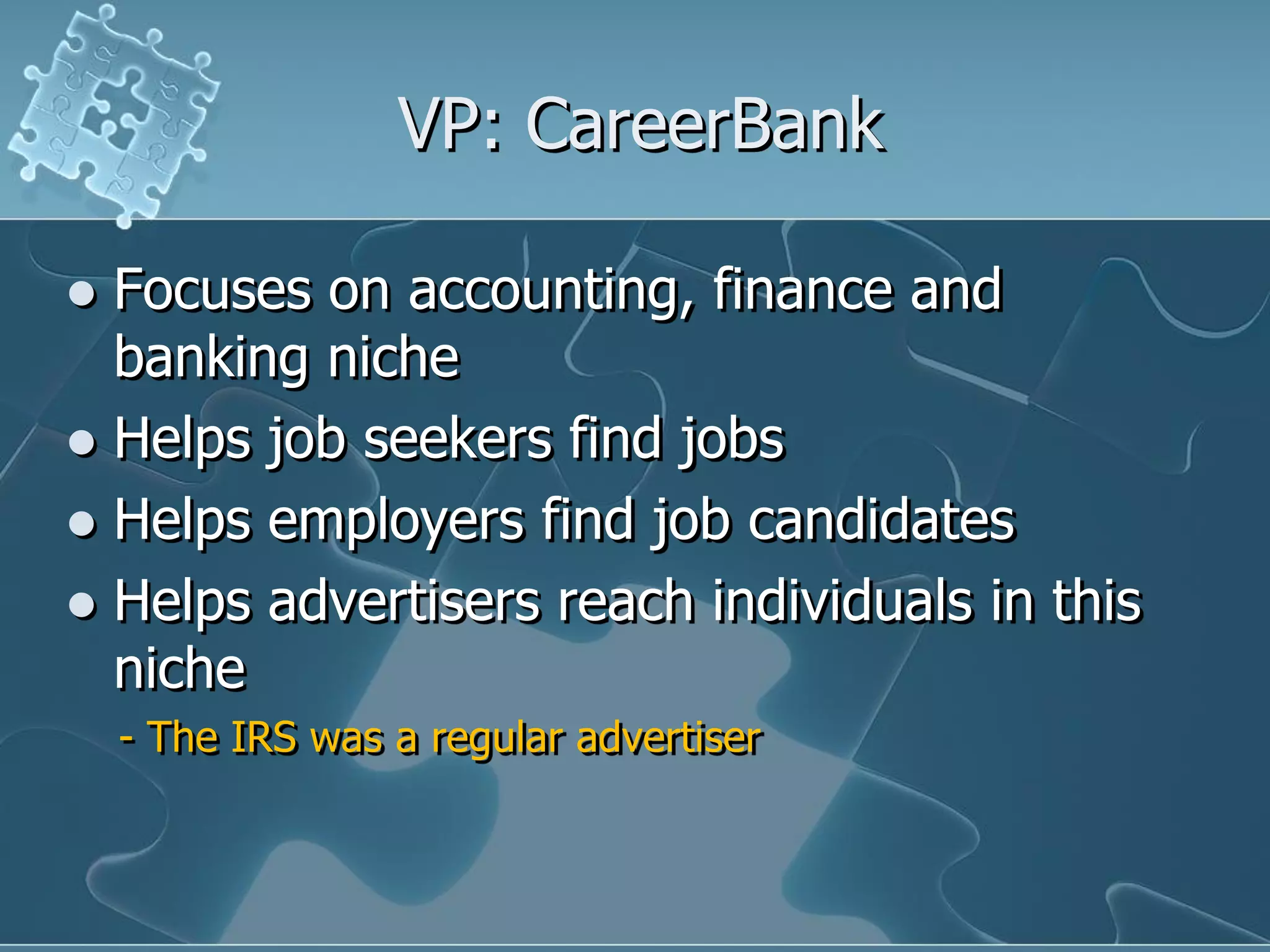
VP: CareerBank

 Focuses on accounting, finance and
  banking niche
 Helps job seekers find jobs
 Helps employers find job candidates
 Helps advertisers reach individuals in this
  niche
    - The IRS was a regular advertiser
Getting it Wrong

 Kodak thought it sold film…
 Kodak was actually in the business of
  “preserving memories”


    The advent of digital photography
    caused a major disruption for Kodak
VP: Snack&Munch

“Your online vending machine”

   Provides a large choice of snacks
   Sells them as a bulk package (25)
   Lets users create customized packages
   Delivers them
   Supports recurring deliveries
Customer Segments (CS)

Customer Segments are groups of
customers that have distinct characteristics

 They have different needs
 Reached through different channels
 Pay for different things
 Have different profitability levels
CS: CareerBank

   Job Seekers
    - Search for jobs
    - Apply for jobs online
    - Will not pay for services!
   Employers
    - Search for qualified candidates
    - Review online applications
    - Will pay for services
   Advertisers
    - Get message out to targeted audience
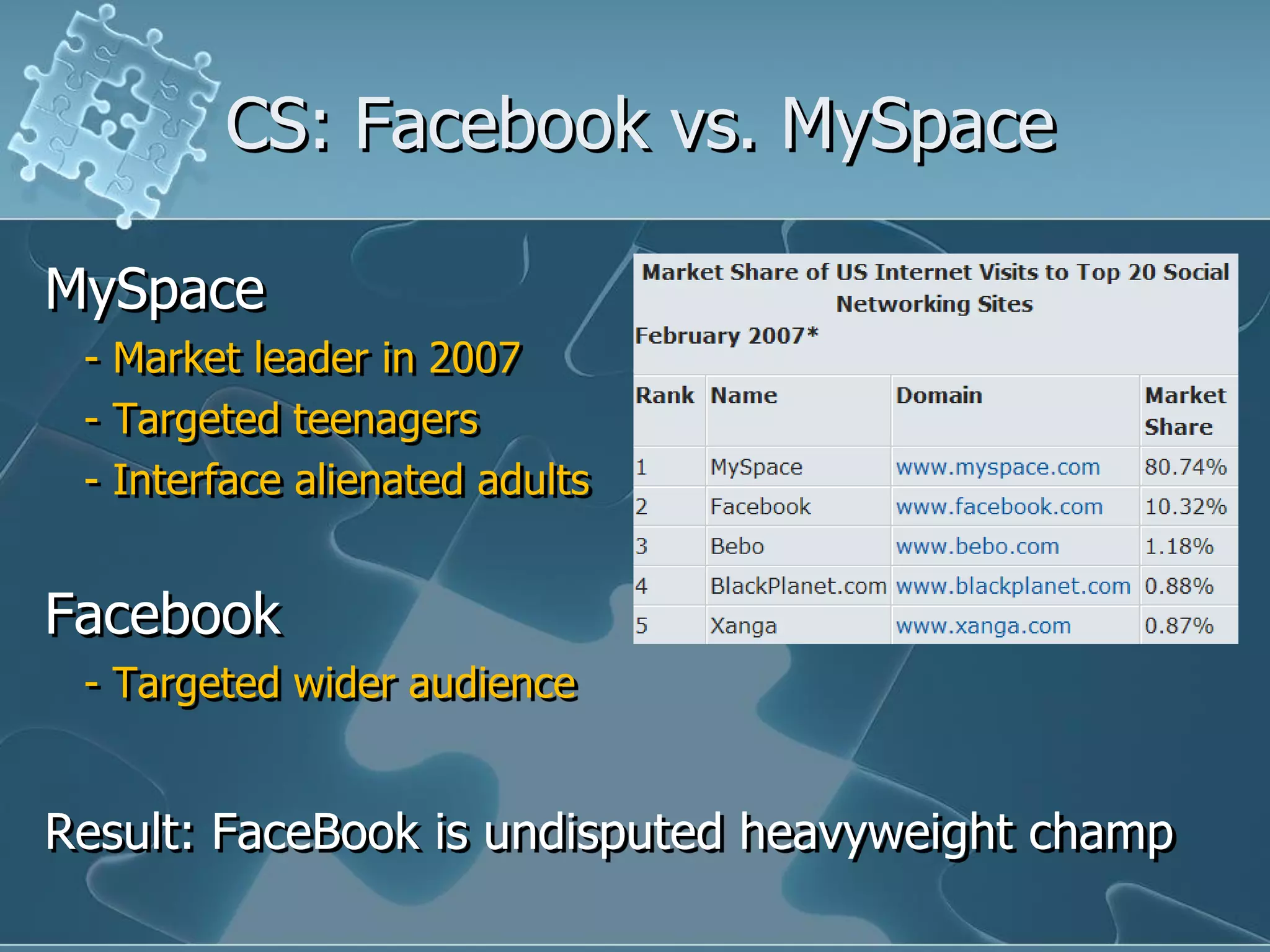
CS: Facebook vs. MySpace

MySpace
 - Market leader in 2007
 - Targeted teenagers
 - Interface alienated adults


Facebook
 - Targeted wider audience


Result: FaceBook is undisputed heavyweight champ
Customer Channels (CC)

How an organization reaches its
Customer Segments to:

  1.   Communicate
  2.   Deliver its Value Proposition

Focus is on getting the Value Proposition
to the customer
CC: Two Examples

   CareerBank.com
    - All activities automated through web site
    Snack&Munch
    - Automated through web site
     - Catalog of Products
     - Ordering of Products
    - Product delivery via Fedex
Customer Relationships (CR)

Defines the type of relationship an
organization will have with customers

Some examples:                      Affects:


   Personal – investment banking   - sales
   Automated – CareerBank          - customer retention
   Community – LinkedIn            - customer aquisition
CR: EngineYard

 I had a problem with          Twitter Chain

  an EngineYard server
 I tweeted about my
  frustration
 I got an impressively
  quick response
                          Response Time: 22 minutes
CR: LivingSocial

   Now that EngineYard
    has set the bar with
    customer support by
    Dr. Nic…

   I expect Chad Fowler
    to help me if I have
    any problems with        Photo by Duncan Davidson


    Living Social
Revenue Streams (R$)

Revenue streams represent the cash
received from a customer segment

   Transactional Revenue
   Recurring Revenue
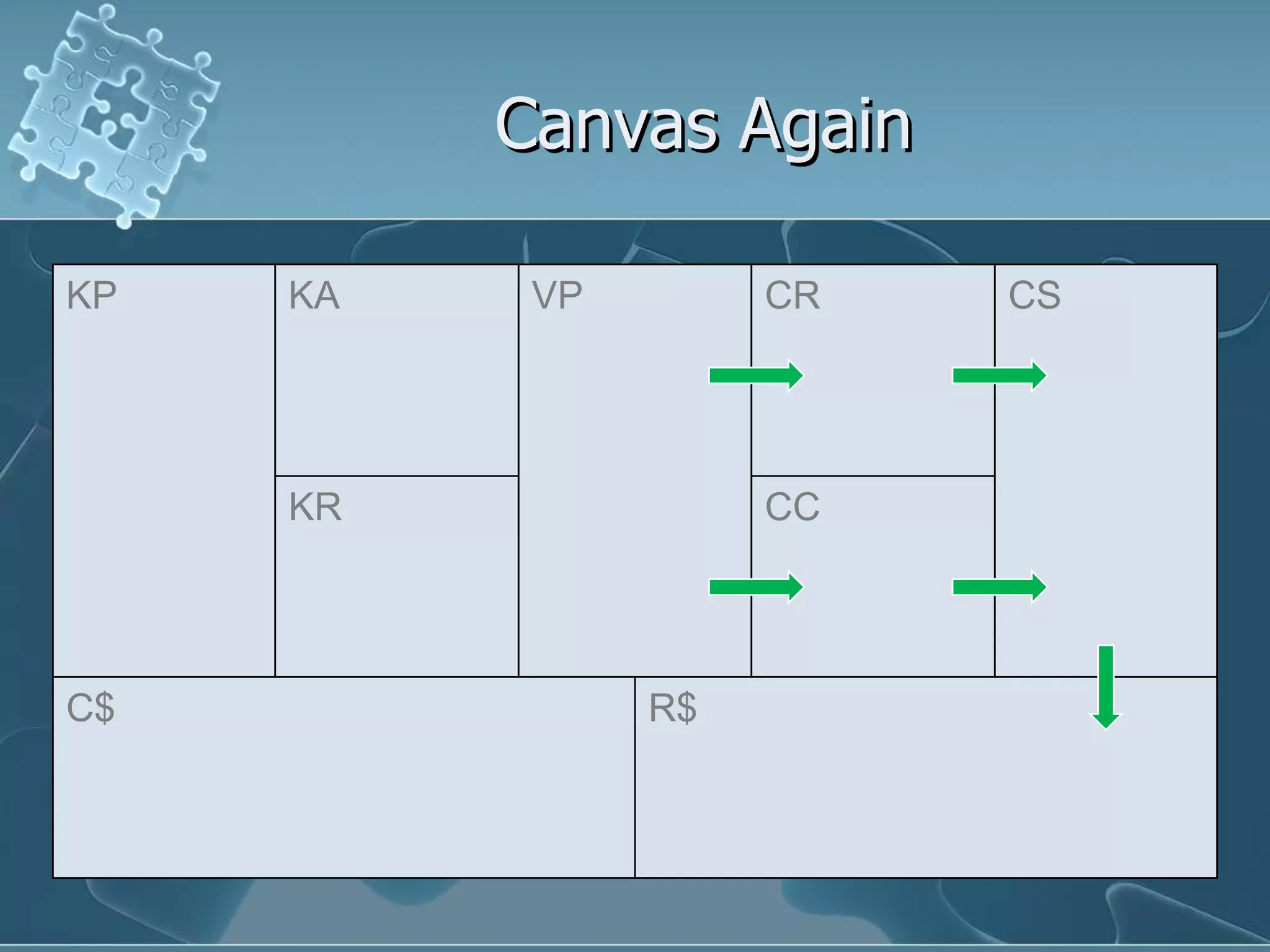
Canvas Again

KP   KA    VP        CR   CS


     KR              CC


C$              R$
CareerBank Canvas…

KP   KA       VP                CR               CS
               Resumes DB         Automated
                                     Via
              Search Resumes       Web Site
                                                 Job Seekers
               Advertising                       Employers
     KR          Slots          CC               Advertisers

                                     Web Site
               Search Jobs
                                   Sales Staff


C$                     R$      Job Postings
                               Resume Database Access
                               Advertisements
Key Resources (KR)

Key resources are the assets required to
make a business model work

 Physical – factories, machinery, etc.
 Intellectual Property – brands, patents…
 Human Resources – Rubyists…
 Financial Resources
Key Activities (KA)

Key activities are the actions that an
organization must perform to make its
business model work

   EngineYard must continually enhance its software
   Amazon must maintain its cloud infrastructure
   CareeBank used a sales team to sell products rather
    than just rely on the automated web site
Key Partners (KP)

No company can do everything.
Organizations rely on key partners to
help make their business model work

Partners can be:
    Suppliers
    Risk Mitigators – movie studios sharing costs
    Etc.
KP: CareerBank

   Partner w/ State Board of Accountancy
    - Partnered with most state orgs
   Partner with accounting-related sites
    - Shared with 1000‟s of accounting-related sites
   Revenue Split
    - 50% of something is better than
      100% of nothing
   Major entry barrier for competitors
Cost Structure (C$)

The cost structure represents all costs
required to operate a business model

          Profit is R$ - C$
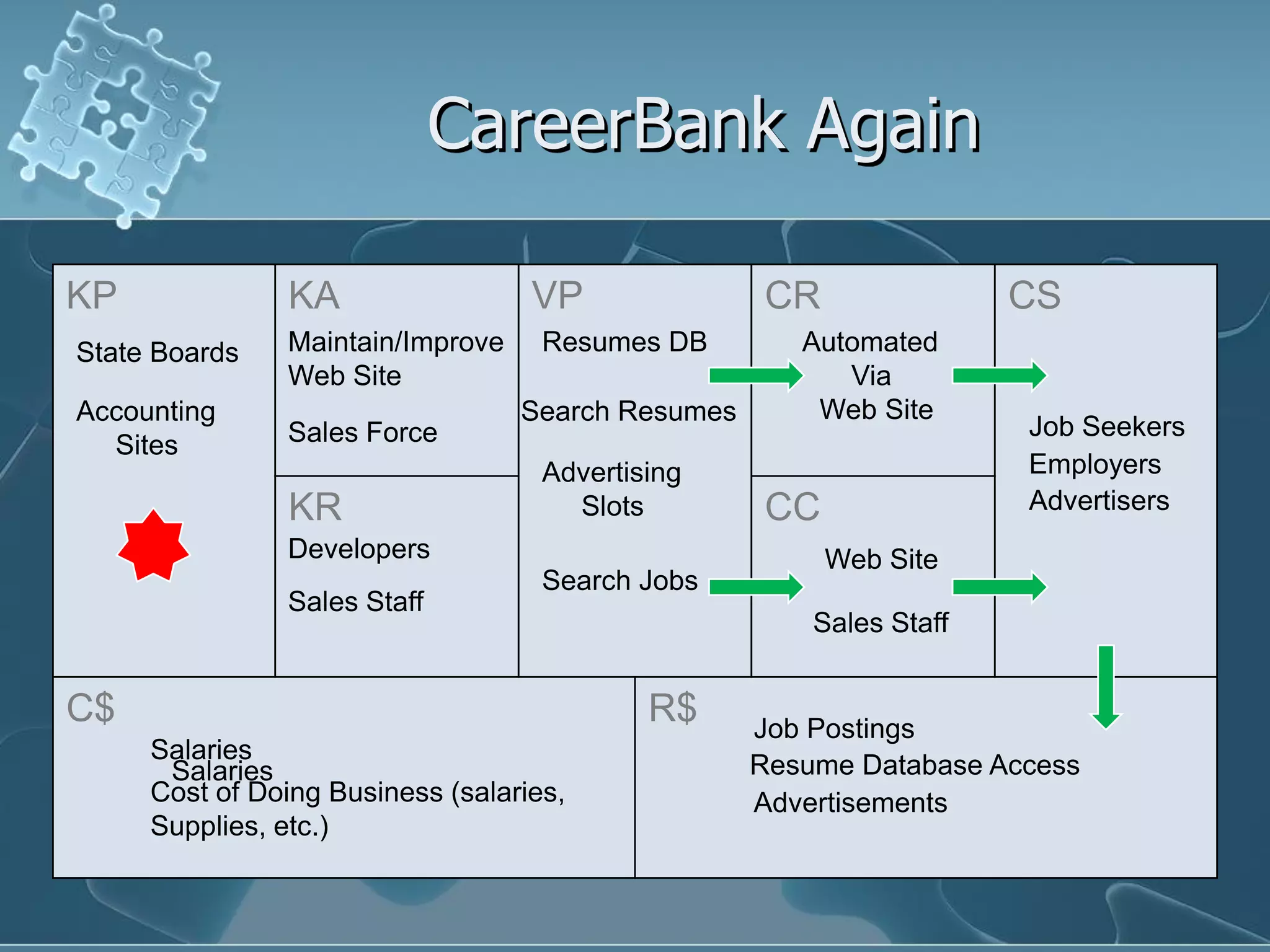
CareerBank Again

KP             KA                  VP               CR               CS
State Boards   Maintain/Improve     Resumes DB        Automated
               Web Site                                  Via
Accounting                        Search Resumes       Web Site
               Sales Force                                           Job Seekers
  Sites
                                    Advertising                      Employers
               KR                     Slots         CC               Advertisers
               Developers                                Web Site
                                    Search Jobs
               Sales Staff
                                                       Sales Staff


C$                                          R$     Job Postings
     Salaries
      Salaries                                     Resume Database Access
     Cost of Doing Business (salaries,             Advertisements
     Supplies, etc.)
How to Use the Canvas

 Good way to visualize a business model
 Can assemble a team to brainstorm
  business models using a large, wall-
  mounted canvas and yellow stickies
 Use as a “common language” to discuss
  business models with others
Business Model Patterns

Just as patterns are useful in software
development, there are also patterns that
apply to businesses


    Here are a few examples…
CareerBank.com

 CareerBank is a “Multi-Sided Business”
 In order to work, the site must attract
  two customer segments
    - Job Seekers
    - Employers
   The Employer customer segment
    subsidizes the Job Seekers
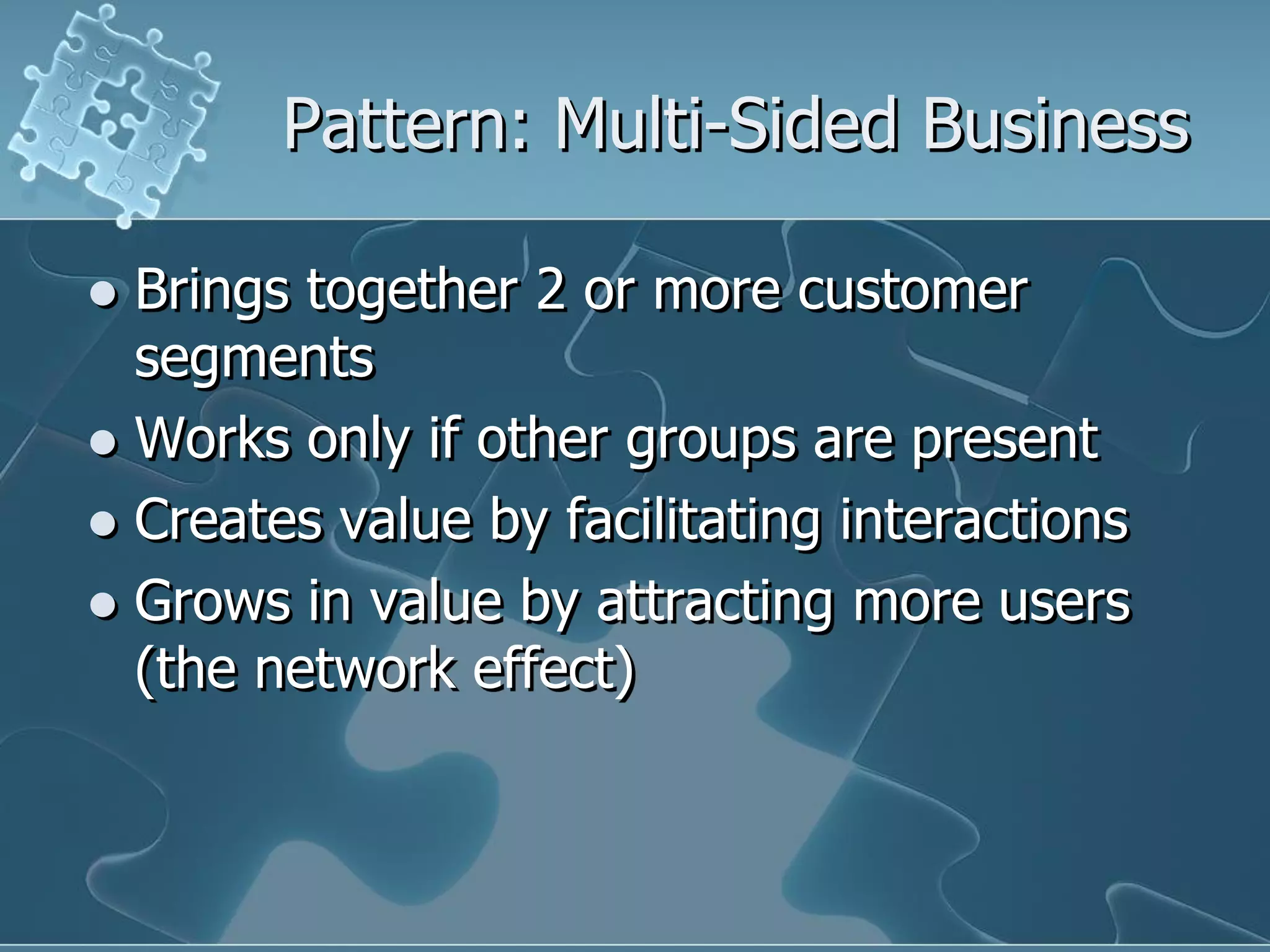
Pattern: Multi-Sided Business

 Brings together 2 or more customer
  segments
 Works only if other groups are present
 Creates value by facilitating interactions
 Grows in value by attracting more users
  (the network effect)
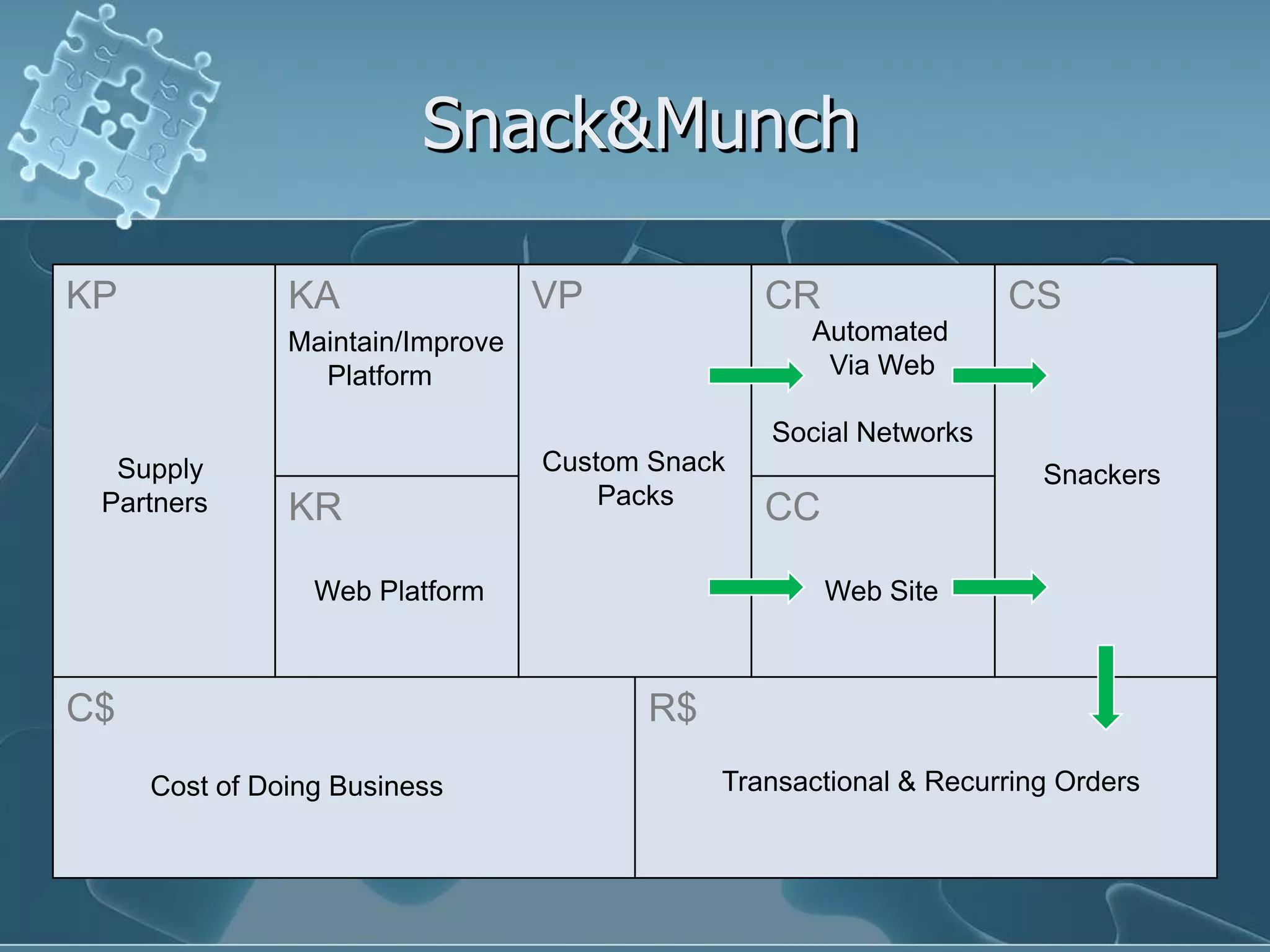
Snack&Munch

KP             KA                 VP             CR                CS
               Maintain/Improve                    Automated
                 Platform                           Via Web

                                                 Social Networks
  Supply                          Custom Snack                       Snackers
 Partners                             Packs
               KR                                CC

                 Web Platform                         Web Site


C$                                      R$
     Cost of Doing Business                  Transactional & Recurring Orders
Hey…

… this is kind of fun


     Let‟s try analyzing a more challenging
     business
Google: Multi-Sided Business

KP             KA                 VP             CR                 CS
               Maintain/Improve   Free Search       Automated
                 Platform                              Via
                                  Targeted Ads       Web Site       Advertisers
                Extend Reach       (AdWords)
                                                                    Searchers
               KR                  Monetizing    CC                  Content
                  Platform          Content                         Producers
                  Search           (AdSense)          Web Site
                 Capabilities


C$                                       R$
     Cost of Doing Business                      Keyword Auctions
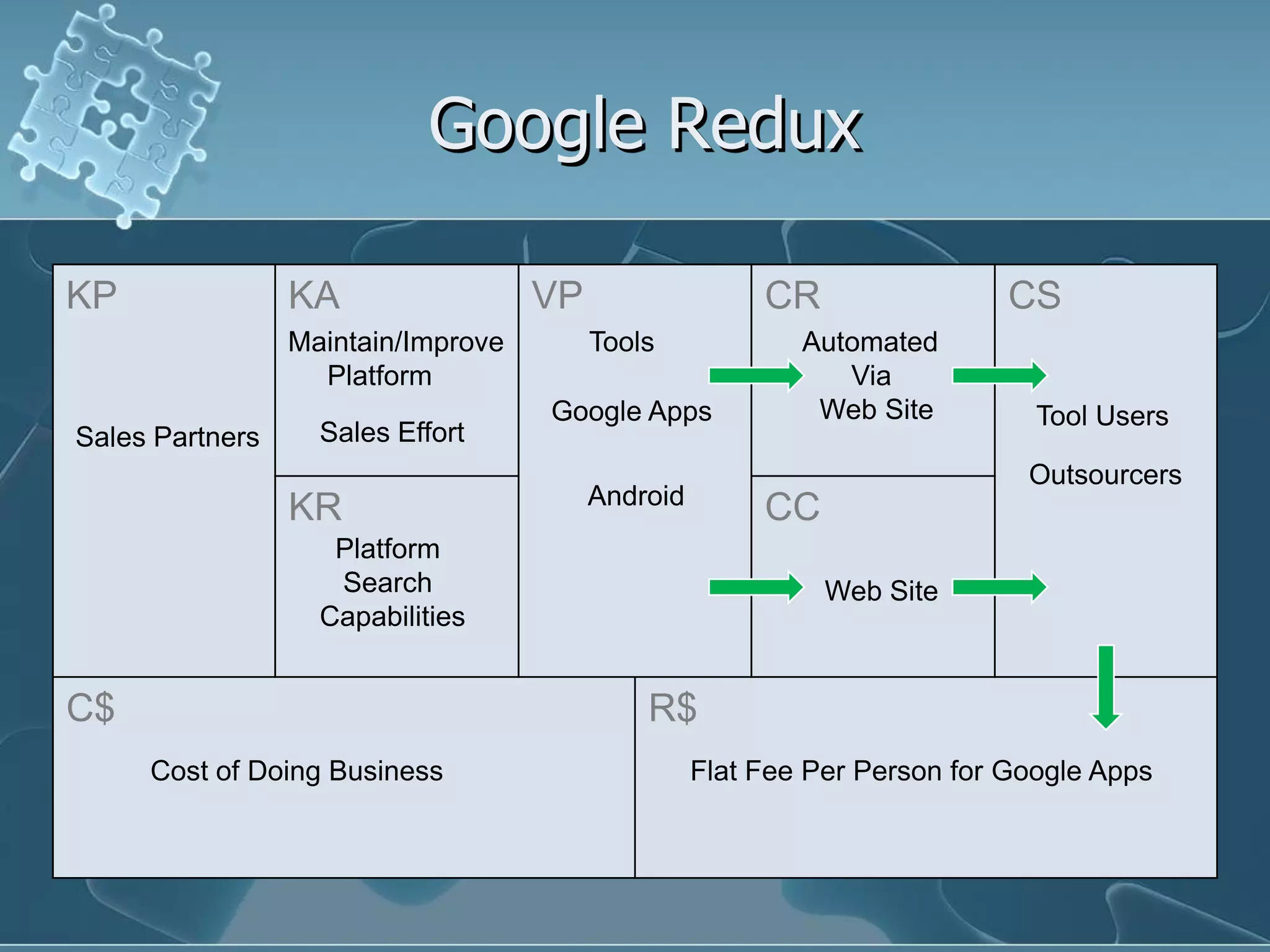
Google Redux

KP               KA                 VP                  CR                 CS
                 Maintain/Improve        Tools             Automated
                   Platform                                   Via
                                    Google Apps             Web Site         Tool Users
Sales Partners     Sales Effort
                                                                            Outsourcers
                                         Android
                 KR                                     CC
                    Platform
                    Search                                   Web Site
                   Capabilities


C$                                           R$
     Cost of Doing Business                        Flat Fee Per Person for Google Apps
Pattern: Infrastructure Provider

 Provides infrastructure that other orgs
  can‟t or don‟t want to support
  themselves
 Focus allows provider to be better at
  what it does than anybody else
 Makes money from the scale of its
  operations
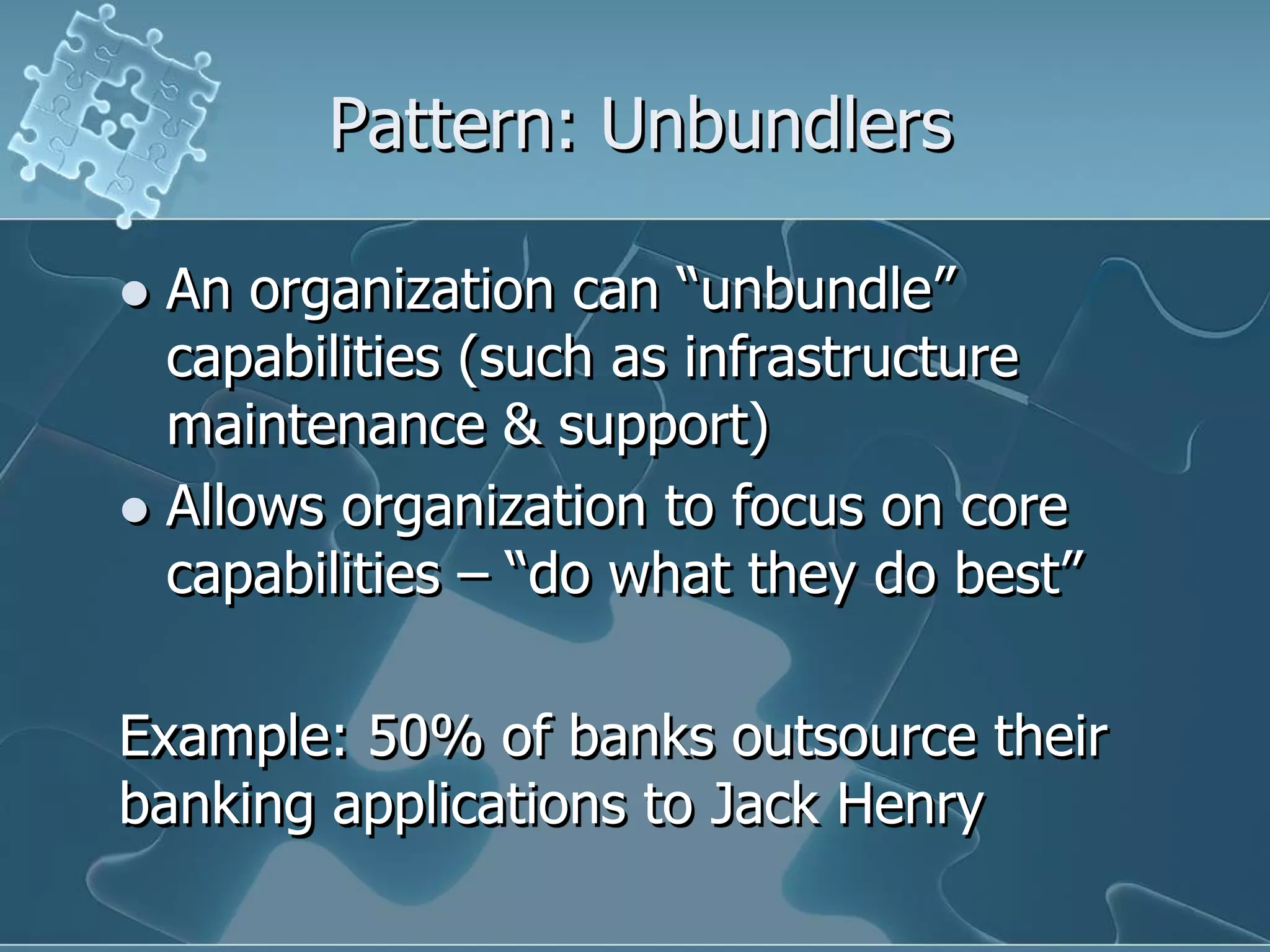
Pattern: Unbundlers

 An organization can “unbundle”
  capabilities (such as infrastructure
  maintenance & support)
 Allows organization to focus on core
  capabilities – “do what they do best”

Example: 50% of banks outsource their
banking applications to Jack Henry
What About Android?

 The Value Proposition that sticks out is
  „Android”
 It‟s not really a Value Proposition at all
Warren Buffet Says…

“In business, I look for economic castles
  protected by unbreachable „moats‟.”

                  - Warren Buffet


 An “economic castle” is a great business
 A “moat” is an entrance barrier that
  prevents other from duplicating that
  business
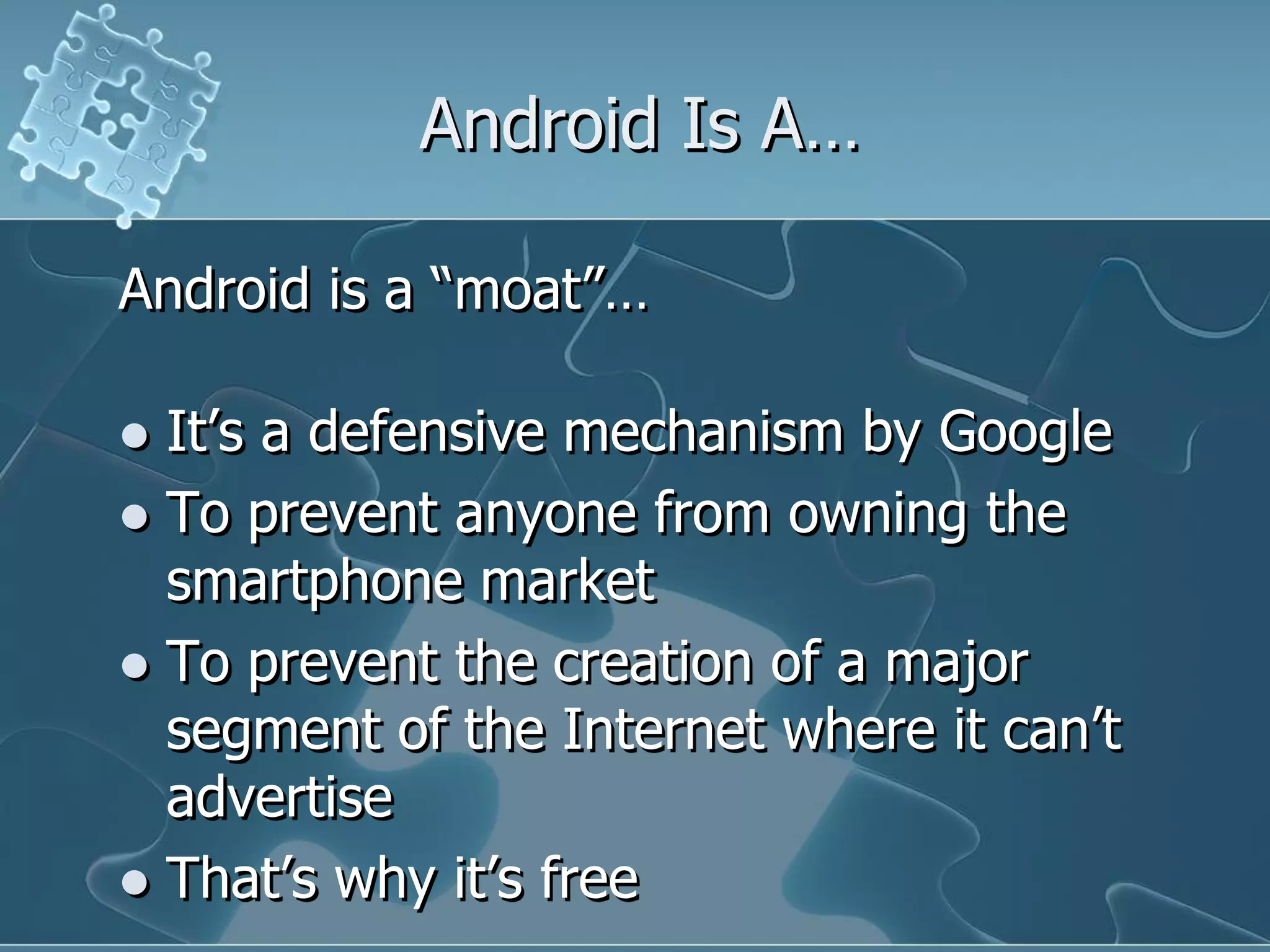
Android Is A…

Android is a “moat”…

 It‟s a defensive mechanism by Google
 To prevent anyone from owning the
  smartphone market
 To prevent the creation of a major
  segment of the Internet where it can‟t
  advertise
 That‟s why it‟s free
Resources

   “Business Model Generation” by
    Alexander Osterwalder & Yves Pineur

   “The Long Tail” by Chris Anderson
Conclusion

 The Business Model Canvas provides a
  “language” for communicating the
  nature of a business
 A new analysis tool in your toolbox
 A way to experiment on paper with
  how a business can be organized
Maybe you‟ll end up with
the tropical island…
Questions

   Feel free to contact me:

     dkeener@keenertech.com
     david.keener@gd-ais.com
     Twitter: dkeener2010
     Blog: http://www.keenertech.com


We‟re also looking for some good Rubyists…

Killer Business Models

  • 1.
    Creating Killer BusinessModels By David Keener
  • 2.
    Introduction  Why amI doing a talk on business models?  My background with startups  Introduce the “Business Model Canvas” - A technique for designing business models  Discuss business model patterns - Using real-world examples  Some final thoughts
  • 3.
    But First, aWarning SURGEON GENERAL’S WARNING: This talk contains no Ruby code. At all. If Ruby code examples are required for your continued health and well-being…this is not the talk for you.
  • 4.
    Why? Why on EarthWould I Give a Talk on Business Models to a Bunch of Ruby Developers at a Ruby Conference?
  • 5.
    Because…  We‟re not JUST Ruby developers…
  • 6.
    Because…  We‟re notJUST Ruby developers…  We‟re not JUST “polyglot programmers”… - a term coined by Neal Ford, by the way
  • 7.
    Because…  We‟re notJUST Ruby developers…  We‟re not JUST “polyglot programmers”… - a term coined by Neal Ford, by the way
  • 8.
    We Are Advisors… Working with clients to understand their business needs  Helping clients to identify and prioritize business objectives  Advising clients on how to use technology to accomplish their business objectives Understanding business models can help us
  • 9.
    We Are Entrepreneurs… Many of us have worked for startups…  Or are working for a startup right now…  Or are considering creating our own start- up Understanding business models can help us
  • 10.
    Snack&Munch A startup fromAmar Youssef (attendee) Custom snack packs delivered http://www.snackandmunch.com
  • 11.
    My Entrepreneurial Background  Co-Founded CareerBank.com - Moderately successful; sold to OnTarget Jobs  Co-Founded RubyNation Conference - Successful non-profit initiative  Co-Founded DevIgnition Conference - Successful non-profit initiative  I‟ve worked for startups  I‟ve helped “incubate” potential startups
  • 12.
    This is what it looked like when it launched in 2000. AND the business model worked.
  • 13.
    A video Votridea Contest Platform contest fielded with Votridea Incubated By MetroStar Systems
  • 14.
    What Is aBusiness Model? “A business model describes the rationale of how an organization creates, delivers and captures value.” - Alexander Osterwalder & Yves Pineur, from “Business Model Generation”
  • 15.
    Some Background  Alexander Osterwalder & Yves Pineur - Did a dissertation on business model innovation in 2004  Formed an online community - The Business Model Hub (costs $ to join) - Solicited ideas from around the world 1. Identified 9 key business components 2. Developed the “Business Model Canvas”
  • 16.
    Key Business Components The community identified 9 key business components…  Value Proposition  Key Activities  Customer Segments  Key Resources  Customer Channels  Key Partners  Customer Relationships  Cost Structure  Revenue Streams
  • 17.
    Business Model Canvas Key Customer Activities Relationships Key Value Customer Partners Proposition Segments Key Customer Resources Channels Cost Revenue Structure Streams
  • 18.
    Value Proposition (VP) Products or services…  That create value for customers  Solve customer problems  Fulfill a customer need * This is the component techies are usually most familiar with… we often build the applications that provide value
  • 19.
    VP: CareerBank  Focuseson accounting, finance and banking niche  Helps job seekers find jobs  Helps employers find job candidates  Helps advertisers reach individuals in this niche - The IRS was a regular advertiser
  • 20.
    Getting it Wrong Kodak thought it sold film…  Kodak was actually in the business of “preserving memories” The advent of digital photography caused a major disruption for Kodak
  • 21.
    VP: Snack&Munch “Your onlinevending machine”  Provides a large choice of snacks  Sells them as a bulk package (25)  Lets users create customized packages  Delivers them  Supports recurring deliveries
  • 22.
    Customer Segments (CS) CustomerSegments are groups of customers that have distinct characteristics  They have different needs  Reached through different channels  Pay for different things  Have different profitability levels
  • 23.
    CS: CareerBank  Job Seekers - Search for jobs - Apply for jobs online - Will not pay for services!  Employers - Search for qualified candidates - Review online applications - Will pay for services  Advertisers - Get message out to targeted audience
  • 24.
    CS: Facebook vs.MySpace MySpace - Market leader in 2007 - Targeted teenagers - Interface alienated adults Facebook - Targeted wider audience Result: FaceBook is undisputed heavyweight champ
  • 25.
    Customer Channels (CC) Howan organization reaches its Customer Segments to: 1. Communicate 2. Deliver its Value Proposition Focus is on getting the Value Proposition to the customer
  • 26.
    CC: Two Examples  CareerBank.com - All activities automated through web site  Snack&Munch - Automated through web site - Catalog of Products - Ordering of Products - Product delivery via Fedex
  • 27.
    Customer Relationships (CR) Definesthe type of relationship an organization will have with customers Some examples: Affects:  Personal – investment banking - sales  Automated – CareerBank - customer retention  Community – LinkedIn - customer aquisition
  • 28.
    CR: EngineYard  Ihad a problem with Twitter Chain an EngineYard server  I tweeted about my frustration  I got an impressively quick response Response Time: 22 minutes
  • 29.
    CR: LivingSocial  Now that EngineYard has set the bar with customer support by Dr. Nic…  I expect Chad Fowler to help me if I have any problems with Photo by Duncan Davidson Living Social
  • 30.
    Revenue Streams (R$) Revenuestreams represent the cash received from a customer segment  Transactional Revenue  Recurring Revenue
  • 31.
    Canvas Again KP KA VP CR CS KR CC C$ R$
  • 32.
    CareerBank Canvas… KP KA VP CR CS Resumes DB Automated Via Search Resumes Web Site Job Seekers Advertising Employers KR Slots CC Advertisers Web Site Search Jobs Sales Staff C$ R$ Job Postings Resume Database Access Advertisements
  • 33.
    Key Resources (KR) Keyresources are the assets required to make a business model work  Physical – factories, machinery, etc.  Intellectual Property – brands, patents…  Human Resources – Rubyists…  Financial Resources
  • 34.
    Key Activities (KA) Keyactivities are the actions that an organization must perform to make its business model work  EngineYard must continually enhance its software  Amazon must maintain its cloud infrastructure  CareeBank used a sales team to sell products rather than just rely on the automated web site
  • 35.
    Key Partners (KP) Nocompany can do everything. Organizations rely on key partners to help make their business model work Partners can be:  Suppliers  Risk Mitigators – movie studios sharing costs  Etc.
  • 36.
    KP: CareerBank  Partner w/ State Board of Accountancy - Partnered with most state orgs  Partner with accounting-related sites - Shared with 1000‟s of accounting-related sites  Revenue Split - 50% of something is better than 100% of nothing  Major entry barrier for competitors
  • 37.
    Cost Structure (C$) Thecost structure represents all costs required to operate a business model Profit is R$ - C$
  • 38.
    CareerBank Again KP KA VP CR CS State Boards Maintain/Improve Resumes DB Automated Web Site Via Accounting Search Resumes Web Site Sales Force Job Seekers Sites Advertising Employers KR Slots CC Advertisers Developers Web Site Search Jobs Sales Staff Sales Staff C$ R$ Job Postings Salaries Salaries Resume Database Access Cost of Doing Business (salaries, Advertisements Supplies, etc.)
  • 39.
    How to Usethe Canvas  Good way to visualize a business model  Can assemble a team to brainstorm business models using a large, wall- mounted canvas and yellow stickies  Use as a “common language” to discuss business models with others
  • 40.
    Business Model Patterns Justas patterns are useful in software development, there are also patterns that apply to businesses Here are a few examples…
  • 41.
    CareerBank.com  CareerBank isa “Multi-Sided Business”  In order to work, the site must attract two customer segments - Job Seekers - Employers  The Employer customer segment subsidizes the Job Seekers
  • 42.
    Pattern: Multi-Sided Business Brings together 2 or more customer segments  Works only if other groups are present  Creates value by facilitating interactions  Grows in value by attracting more users (the network effect)
  • 43.
    Snack&Munch KP KA VP CR CS Maintain/Improve Automated Platform Via Web Social Networks Supply Custom Snack Snackers Partners Packs KR CC Web Platform Web Site C$ R$ Cost of Doing Business Transactional & Recurring Orders
  • 44.
    Hey… … this iskind of fun Let‟s try analyzing a more challenging business
  • 45.
    Google: Multi-Sided Business KP KA VP CR CS Maintain/Improve Free Search Automated Platform Via Targeted Ads Web Site Advertisers Extend Reach (AdWords) Searchers KR Monetizing CC Content Platform Content Producers Search (AdSense) Web Site Capabilities C$ R$ Cost of Doing Business Keyword Auctions
  • 46.
    Google Redux KP KA VP CR CS Maintain/Improve Tools Automated Platform Via Google Apps Web Site Tool Users Sales Partners Sales Effort Outsourcers Android KR CC Platform Search Web Site Capabilities C$ R$ Cost of Doing Business Flat Fee Per Person for Google Apps
  • 47.
    Pattern: Infrastructure Provider Provides infrastructure that other orgs can‟t or don‟t want to support themselves  Focus allows provider to be better at what it does than anybody else  Makes money from the scale of its operations
  • 48.
    Pattern: Unbundlers  Anorganization can “unbundle” capabilities (such as infrastructure maintenance & support)  Allows organization to focus on core capabilities – “do what they do best” Example: 50% of banks outsource their banking applications to Jack Henry
  • 49.
    What About Android? The Value Proposition that sticks out is „Android”  It‟s not really a Value Proposition at all
  • 50.
    Warren Buffet Says… “Inbusiness, I look for economic castles protected by unbreachable „moats‟.” - Warren Buffet  An “economic castle” is a great business  A “moat” is an entrance barrier that prevents other from duplicating that business
  • 51.
    Android Is A… Androidis a “moat”…  It‟s a defensive mechanism by Google  To prevent anyone from owning the smartphone market  To prevent the creation of a major segment of the Internet where it can‟t advertise  That‟s why it‟s free
  • 52.
    Resources  “Business Model Generation” by Alexander Osterwalder & Yves Pineur  “The Long Tail” by Chris Anderson
  • 53.
    Conclusion  The BusinessModel Canvas provides a “language” for communicating the nature of a business  A new analysis tool in your toolbox  A way to experiment on paper with how a business can be organized
  • 54.
    Maybe you‟ll endup with the tropical island…
  • 55.
    Questions Feel free to contact me: dkeener@keenertech.com david.keener@gd-ais.com Twitter: dkeener2010 Blog: http://www.keenertech.com We‟re also looking for some good Rubyists…