



Building Facebook Apps
By David Keener
http://www.keenertech.com
dkeener@keenertech.com
david.keener@gd-ais.com
Version 2.1
About Me
David Keener
From the Washington DC Area.
I’m a Technical Architect for General Dynamics Advanced
Information Systems, where I work on information and
social media projects for ..
• Blog: http://www.keenertech.com
• Facebook: http://www.facebook.com/keenertech
• Twitter: dkeener2010
• Email: dkeener@keenertech.com
david.keener@gd-ais.com
CENSORED
Overview
• Why work with Facebook?
• The Facebook Development Landscape
• How to Get Started
• General Application Types
• Some tips and best practices
Overview
• Why work with Facebook?
- Lots and lots and lots of people
• The Facebook Development Landscape
• How to Get Started
• General Application Types
• Some tips and best practices
Overview
• Why work with Facebook?
- Lots and lots and lots of people
• The Facebook Development Landscape
- Ugly, chaotic, fractured…but gradually improving
• How to Get Started
• General Application Types
• Some tips and best practices
Overview
• Why work with Facebook?
- Lots and lots and lots of people
• The Facebook Development Landscape
- Ugly, chaotic, fractured…but gradually improving
• How to Get Started
- Learning to embrace the chaos
• General Application Types
• Some tips and best practices
Overview
• Why work with Facebook?
- Lots and lots and lots of people
• The Facebook Development Landscape
- Ugly, chaotic, fractured…but gradually improving
• How to Get Started
- Learning to embrace the chaos
• General Application Types
- Plus a few examples
• Some tips and best practices
Overview
• Why work with Facebook?
- Lots and lots and lots of people
• The Facebook Development Landscape
- Ugly, chaotic, fractured…but gradually improving
• How to Get Started
- Learning to embrace the chaos
• General Application Types
- Plus a few examples
• Some tips and best practices
- Your Facebook development survival guide
Why Facebook?
Beyond the Stats….
Facebook provides…
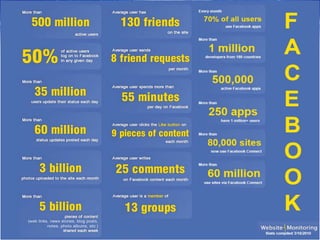
• A large and active audience
• Global reach (70% non-US)
• Methods for apps to interact with that
audience
• Well-defined ways for audience members
to tell their friends what they like
• Successful apps can make real money
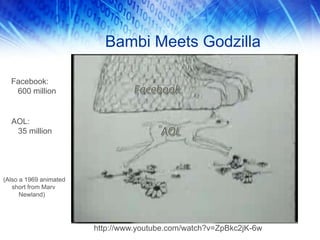
Bambi Meets Godzilla
http://www.youtube.com/watch?v=ZpBkc2jK-6w
Facebook:
600 million
AOL:
35 million
(Also a 1969 animated
short from Marv
Newland)
Pop Quiz
1. In 2001, did you think the Internet Boom
would last forever?
Yes No
2. In 2006, did you think the Real Estate
Boom would last forever?
Yes No
3. Do you seriously think that Facebook
can add 100 million new users every
single year?
Yes No
The Development
Landscape
From a PHP Mindset…
• Facebook was designed with PHP in mind
• Integration features were clunky at best
• …including an API (sort of)
But they bought FriendFeed in Aug 2009
• Key tech people were ex-Google
• Knew API’s and scalability issues
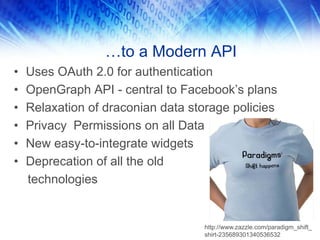
• Uses OAuth 2.0 for authentication
• OpenGraph API - central to Facebook’s plans
• Relaxation of draconian data storage policies
• Privacy Permissions on all Data
• New easy-to-integrate widgets
• Deprecation of all the old
technologies
…to a Modern API
http://www.zazzle.com/paradigm_shift_
shirt-235689301340536532
It’s Been a Rocky Road…
• Facebook still outgrowing the PHP mindset
• No “dev” version of Facebook to test apps
against upcoming platform changes
• Their REST interfaces may not do REST in
the way you expect:
- https://graph.facebook.com/me/friends
- https://graph.facebook.com/me/home (News Feed)
Just accept it and move on…
Gone, Deprecated, etc.
1. Old REST Web Services
2. FBML and FBJS
• HTML with extensions
• JavaScript w/ extensions
3. Facebook Connect
• Single sign-on for external sites
• Rebranded as part of OpenGraph API
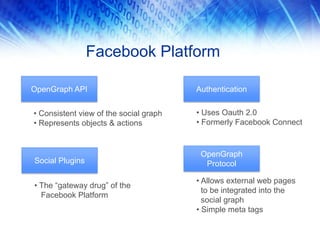
Facebook Platform
OpenGraph API Authentication
Social Plugins
OpenGraph
Protocol
• Uses Oauth 2.0
• Formerly Facebook Connect
• The “gateway drug” of the
Facebook Platform
• Consistent view of the social graph
• Represents objects & actions
• Allows external web pages
to be integrated into the
social graph
• Simple meta tags
It’s Still a Moving Target
• Facebook changes often, and with
little warning
• 3rd party libs always lag behind
platform changes…
Getting Ready to Develop
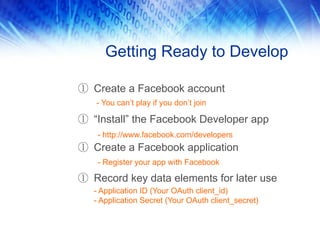
① Create a Facebook account
① “Install” the Facebook Developer app
① Create a Facebook application
① Record key data elements for later use
- You can’t play if you don’t join
- Register your app with Facebook
- http://www.facebook.com/developers
- Application ID (Your OAuth client_id)
- Application Secret (Your OAuth client_secret)
Some App Variations
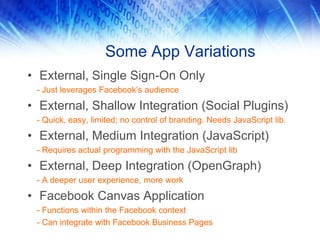
• External, Single Sign-On Only
- Just leverages Facebook’s audience
• External, Shallow Integration (Social Plugins)
- Quick, easy, limited; no control of branding. Needs JavaScript lib.
• External, Medium Integration (JavaScript)
- Requires actual programming with the JavaScript lib
• External, Deep Integration (OpenGraph)
- A deeper user experience, more work
• Facebook Canvas Application
- Functions within the Facebook context
- Can integrate with Facebook Business Pages
Example 1: Single Sign-On
(JavaScript)
Single Sign-On, JavaScript (1)
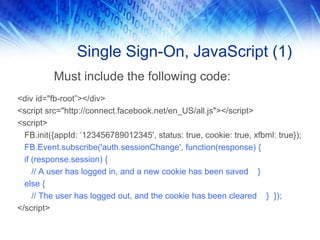
<div id="fb-root”></div>
<script src="http://connect.facebook.net/en_US/all.js"></script>
<script>
FB.init({appId: ’123456789012345', status: true, cookie: true, xfbml: true});
FB.Event.subscribe('auth.sessionChange', function(response) {
if (response.session) {
// A user has logged in, and a new cookie has been saved }
else {
// The user has logged out, and the cookie has been cleared } });
</script>
Must include the following code:
Single Sign-On, JavaScript (2)
<fb:login-button></fb:login-button>
- Or you can have your own button and call
FB.login via JavaScript for a login popup…
FB.login(function(response) {
if (response.session) {
if (response.perms) {
// user is logged in and granted some permissions. }
else {
// user is logged in, but did not get any permissions }
} else {
// user is not logged in
}
}, {perms:'read_stream,publish_stream,offline_access'});
Facebook Cookie
• Successful logins result in the creation of
a Facebook cookie
• The cookie is called: fbs_APP_ID
• That cookie can be interrogated by code
on the server
- access_token, facebook_id (UID)
• Generally, you create local accounts for
Facebook users (and record things like
their name, UID, etc.) after they’ve logged
in for the 1st time
Example 2: Profile Pics
(HTML)
Facebook Profile Pics
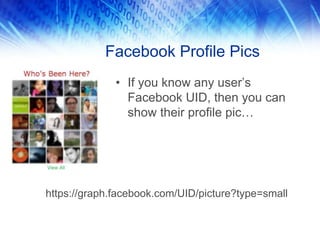
• If you know any user’s
Facebook UID, then you can
show their profile pic…
https://graph.facebook.com/UID/picture?type=small
Example 3: Single Sign-On
(Ruby and OAuth2)
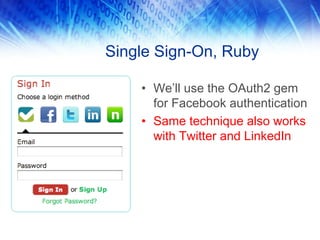
Single Sign-On, Ruby
• We’ll use the OAuth2 gem
for Facebook authentication
• Same technique also works
with Twitter and LinkedIn
<% if @auth_method.nil? || @auth_method == :any %>
<p><%= I18n.t('text.login.choose') %></p>
<ul id="login-types" class="clear">
<li class="vtr" style="cursor:pointer"></li>
<li class="fb"><%= link_to "<span class="alt">" +
I18n.t('label.connect_3rd_party',
:network=>"Facebook") + "</span>",
facebook_login_url(:contest_id => contest_id, :back =>
request.env['REQUEST_URI']), :title =>
I18n.t('label.connect_3rd_party', :network=>"Facebook")
%>
</li>
…
Facebook Login Badge
Facebook Routes
• We support multiple auth schemes
• Each one has its own controller (facebook_controller.rb)
• Here are the relevant routes:
Rails 2.3.x
map.facebook_login "facebook/", :controller => 'facebook', :action => 'new’
map.facebook_oauth_callback "facebook_oauth_callback/”,
:controller => 'facebook', :action => "oauth_callback"
Rails 3
resources :facebook, :only => [:new] do
collection do
get :oauth_callback
end
end
New Login Action
class FacebookController < StoreBaseController
before_filter :authorize, :except=>[:new, :oauth_callback]
def new
session[:return_to] = params[:back] if params[:back]
redirect_to client.web_server.authorize_url(:redirect_uri =>
facebook_oauth_callback_url)
end
def oauth_callback end # Provided on next slide
protected
def client
@config ||= YAML.load(File.open(RAILS_ROOT +
"/config/facebook_auth.yml").read)[RAILS_ENV]
OAuth2::Client.new(@config['client_id'],
@config['client_secret'], :site => @config['base_url'])
end
end
Oauth_Callback Action
def oauth_callback
unless params[:code]
authentication_failed('Authentication info does not match session info.') and return
end
access_token = client.web_server.get_access_token(params[:code],
:redirect_uri => facebook_oauth_callback_url)
user = FacebookUser.identify_or_create_from_access_token(access_token)
session[:user_id] = user.id
session[:user_type] = user.user_type
user.increment!(:login_count)
rescue Net::HTTPServerException => e
case e.message
when '401 "Unauthorized"'
authentication_failed('This auth request is no longer valid') and return
else
authentication_failed('There was a problem trying to auth you.') and return
end
end
Parsing the JSON
def self.identify_or_create_from_access_token(token)
raise ArgumentError, 'Must authenticate with an OAuth2::AccessToken.' unless
(token) || token.is_a?(OAuth2::AccessToken)
user_json = token.get('/me')
user_info = JSON.parse(user_json).symbolize_keys
unless user = self.find_by_external_id(user_info[:id])
user = self.new( :external_id => user_info[:id])
end
FACEBOOK_ATTRIBUTES.each do |att|
user.send("#{att}=", user_info[att]) if user.respond_to?("#{att}=")
end
user.external_id = user_info[:id]
user.access_token = token.token
user.profile_pic = "https://graph.facebook.com/#{user_info[:id]}/picture?type=small"}
user.save
user
end
Tips and Best Practices
Practical Tips
• Look carefully at performance
- Control the number of Facebook calls on a page
- Consider FQL to get data more efficiently
- FQL has been updated to use OpenGraph
- Cache data where possible
• If you use the canvas, use the iframe sub-type
- Better control of the output
- No need for HTML to be scrubbed (or mangled) by Facebook
• Do periodic regression tests on production code
For Canvas Apps
• “Hybrid Apps” is the way to go
• Limited functionality works within the
Facebook “canvas”
• For advanced features, users taken to a
separate site
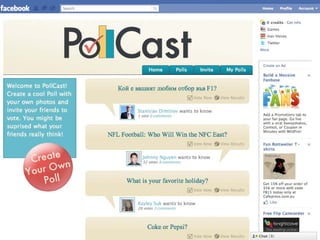
• Example: PollCast – Users can take polls
within Facebook, but they create them by
going to a separate site
Resources
• Facebook Developer Resources
- http://www.facebook.com/developers
- http://developer.facebook.com
• AllFacebook.com
- http://www.allfacebook.com
• “Developing Facebook Platform Applications with Rails” by
Michael J. Mangino, Pragmatic Programmers, 2008
- Seriously outdated, but interesting
Questions
• Blog: http://www.keenertech.com
• Facebook: http://www.facebook.com/keenertech
• Twitter: dkeener2010
• Email: dkeener@keenertech.com
dkeener@metrostarsystems.com
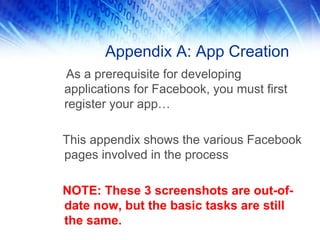
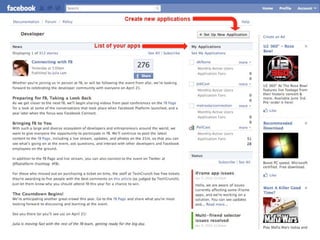
Appendix A: App Creation
As a prerequisite for developing
applications for Facebook, you must first
register your app…
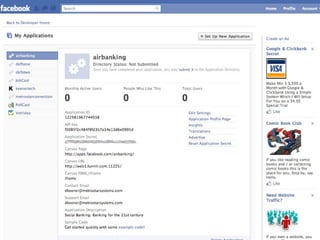
This appendix shows the various Facebook
pages involved in the process
NOTE: These 3 screenshots are out-of-
date now, but the basic tasks are still
the same.
What’s the Big Deal?
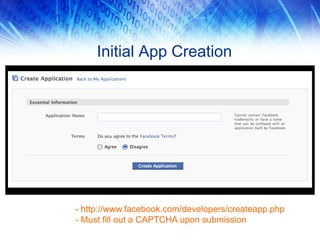
Initial App Creation
- http://www.facebook.com/developers/createapp.php
- Must fill out a CAPTCHA upon submission
Appendix B: SSH Tunneling
SSH tunneling is only needed if:
• You are building an app that will run
within Facebook’s canvas
• You want Facebook to pull the app from
your dev environment, e.g. – your laptop
http://127.0.0.1:3000
…is not acceptable…
Facebook can’t find your laptop…
One Simple Access Method
• Set up ssh access to a host on the Net
• On host, sshd_config file needs:
GatewayPorts = clientspecified
• Run the following command on a UNIX
flavor dev machine (like your laptop):
$ ssh keenertech.com -R
:3001:127.0.0.1:3000 sleep 99999
Forwards host’s port 3001 to 3000 on laptop
Appendix C: Other Examples
Some more code examples:
• Example 4: Social Plugins (“Like” Button)
• Example 5: Metadata
• Example 6: Canvas App
Example 4: Social Plugins
Social Plugins
• Leverages Facebook’s JavaScript SDK
• Can easily add social plugins to web sites
• Enables rapid “shallow integration”
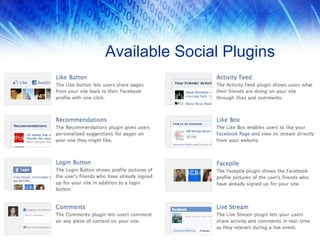
• Eight type of social plugins available
• Each widget supports customization
options
• Customization is still limited, though
Available Social Plugins
Adding a Like Button
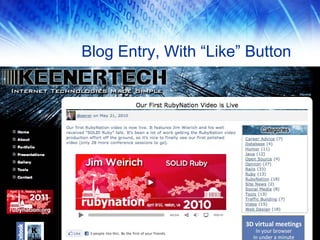
• “Like” will cause the web page to be
promoted on the user’s News Feed…and
will also appear for their friends
• The number of people who “Like” an item
impacts how often the item will be shown
on Facebook news feeds
• Facebook will retrieve info about the page
Blog Entry, With “Like” Button
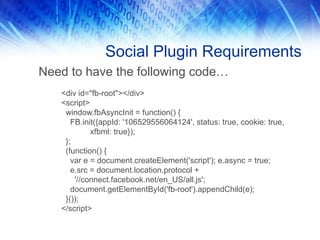
Social Plugin Requirements
Need to have the following code…
<div id="fb-root"></div>
<script>
window.fbAsyncInit = function() {
FB.init({appId: '106529556064124', status: true, cookie: true,
xfbml: true});
};
(function() {
var e = document.createElement('script'); e.async = true;
e.src = document.location.protocol +
'//connect.facebook.net/en_US/all.js';
document.getElementById('fb-root').appendChild(e);
}());
</script>
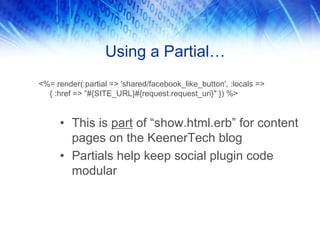
Using a Partial…
• This is part of “show.html.erb” for content
pages on the KeenerTech blog
• Partials help keep social plugin code
modular
<%= render(:partial => 'shared/facebook_like_button', :locals =>
{ :href => ”#{SITE_URL}#{request.request_uri}" }) %>
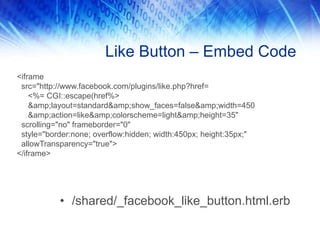
Like Button – Embed Code
<iframe
src="http://www.facebook.com/plugins/like.php?href=
<%= CGI::escape(href%>
&amp;layout=standard&amp;show_faces=false&amp;width=450
&amp;action=like&amp;colorscheme=light&amp;height=35"
scrolling="no" frameborder="0"
style="border:none; overflow:hidden; width:450px; height:35px;"
allowTransparency="true">
</iframe>
• /shared/_facebook_like_button.html.erb
Example 5: Metadata
Metadata for Facebook (1)
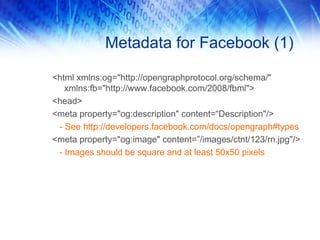
<html xmlns:og="http://opengraphprotocol.org/schema/"
xmlns:fb="http://www.facebook.com/2008/fbml">
<head>
<meta property="og:description" content=“Description"/>
- See http://developers.facebook.com/docs/opengraph#types
<meta property="og:image" content=”/images/ctnt/123/rn.jpg"/>
- Images should be square and at least 50x50 pixels
Metadata for Facebook (2)
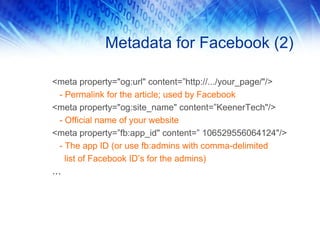
<meta property="og:url" content=”http://.../your_page/"/>
- Permalink for the article; used by Facebook
<meta property="og:site_name" content=”KeenerTech"/>
- Official name of your website
<meta property=”fb:app_id" content=” 106529556064124"/>
- The app ID (or use fb:admins with comma-delimited
list of Facebook ID’s for the admins)
…
Example 6: Canvas App
Prerequisite - Appendix B: SSH Tunneling
Facebook Application
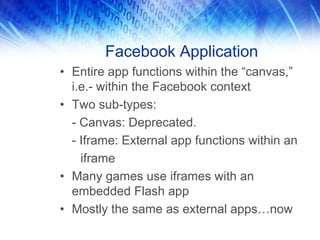
• Entire app functions within the “canvas,”
i.e.- within the Facebook context
• Two sub-types:
- Canvas: Deprecated.
- Iframe: External app functions within an
iframe
• Many games use iframes with an
embedded Flash app
• Mostly the same as external apps…now
What Is the Canvas?
The canvas is the area within the Facebook
web site that your application can control.
- As a “Canvas” app, or…
- An external app running in an iframe
It looks like this…
This is the Canvas
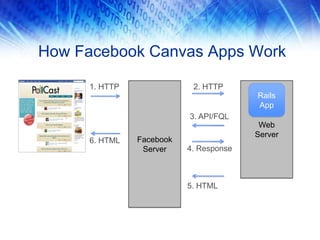
How Facebook Canvas Apps Work
Facebook
Server
Web
Server
Rails
App
1. HTTP 2. HTTP
3. API/FQL
4. Response
5. HTML
6. HTML

Building Facebook Apps

  • 1.
    Building Facebook Apps ByDavid Keener http://www.keenertech.com dkeener@keenertech.com david.keener@gd-ais.com Version 2.1
  • 2.
    About Me David Keener Fromthe Washington DC Area. I’m a Technical Architect for General Dynamics Advanced Information Systems, where I work on information and social media projects for .. • Blog: http://www.keenertech.com • Facebook: http://www.facebook.com/keenertech • Twitter: dkeener2010 • Email: dkeener@keenertech.com david.keener@gd-ais.com CENSORED
  • 3.
    Overview • Why workwith Facebook? • The Facebook Development Landscape • How to Get Started • General Application Types • Some tips and best practices
  • 4.
    Overview • Why workwith Facebook? - Lots and lots and lots of people • The Facebook Development Landscape • How to Get Started • General Application Types • Some tips and best practices
  • 5.
    Overview • Why workwith Facebook? - Lots and lots and lots of people • The Facebook Development Landscape - Ugly, chaotic, fractured…but gradually improving • How to Get Started • General Application Types • Some tips and best practices
  • 6.
    Overview • Why workwith Facebook? - Lots and lots and lots of people • The Facebook Development Landscape - Ugly, chaotic, fractured…but gradually improving • How to Get Started - Learning to embrace the chaos • General Application Types • Some tips and best practices
  • 7.
    Overview • Why workwith Facebook? - Lots and lots and lots of people • The Facebook Development Landscape - Ugly, chaotic, fractured…but gradually improving • How to Get Started - Learning to embrace the chaos • General Application Types - Plus a few examples • Some tips and best practices
  • 8.
    Overview • Why workwith Facebook? - Lots and lots and lots of people • The Facebook Development Landscape - Ugly, chaotic, fractured…but gradually improving • How to Get Started - Learning to embrace the chaos • General Application Types - Plus a few examples • Some tips and best practices - Your Facebook development survival guide
  • 12.
  • 14.
    Beyond the Stats…. Facebookprovides… • A large and active audience • Global reach (70% non-US) • Methods for apps to interact with that audience • Well-defined ways for audience members to tell their friends what they like • Successful apps can make real money
  • 15.
    Bambi Meets Godzilla http://www.youtube.com/watch?v=ZpBkc2jK-6w Facebook: 600million AOL: 35 million (Also a 1969 animated short from Marv Newland)
  • 16.
    Pop Quiz 1. In2001, did you think the Internet Boom would last forever? Yes No 2. In 2006, did you think the Real Estate Boom would last forever? Yes No 3. Do you seriously think that Facebook can add 100 million new users every single year? Yes No
  • 17.
  • 20.
    From a PHPMindset… • Facebook was designed with PHP in mind • Integration features were clunky at best • …including an API (sort of) But they bought FriendFeed in Aug 2009 • Key tech people were ex-Google • Knew API’s and scalability issues
  • 21.
    • Uses OAuth2.0 for authentication • OpenGraph API - central to Facebook’s plans • Relaxation of draconian data storage policies • Privacy Permissions on all Data • New easy-to-integrate widgets • Deprecation of all the old technologies …to a Modern API http://www.zazzle.com/paradigm_shift_ shirt-235689301340536532
  • 22.
    It’s Been aRocky Road… • Facebook still outgrowing the PHP mindset • No “dev” version of Facebook to test apps against upcoming platform changes • Their REST interfaces may not do REST in the way you expect: - https://graph.facebook.com/me/friends - https://graph.facebook.com/me/home (News Feed) Just accept it and move on…
  • 23.
    Gone, Deprecated, etc. 1.Old REST Web Services 2. FBML and FBJS • HTML with extensions • JavaScript w/ extensions 3. Facebook Connect • Single sign-on for external sites • Rebranded as part of OpenGraph API
  • 24.
    Facebook Platform OpenGraph APIAuthentication Social Plugins OpenGraph Protocol • Uses Oauth 2.0 • Formerly Facebook Connect • The “gateway drug” of the Facebook Platform • Consistent view of the social graph • Represents objects & actions • Allows external web pages to be integrated into the social graph • Simple meta tags
  • 25.
    It’s Still aMoving Target • Facebook changes often, and with little warning • 3rd party libs always lag behind platform changes…
  • 26.
    Getting Ready toDevelop ① Create a Facebook account ① “Install” the Facebook Developer app ① Create a Facebook application ① Record key data elements for later use - You can’t play if you don’t join - Register your app with Facebook - http://www.facebook.com/developers - Application ID (Your OAuth client_id) - Application Secret (Your OAuth client_secret)
  • 27.
    Some App Variations •External, Single Sign-On Only - Just leverages Facebook’s audience • External, Shallow Integration (Social Plugins) - Quick, easy, limited; no control of branding. Needs JavaScript lib. • External, Medium Integration (JavaScript) - Requires actual programming with the JavaScript lib • External, Deep Integration (OpenGraph) - A deeper user experience, more work • Facebook Canvas Application - Functions within the Facebook context - Can integrate with Facebook Business Pages
  • 28.
    Example 1: SingleSign-On (JavaScript)
  • 29.
    Single Sign-On, JavaScript(1) <div id="fb-root”></div> <script src="http://connect.facebook.net/en_US/all.js"></script> <script> FB.init({appId: ’123456789012345', status: true, cookie: true, xfbml: true}); FB.Event.subscribe('auth.sessionChange', function(response) { if (response.session) { // A user has logged in, and a new cookie has been saved } else { // The user has logged out, and the cookie has been cleared } }); </script> Must include the following code:
  • 30.
    Single Sign-On, JavaScript(2) <fb:login-button></fb:login-button> - Or you can have your own button and call FB.login via JavaScript for a login popup… FB.login(function(response) { if (response.session) { if (response.perms) { // user is logged in and granted some permissions. } else { // user is logged in, but did not get any permissions } } else { // user is not logged in } }, {perms:'read_stream,publish_stream,offline_access'});
  • 31.
    Facebook Cookie • Successfullogins result in the creation of a Facebook cookie • The cookie is called: fbs_APP_ID • That cookie can be interrogated by code on the server - access_token, facebook_id (UID) • Generally, you create local accounts for Facebook users (and record things like their name, UID, etc.) after they’ve logged in for the 1st time
  • 32.
    Example 2: ProfilePics (HTML)
  • 33.
    Facebook Profile Pics •If you know any user’s Facebook UID, then you can show their profile pic… https://graph.facebook.com/UID/picture?type=small
  • 34.
    Example 3: SingleSign-On (Ruby and OAuth2)
  • 35.
    Single Sign-On, Ruby •We’ll use the OAuth2 gem for Facebook authentication • Same technique also works with Twitter and LinkedIn
  • 36.
    <% if @auth_method.nil?|| @auth_method == :any %> <p><%= I18n.t('text.login.choose') %></p> <ul id="login-types" class="clear"> <li class="vtr" style="cursor:pointer"></li> <li class="fb"><%= link_to "<span class="alt">" + I18n.t('label.connect_3rd_party', :network=>"Facebook") + "</span>", facebook_login_url(:contest_id => contest_id, :back => request.env['REQUEST_URI']), :title => I18n.t('label.connect_3rd_party', :network=>"Facebook") %> </li> … Facebook Login Badge
  • 37.
    Facebook Routes • Wesupport multiple auth schemes • Each one has its own controller (facebook_controller.rb) • Here are the relevant routes: Rails 2.3.x map.facebook_login "facebook/", :controller => 'facebook', :action => 'new’ map.facebook_oauth_callback "facebook_oauth_callback/”, :controller => 'facebook', :action => "oauth_callback" Rails 3 resources :facebook, :only => [:new] do collection do get :oauth_callback end end
  • 38.
    New Login Action classFacebookController < StoreBaseController before_filter :authorize, :except=>[:new, :oauth_callback] def new session[:return_to] = params[:back] if params[:back] redirect_to client.web_server.authorize_url(:redirect_uri => facebook_oauth_callback_url) end def oauth_callback end # Provided on next slide protected def client @config ||= YAML.load(File.open(RAILS_ROOT + "/config/facebook_auth.yml").read)[RAILS_ENV] OAuth2::Client.new(@config['client_id'], @config['client_secret'], :site => @config['base_url']) end end
  • 39.
    Oauth_Callback Action def oauth_callback unlessparams[:code] authentication_failed('Authentication info does not match session info.') and return end access_token = client.web_server.get_access_token(params[:code], :redirect_uri => facebook_oauth_callback_url) user = FacebookUser.identify_or_create_from_access_token(access_token) session[:user_id] = user.id session[:user_type] = user.user_type user.increment!(:login_count) rescue Net::HTTPServerException => e case e.message when '401 "Unauthorized"' authentication_failed('This auth request is no longer valid') and return else authentication_failed('There was a problem trying to auth you.') and return end end
  • 40.
    Parsing the JSON defself.identify_or_create_from_access_token(token) raise ArgumentError, 'Must authenticate with an OAuth2::AccessToken.' unless (token) || token.is_a?(OAuth2::AccessToken) user_json = token.get('/me') user_info = JSON.parse(user_json).symbolize_keys unless user = self.find_by_external_id(user_info[:id]) user = self.new( :external_id => user_info[:id]) end FACEBOOK_ATTRIBUTES.each do |att| user.send("#{att}=", user_info[att]) if user.respond_to?("#{att}=") end user.external_id = user_info[:id] user.access_token = token.token user.profile_pic = "https://graph.facebook.com/#{user_info[:id]}/picture?type=small"} user.save user end
  • 41.
    Tips and BestPractices
  • 42.
    Practical Tips • Lookcarefully at performance - Control the number of Facebook calls on a page - Consider FQL to get data more efficiently - FQL has been updated to use OpenGraph - Cache data where possible • If you use the canvas, use the iframe sub-type - Better control of the output - No need for HTML to be scrubbed (or mangled) by Facebook • Do periodic regression tests on production code
  • 43.
    For Canvas Apps •“Hybrid Apps” is the way to go • Limited functionality works within the Facebook “canvas” • For advanced features, users taken to a separate site • Example: PollCast – Users can take polls within Facebook, but they create them by going to a separate site
  • 44.
    Resources • Facebook DeveloperResources - http://www.facebook.com/developers - http://developer.facebook.com • AllFacebook.com - http://www.allfacebook.com • “Developing Facebook Platform Applications with Rails” by Michael J. Mangino, Pragmatic Programmers, 2008 - Seriously outdated, but interesting
  • 45.
    Questions • Blog: http://www.keenertech.com •Facebook: http://www.facebook.com/keenertech • Twitter: dkeener2010 • Email: dkeener@keenertech.com dkeener@metrostarsystems.com
  • 46.
    Appendix A: AppCreation As a prerequisite for developing applications for Facebook, you must first register your app… This appendix shows the various Facebook pages involved in the process NOTE: These 3 screenshots are out-of- date now, but the basic tasks are still the same.
  • 47.
  • 48.
    Initial App Creation -http://www.facebook.com/developers/createapp.php - Must fill out a CAPTCHA upon submission
  • 50.
    Appendix B: SSHTunneling SSH tunneling is only needed if: • You are building an app that will run within Facebook’s canvas • You want Facebook to pull the app from your dev environment, e.g. – your laptop
  • 51.
  • 52.
    One Simple AccessMethod • Set up ssh access to a host on the Net • On host, sshd_config file needs: GatewayPorts = clientspecified • Run the following command on a UNIX flavor dev machine (like your laptop): $ ssh keenertech.com -R :3001:127.0.0.1:3000 sleep 99999 Forwards host’s port 3001 to 3000 on laptop
  • 53.
    Appendix C: OtherExamples Some more code examples: • Example 4: Social Plugins (“Like” Button) • Example 5: Metadata • Example 6: Canvas App
  • 54.
  • 55.
    Social Plugins • LeveragesFacebook’s JavaScript SDK • Can easily add social plugins to web sites • Enables rapid “shallow integration” • Eight type of social plugins available • Each widget supports customization options • Customization is still limited, though
  • 56.
  • 57.
    Adding a LikeButton • “Like” will cause the web page to be promoted on the user’s News Feed…and will also appear for their friends • The number of people who “Like” an item impacts how often the item will be shown on Facebook news feeds • Facebook will retrieve info about the page
  • 58.
    Blog Entry, With“Like” Button
  • 59.
    Social Plugin Requirements Needto have the following code… <div id="fb-root"></div> <script> window.fbAsyncInit = function() { FB.init({appId: '106529556064124', status: true, cookie: true, xfbml: true}); }; (function() { var e = document.createElement('script'); e.async = true; e.src = document.location.protocol + '//connect.facebook.net/en_US/all.js'; document.getElementById('fb-root').appendChild(e); }()); </script>
  • 60.
    Using a Partial… •This is part of “show.html.erb” for content pages on the KeenerTech blog • Partials help keep social plugin code modular <%= render(:partial => 'shared/facebook_like_button', :locals => { :href => ”#{SITE_URL}#{request.request_uri}" }) %>
  • 61.
    Like Button –Embed Code <iframe src="http://www.facebook.com/plugins/like.php?href= <%= CGI::escape(href%> &amp;layout=standard&amp;show_faces=false&amp;width=450 &amp;action=like&amp;colorscheme=light&amp;height=35" scrolling="no" frameborder="0" style="border:none; overflow:hidden; width:450px; height:35px;" allowTransparency="true"> </iframe> • /shared/_facebook_like_button.html.erb
  • 62.
  • 63.
    Metadata for Facebook(1) <html xmlns:og="http://opengraphprotocol.org/schema/" xmlns:fb="http://www.facebook.com/2008/fbml"> <head> <meta property="og:description" content=“Description"/> - See http://developers.facebook.com/docs/opengraph#types <meta property="og:image" content=”/images/ctnt/123/rn.jpg"/> - Images should be square and at least 50x50 pixels
  • 64.
    Metadata for Facebook(2) <meta property="og:url" content=”http://.../your_page/"/> - Permalink for the article; used by Facebook <meta property="og:site_name" content=”KeenerTech"/> - Official name of your website <meta property=”fb:app_id" content=” 106529556064124"/> - The app ID (or use fb:admins with comma-delimited list of Facebook ID’s for the admins) …
  • 65.
    Example 6: CanvasApp Prerequisite - Appendix B: SSH Tunneling
  • 66.
    Facebook Application • Entireapp functions within the “canvas,” i.e.- within the Facebook context • Two sub-types: - Canvas: Deprecated. - Iframe: External app functions within an iframe • Many games use iframes with an embedded Flash app • Mostly the same as external apps…now
  • 67.
    What Is theCanvas? The canvas is the area within the Facebook web site that your application can control. - As a “Canvas” app, or… - An external app running in an iframe It looks like this…
  • 68.
  • 69.
    How Facebook CanvasApps Work Facebook Server Web Server Rails App 1. HTTP 2. HTTP 3. API/FQL 4. Response 5. HTML 6. HTML