


Attacking HTTP/2
Implementations
Stuart Larsen and John Villamil
Yahoo! Pentest Team
Introduction
▪  HTTP/2
▪  Why HTTP/2 is hard
▪  http2fuzz
▪  ATS
▪  Firefox
▪  NodeJS
▪  Conclusion
Stuart Larsen
▪  https://c0nrad.io
John Villamil
▪  @day6reak
whoami
HTTP/1.1 came out in 1999
Since then…
▪  HTML and JS have evolved
▪  Sites are much more complex
▪  ISP speeds have improved and more bandwidth is available
▪  Far more content is served over the web
▪  SSL is now more common
▪  “Hello HTTP/2, Goodbye SPDY”
http://blog.chromium.org/2015/02/hello-http2-goodbye-spdy-http-is_9.html
▪  HTTP/2 evolved from SPDY and SPDY/2
▪  Features:
›  Better use of TCP
›  Binary protocol
•  Frames and Streams
›  Multiplexing (Streams)
•  reducing perceived latency
›  Server Push (PUSH_PROMISE)
›  Compression (HPACK)
›  Frames
HTTP/2 is about performance
Upgrading from HTTP/1.1
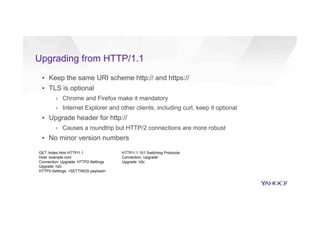
▪  Keep the same URI scheme http:// and https://
▪  TLS is optional
›  Chrome and Firefox make it mandatory
›  Internet Explorer and other clients, including curl, keep it optional
▪  Upgrade header for http://
›  Causes a roundtrip but HTTP/2 connections are more robust
▪  No minor version numbers
HTTP/1.1 101 Switching Protocols
Connection: Upgrade
Upgrade: h2c
GET /index.html HTTP/1.1
Host: example.com
Connection: Upgrade, HTTP2-Settings
Upgrade: h2c
HTTP2-Settings: <SETTINGS payload>
HPACK
▪  HTTP is stateless
›  Request sizes (cookies and other headers) are significant in size
›  Compression is a natural solution
▪  “Hpack was designed to make it difficult for a conforming implementation to leak information, to make encoding and
decoding very fast/cheap, to provide for receiver control over compression context size, to allow for proxy re-indexing
(i.e. shared state between frontend and backend within a proxy), and for quick comparisons of huffman-encoded
strings.”
›  Roberto Peon, http://lists.w3.org/Archives/Public/ietf-http-wg//2014AprJun/1044.html
▪  Receiver controls the maximum memory used
›  0 at a minimum and 2^32 at a maximum
›  Specified in SETTINGS frame
▪  SPDY uses deflate algorithm
›  Vulnerable to CRIME
HPACK
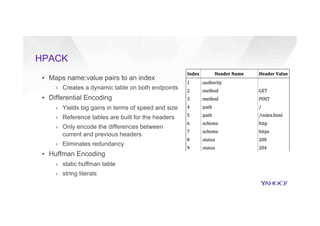
▪  Maps name:value pairs to an index
›  Creates a dynamic table on both endpoints
▪  Differential Encoding
›  Yields big gains in terms of speed and size
›  Reference tables are built for the headers
›  Only encode the differences between
current and previous headers
›  Eliminates redundancy
▪  Huffman Encoding
›  static huffman table
›  string literals
HPACK Attack Surface
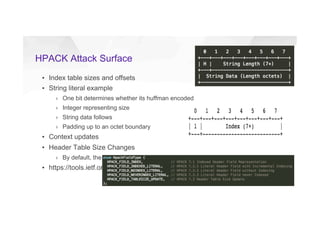
▪  Index table sizes and offsets
▪  String literal example
›  One bit determines whether its huffman encoded
›  Integer representing size
›  String data follows
›  Padding up to an octet boundary
▪  Context updates
▪  Header Table Size Changes
›  By default, the dynamic table size is 4k
▪  https://tools.ietf.org/html/rfc7541
Multiplexing
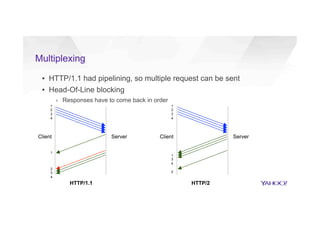
▪  HTTP/1.1 had pipelining, so multiple request can be sent
▪  Head-Of-Line blocking
›  Responses have to come back in order
Client Server
HTTP/1.1
Client Server
HTTP/2
1
3
4
2
1
2
3
4
1
2
3
4
1
2
3
4
Frames
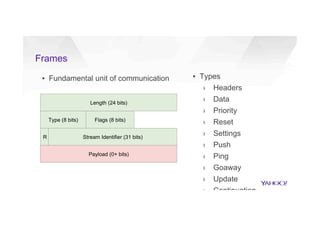
▪  Fundamental unit of communication
Length (24 bits)
Type (8 bits) Flags (8 bits)
R Stream Identifier (31 bits)
Payload (0+ bits)
▪  Types
›  Headers
›  Data
›  Priority
›  Reset
›  Settings
›  Push
›  Ping
›  Goaway
›  Update
›  Continuation
Push
▪  New feature for pushing resources onto a client
▪  For example, if a client requests index.html from a web server, the
web server can probably assume the client will also want logo.png
›  Instead of waiting for the client to request logo.png, the server can preemptively
push logo.png so the user doesn’t have to wait an entire request
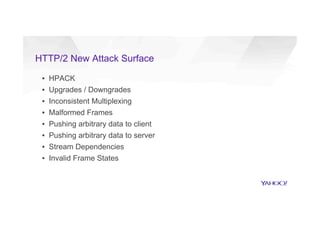
HTTP/2 New Attack Surface
▪  HPACK
▪  Upgrades / Downgrades
▪  Inconsistent Multiplexing
▪  Malformed Frames
▪  Pushing arbitrary data to client
▪  Pushing arbitrary data to server
▪  Stream Dependencies
▪  Invalid Frame States
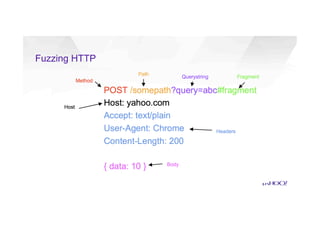
Fuzzing
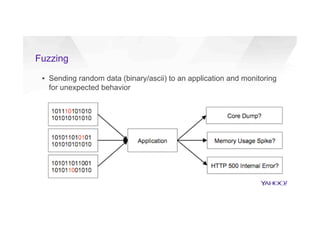
▪  Sending random data (binary/ascii) to an application and monitoring
for unexpected behavior
Fuzzing HTTP
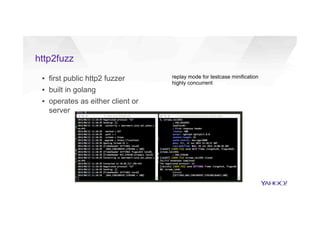
http2fuzz
▪  first public http2 fuzzer
▪  built in golang
▪  operates as either client or
server
replay mode for testcase minification
highly concurrent
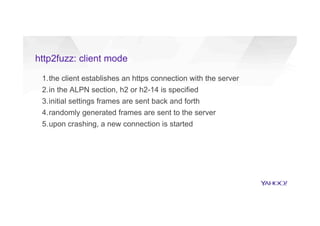
http2fuzz: client mode
1. the client establishes an https connection with the server
2. in the ALPN section, h2 or h2-14 is specified
3. initial settings frames are sent back and forth
4. randomly generated frames are sent to the server
5. upon crashing, a new connection is started
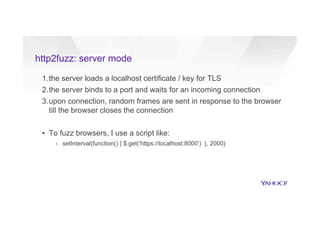
http2fuzz: server mode
1. the server loads a localhost certificate / key for TLS
2. the server binds to a port and waits for an incoming connection
3. upon connection, random frames are sent in response to the browser
till the browser closes the connection
▪  To fuzz browsers, I use a script like:
›  setInterval(function() { $.get(‘https://localhost:8000’) }, 2000)
Strategies
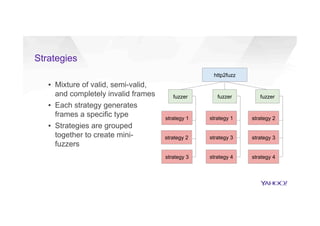
▪  Mixture of valid, semi-valid,
and completely invalid frames
▪  Each strategy generates
frames a specific type
▪  Strategies are grouped
together to create mini-
fuzzers
http2fuzz
fuzzer fuzzer fuzzer
strategy 1
strategy 2
strategy 3
strategy 1
strategy 3
strategy 4
strategy 2
strategy 3
strategy 4
Strategies
SettingsFuzzer:
▪  Picks a random number between 0-5
▪  Appends that many random settings with random values to a
SettingsFrame
HeaderFuzzer:
▪  Picks a random number between 0-5
▪  Appends that many random HTTP headers with random values to a
HeadersFrame
Strategies
PriorityFuzzer:
▪  Sends Priority frames with a random streamDependency, steamId,
weight, and exclusive value
PingFuzzer:
▪  Sends a ping frame with a random 8 byte payload
ResetFuzzer:
▪  Sends a RST Frame with a random streamId and errorCode
Strategies
WindowUpdateFuzzer:
▪  Sends a Window Update Frame with a random streamId, and incr
value.
RawFrameFuzzer:
▪  Generates a random frameType (0-12), randomFlags (0-256), and
streamId(2**31), and a random byte array of length 0-10000.
▪  Sends the invalid frame
Strategies
DataFuzzer:
▪  Sends a Data Frame with a random streamId, endStream bool, and
random payload between 0-10000 bytes
PushPromiseFuzzer:
▪  Sends a PushPromise Frame with a random payload of 0-10000
bytes, streamId, promiseId, endHeaders bool, and padlengnth (0-256)
Strategies
ContinuationFuzzer:
▪  Sends a Continuation Frame with a random streamId, endStream
bool and payload of length 0-10000 bytes.
RawTCPFuzzer:
▪  Establishes a TLS connection, and sends complete garbage to it. The
payload is a byte array of length 0-10000.
Replay Mode
▪  Once the fuzzer finds a crash, the cause needs to be determined
▪  When fuzzing, each payload is saved in replay.json
▪  After a crash the fuzzer stops and the file is closed
▪  Running ./http2fuzz --replay send the frames back to the server in the
same order
▪  So you can delete some frames, and see if the payload is still
crashing the server, reducing the set of frames till only the necessary
frames remain
It started with ATS
▪  Yahoo Pentest Team decided to look at ATS (Apache Traffic Server)
Http2ConnectionState.cc
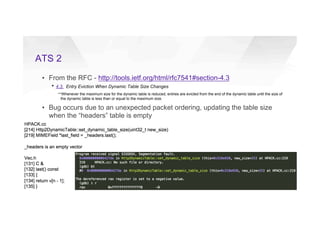
ATS 2
▪  From the RFC - http://tools.ietf.org/html/rfc7541#section-4.3
• 4.3. Entry Eviction When Dynamic Table Size Changes
– Whenever the maximum size for the dynamic table is reduced, entries are evicted from the end of the dynamic table until the size of
the dynamic table is less than or equal to the maximum size.
▪  Bug occurs due to an unexpected packet ordering, updating the table size
when the “headers” table is empty
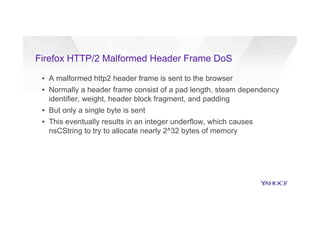
Firefox HTTP/2 Malformed Header Frame DoS
▪  A malformed http2 header frame is sent to the browser
▪  Normally a header frame consist of a pad length, steam dependency
identifier, weight, header block fragment, and padding
▪  But only a single byte is sent
▪  This eventually results in an integer underflow, which causes
nsCString to try to allocate nearly 2^32 bytes of memory
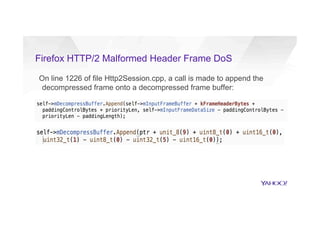
Firefox HTTP/2 Malformed Header Frame DoS
On line 1226 of file Http2Session.cpp, a call is made to append the
decompressed frame onto a decompressed frame buffer:
= 4294967292
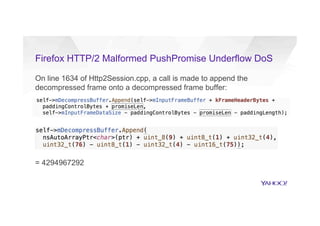
Firefox HTTP/2 Malformed PushPromise Underflow DoS
On line 1634 of Http2Session.cpp, a call is made to append the
decompressed frame onto a decompressed frame buffer:
= 4294967292
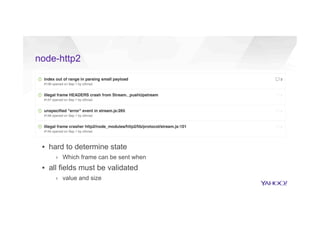
node-http2
▪  hard to determine state
›  Which frame can be sent when
▪  all fields must be validated
›  value and size
Conclusion
▪  HTTP2
▪  Why HTTP2 is hard
▪  http2fuzz
▪  ATS
▪  Firefox
▪  NodeJS
The End
Questions?

Stuart Larsen, attacking http2implementations-rev1

  • 1.
    Attacking HTTP/2 Implementations Stuart Larsenand John Villamil Yahoo! Pentest Team
  • 2.
    Introduction ▪  HTTP/2 ▪  WhyHTTP/2 is hard ▪  http2fuzz ▪  ATS ▪  Firefox ▪  NodeJS ▪  Conclusion
  • 3.
    Stuart Larsen ▪  https://c0nrad.io JohnVillamil ▪  @day6reak whoami
  • 4.
    HTTP/1.1 came outin 1999 Since then… ▪  HTML and JS have evolved ▪  Sites are much more complex ▪  ISP speeds have improved and more bandwidth is available ▪  Far more content is served over the web ▪  SSL is now more common
  • 5.
    ▪  “Hello HTTP/2,Goodbye SPDY” http://blog.chromium.org/2015/02/hello-http2-goodbye-spdy-http-is_9.html ▪  HTTP/2 evolved from SPDY and SPDY/2 ▪  Features: ›  Better use of TCP ›  Binary protocol •  Frames and Streams ›  Multiplexing (Streams) •  reducing perceived latency ›  Server Push (PUSH_PROMISE) ›  Compression (HPACK) ›  Frames HTTP/2 is about performance
  • 6.
    Upgrading from HTTP/1.1 ▪ Keep the same URI scheme http:// and https:// ▪  TLS is optional ›  Chrome and Firefox make it mandatory ›  Internet Explorer and other clients, including curl, keep it optional ▪  Upgrade header for http:// ›  Causes a roundtrip but HTTP/2 connections are more robust ▪  No minor version numbers HTTP/1.1 101 Switching Protocols Connection: Upgrade Upgrade: h2c GET /index.html HTTP/1.1 Host: example.com Connection: Upgrade, HTTP2-Settings Upgrade: h2c HTTP2-Settings: <SETTINGS payload>
  • 7.
    HPACK ▪  HTTP isstateless ›  Request sizes (cookies and other headers) are significant in size ›  Compression is a natural solution ▪  “Hpack was designed to make it difficult for a conforming implementation to leak information, to make encoding and decoding very fast/cheap, to provide for receiver control over compression context size, to allow for proxy re-indexing (i.e. shared state between frontend and backend within a proxy), and for quick comparisons of huffman-encoded strings.” ›  Roberto Peon, http://lists.w3.org/Archives/Public/ietf-http-wg//2014AprJun/1044.html ▪  Receiver controls the maximum memory used ›  0 at a minimum and 2^32 at a maximum ›  Specified in SETTINGS frame ▪  SPDY uses deflate algorithm ›  Vulnerable to CRIME
  • 8.
    HPACK ▪  Maps name:valuepairs to an index ›  Creates a dynamic table on both endpoints ▪  Differential Encoding ›  Yields big gains in terms of speed and size ›  Reference tables are built for the headers ›  Only encode the differences between current and previous headers ›  Eliminates redundancy ▪  Huffman Encoding ›  static huffman table ›  string literals
  • 9.
    HPACK Attack Surface ▪ Index table sizes and offsets ▪  String literal example ›  One bit determines whether its huffman encoded ›  Integer representing size ›  String data follows ›  Padding up to an octet boundary ▪  Context updates ▪  Header Table Size Changes ›  By default, the dynamic table size is 4k ▪  https://tools.ietf.org/html/rfc7541
  • 10.
    Multiplexing ▪  HTTP/1.1 hadpipelining, so multiple request can be sent ▪  Head-Of-Line blocking ›  Responses have to come back in order Client Server HTTP/1.1 Client Server HTTP/2 1 3 4 2 1 2 3 4 1 2 3 4 1 2 3 4
  • 11.
    Frames ▪  Fundamental unitof communication Length (24 bits) Type (8 bits) Flags (8 bits) R Stream Identifier (31 bits) Payload (0+ bits) ▪  Types ›  Headers ›  Data ›  Priority ›  Reset ›  Settings ›  Push ›  Ping ›  Goaway ›  Update ›  Continuation
  • 12.
    Push ▪  New featurefor pushing resources onto a client ▪  For example, if a client requests index.html from a web server, the web server can probably assume the client will also want logo.png ›  Instead of waiting for the client to request logo.png, the server can preemptively push logo.png so the user doesn’t have to wait an entire request
  • 13.
    HTTP/2 New AttackSurface ▪  HPACK ▪  Upgrades / Downgrades ▪  Inconsistent Multiplexing ▪  Malformed Frames ▪  Pushing arbitrary data to client ▪  Pushing arbitrary data to server ▪  Stream Dependencies ▪  Invalid Frame States
  • 14.
    Fuzzing ▪  Sending randomdata (binary/ascii) to an application and monitoring for unexpected behavior
  • 15.
  • 16.
    http2fuzz ▪  first publichttp2 fuzzer ▪  built in golang ▪  operates as either client or server replay mode for testcase minification highly concurrent
  • 17.
    http2fuzz: client mode 1. theclient establishes an https connection with the server 2. in the ALPN section, h2 or h2-14 is specified 3. initial settings frames are sent back and forth 4. randomly generated frames are sent to the server 5. upon crashing, a new connection is started
  • 18.
    http2fuzz: server mode 1. theserver loads a localhost certificate / key for TLS 2. the server binds to a port and waits for an incoming connection 3. upon connection, random frames are sent in response to the browser till the browser closes the connection ▪  To fuzz browsers, I use a script like: ›  setInterval(function() { $.get(‘https://localhost:8000’) }, 2000)
  • 19.
    Strategies ▪  Mixture ofvalid, semi-valid, and completely invalid frames ▪  Each strategy generates frames a specific type ▪  Strategies are grouped together to create mini- fuzzers http2fuzz fuzzer fuzzer fuzzer strategy 1 strategy 2 strategy 3 strategy 1 strategy 3 strategy 4 strategy 2 strategy 3 strategy 4
  • 20.
    Strategies SettingsFuzzer: ▪  Picks arandom number between 0-5 ▪  Appends that many random settings with random values to a SettingsFrame HeaderFuzzer: ▪  Picks a random number between 0-5 ▪  Appends that many random HTTP headers with random values to a HeadersFrame
  • 21.
    Strategies PriorityFuzzer: ▪  Sends Priorityframes with a random streamDependency, steamId, weight, and exclusive value PingFuzzer: ▪  Sends a ping frame with a random 8 byte payload ResetFuzzer: ▪  Sends a RST Frame with a random streamId and errorCode
  • 22.
    Strategies WindowUpdateFuzzer: ▪  Sends aWindow Update Frame with a random streamId, and incr value. RawFrameFuzzer: ▪  Generates a random frameType (0-12), randomFlags (0-256), and streamId(2**31), and a random byte array of length 0-10000. ▪  Sends the invalid frame
  • 23.
    Strategies DataFuzzer: ▪  Sends aData Frame with a random streamId, endStream bool, and random payload between 0-10000 bytes PushPromiseFuzzer: ▪  Sends a PushPromise Frame with a random payload of 0-10000 bytes, streamId, promiseId, endHeaders bool, and padlengnth (0-256)
  • 24.
    Strategies ContinuationFuzzer: ▪  Sends aContinuation Frame with a random streamId, endStream bool and payload of length 0-10000 bytes. RawTCPFuzzer: ▪  Establishes a TLS connection, and sends complete garbage to it. The payload is a byte array of length 0-10000.
  • 25.
    Replay Mode ▪  Oncethe fuzzer finds a crash, the cause needs to be determined ▪  When fuzzing, each payload is saved in replay.json ▪  After a crash the fuzzer stops and the file is closed ▪  Running ./http2fuzz --replay send the frames back to the server in the same order ▪  So you can delete some frames, and see if the payload is still crashing the server, reducing the set of frames till only the necessary frames remain
  • 26.
    It started withATS ▪  Yahoo Pentest Team decided to look at ATS (Apache Traffic Server) Http2ConnectionState.cc
  • 27.
    ATS 2 ▪  Fromthe RFC - http://tools.ietf.org/html/rfc7541#section-4.3 • 4.3. Entry Eviction When Dynamic Table Size Changes – Whenever the maximum size for the dynamic table is reduced, entries are evicted from the end of the dynamic table until the size of the dynamic table is less than or equal to the maximum size. ▪  Bug occurs due to an unexpected packet ordering, updating the table size when the “headers” table is empty
  • 28.
    Firefox HTTP/2 MalformedHeader Frame DoS ▪  A malformed http2 header frame is sent to the browser ▪  Normally a header frame consist of a pad length, steam dependency identifier, weight, header block fragment, and padding ▪  But only a single byte is sent ▪  This eventually results in an integer underflow, which causes nsCString to try to allocate nearly 2^32 bytes of memory
  • 29.
    Firefox HTTP/2 MalformedHeader Frame DoS On line 1226 of file Http2Session.cpp, a call is made to append the decompressed frame onto a decompressed frame buffer: = 4294967292
  • 30.
    Firefox HTTP/2 MalformedPushPromise Underflow DoS On line 1634 of Http2Session.cpp, a call is made to append the decompressed frame onto a decompressed frame buffer: = 4294967292
  • 31.
    node-http2 ▪  hard todetermine state ›  Which frame can be sent when ▪  all fields must be validated ›  value and size
  • 32.
    Conclusion ▪  HTTP2 ▪  WhyHTTP2 is hard ▪  http2fuzz ▪  ATS ▪  Firefox ▪  NodeJS
  • 33.