BONE TUMORS

               Basic

   DR BHUSHAN LAKHKAR
Plain X rays
SEVEN
1. Where is the lesion – what bone and what part
                          of the bone
2. Age & size of the lesion?
3. What is the lesion doing to bone?
4. What is the bone doing in response?
5. Is the lesion making matrix?
6. Is the cortex eroded?
7. Is a soft tissue mass evident?
How are bone tumours

Like Real Estate ?

  LOCATION !


       LOCATION !


               LOCATION !
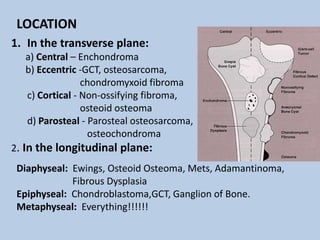
LOCATION
1. In the transverse plane:
  a) Central – Enchondroma
  b) Eccentric -GCT, osteosarcoma,
                chondromyxoid fibroma
  c) Cortical - Non-ossifying fibroma,
                osteoid osteoma
  d) Parosteal - Parosteal osteosarcoma,
                 osteochondroma
2. In the longitudinal plane:
 Diaphyseal: Ewings, Osteoid Osteoma, Mets, Adamantinoma,
             Fibrous Dysplasia
 Epiphyseal: Chondroblastoma,GCT, Ganglion of Bone.
 Metaphyseal: Everything!!!!!!
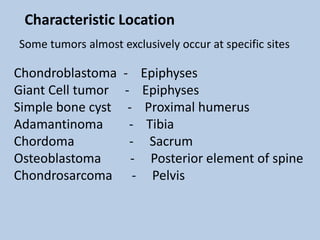
Characteristic Location
Some tumors almost exclusively occur at specific sites
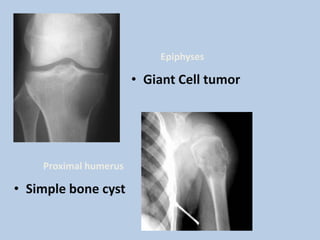
Chondroblastoma     -      Epiphyses
Giant Cell tumor    -      Epiphyses
Simple bone cyst     -      Proximal humerus
Adamantinoma          -     Tibia
Chordoma              -      Sacrum
Osteoblastoma         -      Posterior element of spine
Chondrosarcoma         -     Pelvis
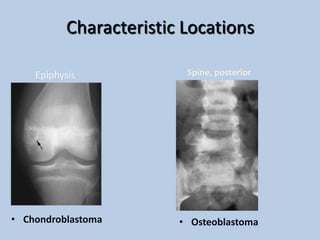
Characteristic Locations

    Epiphysis             Spine, posterior


• Chondroblastoma        • Osteoblastoma
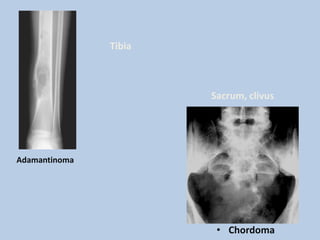
Tibia


                       Sacrum, clivus


Adamantinoma


                        • Chordoma
Epiphyses

                       • Giant Cell tumor


    Proximal humerus

• Simple bone cyst
Age of the patient

• 20>…..Osteogenic Sarcoma, Ewings. simple bone
           cysts and chondroblastomas

• 40……GCT, Chondrosarcoma, MFH, Lymphoma, Mets.

• 60……Mets, Myeloma, Chondrosarcoma, MFH
        – Late Osteogenic, Fibrosarcoma.
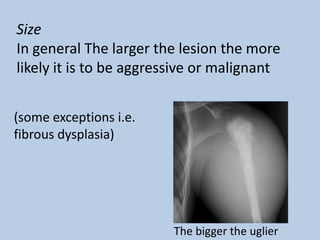
Size
In general The larger the lesion the more
likely it is to be aggressive or malignant


(some exceptions i.e.
fibrous dysplasia)


                         The bigger the uglier
What is the bone doing to the tumor ?

Bone reacts in two ways -- either by removing
some of itself or by creating more of itself.

If the disorder is rapidly progressive, there may
only be time for retreat (defense).

If the process is slow growing, then the bone
may have time to mount an offense and try to
form a sclerotic area around the offender.
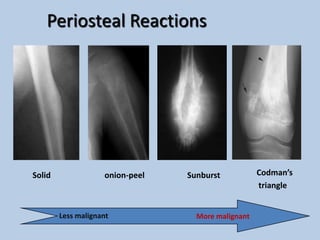
Periostitis
  A periosteal reaction will occur whenever the
    periosteum is irritated.
  This may occur due to a malignant
    tumor, benign tumor, infection or trauma.
  Two types Benign or Aggressive.


• Benign            Aggressive or malignant
  – None              – Lamellated or onion peel
  – Solid             – Sunburst
                      – Codman’s triangle
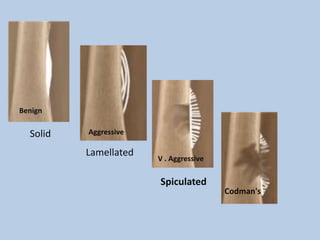
Benign

  Solid   Aggressive

          Lamellated
                       V . Aggressive

                       Spiculated
                                        Codman's
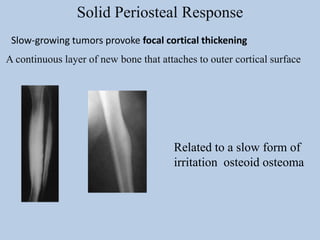
Solid Periosteal Response
 Slow-growing tumors provoke focal cortical thickening
A continuous layer of new bone that attaches to outer cortical surface


                                       Related to a slow form of
                                       irritation osteoid osteoma
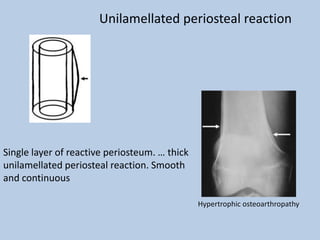
Unilamellated periosteal reaction


Single layer of reactive periosteum. … thick
unilamellated periosteal reaction. Smooth
and continuous

                                               Hypertrophic osteoarthropathy
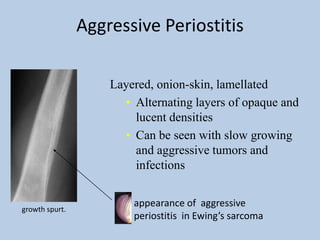
Aggressive Periostitis

                    Layered, onion-skin, lamellated
                      • Alternating layers of opaque and
                        lucent densities
                      • Can be seen with slow growing
                        and aggressive tumors and
                        infections


                        appearance of aggressive
growth spurt.
                        periostitis in Ewing’s sarcoma
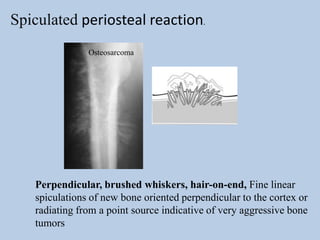
Spiculated periosteal reaction.
               Osteosarcoma


   Perpendicular, brushed whiskers, hair-on-end, Fine linear
   spiculations of new bone oriented perpendicular to the cortex or
   radiating from a point source indicative of very aggressive bone
   tumors
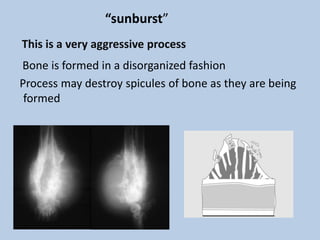
“sunburst”
This is a very aggressive process
Bone is formed in a disorganized fashion
Process may destroy spicules of bone as they are being
 formed
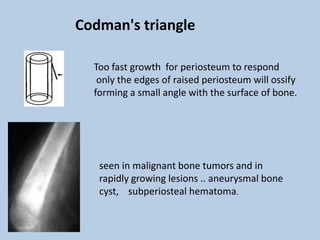
Codman's triangle

  Too fast growth for periosteum to respond
   only the edges of raised periosteum will ossify
  forming a small angle with the surface of bone.


   seen in malignant bone tumors and in
   rapidly growing lesions .. aneurysmal bone
   cyst, subperiosteal hematoma.
Periosteal Reactions


Solid               onion-peel   Sunburst           Codman’s
                                                    triangle


        Less malignant             More malignant
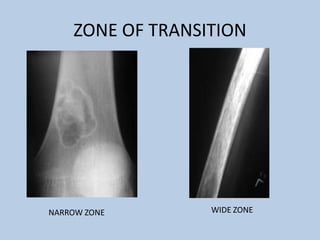
Zone of Transition

Most reliable indicator for benign versus malignant lesions.


“Narrow”, if it is so well defined that it can be drawn
 with a fine-point pen.

“Wide”, if it is imperceptible and can not be drawn at all.
 An aggressive process should be considered, although
 not necessarily a malignant lesion.
ZONE OF TRANSITION


NARROW ZONE       WIDE ZONE
Three Patterns of Bone Destruction

  • Geographic Pattern
  • Moth-Eaten Pattern
  • Permeative Pattern

  Result from the degree of aggressiveness of
  the lesion
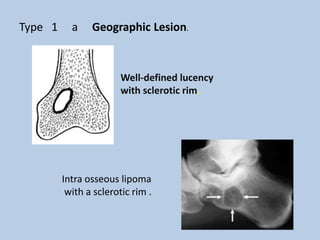
Type 1     a    Geographic Lesion.


                        Well-defined lucency
                        with sclerotic rim.


         Intra osseous lipoma
          with a sclerotic rim .
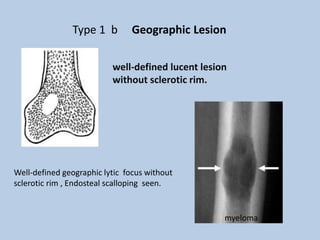
Type 1 b        Geographic Lesion

                          well-defined lucent lesion
                          without sclerotic rim.


Well-defined geographic lytic focus without
sclerotic rim , Endosteal scalloping seen.


                                                   myeloma
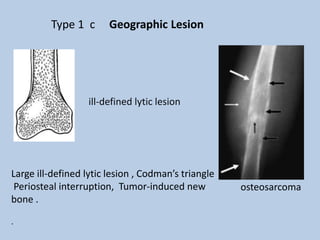
Type 1 c       Geographic Lesion


                   ill-defined lytic lesion


Large ill-defined lytic lesion , Codman’s triangle
 Periosteal interruption, Tumor-induced new          osteosarcoma
bone .

.
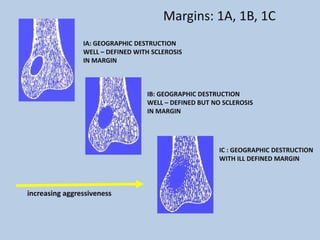
Margins: 1A, 1B, 1C
                IA: GEOGRAPHIC DESTRUCTION
                WELL – DEFINED WITH SCLEROSIS
                IN MARGIN


                                  IB: GEOGRAPHIC DESTRUCTION
                                  WELL – DEFINED BUT NO SCLEROSIS
                                  IN MARGIN


                                                       IC : GEOGRAPHIC DESTRUCTION
                                                       WITH ILL DEFINED MARGIN


increasing aggressiveness
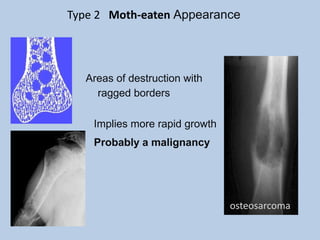
Type 2 Moth-eaten Appearance


  Areas of destruction with
    ragged borders

    Implies more rapid growth
    Probably a malignancy


                                osteosarcoma
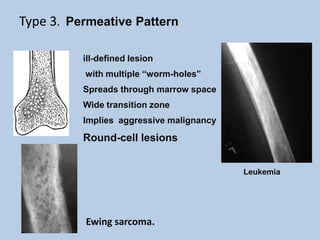
Type 3. Permeative Pattern

          ill-defined lesion
          with multiple “worm-holes”
          Spreads through marrow space
          Wide transition zone
          Implies aggressive malignancy

          Round-cell lesions


                                          Leukemia


          Ewing sarcoma.
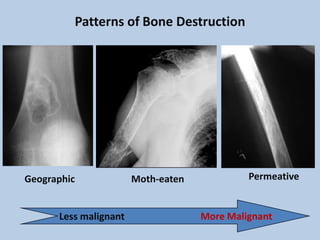
Patterns of Bone Destruction


Geographic             Moth-eaten            Permeative


      Less malignant                More Malignant
Is the Cortex Eroded?

Cortical erosion is hallmark of active, aggressive, or
malignant tumors.

High-grade malignant tumors may erode through cortex
with ineffective periosteal response to erosion

In general, low grade tumors will produce endosteal
erosion with orderly response; high grade tumors will
erode through the endosteal surface without adequate
response, increasing surface risk of fracture
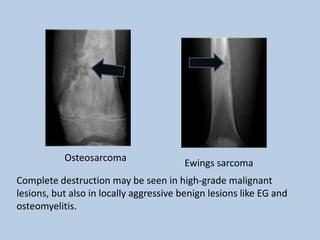
Osteosarcoma                 Ewings sarcoma
Complete destruction may be seen in high-grade malignant
lesions, but also in locally aggressive benign lesions like EG and
osteomyelitis.
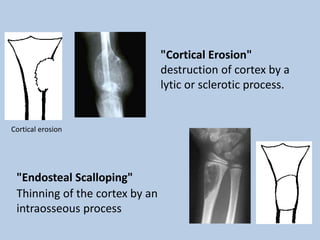
"Cortical Erosion"
                                destruction of cortex by a
                                lytic or sclerotic process.


Cortical erosion


 "Endosteal Scalloping"
 Thinning of the cortex by an
 intraosseous process
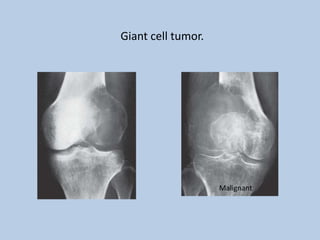
Giant cell tumor.


                    Malignant
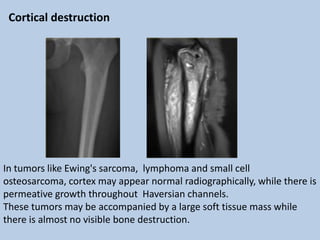
Cortical destruction


In tumors like Ewing's sarcoma, lymphoma and small cell
osteosarcoma, cortex may appear normal radiographically, while there is
permeative growth throughout Haversian channels.
These tumors may be accompanied by a large soft tissue mass while
there is almost no visible bone destruction.
Cortical Destruction

• The presence of cortical destruction is not a
  reliable indicator of whether the lesion is a
  malignant process or a benign process.

• Other radiographic findings must also be
  examined.
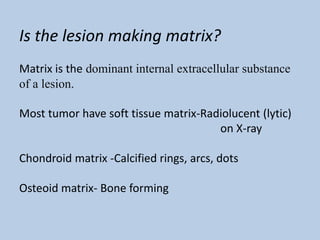
Is the lesion making matrix?
Matrix is the dominant internal extracellular substance
of a lesion.

Most tumor have soft tissue matrix-Radiolucent (lytic)
                                      on X-ray

Chondroid matrix -Calcified rings, arcs, dots

Osteoid matrix- Bone forming
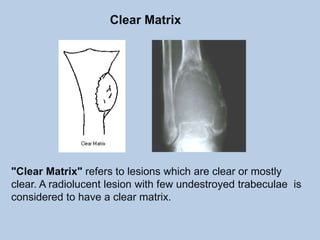
Clear Matrix


"Clear Matrix" refers to lesions which are clear or mostly
clear. A radiolucent lesion with few undestroyed trabeculae is
considered to have a clear matrix.
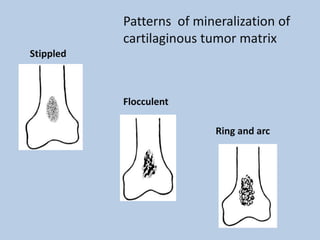
Patterns of mineralization of
           cartilaginous tumor matrix
Stippled


           Flocculent

                           Ring and arc
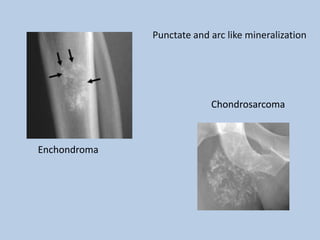
Punctate and arc like mineralization


                           Chondrosarcoma


Enchondroma
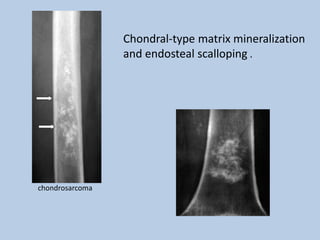
Chondral-type matrix mineralization
                 and endosteal scalloping .


chondrosarcoma
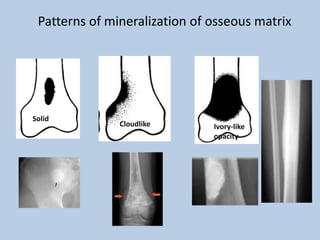
Patterns of mineralization of osseous matrix


Solid
               Cloudlike       Ivory-like
                               opacity
Let’s turn from
                         spectators
                          into
                          participants.

‘ What I hear, I forget ;
what I see, I remember ;
what I do, I understand. ’
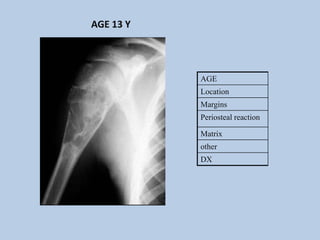
AGE 13 Y


           AGE
           Location
           Margins
           Periosteal reaction

           Matrix
           other
           DX
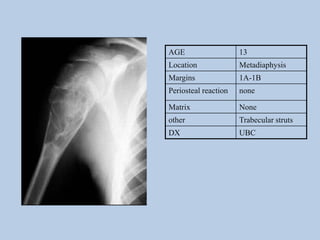
AGE                   13
Location              Metadiaphysis
Margins               1A-1B
Periosteal reaction   none

Matrix                None
other                 Trabecular struts
DX                    UBC
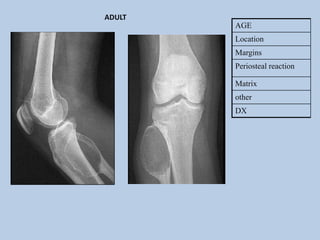
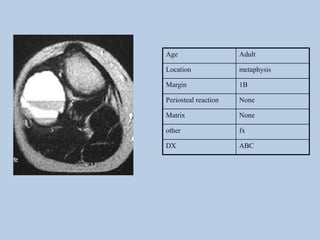
ADULT
        AGE
        Location
        Margins
        Periosteal reaction

        Matrix
        other
        DX
Age                   Adult

Location              metaphysis

Margin                1B

Periosteal reaction   None

Matrix                None

other                 fx

DX                    ABC
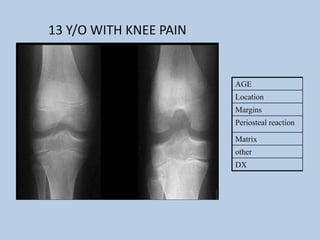
13 Y/O WITH KNEE PAIN


                        AGE
                        Location
                        Margins
                        Periosteal reaction

                        Matrix
                        other
                        DX
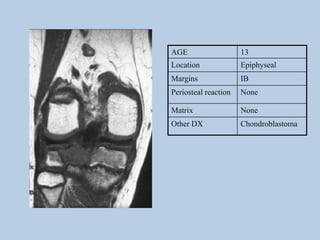
AGE                   13
Location              Epiphyseal
Margins               IB
Periosteal reaction   None

Matrix                None
Other DX              Chondroblastoma
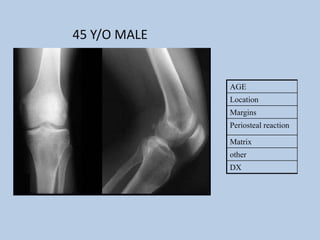
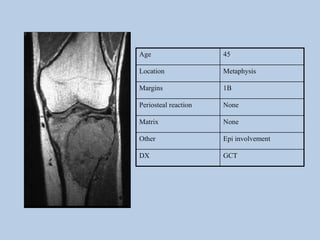
45 Y/O MALE


              AGE
              Location
              Margins
              Periosteal reaction

              Matrix
              other
              DX
Age                   45

Location              Metaphysis

Margins               1B

Periosteal reaction   None

Matrix                None

Other                 Epi involvement

DX                    GCT
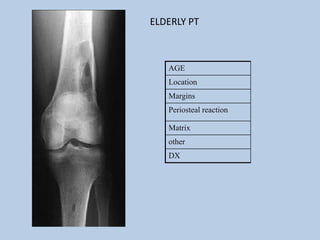
ELDERLY PT


   AGE
   Location
   Margins
   Periosteal reaction

   Matrix
   other
   DX
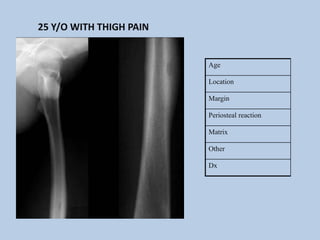
25 Y/O WITH THIGH PAIN


                         Age

                         Location

                         Margin

                         Periosteal reaction

                         Matrix

                         Other

                         Dx
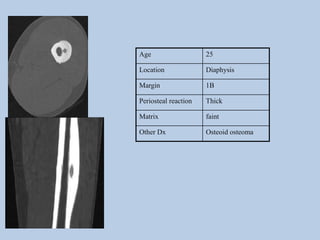
Age                   25

Location              Diaphysis

Margin                1B

Periosteal reaction   Thick

Matrix                faint

Other Dx              Osteoid osteoma
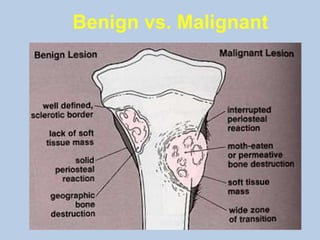
Benign vs. Malignant
Don’t Give Flash Diagnosis !!!!
• Think of the age of the patient.

• Think of where the abnormality is …. or isn’t.

• Think of the tissue categories of tumors.

• Think in terms of benign, benign aggressive or
  malignant.
Don’t ever look at
MRI or CT scan
Before plain X-rays
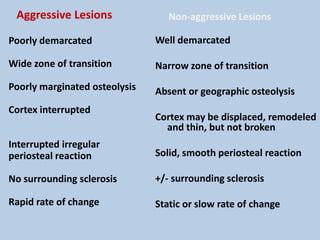
Aggressive Lesions               Non-aggressive Lesions

Poorly demarcated              Well demarcated

Wide zone of transition        Narrow zone of transition
Poorly marginated osteolysis   Absent or geographic osteolysis
Cortex interrupted
                               Cortex may be displaced, remodeled
                                 and thin, but not broken
Interrupted irregular
periosteal reaction            Solid, smooth periosteal reaction

No surrounding sclerosis       +/- surrounding sclerosis

Rapid rate of change           Static or slow rate of change

Bone tumors

  • 1.
    BONE TUMORS Basic DR BHUSHAN LAKHKAR
  • 2.
    Plain X rays SEVEN 1.Where is the lesion – what bone and what part of the bone 2. Age & size of the lesion? 3. What is the lesion doing to bone? 4. What is the bone doing in response? 5. Is the lesion making matrix? 6. Is the cortex eroded? 7. Is a soft tissue mass evident?
  • 3.
    How are bonetumours Like Real Estate ? LOCATION ! LOCATION ! LOCATION !
  • 4.
    LOCATION 1. In thetransverse plane: a) Central – Enchondroma b) Eccentric -GCT, osteosarcoma, chondromyxoid fibroma c) Cortical - Non-ossifying fibroma, osteoid osteoma d) Parosteal - Parosteal osteosarcoma, osteochondroma 2. In the longitudinal plane: Diaphyseal: Ewings, Osteoid Osteoma, Mets, Adamantinoma, Fibrous Dysplasia Epiphyseal: Chondroblastoma,GCT, Ganglion of Bone. Metaphyseal: Everything!!!!!!
  • 5.
    Characteristic Location Some tumorsalmost exclusively occur at specific sites Chondroblastoma - Epiphyses Giant Cell tumor - Epiphyses Simple bone cyst - Proximal humerus Adamantinoma - Tibia Chordoma - Sacrum Osteoblastoma - Posterior element of spine Chondrosarcoma - Pelvis
  • 6.
    Characteristic Locations Epiphysis Spine, posterior • Chondroblastoma • Osteoblastoma
  • 7.
    Tibia Sacrum, clivus Adamantinoma • Chordoma
  • 8.
    Epiphyses • Giant Cell tumor Proximal humerus • Simple bone cyst
  • 9.
    Age of thepatient • 20>…..Osteogenic Sarcoma, Ewings. simple bone cysts and chondroblastomas • 40……GCT, Chondrosarcoma, MFH, Lymphoma, Mets. • 60……Mets, Myeloma, Chondrosarcoma, MFH – Late Osteogenic, Fibrosarcoma.
  • 10.
    Size In general Thelarger the lesion the more likely it is to be aggressive or malignant (some exceptions i.e. fibrous dysplasia) The bigger the uglier
  • 11.
    What is thebone doing to the tumor ? Bone reacts in two ways -- either by removing some of itself or by creating more of itself. If the disorder is rapidly progressive, there may only be time for retreat (defense). If the process is slow growing, then the bone may have time to mount an offense and try to form a sclerotic area around the offender.
  • 12.
    Periostitis Aperiosteal reaction will occur whenever the periosteum is irritated. This may occur due to a malignant tumor, benign tumor, infection or trauma. Two types Benign or Aggressive. • Benign Aggressive or malignant – None – Lamellated or onion peel – Solid – Sunburst – Codman’s triangle
  • 13.
    Benign Solid Aggressive Lamellated V . Aggressive Spiculated Codman's
  • 14.
    Solid Periosteal Response Slow-growing tumors provoke focal cortical thickening A continuous layer of new bone that attaches to outer cortical surface Related to a slow form of irritation osteoid osteoma
  • 15.
    Unilamellated periosteal reaction Singlelayer of reactive periosteum. … thick unilamellated periosteal reaction. Smooth and continuous Hypertrophic osteoarthropathy
  • 16.
    Aggressive Periostitis Layered, onion-skin, lamellated • Alternating layers of opaque and lucent densities • Can be seen with slow growing and aggressive tumors and infections appearance of aggressive growth spurt. periostitis in Ewing’s sarcoma
  • 17.
    Spiculated periosteal reaction. Osteosarcoma Perpendicular, brushed whiskers, hair-on-end, Fine linear spiculations of new bone oriented perpendicular to the cortex or radiating from a point source indicative of very aggressive bone tumors
  • 18.
    “sunburst” This is avery aggressive process Bone is formed in a disorganized fashion Process may destroy spicules of bone as they are being formed
  • 19.
    Codman's triangle Too fast growth for periosteum to respond only the edges of raised periosteum will ossify forming a small angle with the surface of bone. seen in malignant bone tumors and in rapidly growing lesions .. aneurysmal bone cyst, subperiosteal hematoma.
  • 20.
    Periosteal Reactions Solid onion-peel Sunburst Codman’s triangle Less malignant More malignant
  • 21.
    Zone of Transition Mostreliable indicator for benign versus malignant lesions. “Narrow”, if it is so well defined that it can be drawn with a fine-point pen. “Wide”, if it is imperceptible and can not be drawn at all. An aggressive process should be considered, although not necessarily a malignant lesion.
  • 22.
  • 23.
    Three Patterns ofBone Destruction • Geographic Pattern • Moth-Eaten Pattern • Permeative Pattern Result from the degree of aggressiveness of the lesion
  • 24.
    Type 1 a Geographic Lesion. Well-defined lucency with sclerotic rim. Intra osseous lipoma with a sclerotic rim .
  • 25.
    Type 1 b Geographic Lesion well-defined lucent lesion without sclerotic rim. Well-defined geographic lytic focus without sclerotic rim , Endosteal scalloping seen. myeloma
  • 26.
    Type 1 c Geographic Lesion ill-defined lytic lesion Large ill-defined lytic lesion , Codman’s triangle Periosteal interruption, Tumor-induced new osteosarcoma bone . .
  • 27.
    Margins: 1A, 1B,1C IA: GEOGRAPHIC DESTRUCTION WELL – DEFINED WITH SCLEROSIS IN MARGIN IB: GEOGRAPHIC DESTRUCTION WELL – DEFINED BUT NO SCLEROSIS IN MARGIN IC : GEOGRAPHIC DESTRUCTION WITH ILL DEFINED MARGIN increasing aggressiveness
  • 28.
    Type 2 Moth-eatenAppearance Areas of destruction with ragged borders Implies more rapid growth Probably a malignancy osteosarcoma
  • 29.
    Type 3. PermeativePattern ill-defined lesion with multiple “worm-holes” Spreads through marrow space Wide transition zone Implies aggressive malignancy Round-cell lesions Leukemia Ewing sarcoma.
  • 30.
    Patterns of BoneDestruction Geographic Moth-eaten Permeative Less malignant More Malignant
  • 31.
    Is the CortexEroded? Cortical erosion is hallmark of active, aggressive, or malignant tumors. High-grade malignant tumors may erode through cortex with ineffective periosteal response to erosion In general, low grade tumors will produce endosteal erosion with orderly response; high grade tumors will erode through the endosteal surface without adequate response, increasing surface risk of fracture
  • 32.
    Osteosarcoma Ewings sarcoma Complete destruction may be seen in high-grade malignant lesions, but also in locally aggressive benign lesions like EG and osteomyelitis.
  • 33.
    "Cortical Erosion" destruction of cortex by a lytic or sclerotic process. Cortical erosion "Endosteal Scalloping" Thinning of the cortex by an intraosseous process
  • 34.
  • 35.
    Cortical destruction In tumorslike Ewing's sarcoma, lymphoma and small cell osteosarcoma, cortex may appear normal radiographically, while there is permeative growth throughout Haversian channels. These tumors may be accompanied by a large soft tissue mass while there is almost no visible bone destruction.
  • 36.
    Cortical Destruction • Thepresence of cortical destruction is not a reliable indicator of whether the lesion is a malignant process or a benign process. • Other radiographic findings must also be examined.
  • 37.
    Is the lesionmaking matrix? Matrix is the dominant internal extracellular substance of a lesion. Most tumor have soft tissue matrix-Radiolucent (lytic) on X-ray Chondroid matrix -Calcified rings, arcs, dots Osteoid matrix- Bone forming
  • 38.
    Clear Matrix "Clear Matrix"refers to lesions which are clear or mostly clear. A radiolucent lesion with few undestroyed trabeculae is considered to have a clear matrix.
  • 39.
    Patterns of mineralizationof cartilaginous tumor matrix Stippled Flocculent Ring and arc
  • 40.
    Punctate and arclike mineralization Chondrosarcoma Enchondroma
  • 41.
    Chondral-type matrix mineralization and endosteal scalloping . chondrosarcoma
  • 42.
    Patterns of mineralizationof osseous matrix Solid Cloudlike Ivory-like opacity
  • 43.
    Let’s turn from spectators into participants. ‘ What I hear, I forget ; what I see, I remember ; what I do, I understand. ’
  • 44.
    AGE 13 Y AGE Location Margins Periosteal reaction Matrix other DX
  • 45.
    AGE 13 Location Metadiaphysis Margins 1A-1B Periosteal reaction none Matrix None other Trabecular struts DX UBC
  • 46.
    ADULT AGE Location Margins Periosteal reaction Matrix other DX
  • 47.
    Age Adult Location metaphysis Margin 1B Periosteal reaction None Matrix None other fx DX ABC
  • 48.
    13 Y/O WITHKNEE PAIN AGE Location Margins Periosteal reaction Matrix other DX
  • 49.
    AGE 13 Location Epiphyseal Margins IB Periosteal reaction None Matrix None Other DX Chondroblastoma
  • 50.
    45 Y/O MALE AGE Location Margins Periosteal reaction Matrix other DX
  • 51.
    Age 45 Location Metaphysis Margins 1B Periosteal reaction None Matrix None Other Epi involvement DX GCT
  • 52.
    ELDERLY PT AGE Location Margins Periosteal reaction Matrix other DX
  • 55.
    25 Y/O WITHTHIGH PAIN Age Location Margin Periosteal reaction Matrix Other Dx
  • 56.
    Age 25 Location Diaphysis Margin 1B Periosteal reaction Thick Matrix faint Other Dx Osteoid osteoma
  • 57.
  • 58.
    Don’t Give FlashDiagnosis !!!! • Think of the age of the patient. • Think of where the abnormality is …. or isn’t. • Think of the tissue categories of tumors. • Think in terms of benign, benign aggressive or malignant.
  • 59.
    Don’t ever lookat MRI or CT scan Before plain X-rays
  • 62.
    Aggressive Lesions Non-aggressive Lesions Poorly demarcated Well demarcated Wide zone of transition Narrow zone of transition Poorly marginated osteolysis Absent or geographic osteolysis Cortex interrupted Cortex may be displaced, remodeled and thin, but not broken Interrupted irregular periosteal reaction Solid, smooth periosteal reaction No surrounding sclerosis +/- surrounding sclerosis Rapid rate of change Static or slow rate of change