SMALL INTESTINE
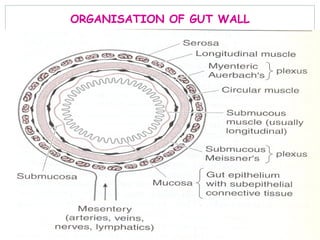
ORGANISATION OF GUT WALL
INTRODUCTION
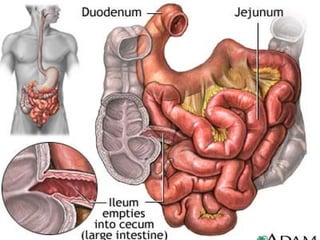
 Duodenum – 25 cm


 Jejunum and Ileum – 260 cm


 Duodenum        I Part
                II Part
              III Part

 Second part of duodenum receives bile
  and pancreatic secretions
SMALL INTESTINE

 It is the major part of digestion and
 absorption of carbohydrates, proteins and
 fats.

 It is presented with 9 litres of fluid/day (2
 litres - dietary sources and 7 litres - GI
 secretions).

 1-2 litres passes onto the colon.
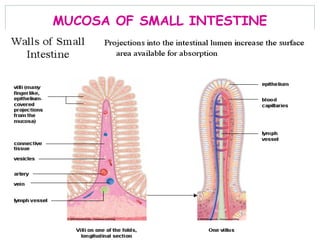
MUCOSA OF SMALL INTESTINE
STRUCTURE OF SMALL INTESTINE

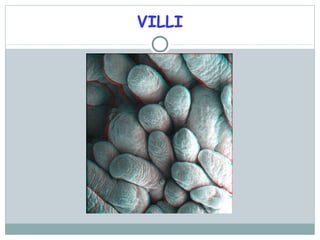
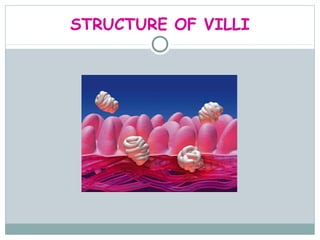
• Finger like projections of 1mm height – Villi
 (20- 40 villi/mm2)
• Covered by columnar epithelium which has
 microvilli (1 µM in length and 0.1 µM in
 width).
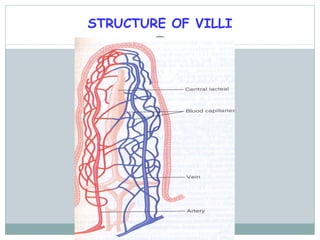
• Each villus has a central lymphatic vessels –
 lacteal.
• Villus also has nerve net & capillaries.
INTESTINAL GLANDS
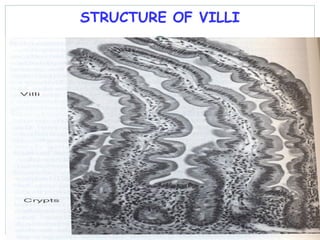
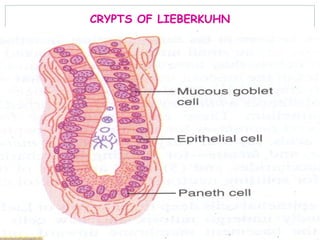
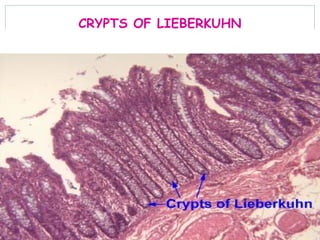
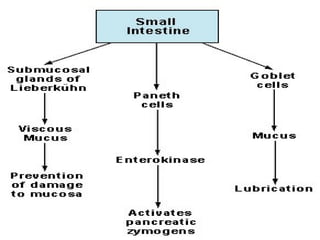
Between villi are tubular glands - Crypts of
 Lieberkuhn.


Duodenum in addition has coiled tubuloacinar
 glands- Brunner’s gland.


Epithelium of crypts are mitotic, move upwards,
 and shed off.
STRUCTURE OF VILLI
VILLI
ENTEROCYTE
STRUCTURE OF VILLI
STRUCTURE OF VILLI
CRYPTS OF LIEBERKUHN
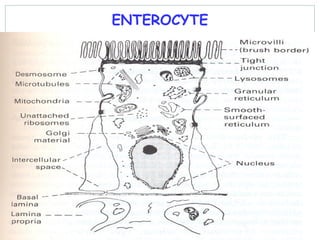
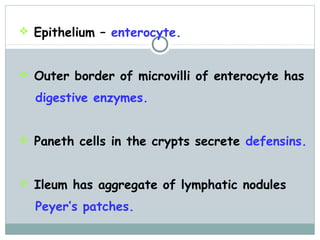
   Epithelium – enterocyte.


 Outer border of microvilli of enterocyte has

    digestive enzymes.


 Paneth cells in the crypts secrete defensins.


 Ileum has aggregate of lymphatic nodules

    Peyer’s patches.
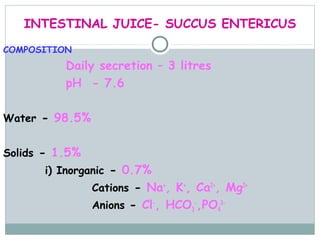
INTESTINAL JUICE- SUCCUS ENTERICUS

COMPOSITION
          Daily secretion – 3 litres
          pH - 7.6

Water - 98.5%


Solids - 1.5%
      i) Inorganic - 0.7%
                Cations - Na+, K+, Ca2+, Mg2+
                Anions - Cl-, HCO3-,PO43-
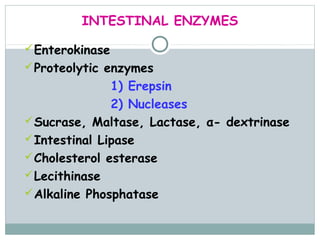
INTESTINAL ENZYMES

 Enterokinase
 Proteolytic enzymes
               1) Erepsin
               2) Nucleases
 Sucrase, Maltase, Lactase, α- dextrinase
 Intestinal Lipase
 Cholesterol esterase
 Lecithinase
 Alkaline Phosphatase
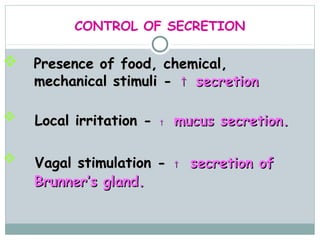
CONTROL OF SECRETION

   Presence of food, chemical,
    mechanical stimuli - ↑ secretion

   Local irritation -   ↑   mucus secretion.

   Vagal stimulation -      ↑   secretion of
    Brunner’s gland.
MOVEMENTS OF SMALL INTESTINE
MIGRATING MOTOR COMPLEX

The periodic intense electrical activity seen
 in the empty stomach or small intestine that
 last for 3-6 min and spread from stomach
 to ileum is called MMC.

It is cyclical and repeated every 90 min.
SMALL INTESTINE

Inner circular (thicker)

Outer longitudinal (thinner)
TYPES OF MOVEMENTS
Rhythmic segmentation contractions (Mixing
contractions)

Pendular movements

Peristalsis

Movements of villi
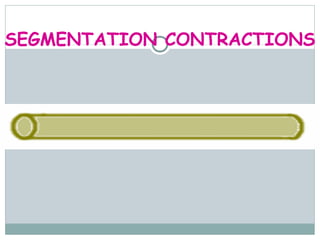
1.Segmentation contractions

A loop of intestine is divided into a number
of segments of nearly equal size.

As one set of contraction relaxes, a new set
begins but the contraction occur at new
points between the previous contractions.

It helps to chop the chyme 2 – 3 times per
minute.
SEGMENTATION CONTRACTIONS
Control of segmental contractions

 The pacemaker for these movements - near
 ampulla of Vater.

 The interstitial cells of Cajal (present
 between LM and CM) initiates BER which
 decides the frequency of segmentation
 contractions.
FREQUENCY

Frequency α frequency of slow waves.


Strength of contraction α frequency of spikes.


This frequency is controlled by the amplitude of
 the slow waves.

+ Gastrin, CCK – PZ and motilin.
 - Secretin and glucagon.
12/min – duodenum and proximal jejunum.

8 - 9/min – terminal ileum.

Vagus N ↑ and sympathetic nerve ↓ the
movements.
FUNCTIONS OF SEGMENTATION CONTRACTIONS

    Agitation of intestinal contents
 It tends to increase the degree of subdivision of food
  particles.


 Mixing of food with intestinal secretions.


 Changing the layers of food in contact with mucosa,
 facilitating absorption.
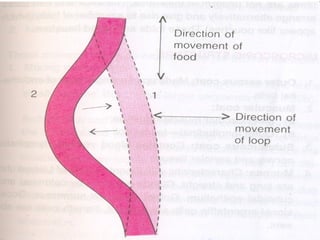
2. Pendular movements

These are side to side swaying movements
accompanied by lengthening and shortening of the
intestine.

Function: similar to segmentation contractions.
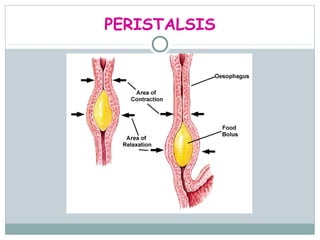
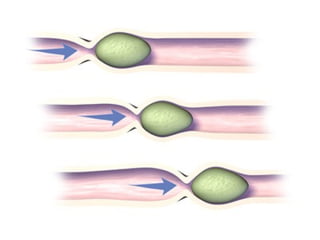
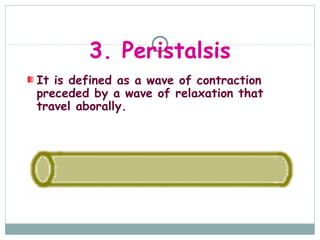
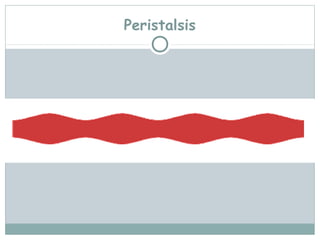
3. Peristalsis
It is defined as a wave of contraction
preceded by a wave of relaxation that
travel aborally.
PERISTALSIS
PERISTALSIS
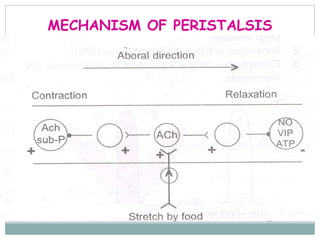
Peristalsis
It is neurogenic and depends on the
myenteric plexus.


They move analward at a velocity of 0.5 –
2cm / sec.


They are very weak and die out at a distance
of 3 – 5 cm.


Net movement – 1cm / min.
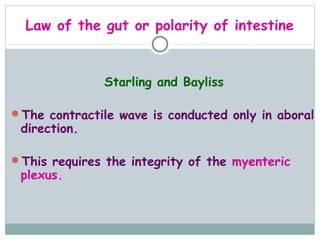
Law of the gut or polarity of intestine


               Starling and Bayliss

The contractile wave is conducted only in aboral
 direction.

This requires the integrity of the myenteric
 plexus.
MECHANISM OF PERISTALSIS
Factors that influence peristalsis
It is increased after a meal. This is caused by
gastro-enteric reflex.

Gastrin, CCK, insulin, and serotonin enhance GI
motility.

Secretin and glucagon inhibit small intestinal
motility.
Functions of peristalsis
Progression of the chyme towards the ileo-
caecal valve.

Spreading of the chyme along the intestine .
PERISTALTIC RUSH
Powerful irritation of the intestinal mucosa -
 relieving the SI from irritating chyme.


Initiated by physical or chemical irritation.

Powerful and rapid peristalsis.

Sweeps the contents into colon.

Cause of infective diarrhea.
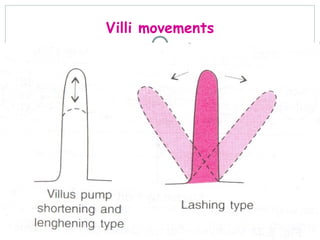
4. Movements of villi

They are initiated by local nervous reflexes
that occur in response to chyme.

The muscularis mucosa extends into each
villus as a filament of the smooth muscle
fiber.
Lashing movements
Villus pump

Function: These movements accelerate the
flow of blood and lymph and increase the
absorption.
Villi movements
DISORDERS OF SMALL INTESTINE
CAUSES
1. Abnormal digestion of foods –
   Pancreatitis

2. Malabsorption Syndrome
   Causes
       Resection of small intestine
       Gastro-colic fistula
       Sprue
       Coeliac disease
APPLIED PHYSIOLOGY

1. Adynamic ileus or paralytic ileus

   Injury either due to surgery or due to
   infection.

   It reappears in the small intestine within 6
   – 8 hours.


2. Mechanical obstruction of small intestine
Thank you

Small intestine physiology

  • 1.
  • 2.
  • 3.
    INTRODUCTION  Duodenum –25 cm  Jejunum and Ileum – 260 cm  Duodenum I Part II Part III Part  Second part of duodenum receives bile and pancreatic secretions
  • 4.
    SMALL INTESTINE  Itis the major part of digestion and absorption of carbohydrates, proteins and fats.  It is presented with 9 litres of fluid/day (2 litres - dietary sources and 7 litres - GI secretions).  1-2 litres passes onto the colon.
  • 5.
    MUCOSA OF SMALLINTESTINE
  • 6.
    STRUCTURE OF SMALLINTESTINE • Finger like projections of 1mm height – Villi (20- 40 villi/mm2) • Covered by columnar epithelium which has microvilli (1 µM in length and 0.1 µM in width). • Each villus has a central lymphatic vessels – lacteal. • Villus also has nerve net & capillaries.
  • 7.
    INTESTINAL GLANDS Between villiare tubular glands - Crypts of Lieberkuhn. Duodenum in addition has coiled tubuloacinar glands- Brunner’s gland. Epithelium of crypts are mitotic, move upwards, and shed off.
  • 8.
  • 9.
  • 10.
  • 11.
  • 12.
  • 13.
  • 14.
  • 15.
    Epithelium – enterocyte.  Outer border of microvilli of enterocyte has digestive enzymes.  Paneth cells in the crypts secrete defensins.  Ileum has aggregate of lymphatic nodules Peyer’s patches.
  • 17.
    INTESTINAL JUICE- SUCCUSENTERICUS COMPOSITION Daily secretion – 3 litres pH - 7.6 Water - 98.5% Solids - 1.5% i) Inorganic - 0.7% Cations - Na+, K+, Ca2+, Mg2+ Anions - Cl-, HCO3-,PO43-
  • 18.
    INTESTINAL ENZYMES  Enterokinase Proteolytic enzymes 1) Erepsin 2) Nucleases  Sucrase, Maltase, Lactase, α- dextrinase  Intestinal Lipase  Cholesterol esterase  Lecithinase  Alkaline Phosphatase
  • 19.
    CONTROL OF SECRETION  Presence of food, chemical, mechanical stimuli - ↑ secretion  Local irritation - ↑ mucus secretion.  Vagal stimulation - ↑ secretion of Brunner’s gland.
  • 20.
  • 21.
    MIGRATING MOTOR COMPLEX Theperiodic intense electrical activity seen in the empty stomach or small intestine that last for 3-6 min and spread from stomach to ileum is called MMC. It is cyclical and repeated every 90 min.
  • 22.
    SMALL INTESTINE Inner circular(thicker) Outer longitudinal (thinner)
  • 24.
    TYPES OF MOVEMENTS Rhythmicsegmentation contractions (Mixing contractions) Pendular movements Peristalsis Movements of villi
  • 25.
    1.Segmentation contractions A loopof intestine is divided into a number of segments of nearly equal size. As one set of contraction relaxes, a new set begins but the contraction occur at new points between the previous contractions. It helps to chop the chyme 2 – 3 times per minute.
  • 26.
  • 27.
    Control of segmentalcontractions The pacemaker for these movements - near ampulla of Vater. The interstitial cells of Cajal (present between LM and CM) initiates BER which decides the frequency of segmentation contractions.
  • 28.
    FREQUENCY Frequency α frequencyof slow waves. Strength of contraction α frequency of spikes. This frequency is controlled by the amplitude of the slow waves. + Gastrin, CCK – PZ and motilin. - Secretin and glucagon.
  • 29.
    12/min – duodenumand proximal jejunum. 8 - 9/min – terminal ileum. Vagus N ↑ and sympathetic nerve ↓ the movements.
  • 30.
    FUNCTIONS OF SEGMENTATIONCONTRACTIONS Agitation of intestinal contents  It tends to increase the degree of subdivision of food particles.  Mixing of food with intestinal secretions.  Changing the layers of food in contact with mucosa, facilitating absorption.
  • 31.
    2. Pendular movements Theseare side to side swaying movements accompanied by lengthening and shortening of the intestine. Function: similar to segmentation contractions.
  • 33.
    3. Peristalsis It isdefined as a wave of contraction preceded by a wave of relaxation that travel aborally.
  • 34.
  • 35.
  • 37.
  • 38.
    It is neurogenicand depends on the myenteric plexus. They move analward at a velocity of 0.5 – 2cm / sec. They are very weak and die out at a distance of 3 – 5 cm. Net movement – 1cm / min.
  • 39.
    Law of thegut or polarity of intestine Starling and Bayliss The contractile wave is conducted only in aboral direction. This requires the integrity of the myenteric plexus.
  • 40.
  • 41.
    Factors that influenceperistalsis It is increased after a meal. This is caused by gastro-enteric reflex. Gastrin, CCK, insulin, and serotonin enhance GI motility. Secretin and glucagon inhibit small intestinal motility.
  • 42.
    Functions of peristalsis Progressionof the chyme towards the ileo- caecal valve. Spreading of the chyme along the intestine .
  • 43.
    PERISTALTIC RUSH Powerful irritationof the intestinal mucosa - relieving the SI from irritating chyme. Initiated by physical or chemical irritation. Powerful and rapid peristalsis. Sweeps the contents into colon. Cause of infective diarrhea.
  • 44.
    4. Movements ofvilli They are initiated by local nervous reflexes that occur in response to chyme. The muscularis mucosa extends into each villus as a filament of the smooth muscle fiber.
  • 45.
    Lashing movements Villus pump Function:These movements accelerate the flow of blood and lymph and increase the absorption.
  • 46.
  • 47.
    DISORDERS OF SMALLINTESTINE CAUSES 1. Abnormal digestion of foods – Pancreatitis 2. Malabsorption Syndrome Causes Resection of small intestine Gastro-colic fistula Sprue Coeliac disease
  • 48.
    APPLIED PHYSIOLOGY 1. Adynamicileus or paralytic ileus Injury either due to surgery or due to infection. It reappears in the small intestine within 6 – 8 hours. 2. Mechanical obstruction of small intestine
  • 49.