Module 4
Fundamental Concepts of
Data Communications
Chapter 22
Electronic Communications Sytems , Fifth Editon
By: Wayne Tomasi
ECE @Saint Louis University, Baguio City 1
Prepared by: Engr. Jeffrey Des B. Binwag
Data Communication Codes
• Baudot Code
• ASCII (American Standard Code for
Information Interchange)
• EBCDIC (Extended Binary Coded Decimal
Interchange Code)
• Bar Codes
– Code 39
– UPC (Universal Product Code)
ECE @Saint Louis University, Baguio City 2
Data Communication Codes
• Categories:
–Alphanumeric Characters
–Graphic Control Characters
–Data Link Control Characters
ECE @Saint Louis University, Baguio City 3
Error Coding
• Error Detection. Involves monitoring data transmission
and determining when errors have occurred.
– Redundancy Checking: VRC and/or LRC, CRC,
Checksum
– Hamming Code
• Error Correction. Involves the correction of messages
that have been determined by error detection codes to
contain errors at the receiver.
– Retransmission
– Forward Error Correction: VRC/LRC, Hamming Code
– Symbol Substitution
ECE @Saint Louis University, Baguio City 4
Character Synchronization
• Character Synchronization. Involves identifying the
beginning and end of a character within a message or an
extended bit sequence.
– Asynchronous Serial Data. Also known as start-stop
transmission because each data character is framed between
start and stop bits so that time gaps in between characters do
not present a problem.
– Synchronous Serial Data. Generally involves transporting
serial data at relatively high speeds in group of characters
called blocks or frames with no lapses in between characters.
A unique synchronization character is transmitted at the
beginning of each message block as opposed to providing start
and stop bits per character.
ECE @Saint Louis University, Baguio City 5
Bit Synchronization
• Bit Synchronization. A process that ensures the
transmission and reception of the same number of
bits without errors and in the correct order without
considering the relation of each bit to adjacent bits
as part of a character or message. Such procedures
include correct sampling as well as proper start-bit
verification.
ECE @Saint Louis University, Baguio City 6
Data Communications Hardware
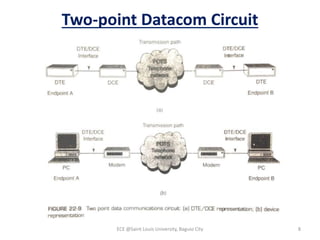
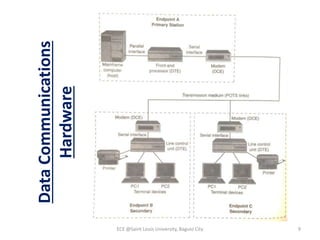
All endpoints in a data communication network have
three fundamental components namely:
• Data Terminal Equipment (DTE). Any binary digital
device that generates, transmits, receives, and/or
interprets data messages. (i.e.: LCU, STACO, ACIA, UART,
USRT)
• Data Communication Equipment (DCE). These are
equipment that interfaces data terminal equipment to
the transmission channel. (i.e.: MODEM)
• Serial Interface. A communication line that ensures the
orderly flow of data between a DTE and DCE. (i.e.: USB,
RS 232)
ECE @Saint Louis University, Baguio City 7
Two-point Datacom Circuit
ECE @Saint Louis University, Baguio City 8
DataCommunications
Hardware
ECE @Saint Louis University, Baguio City 9
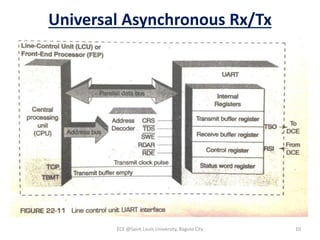
Universal Asynchronous Rx/Tx
ECE @Saint Louis University, Baguio City 10
UART FUNCTIONS
• Parallel-to-serial at the Tx and Serial-
to-parallel conversion at the Rx
• Error detection
• Framing
• Formatting
• Status monitoring
• Voltage level conversion/matching
• Bit and character synchronization
ECE @Saint Louis University, Baguio City 11
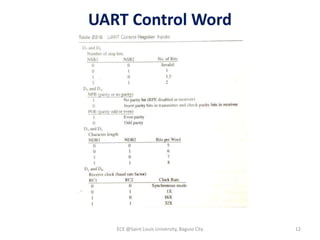
UART Control Word
ECE @Saint Louis University, Baguio City 12
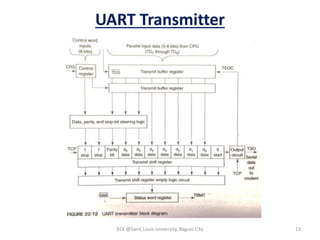
UART Transmitter
ECE @Saint Louis University, Baguio City 13
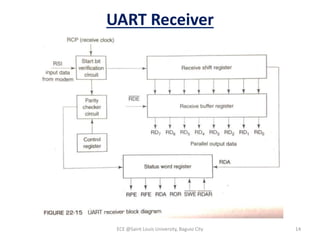
UART Receiver
ECE @Saint Louis University, Baguio City 14
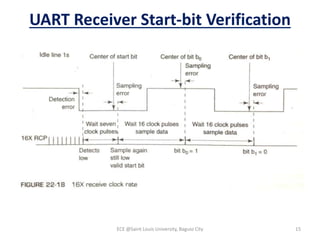
UART Receiver Start-bit Verification
ECE @Saint Louis University, Baguio City 15
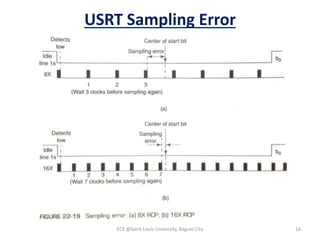
USRT Sampling Error
ECE @Saint Louis University, Baguio City 16
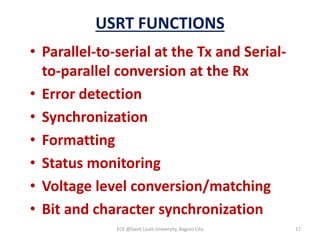
USRT FUNCTIONS
• Parallel-to-serial at the Tx and Serial-
to-parallel conversion at the Rx
• Error detection
• Synchronization
• Formatting
• Status monitoring
• Voltage level conversion/matching
• Bit and character synchronization
ECE @Saint Louis University, Baguio City 17
QUIZ 2 COVERAGE
All Discussions in the book by Tomasi covering the following topics:
• Datacom Circuits
• Serial and Parallel Data Transmission
• Datacom Circuit Arrangements
• Datacom Networks
– Components, Functions, and Features
– Models
– Topologies
– Classifications
• Datacom Codes
• Error Coding
• Character and Bit Synchronization
• Datacom Hardware
• Datacom Circuits
• UART and USRT
ECE @Saint Louis University, Baguio City 18

Datacom module 4: Fundamentals of Data Communication

  • 1.
    Module 4 Fundamental Conceptsof Data Communications Chapter 22 Electronic Communications Sytems , Fifth Editon By: Wayne Tomasi ECE @Saint Louis University, Baguio City 1 Prepared by: Engr. Jeffrey Des B. Binwag
  • 2.
    Data Communication Codes •Baudot Code • ASCII (American Standard Code for Information Interchange) • EBCDIC (Extended Binary Coded Decimal Interchange Code) • Bar Codes – Code 39 – UPC (Universal Product Code) ECE @Saint Louis University, Baguio City 2
  • 3.
    Data Communication Codes •Categories: –Alphanumeric Characters –Graphic Control Characters –Data Link Control Characters ECE @Saint Louis University, Baguio City 3
  • 4.
    Error Coding • ErrorDetection. Involves monitoring data transmission and determining when errors have occurred. – Redundancy Checking: VRC and/or LRC, CRC, Checksum – Hamming Code • Error Correction. Involves the correction of messages that have been determined by error detection codes to contain errors at the receiver. – Retransmission – Forward Error Correction: VRC/LRC, Hamming Code – Symbol Substitution ECE @Saint Louis University, Baguio City 4
  • 5.
    Character Synchronization • CharacterSynchronization. Involves identifying the beginning and end of a character within a message or an extended bit sequence. – Asynchronous Serial Data. Also known as start-stop transmission because each data character is framed between start and stop bits so that time gaps in between characters do not present a problem. – Synchronous Serial Data. Generally involves transporting serial data at relatively high speeds in group of characters called blocks or frames with no lapses in between characters. A unique synchronization character is transmitted at the beginning of each message block as opposed to providing start and stop bits per character. ECE @Saint Louis University, Baguio City 5
  • 6.
    Bit Synchronization • BitSynchronization. A process that ensures the transmission and reception of the same number of bits without errors and in the correct order without considering the relation of each bit to adjacent bits as part of a character or message. Such procedures include correct sampling as well as proper start-bit verification. ECE @Saint Louis University, Baguio City 6
  • 7.
    Data Communications Hardware Allendpoints in a data communication network have three fundamental components namely: • Data Terminal Equipment (DTE). Any binary digital device that generates, transmits, receives, and/or interprets data messages. (i.e.: LCU, STACO, ACIA, UART, USRT) • Data Communication Equipment (DCE). These are equipment that interfaces data terminal equipment to the transmission channel. (i.e.: MODEM) • Serial Interface. A communication line that ensures the orderly flow of data between a DTE and DCE. (i.e.: USB, RS 232) ECE @Saint Louis University, Baguio City 7
  • 8.
    Two-point Datacom Circuit ECE@Saint Louis University, Baguio City 8
  • 9.
  • 10.
    Universal Asynchronous Rx/Tx ECE@Saint Louis University, Baguio City 10
  • 11.
    UART FUNCTIONS • Parallel-to-serialat the Tx and Serial- to-parallel conversion at the Rx • Error detection • Framing • Formatting • Status monitoring • Voltage level conversion/matching • Bit and character synchronization ECE @Saint Louis University, Baguio City 11
  • 12.
    UART Control Word ECE@Saint Louis University, Baguio City 12
  • 13.
    UART Transmitter ECE @SaintLouis University, Baguio City 13
  • 14.
    UART Receiver ECE @SaintLouis University, Baguio City 14
  • 15.
    UART Receiver Start-bitVerification ECE @Saint Louis University, Baguio City 15
  • 16.
    USRT Sampling Error ECE@Saint Louis University, Baguio City 16
  • 17.
    USRT FUNCTIONS • Parallel-to-serialat the Tx and Serial- to-parallel conversion at the Rx • Error detection • Synchronization • Formatting • Status monitoring • Voltage level conversion/matching • Bit and character synchronization ECE @Saint Louis University, Baguio City 17
  • 18.
    QUIZ 2 COVERAGE AllDiscussions in the book by Tomasi covering the following topics: • Datacom Circuits • Serial and Parallel Data Transmission • Datacom Circuit Arrangements • Datacom Networks – Components, Functions, and Features – Models – Topologies – Classifications • Datacom Codes • Error Coding • Character and Bit Synchronization • Datacom Hardware • Datacom Circuits • UART and USRT ECE @Saint Louis University, Baguio City 18