HENRY MOORE

NO ONE EVER KNOWS
WHAT EACH DAY IS GOING
TO BRING . THE IMPORTANT
THING IS TO BE OPEN AND
READY FOR IT.
UNIVERSITY FOR
DEVELOPMENT
   STUDIES
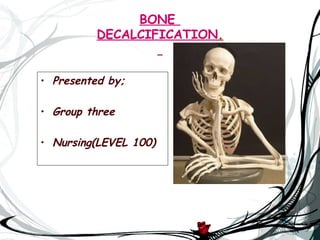
BONE
          DECALCIFICATION.


• Presented by;

• Group three

• Nursing(LEVEL 100)
Calcium ions found in the bones are responsible
for its rigid posture and without it, bones may be
flexible and most of time unable to carry their
body weight. Diseases such as osteomalacia and
rickets are as a result of lack of calcium in the
bones of those areas.
De-calcification of bones as our topic is about the
removal of these calcium from the bones. As
such, we are going to look at the following about
the topic:
•The definition of decalcification of bones
•The purpose of decalcification of bones
•The principle of bone decalcification
•The method of decalcification of bones
How to test for the completion of decalcification
INTRODUCTION


            Decalcification
Loss of calcium salts from a bone or tooth.
                             OR
 The process of removing calcareous matter.


        Bone decalcification
   Removal of calcium ions from the bone
through histological process thereby making
the bone flexible and easy for pathological
investigation.
PURPOSE OF BONE DECALCIFICATION


• The purpose is to make the bone flexible
  and easy for pathological investigation.
  This is necessary in order to obtain soft
  sections of the bone using the microtome

• Failure to decalcification results in torn,
  ragged sections and damage to the
  cutting edge of the microtome knife
PRINCIPLE OF DECALCIFICATION


• Insoluble calcium salt are converted into
  soluble calcium salts by the action of
  decalcifying agent so that the tissue
  become soft.
• Chelating agent binds to calcium ions
  present in the bone and decalcification is
  carried out.
Methods of decalcification

• Traditional method

• Acid decalcifying agents.

• Ion exchange resins with acid and
  decalcifying fluids.

• Electrolytic decalcification.

• Chelating agents.
TRADITIONAL METHOD


• There is a traditional method of handling hard
  tissues such as bones ,but it posses problems to
  both pathologists and histotechnologists.

• This is because ,it involves a lot of cutting of the
  tissue and keeping them for long periods in
  decalcifying solutions and this makes it difficult to
  get the cellular details intact.
Acid decalcifying agent
 • Acids are further divided into two
   namely : weak acids and strong
   acids.

 • Weak ( Picric, Acetic and Formic
   acid)

 • Strong (Nitric and Hydrochloric
   acid)
Nitric acid

                 MEHTOD
Thin slices of fixed tissue are placed in
  a freshly prepared 5-10% solution of
  nitric acid in distilled water.


Decalcification through this should not
  extend beyond 48 hours.


Formalin is added to nitric acid to
  protect the tissue against maceration
  and swelling.
Formic acid

• Formic acid is widely used as a
  decalcifying agent.

• For routine 10% of formic acid in distilled
  water is recommended and higher
  concentration gives more rapid
  decalcification.

• A large volume of fluid is used and
  renewed every 48 hours.
Ion exchange resins with acid
             decalcifying fluids
 It is an advanced system that quickly
  remove calcium from bone while
  leaving superior cellular details intact.


     Electrolytic Decalcification
It is the speedier decalcification without
    damage to cytological features and
    staining.
Drawback:
Heat produced in the process may cause
    the charring of specimen in the process
Chelating Agents
• EDTA is a chelating agent, it is a white
  crystalline powder soluble in distilled
  water to about 20%.

• As a decalcifying agent it combines
  with calcium ions to form soluble, non
  ionized compounds.

• The volume of solution for decalcifying
  should be 150 times that of the tissue.

• The solution should be renewed every
  5 to 7 days during decalcification.
Advantages of EDTA


• Deposits of iron and other metals may also
  be removed by EDTA.

• Tissue is not hardened after decalcification.

• It can be good for Bone ,Teeth and any
  calcified tissue.

• This is also the preferred solution for
  decalcifying bone material for transmission
  electron microscopy .
Test for completion of Decalcification
   There are three methods for determining
     the completion of progress of
     decalcification.


    By X-ray examination.

    By Ammonia method(chemical method).

    By Physical method
X-ray Examination


• The most reliable method for
  determining decalcification.

• But as this facility is not present
  in all the laboratories
Ammonia Method

• In this method ammonia is added drop
  by drop in the decalcifying solution
  cloudiness indicate the presence of
  calcium.

• The specimen is then placed in a fresh
  solution of decalcifying fluid and test
  is repeated after a suitable interval of
  time.
PHYSICAL METHOD

• This include bending the specimen or inserting a
  pin, razor or scalpel directly into the tissue.
• The disadvantage of inserting a pin is introduction
  of tears and pinhole or artifacts.
• Slightly bending is less disruptive but will not
  conclusively determine if all calcium salts have
  been removed.
• After checking for rigidity, wash thoroughly prior to
  processing.
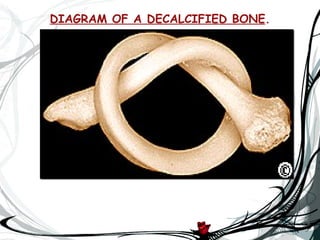
DIAGRAM OF A DECALCIFIED BONE.
SUMMARY
BONE DECALCIFICATION
Removal of calcium ions from the bone through
 histological process thereby making the bone
 flexible and easy for pathological investigation.


Methods;
 Acid decalcifying agents
 Traditional method
 Ion exchange resins with acid and decalcifying
  fluids.
 Electrolytic decalcification
 Chelating agents
QUOTE :


THE ONLY WAY TO DISCOVER THE LIMIT
  OF THE POSSIBLE IS TO GO BEYOND
  THEM INTO THE IMPOSSIBLE.
Decalcification of bone

Decalcification of bone

  • 1.
    HENRY MOORE NO ONEEVER KNOWS WHAT EACH DAY IS GOING TO BRING . THE IMPORTANT THING IS TO BE OPEN AND READY FOR IT.
  • 2.
  • 3.
    BONE DECALCIFICATION. • Presented by; • Group three • Nursing(LEVEL 100)
  • 4.
    Calcium ions foundin the bones are responsible for its rigid posture and without it, bones may be flexible and most of time unable to carry their body weight. Diseases such as osteomalacia and rickets are as a result of lack of calcium in the bones of those areas. De-calcification of bones as our topic is about the removal of these calcium from the bones. As such, we are going to look at the following about the topic: •The definition of decalcification of bones •The purpose of decalcification of bones •The principle of bone decalcification •The method of decalcification of bones How to test for the completion of decalcification
  • 5.
    INTRODUCTION Decalcification Loss of calcium salts from a bone or tooth. OR The process of removing calcareous matter. Bone decalcification Removal of calcium ions from the bone through histological process thereby making the bone flexible and easy for pathological investigation.
  • 6.
    PURPOSE OF BONEDECALCIFICATION • The purpose is to make the bone flexible and easy for pathological investigation. This is necessary in order to obtain soft sections of the bone using the microtome • Failure to decalcification results in torn, ragged sections and damage to the cutting edge of the microtome knife
  • 7.
    PRINCIPLE OF DECALCIFICATION •Insoluble calcium salt are converted into soluble calcium salts by the action of decalcifying agent so that the tissue become soft. • Chelating agent binds to calcium ions present in the bone and decalcification is carried out.
  • 8.
    Methods of decalcification •Traditional method • Acid decalcifying agents. • Ion exchange resins with acid and decalcifying fluids. • Electrolytic decalcification. • Chelating agents.
  • 9.
    TRADITIONAL METHOD • Thereis a traditional method of handling hard tissues such as bones ,but it posses problems to both pathologists and histotechnologists. • This is because ,it involves a lot of cutting of the tissue and keeping them for long periods in decalcifying solutions and this makes it difficult to get the cellular details intact.
  • 10.
    Acid decalcifying agent • Acids are further divided into two namely : weak acids and strong acids. • Weak ( Picric, Acetic and Formic acid) • Strong (Nitric and Hydrochloric acid)
  • 11.
    Nitric acid MEHTOD Thin slices of fixed tissue are placed in a freshly prepared 5-10% solution of nitric acid in distilled water. Decalcification through this should not extend beyond 48 hours. Formalin is added to nitric acid to protect the tissue against maceration and swelling.
  • 12.
    Formic acid • Formicacid is widely used as a decalcifying agent. • For routine 10% of formic acid in distilled water is recommended and higher concentration gives more rapid decalcification. • A large volume of fluid is used and renewed every 48 hours.
  • 13.
    Ion exchange resinswith acid decalcifying fluids It is an advanced system that quickly remove calcium from bone while leaving superior cellular details intact. Electrolytic Decalcification It is the speedier decalcification without damage to cytological features and staining. Drawback: Heat produced in the process may cause the charring of specimen in the process
  • 14.
    Chelating Agents • EDTAis a chelating agent, it is a white crystalline powder soluble in distilled water to about 20%. • As a decalcifying agent it combines with calcium ions to form soluble, non ionized compounds. • The volume of solution for decalcifying should be 150 times that of the tissue. • The solution should be renewed every 5 to 7 days during decalcification.
  • 15.
    Advantages of EDTA •Deposits of iron and other metals may also be removed by EDTA. • Tissue is not hardened after decalcification. • It can be good for Bone ,Teeth and any calcified tissue. • This is also the preferred solution for decalcifying bone material for transmission electron microscopy .
  • 16.
    Test for completionof Decalcification There are three methods for determining the completion of progress of decalcification.  By X-ray examination.  By Ammonia method(chemical method).  By Physical method
  • 17.
    X-ray Examination • Themost reliable method for determining decalcification. • But as this facility is not present in all the laboratories
  • 18.
    Ammonia Method • Inthis method ammonia is added drop by drop in the decalcifying solution cloudiness indicate the presence of calcium. • The specimen is then placed in a fresh solution of decalcifying fluid and test is repeated after a suitable interval of time.
  • 19.
    PHYSICAL METHOD • Thisinclude bending the specimen or inserting a pin, razor or scalpel directly into the tissue. • The disadvantage of inserting a pin is introduction of tears and pinhole or artifacts. • Slightly bending is less disruptive but will not conclusively determine if all calcium salts have been removed. • After checking for rigidity, wash thoroughly prior to processing.
  • 20.
    DIAGRAM OF ADECALCIFIED BONE.
  • 21.
  • 22.
    BONE DECALCIFICATION Removal ofcalcium ions from the bone through histological process thereby making the bone flexible and easy for pathological investigation. Methods;  Acid decalcifying agents  Traditional method  Ion exchange resins with acid and decalcifying fluids.  Electrolytic decalcification  Chelating agents
  • 23.
    QUOTE : THE ONLYWAY TO DISCOVER THE LIMIT OF THE POSSIBLE IS TO GO BEYOND THEM INTO THE IMPOSSIBLE.

Editor's Notes

  • #15 “ EDTA”: ethylenediaminetraacetic acid