Exceptions are the Norm
Dealing with Bad Actors in ETL
Sameer Agarwal
Spark Summit | Boston | Feb 9th 2017
About Me
• Software Engineer at Databricks (Spark Core/SQL)
• PhD in Databases (AMPLab, UC Berkeley)
• Research on BlinkDB (Approximate Queries in Spark)
Overview
1. What’s an ETL Pipeline?
- How is it different from a regular query execution pipeline?
2. Using SparkSQL for ETL
- Dealing with Dirty Data (Bad Records or Files)
- Performance (Project Tungsten)
3. New Features in Spark 2.2 and 2.3
- Focus on building ETL-friendly pipelines
What is a Data Pipeline?
1. Sequence of transformations on data
2. Source data is typically semi-structured/unstructured
(JSON, CSV etc.)
3. Output data is structured and ready for use by analysts
and data scientists
4. Source and destination are often on different storage
systems.
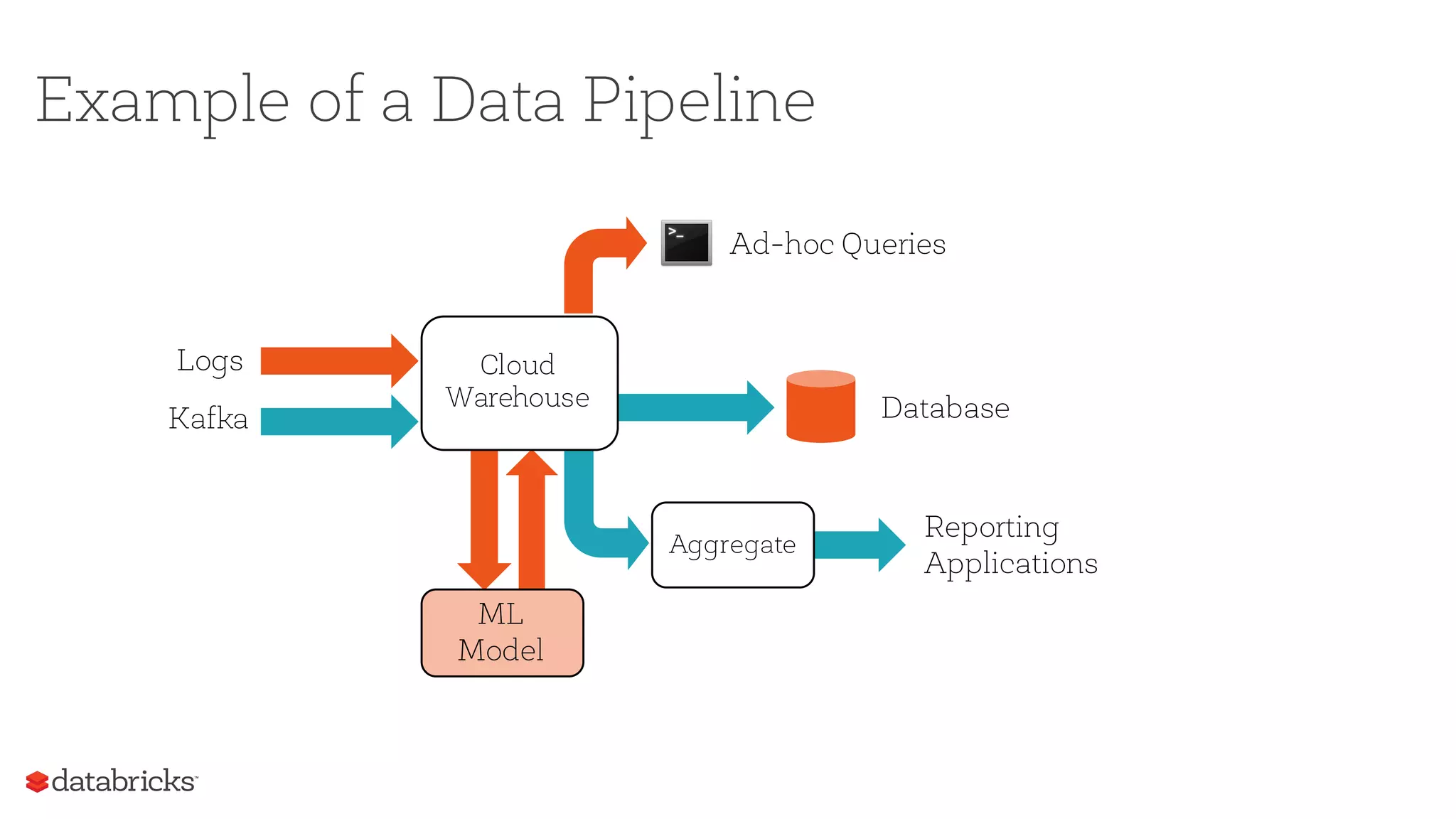
Example of a Data Pipeline
Aggregate
Reporting
Applications
ML
Model
Ad-hoc Queries
Kafka Database
Cloud
Warehouse
Logs
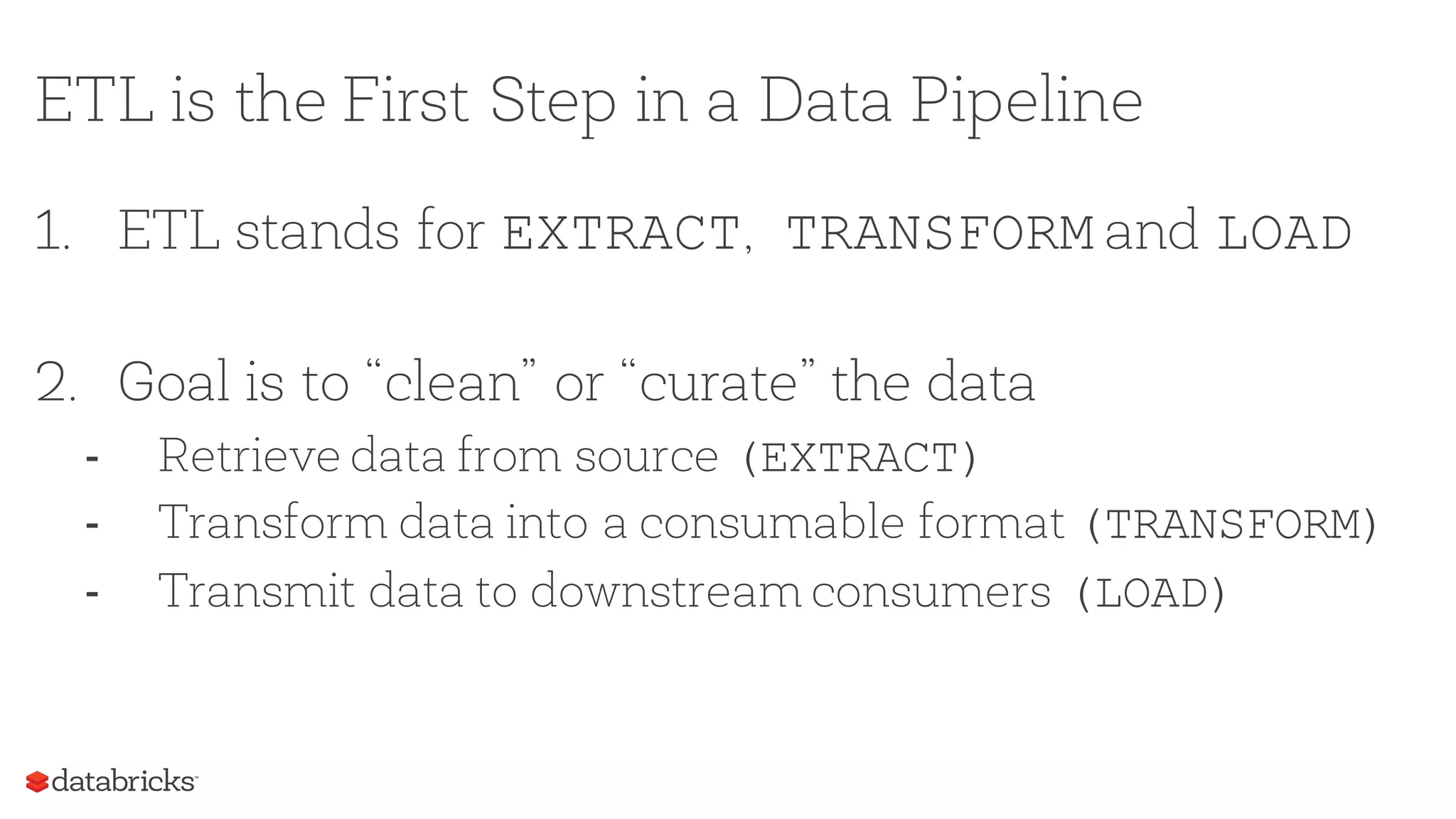
ETL is the First Step in a Data Pipeline
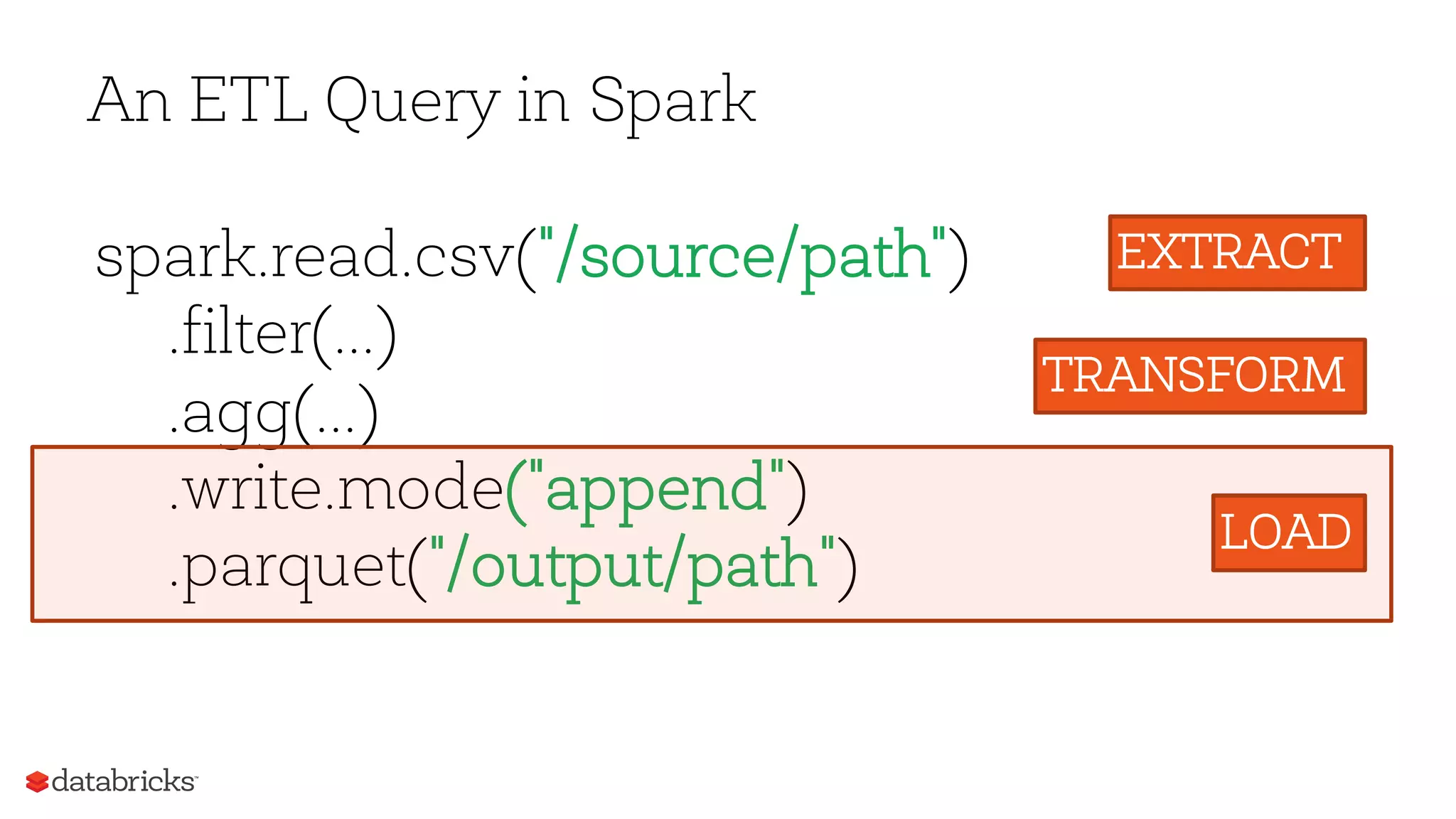
1. ETL stands for EXTRACT, TRANSFORM and LOAD
2. Goal is to “clean” or “curate” the data
- Retrieve data from source (EXTRACT)
- Transform data into a consumable format (TRANSFORM)
- Transmit data to downstream consumers (LOAD)
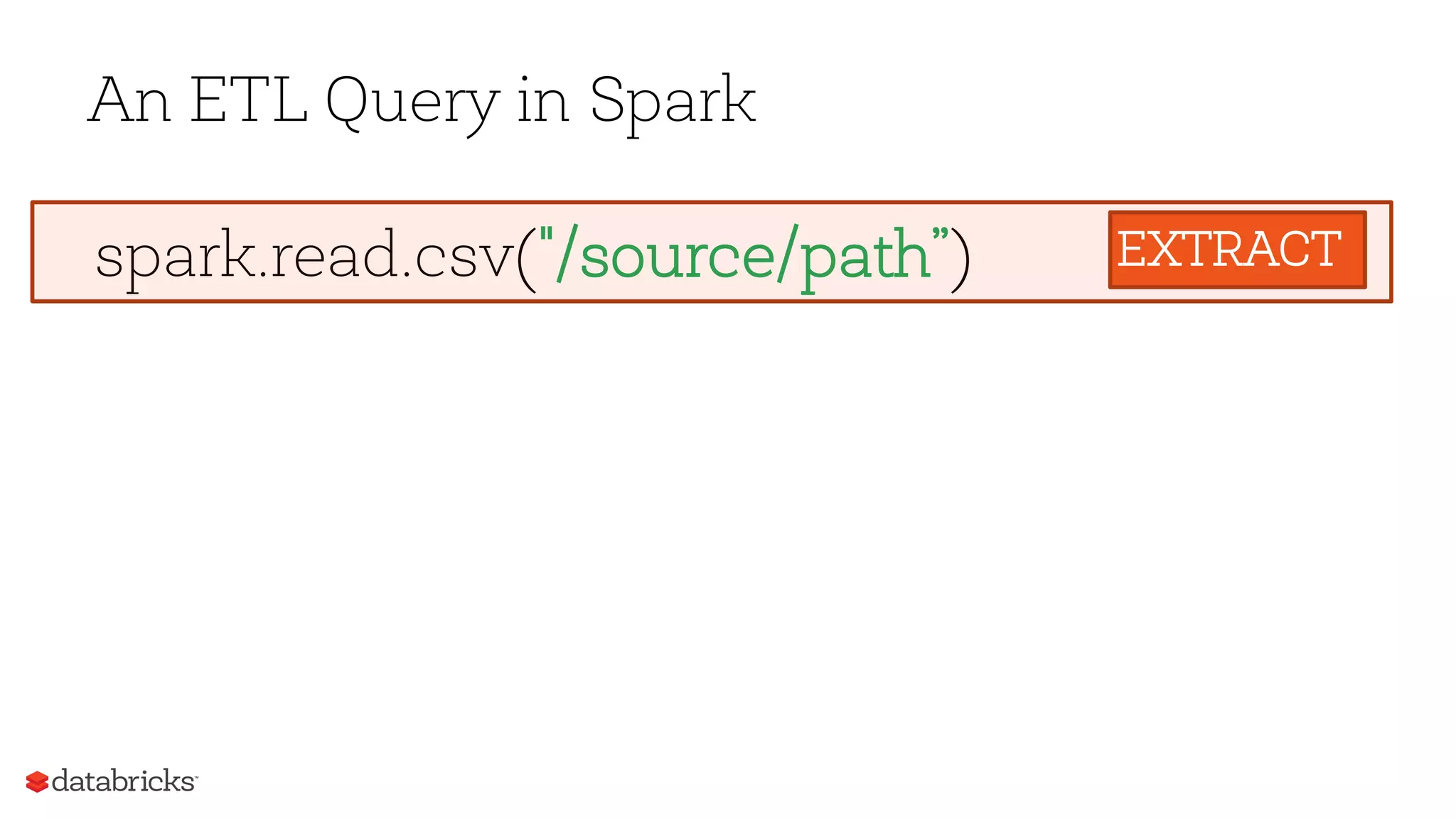
An ETL Query in Spark
Extractspark.read.csv("/source/path”) EXTRACT
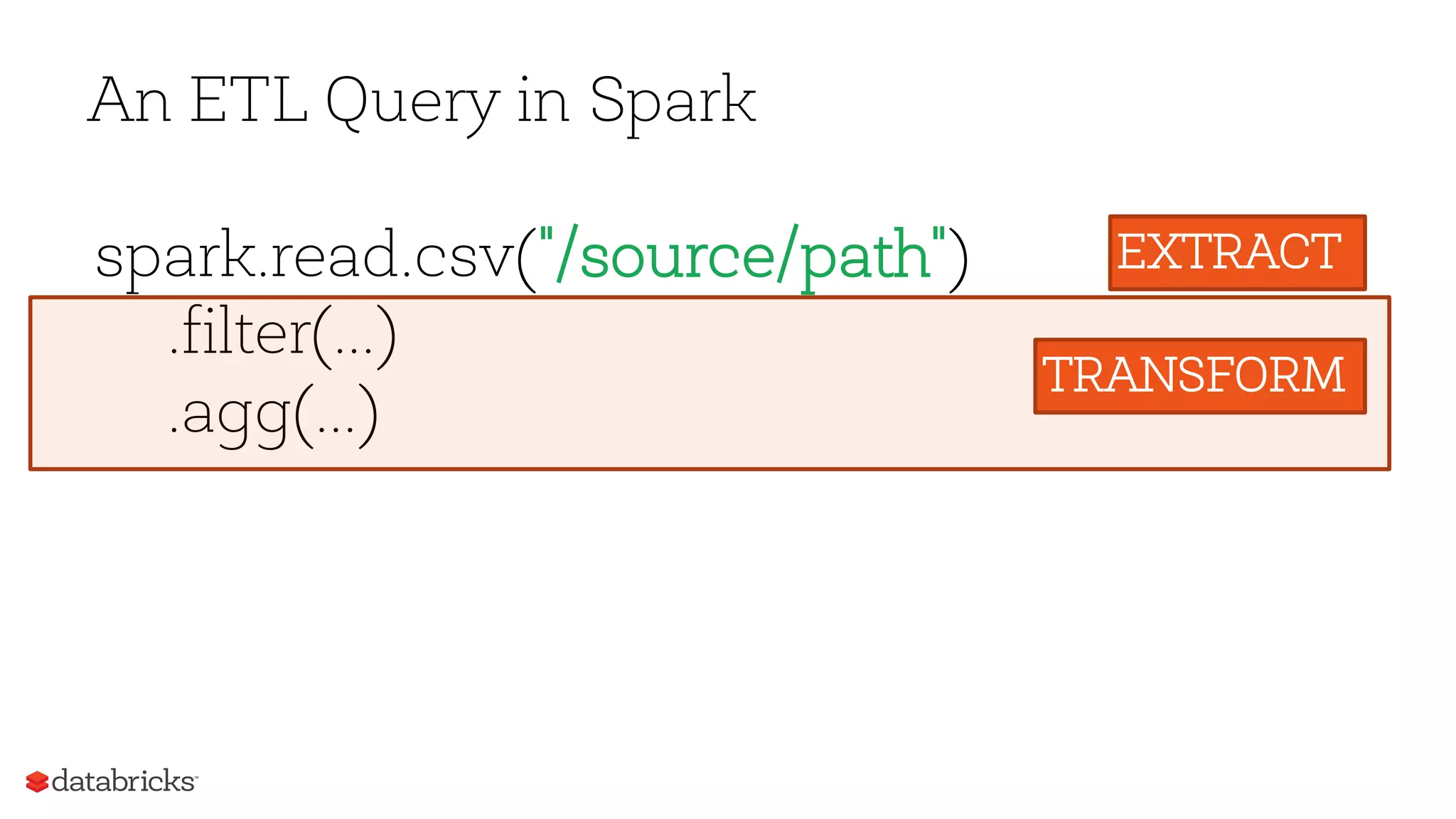
An ETL Query in Spark
Extractspark.read.csv("/source/path")
.filter(...)
.agg(...)
EXTRACT
TRANSFORM
An ETL Query in Spark
Extractspark.read.csv("/source/path")
.filter(...)
.agg(...)
.write.mode("append")
.parquet("/output/path")
EXTRACT
TRANSFORM
LOAD
What’s so hard about ETL
Queries?
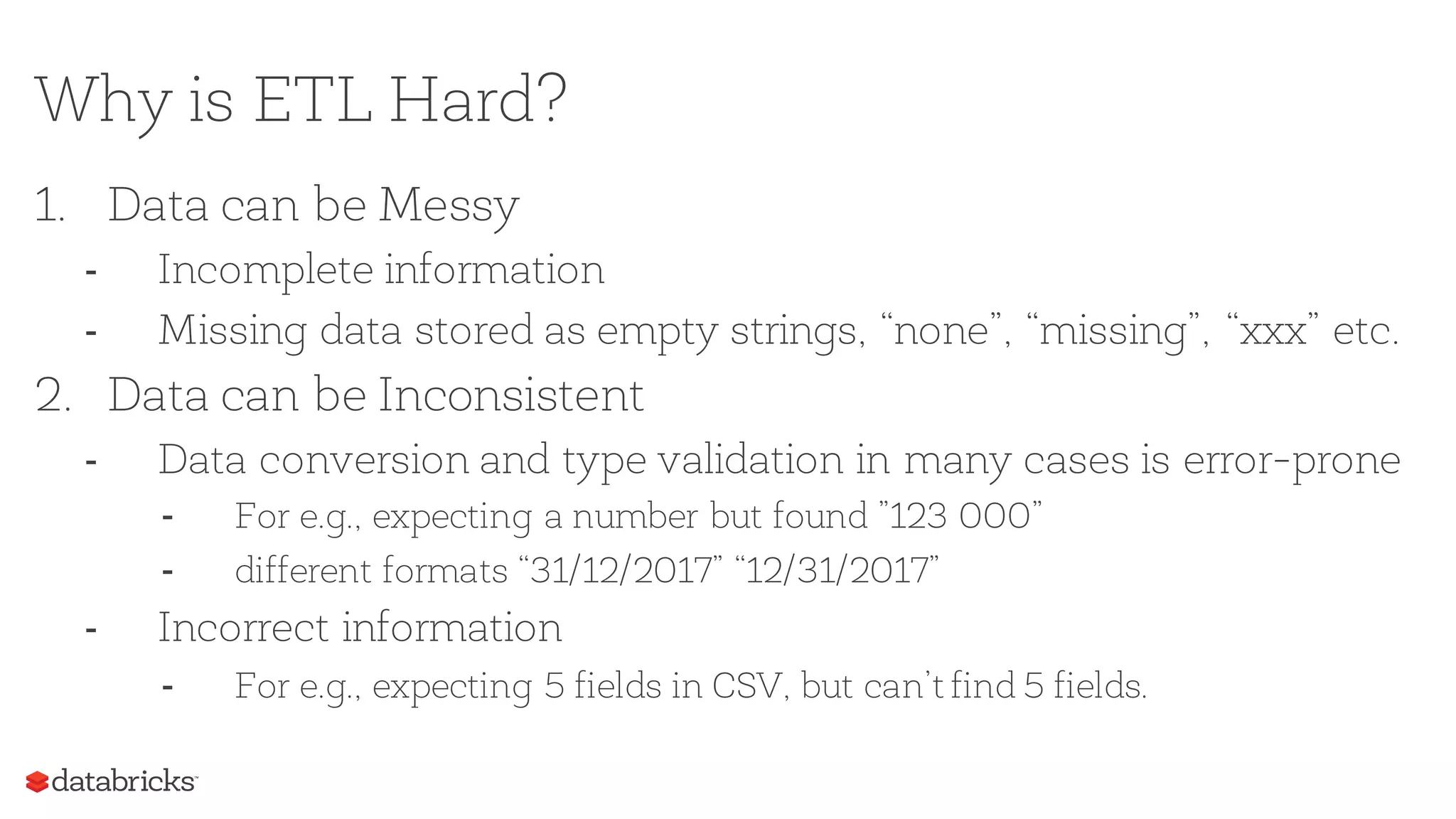
Why is ETL Hard?
1. Data can be Messy
- Incomplete information
- Missing data stored as empty strings, “none”, “missing”, “xxx” etc.
2. Data can be Inconsistent
- Data conversion and type validation in many cases is error-prone
- For e.g., expecting a number but found ”123 000”
- different formats “31/12/2017” “12/31/2017”
- Incorrect information
- For e.g., expecting 5 fields in CSV, but can’t find 5 fields.
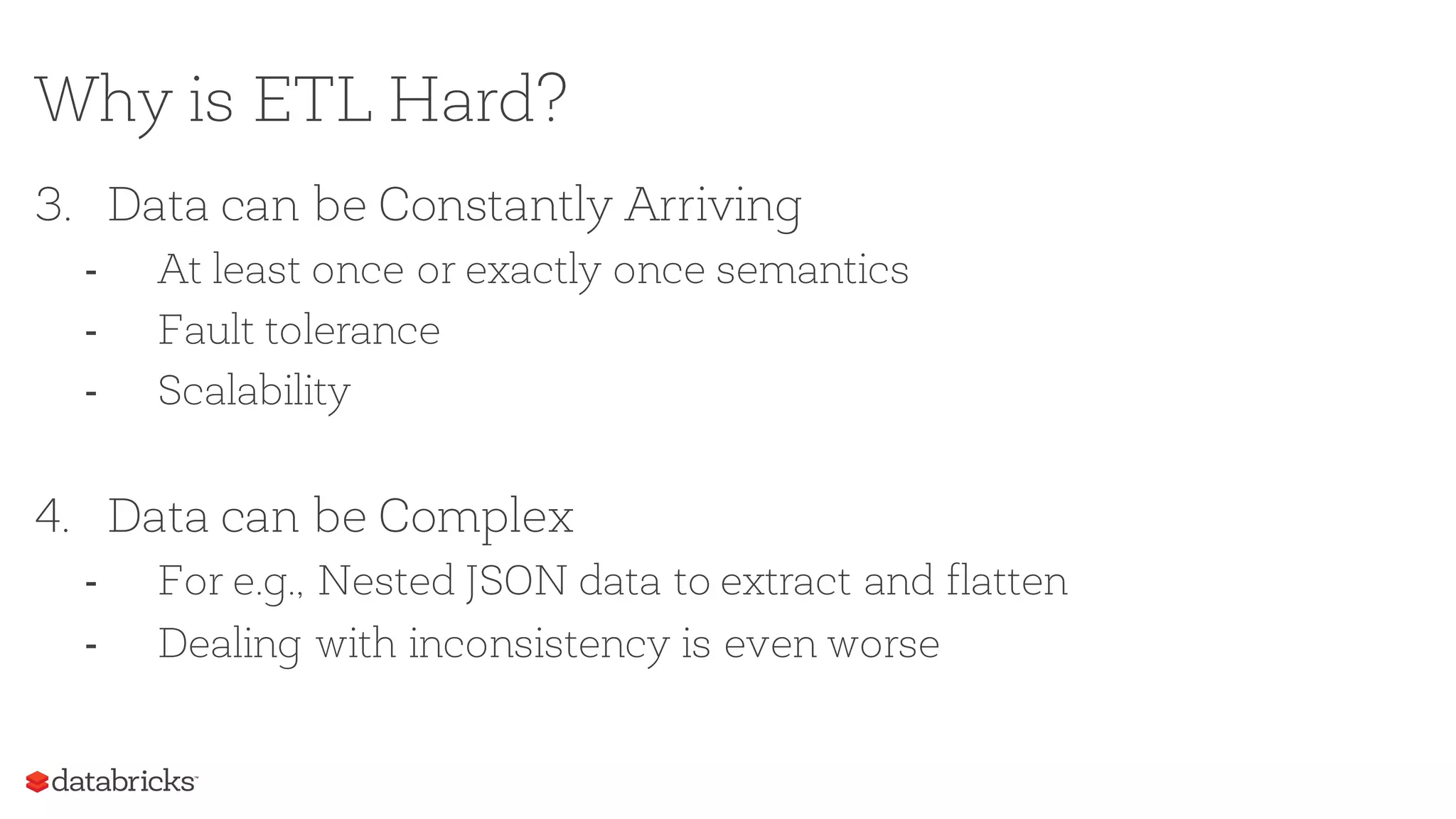
Why is ETL Hard?
3. Data can be Constantly Arriving
- At least once or exactly once semantics
- Fault tolerance
- Scalability
4. Data can be Complex
- For e.g., Nested JSON data to extract and flatten
- Dealing with inconsistency is even worse
This is why ETL is important
Consumers of this data don’t want to deal with this
messiness and complexity
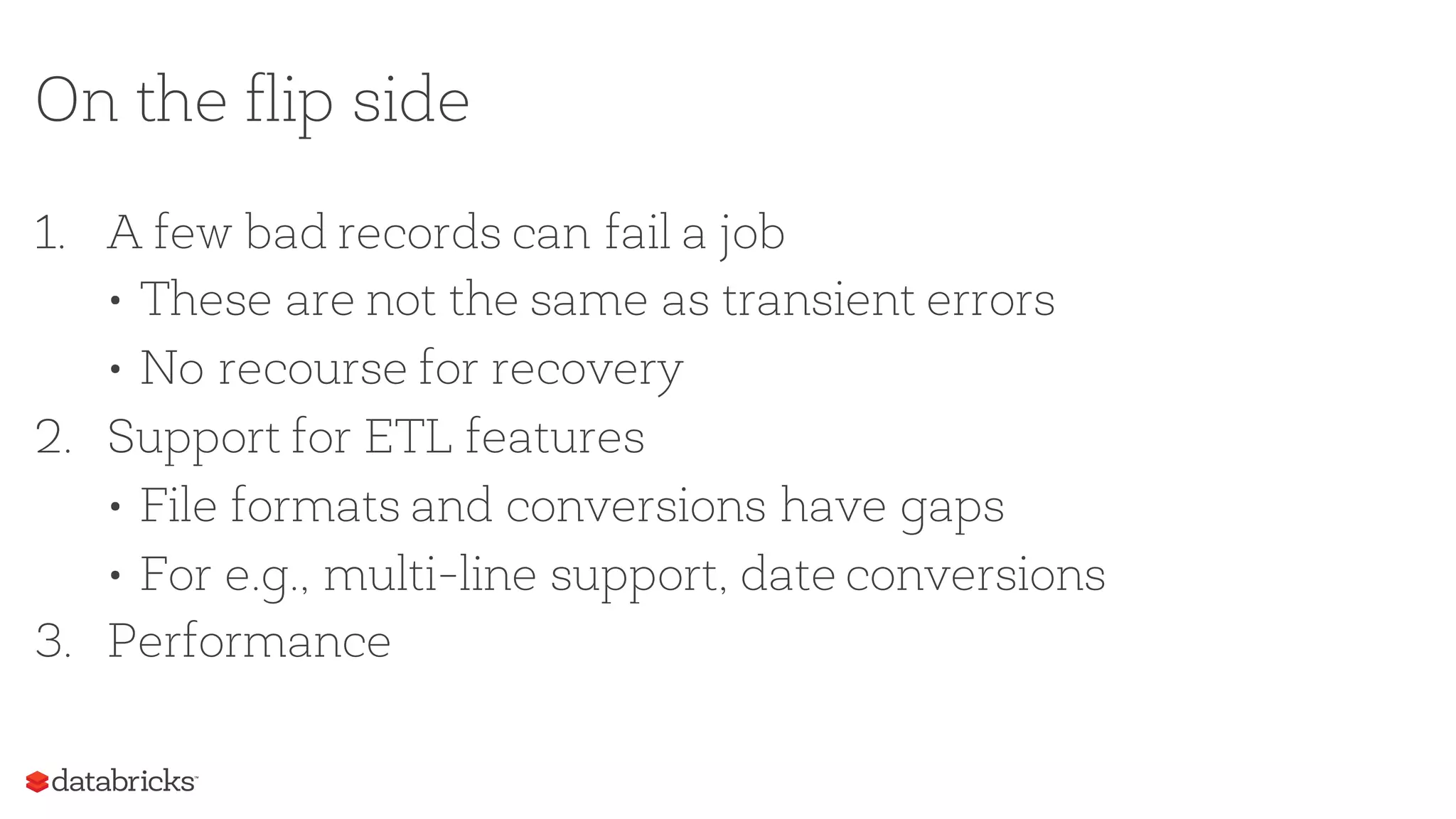
On the flip side
1. A few bad records can fail a job
• These are not the same as transient errors
• No recourse for recovery
2. Support for ETL features
• File formats and conversions have gaps
• For e.g., multi-line support, date conversions
3. Performance
Spark's flexible APIs, support for a wide variety of
datasources and state of art tungsten execution
engine makes it a great framework for building
end-to-end ETL Pipelines
Using SparkSQL for ETL
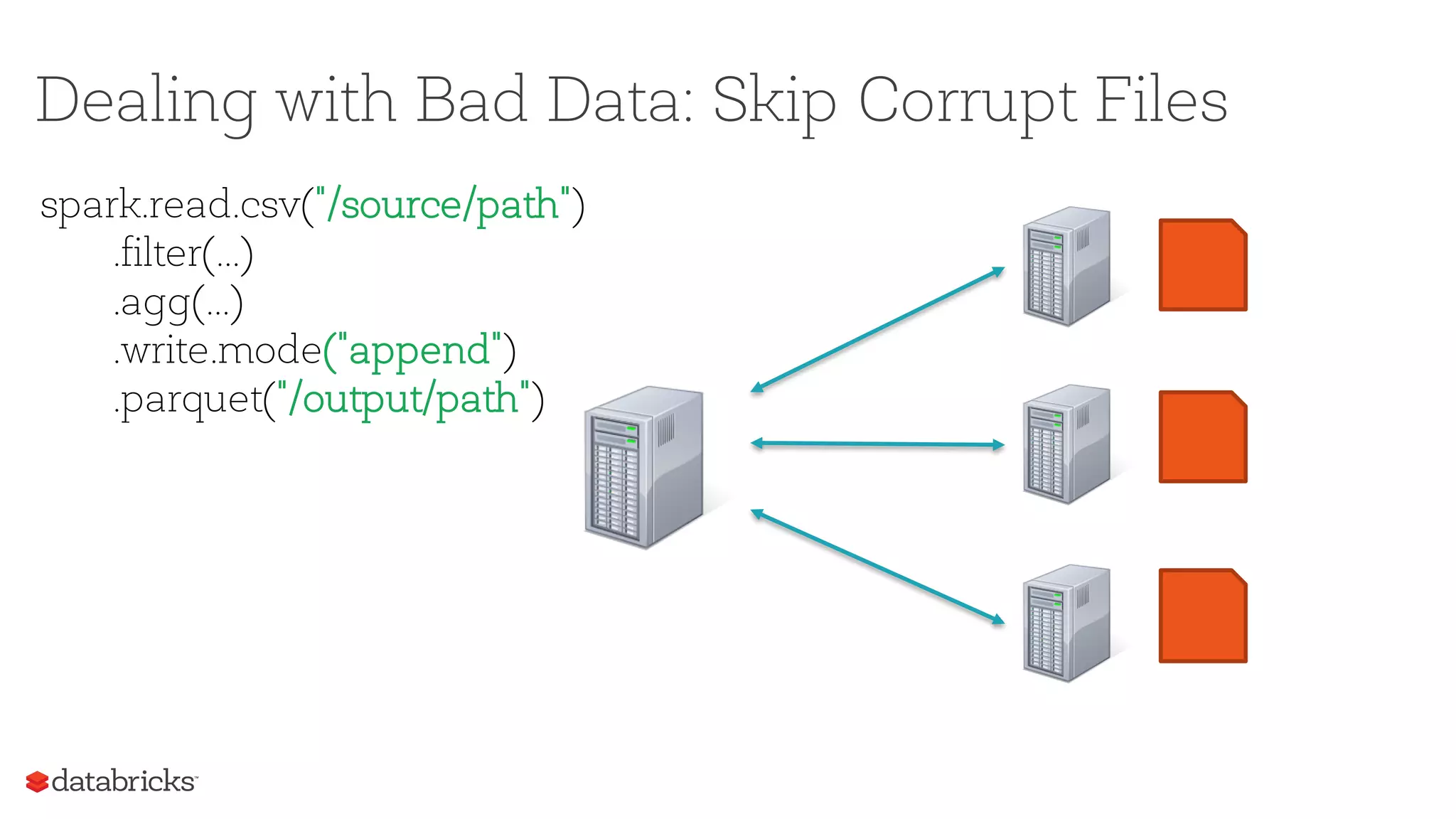
Dealing with Bad Data: Skip Corrupt Files
spark.read.csv("/source/path")
.filter(...)
.agg(...)
.write.mode("append")
.parquet("/output/path")
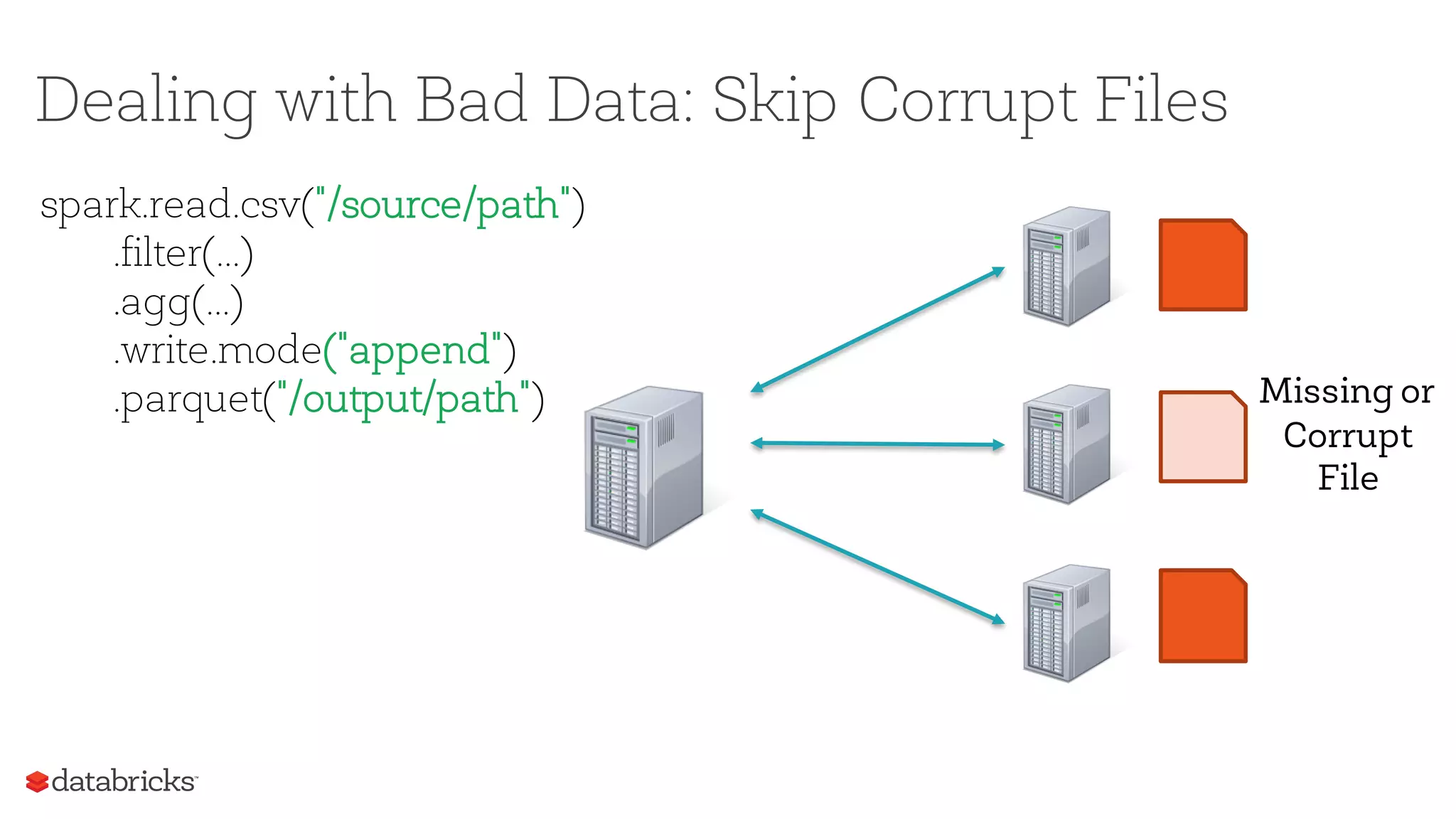
Dealing with Bad Data: Skip Corrupt Files
spark.read.csv("/source/path")
.filter(...)
.agg(...)
.write.mode("append")
.parquet("/output/path") Missing or
Corrupt
File
Dealing with Bad Data: Skip Corrupt Files
spark.sql.files.ignoreCorruptFiles = true
Missing or
Corrupt
File
[SPARK-17850] If true,
the Spark jobs will
continue to run even
when it encounters
corrupt or non-existent
files. The contents that
have been read will still
be returned.
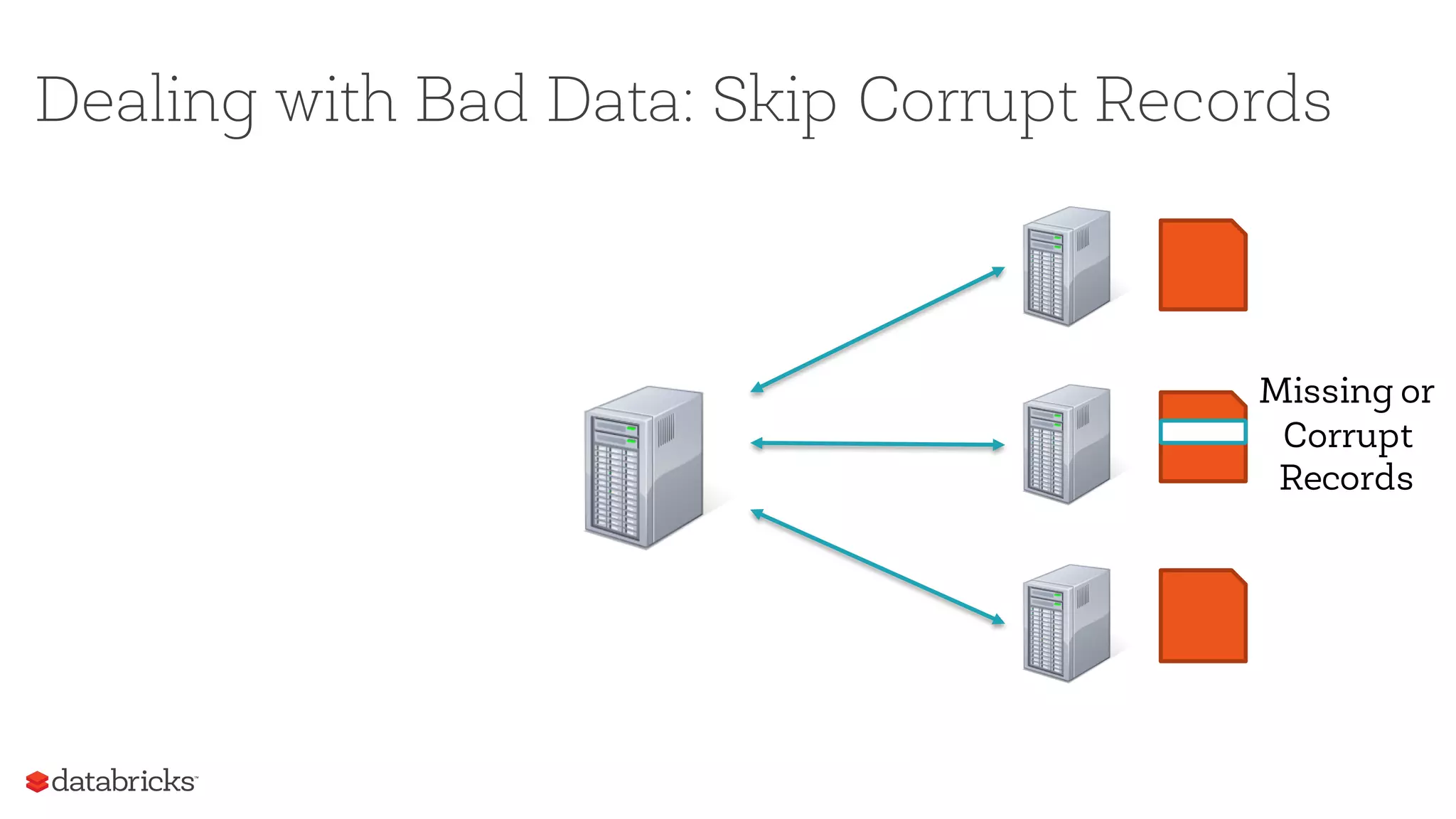
Dealing with Bad Data: Skip Corrupt Records
Missing or
Corrupt
Records
Dealing with Bad Data: Skip Corrupt Records
Missing or
Corrupt
Records
[SPARK-12833][SPARK-
13764] TextFile formats
(JSON and CSV) support 3
different ParseModes
while reading data:
1. PERMISSIVE
2. DROPMALFORMED
3. FAILFAST
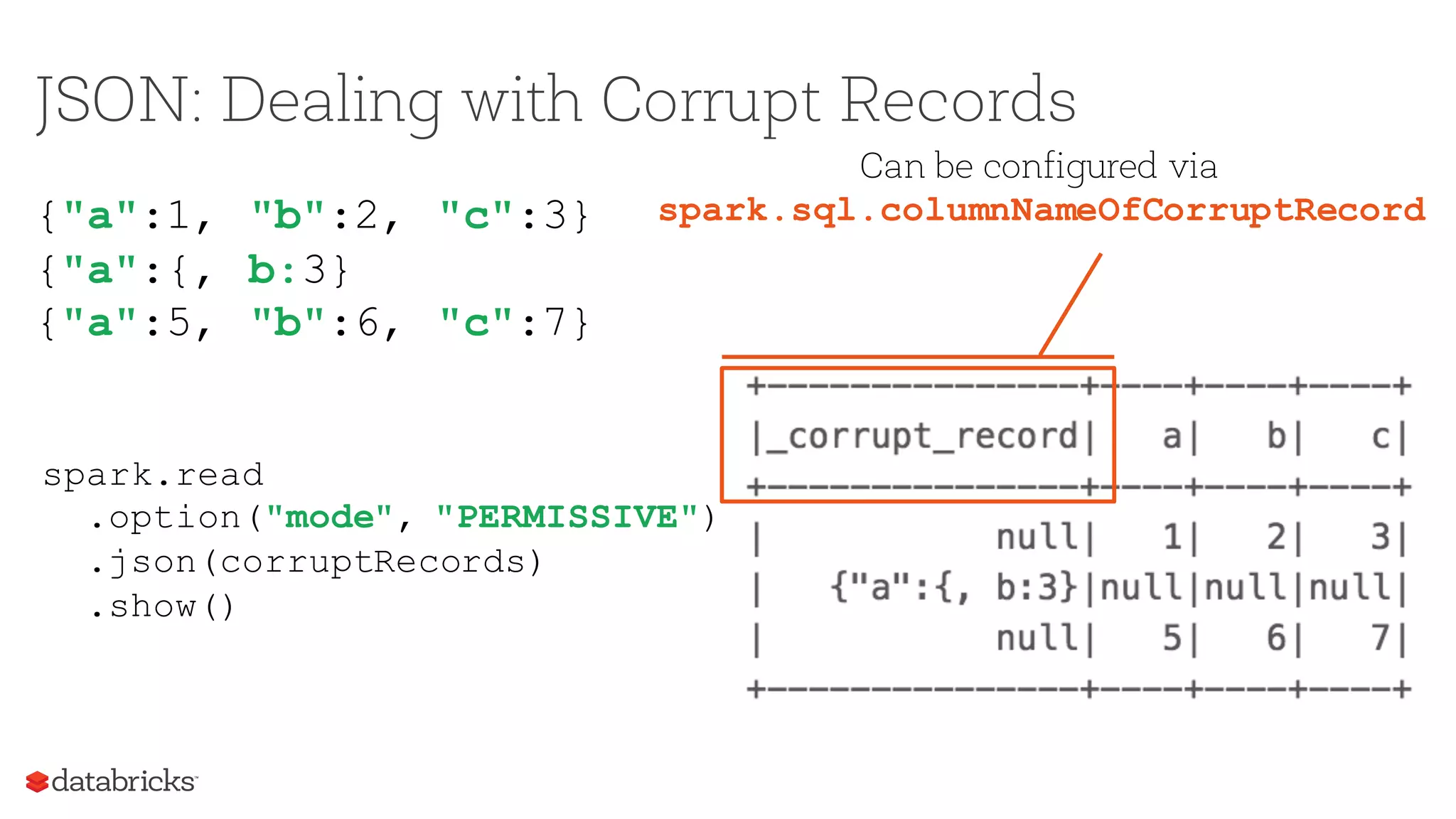
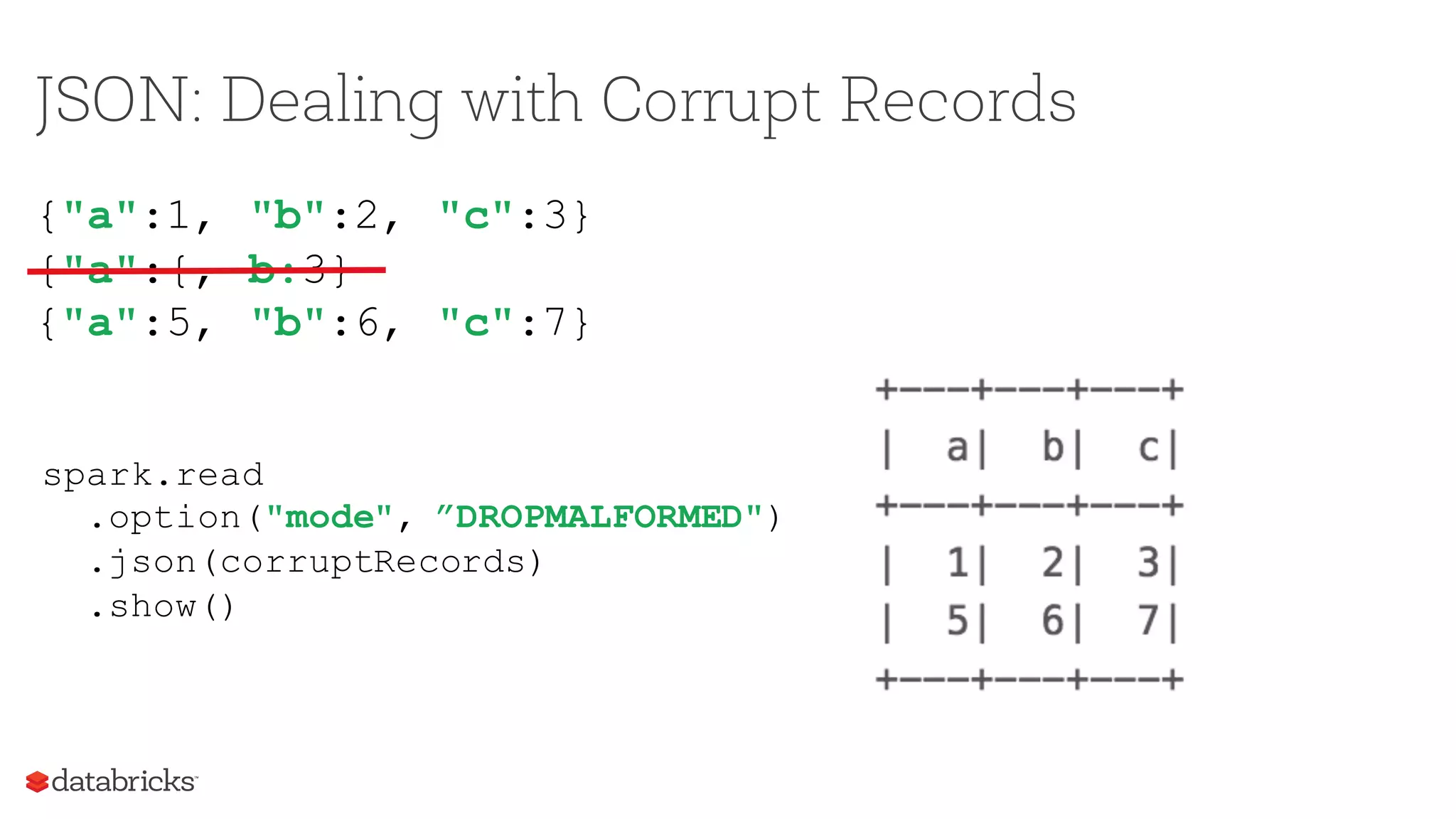
JSON: Dealing with Corrupt Records
{"a":1, "b":2, "c":3}
{"a":{, b:3}
{"a":5, "b":6, "c":7}
spark.read
.option("mode", "PERMISSIVE")
.json(corruptRecords)
.show()
Can be configured via
spark.sql.columnNameOfCorruptRecord
JSON: Dealing with Corrupt Records
{"a":1, "b":2, "c":3}
{"a":{, b:3}
{"a":5, "b":6, "c":7}
spark.read
.option("mode", ”DROPMALFORMED")
.json(corruptRecords)
.show()
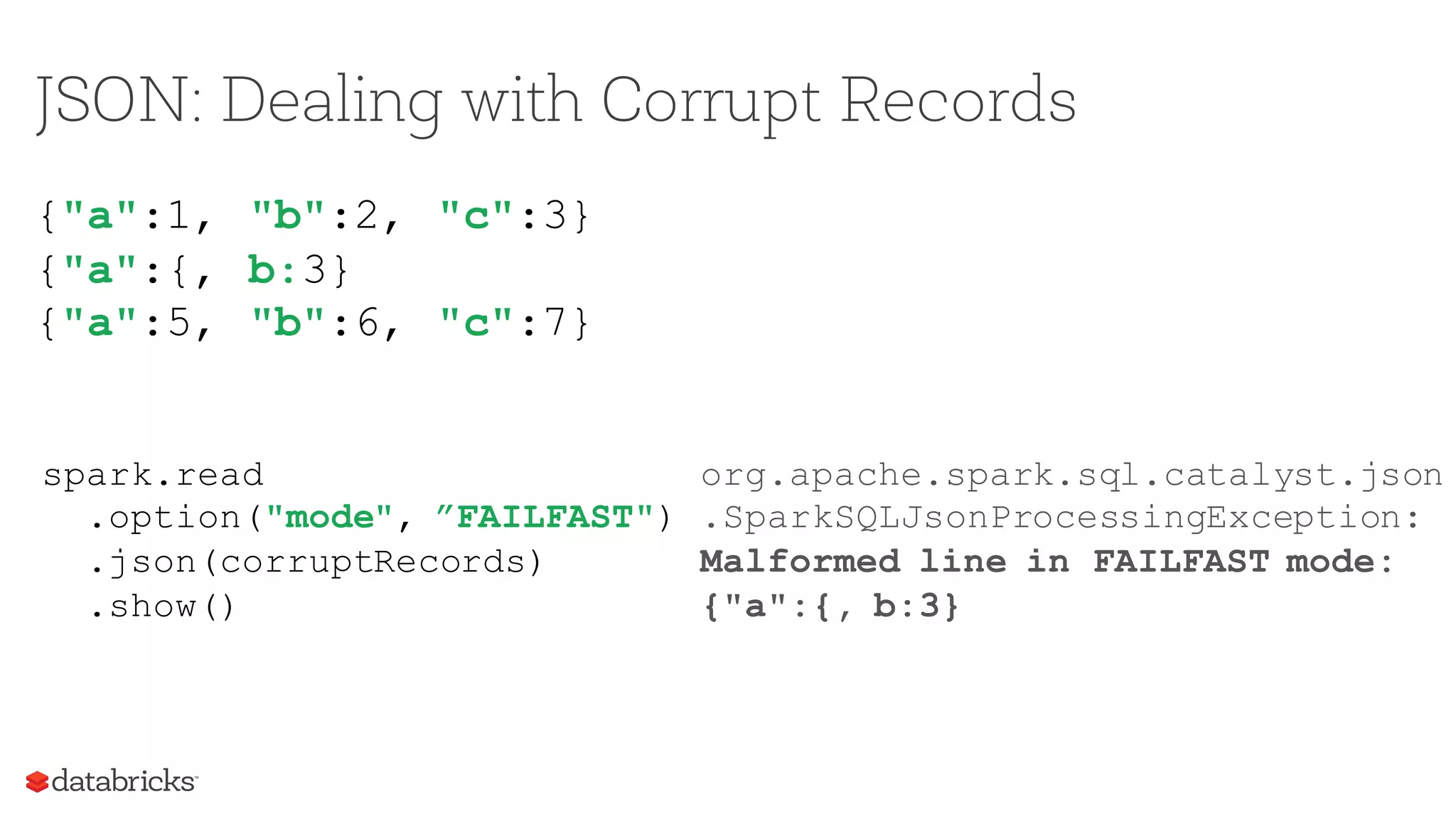
JSON: Dealing with Corrupt Records
{"a":1, "b":2, "c":3}
{"a":{, b:3}
{"a":5, "b":6, "c":7}
spark.read
.option("mode", ”FAILFAST")
.json(corruptRecords)
.show()
org.apache.spark.sql.catalyst.json
.SparkSQLJsonProcessingException:
Malformed line in FAILFAST mode:
{"a":{, b:3}
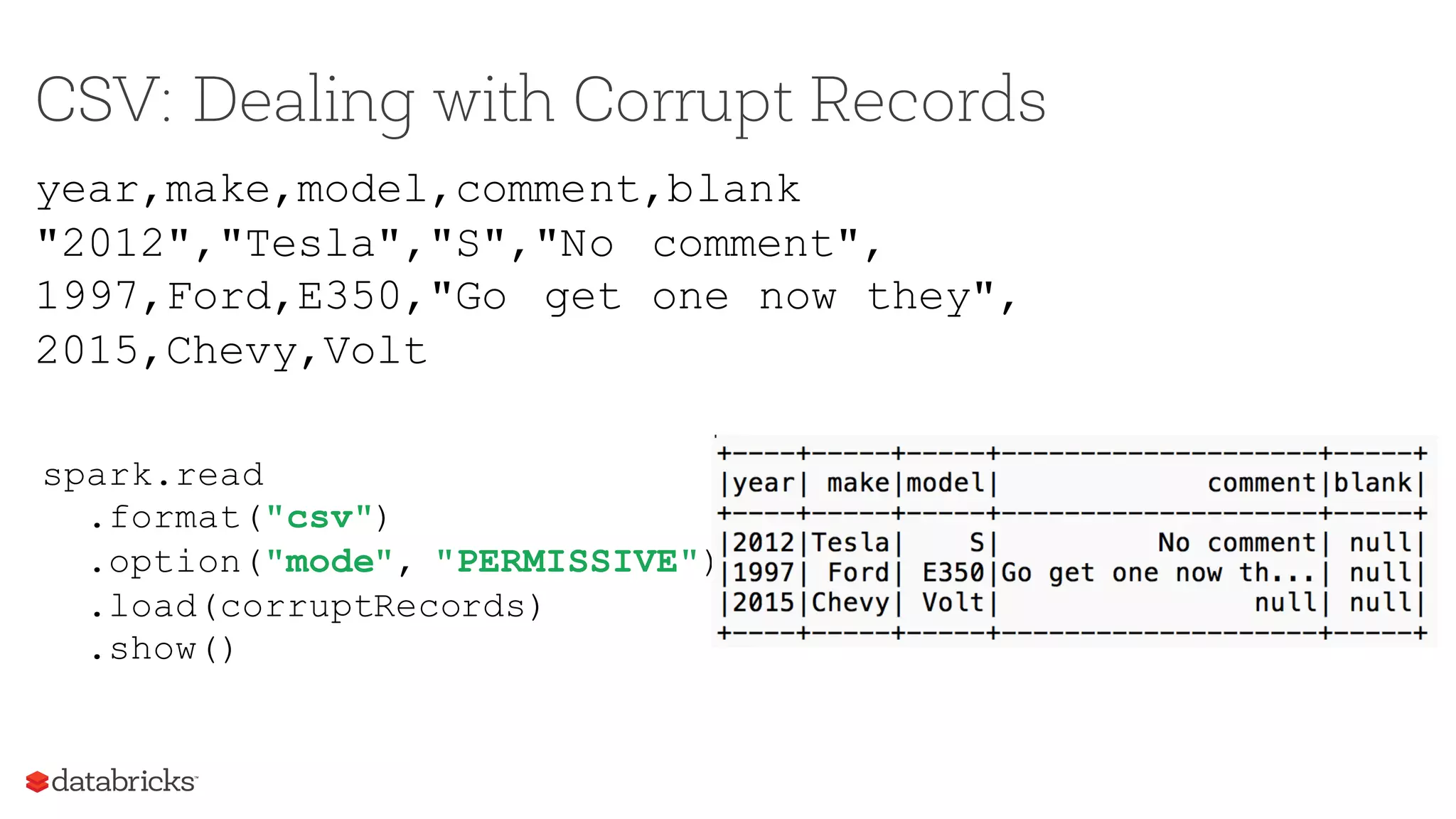
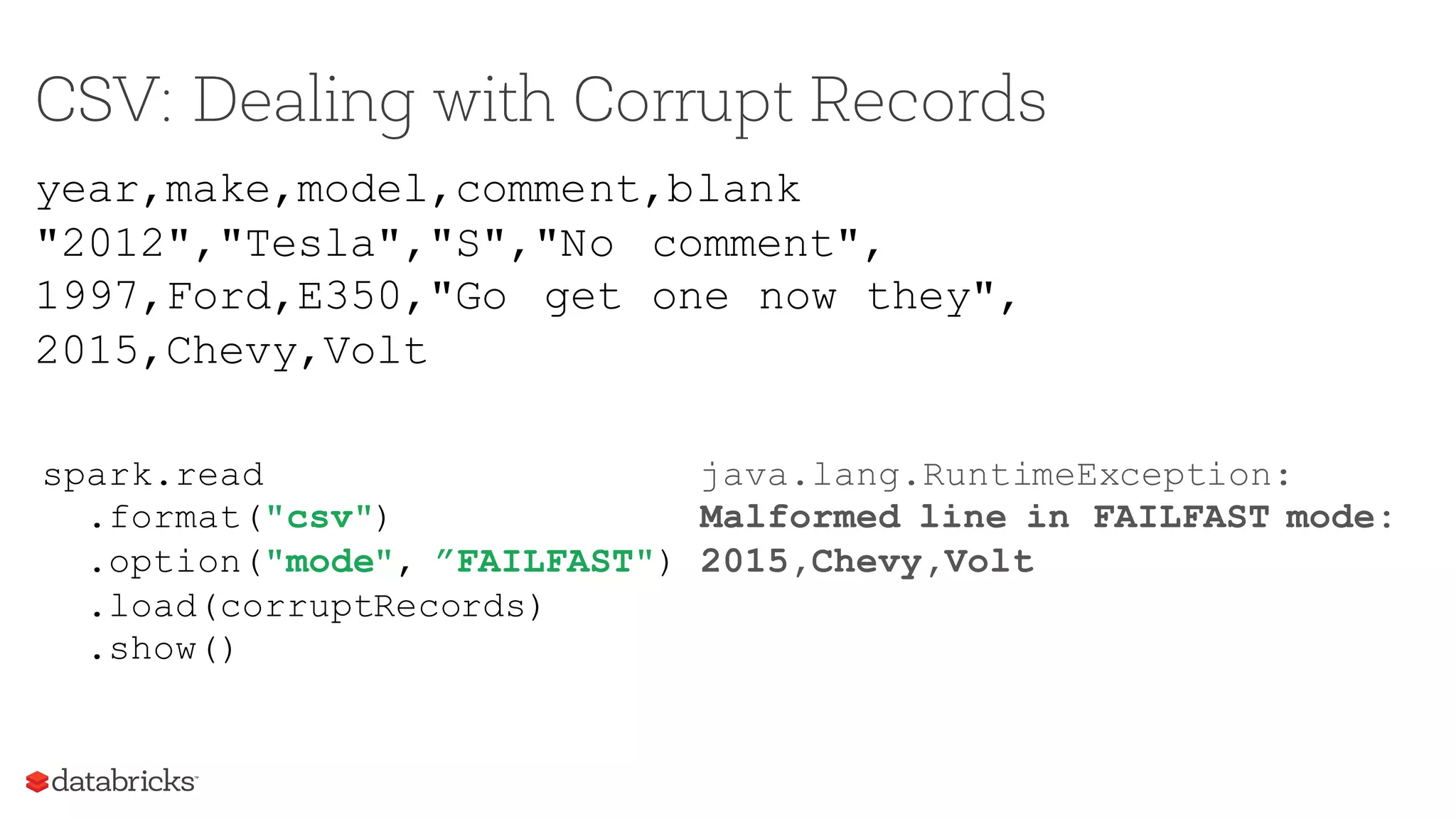
CSV: Dealing with Corrupt Records
year,make,model,comment,blank
"2012","Tesla","S","No comment",
1997,Ford,E350,"Go get one now they",
2015,Chevy,Volt
spark.read
.format("csv")
.option("mode", "PERMISSIVE")
.load(corruptRecords)
.show()
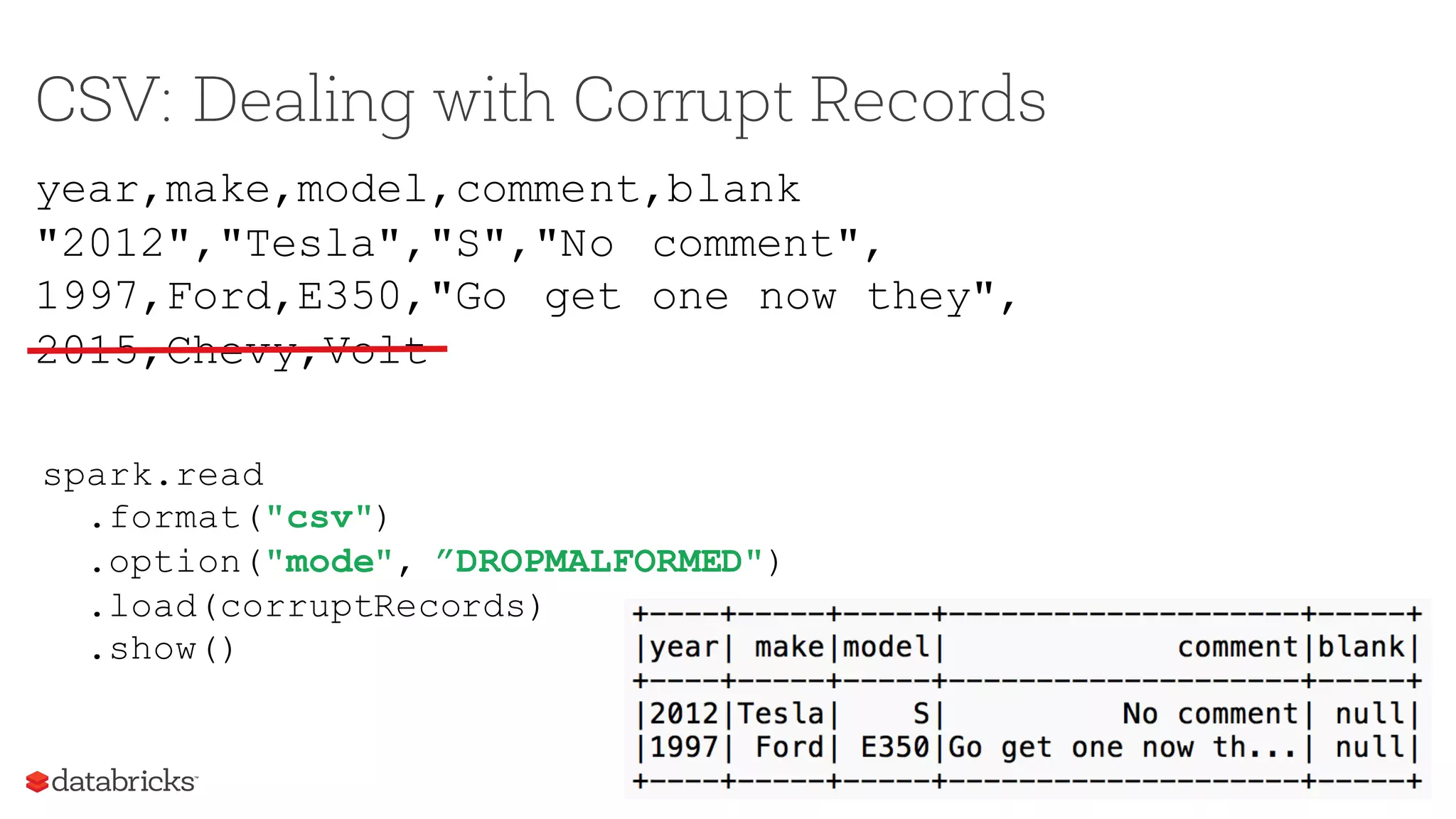
CSV: Dealing with Corrupt Records
year,make,model,comment,blank
"2012","Tesla","S","No comment",
1997,Ford,E350,"Go get one now they",
2015,Chevy,Volt
spark.read
.format("csv")
.option("mode", ”DROPMALFORMED")
.load(corruptRecords)
.show()
CSV: Dealing with Corrupt Records
year,make,model,comment,blank
"2012","Tesla","S","No comment",
1997,Ford,E350,"Go get one now they",
2015,Chevy,Volt
spark.read
.format("csv")
.option("mode", ”FAILFAST")
.load(corruptRecords)
.show()
java.lang.RuntimeException:
Malformed line in FAILFAST mode:
2015,Chevy,Volt
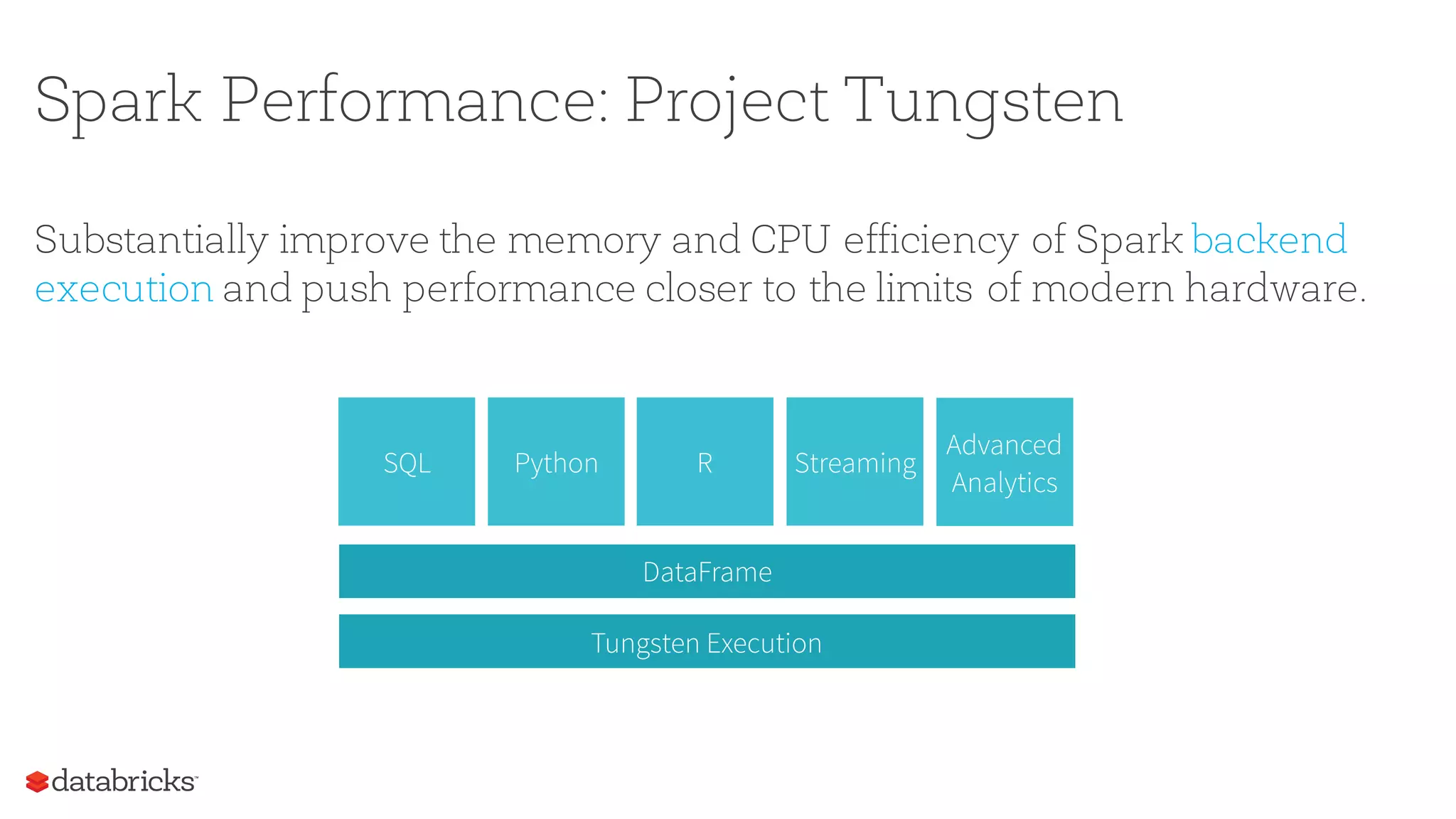
Spark Performance: Project Tungsten
Substantially improve the memory and CPU efficiency of Spark backend
execution and push performance closer to the limits of modern hardware.
Tungsten Execution
PythonSQL R Streaming
DataFrame
Advanced	
Analytics
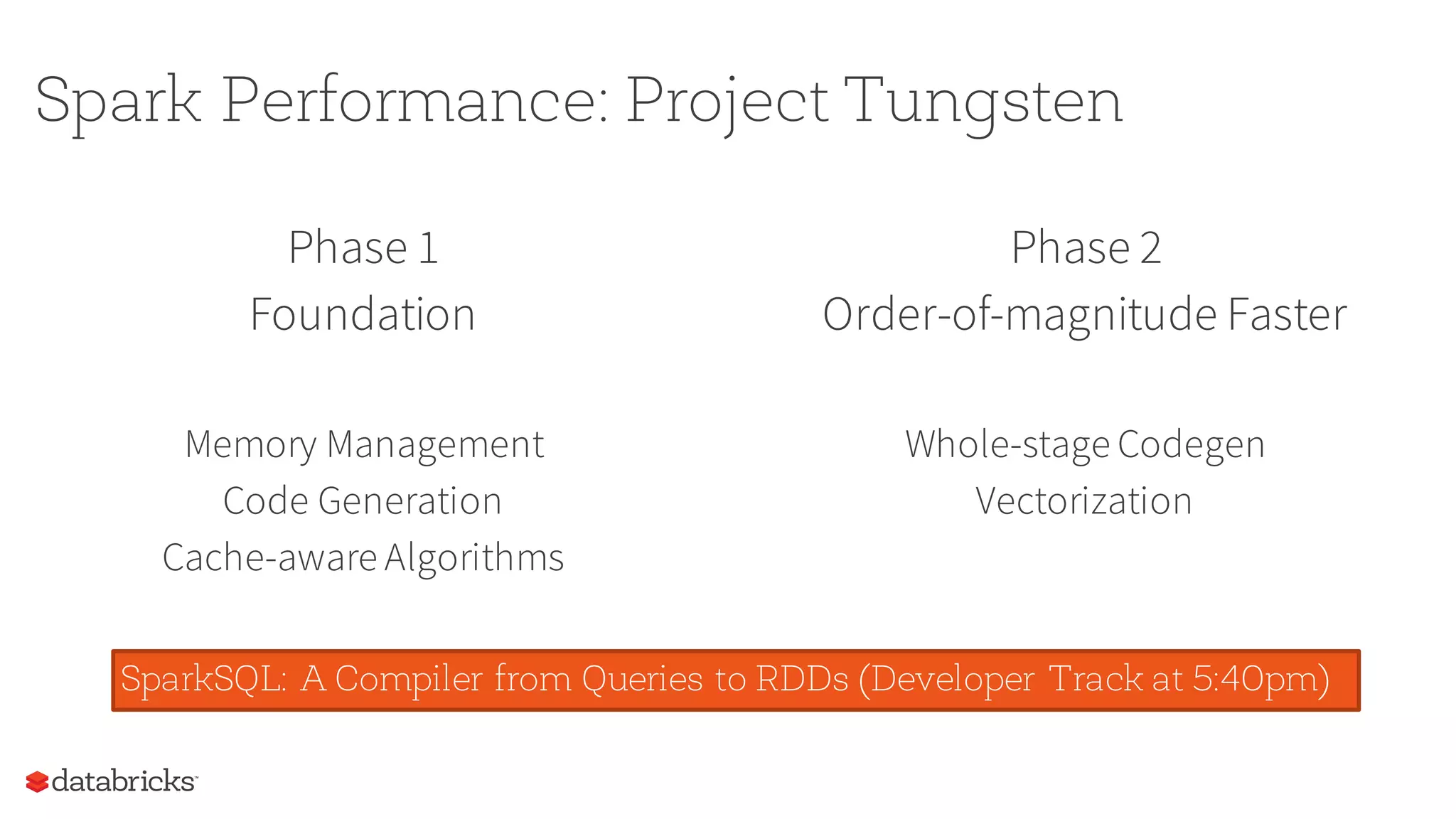
Phase 1
Foundation
Memory Management
Code Generation
Cache-aware Algorithms
Phase 2
Order-of-magnitude Faster
Whole-stage Codegen
Vectorization
Spark Performance: Project Tungsten
SparkSQL: A Compiler from Queries to RDDs (Developer Track at 5:40pm)
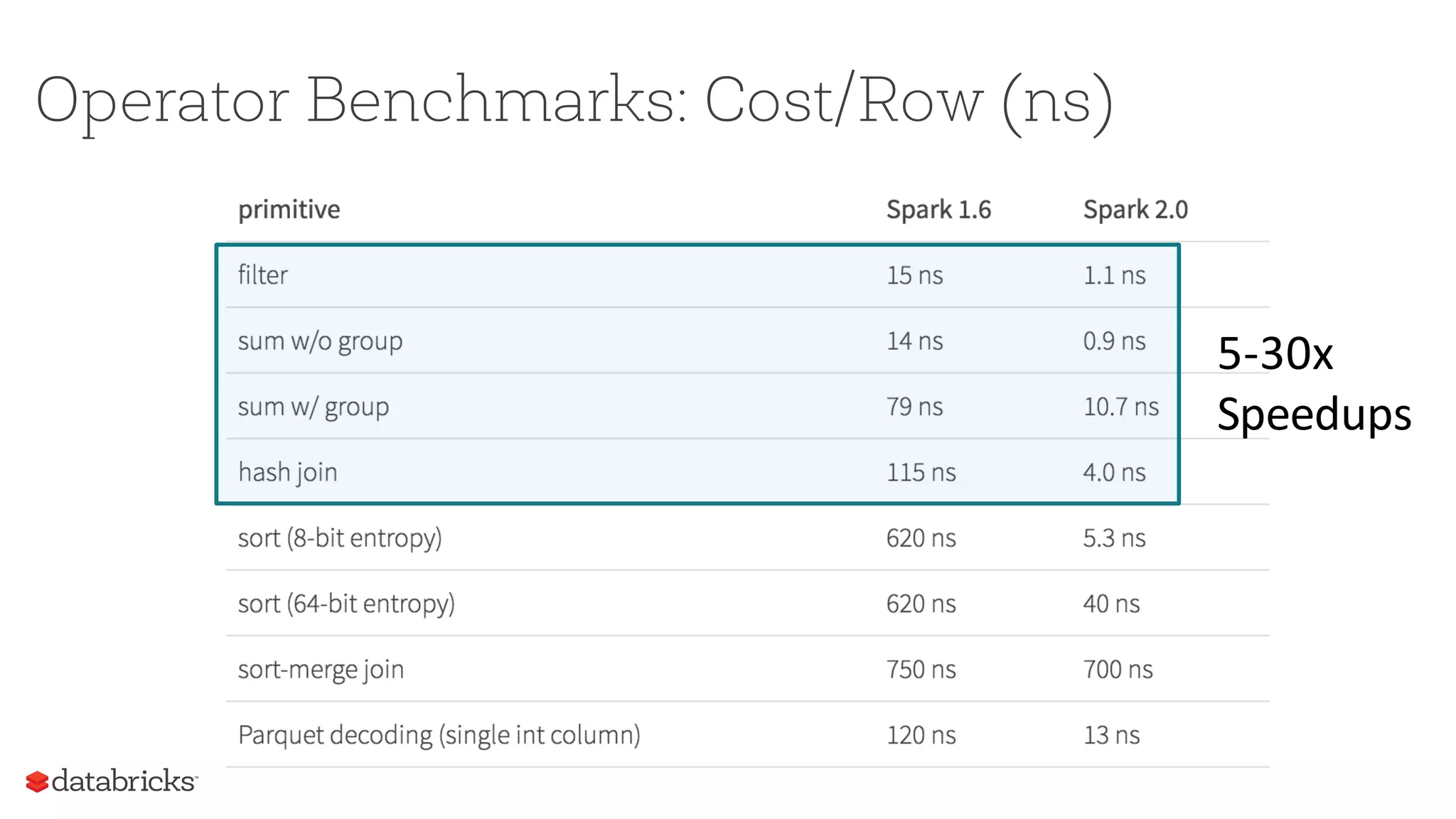
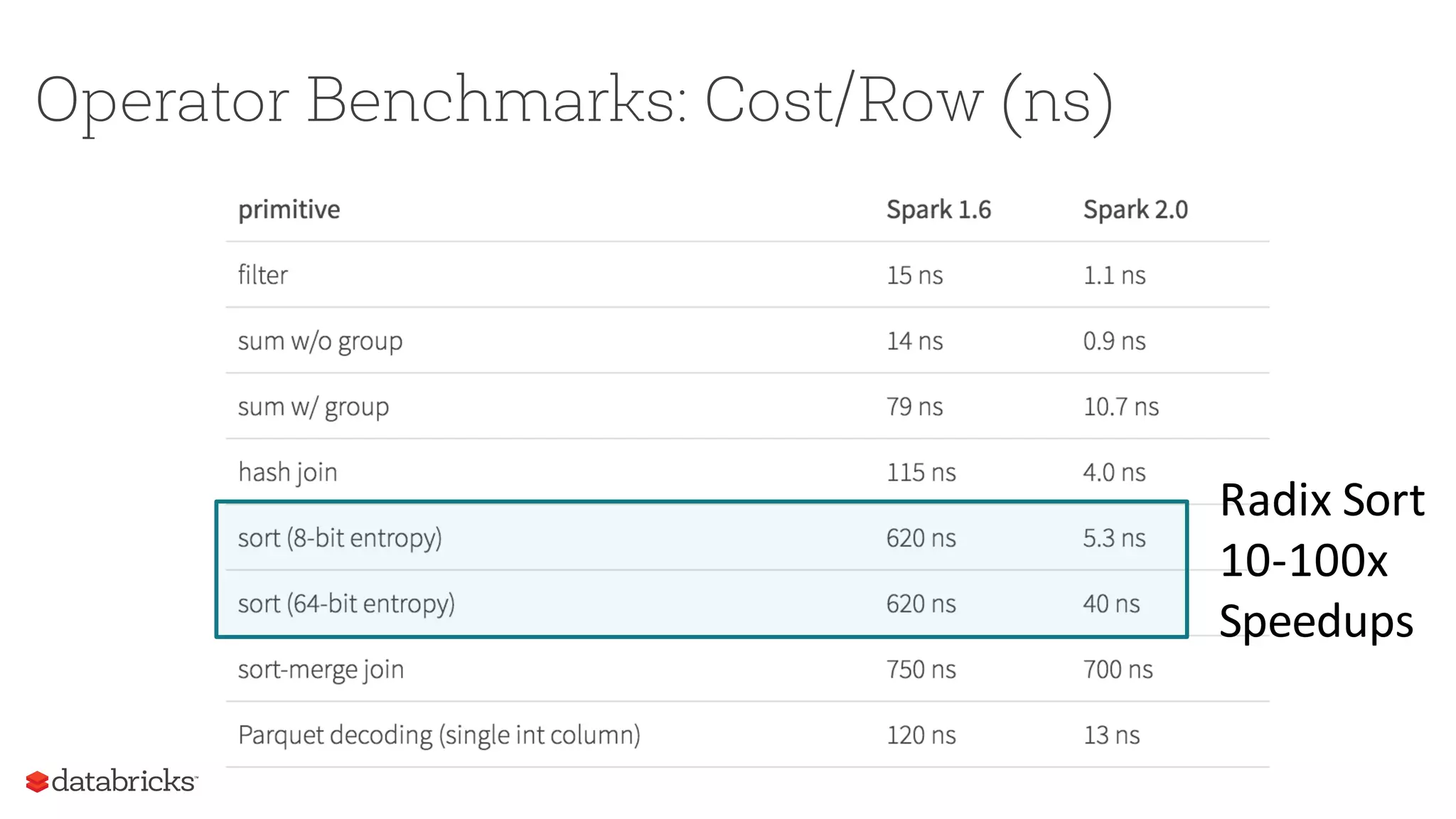
Operator Benchmarks: Cost/Row (ns)
5-30x
Speedups
Operator Benchmarks: Cost/Row (ns)
Radix Sort
10-100x
Speedups
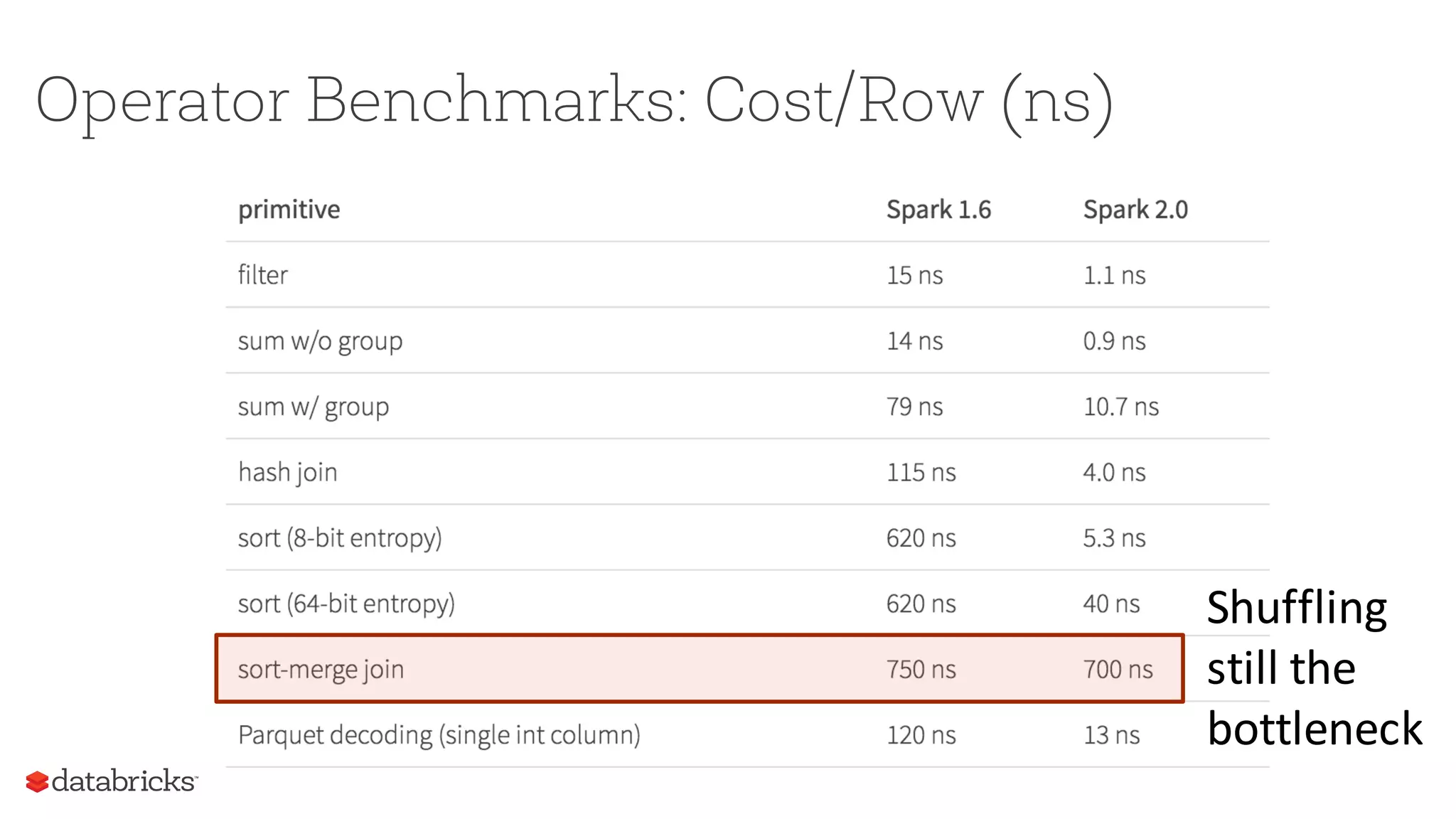
Operator Benchmarks: Cost/Row (ns)
Shuffling
still the
bottleneck
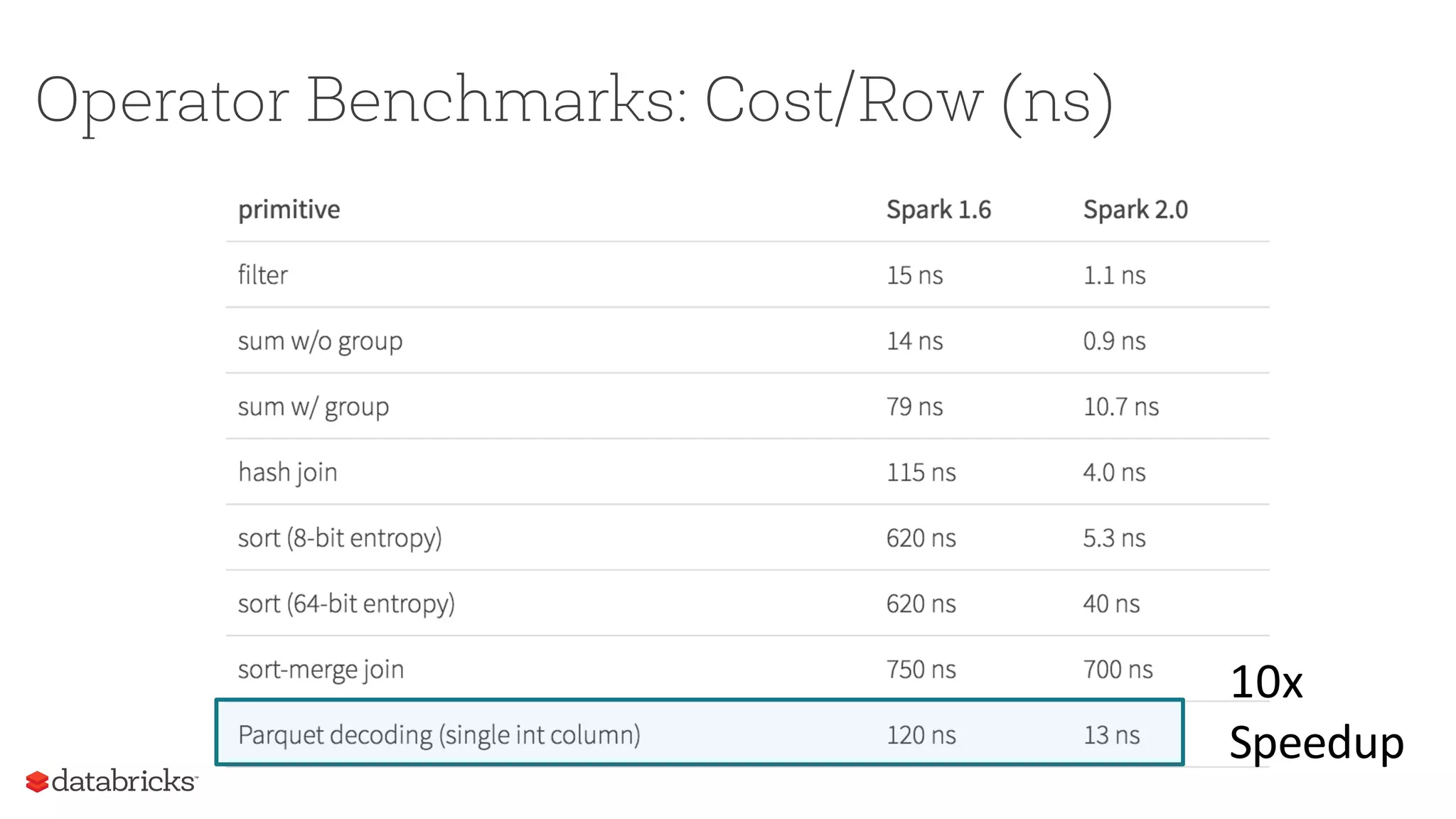
Operator Benchmarks: Cost/Row (ns)
10x
Speedup
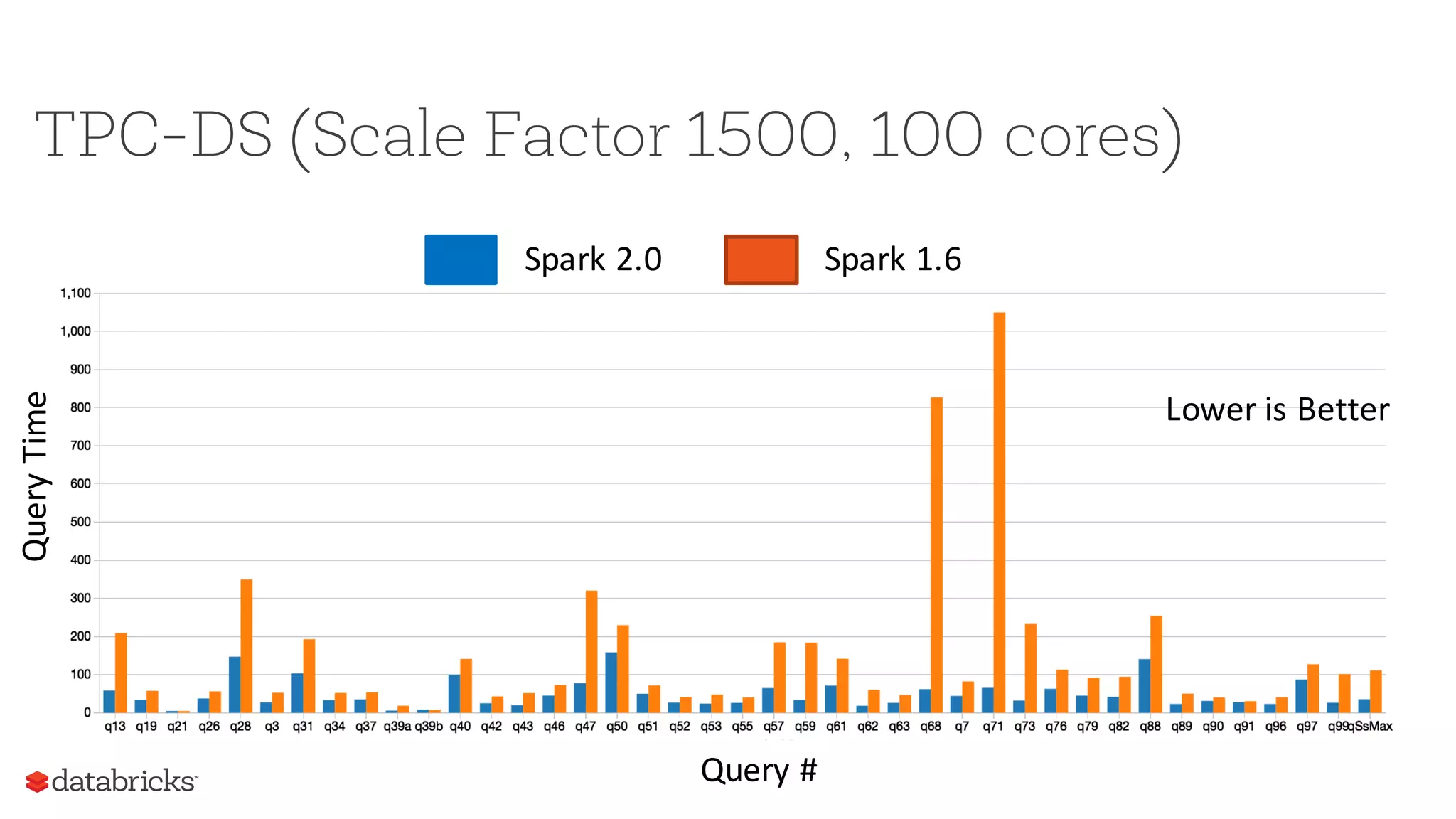
TPC-DS (Scale Factor 1500, 100 cores)
QueryTime
Query #
Spark 2.0 Spark 1.6
Lower is Better
Apache Spark 2.2 and 2.3
Massive focus on building ETL-friendly pipelines
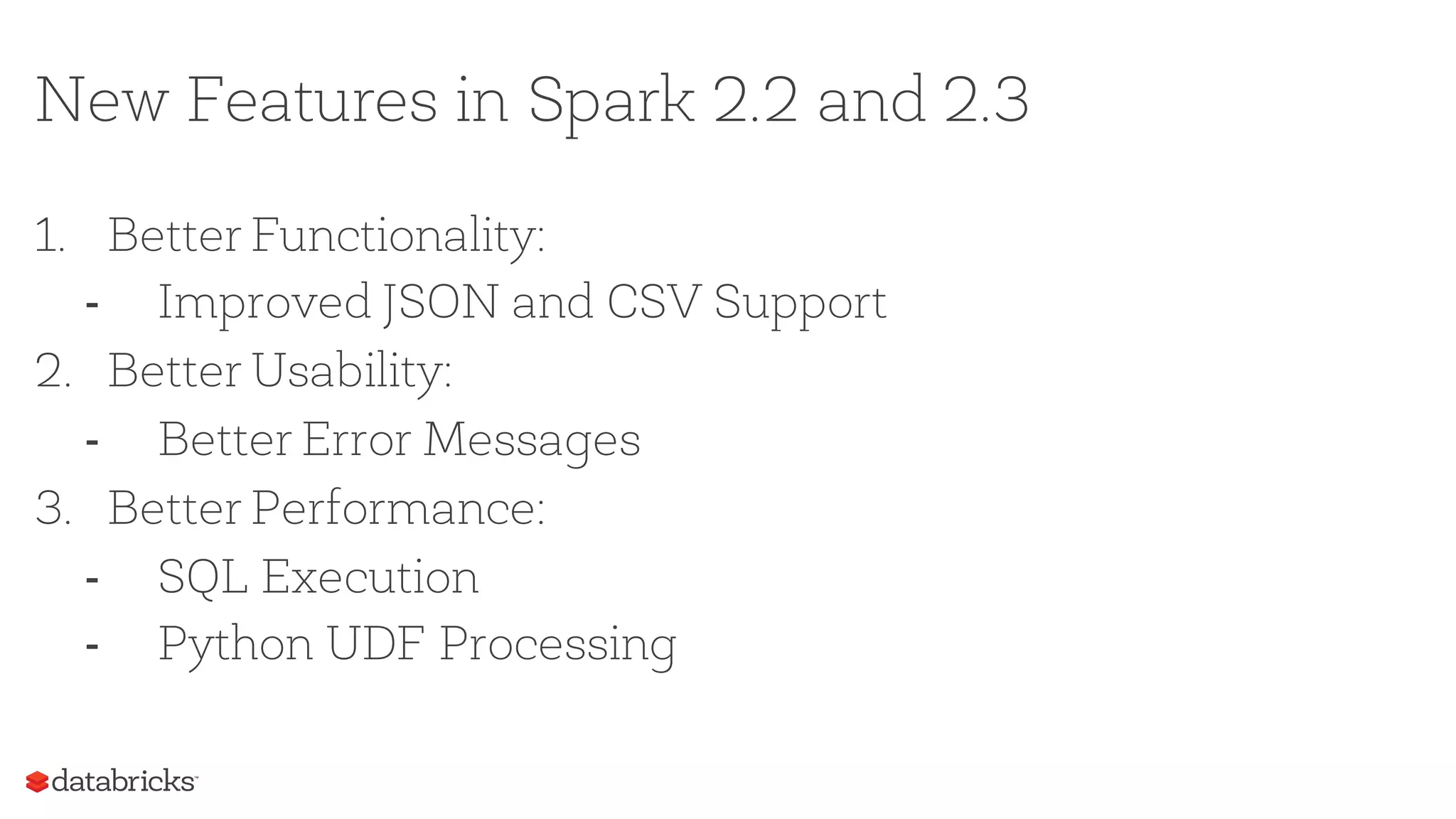
New Features in Spark 2.2 and 2.3
1. Better Functionality:
- Improved JSON and CSV Support
2. Better Usability:
- Better Error Messages
3. Better Performance:
- SQL Execution
- Python UDF Processing
Functionality: Better JSON Support
1. [SPARK-18352] Multi-line JSON Support
- Spark currently reads JSON one line at a time
- This currently requires custom ETL
spark.read
.option("wholeFile",true)
.json(path)
Availability: Spark 2.2
Functionality: Better JSON Support
2. [SPARK-19480] Higher order functions in SQL
- Enable users to manipulate nested data in Spark
- Operations include map, filter, reduce on arrays/maps
tbl_x
|-- key: long (nullable = false)
|-- values: array (nullable = false)
| |-- element: long (containsNull = false)
Functionality: Better JSON Support
2. [SPARK-19480] Higher order functions in SQL
Availability: Spark 2.3+
tbl_x
|-- key: long (nullable = false)
|-- values: array (nullable = false)
| |-- element: long (containsNull = false)
SELECT key, TRANSFORM(values, v -> v + key)
FROM tbl_x
Functionality: Better CSV Support
1. [SPARK-16099] Improved/Performant CSV Datasource
- Multiline CSV Support
- Additional options for CSV Parsing
- Whole text reader for dataframes
Availability: Spark 2.2
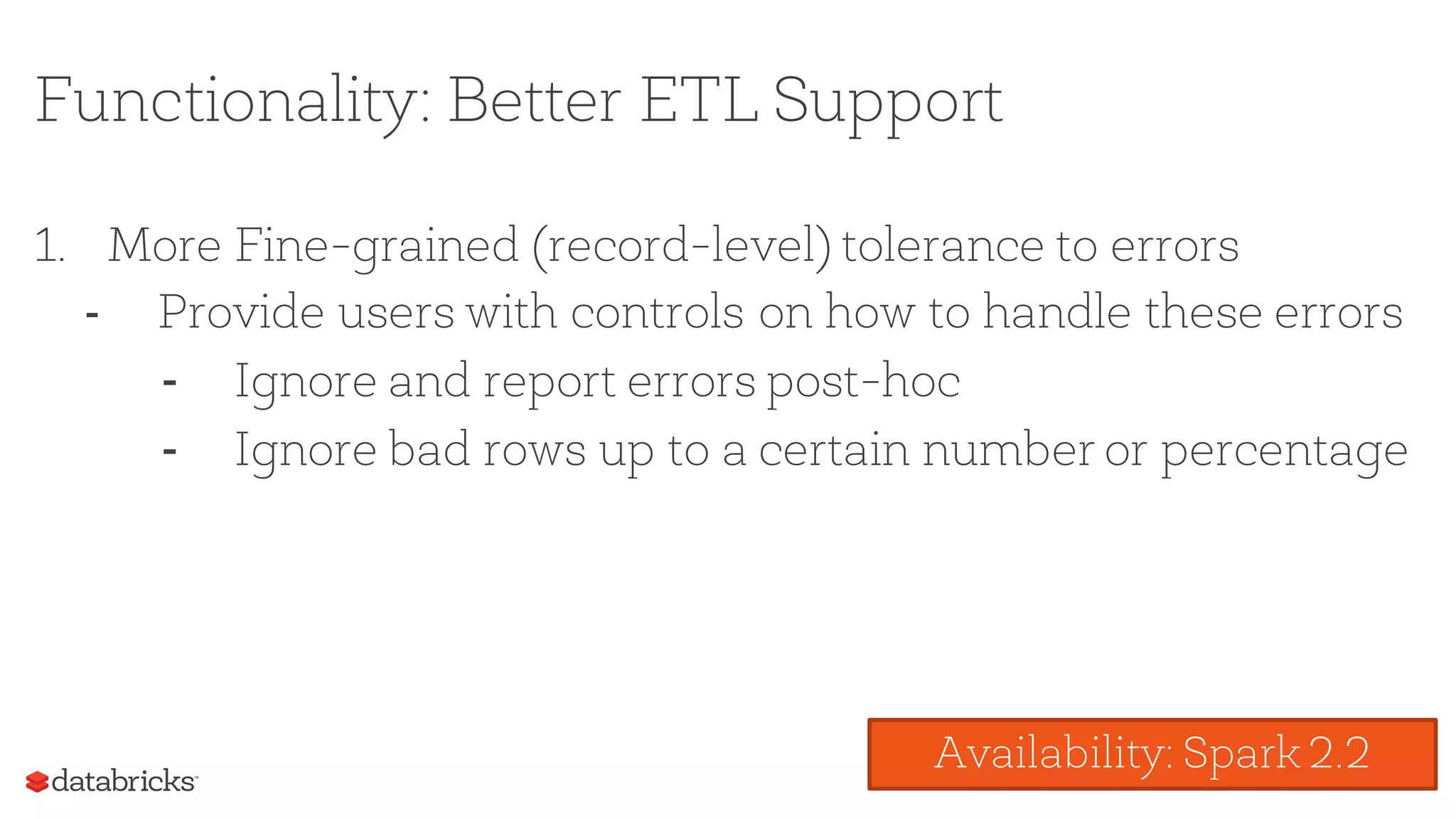
Functionality: Better ETL Support
1. More Fine-grained (record-level) tolerance to errors
- Provide users with controls on how to handle these errors
- Ignore and report errors post-hoc
- Ignore bad rows up to a certain number or percentage
Availability: Spark 2.2
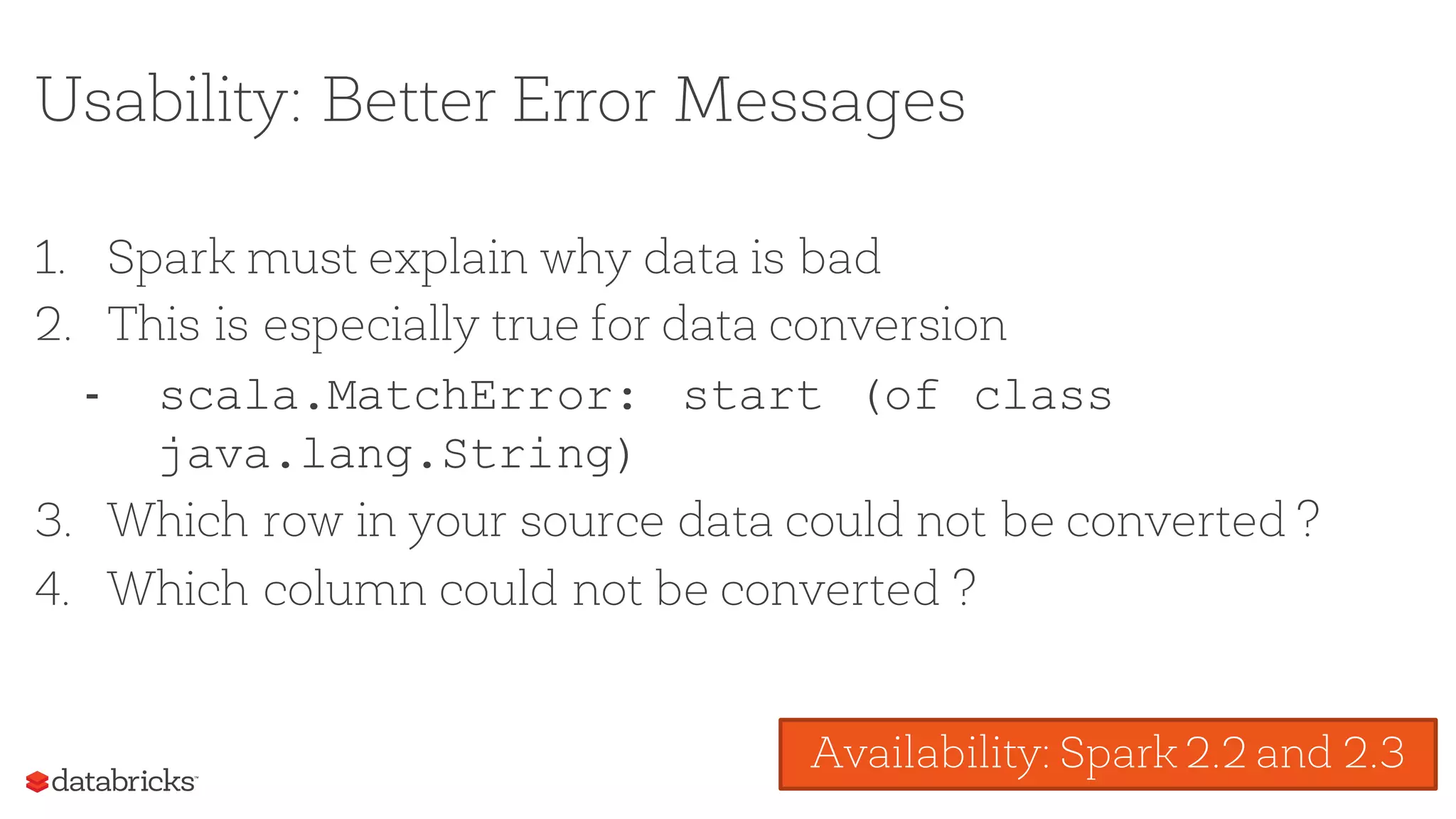
Usability: Better Error Messages
1. Spark must explain why data is bad
2. This is especially true for data conversion
- scala.MatchError: start (of class
java.lang.String)
3. Which row in your source data could not be converted ?
4. Which column could not be converted ?
Availability: Spark 2.2 and 2.3
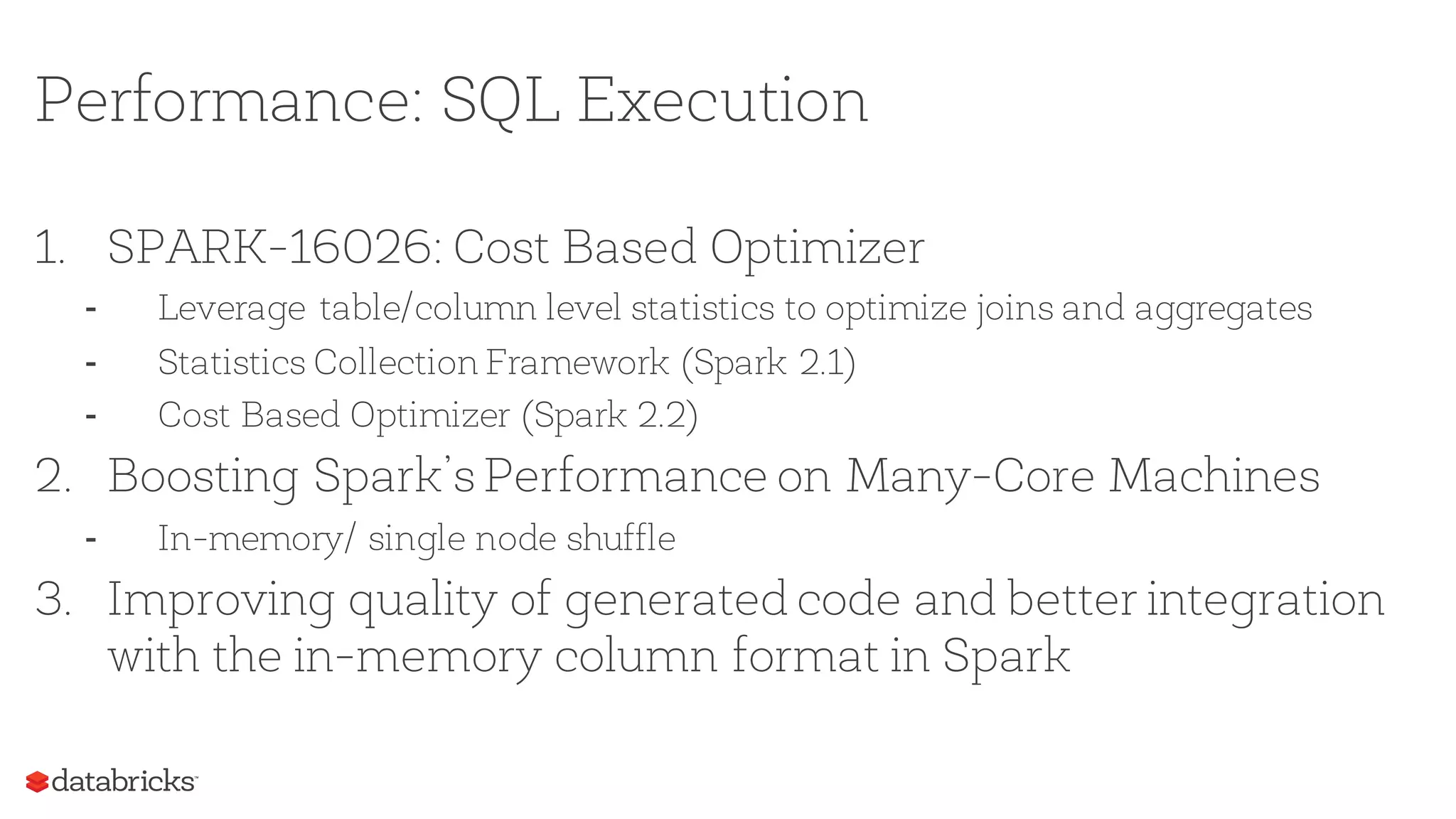
Performance: SQL Execution
1. SPARK-16026: Cost Based Optimizer
- Leverage table/column level statistics to optimize joins and aggregates
- Statistics Collection Framework (Spark 2.1)
- Cost Based Optimizer (Spark 2.2)
2. Boosting Spark’s Performance on Many-Core Machines
- In-memory/ single node shuffle
3. Improving quality of generated code and better integration
with the in-memory column format in Spark
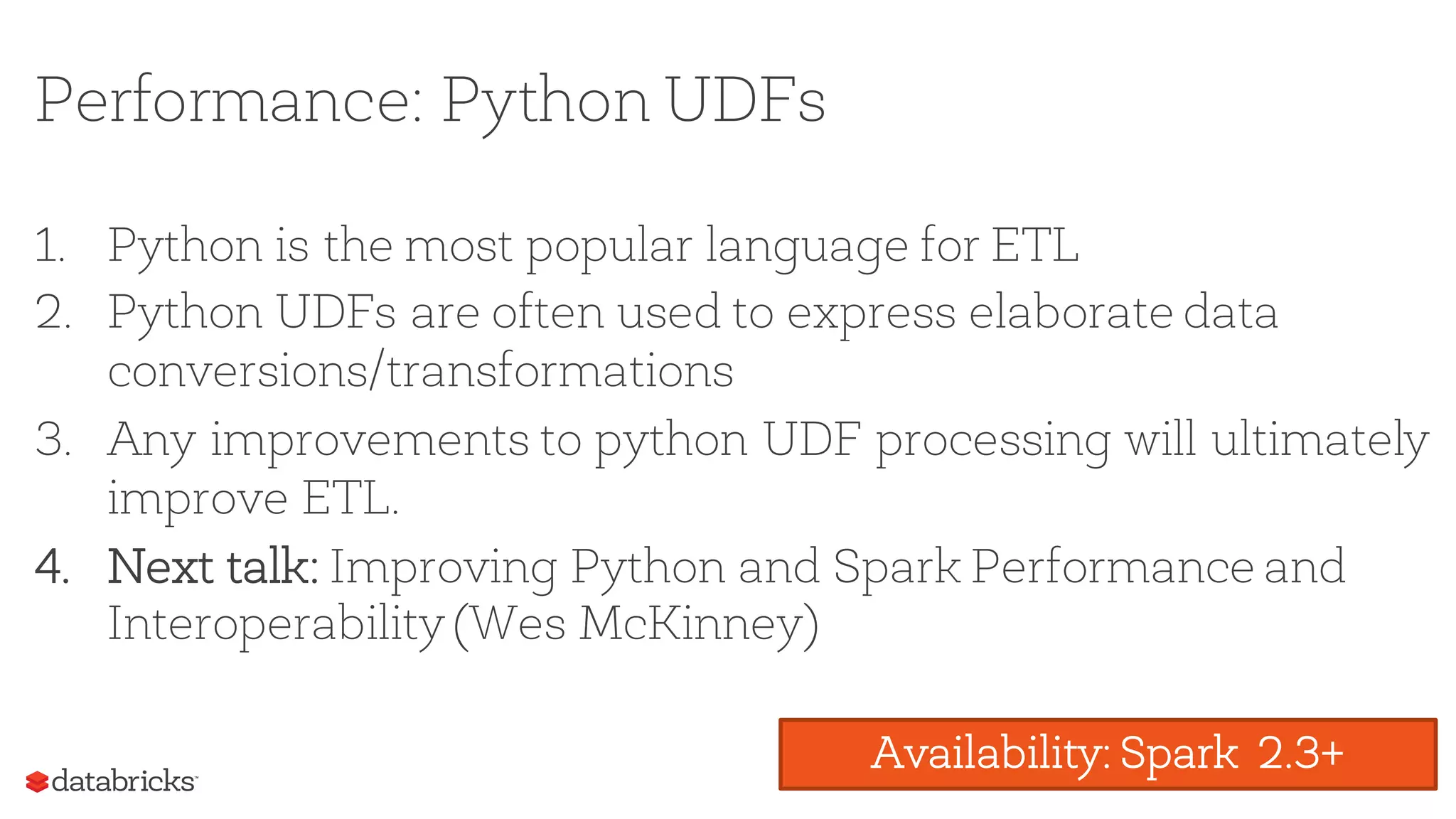
Performance: Python UDFs
1. Python is the most popular language for ETL
2. Python UDFs are often used to express elaborate data
conversions/transformations
3. Any improvements to python UDF processing will ultimately
improve ETL.
4. Next talk: Improving Python and Spark Performance and
Interoperability (Wes McKinney)
Availability: Spark 2.3+
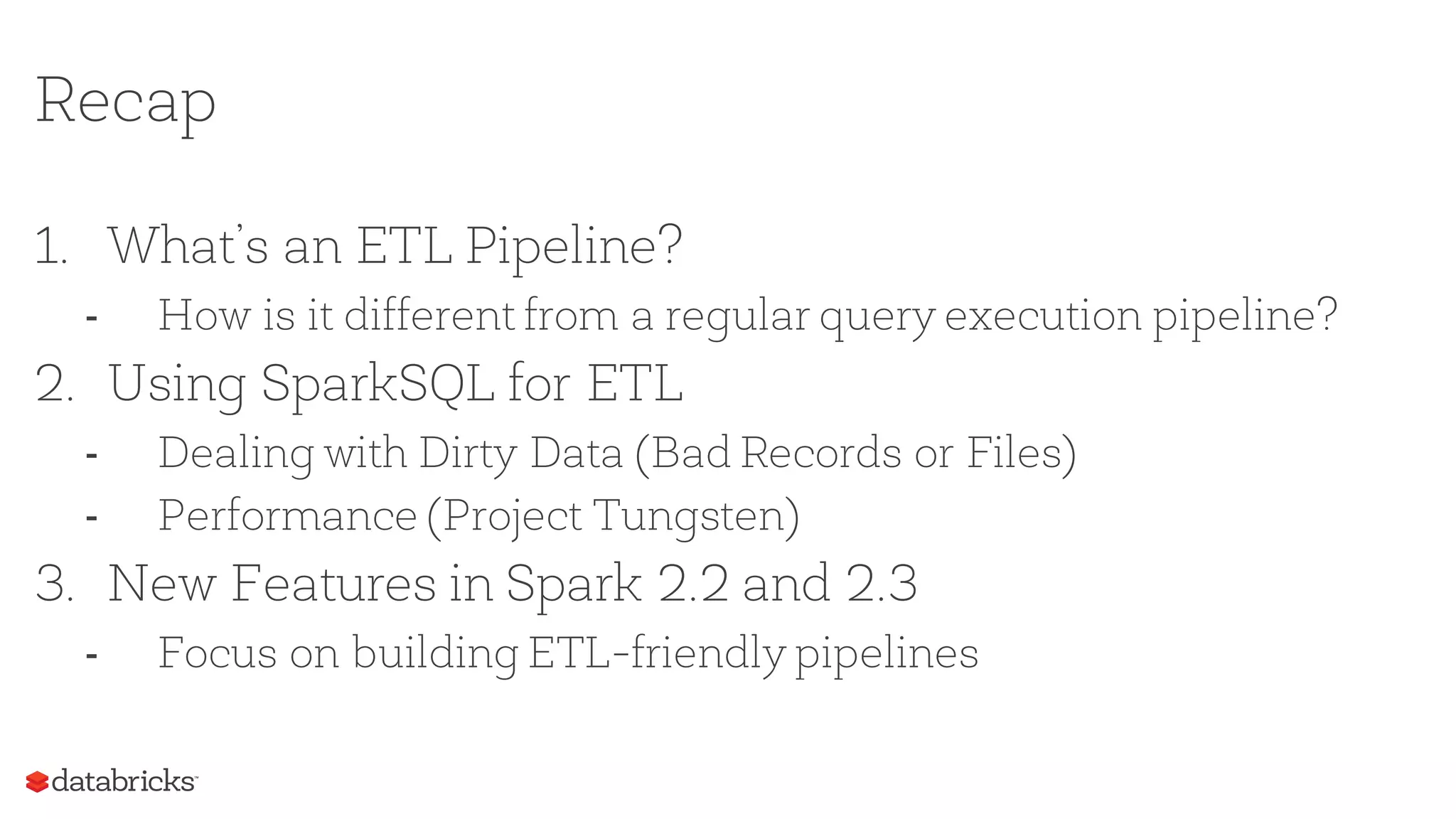
Recap
1. What’s an ETL Pipeline?
- How is it different from a regular query execution pipeline?
2. Using SparkSQL for ETL
- Dealing with Dirty Data (Bad Records or Files)
- Performance (Project Tungsten)
3. New Features in Spark 2.2 and 2.3
- Focus on building ETL-friendly pipelines
Questions?

Exceptions are the Norm: Dealing with Bad Actors in ETL

  • 1.
    Exceptions are theNorm Dealing with Bad Actors in ETL Sameer Agarwal Spark Summit | Boston | Feb 9th 2017
  • 2.
    About Me • SoftwareEngineer at Databricks (Spark Core/SQL) • PhD in Databases (AMPLab, UC Berkeley) • Research on BlinkDB (Approximate Queries in Spark)
  • 3.
    Overview 1. What’s anETL Pipeline? - How is it different from a regular query execution pipeline? 2. Using SparkSQL for ETL - Dealing with Dirty Data (Bad Records or Files) - Performance (Project Tungsten) 3. New Features in Spark 2.2 and 2.3 - Focus on building ETL-friendly pipelines
  • 4.
    What is aData Pipeline? 1. Sequence of transformations on data 2. Source data is typically semi-structured/unstructured (JSON, CSV etc.) 3. Output data is structured and ready for use by analysts and data scientists 4. Source and destination are often on different storage systems.
  • 5.
    Example of aData Pipeline Aggregate Reporting Applications ML Model Ad-hoc Queries Kafka Database Cloud Warehouse Logs
  • 6.
    ETL is theFirst Step in a Data Pipeline 1. ETL stands for EXTRACT, TRANSFORM and LOAD 2. Goal is to “clean” or “curate” the data - Retrieve data from source (EXTRACT) - Transform data into a consumable format (TRANSFORM) - Transmit data to downstream consumers (LOAD)
  • 7.
    An ETL Queryin Spark Extractspark.read.csv("/source/path”) EXTRACT
  • 8.
    An ETL Queryin Spark Extractspark.read.csv("/source/path") .filter(...) .agg(...) EXTRACT TRANSFORM
  • 9.
    An ETL Queryin Spark Extractspark.read.csv("/source/path") .filter(...) .agg(...) .write.mode("append") .parquet("/output/path") EXTRACT TRANSFORM LOAD
  • 10.
    What’s so hardabout ETL Queries?
  • 11.
    Why is ETLHard? 1. Data can be Messy - Incomplete information - Missing data stored as empty strings, “none”, “missing”, “xxx” etc. 2. Data can be Inconsistent - Data conversion and type validation in many cases is error-prone - For e.g., expecting a number but found ”123 000” - different formats “31/12/2017” “12/31/2017” - Incorrect information - For e.g., expecting 5 fields in CSV, but can’t find 5 fields.
  • 12.
    Why is ETLHard? 3. Data can be Constantly Arriving - At least once or exactly once semantics - Fault tolerance - Scalability 4. Data can be Complex - For e.g., Nested JSON data to extract and flatten - Dealing with inconsistency is even worse
  • 13.
    This is whyETL is important Consumers of this data don’t want to deal with this messiness and complexity
  • 14.
    On the flipside 1. A few bad records can fail a job • These are not the same as transient errors • No recourse for recovery 2. Support for ETL features • File formats and conversions have gaps • For e.g., multi-line support, date conversions 3. Performance
  • 15.
    Spark's flexible APIs,support for a wide variety of datasources and state of art tungsten execution engine makes it a great framework for building end-to-end ETL Pipelines
  • 16.
  • 17.
    Dealing with BadData: Skip Corrupt Files spark.read.csv("/source/path") .filter(...) .agg(...) .write.mode("append") .parquet("/output/path")
  • 18.
    Dealing with BadData: Skip Corrupt Files spark.read.csv("/source/path") .filter(...) .agg(...) .write.mode("append") .parquet("/output/path") Missing or Corrupt File
  • 19.
    Dealing with BadData: Skip Corrupt Files spark.sql.files.ignoreCorruptFiles = true Missing or Corrupt File [SPARK-17850] If true, the Spark jobs will continue to run even when it encounters corrupt or non-existent files. The contents that have been read will still be returned.
  • 20.
    Dealing with BadData: Skip Corrupt Records Missing or Corrupt Records
  • 21.
    Dealing with BadData: Skip Corrupt Records Missing or Corrupt Records [SPARK-12833][SPARK- 13764] TextFile formats (JSON and CSV) support 3 different ParseModes while reading data: 1. PERMISSIVE 2. DROPMALFORMED 3. FAILFAST
  • 22.
    JSON: Dealing withCorrupt Records {"a":1, "b":2, "c":3} {"a":{, b:3} {"a":5, "b":6, "c":7} spark.read .option("mode", "PERMISSIVE") .json(corruptRecords) .show() Can be configured via spark.sql.columnNameOfCorruptRecord
  • 23.
    JSON: Dealing withCorrupt Records {"a":1, "b":2, "c":3} {"a":{, b:3} {"a":5, "b":6, "c":7} spark.read .option("mode", ”DROPMALFORMED") .json(corruptRecords) .show()
  • 24.
    JSON: Dealing withCorrupt Records {"a":1, "b":2, "c":3} {"a":{, b:3} {"a":5, "b":6, "c":7} spark.read .option("mode", ”FAILFAST") .json(corruptRecords) .show() org.apache.spark.sql.catalyst.json .SparkSQLJsonProcessingException: Malformed line in FAILFAST mode: {"a":{, b:3}
  • 25.
    CSV: Dealing withCorrupt Records year,make,model,comment,blank "2012","Tesla","S","No comment", 1997,Ford,E350,"Go get one now they", 2015,Chevy,Volt spark.read .format("csv") .option("mode", "PERMISSIVE") .load(corruptRecords) .show()
  • 26.
    CSV: Dealing withCorrupt Records year,make,model,comment,blank "2012","Tesla","S","No comment", 1997,Ford,E350,"Go get one now they", 2015,Chevy,Volt spark.read .format("csv") .option("mode", ”DROPMALFORMED") .load(corruptRecords) .show()
  • 27.
    CSV: Dealing withCorrupt Records year,make,model,comment,blank "2012","Tesla","S","No comment", 1997,Ford,E350,"Go get one now they", 2015,Chevy,Volt spark.read .format("csv") .option("mode", ”FAILFAST") .load(corruptRecords) .show() java.lang.RuntimeException: Malformed line in FAILFAST mode: 2015,Chevy,Volt
  • 28.
    Spark Performance: ProjectTungsten Substantially improve the memory and CPU efficiency of Spark backend execution and push performance closer to the limits of modern hardware. Tungsten Execution PythonSQL R Streaming DataFrame Advanced Analytics
  • 29.
    Phase 1 Foundation Memory Management CodeGeneration Cache-aware Algorithms Phase 2 Order-of-magnitude Faster Whole-stage Codegen Vectorization Spark Performance: Project Tungsten SparkSQL: A Compiler from Queries to RDDs (Developer Track at 5:40pm)
  • 30.
    Operator Benchmarks: Cost/Row(ns) 5-30x Speedups
  • 31.
    Operator Benchmarks: Cost/Row(ns) Radix Sort 10-100x Speedups
  • 32.
    Operator Benchmarks: Cost/Row(ns) Shuffling still the bottleneck
  • 33.
  • 34.
    TPC-DS (Scale Factor1500, 100 cores) QueryTime Query # Spark 2.0 Spark 1.6 Lower is Better
  • 35.
    Apache Spark 2.2and 2.3 Massive focus on building ETL-friendly pipelines
  • 36.
    New Features inSpark 2.2 and 2.3 1. Better Functionality: - Improved JSON and CSV Support 2. Better Usability: - Better Error Messages 3. Better Performance: - SQL Execution - Python UDF Processing
  • 37.
    Functionality: Better JSONSupport 1. [SPARK-18352] Multi-line JSON Support - Spark currently reads JSON one line at a time - This currently requires custom ETL spark.read .option("wholeFile",true) .json(path) Availability: Spark 2.2
  • 38.
    Functionality: Better JSONSupport 2. [SPARK-19480] Higher order functions in SQL - Enable users to manipulate nested data in Spark - Operations include map, filter, reduce on arrays/maps tbl_x |-- key: long (nullable = false) |-- values: array (nullable = false) | |-- element: long (containsNull = false)
  • 39.
    Functionality: Better JSONSupport 2. [SPARK-19480] Higher order functions in SQL Availability: Spark 2.3+ tbl_x |-- key: long (nullable = false) |-- values: array (nullable = false) | |-- element: long (containsNull = false) SELECT key, TRANSFORM(values, v -> v + key) FROM tbl_x
  • 40.
    Functionality: Better CSVSupport 1. [SPARK-16099] Improved/Performant CSV Datasource - Multiline CSV Support - Additional options for CSV Parsing - Whole text reader for dataframes Availability: Spark 2.2
  • 41.
    Functionality: Better ETLSupport 1. More Fine-grained (record-level) tolerance to errors - Provide users with controls on how to handle these errors - Ignore and report errors post-hoc - Ignore bad rows up to a certain number or percentage Availability: Spark 2.2
  • 42.
    Usability: Better ErrorMessages 1. Spark must explain why data is bad 2. This is especially true for data conversion - scala.MatchError: start (of class java.lang.String) 3. Which row in your source data could not be converted ? 4. Which column could not be converted ? Availability: Spark 2.2 and 2.3
  • 43.
    Performance: SQL Execution 1.SPARK-16026: Cost Based Optimizer - Leverage table/column level statistics to optimize joins and aggregates - Statistics Collection Framework (Spark 2.1) - Cost Based Optimizer (Spark 2.2) 2. Boosting Spark’s Performance on Many-Core Machines - In-memory/ single node shuffle 3. Improving quality of generated code and better integration with the in-memory column format in Spark
  • 44.
    Performance: Python UDFs 1.Python is the most popular language for ETL 2. Python UDFs are often used to express elaborate data conversions/transformations 3. Any improvements to python UDF processing will ultimately improve ETL. 4. Next talk: Improving Python and Spark Performance and Interoperability (Wes McKinney) Availability: Spark 2.3+
  • 45.
    Recap 1. What’s anETL Pipeline? - How is it different from a regular query execution pipeline? 2. Using SparkSQL for ETL - Dealing with Dirty Data (Bad Records or Files) - Performance (Project Tungsten) 3. New Features in Spark 2.2 and 2.3 - Focus on building ETL-friendly pipelines
  • 46.