Floral formula and floral
diagram
Dambar Singh Khatri
At first we need to know..
• Floral formula tells us about nature of flower. Following natures of flowers are written symbolically to write
floral formula
• Bracteate or ebracteate
• Symmetry of flower( actinomorphic or zygomorphic)
• Sexuality of flower
• Number of sepals
• Union of sepals( poly or gamosepalous)
• Number of petals
• Union of petals (poly or gamopetalous)
• Number and union of stamens and carpels
Symbols used for different floral characters..
• Bracteate – Br Unisexual, male - ⚦
• Ebracteate- Ebr Unisexual female- ♀
• Bracteolate- Brl Neuter- N
• Ebracteolate- Ebrl Calyx, sepals- K
• Actinomorphic- ⊕ Corolla, petals- C
• Zygomorphic - % Perianth, tapals- P
• Bisexual- ⚥ Androecium, stamen- A
• Gynoecium, carpel- G
Some basic ideas..
• Number of floral leaves are written after their symbol.
• If the number of sepals is five, 5 is written after K. If it is polysepalous then it is
written as K5 and if it gamosepalous, it is written as K(5).
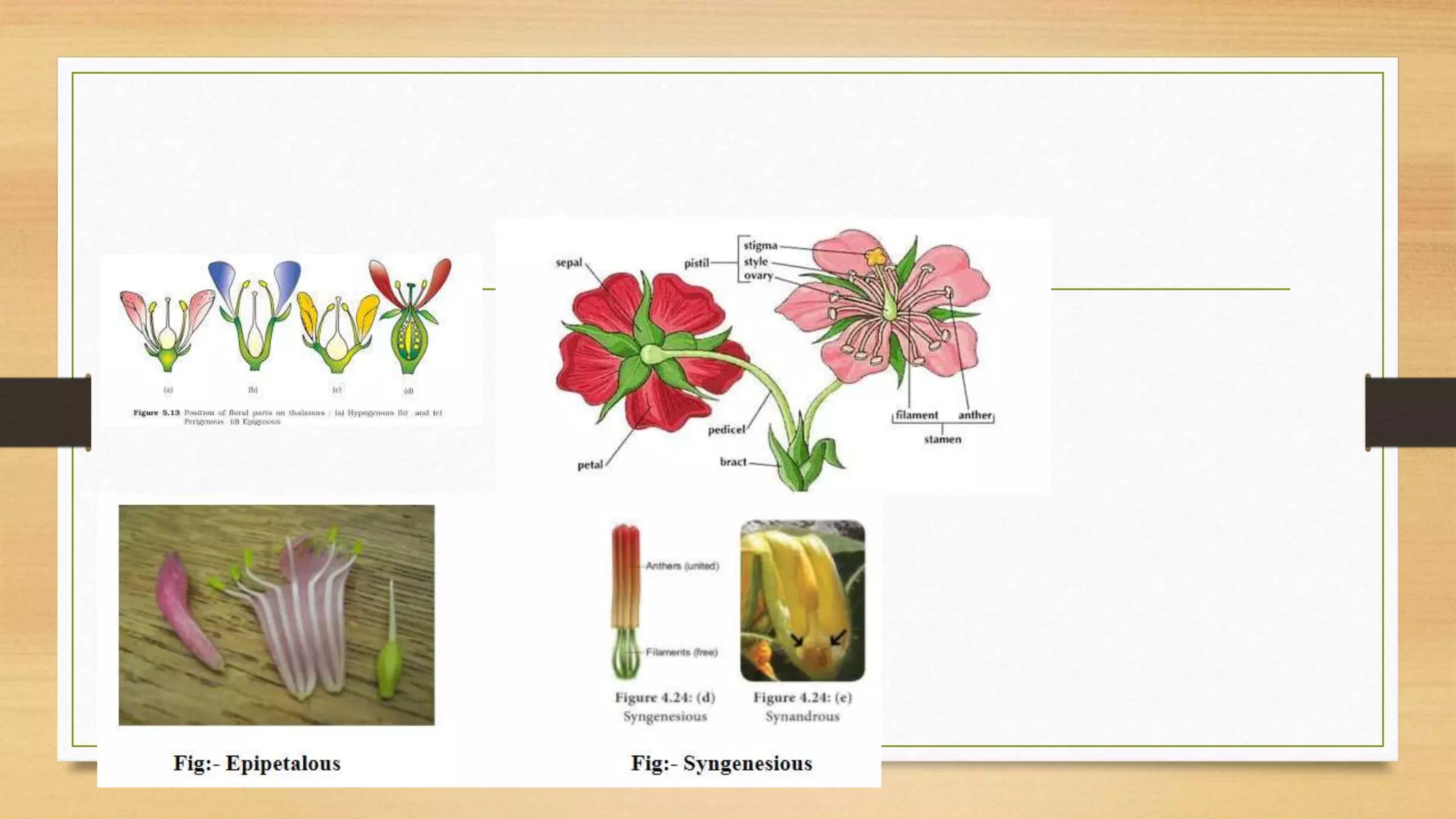
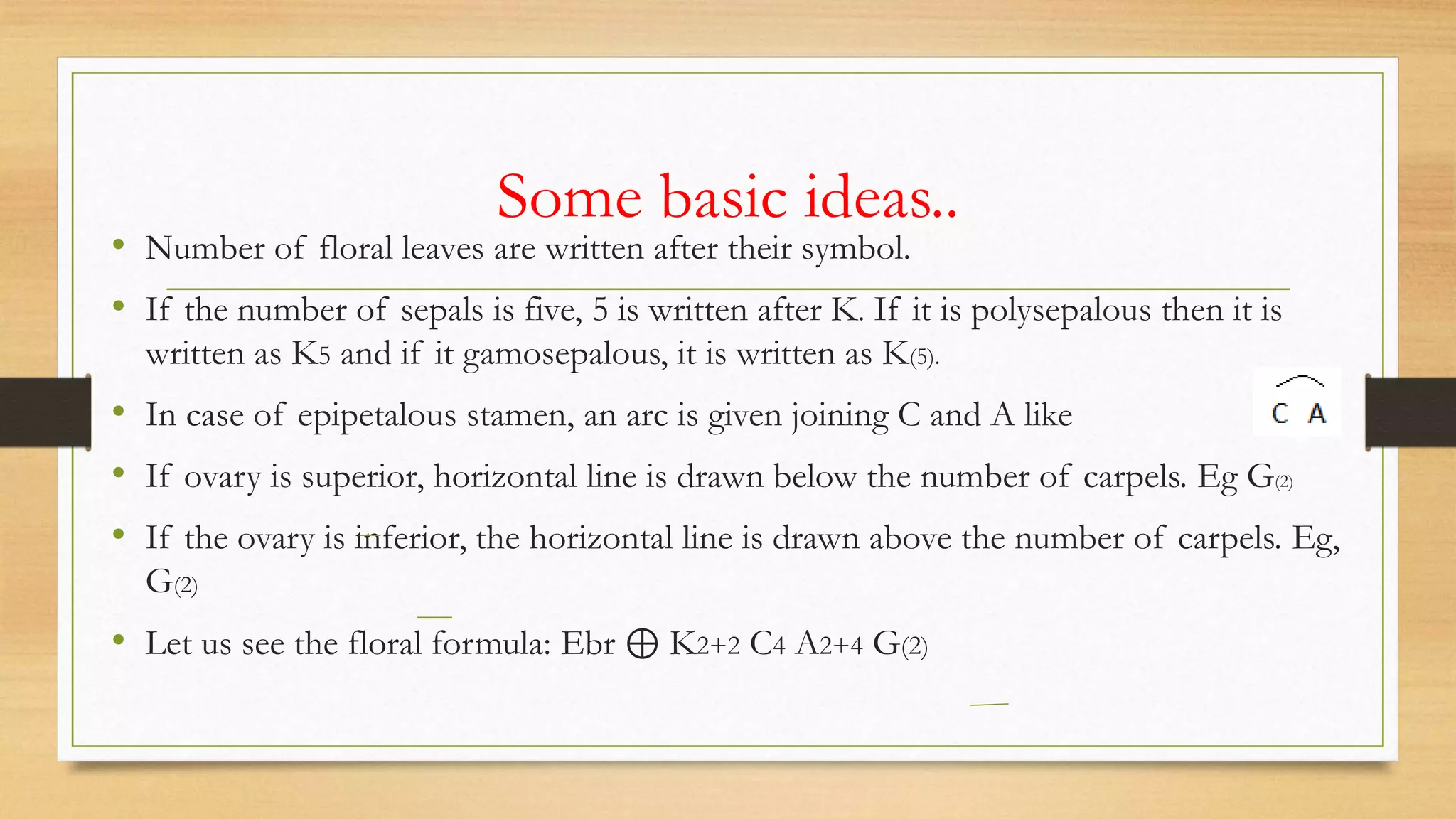
• In case of epipetalous stamen, an arc is given joining C and A like
• If ovary is superior, horizontal line is drawn below the number of carpels. Eg G(2)
• If the ovary is inferior, the horizontal line is drawn above the number of carpels. Eg,
G(2)
• Let us see the floral formula: Ebr ⊕ K2+2 C4 A2+4 G(2)
Floral diagram
• Floral diagram represents the plan of arrangements of floral whorls in relation to mother axis. It
describes most of the feathers of a flower like symmetry, regular, irregular, sexuality, number of
floral parts, relation between floral parts, nature of anthers, lobes of ovary placentation etc.
• T.S. of ovary is present in the center of floral diagram. Whorl of androecium, corolla, calyx are
drawn inside to outside of ovary.
• The sepals are represented by arc, androecium are represented by single or double kidney shaped
spots. If they are epipetalous, stamen and petals are joined by line.
• For gamopetalous or gamosepalous condition, adjacent petals or sepals are joined.
• Mother axis is represented by dots. If flower is bractate, additional arc is drawn at the anterior
side of flower diagram.
Floral diagram
Thank you

Floral formula and floral diagram

  • 1.
    Floral formula andfloral diagram Dambar Singh Khatri
  • 2.
    At first weneed to know.. • Floral formula tells us about nature of flower. Following natures of flowers are written symbolically to write floral formula • Bracteate or ebracteate • Symmetry of flower( actinomorphic or zygomorphic) • Sexuality of flower • Number of sepals • Union of sepals( poly or gamosepalous) • Number of petals • Union of petals (poly or gamopetalous) • Number and union of stamens and carpels
  • 4.
    Symbols used fordifferent floral characters.. • Bracteate – Br Unisexual, male - ⚦ • Ebracteate- Ebr Unisexual female- ♀ • Bracteolate- Brl Neuter- N • Ebracteolate- Ebrl Calyx, sepals- K • Actinomorphic- ⊕ Corolla, petals- C • Zygomorphic - % Perianth, tapals- P • Bisexual- ⚥ Androecium, stamen- A • Gynoecium, carpel- G
  • 5.
    Some basic ideas.. •Number of floral leaves are written after their symbol. • If the number of sepals is five, 5 is written after K. If it is polysepalous then it is written as K5 and if it gamosepalous, it is written as K(5). • In case of epipetalous stamen, an arc is given joining C and A like • If ovary is superior, horizontal line is drawn below the number of carpels. Eg G(2) • If the ovary is inferior, the horizontal line is drawn above the number of carpels. Eg, G(2) • Let us see the floral formula: Ebr ⊕ K2+2 C4 A2+4 G(2)
  • 6.
    Floral diagram • Floraldiagram represents the plan of arrangements of floral whorls in relation to mother axis. It describes most of the feathers of a flower like symmetry, regular, irregular, sexuality, number of floral parts, relation between floral parts, nature of anthers, lobes of ovary placentation etc. • T.S. of ovary is present in the center of floral diagram. Whorl of androecium, corolla, calyx are drawn inside to outside of ovary. • The sepals are represented by arc, androecium are represented by single or double kidney shaped spots. If they are epipetalous, stamen and petals are joined by line. • For gamopetalous or gamosepalous condition, adjacent petals or sepals are joined. • Mother axis is represented by dots. If flower is bractate, additional arc is drawn at the anterior side of flower diagram.
  • 7.
  • 8.