Hemispheric
Specialisation
Hemispheric
       Specialisation
This is the idea that one hemisphere has
specialised functions, or that it exerts
greater control over a particular function. It
is also known as hemispheric dominance
and hemispheric lateralisation.
 In reality both the left and right
hemispheres are involved in nearly all
functions.
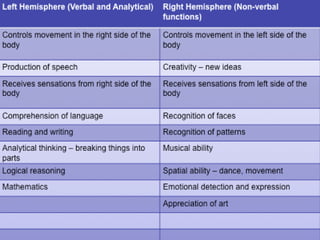
The Left Hemisphere
The left hemisphere specialises in verbal and
analytical functions.
Verbal functions involve the use or recognition of
words eg. reading, writing, speaking and
understanding speech.
Analytical functions involve breaking down a task
into its key parts and approaching it in a sequential ,
‘step by step’ way, as is required when using logical
reasoning to interpret and apply a formula to solve a
maths problem.
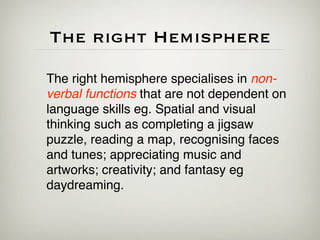
The right Hemisphere

The right hemisphere specialises in non-
verbal functions that are not dependent on
language skills eg. Spatial and visual
thinking such as completing a jigsaw
puzzle, reading a map, recognising faces
and tunes; appreciating music and
artworks; creativity; and fantasy eg
daydreaming.
Summary
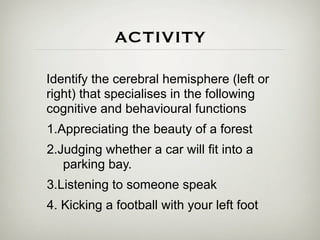
ACTIVITY

Identify the cerebral hemisphere (left or
right) that specialises in the following
cognitive and behavioural functions
1.Appreciating the beauty of a forest
2.Judging whether a car will fit into a
   parking bay.
3.Listening to someone speak
4. Kicking a football with your left foot
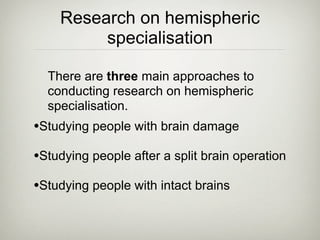
Research on hemispheric
         specialisation

  There are three main approaches to
  conducting research on hemispheric
  specialisation.
•Studying people with brain damage
•Studying people after a split brain operation
•Studying people with intact brains
Brain Damage Paitents

• Provided evidence of localisation of
  language skills (Broca’s and Wernicke’s
  areas)


• Neglect syndrome, a disorder caused by
  damage to the right hemisphere.
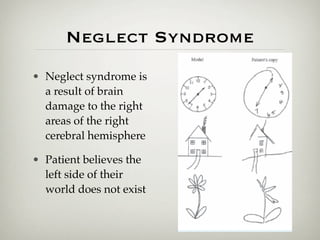
Neglect Syndrome
• Neglect syndrome is
  a result of brain
  damage to the right
  areas of the right
  cerebral hemisphere

• Patient believes the
  left side of their
  world does not exist
Split Brain Surgery
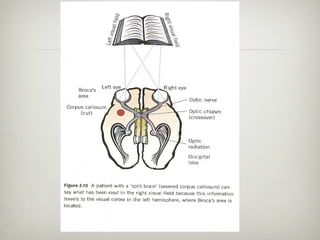
  Patients who have undergone a procedure
  called a split-brain operation have their
  corpus callosum surgically cut, which is a
  bundle of nerve fibres that connect the two
  hemispheres thereby disconnecting one
  hemisphere from the other. This procedure
  was first used in the 1940’s to stop recurring
  seizures in severe cases of epilepsy.
• http://www.youtube.com/watch?
  v=SpBc5Y0ES2s
Roger Sperry
• In the 1960’s Roger Sperry conducted a
  series of tests which involved patients
  viewing visual information being
  presented to only one hemispheres
• Information presented to the left visual
  field only (to the left side of patients
  vision) was sent to the right hemisphere
  of the brain and information presented
  to the right visual field only was sent to
  the left hemisphere.
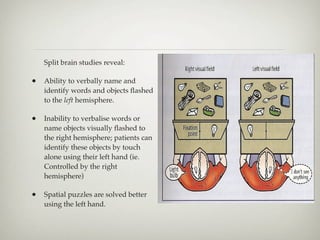
Split brain studies reveal:

•   Ability to verbally name and
    identify words and objects flashed
    to the left hemisphere.

•   Inability to verbalise words or
    name objects visually flashed to
    the right hemisphere; patients can
    identify these objects by touch
    alone using their left hand (ie.
    Controlled by the right
    hemisphere)

•   Spatial puzzles are solved better
    using the left hand.
Avtivity


Draw a diagram to demonstrate your
knowledge of Sperry’s experiments.
Intact Brains


• Wada test
• Tachisscope
Wada Test
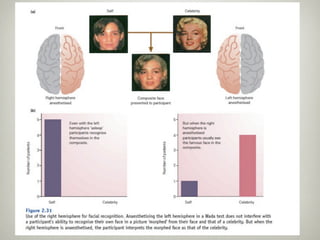
• Some of the best evidence relating to hemispheric
  specialization comes from the Wada test—a procedure
  carried out before brain surgery.
• In the Wada test each hemisphere is put to sleep at
  different times by injecting anesthetic into a major
  artery that leads only to that hemisphere. While one
  hemisphere is anesthetized, the other remains awake
  and conscious. Once half the brain is anesthetized,
  doctors can interview the other half (if the patient is
  capable of talking) or give instructions to perform
  simple tasks. This helps to determine what skills or
  abilities might be confined to one hemisphere.
Tachistoscope


• What is it?
• How has it helped show evidence for
  hemispheric specialisation
Revision
1. List three hemispheric specialisations of
   each of the left and right hemispheres.
2. Describe neglect syndrome. What causes
   it?
3. Explain how split brain surgery has
   contributed to evidence to support
   hemispheric specialisation.

Hemispheric Specialisation

  • 1.
  • 2.
    Hemispheric Specialisation This is the idea that one hemisphere has specialised functions, or that it exerts greater control over a particular function. It is also known as hemispheric dominance and hemispheric lateralisation. In reality both the left and right hemispheres are involved in nearly all functions.
  • 3.
    The Left Hemisphere Theleft hemisphere specialises in verbal and analytical functions. Verbal functions involve the use or recognition of words eg. reading, writing, speaking and understanding speech. Analytical functions involve breaking down a task into its key parts and approaching it in a sequential , ‘step by step’ way, as is required when using logical reasoning to interpret and apply a formula to solve a maths problem.
  • 4.
    The right Hemisphere Theright hemisphere specialises in non- verbal functions that are not dependent on language skills eg. Spatial and visual thinking such as completing a jigsaw puzzle, reading a map, recognising faces and tunes; appreciating music and artworks; creativity; and fantasy eg daydreaming.
  • 5.
  • 6.
    ACTIVITY Identify the cerebralhemisphere (left or right) that specialises in the following cognitive and behavioural functions 1.Appreciating the beauty of a forest 2.Judging whether a car will fit into a parking bay. 3.Listening to someone speak 4. Kicking a football with your left foot
  • 7.
    Research on hemispheric specialisation There are three main approaches to conducting research on hemispheric specialisation. •Studying people with brain damage •Studying people after a split brain operation •Studying people with intact brains
  • 8.
    Brain Damage Paitents •Provided evidence of localisation of language skills (Broca’s and Wernicke’s areas) • Neglect syndrome, a disorder caused by damage to the right hemisphere.
  • 9.
    Neglect Syndrome • Neglectsyndrome is a result of brain damage to the right areas of the right cerebral hemisphere • Patient believes the left side of their world does not exist
  • 10.
    Split Brain Surgery Patients who have undergone a procedure called a split-brain operation have their corpus callosum surgically cut, which is a bundle of nerve fibres that connect the two hemispheres thereby disconnecting one hemisphere from the other. This procedure was first used in the 1940’s to stop recurring seizures in severe cases of epilepsy. • http://www.youtube.com/watch? v=SpBc5Y0ES2s
  • 11.
    Roger Sperry • Inthe 1960’s Roger Sperry conducted a series of tests which involved patients viewing visual information being presented to only one hemispheres • Information presented to the left visual field only (to the left side of patients vision) was sent to the right hemisphere of the brain and information presented to the right visual field only was sent to the left hemisphere.
  • 12.
    Split brain studiesreveal: • Ability to verbally name and identify words and objects flashed to the left hemisphere. • Inability to verbalise words or name objects visually flashed to the right hemisphere; patients can identify these objects by touch alone using their left hand (ie. Controlled by the right hemisphere) • Spatial puzzles are solved better using the left hand.
  • 13.
    Avtivity Draw a diagramto demonstrate your knowledge of Sperry’s experiments.
  • 15.
    Intact Brains • Wadatest • Tachisscope
  • 16.
    Wada Test • Someof the best evidence relating to hemispheric specialization comes from the Wada test—a procedure carried out before brain surgery. • In the Wada test each hemisphere is put to sleep at different times by injecting anesthetic into a major artery that leads only to that hemisphere. While one hemisphere is anesthetized, the other remains awake and conscious. Once half the brain is anesthetized, doctors can interview the other half (if the patient is capable of talking) or give instructions to perform simple tasks. This helps to determine what skills or abilities might be confined to one hemisphere.
  • 18.
    Tachistoscope • What isit? • How has it helped show evidence for hemispheric specialisation
  • 19.
    Revision 1. List threehemispheric specialisations of each of the left and right hemispheres. 2. Describe neglect syndrome. What causes it? 3. Explain how split brain surgery has contributed to evidence to support hemispheric specialisation.