Surveys in
practice and theory
2011
Caroline Jarrett
J.Boye Conference Denmark
Agenda Introduction and getting started with surveys
Surveys in practice:
• Working on questions
• A practical survey process
Surveys in theory:
• What the experts tell us about an ideal process
• The four types of survey error
• Some tips from the experts on how to avoid error
2
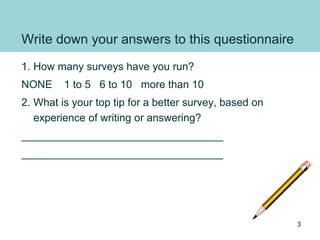
Write down your answers to this questionnaire
1. How many surveys have you run?
NONE 1 to 5 6 to 10 more than 10
2. What is your top tip for a better survey, based on
experience of writing or answering?
__________________________________
__________________________________
3
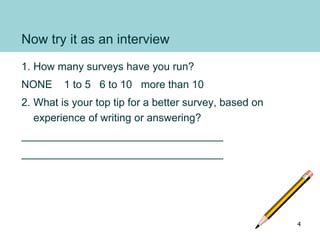
Now try it as an interview
1. How many surveys have you run?
NONE 1 to 5 6 to 10 more than 10
2. What is your top tip for a better survey, based on
experience of writing or answering?
__________________________________
__________________________________
4
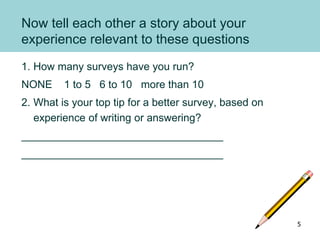
Now tell each other a story about your
experience relevant to these questions
1. How many surveys have you run?
NONE 1 to 5 6 to 10 more than 10
2. What is your top tip for a better survey, based on
experience of writing or answering?
__________________________________
__________________________________
5
Now let’s share data and stories
• What numbers have we collected?
• What open answers?
• What stories?
• Which of the three little surveys was the best?
6
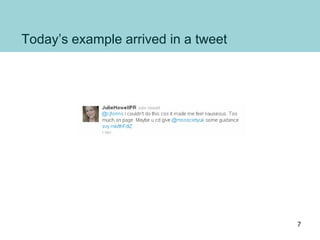
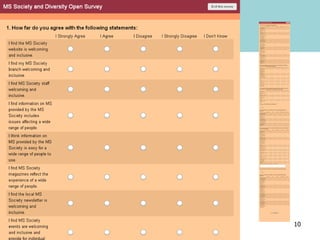
Today’s example arrived in a tweet
7
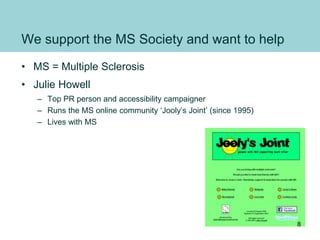
We support the MS Society and want to help
• MS = Multiple Sclerosis
• Julie Howell
– Top PR person and accessibility campaigner
– Runs the MS online community ‘Jooly’s Joint’ (since 1995)
– Lives with MS
8
9
10
Agenda Introduction and getting started with surveys
Surveys in practice:
• Working on questions
• A practical survey process
Surveys in theory:
• What the experts tell us about an ideal process
• The four types of survey error
• Some tips from the experts on how to avoid error
11
Write good questions
• Mix question types: closed and open
• Use appropriate, unambiguous language
• Avoid leading questions
• Present one question at a time
• Keep questions concise
• Keep positive; negatives are harder to understand
12

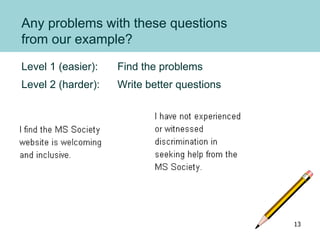
Any problems with these questions
from our example?
Level 1 (easier): Find the problems
Level 2 (harder): Write better questions
13
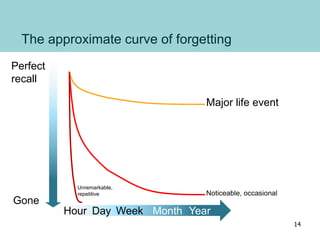
The approximate curve of forgetting
Perfect
recall
Day
Gone
Major life event
Noticeable, occasional
Unremarkable,
repetitive
Week Month YearHour
14
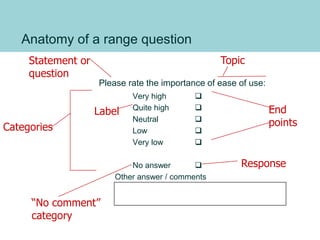
Anatomy of a range question
Please rate the importance of ease of use:
Very high 
Quite high 
Neutral 
Low 
Very low 
No answer 
Other answer / comments
End
points
Topic
Categories
“No comment”
category
Label
Statement or
question
Response
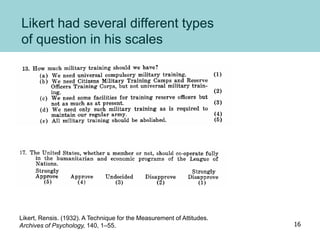
Likert had several different types
of question in his scales
Likert, Rensis. (1932). A Technique for the Measurement of Attitudes.
Archives of Psychology, 140, 1–55. 16
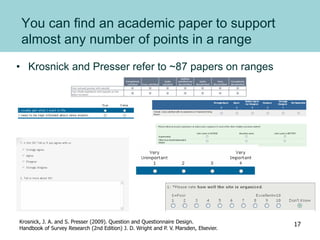
You can find an academic paper to support
almost any number of points in a range
• Krosnick and Presser refer to ~87 papers on ranges
Krosnick, J. A. and S. Presser (2009). Question and Questionnaire Design.
Handbook of Survey Research (2nd Edition) J. D. Wright and P. V. Marsden, Elsevier.
17
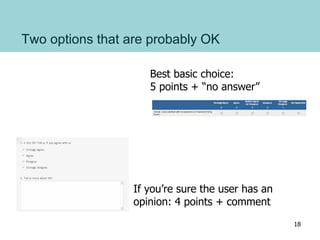
Two options that are probably OK
Best basic choice:
5 points + “no answer”
If you’re sure the user has an
opinion: 4 points + comment
18
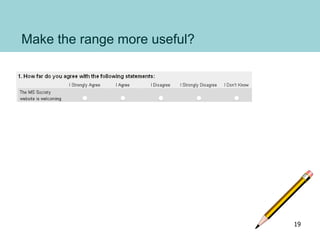
Make the range more useful?
19
Agenda Introduction and getting started with surveys
Surveys in practice:
• Working on questions
• A practical survey process
Surveys in theory:
• What the experts tell us about an ideal process
• The four types of survey error
• Some tips from the experts on how to avoid error
20
A survey is
more than
questions
© Caroline Jarrett and Effortmark Ltd
If you use this cartoon in another context,
please credit Caroline Jarrett and Effortmark Ltd.
21
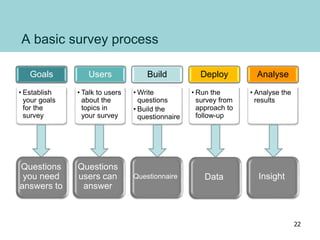
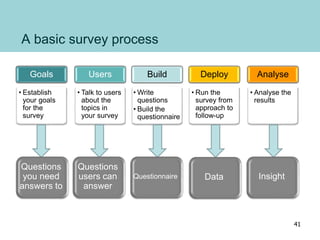
A basic survey process
Goals
• Establish
your goals
for the
survey
Questions
you need
answers to
Users
• Talk to users
about the
topics in
your survey
Questions
users can
answer
Build
• Write
questions
• Build the
questionnaire
Questionnaire
Deploy
• Run the
survey from
approach to
follow-up
Data
Analyse
• Analyse the
results
Insight
22
Goals
• Establish
your goals
for the
survey
What do you want to know?
Why do you want to know?
What will you do with the answers?
23
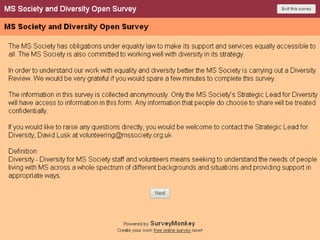
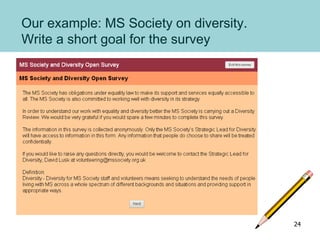
Our example: MS Society on diversity.
Write a short goal for the survey
24
Goals Users
• Talk to users
about the
topics in
your survey
• Who are they?
• How will you find them?
• Do they want to answer your questions?
• Do they understand your questions?
25
Users
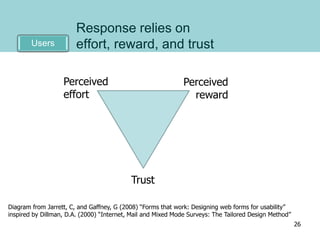
Response relies on
effort, reward, and trust
Trust
Perceived
effort
Perceived
reward
Diagram from Jarrett, C, and Gaffney, G (2008) “Forms that work: Designing web forms for usability”
inspired by Dillman, D.A. (2000) “Internet, Mail and Mixed Mode Surveys: The Tailored Design Method”
26
A token incentive works
better than no incentive
or a prize draw
27
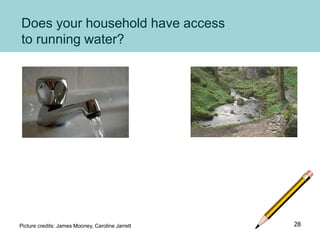
Does your household have access
to running water?
Picture credits: James Mooney, Caroline Jarrett 28
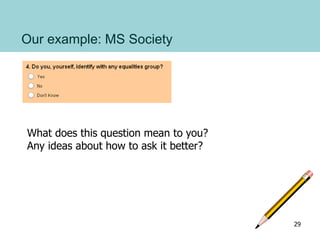
Our example: MS Society
What does this question mean to you?
Any ideas about how to ask it better?
29
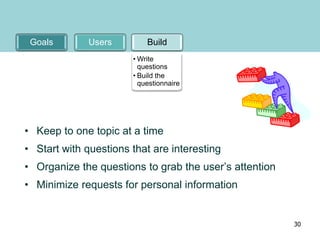
Goals Users Build
• Write
questions
• Build the
questionnaire
• Keep to one topic at a time
• Start with questions that are interesting
• Organize the questions to grab the user’s attention
• Minimize requests for personal information
30
Sorting out the topics: group these ones
1. What was your total family income in 2009?
2. Do you like to play golf?
3. What is your opinion on global warming?
4. Are you married?
5. Which political party does the best job of promoting economic growth?
6. How many times have you gone bowling in the last year?
7. What is your political party preference?
8. Do you favour or oppose higher tax on fuel as a measure
to reduce environmental pollution?
9. What is your occupation?
10.Please describe your favourite recreational activity.
11.How old are you?
Adapted from Dillman, D.A., Smyth, J.D. and Christian, L.M. (2009)
Internet, Mail and Mixed Mode Surveys: The Tailored Design Method 31
Goals Users Build Deploy
• Run the
survey from
approach to
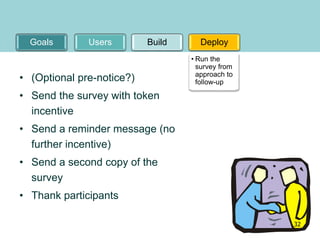
follow-up• (Optional pre-notice?)
• Send the survey with token
incentive
• Send a reminder message (no
further incentive)
• Send a second copy of the
survey
• Thank participants
32
33
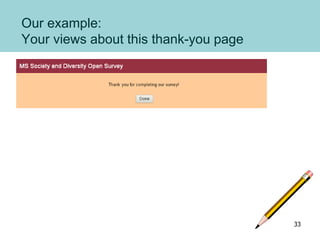
Our example:
Your views about this thank-you page
Goals Users Build Deploy Analyse
• Create
summaries and
comparisons
• Present the
results
• Tidy up the data
• Decide what to do about “item non-response”
• Remove the whole entry?
• Use the partial entry?
• Calculate an “inferred value”?
34
Analyse Compile responses
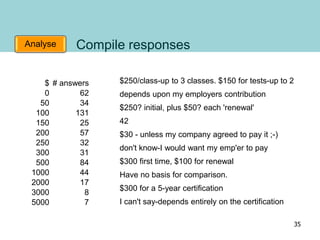
$ # answers
0 62
50 34
100 131
150 25
200 57
250 32
300 31
500 84
1000 44
2000 17
3000 8
5000 7
$250/class-up to 3 classes. $150 for tests-up to 2
depends upon my employers contribution
$250? initial, plus $50? each 'renewal'
42
$30 - unless my company agreed to pay it ;-)
don't know-I would want my emp'er to pay
$300 first time, $100 for renewal
Have no basis for comparison.
$300 for a 5-year certification
I can't say-depends entirely on the certification
35
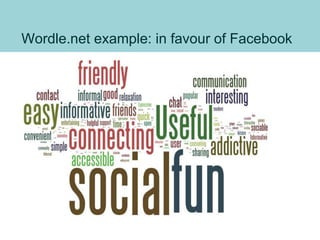
Wordle.net example: in favour of Facebook
Another: against Facebook
Wordle from the UPA survey on certification
38
Analyse Publish results - gently
• Don’t surprise people with bad news
• Make sure publication is timely
• Keep reports short
• It’s OK to have some gaps
in the results, “more work
needed”
39
Agenda Introduction and getting started with surveys
Surveys in practice:
• Working on questions
• A practical survey process
Surveys in theory:
• What the experts tell us about an ideal process
• The four types of survey error
• Some tips from the experts on how to avoid error
40
A basic survey process
Goals
• Establish
your goals
for the
survey
Questions
you need
answers to
Users
• Talk to users
about the
topics in
your survey
Questions
users can
answer
Build
• Write
questions
• Build the
questionnaire
Questionnaire
Deploy
• Run the
survey from
approach to
follow-up
Data
Analyse
• Analyse the
results
Insight
41
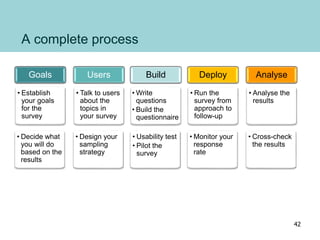
A complete process
Goals
• Establish
your goals
for the
survey
• Decide what
you will do
based on the
results
Users
• Talk to users
about the
topics in
your survey
• Design your
sampling
strategy
Build
• Write
questions
• Build the
questionnaire
• Usability test
• Pilot the
survey
Deploy
• Run the
survey from
approach to
follow-up
• Monitor your
response
rate
Analyse
• Analyse the
results
• Cross-check
the results
42
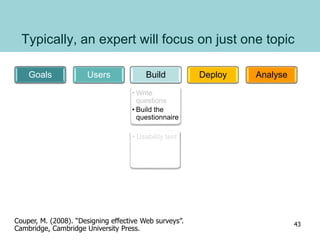
Typically, an expert will focus on just one topic
Goals Users Build
• Write
questions
• Build the
questionnaire
• Usability test
Deploy Analyse
Couper, M. (2008). “Designing effective Web surveys”.
Cambridge, Cambridge University Press.
43
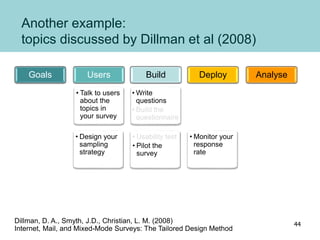
Another example:
topics discussed by Dillman et al (2008)
Goals Users
• Talk to users
about the
topics in
your survey
• Design your
sampling
strategy
Build
• Write
questions
• Build the
questionnaire
• Usability test
• Pilot the
survey
Deploy
• Monitor your
response
rate
Analyse
Dillman, D. A., Smyth, J.D., Christian, L. M. (2008)
Internet, Mail, and Mixed-Mode Surveys: The Tailored Design Method
44
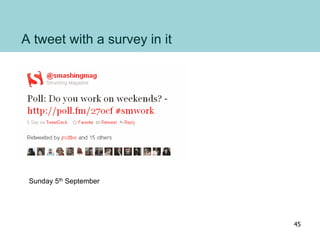
A tweet with a survey in it
Sunday 5th September
45
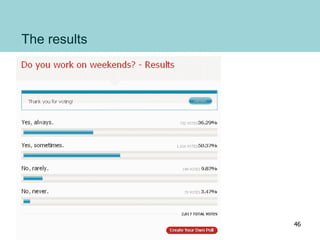
The results
46
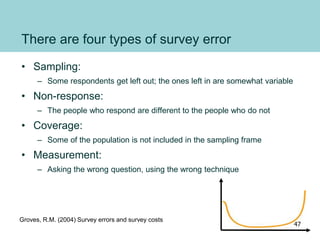
There are four types of survey error
• Sampling:
– Some respondents get left out; the ones left in are somewhat variable
• Non-response:
– The people who respond are different to the people who do not
• Coverage:
– Some of the population is not included in the sampling frame
• Measurement:
– Asking the wrong question, using the wrong technique
Groves, R.M. (2004) Survey errors and survey costs
47
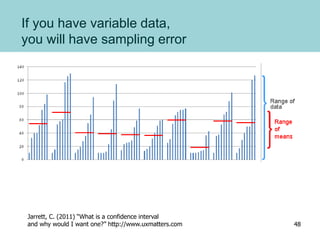
If you have variable data,
you will have sampling error
Jarrett, C. (2011) “What is a confidence interval
and why would I want one?” http://www.uxmatters.com 48
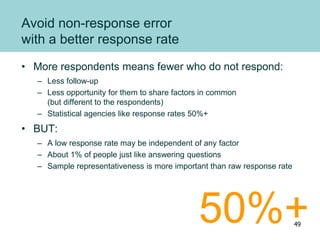
Avoid non-response error
with a better response rate
• More respondents means fewer who do not respond:
– Less follow-up
– Less opportunity for them to share factors in common
(but different to the respondents)
– Statistical agencies like response rates 50%+
• BUT:
– A low response rate may be independent of any factor
– About 1% of people just like answering questions
– Sample representativeness is more important than raw response rate
50%+49
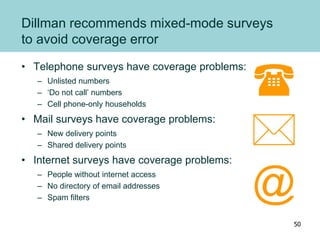
Dillman recommends mixed-mode surveys
to avoid coverage error
• Telephone surveys have coverage problems:
– Unlisted numbers
– ‘Do not call’ numbers
– Cell phone-only households
• Mail surveys have coverage problems:
– New delivery points
– Shared delivery points
• Internet surveys have coverage problems:
– People without internet access
– No directory of email addresses
– Spam filters


@
50
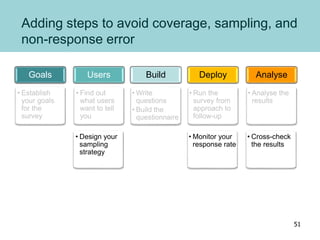
Adding steps to avoid coverage, sampling, and
non-response error
Users
• Design your
sampling
strategy
Deploy
• Monitor your
response rate
Analyse
• Cross-check
the results
Goals
• Establish
your goals
for the
survey
• Find out
what users
want to tell
you
Build
• Write
questions
• Build the
questionnaire
• Run the
survey from
approach to
follow-up
• Analyse the
results
51
Avoid measurement error by being careful
• Have clear goals for your survey
• Make sure your users want to answer your questions
• Keep testing everything, all the time
• Make sure that you analyse the data from your pilot
52
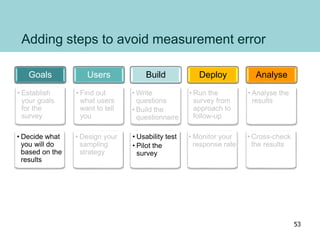
Adding steps to avoid measurement error
Goals
• Decide what
you will do
based on the
results
Build
• Usability test
• Pilot the
survey
• Establish
your goals
for the
survey
Users
• Find out
what users
want to tell
you
• Design your
sampling
strategy
• Write
questions
• Build the
questionnaire
Deploy
• Run the
survey from
approach to
follow-up
• Monitor your
response rate
Analyse
• Analyse the
results
• Cross-check
the results
53
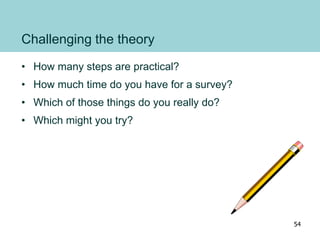
Challenging the theory
• How many steps are practical?
• How much time do you have for a survey?
• Which of those things do you really do?
• Which might you try?
54
Acknowledgement and references
• Thanks to Karen Bachmann
– Workshop started as one that we presented together in 2002 and 2003
• Books on survey design
– Dillman, D.A., Smyth, J.D. and Christian, L.M. (2009)
Internet, Mail and Mixed Mode Surveys: The Tailored Design Method
• Very practical, informed by many years’ research. Written in a straightforward style.
• The earlier editions (1999 and 2007) are also good and you may be able to get one
cheaply second-hand
– Gilham, Bill (2008) "Developing a questionnaire" Continuum Books
• Thin, clear and practical book that takes you through the survey process.
• My edition is the 2000; there is a newer one in 2008 which I’m sure will be even better
– Schuman, H. and Presser, S. (1996) “Questions and Answers in Attitude
Surveys: Experiments on Question Form, Wording, and Context”
• Thorough analysis of all the ways in which questions can be slippery, based on many
years’ research.
55
Other references
• Krosnick, J. and Presser S. (2009) “Question and Questionnaire
Design” in Handbook of Survey Research (2nd Edition) James D.
Wright and Peter V. Marsden (Eds).
– http://comm.stanford.edu/faculty/krosnick/Handbook%20of%20Survey%20Resea
rch.pdf
– Literature review, comprehensively referenced
• Barnum, C. M. (2011) “Usability Testing Essentials: Ready Set, Test”
Morgan Kaufmann
– Thorough but approachable book on how to do usability testing
• Groves, R. M. (2004) “Survey errors and survey costs” Wiley
– More detail about this book here:
http://www.rosenfeldmedia.com/books/survey-
design/blog/survey_book_of_the_month_may_2/
56
Caroline Jarrett
twitter @cjforms
caroline.jarrett@effortmark.co.uk
57

Surveys in practice and theory

  • 1.
    Surveys in practice andtheory 2011 Caroline Jarrett J.Boye Conference Denmark
  • 2.
    Agenda Introduction andgetting started with surveys Surveys in practice: • Working on questions • A practical survey process Surveys in theory: • What the experts tell us about an ideal process • The four types of survey error • Some tips from the experts on how to avoid error 2
  • 3.
    Write down youranswers to this questionnaire 1. How many surveys have you run? NONE 1 to 5 6 to 10 more than 10 2. What is your top tip for a better survey, based on experience of writing or answering? __________________________________ __________________________________ 3
  • 4.
    Now try itas an interview 1. How many surveys have you run? NONE 1 to 5 6 to 10 more than 10 2. What is your top tip for a better survey, based on experience of writing or answering? __________________________________ __________________________________ 4
  • 5.
    Now tell eachother a story about your experience relevant to these questions 1. How many surveys have you run? NONE 1 to 5 6 to 10 more than 10 2. What is your top tip for a better survey, based on experience of writing or answering? __________________________________ __________________________________ 5
  • 6.
    Now let’s sharedata and stories • What numbers have we collected? • What open answers? • What stories? • Which of the three little surveys was the best? 6
  • 7.
  • 8.
    We support theMS Society and want to help • MS = Multiple Sclerosis • Julie Howell – Top PR person and accessibility campaigner – Runs the MS online community ‘Jooly’s Joint’ (since 1995) – Lives with MS 8
  • 9.
  • 10.
  • 11.
    Agenda Introduction andgetting started with surveys Surveys in practice: • Working on questions • A practical survey process Surveys in theory: • What the experts tell us about an ideal process • The four types of survey error • Some tips from the experts on how to avoid error 11
  • 12.
    Write good questions •Mix question types: closed and open • Use appropriate, unambiguous language • Avoid leading questions • Present one question at a time • Keep questions concise • Keep positive; negatives are harder to understand 12 
  • 13.
    Any problems withthese questions from our example? Level 1 (easier): Find the problems Level 2 (harder): Write better questions 13
  • 14.
    The approximate curveof forgetting Perfect recall Day Gone Major life event Noticeable, occasional Unremarkable, repetitive Week Month YearHour 14
  • 15.
    Anatomy of arange question Please rate the importance of ease of use: Very high  Quite high  Neutral  Low  Very low  No answer  Other answer / comments End points Topic Categories “No comment” category Label Statement or question Response
  • 16.
    Likert had severaldifferent types of question in his scales Likert, Rensis. (1932). A Technique for the Measurement of Attitudes. Archives of Psychology, 140, 1–55. 16
  • 17.
    You can findan academic paper to support almost any number of points in a range • Krosnick and Presser refer to ~87 papers on ranges Krosnick, J. A. and S. Presser (2009). Question and Questionnaire Design. Handbook of Survey Research (2nd Edition) J. D. Wright and P. V. Marsden, Elsevier. 17
  • 18.
    Two options thatare probably OK Best basic choice: 5 points + “no answer” If you’re sure the user has an opinion: 4 points + comment 18
  • 19.
    Make the rangemore useful? 19
  • 20.
    Agenda Introduction andgetting started with surveys Surveys in practice: • Working on questions • A practical survey process Surveys in theory: • What the experts tell us about an ideal process • The four types of survey error • Some tips from the experts on how to avoid error 20
  • 21.
    A survey is morethan questions © Caroline Jarrett and Effortmark Ltd If you use this cartoon in another context, please credit Caroline Jarrett and Effortmark Ltd. 21
  • 22.
    A basic surveyprocess Goals • Establish your goals for the survey Questions you need answers to Users • Talk to users about the topics in your survey Questions users can answer Build • Write questions • Build the questionnaire Questionnaire Deploy • Run the survey from approach to follow-up Data Analyse • Analyse the results Insight 22
  • 23.
    Goals • Establish your goals forthe survey What do you want to know? Why do you want to know? What will you do with the answers? 23
  • 24.
    Our example: MSSociety on diversity. Write a short goal for the survey 24
  • 25.
    Goals Users • Talkto users about the topics in your survey • Who are they? • How will you find them? • Do they want to answer your questions? • Do they understand your questions? 25
  • 26.
    Users Response relies on effort,reward, and trust Trust Perceived effort Perceived reward Diagram from Jarrett, C, and Gaffney, G (2008) “Forms that work: Designing web forms for usability” inspired by Dillman, D.A. (2000) “Internet, Mail and Mixed Mode Surveys: The Tailored Design Method” 26
  • 27.
    A token incentiveworks better than no incentive or a prize draw 27
  • 28.
    Does your householdhave access to running water? Picture credits: James Mooney, Caroline Jarrett 28
  • 29.
    Our example: MSSociety What does this question mean to you? Any ideas about how to ask it better? 29
  • 30.
    Goals Users Build •Write questions • Build the questionnaire • Keep to one topic at a time • Start with questions that are interesting • Organize the questions to grab the user’s attention • Minimize requests for personal information 30
  • 31.
    Sorting out thetopics: group these ones 1. What was your total family income in 2009? 2. Do you like to play golf? 3. What is your opinion on global warming? 4. Are you married? 5. Which political party does the best job of promoting economic growth? 6. How many times have you gone bowling in the last year? 7. What is your political party preference? 8. Do you favour or oppose higher tax on fuel as a measure to reduce environmental pollution? 9. What is your occupation? 10.Please describe your favourite recreational activity. 11.How old are you? Adapted from Dillman, D.A., Smyth, J.D. and Christian, L.M. (2009) Internet, Mail and Mixed Mode Surveys: The Tailored Design Method 31
  • 32.
    Goals Users BuildDeploy • Run the survey from approach to follow-up• (Optional pre-notice?) • Send the survey with token incentive • Send a reminder message (no further incentive) • Send a second copy of the survey • Thank participants 32
  • 33.
    33 Our example: Your viewsabout this thank-you page
  • 34.
    Goals Users BuildDeploy Analyse • Create summaries and comparisons • Present the results • Tidy up the data • Decide what to do about “item non-response” • Remove the whole entry? • Use the partial entry? • Calculate an “inferred value”? 34
  • 35.
    Analyse Compile responses $# answers 0 62 50 34 100 131 150 25 200 57 250 32 300 31 500 84 1000 44 2000 17 3000 8 5000 7 $250/class-up to 3 classes. $150 for tests-up to 2 depends upon my employers contribution $250? initial, plus $50? each 'renewal' 42 $30 - unless my company agreed to pay it ;-) don't know-I would want my emp'er to pay $300 first time, $100 for renewal Have no basis for comparison. $300 for a 5-year certification I can't say-depends entirely on the certification 35
  • 36.
    Wordle.net example: infavour of Facebook
  • 37.
  • 38.
    Wordle from theUPA survey on certification 38
  • 39.
    Analyse Publish results- gently • Don’t surprise people with bad news • Make sure publication is timely • Keep reports short • It’s OK to have some gaps in the results, “more work needed” 39
  • 40.
    Agenda Introduction andgetting started with surveys Surveys in practice: • Working on questions • A practical survey process Surveys in theory: • What the experts tell us about an ideal process • The four types of survey error • Some tips from the experts on how to avoid error 40
  • 41.
    A basic surveyprocess Goals • Establish your goals for the survey Questions you need answers to Users • Talk to users about the topics in your survey Questions users can answer Build • Write questions • Build the questionnaire Questionnaire Deploy • Run the survey from approach to follow-up Data Analyse • Analyse the results Insight 41
  • 42.
    A complete process Goals •Establish your goals for the survey • Decide what you will do based on the results Users • Talk to users about the topics in your survey • Design your sampling strategy Build • Write questions • Build the questionnaire • Usability test • Pilot the survey Deploy • Run the survey from approach to follow-up • Monitor your response rate Analyse • Analyse the results • Cross-check the results 42
  • 43.
    Typically, an expertwill focus on just one topic Goals Users Build • Write questions • Build the questionnaire • Usability test Deploy Analyse Couper, M. (2008). “Designing effective Web surveys”. Cambridge, Cambridge University Press. 43
  • 44.
    Another example: topics discussedby Dillman et al (2008) Goals Users • Talk to users about the topics in your survey • Design your sampling strategy Build • Write questions • Build the questionnaire • Usability test • Pilot the survey Deploy • Monitor your response rate Analyse Dillman, D. A., Smyth, J.D., Christian, L. M. (2008) Internet, Mail, and Mixed-Mode Surveys: The Tailored Design Method 44
  • 45.
    A tweet witha survey in it Sunday 5th September 45
  • 46.
  • 47.
    There are fourtypes of survey error • Sampling: – Some respondents get left out; the ones left in are somewhat variable • Non-response: – The people who respond are different to the people who do not • Coverage: – Some of the population is not included in the sampling frame • Measurement: – Asking the wrong question, using the wrong technique Groves, R.M. (2004) Survey errors and survey costs 47
  • 48.
    If you havevariable data, you will have sampling error Jarrett, C. (2011) “What is a confidence interval and why would I want one?” http://www.uxmatters.com 48
  • 49.
    Avoid non-response error witha better response rate • More respondents means fewer who do not respond: – Less follow-up – Less opportunity for them to share factors in common (but different to the respondents) – Statistical agencies like response rates 50%+ • BUT: – A low response rate may be independent of any factor – About 1% of people just like answering questions – Sample representativeness is more important than raw response rate 50%+49
  • 50.
    Dillman recommends mixed-modesurveys to avoid coverage error • Telephone surveys have coverage problems: – Unlisted numbers – ‘Do not call’ numbers – Cell phone-only households • Mail surveys have coverage problems: – New delivery points – Shared delivery points • Internet surveys have coverage problems: – People without internet access – No directory of email addresses – Spam filters   @ 50
  • 51.
    Adding steps toavoid coverage, sampling, and non-response error Users • Design your sampling strategy Deploy • Monitor your response rate Analyse • Cross-check the results Goals • Establish your goals for the survey • Find out what users want to tell you Build • Write questions • Build the questionnaire • Run the survey from approach to follow-up • Analyse the results 51
  • 52.
    Avoid measurement errorby being careful • Have clear goals for your survey • Make sure your users want to answer your questions • Keep testing everything, all the time • Make sure that you analyse the data from your pilot 52
  • 53.
    Adding steps toavoid measurement error Goals • Decide what you will do based on the results Build • Usability test • Pilot the survey • Establish your goals for the survey Users • Find out what users want to tell you • Design your sampling strategy • Write questions • Build the questionnaire Deploy • Run the survey from approach to follow-up • Monitor your response rate Analyse • Analyse the results • Cross-check the results 53
  • 54.
    Challenging the theory •How many steps are practical? • How much time do you have for a survey? • Which of those things do you really do? • Which might you try? 54
  • 55.
    Acknowledgement and references •Thanks to Karen Bachmann – Workshop started as one that we presented together in 2002 and 2003 • Books on survey design – Dillman, D.A., Smyth, J.D. and Christian, L.M. (2009) Internet, Mail and Mixed Mode Surveys: The Tailored Design Method • Very practical, informed by many years’ research. Written in a straightforward style. • The earlier editions (1999 and 2007) are also good and you may be able to get one cheaply second-hand – Gilham, Bill (2008) "Developing a questionnaire" Continuum Books • Thin, clear and practical book that takes you through the survey process. • My edition is the 2000; there is a newer one in 2008 which I’m sure will be even better – Schuman, H. and Presser, S. (1996) “Questions and Answers in Attitude Surveys: Experiments on Question Form, Wording, and Context” • Thorough analysis of all the ways in which questions can be slippery, based on many years’ research. 55
  • 56.
    Other references • Krosnick,J. and Presser S. (2009) “Question and Questionnaire Design” in Handbook of Survey Research (2nd Edition) James D. Wright and Peter V. Marsden (Eds). – http://comm.stanford.edu/faculty/krosnick/Handbook%20of%20Survey%20Resea rch.pdf – Literature review, comprehensively referenced • Barnum, C. M. (2011) “Usability Testing Essentials: Ready Set, Test” Morgan Kaufmann – Thorough but approachable book on how to do usability testing • Groves, R. M. (2004) “Survey errors and survey costs” Wiley – More detail about this book here: http://www.rosenfeldmedia.com/books/survey- design/blog/survey_book_of_the_month_may_2/ 56

  • 57.