SESSION	ID:SESSION	ID:
#RSAC
Emil	Isaakian
IEEE	MACSec and	NSA	ESS:	How	to	
Protect	Your	WAN,	LAN	and	Cloud
PDAC-F01
Security	Architect
ViaSat
#RSAC
Enterprise	Networks	are	Wide-Open	
Past	Front	Door
2
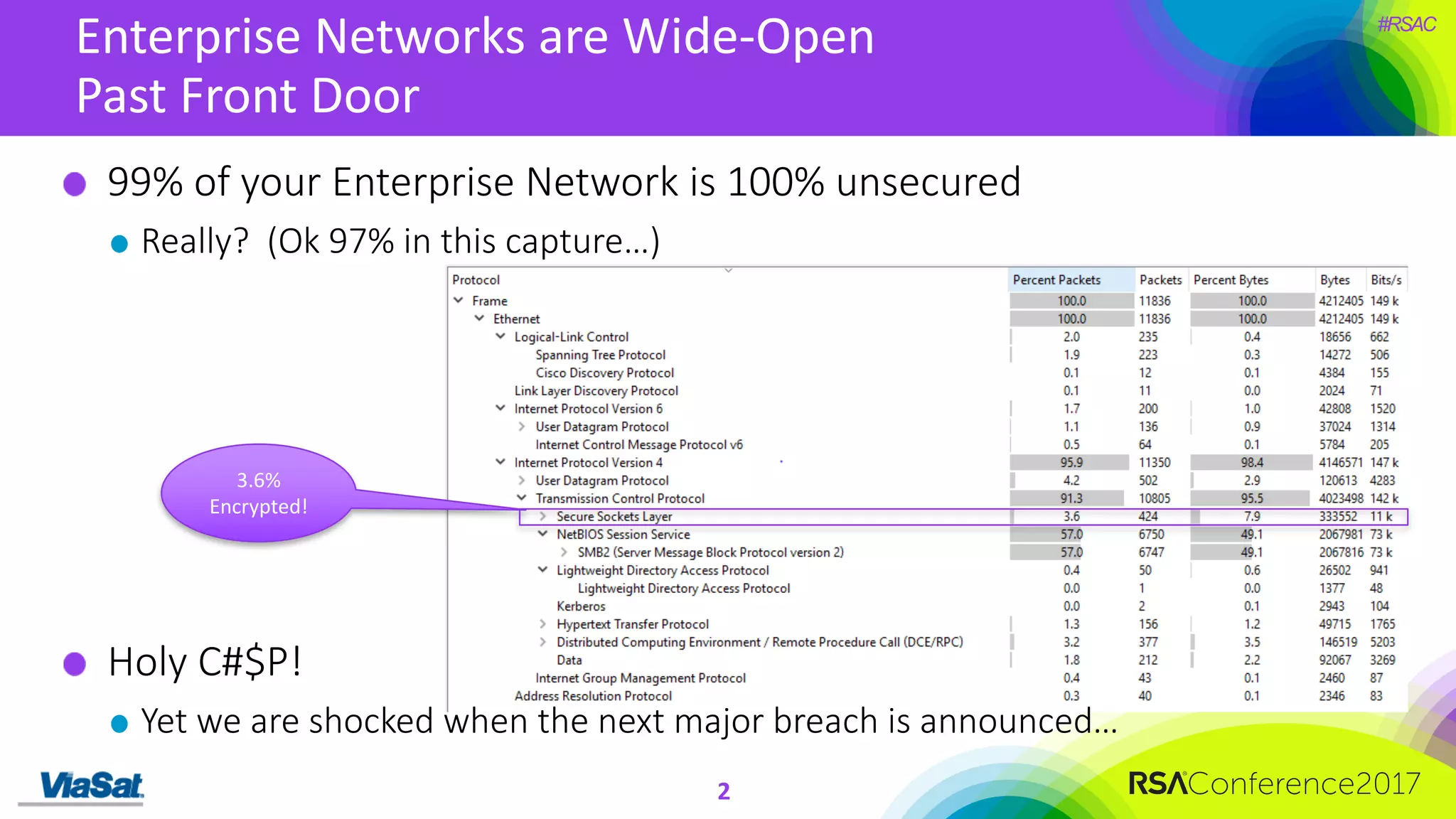
99%	of	your	Enterprise	Network	is	100%	unsecured
Really?		(Ok	97%	in	this	capture…)
Holy	C#$P!	
Yet	we	are	shocked	when	the	next	major	breach	is	announced…
3.6%	
Encrypted!
#RSAC
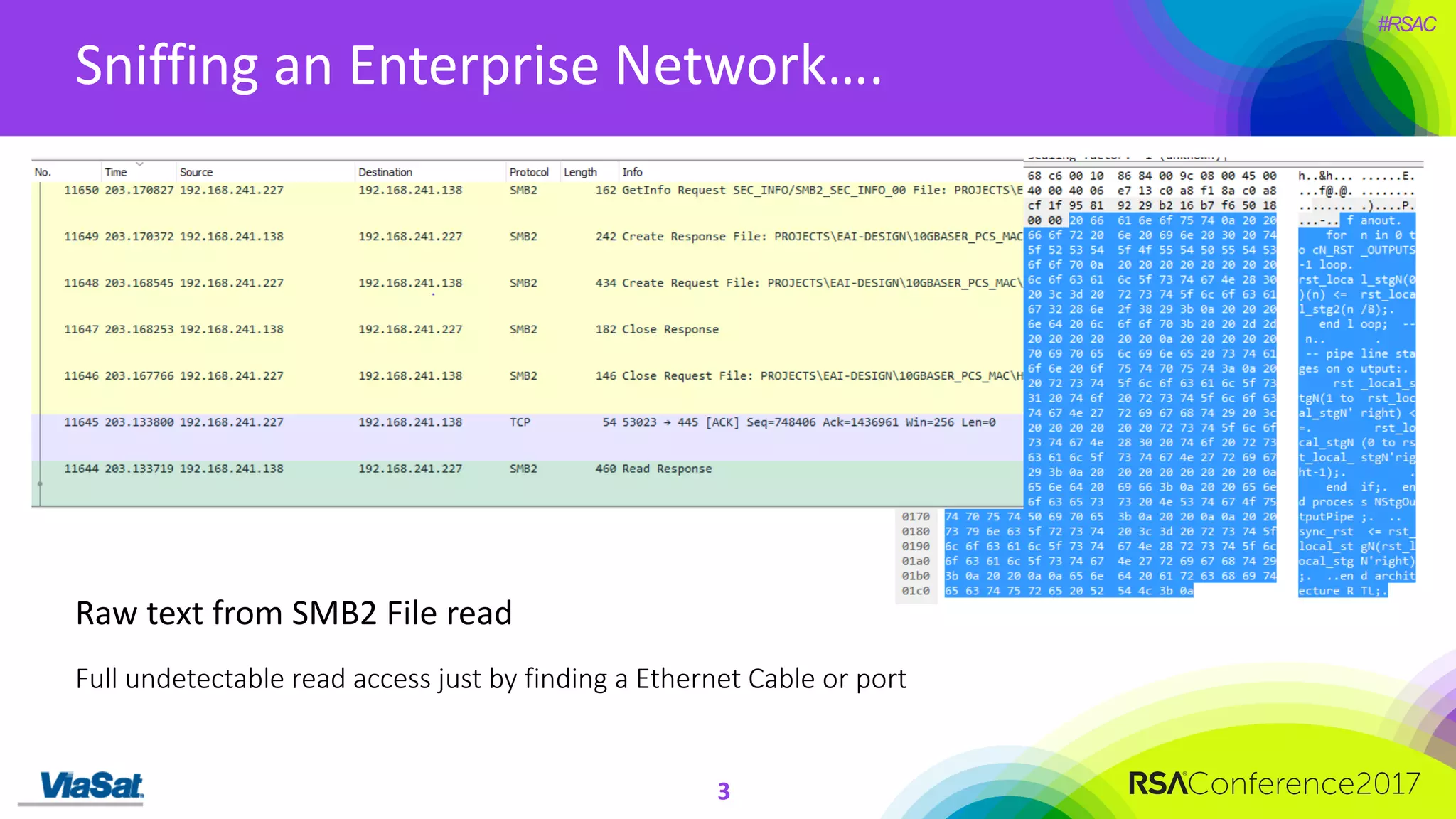
Full	undetectable	read	access	just	by	finding	a	Ethernet	Cable	or	port
3
Raw	text	from	SMB2	File	read	
Sniffing	an	Enterprise	Network….
#RSAC
Data	Center/Cloud	security
4
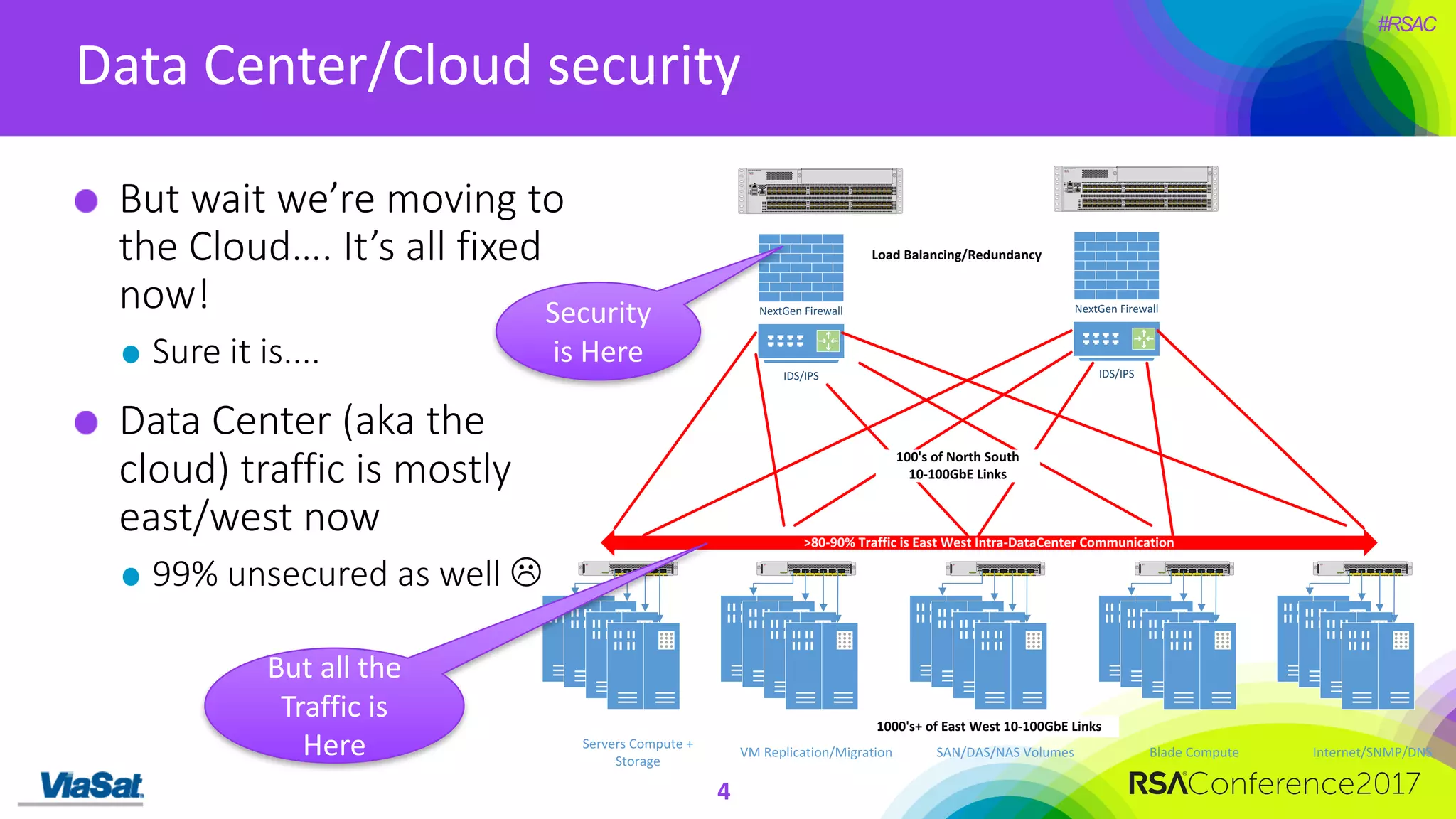
But	wait	we’re	moving	to	
the	Cloud….	It’s	all	fixed	
now!
Sure	it	is....
Data	Center	(aka	the	
cloud)	traffic	is	mostly	
east/west	now
99%	unsecured	as	well	L N9K-M6PQ STS 1
ACT ACT ACT ACT ACT ACT
2 3 4 5 6
Servers	Compute	+	
Storage
N9K-M6PQ STS 1
ACT ACT ACT ACT ACT ACT
2 3 4 5 6
VM	Replication/Migration
N9K-M6PQ STS 1
ACT ACT ACT ACT ACT ACT
2 3 4 5 6
SAN/DAS/NAS	Volumes
N9K-M6PQ STS 1
ACT ACT ACT ACT ACT ACT
2 3 4 5 6
Blade	Compute
N9K-M6PQ STS 1
ACT ACT ACT ACT ACT ACT
2 3 4 5 6
Internet/SNMP/DNS
NextGen	Firewall
IDS/IPS
49 50 51 52 53 54 55 56 57 58 59 60 61 62 63 64 65 66 67 68 69 70 71 72 73 74 75 76 77 78 79 80 81 82 83 84 85 86 87 88 89 90 91 92 93 94 95 96
1 2 3 4 5 6 7 8 9 10 11 12 13 14 15 16 17 18 19 20 21 22 23 24 25 26 27 28 29 30 31 32 33 34 35 36 37 38 39 40 41 42 43 44 45 46 47 48
STS
BCN
ACT
1
2
	
Cisco Nexus 93128TX
>80-90%	Traffic	is	East	West	Intra-DataCenter	Communication	
NextGen	Firewall
IDS/IPS
49 50 51 52 53 54 55 56 57 58 59 60 61 62 63 64 65 66 67 68 69 70 71 72 73 74 75 76 77 78 79 80 81 82 83 84 85 86 87 88 89 90 91 92 93 94 95 96
1 2 3 4 5 6 7 8 9 10 11 12 13 14 15 16 17 18 19 20 21 22 23 24 25 26 27 28 29 30 31 32 33 34 35 36 37 38 39 40 41 42 43 44 45 46 47 48
STS
BCN
ACT
1
2
	
Cisco Nexus 93128TX
1000's+	of	East	West	10-100GbE	Links
Load	Balancing/Redundancy
100's	of	North	South	
10-100GbE	Links
Security	
is	Here
But	all	the	
Traffic	is	
Here
#RSAC
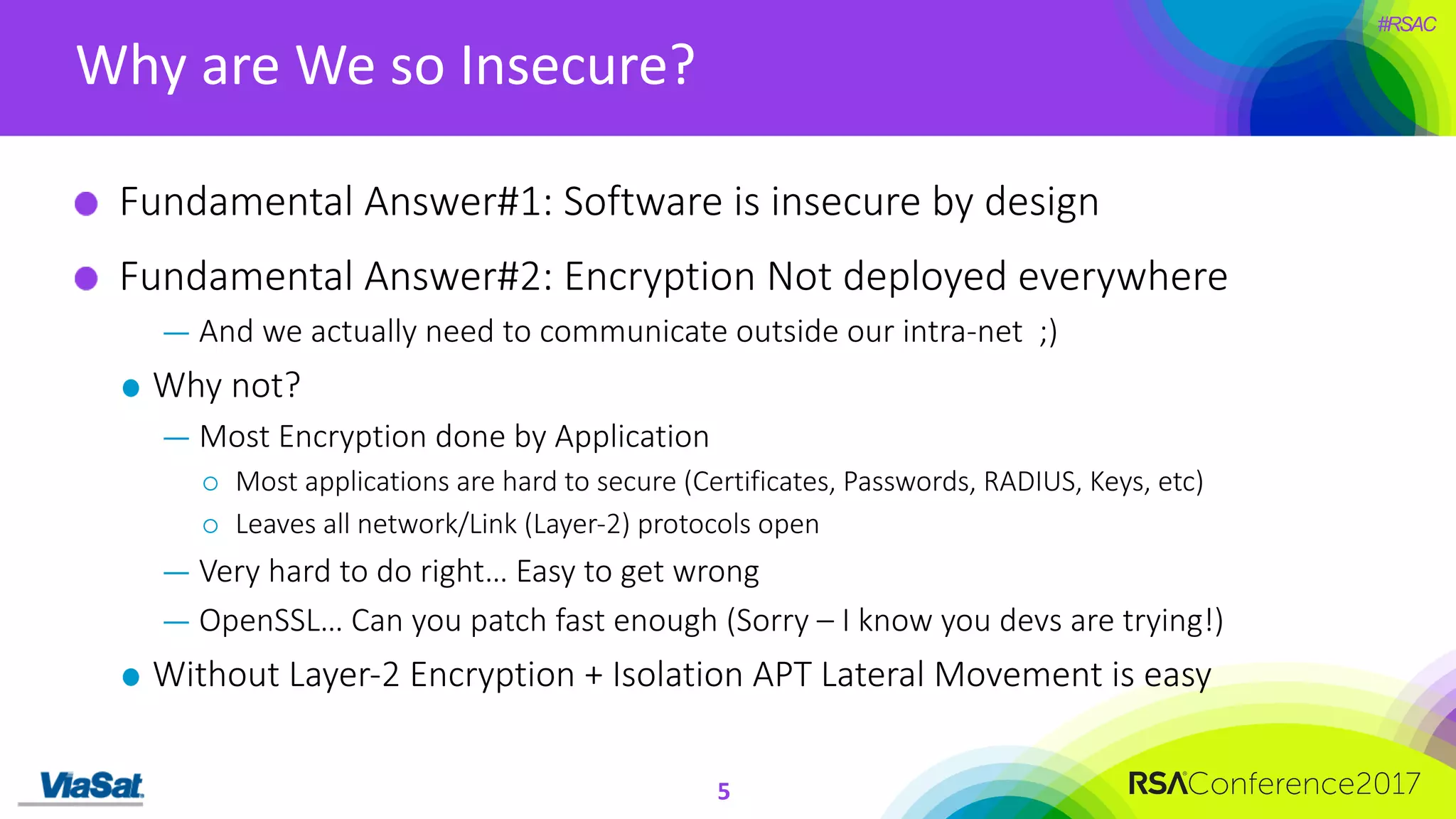
Why	are	We	so	Insecure?
5
Fundamental	Answer#1:	Software	is	insecure	by	design
Fundamental	Answer#2:	Encryption	Not	deployed	everywhere
— And	we	actually	need	to	communicate	outside	our	intra-net		;)
Why	not?
— Most	Encryption	done	by	Application
¡ Most	applications	are	hard	to	secure	(Certificates,	Passwords,	RADIUS,	Keys,	etc)
¡ Leaves	all	network/Link	(Layer-2)	protocols	open	
— Very	hard	to	do	right…	Easy	to	get	wrong
— OpenSSL…	Can	you	patch	fast	enough	(Sorry	– I	know	you	devs are	trying!)
Without	Layer-2	Encryption	+	Isolation	APT	Lateral	Movement	is	easy
#RSAC
Easy/Hard	L2	Encryption	Targets
6
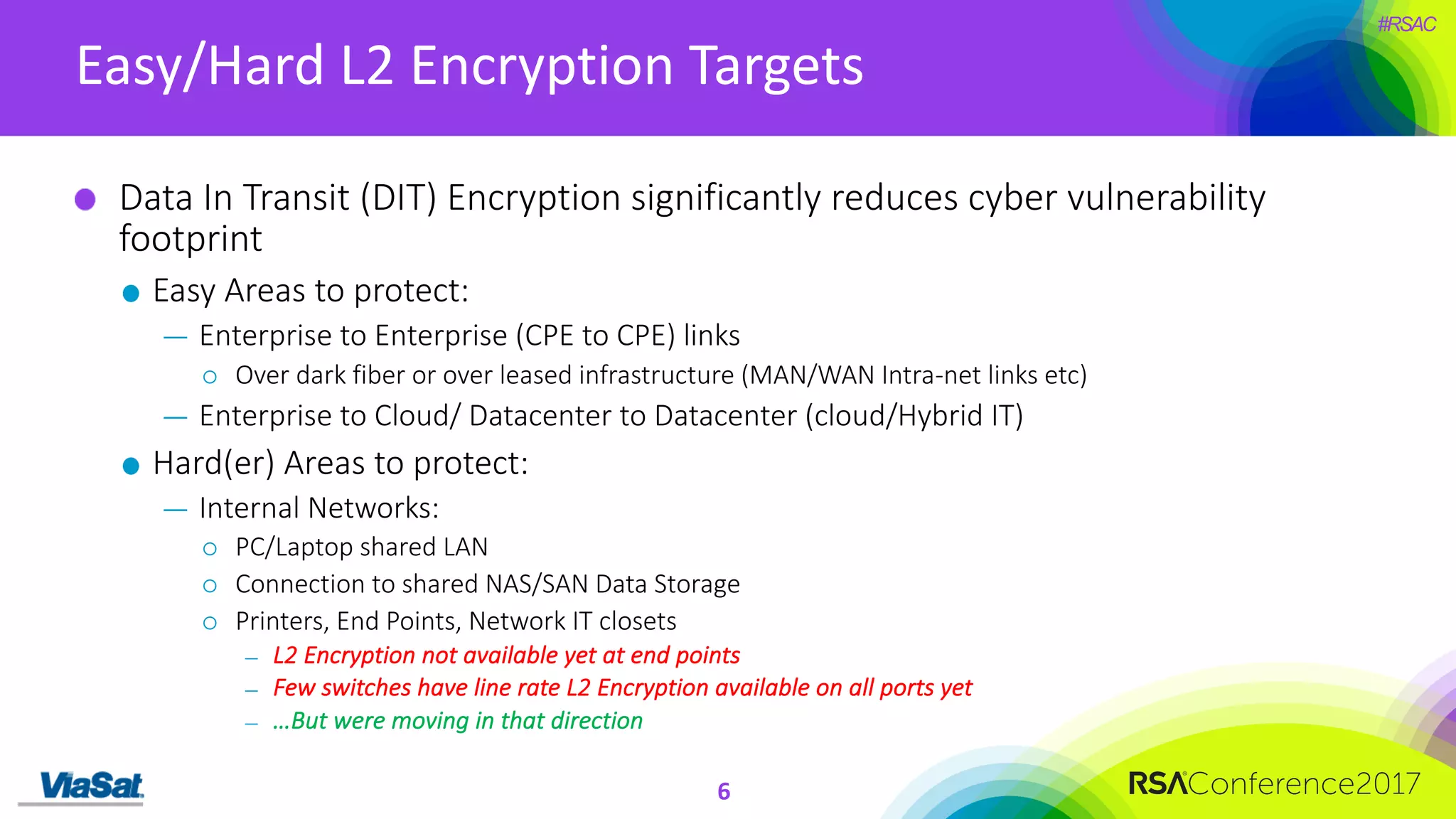
Data	In	Transit	(DIT)	Encryption	significantly	reduces	cyber	vulnerability	
footprint
Easy	Areas	to	protect:
— Enterprise	to	Enterprise	(CPE	to	CPE)	links
¡ Over	dark	fiber	or	over	leased	infrastructure	(MAN/WAN	Intra-net	links	etc)
— Enterprise	to	Cloud/	Datacenter	to	Datacenter	(cloud/Hybrid	IT)
Hard(er)	Areas	to	protect:
— Internal	Networks:		
¡ PC/Laptop	shared	LAN
¡ Connection	to	shared	NAS/SAN	Data	Storage
¡ Printers,	End	Points,	Network	IT	closets
— L2	Encryption	not	available	yet	at	end	points
— Few	switches	have	line	rate	L2	Encryption	available	on	all	ports	yet
— …But	were	moving	in	that	direction
#RSAC
Here’s	where	MACSec +	ESS	
come	in
Now	were	getting	technical
#RSAC
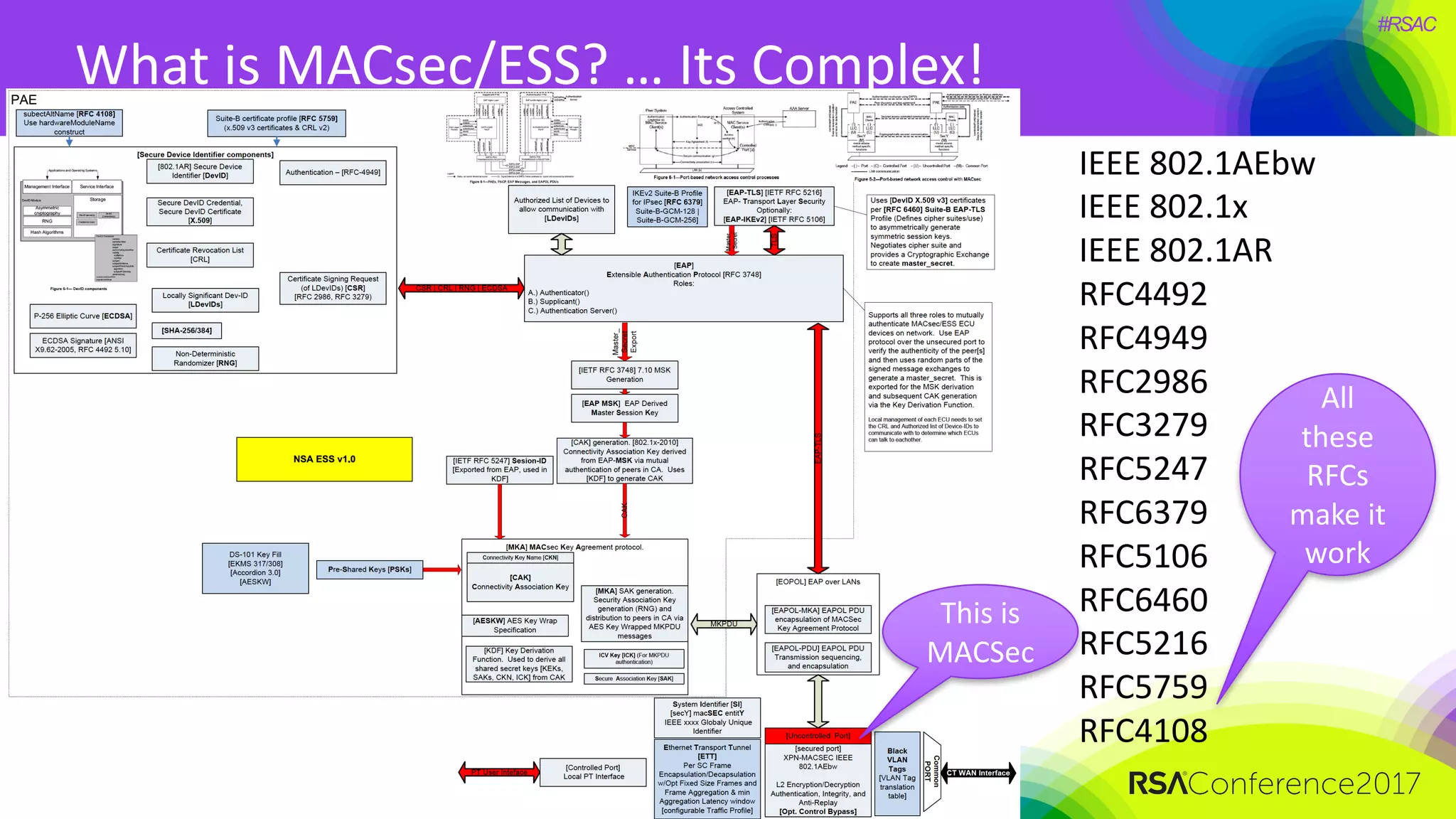
What	is	MACsec/ESS?	…	Its	Complex!
8
IEEE	802.1AEbw
IEEE	802.1x
IEEE	802.1AR
RFC4492
RFC4949
RFC2986
RFC3279
RFC5247
RFC6379
RFC5106
RFC6460
RFC5216
RFC5759
RFC4108
This	is	
MACSec
All	
these	
RFCs	
make	it	
work
#RSAC
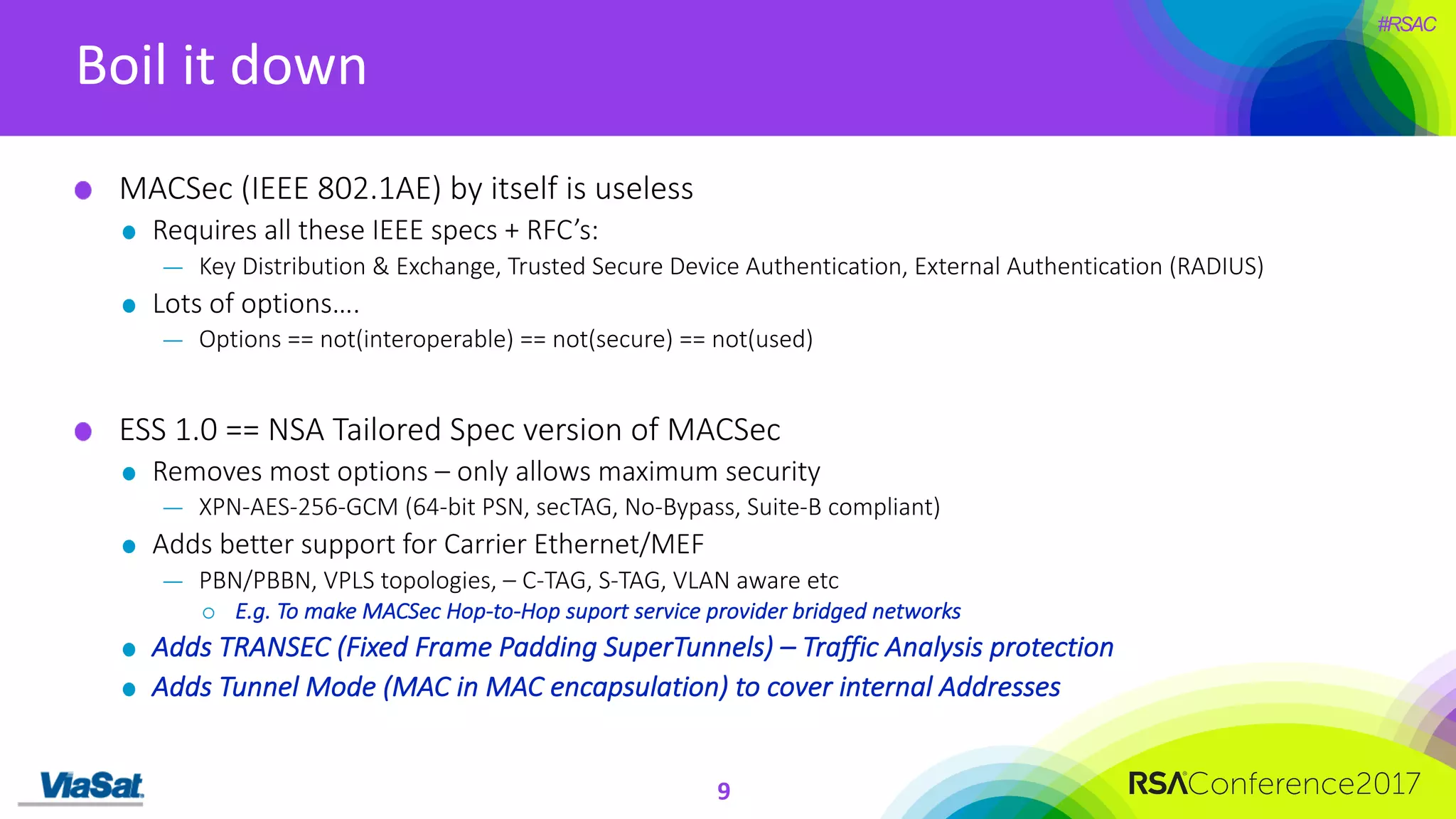
Boil	it	down
9
MACSec (IEEE	802.1AE)	by	itself	is	useless
Requires	all	these	IEEE	specs	+	RFC’s:
— Key	Distribution	&	Exchange,	Trusted	Secure	Device	Authentication,	External	Authentication	(RADIUS)
Lots	of	options….
— Options	==	not(interoperable)	==	not(secure)	==	not(used)
ESS	1.0	==	NSA	Tailored	Spec	version	of	MACSec
Removes	most	options	– only	allows	maximum	security
— XPN-AES-256-GCM	(64-bit	PSN,	secTAG,	No-Bypass,	Suite-B	compliant)
Adds	better	support	for	Carrier	Ethernet/MEF
— PBN/PBBN,	VPLS	topologies,	– C-TAG,	S-TAG,	VLAN	aware	etc
¡ E.g.	To	make	MACSec	Hop-to-Hop	suport	service	provider	bridged	networks
Adds	TRANSEC	(Fixed	Frame	Padding	SuperTunnels)	– Traffic	Analysis	protection
Adds	Tunnel	Mode	(MAC	in	MAC	encapsulation)	to	cover	internal	Addresses
#RSAC
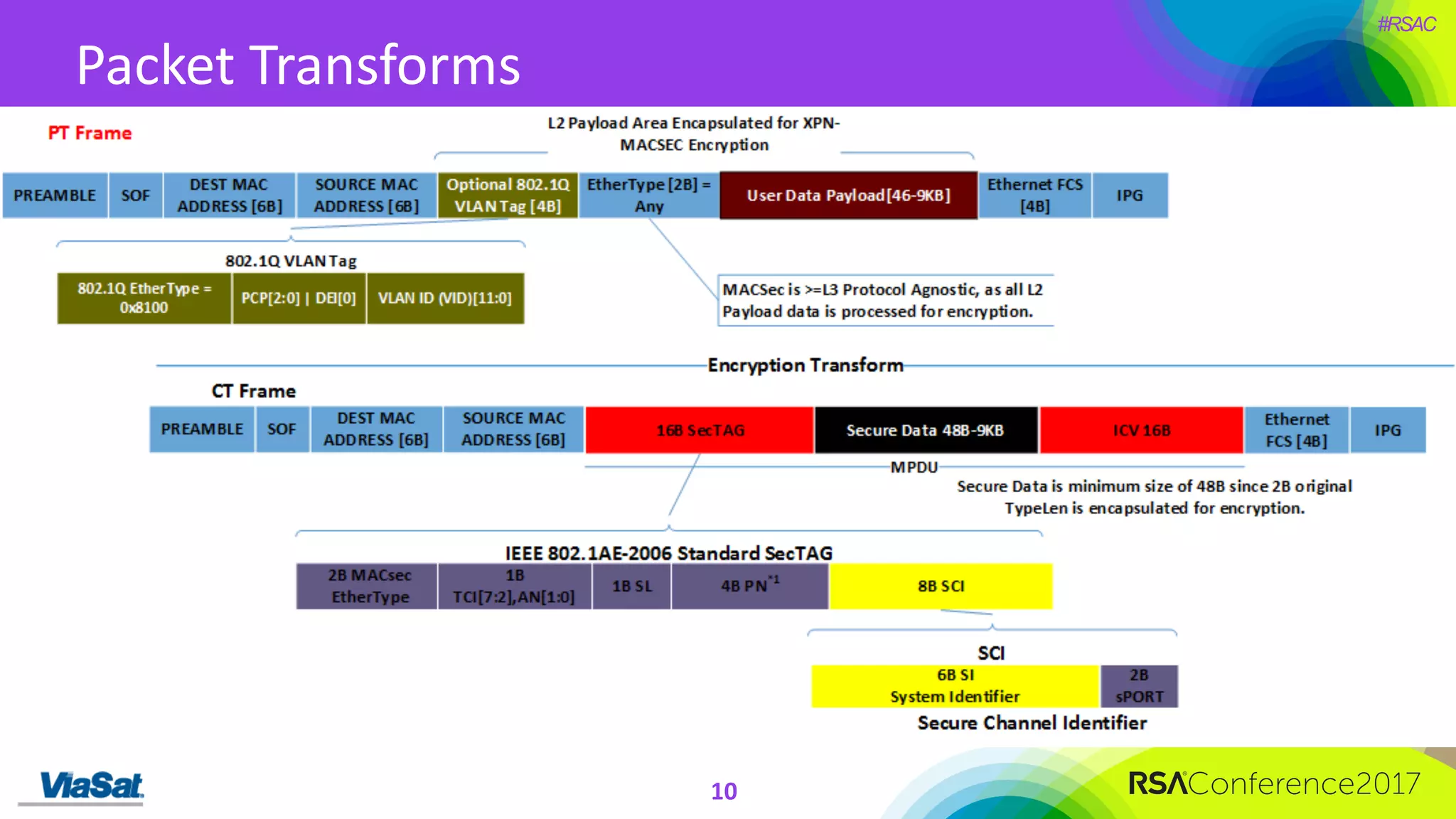
Packet	Transforms
10
#RSAC
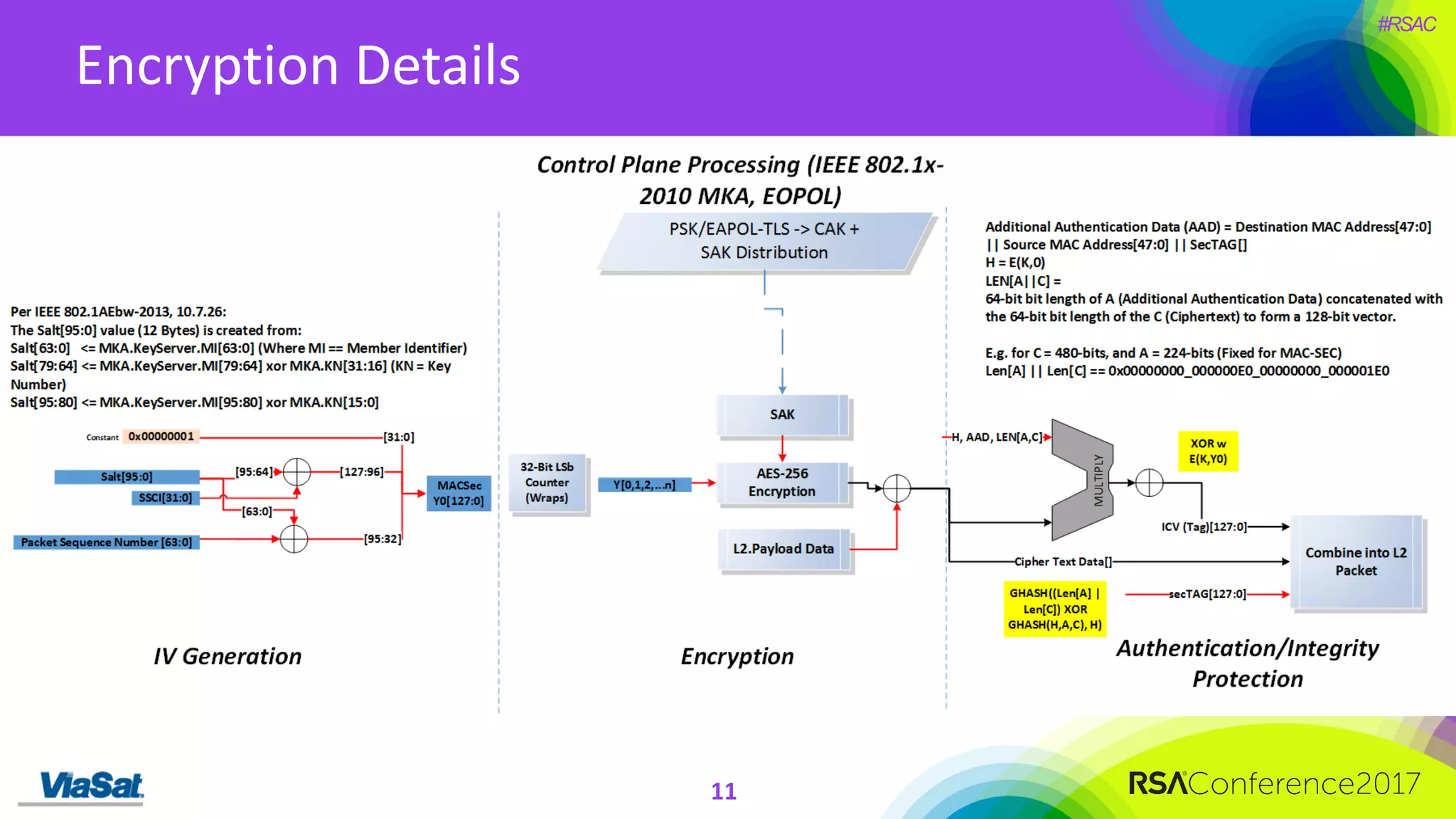
Encryption	Details
11
#RSAC
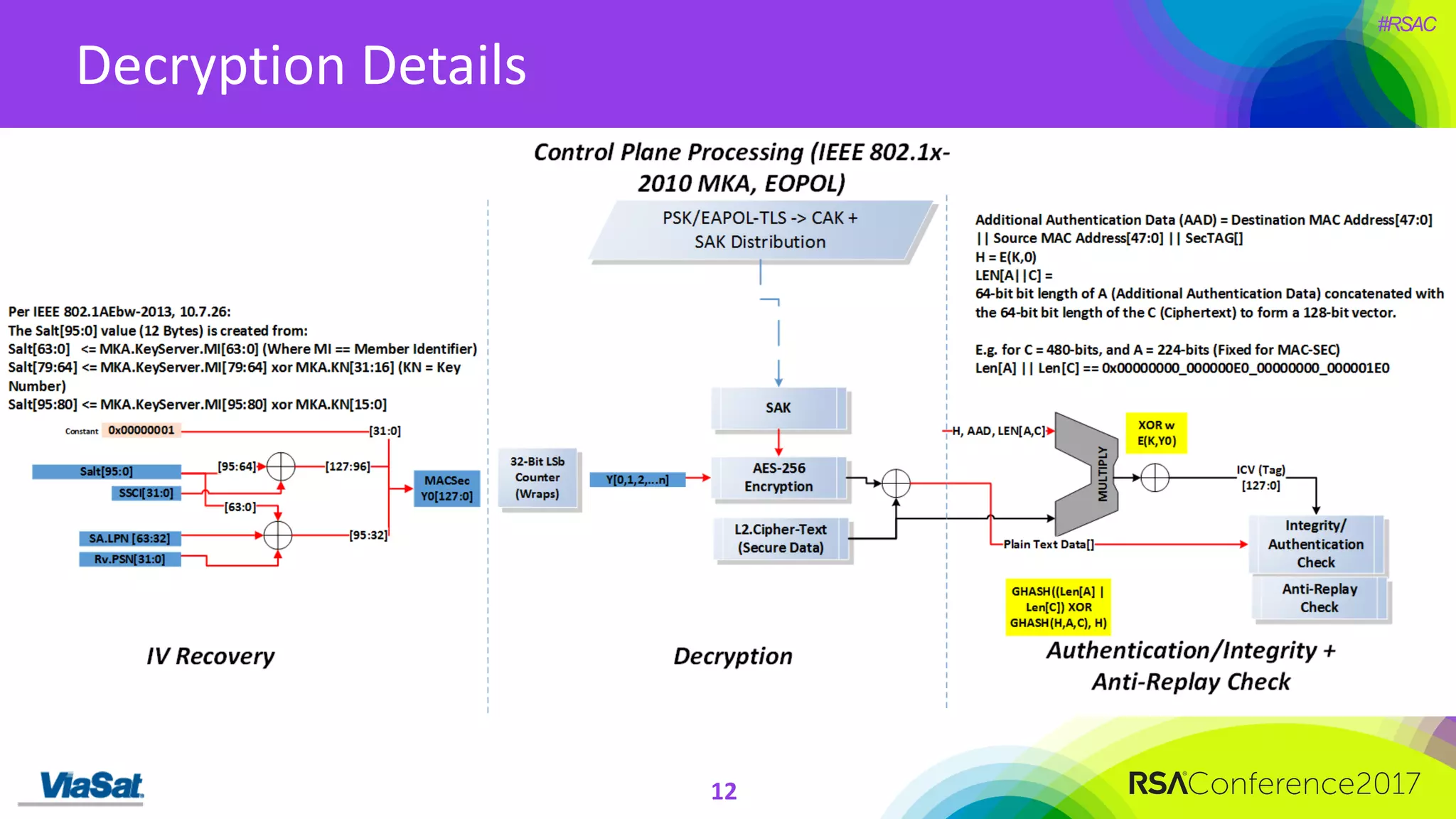
Decryption	Details
12
#RSAC
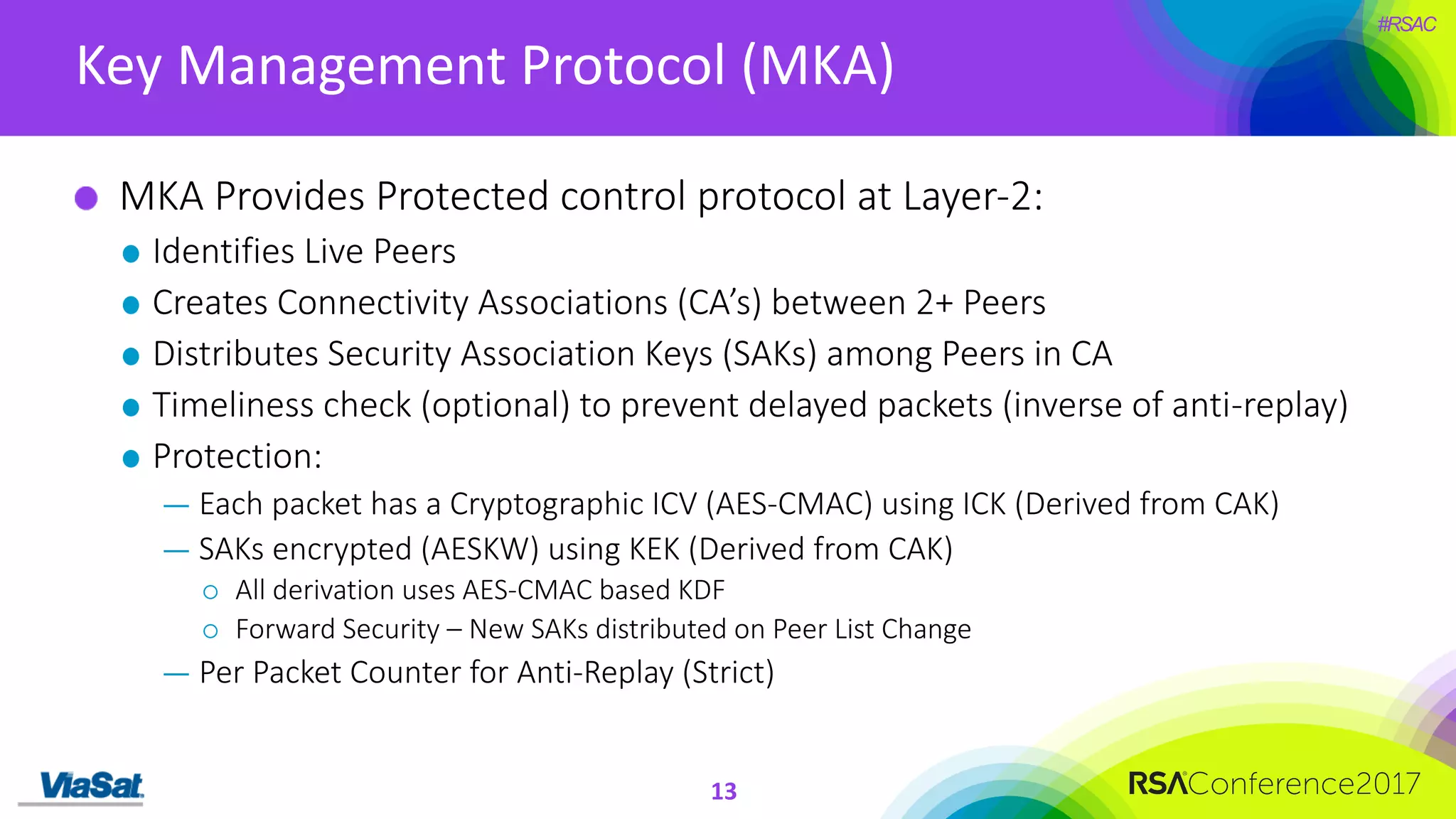
Key	Management	Protocol	(MKA)
13
MKA	Provides	Protected	control	protocol	at	Layer-2:
Identifies	Live	Peers
Creates	Connectivity	Associations	(CA’s)	between	2+	Peers
Distributes	Security	Association	Keys	(SAKs)	among	Peers	in	CA
Timeliness	check	(optional)	to	prevent	delayed	packets	(inverse	of	anti-replay)
Protection:
— Each	packet	has	a	Cryptographic	ICV	(AES-CMAC)	using	ICK	(Derived	from	CAK)
— SAKs	encrypted	(AESKW)	using	KEK	(Derived	from	CAK)
¡ All	derivation	uses	AES-CMAC	based	KDF
¡ Forward	Security	– New	SAKs	distributed	on	Peer	List	Change
— Per	Packet	Counter	for	Anti-Replay	(Strict)
#RSAC
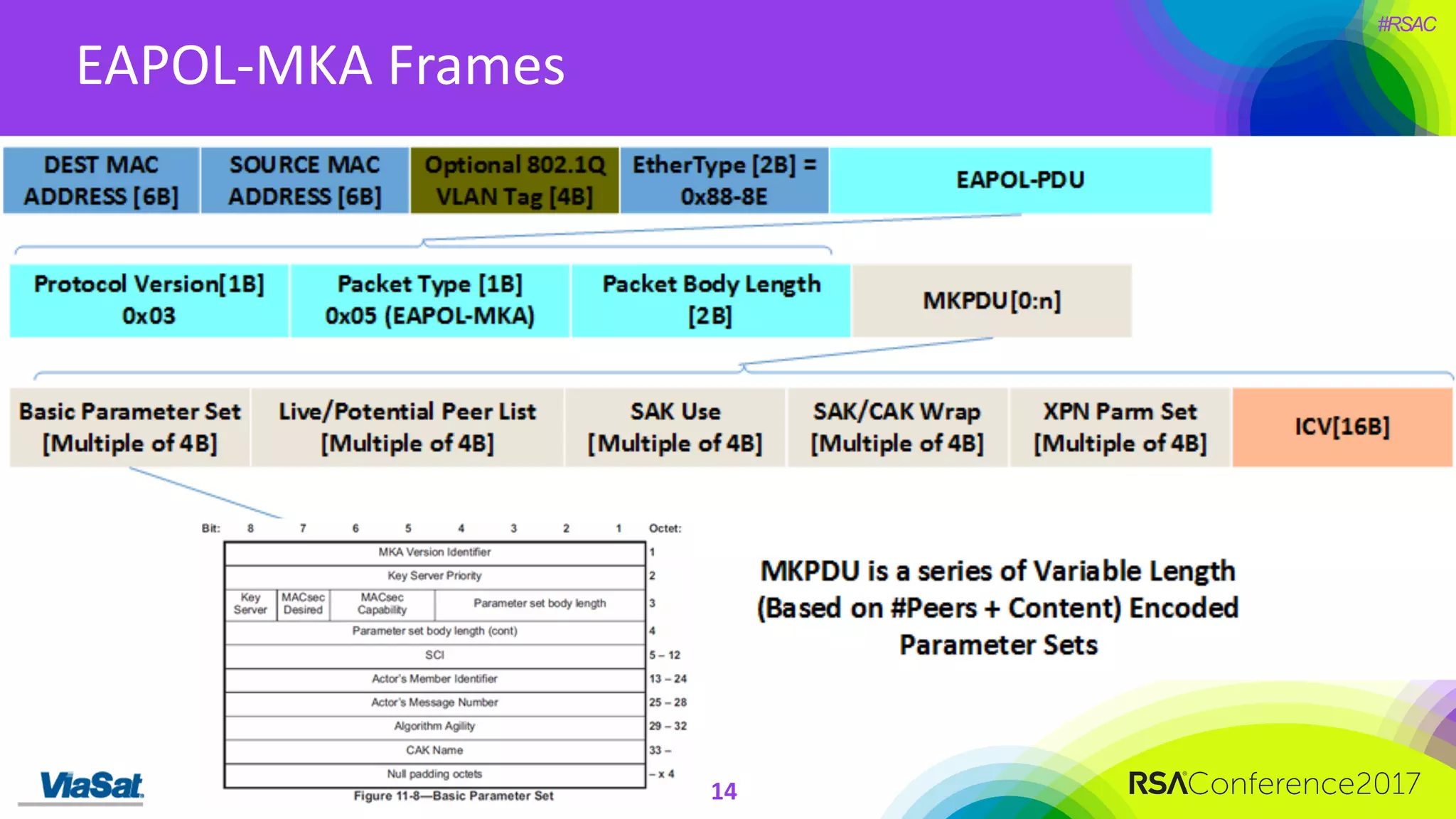
EAPOL-MKA	Frames
14
#RSAC
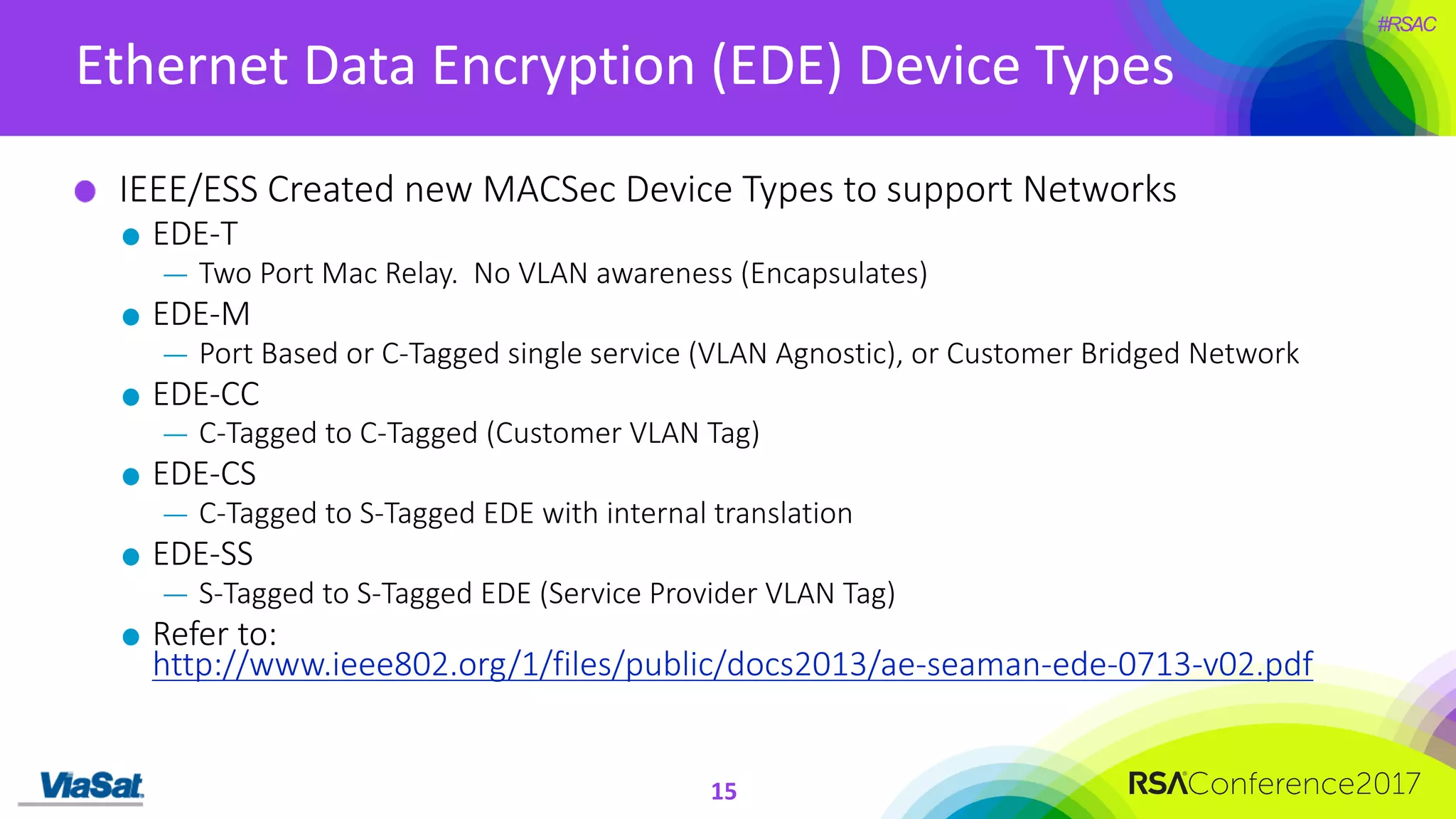
Ethernet	Data	Encryption	(EDE)	Device	Types
15
IEEE/ESS	Created	new	MACSec Device	Types	to	support	Networks
EDE-T
— Two	Port	Mac	Relay.		No	VLAN	awareness	(Encapsulates)
EDE-M
— Port	Based	or	C-Tagged	single	service	(VLAN	Agnostic),	or	Customer	Bridged	Network
EDE-CC
— C-Tagged	to	C-Tagged	(Customer	VLAN	Tag)
EDE-CS
— C-Tagged	to	S-Tagged	EDE	with	internal	translation	
EDE-SS
— S-Tagged	to	S-Tagged	EDE	(Service	Provider	VLAN	Tag)
Refer	to:	
http://www.ieee802.org/1/files/public/docs2013/ae-seaman-ede-0713-v02.pdf
#RSAC
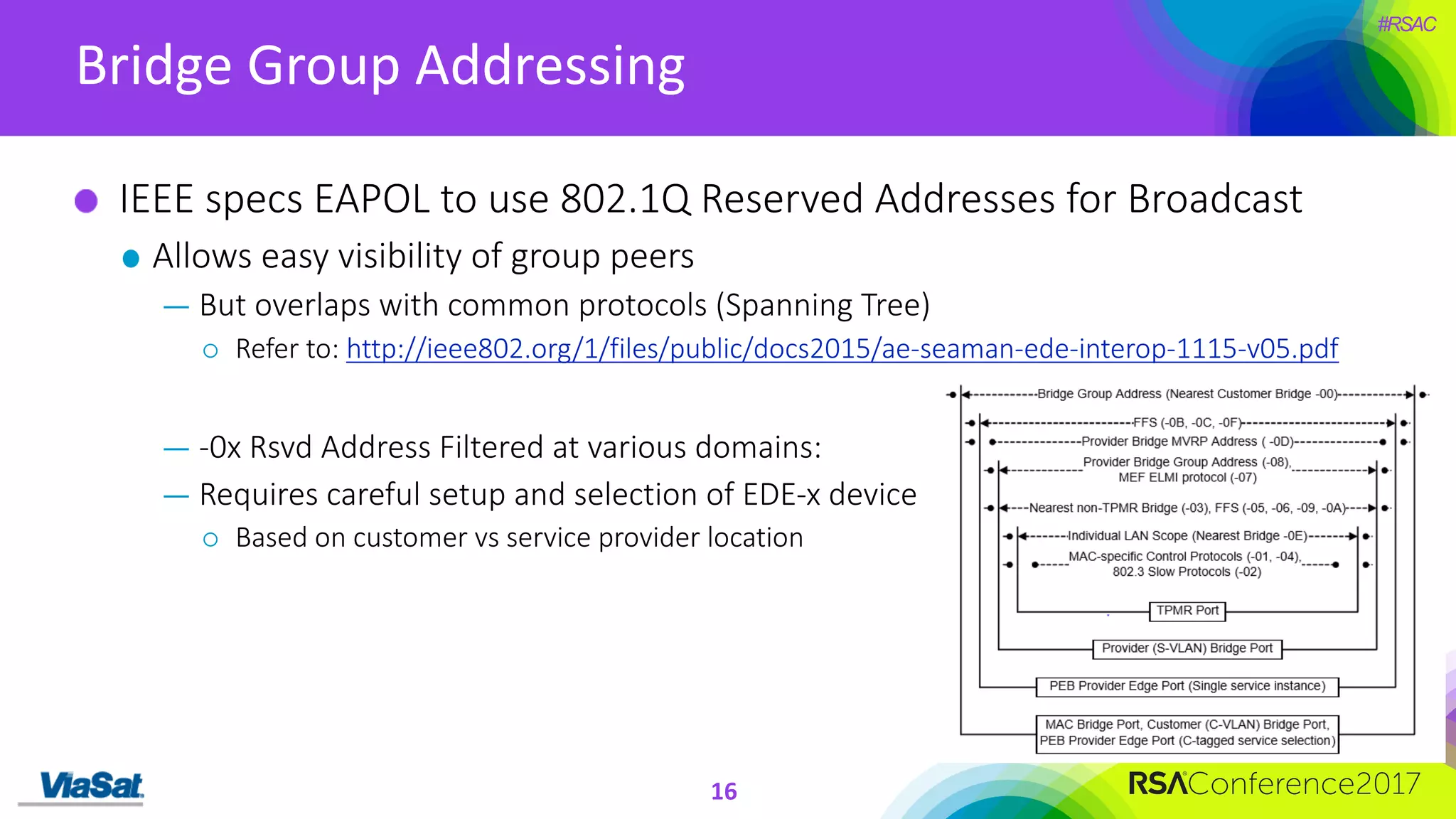
Bridge	Group	Addressing
16
IEEE	specs	EAPOL	to	use	802.1Q	Reserved	Addresses	for	Broadcast
Allows	easy	visibility	of	group	peers
— But	overlaps	with	common	protocols	(Spanning	Tree)
¡ Refer	to:	http://ieee802.org/1/files/public/docs2015/ae-seaman-ede-interop-1115-v05.pdf
— -0x	Rsvd Address	Filtered	at	various	domains:
— Requires	careful	setup	and	selection	of	EDE-x	device
¡ Based	on	customer	vs	service	provider	location
#RSAC
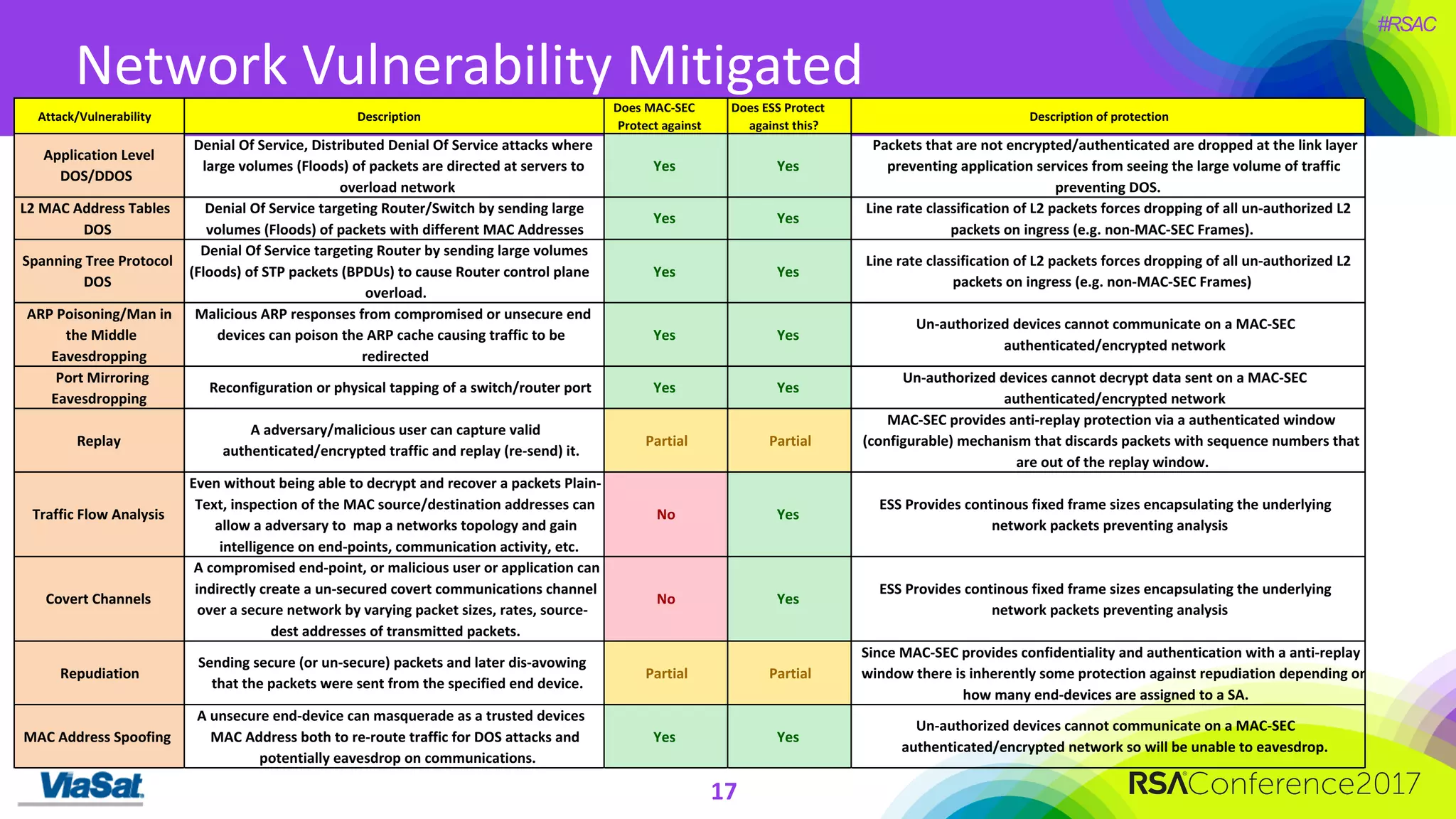
Network	Vulnerability	Mitigated
17
Attack/Vulnerability Description
Does	MAC-SEC	
Protect	against	
Does	ESS	Protect	
against	this?
Description	of	protection
Application	Level	
DOS/DDOS
Denial	Of	Service,	Distributed	Denial	Of	Service	attacks	where	
large	volumes	(Floods)	of	packets	are	directed	at	servers	to	
overload	network
Yes Yes
Packets	that	are	not	encrypted/authenticated	are	dropped	at	the	link	layer	
preventing	application	services	from	seeing	the	large	volume	of	traffic	
preventing	DOS.
L2	MAC	Address	Tables	
DOS
Denial	Of	Service	targeting	Router/Switch	by	sending	large	
volumes	(Floods)	of	packets	with	different	MAC	Addresses	
Yes Yes
Line	rate	classification	of	L2	packets	forces	dropping	of	all	un-authorized	L2	
packets	on	ingress	(e.g.	non-MAC-SEC	Frames).	
Spanning	Tree	Protocol	
DOS
Denial	Of	Service	targeting	Router	by	sending	large	volumes	
(Floods)	of	STP	packets	(BPDUs)	to	cause	Router	control	plane	
overload.	
Yes Yes
Line	rate	classification	of	L2	packets	forces	dropping	of	all	un-authorized	L2	
packets	on	ingress	(e.g.	non-MAC-SEC	Frames)
ARP	Poisoning/Man	in	
the	Middle	
Eavesdropping
Malicious	ARP	responses	from	compromised	or	unsecure	end	
devices	can	poison	the	ARP	cache	causing	traffic	to	be	
redirected
Yes Yes
Un-authorized	devices	cannot	communicate	on	a	MAC-SEC	
authenticated/encrypted	network
Port	Mirroring	
Eavesdropping
Reconfiguration	or	physical	tapping	of	a	switch/router	port Yes Yes
Un-authorized	devices	cannot	decrypt	data	sent	on	a	MAC-SEC	
authenticated/encrypted	network	
Replay
A	adversary/malicious	user	can	capture	valid	
authenticated/encrypted	traffic	and	replay	(re-send)	it.	
Partial Partial
MAC-SEC	provides	anti-replay	protection	via	a	authenticated	window	
(configurable)	mechanism	that	discards	packets	with	sequence	numbers	that	
are	out	of	the	replay	window.		
Traffic	Flow	Analysis
Even	without	being	able	to	decrypt	and	recover	a	packets	Plain-
Text,	inspection	of	the	MAC	source/destination	addresses	can	
allow	a	adversary	to		map	a	networks	topology	and	gain	
intelligence	on	end-points,	communication	activity,	etc.
No Yes
ESS	Provides	continous	fixed	frame	sizes	encapsulating	the	underlying	
network	packets	preventing	analysis
Covert	Channels
A	compromised	end-point,	or	malicious	user	or	application	can	
indirectly	create	a	un-secured	covert	communications	channel	
over	a	secure	network	by	varying	packet	sizes,	rates,	source-
dest	addresses	of	transmitted	packets.	
No Yes
ESS	Provides	continous	fixed	frame	sizes	encapsulating	the	underlying	
network	packets	preventing	analysis
Repudiation
Sending	secure	(or	un-secure)	packets	and	later	dis-avowing	
that	the	packets	were	sent	from	the	specified	end	device.		
Partial Partial
Since	MAC-SEC	provides	confidentiality	and	authentication	with	a	anti-replay	
window	there	is	inherently	some	protection	against	repudiation	depending	on	
how	many	end-devices	are	assigned	to	a	SA.
MAC	Address	Spoofing
A	unsecure	end-device	can	masquerade	as	a	trusted	devices	
MAC	Address	both	to	re-route	traffic	for	DOS	attacks	and	
potentially	eavesdrop	on	communications.
Yes Yes
Un-authorized	devices	cannot	communicate	on	a	MAC-SEC	
authenticated/encrypted	network	so	will	be	unable	to	eavesdrop.
#RSAC
What	to	do!
How	do	I	apply	this	in	my	network
#RSAC
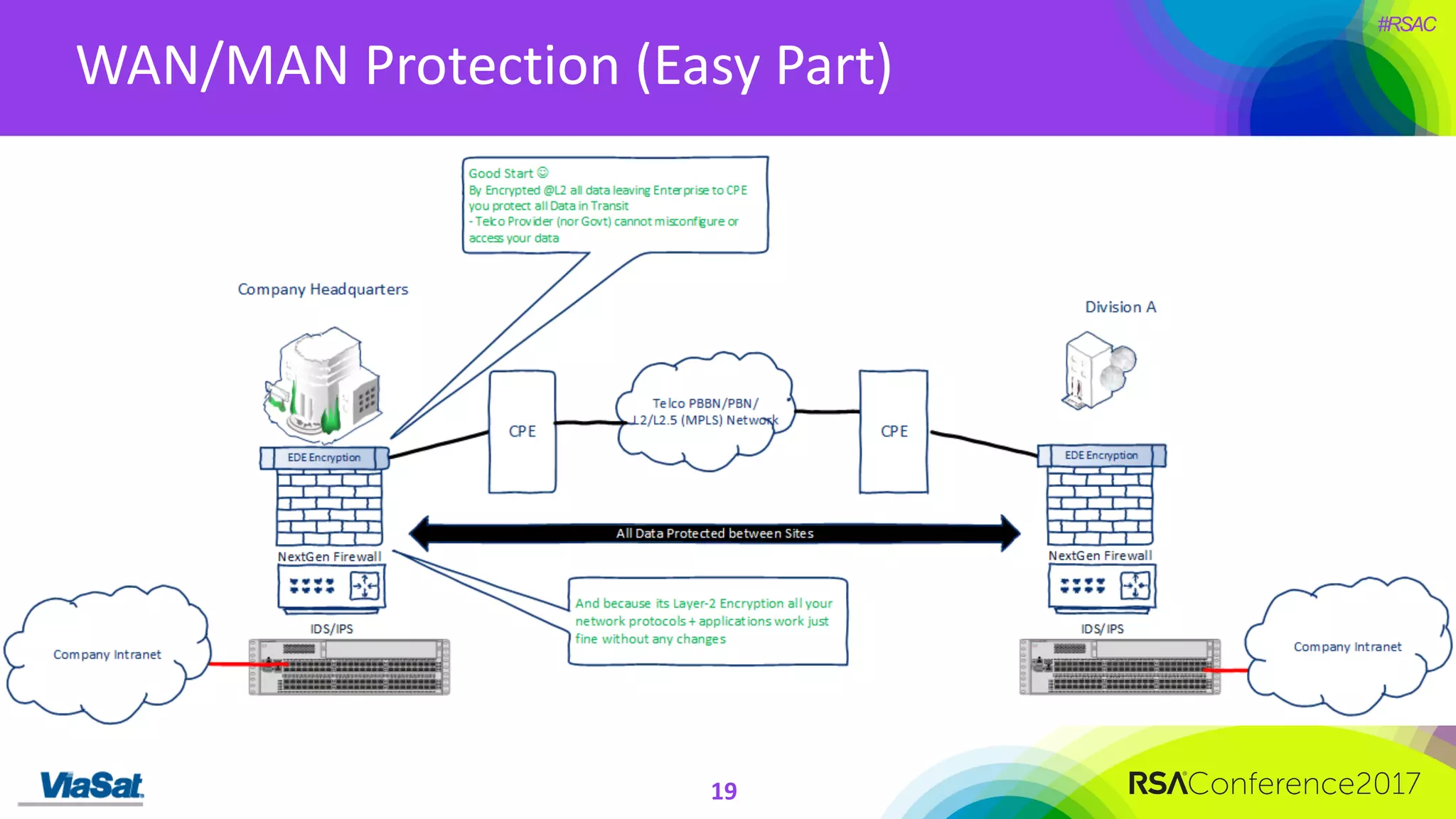
WAN/MAN	Protection	(Easy	Part)
19
#RSAC
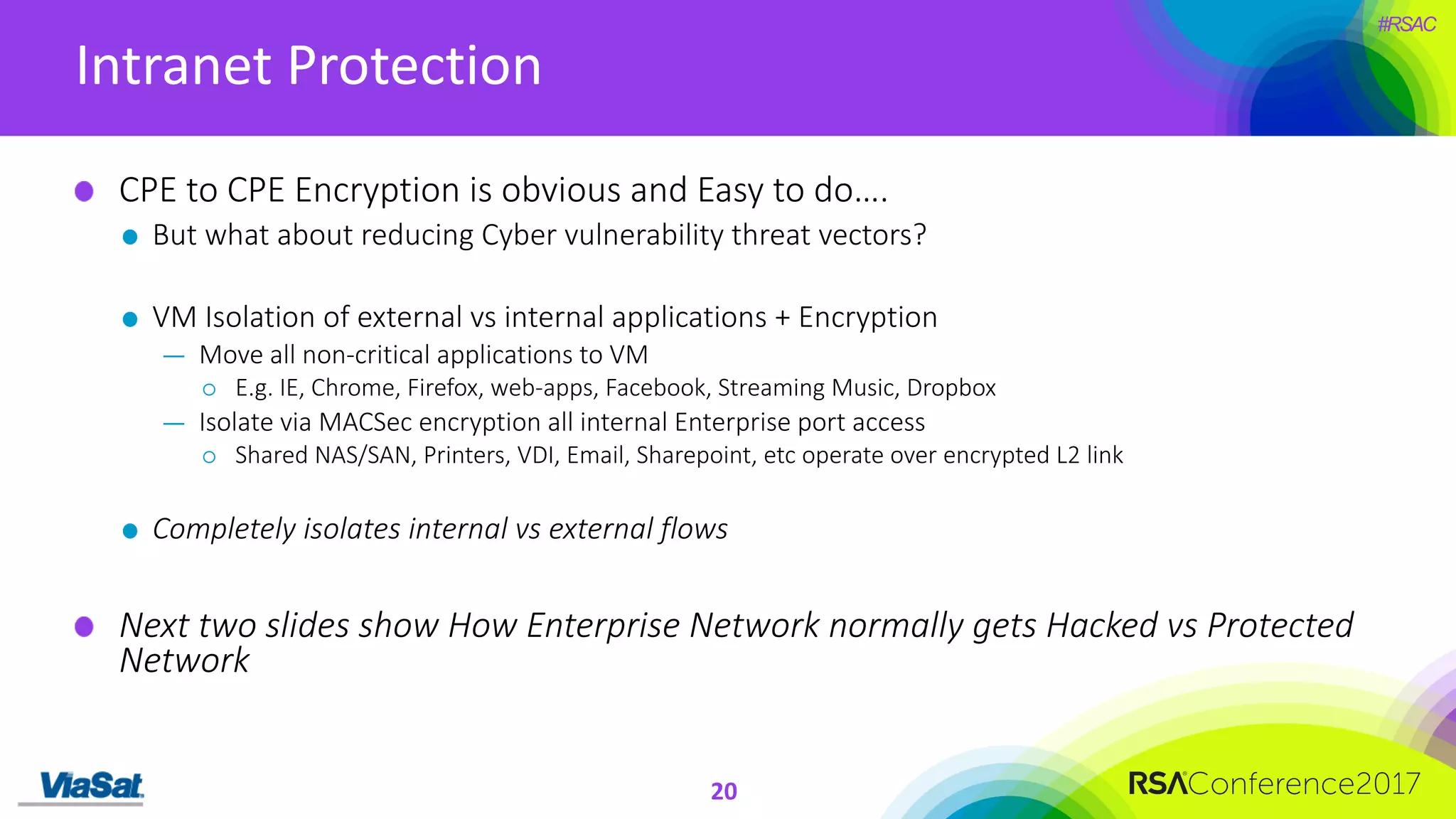
Intranet	Protection
20
CPE	to	CPE	Encryption	is	obvious	and	Easy	to	do….
But	what	about	reducing	Cyber	vulnerability	threat	vectors?
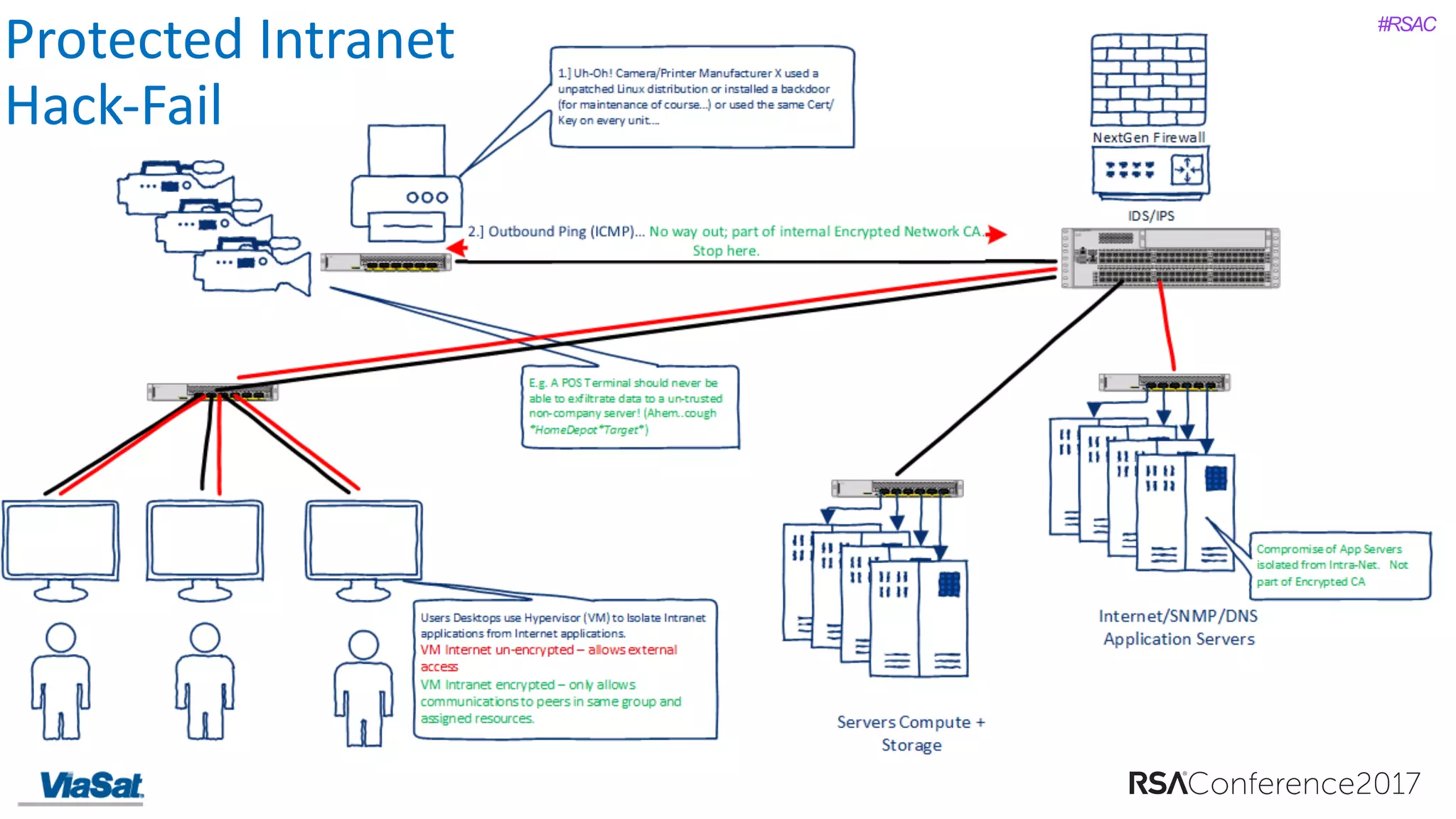
VM	Isolation	of	external	vs	internal	applications	+	Encryption
— Move	all	non-critical	applications	to	VM
¡ E.g.	IE,	Chrome,	Firefox,	web-apps,	Facebook,	Streaming	Music,	Dropbox	
— Isolate	via	MACSec encryption	all	internal	Enterprise	port	access
¡ Shared	NAS/SAN,	Printers,	VDI,	Email,	Sharepoint,	etc operate	over	encrypted	L2	link
Completely	isolates	internal	vs	external	flows
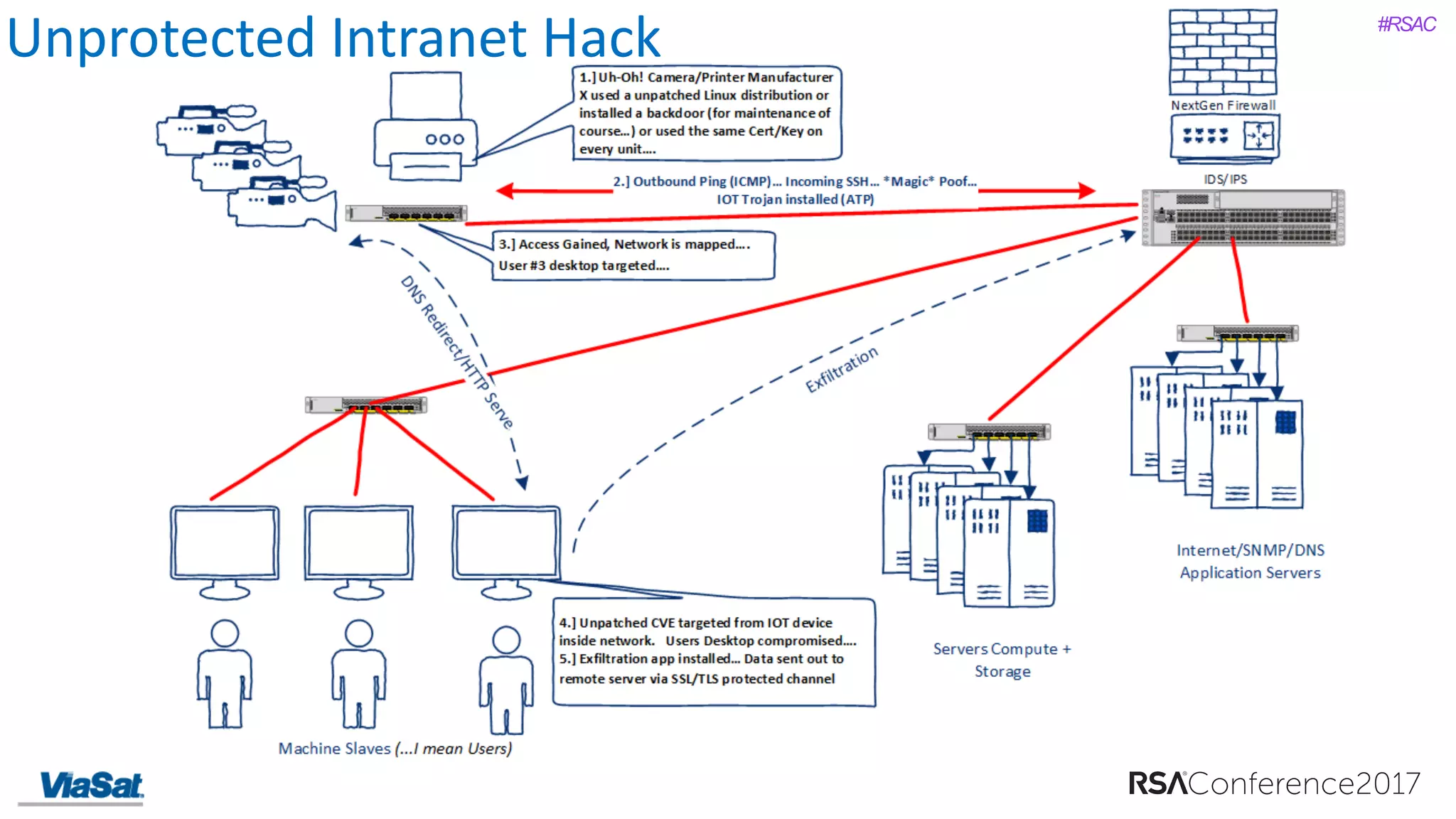
Next	two	slides	show	How	Enterprise	Network	normally	gets	Hacked	vs	Protected	
Network
#RSAC
Unprotected	Intranet	Hack
#RSAC
Intranet	ProtectionProtected	Intranet	
Hack-Fail
#RSAC
Cloud	Protection
23
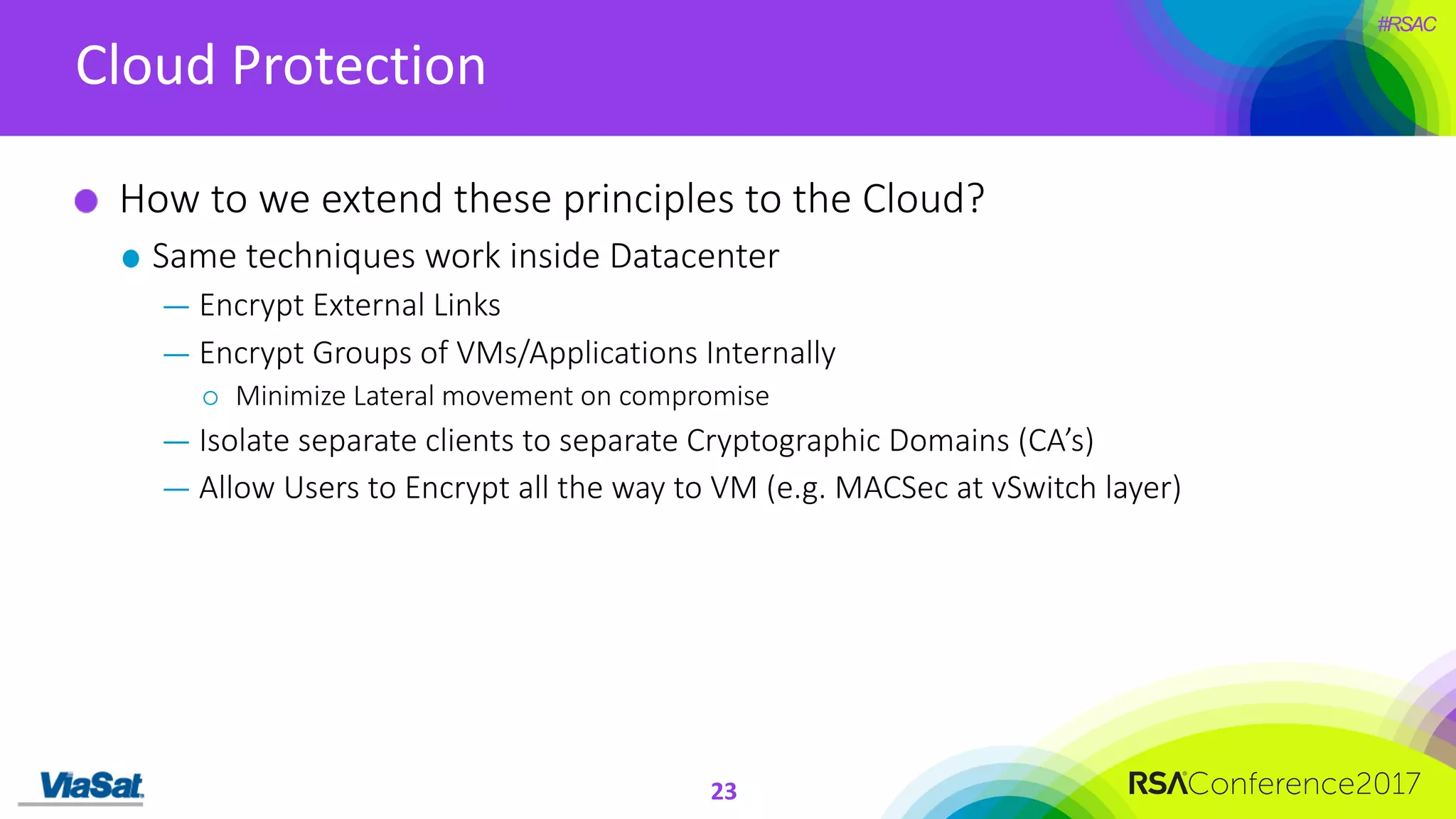
How	to	we	extend	these	principles	to	the	Cloud?
Same	techniques	work	inside	Datacenter
— Encrypt	External	Links
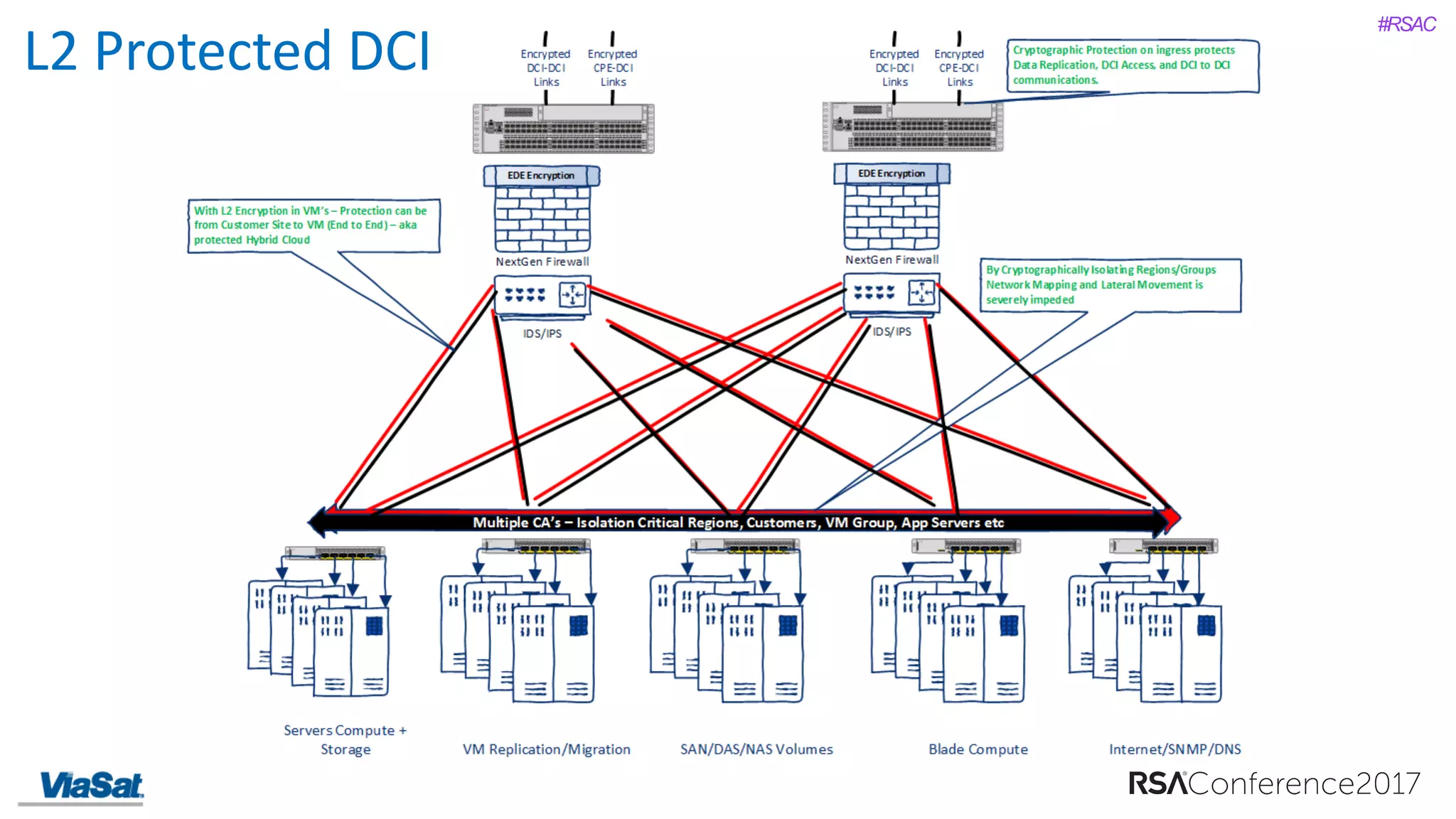
— Encrypt	Groups	of	VMs/Applications	Internally
¡ Minimize	Lateral	movement	on	compromise
— Isolate	separate	clients	to	separate	Cryptographic	Domains	(CA’s)
— Allow	Users	to	Encrypt	all	the	way	to	VM	(e.g.	MACSec at	vSwitch layer)
#RSAC
L2	Protected	DCI
#RSAC
What	to	Do	next
25
Analyze	your	internal	network….	Get	scared!	
Encrypt	your	inter-office	links
Stop	using	openSSL to	“Secure”	your	network
— You	cant	possibly	patch	fast	enough….	And	all	Layer-2	is	exposed	L
Deploy	High	Grade	Encryption	Appliances	or	Embedded	Hardware	Encryption
Require	Switches	to	support	MACSec/ESS	L2	Encryption	on	all	ports
— Only	use	Software	based	encryption	in	VMs	and	applications
— For	follow	up	- Contact	me:
¡ Yep	after	all	that	security	talk	I’ll	give	you	an	email	address	K

IEEE MACSec and NSA ESS: How to Protect Your WAN, LAN and Cloud