Continually
Becoming:
Open learners and
open educators
Catherine Cronin
CELT, NUI Galway
@catherinecronin
#OER18
Image:CC0bycogdog
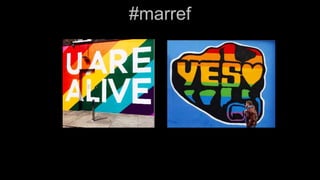
#marref
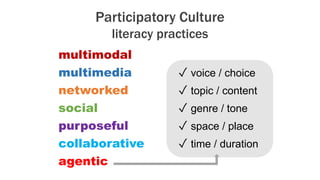
multimodal
multimedia ✓ voice / choice
networked ✓ topic / content
social ✓ genre / tone
purposeful ✓ space / place
collaborative ✓ time / duration
agentic
Participatory Culture
literacy practices
Openness is not the opposite of closed-ness,
nor is there simply a continuum between the two…
An important question becomes not simply whether
education is more or less open, but what forms
of openness are worthwhile and for whom;
openness alone is not an educational virtue.
Richard Edwards (2015)
@RichardEd1
Knowledge infrastructures and the inscrutability of openness in education
Learning, Media and Technology 40(3)
“
Image:CCBYBeckPitt
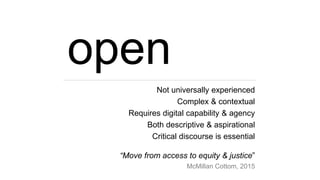
open
Not universally experienced
Complex & contextual
Requires digital capability & agency
Both descriptive & aspirational
Critical discourse is essential
“Move from access to equity & justice”
McMillan Cottom, 2015
I began with a question:
In academic settings in which the use of OEP is not
required, requested, expected, or specifically supported,
WHY do some educators, and not others, choose to
use Open Educational Practices?
(...and then what happens?)
Openness and praxis:
A situated study of academic staff
meaning-making & decision-making with respect to openness
and
use of open educational practices
in higher education
4.5 years later…
just completed PhD study
Image:CC0bySakshamGangwar
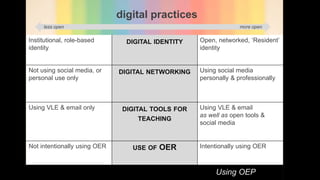
Institutional, role-based
identity
DIGITAL IDENTITY Open, networked, ‘Resident’
identity
Not using social media, or
personal use only
DIGITAL NETWORKING Using social media
personally & professionally
Using VLE & email only DIGITAL TOOLS FOR
TEACHING
Using VLE & email
as well as open tools &
social media
Not intentionally using OER USE OF OER Intentionally using OER
less open more open
digital practices
Using OEP
4 dimensions shared by open educators
inner circle
(2 dimensions)
Networked
Individuals
both circles
(4 dimensions)
Networked
Educators
Image:CC0BY-NCJamesKirkpqtrick
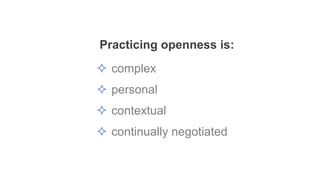
Practicing openness is:
 complex
 personal
 contextual
 continually negotiated
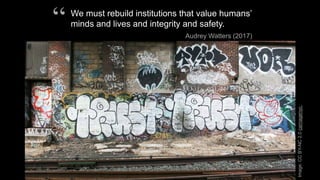
We must rebuild institutions that value humans’
minds and lives and integrity and safety.
Audrey Watters (2017)
“
Image:CCBY-NC2.0carnagenyc
If we truly value participatory culture,
we must recognize the right of individuals
to choose not to participate.
Henry Jenkins (2013)
“
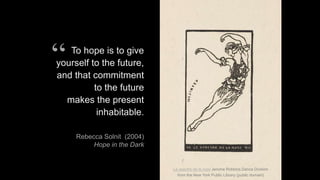
Le spectre de la rose Jerome Robbins Dance Division
from the New York Public Library (public domain)
To hope is to give
yourself to the future,
and that commitment
to the future
makes the present
inhabitable.
Rebecca Solnit (2004)
Hope in the Dark
“
Le spectre de la rose Jerome Robbins Dance Division
from the New York Public Library (public domain)
Thank You!
Catherine Cronin
@catherinecronin
catherinecronin.net

Continually becoming: Open learners and open educators

  • 1.
    Continually Becoming: Open learners and openeducators Catherine Cronin CELT, NUI Galway @catherinecronin #OER18 Image:CC0bycogdog
  • 2.
  • 3.
    multimodal multimedia ✓ voice/ choice networked ✓ topic / content social ✓ genre / tone purposeful ✓ space / place collaborative ✓ time / duration agentic Participatory Culture literacy practices
  • 4.
    Openness is notthe opposite of closed-ness, nor is there simply a continuum between the two… An important question becomes not simply whether education is more or less open, but what forms of openness are worthwhile and for whom; openness alone is not an educational virtue. Richard Edwards (2015) @RichardEd1 Knowledge infrastructures and the inscrutability of openness in education Learning, Media and Technology 40(3) “
  • 5.
  • 6.
    open Not universally experienced Complex& contextual Requires digital capability & agency Both descriptive & aspirational Critical discourse is essential “Move from access to equity & justice” McMillan Cottom, 2015
  • 7.
    I began witha question: In academic settings in which the use of OEP is not required, requested, expected, or specifically supported, WHY do some educators, and not others, choose to use Open Educational Practices? (...and then what happens?)
  • 8.
    Openness and praxis: Asituated study of academic staff meaning-making & decision-making with respect to openness and use of open educational practices in higher education 4.5 years later… just completed PhD study
  • 9.
  • 10.
    Institutional, role-based identity DIGITAL IDENTITYOpen, networked, ‘Resident’ identity Not using social media, or personal use only DIGITAL NETWORKING Using social media personally & professionally Using VLE & email only DIGITAL TOOLS FOR TEACHING Using VLE & email as well as open tools & social media Not intentionally using OER USE OF OER Intentionally using OER less open more open digital practices Using OEP
  • 11.
    4 dimensions sharedby open educators inner circle (2 dimensions) Networked Individuals both circles (4 dimensions) Networked Educators
  • 12.
  • 13.
    Practicing openness is: complex  personal  contextual  continually negotiated
  • 14.
    We must rebuildinstitutions that value humans’ minds and lives and integrity and safety. Audrey Watters (2017) “ Image:CCBY-NC2.0carnagenyc
  • 15.
    If we trulyvalue participatory culture, we must recognize the right of individuals to choose not to participate. Henry Jenkins (2013) “
  • 16.
    Le spectre dela rose Jerome Robbins Dance Division from the New York Public Library (public domain) To hope is to give yourself to the future, and that commitment to the future makes the present inhabitable. Rebecca Solnit (2004) Hope in the Dark “
  • 17.
    Le spectre dela rose Jerome Robbins Dance Division from the New York Public Library (public domain) Thank You! Catherine Cronin @catherinecronin catherinecronin.net