Climate Finance in Agriculture &
Agribusiness :
Early Lessons Learnt at the NAMA Facility
Climate Finance : Emerging Instruments for Mitigation in Agriculture
COP23 Side Event, Bonn,
Thursday 9 November 2017
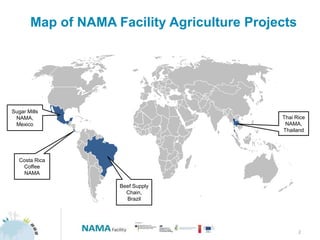
Map of NAMA Facility Agriculture Projects
2
Sugar Mills
NAMA,
Mexico
Beef Supply
Chain,
Brazil
Costa Rica
Coffee
NAMA
Thai Rice
NAMA,
Thailand
Focus on transformation
• Objective is to shift a sector in a country toward a
sustainable, irreversible low carbon pathway
 That happens quicker than the BAU scenario of technological
development
• Achieving transformational change with up to €20m is
ambitious, and requires significant leveraging
• Financial mechanisms are at the core of the NAMA, as they
are needed to kick-start the reversal of funding flows
 There is a diversity of potential instruments
 Most NSPs foresee a mix of at least two financing mechanisms
 Some include results based financing, although for a limited
grant facility this limits the reach, scaleability of the intervention
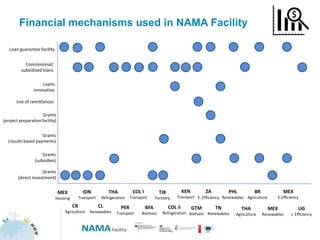
Financial mechanisms used in NAMA Facility
Concessional/
subsidised loans
Grants
(results based payments)
Grants
(project preparation facility)
Use of remittances
Grants
(direct investment)
Grants
(subsidies)
MEX
Housing
COL I
Transport
BFA
Biomass
TJK
Forestry
COL II
Refrigeration
KEN
Transport
GTM
Biofuels
ZA
E. Efficiency
CR
Agriculture
IDN
Transport
CL
Renewables
THA
Refrigeration
PER
Transport
Loans
innovative
Loan guarantee facility
TN
Renewables
THA
Agriculture
PHL
Renewables
BR
Agriculture
MEX
Renewables
MEX
E.Efficiency
UG
E. Efficiency
Business models (1)
• Refers to the economic viability of the project concept for the target
group, end users or other market actors such as users/ buyers/
clients and/or producers or suppliers
• A convincing business case addresses the following key issues:
• Economic/other motivations of each group should be adequately described
• Is the project rationale cost effective / profitable for users/suppliers?
• Describe the incentives to change behaviour, investment/capital flows,
taking into account market conditions, competitiveness and prices
• Demonstrate using calculations and evidence on issues such as price
differential between current and low carbon technologies, operating costs,
investment appraisal (IRR, break even point, pay back times etc)
• Affordability is key. After the transitional support of the NF, the new
technology should be priced within the affordability of the target group, or a
concept for sustainable financing of the uptake should be described
Business Models continued (2)
• Business cases built on capital cost/CAPEX subsidies are rarely
considered viable, and typically offer a low leverage rate
• NF support should only be a minor share of CAPEX
• Avoid market distortions such as preferential treatment of one/few
private actors/investors, with fair/transparent selection procedure
• A capital subsidy model may not be financially sustainable nor
scaleable, due to low transformational effect
• Demonstration projects are commonly proposed on basis of proof of
concept, implying a self-sustaining business model thereafter
• A plausible business case should be made regarding how the
project will be replicable and scaleable given that the supported
projects has received a high share of grant/subsidy in the absence
of “real life” financing conditions
• The higher the (capital) subsidy, the less likely that later market
participants can emulate the model through conventional bank loans
Financial sustainability is critical
• NAMA proponents have typically looked at short term
instruments that can be funded by the NF e.g. interest rate
subsidies
 Better to look at more permanent financing sources to redirect
financial flows, e.g. public sector budgets, taxes, guarantees
 Also, contribution from private households and industry aids
financial sustainability
 NF funding needs to be temporary with a clear phase-in and
phase-out concept
• Note : also strong role for policy reform and regulatory change,
which can be funded through technical assistance
Contact
ash.sharma@nama-facility.org
Senior Adviser, Climate Finance
Further information at www.nama-facility.org
or contact the Technical Support Unit at
contact@nama-facility.org

Finance and lessons learned at the NAMA Facility

  • 1.
    Climate Finance inAgriculture & Agribusiness : Early Lessons Learnt at the NAMA Facility Climate Finance : Emerging Instruments for Mitigation in Agriculture COP23 Side Event, Bonn, Thursday 9 November 2017
  • 2.
    Map of NAMAFacility Agriculture Projects 2 Sugar Mills NAMA, Mexico Beef Supply Chain, Brazil Costa Rica Coffee NAMA Thai Rice NAMA, Thailand
  • 3.
    Focus on transformation •Objective is to shift a sector in a country toward a sustainable, irreversible low carbon pathway  That happens quicker than the BAU scenario of technological development • Achieving transformational change with up to €20m is ambitious, and requires significant leveraging • Financial mechanisms are at the core of the NAMA, as they are needed to kick-start the reversal of funding flows  There is a diversity of potential instruments  Most NSPs foresee a mix of at least two financing mechanisms  Some include results based financing, although for a limited grant facility this limits the reach, scaleability of the intervention
  • 4.
    Financial mechanisms usedin NAMA Facility Concessional/ subsidised loans Grants (results based payments) Grants (project preparation facility) Use of remittances Grants (direct investment) Grants (subsidies) MEX Housing COL I Transport BFA Biomass TJK Forestry COL II Refrigeration KEN Transport GTM Biofuels ZA E. Efficiency CR Agriculture IDN Transport CL Renewables THA Refrigeration PER Transport Loans innovative Loan guarantee facility TN Renewables THA Agriculture PHL Renewables BR Agriculture MEX Renewables MEX E.Efficiency UG E. Efficiency
  • 5.
    Business models (1) •Refers to the economic viability of the project concept for the target group, end users or other market actors such as users/ buyers/ clients and/or producers or suppliers • A convincing business case addresses the following key issues: • Economic/other motivations of each group should be adequately described • Is the project rationale cost effective / profitable for users/suppliers? • Describe the incentives to change behaviour, investment/capital flows, taking into account market conditions, competitiveness and prices • Demonstrate using calculations and evidence on issues such as price differential between current and low carbon technologies, operating costs, investment appraisal (IRR, break even point, pay back times etc) • Affordability is key. After the transitional support of the NF, the new technology should be priced within the affordability of the target group, or a concept for sustainable financing of the uptake should be described
  • 6.
    Business Models continued(2) • Business cases built on capital cost/CAPEX subsidies are rarely considered viable, and typically offer a low leverage rate • NF support should only be a minor share of CAPEX • Avoid market distortions such as preferential treatment of one/few private actors/investors, with fair/transparent selection procedure • A capital subsidy model may not be financially sustainable nor scaleable, due to low transformational effect • Demonstration projects are commonly proposed on basis of proof of concept, implying a self-sustaining business model thereafter • A plausible business case should be made regarding how the project will be replicable and scaleable given that the supported projects has received a high share of grant/subsidy in the absence of “real life” financing conditions • The higher the (capital) subsidy, the less likely that later market participants can emulate the model through conventional bank loans
  • 7.
    Financial sustainability iscritical • NAMA proponents have typically looked at short term instruments that can be funded by the NF e.g. interest rate subsidies  Better to look at more permanent financing sources to redirect financial flows, e.g. public sector budgets, taxes, guarantees  Also, contribution from private households and industry aids financial sustainability  NF funding needs to be temporary with a clear phase-in and phase-out concept • Note : also strong role for policy reform and regulatory change, which can be funded through technical assistance
  • 8.
    Contact ash.sharma@nama-facility.org Senior Adviser, ClimateFinance Further information at www.nama-facility.org or contact the Technical Support Unit at contact@nama-facility.org

Editor's Notes

  • #2 NAMAs are vehicles for learning and disseminating best practice in mitigation actions with a focus on “what works” and practical experiences. The NAMA Facility strives to be a learning hub for the broader climate change community providing good practices, analytical tools and resources, and wherever possible, facilitating peer to peer learning and exchange. It is uniquely positioned to do so given its early and ongoing experience in supporting sector-wide, ambitious mitigation actions and associated monitoring, reporting and verification (MRV) measures. Given the huge challenges faced by developing countries and emerging economies in achieving their commitments under the Paris Agreement, there is an underserved and ongoing need for practical, evidence-based advice on specific implementation needs to underpin NDCs. The NAMA Facilityʼs experience allows it to move beyond traditional knowledge products, imparting real life experience with a specific focus on finance.
  • #3 The four projects related to agricluture/agribusiness are: Costa Rica Coffee NAMA Beef Supply chain, Brazil Thai Rice NAMA, Thailand (Sugar Mills NAMA, Mexico – Renewables/use of biomass as a fuel source)
  • #4  The most convincing outlines addressed the following key issues: Economic and other motivations of each group should be adequately described Is the project rationale cost effective / profitable for users/suppliers? Describe the incentives to change behaviour, investment/capital flows, taking into account market conditions, competitiveness and prices Demonstrate using calculations and evidence on issues such as price differential between current and low carbon technologies, operating costs, investment appraisal (IRR, break even point, pay back times etc) Affordability is key. After the transitional support of the NF, the new technology should be priced within the affordability of the target group, or a concept for sustainable financing of the uptake should be described Important Comment on Concessional finance: NF favours crowding in private sector resources and seeks minimum concessionality, especially in middle income countries.
  • #5  We turn our attention to financial instruments to be employed in the NAMA Facility funded NSPs. Concessional or subsidised loans are most common type of financial instrument employed in the selected NSPs (9 out of 13), followed by loan guarantee facilities (6/13) and various forms of grants. Most NSPs foresee a mix of 2 or more instruments. For agri-projects also loans are used in the Thai Rice,CR Coffee and brazil beef NAMAs and grants for Brazil. Brazil also has a first loss guarantee programme, linked to Banco do Brasil credit lines, expected leveraging 1 : 15-20 Many of these financial instruments are yet to be tested, but the NAMA Facility is committed to disseminate lessons learnt going forward. Financial components take longer than technical assistance to mobilise, requiring establishment time for modalities of the financial scheme, training, legal work and possibly, regulatory clearances Importance of local institutions : Thai Rice uses national agricultural bank, CR uses CABEI (regional) and Brazil IDB (an MDB) and Banco do Brasil.
  • #6 NF focuses on minimum concessionality, greater leverage, crowding in private sector finance and (investment more generally)
  • #8 This captures the NAMA Facility vision for scaling up and mainstreaming more private finance to have mitigation co-benefits: Strategically targeting limited public funding to de-risk investment, build project pipelines Unlocking private finance through blended, concessional public finance through financing structures such as risk sharing facilities and buying down interest rates. NAMAs are a testbed for innovative use of financial instruments and business models for sectoral initiatives. Financing climate change mitigation is a challenge in many developing country contexts. International climate funding support is limited, domestic public budgets are constrained and private sector capital faces many barriers to investment. The NFhas a growing experience with innovative financing concepts and smart combinations of different funding sources which leads to the leverage of private finance and the mobilisation of sustainable domestic funding sources. These initiatives may inspire further implementation of ambitious NDCs.