Sentence Fragments
What is a Fragment?
 Fragment: a group of words that is missing a part of a
complete sentence
 Reminder: A complete sentence includes a subject (noun)
and an action (verb), and it must express a complete
thought.
How to Spot a Fragment?
 Ask yourself:
 Does the group of words have a subject?
 Does it have a verb?
 Does it express a complete thought?
 If the answer to any of these questions are no then the
group of words create a fragment.
Examples of Sentence Fragments
 The car was very old. But stylish.
 Because he wanted to be up early. He knew he needed to
go to sleep.
 Feeling depressed. Jan walked home silently.
Where is the Fragment?
 Brittany was a little nervous about Monday. Because of her
first grammar activity presentation.
 A. Brittany was a little nervous about Monday.
 B. Because of her first grammar activity presentation.
 C. Neither of them
 D. Both of them
 Why?
Where is the Fragment?
 The flowers smelled sweet. Like fruit or candy.
 A. The flowers smelled sweet.
 B. Like fruit or candy.
 C. Neither of them.
 D. Both of them.
 Why?
When are Fragments
Unacceptable?
 Professional Writing:
 Every Word Counts
 Fragments can make your writing confusing
 Fragments make your writing informal
 Examples: Formal Essays and other writing assignments
 Examples: Cover letters
When are Fragments Acceptable?
 Professional Writing:
 To create a casual or conversational tone.
 Example: Does this mean that we should follow the rule of fragments all the
time in our writing? Not necessarily.
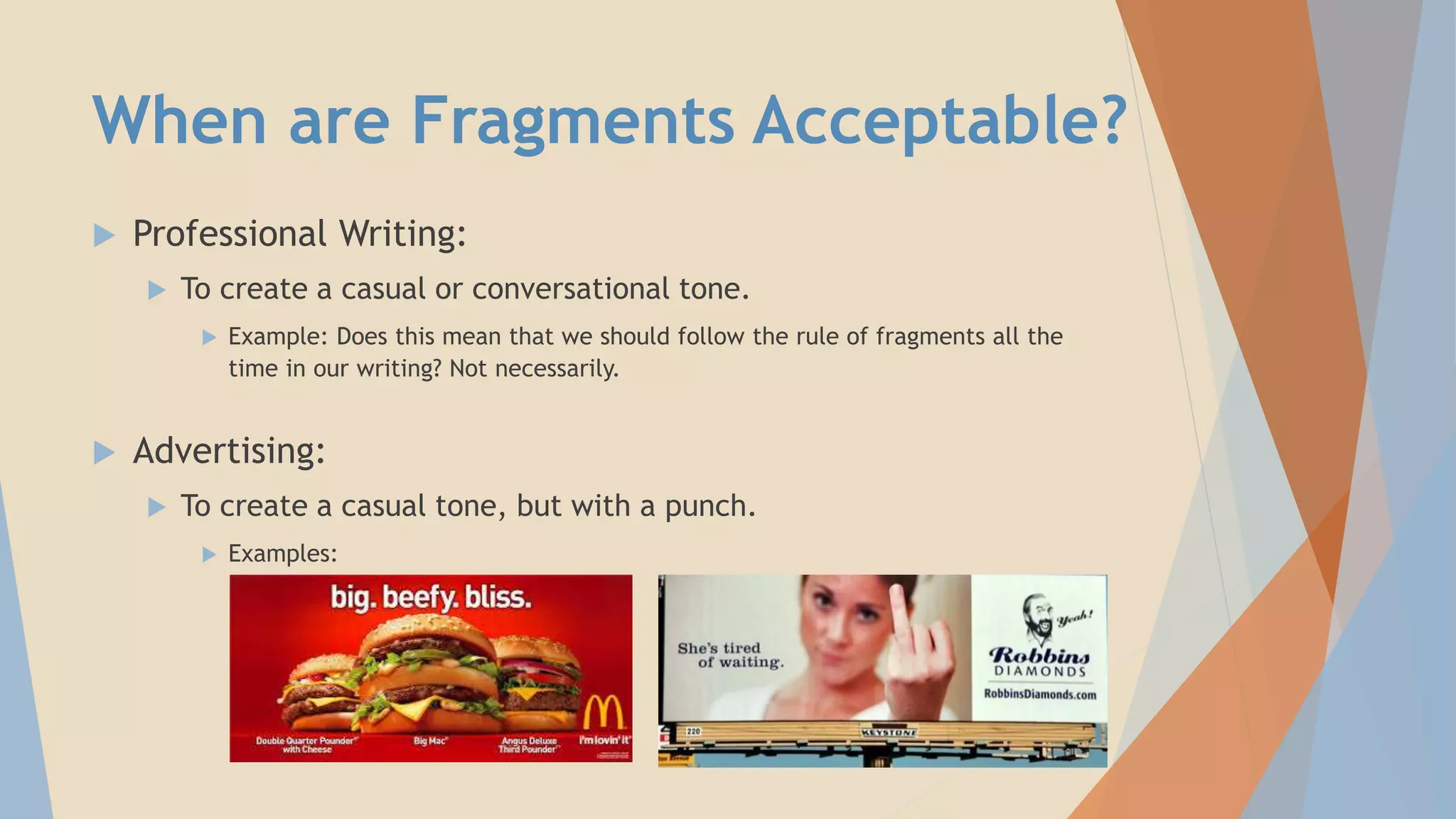
 Advertising:
 To create a casual tone, but with a punch.
 Examples:
When are Fragments Acceptable?
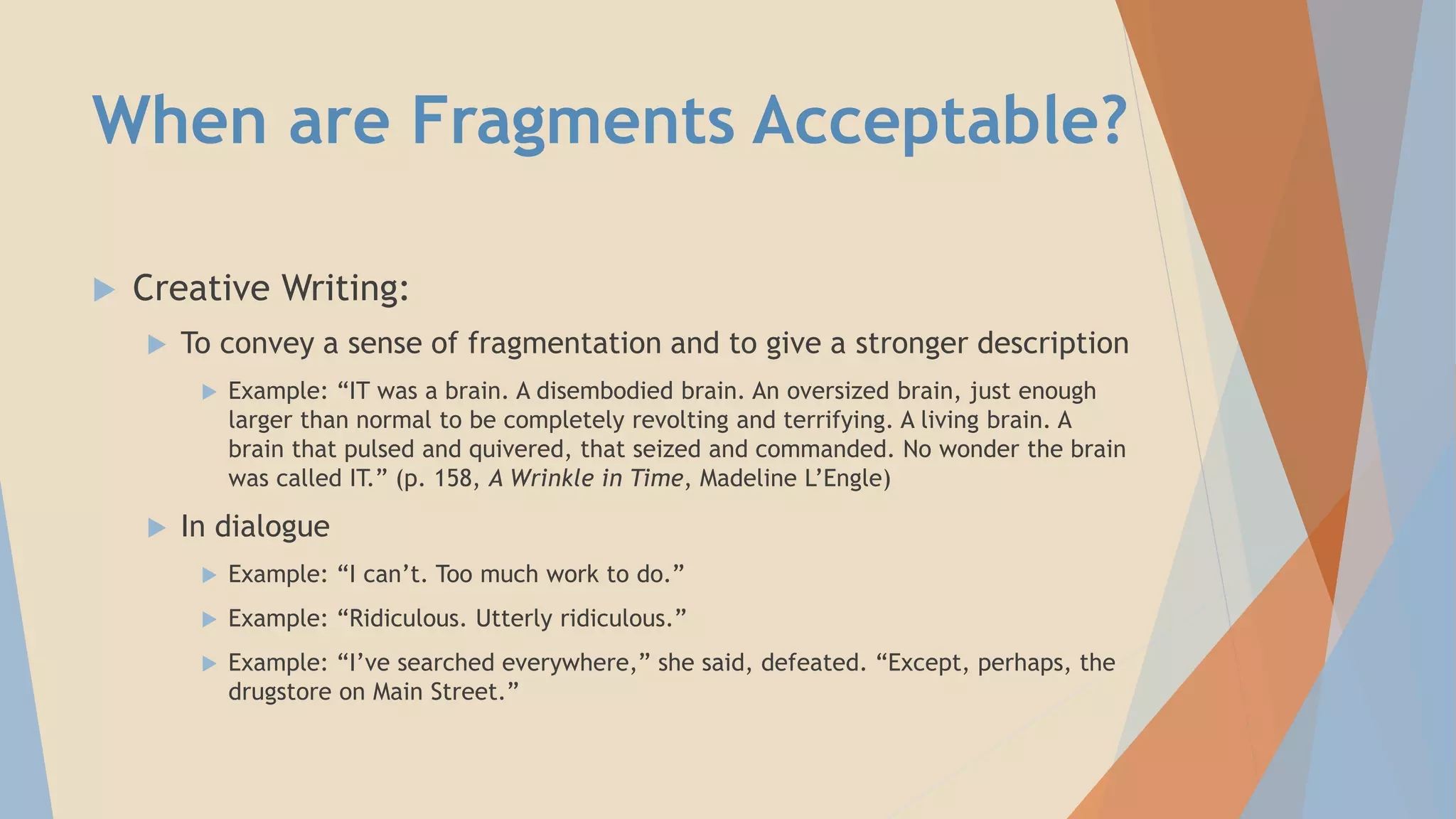
 Creative Writing:
 To convey a sense of fragmentation and to give a stronger description
 Example: “IT was a brain. A disembodied brain. An oversized brain, just enough
larger than normal to be completely revolting and terrifying. A living brain. A
brain that pulsed and quivered, that seized and commanded. No wonder the brain
was called IT.” (p. 158, A Wrinkle in Time, Madeline L’Engle)
 In dialogue
 Example: “I can’t. Too much work to do.”
 Example: “Ridiculous. Utterly ridiculous.”
 Example: “I’ve searched everywhere,” she said, defeated. “Except, perhaps, the
drugstore on Main Street.”
Review
 What are Fragments?
 How can you spot a fragment?
 Why are they not appropriate for some professional
writing pieces?
 When are they appropriate?
Now It’s Your Turn!
Please pull out your short stories and try to find sections where you have
or could have used sentence fragments. Please share with the class. 
Sources
 http://www.sophia.org/tutorials/using-sentence-fragments-wisely
 http://www.sophia.org/tutorials/using-sentence-fragments-wisely--2
 http://writersrelief.com/blog/2008/03/the-scoop-on-sentence-fragments/

Sentence Fragments

  • 1.
  • 2.
    What is aFragment?  Fragment: a group of words that is missing a part of a complete sentence  Reminder: A complete sentence includes a subject (noun) and an action (verb), and it must express a complete thought.
  • 3.
    How to Spota Fragment?  Ask yourself:  Does the group of words have a subject?  Does it have a verb?  Does it express a complete thought?  If the answer to any of these questions are no then the group of words create a fragment.
  • 4.
    Examples of SentenceFragments  The car was very old. But stylish.  Because he wanted to be up early. He knew he needed to go to sleep.  Feeling depressed. Jan walked home silently.
  • 5.
    Where is theFragment?  Brittany was a little nervous about Monday. Because of her first grammar activity presentation.  A. Brittany was a little nervous about Monday.  B. Because of her first grammar activity presentation.  C. Neither of them  D. Both of them  Why?
  • 6.
    Where is theFragment?  The flowers smelled sweet. Like fruit or candy.  A. The flowers smelled sweet.  B. Like fruit or candy.  C. Neither of them.  D. Both of them.  Why?
  • 7.
    When are Fragments Unacceptable? Professional Writing:  Every Word Counts  Fragments can make your writing confusing  Fragments make your writing informal  Examples: Formal Essays and other writing assignments  Examples: Cover letters
  • 8.
    When are FragmentsAcceptable?  Professional Writing:  To create a casual or conversational tone.  Example: Does this mean that we should follow the rule of fragments all the time in our writing? Not necessarily.  Advertising:  To create a casual tone, but with a punch.  Examples:
  • 9.
    When are FragmentsAcceptable?  Creative Writing:  To convey a sense of fragmentation and to give a stronger description  Example: “IT was a brain. A disembodied brain. An oversized brain, just enough larger than normal to be completely revolting and terrifying. A living brain. A brain that pulsed and quivered, that seized and commanded. No wonder the brain was called IT.” (p. 158, A Wrinkle in Time, Madeline L’Engle)  In dialogue  Example: “I can’t. Too much work to do.”  Example: “Ridiculous. Utterly ridiculous.”  Example: “I’ve searched everywhere,” she said, defeated. “Except, perhaps, the drugstore on Main Street.”
  • 10.
    Review  What areFragments?  How can you spot a fragment?  Why are they not appropriate for some professional writing pieces?  When are they appropriate?
  • 11.
    Now It’s YourTurn! Please pull out your short stories and try to find sections where you have or could have used sentence fragments. Please share with the class. 
  • 12.