SEN – The new legislation
Practices and processes in
school
Welcome
4.00 Welcome, introduction and housekeeping – 2 Questions/issues
 Inclusion
 The Children and Families Bill – legislation changes
 The wider reform
 What does the reform mean for class teachers
 What does the reform mean for classroom support
 Assess, Plan, Do, Review
 Reforms in practice
5.00 Break – 5/10 minutes – discussion
 SEN provision
 Wave interventions
 Quality First Teaching
 School examples
5.45 Review
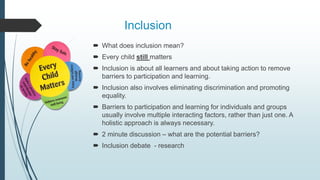
Inclusion
 What does inclusion mean?
 Every child still matters
 Inclusion is about all learners and about taking action to remove
barriers to participation and learning.
 Inclusion also involves eliminating discrimination and promoting
equality.
 Barriers to participation and learning for individuals and groups
usually involve multiple interacting factors, rather than just one. A
holistic approach is always necessary.
 2 minute discussion – what are the potential barriers?
 Inclusion debate - research
The new Code of Practice – the changes
Changes from the SEN Code of Practice 2001 - The Code of Practice (2014) covers
the 0-25 age range
 Teachers are directly responsible for the children in their class with SEN and must
make appropriate provision to meet those needs.
 There is a clearer focus on the views of children and young people and on their role
in decision-making
 For children and young people with more complex needs a co-ordinated
assessment process and the new 0-25 Education, Health and Care Plan (EHC
plan) replace statements and Learning Difficulty Assessments (LDAs)
 There is a greater focus on support that enables those with SEN to succeed in their
education and make a successful transition to adulthood.
 From 1 September 2014 the provisions of the Children and Families Bill, its
associated regulations and the Code of Practice will be in force. Transitional
arrangements will be in place to support the changeover from the current system to
the new system in an orderly way.
 Under the new Code of Practice, special educational needs and provision can be
considered as falling under four broad areas - Communication and interaction (CI),
Cognition and learning (CL), Social, mental and emotional health (SEMH)and
Sensory and/or physical (SP)
continued…
School currently has positive links and effective working relationships with stakeholders –
including parents, governors, external agencies such as attendance support, social care
and health. This will continue and be extended from September 2014.
The code of practice requires (amongst others)-
 Involving children, parents and young people in decision making
 Education, health and social care must work together to support children, young
people and their families.
 Schools should put appropriate evidence-based interventions in place and provide
high quality teaching which is differentiated and personalised and should be available
for all pupils
 Schools have a legal duty to publish information on their websites about the
implementation of the governing body’s or the proprietor’s policy for pupils with SEN –
school offer must be kept up to date and on the website
 A local authority must conduct an assessment of education, health and care needs
and prepare an Education, Health and Care (EHC) plan when it considers that it may
be necessary for special educational provision to be made for the child or young
person through an EHC plan.
 Young people and parents of children have a right to ask the local authority to prepare
a personal budget once the authority has completed the assessment and confirmed
that it will prepare an EHC plan
New teachers’ pay
arrangements
National
Curriculum
Assessment
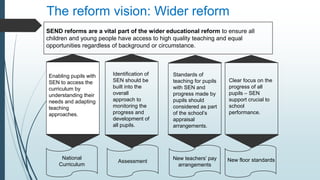
SEND reforms are a vital part of the wider educational reform to ensure all
children and young people have access to high quality teaching and equal
opportunities regardless of background or circumstance.
Enabling pupils with
SEN to access the
curriculum by
understanding their
needs and adapting
teaching
approaches.
.
Standards of
teaching for pupils
with SEN and
progress made by
pupils should
considered as part
of the school’s
appraisal
arrangements.
Identification of
SEN should be
built into the
overall
approach to
monitoring the
progress and
development of
all pupils.
New floor standards
The reform vision: Wider reform
Clear focus on the
progress of all
pupils – SEN
support crucial to
school
performance.
External support
ec
Child or
young
Persons
with
SEN
Review
Assess
Do
Plan
The reform vision: A whole school approach
Engageparent
Engage parent
Engageparent
Engage parent
What the reforms mean for
classroom/subject teachers
Classroom and subject teachers are at the heart of the new SEN Support system,
driving the movement around the four stages (assess, plan, do, review) of action with
the support guidance of the SENCO and specialist staff.
The classroom teacher should:
 Focus on outcomes for the child: Be clear about the outcome wanted from any
SEN support.
 Be responsible for meeting special educational needs: Use the SENCO
strategically to support the quality of teaching, evaluate the quality of support and
contribute to school improvement.
 Have high aspirations for every pupils: Set clear progress targets for pupils and
be clear about how the full range of resources are going to help reach them.
 Involve parents and pupils in planning and reviewing progress: Seek their
views and provide regular updates on progress.
Classroom support
• Teaching Assistants are part of the whole school approach to SEN working in
partnership with the classroom/subject teacher and the SENCO to deliver pupil
progress and narrow gaps in performance.
• It is for schools to decide how they deploy teaching assistants depending on their
level of experience. To be most effective the support they give should be focused
on the achievement of specific outcomes within the graduated approach to SEN
support agreed with parents in the context of high quality teaching overall.
• Teaching Assistants can be part of a package of support for the individual child but
should never be a substitute for the teacher’s involvement with that child.
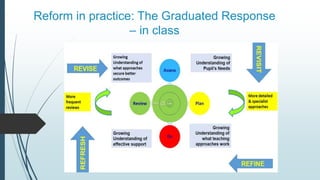
Reform in practice: The Graduated Response
– in class
Reform in practice: Assessing and
reviewing progress
Classroom or subject teacher working with the SENCO should assess where a
child is not making adequate progress, despite high quality teaching targeted at an
area of weakness.
They should draw on evidence from a clear analysis of pupil’s need such as:
• teacher’s assessment and experience of the pupil;
• information on pupil progress, attainment, and behaviour;
• individual’s development in comparison to their peers;
• the views and experience of parents;
• the child’s own views; and
• advice from external support services.
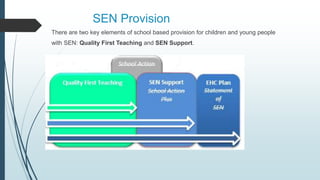
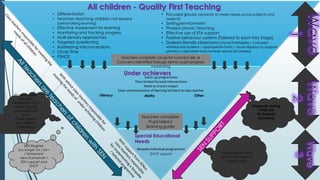
SEN Provision
There are two key elements of school based provision for children and young people
with SEN: Quality First Teaching and SEN Support.
Teachers complete cause for concern slip or
Concerns identified through termly pupil progress
monitoring
EHCP support
• Differentiation
• Teachers teaching children not lessons
(personalising learning)
• Effective Assessment for learning
• Monitoring and tracking progress
• Multi sensory approaches
• Targeted questioning
• Addressing misconceptions
• Circle Time
• PSHCE
Catch up programmes
Time limited focused interventions
Need to ensure impact
Clear communication of learning fed back to class teacher
Under achievers
Special Educational
Needs
Teachers complete
Pupil helpful
learning guide
All children - Quality First Teaching
Diagnostic testing
PHAB test
GL Dyslexia
Screening
• Focused groups (dynamic to meet needs across subjects and
aspects)
• Setting/environment
• Phased phonic Teaching
• Effective use of ETA support
• Positive behaviour systems (Tailored to each Key Stage)
• Dyslexia friendly classrooms (visual timetables / coloured
whiteboard screens / appropriate fonts / visual displays to support
phonics / alphabet and number across all classes)
MathsLiteracy Other
Bespoke Individual programmes
SEN Register
(no longer SA / SA+
/ Statement
New framework =
SEN support and
EHCP
Involve parent and
child at all stages of
support plan
Provision map
records
information at a
school / group
and individual
level
Clear targets
and impact
evaluation
Quality First Teaching
 High expectations and aspirations; for all children and young people with SEN, whatever
their prior attainment
 Differentiation; planned and targeted to address weaknesses, overcome barriers to
learning and reduce the need for ‘additional’ or ‘different’ interventions. This should include
provision of extra processing time and recording time and special arrangements for exam
access.
 Opportunities for collaboration; the curriculum provides opportunities for the development
of collaborative working skills for children and young people
 Rewards: consistent systems in place across whole school, classes and specific groups
 Understanding; planning is informed by and understanding of child development and
reflects opportunities across different learning styles (including play) and sensory
preferences
 Enjoyment: teaching is planned in a way which imparts enjoyment and enthusiasm to learn
and progress whilst being able to take learning risks
Continued…
 Small groups and collective learning: targeting specific areas of weakness or
developing certain skills
 Understanding, reinforcement and memory aids; e.g. use of visual timetables,
checklists, to do list, word maps and reinforcement strategies
 Expectations; clear expectations in relation to work and behaviour
 Peer support and buddying; to support learning and peer relationships
 Self-confidence and independent learning skills; through opportunities,
recognition, modelled self-reflection and carefully managed support
 Regular movement breaks; for children and young people when they are sat for
an extended period of time
 Responsive one to one support; should be made available for all children and
young people as they require it.
SEN support replaces School Action / School Action Plus. It is the category of support
for children with SEN but not on EHC plans.
 It focuses the system on the impact of the support provided to that individual
child, rather than how children access support according to the category they fit
into.
 It places emphasises on a graduated approach (assess, plan, do and review).
 The aim is to improve the experience and outcomes within schools for all
pupils, ensuring high quality teaching and learning.
 Any children needing EHC plans should be the responsibility of the school
SENCo using information provided by the class teacher
SEN Support
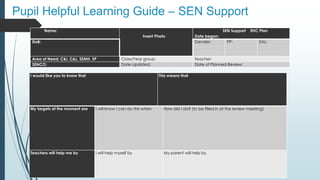
Pupil Helpful Learning Guide – SEN Support
Name:
Insert Photo
SEN Support EHC Plan
Date began:
DoB: Gender: PP: EAL:
Area of Need: C&I, C&L, SEMH, SP Class/Year group: Teacher:
SENCO: Date Updated: Date of Planned Review:
I would like you to know that This means that
My targets at the moment are I will know I can do this when How did I do? (to be filled in at the review meeting)
Teachers will help me by I will help myself by My parent will help by
Effective Targeted Intervention
 Is not used as a substitute for properly differentiated quality first teaching (QFT)
 Feeds back into QFT
 Targets the right children through data tracking
 Has clear entry and exit criteria and regularly reviews children’s progress
 Involves children so they understand the purpose and intended outcomes and involves parents
and lets them know how they can support children at home
 Is generally time limited and is delivered by someone with appropriate training, knowledge and
support
 Is monitored regularly by the class teacher and the SENCo
 Is jointly planned by the class teacher and the person delivering.
 Is reinforced in class and is jointly reviewed by the class teacher and the person delivering
 Is evaluated in terms of impact – both short and long term – using this information to decide
whether it should continue to run
 Includes strategies for the children to identify and monitor their own progress
 Helps children become more independent learners.
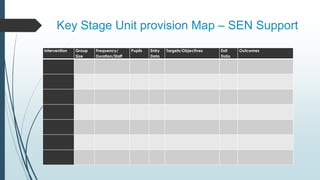
Key Stage Unit provision Map – SEN Support
Intervention Group
Size
Frequency/
Duration/Staff
Pupils Entry
Data
Targets/Objectives Exit
Data
Outcomes
Review
Final discussion
Have questions been addressed?
Thank you for listening

Sen

  • 1.
    SEN – Thenew legislation Practices and processes in school
  • 2.
    Welcome 4.00 Welcome, introductionand housekeeping – 2 Questions/issues  Inclusion  The Children and Families Bill – legislation changes  The wider reform  What does the reform mean for class teachers  What does the reform mean for classroom support  Assess, Plan, Do, Review  Reforms in practice 5.00 Break – 5/10 minutes – discussion  SEN provision  Wave interventions  Quality First Teaching  School examples 5.45 Review
  • 3.
    Inclusion  What doesinclusion mean?  Every child still matters  Inclusion is about all learners and about taking action to remove barriers to participation and learning.  Inclusion also involves eliminating discrimination and promoting equality.  Barriers to participation and learning for individuals and groups usually involve multiple interacting factors, rather than just one. A holistic approach is always necessary.  2 minute discussion – what are the potential barriers?  Inclusion debate - research
  • 4.
    The new Codeof Practice – the changes Changes from the SEN Code of Practice 2001 - The Code of Practice (2014) covers the 0-25 age range  Teachers are directly responsible for the children in their class with SEN and must make appropriate provision to meet those needs.  There is a clearer focus on the views of children and young people and on their role in decision-making  For children and young people with more complex needs a co-ordinated assessment process and the new 0-25 Education, Health and Care Plan (EHC plan) replace statements and Learning Difficulty Assessments (LDAs)  There is a greater focus on support that enables those with SEN to succeed in their education and make a successful transition to adulthood.  From 1 September 2014 the provisions of the Children and Families Bill, its associated regulations and the Code of Practice will be in force. Transitional arrangements will be in place to support the changeover from the current system to the new system in an orderly way.  Under the new Code of Practice, special educational needs and provision can be considered as falling under four broad areas - Communication and interaction (CI), Cognition and learning (CL), Social, mental and emotional health (SEMH)and Sensory and/or physical (SP)
  • 5.
    continued… School currently haspositive links and effective working relationships with stakeholders – including parents, governors, external agencies such as attendance support, social care and health. This will continue and be extended from September 2014. The code of practice requires (amongst others)-  Involving children, parents and young people in decision making  Education, health and social care must work together to support children, young people and their families.  Schools should put appropriate evidence-based interventions in place and provide high quality teaching which is differentiated and personalised and should be available for all pupils  Schools have a legal duty to publish information on their websites about the implementation of the governing body’s or the proprietor’s policy for pupils with SEN – school offer must be kept up to date and on the website  A local authority must conduct an assessment of education, health and care needs and prepare an Education, Health and Care (EHC) plan when it considers that it may be necessary for special educational provision to be made for the child or young person through an EHC plan.  Young people and parents of children have a right to ask the local authority to prepare a personal budget once the authority has completed the assessment and confirmed that it will prepare an EHC plan
  • 6.
    New teachers’ pay arrangements National Curriculum Assessment SENDreforms are a vital part of the wider educational reform to ensure all children and young people have access to high quality teaching and equal opportunities regardless of background or circumstance. Enabling pupils with SEN to access the curriculum by understanding their needs and adapting teaching approaches. . Standards of teaching for pupils with SEN and progress made by pupils should considered as part of the school’s appraisal arrangements. Identification of SEN should be built into the overall approach to monitoring the progress and development of all pupils. New floor standards The reform vision: Wider reform Clear focus on the progress of all pupils – SEN support crucial to school performance.
  • 7.
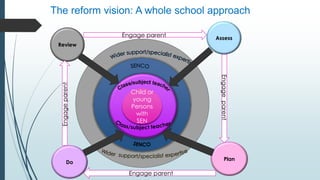
    External support ec Child or young Persons with SEN Review Assess Do Plan Thereform vision: A whole school approach Engageparent Engage parent Engageparent Engage parent
  • 8.
    What the reformsmean for classroom/subject teachers Classroom and subject teachers are at the heart of the new SEN Support system, driving the movement around the four stages (assess, plan, do, review) of action with the support guidance of the SENCO and specialist staff. The classroom teacher should:  Focus on outcomes for the child: Be clear about the outcome wanted from any SEN support.  Be responsible for meeting special educational needs: Use the SENCO strategically to support the quality of teaching, evaluate the quality of support and contribute to school improvement.  Have high aspirations for every pupils: Set clear progress targets for pupils and be clear about how the full range of resources are going to help reach them.  Involve parents and pupils in planning and reviewing progress: Seek their views and provide regular updates on progress.
  • 9.
    Classroom support • TeachingAssistants are part of the whole school approach to SEN working in partnership with the classroom/subject teacher and the SENCO to deliver pupil progress and narrow gaps in performance. • It is for schools to decide how they deploy teaching assistants depending on their level of experience. To be most effective the support they give should be focused on the achievement of specific outcomes within the graduated approach to SEN support agreed with parents in the context of high quality teaching overall. • Teaching Assistants can be part of a package of support for the individual child but should never be a substitute for the teacher’s involvement with that child.
  • 10.
    Reform in practice:The Graduated Response – in class
  • 11.
    Reform in practice:Assessing and reviewing progress Classroom or subject teacher working with the SENCO should assess where a child is not making adequate progress, despite high quality teaching targeted at an area of weakness. They should draw on evidence from a clear analysis of pupil’s need such as: • teacher’s assessment and experience of the pupil; • information on pupil progress, attainment, and behaviour; • individual’s development in comparison to their peers; • the views and experience of parents; • the child’s own views; and • advice from external support services.
  • 13.
    SEN Provision There aretwo key elements of school based provision for children and young people with SEN: Quality First Teaching and SEN Support.
  • 14.
    Teachers complete causefor concern slip or Concerns identified through termly pupil progress monitoring EHCP support • Differentiation • Teachers teaching children not lessons (personalising learning) • Effective Assessment for learning • Monitoring and tracking progress • Multi sensory approaches • Targeted questioning • Addressing misconceptions • Circle Time • PSHCE Catch up programmes Time limited focused interventions Need to ensure impact Clear communication of learning fed back to class teacher Under achievers Special Educational Needs Teachers complete Pupil helpful learning guide All children - Quality First Teaching Diagnostic testing PHAB test GL Dyslexia Screening • Focused groups (dynamic to meet needs across subjects and aspects) • Setting/environment • Phased phonic Teaching • Effective use of ETA support • Positive behaviour systems (Tailored to each Key Stage) • Dyslexia friendly classrooms (visual timetables / coloured whiteboard screens / appropriate fonts / visual displays to support phonics / alphabet and number across all classes) MathsLiteracy Other Bespoke Individual programmes SEN Register (no longer SA / SA+ / Statement New framework = SEN support and EHCP Involve parent and child at all stages of support plan Provision map records information at a school / group and individual level Clear targets and impact evaluation
  • 15.
    Quality First Teaching High expectations and aspirations; for all children and young people with SEN, whatever their prior attainment  Differentiation; planned and targeted to address weaknesses, overcome barriers to learning and reduce the need for ‘additional’ or ‘different’ interventions. This should include provision of extra processing time and recording time and special arrangements for exam access.  Opportunities for collaboration; the curriculum provides opportunities for the development of collaborative working skills for children and young people  Rewards: consistent systems in place across whole school, classes and specific groups  Understanding; planning is informed by and understanding of child development and reflects opportunities across different learning styles (including play) and sensory preferences  Enjoyment: teaching is planned in a way which imparts enjoyment and enthusiasm to learn and progress whilst being able to take learning risks
  • 16.
    Continued…  Small groupsand collective learning: targeting specific areas of weakness or developing certain skills  Understanding, reinforcement and memory aids; e.g. use of visual timetables, checklists, to do list, word maps and reinforcement strategies  Expectations; clear expectations in relation to work and behaviour  Peer support and buddying; to support learning and peer relationships  Self-confidence and independent learning skills; through opportunities, recognition, modelled self-reflection and carefully managed support  Regular movement breaks; for children and young people when they are sat for an extended period of time  Responsive one to one support; should be made available for all children and young people as they require it.
  • 17.
    SEN support replacesSchool Action / School Action Plus. It is the category of support for children with SEN but not on EHC plans.  It focuses the system on the impact of the support provided to that individual child, rather than how children access support according to the category they fit into.  It places emphasises on a graduated approach (assess, plan, do and review).  The aim is to improve the experience and outcomes within schools for all pupils, ensuring high quality teaching and learning.  Any children needing EHC plans should be the responsibility of the school SENCo using information provided by the class teacher SEN Support
  • 18.
    Pupil Helpful LearningGuide – SEN Support Name: Insert Photo SEN Support EHC Plan Date began: DoB: Gender: PP: EAL: Area of Need: C&I, C&L, SEMH, SP Class/Year group: Teacher: SENCO: Date Updated: Date of Planned Review: I would like you to know that This means that My targets at the moment are I will know I can do this when How did I do? (to be filled in at the review meeting) Teachers will help me by I will help myself by My parent will help by
  • 19.
    Effective Targeted Intervention Is not used as a substitute for properly differentiated quality first teaching (QFT)  Feeds back into QFT  Targets the right children through data tracking  Has clear entry and exit criteria and regularly reviews children’s progress  Involves children so they understand the purpose and intended outcomes and involves parents and lets them know how they can support children at home  Is generally time limited and is delivered by someone with appropriate training, knowledge and support  Is monitored regularly by the class teacher and the SENCo  Is jointly planned by the class teacher and the person delivering.  Is reinforced in class and is jointly reviewed by the class teacher and the person delivering  Is evaluated in terms of impact – both short and long term – using this information to decide whether it should continue to run  Includes strategies for the children to identify and monitor their own progress  Helps children become more independent learners.
  • 20.
    Key Stage Unitprovision Map – SEN Support Intervention Group Size Frequency/ Duration/Staff Pupils Entry Data Targets/Objectives Exit Data Outcomes
  • 21.
    Review Final discussion Have questionsbeen addressed? Thank you for listening

Editor's Notes

  • #7 When the new SEN arrangements kick in this September, everyone in school will also be grappling with a number of other big changes at the same time. Change is never easy – especially not on several fronts at once. All these reforms, to SEN and to schools, share the same aim - to provide the best possible education and prospects for all children, regardless of background. So these reforms work together and reinforce each other – all seeking to raise standards and aspirations, whatever a child’s circumstances. Curriculum The new national curriculum will be taught in all maintained primary and secondary schools from September 2014. In planning their schemes of work, teachers should be thinking about how they can adapt teaching to respond to the needs of pupils with SEND and work together with the SENCO, drawing in specialist expertise to remove barriers to learning The National Curriculum Inclusion Statement states that teachers should set high expectations for every pupil, whatever their prior attainment. Lesson planning to address potential areas of difficulty and remove barriers will mean that in many cases, pupils with SEN and disabilities will be able to study the full curriculum. Assessment without levels As part of the reforms to the national curriculum , the current system of ‘levels’ used to report children’s attainment and progress will be removed from September 2014. Schools will be able to introduce their own approaches to formative and summative assessment.   Where a pupil is receiving SEN support, schools should talk to parents regularly to set clear outcomes and review progress towards them. It is for schools to determine their own approach to record keeping, but the provision made for pupils with SEN should be recorded accurately and kept up to date. As part of any Ofsted expectation, Ofsted will expect to see evidence of pupil progress a focus on outcomes and a rigorous approach to the monitoring and evaluation of any SEN support provided. P scales will continue to exist for all National Curriculum subjects, to enable schools to report on the attainment for children with special educational needs who are working below level 1 of the national curriculum.   Pay Reform New teachers’ pay arrangements were introduced in September 2013. The main change was the introduction of performance-related pay progression. Schools should make the first pay decisions under these new arrangements in September 2014. Further changes will be introduced in September 2014 which provide greater flexibility for schools to decide the pay of school leaders. In reviewing their pay policies, schools should make clear what relevant evidence will be taken into account in assessing all teachers against the Teachers’ Standards and their objectives (for example, this may include how they will assess performance in meeting the needs of pupils with SEND), to give teachers a fair opportunity to demonstrate they are meeting the standards and their objectives.   New floor standards The new floor standards reinforce the need for a whole schools approach to children with SEN. Instead of focusing on thresholds that many pupils with SEN get nowhere near, the floor standards will have a clear focus on the progress of all pupils.  This means that SEN support will be crucial to school performance in future.    
  • #8  Whilst the main legal duties on schools will not change; the way they will be met will change. The reforms aim to bring about a culture change by placing classroom and subject teachers at the heart of the new SEN Support system, with parents or carers fully involved in decisions about their support and what they want to achieve. Classroom and subject teachers work together with the SENCO, drawing in specialist expertise to remove barriers to learning and put in place effective provision in the form of a four part cycle of assessment, planning, action and review (the graduated approach). The Teacher’s Standards 2012, make it clear that it is every teacher’s responsibility to “adapt teaching to respond to the strengths and needs of all pupils”. The SEN Code of Practice echoes this point, as it states that “teachers are responsible and accountable for the progress and development of the pupils in their class, even where pupils access support from teaching assistants or specialist staff”.
  • #9 The classroom teacher plays a central role constantly reviewing and monitoring progress and setting targets for the child. (Code of Practice, section 6.45-6.56) Teachers should set a clear date to check progress and evaluate the support and have open conversations with parents about what support is intended to achieve, how they will know whether it has worked and what they will do next if it hasn’t. Hearing the views of parents and carers and of children and young people themselves, then planning on the basis of those views, are key elements in securing parental confidence and involvement.
  • #11 Where a pupil is identified as having SEN, schools should take action to remove barriers to learning and put effective special educational provision in place. This SEN support should take the form of a four-part cycle through which earlier decisions and actions are revisited, refined and revised with a growing understanding of the pupil’s needs and of what supports the pupil in making good progress and securing good outcomes. Code of Practice, section 6.45 – 6.53
  • #12 In reviewing progress, teachers should: review the effectiveness of the intervention and their impact on the pupil’s progress; evaluate the impact and quality of the support and interventions taking into account the views of the parent and pupil themselves; revise the support in light of the pupil’s progress and development including any changes and outcomes; parents should have clear information about the impact of the support and interventions provided; and for Children on EHC plans, the LA must review the plan as a minimum of twelve months, but the school must co-operate with the LA during the review. The current arrangements for P scales still apply for more information on P – Scales: https://www.gov.uk/teacher-assessment-using-p-scales Code of Practice, section 6.53. “P-scales” are a set of descriptions for recording the achievement of pupils with learning difficulties working below the level assumed to be the starting point of the National Curriculum.
  • #18 What is SEN support? SEN support provides every child or young person with SEN, but not on EHC plan with the additional support they need to progress at school. SEN support puts pupils at the heart of the provision, and encourage schools to respond more flexibly to pupils’ needs. The Code of Practice outlines a four part cycle of assessment, planning, implementing and reviewing for a child receiving SEN support. This is known as the graduated approach. How will SEN support category improve things? A simplified, rigorous approach will focus the system on the impact of the support provided to that individual child, rather than how children access support according to the category they fit into. It will also challenge schools to improve the quality of teaching and learning for all pupils, rather than inappropriately and inaccurately labelling some pupils as having SEN. Examples of what good SEN support looks like, including case studies can be found at: The send gateway at: www.nasen.org.uk Achievement for All at: www.achievementforall3As.org.uk Local authorities websites, particularly the local offer pages. Code of Practice, section 6.44