SEN/D Code of Practice 2014 
@ASTSupportaali
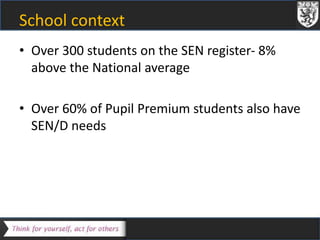
School context 
• Over 300 students on the SEN register- 8% 
above the National average 
• Over 60% of Pupil Premium students also have 
SEN/D needs
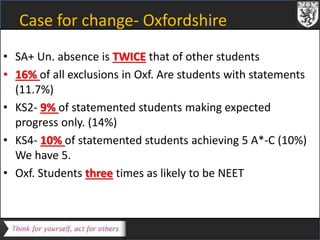
Case for change- Oxfordshire 
• SA+ Un. absence is TWICE that of other students 
• 16% of all exclusions in Oxf. Are students with statements 
(11.7%) 
• KS2- 9% of statemented students making expected 
progress only. (14%) 
• KS4- 10% of statemented students achieving 5 A*-C (10%) 
We have 5. 
• Oxf. Students three times as likely to be NEET
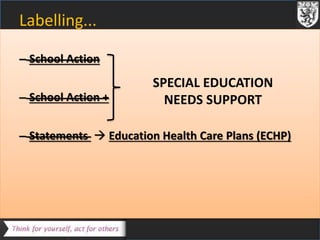
Labelling... 
– School Action 
– School Action + 
SPECIAL EDUCATION 
NEEDS SUPPORT 
– Statements  Education Health Care Plans (ECHP)
Four primary areas of SEN/D 
1.Communication & Interaction (ASD/SLCN) 
2.Cognition & learning (MLD/SpLD) 
3.Social, Emotional and Mental Health 
(ADHD/BESD) 
4.Sensory &/or physical (HI/VI/PD)
Task- 20 minutes 
• Take 5 minutes to read through each of the 
SEN/D needs 
• Jot down any questions you have/any support 
you need
Learning Support Team- 2014-2015 
• A Ali- Director of Inclusion and SENCO 
• Assistant SENCO 
• Learning Support Manager 
• Learning Support Admin 
• SEN/D Teachers 
• HLTA for Physical Disability 
• Education Inclusion Tutor 
• Cheney + Coordinators 
• TA for LAC 
• Academic Mentors 
• Literacy Team 
• Young Carers 
• Pupil Premium Lead 
• Head of G&T 
• Head of EAL and Exam Access Arrangements
Learner Space 
• Order and organisation of the tables? 
• Visibility/hearing from the board/Teacher 
• Resources/Displays/Storage
Objectives 
• Tasks or learning
Seating Plan 
• *Reminder* Use the automated seating plan 
generator - T:Staff ResourcesData - Student 
ProgressSeating Plan 
• Class Photos- annotated- Keep history
SEN/D Register 
• T:Staff ResourcesSPECIAL EDUCATIONAL 
NEEDSSEN REGISTER 2014 
• Vulnerable Learners register (List/information 
to follow). 
• Transition information
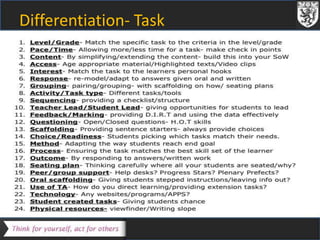
Differentiation- Task
A-Z Checklist for TAs 
• Ask challenging questions that encourage the pursuit of excellence Assess when pupils can be moved on to an extra 
extension task 
• Bring different opinions, ideas & experiences to class discussions Build self esteem in your class 
• Catch them being clever and reward them 
• Differentiate the lesson instructions/activities according to need 
• Elaborate on difficult questions Encouragement through individual quiet words on a one-to- one basis 
• Foster creativeness from the students Find the invisible child 
• Generate lesson activities Give advice on an activity 
• Hand out resources leaving the teacher free to explain the tasks Help pupils to organise their ideas before writing. 
• Individual attention given to pupils who need extra support at times Identify success from the students they are supporting 
• Join in with activities with all the class Just take a minute to brief your LSA before/after the lesson or drop an email 
• Keep students focused and on task 
• Listen to reading groups Lead small groups 
• Monitor progress of individual or group 
• Negotiate with students to move them on to more challenging tasks Notice the underachiever and report back to teacher 
• Organise some pupils eg. Write homework in planner 
• Present ideas in a variety of ways e.g. Mind maps, suggestions for learning styles Praise – in writing and verbally 
• Quirkily contribute to and enrich classroom discussions Question pupils with open ended questions 
• Revivify subject content incorporating a different point of view Reinforce lesson objectives/outcomes 
• Support other students allowing teacher time with SEND students. Spot the off task student 
• Tell teacher of pupils working well - praise them Take notes if student is absent or unable to keep up 
• Unable to support fully unless we become a professional teaching team 
• Valuable support & stress relief with a difficult class or student Visualisation help for SEND students 
• Work with small groups of pupils in or outside of the classroom Write key words in glossaries 
• (e)Xplore higher order thinking skills 
• Yield results when we work together as a team 
• Zoom into the vulnerable/difficult student to ensure that they get on task quickly
Agile Teaching and Learning- OCC 
1) analysis of evidence leading to quality 
information being made available to support 
2) detailed planning, including the provision of 
appropriate resources 
3) Students in the best practice, actively sharing 
in their learning journey, which is 
4) tracked and reviewed at regular intervals with 
5) records being collated and disseminated, 
allowing the process to be cyclic and 
developmental
Inclusive Teaching
New SEN/D Policy- DRAFT 
Teaching Staff and Teaching Assistants 
• Class teachers are involved in the development of the 
school’s SEN/D policy and implement the procedures for 
identifying, assessing and making provision for pupils with 
SEN/D, including planning for differentiation. 
• The identification of SEN is built into the overall approach 
to monitoring the progress and development of pupils. 
• Class teachers are responsible for working with children on 
a daily basis and closely monitor children involved in 
interventions away from the main class. 
• Teachers work closely with teaching assistants to plan and 
assess the impact of support and interventions and how 
they can be linked to classroom teaching.
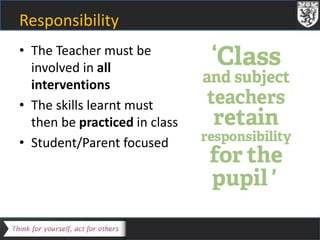
Responsibility 
• The Teacher must be 
involved in all 
interventions 
• The skills learnt must 
then be practiced in class 
• Student/Parent focused
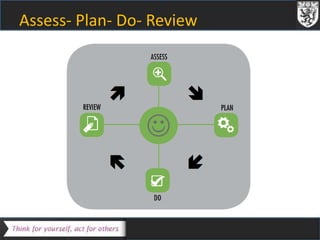
Assess- Plan- Do- Review
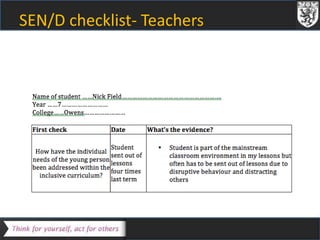
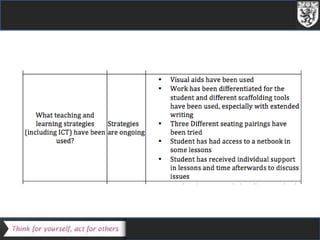
SEN/D checklist- Teachers
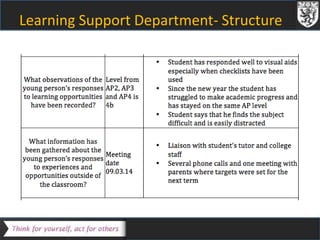
Learning Support Department- Structure
Challenges 
Specific circumstances 
• Progress can be affected by a number of factors inside 
and outside of the setting or school including family 
crises, bereavement and bullying. Some of these will 
not necessarily lead to a learner having SEN but may 
cause significant short term needs. 
• Behavioural difficulties do not necessarily mean that a 
child or young person has a SEN, but consistent 
disruptive or withdrawn behaviours can indicate 
underlying and unmet needs and so it’s important to 
look across the range of indicators to check where 
difficulties originate.
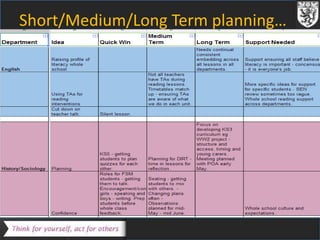
Short/Medium/Long Term planning…
Focus on outcomes 
• Creativity!
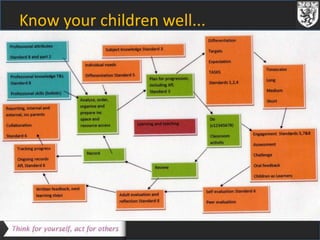
Know your children well...
Thanks to @ChrisChivers2 for his blogs! 
• For more information go to 
www.cheneyagilitytoolkit.blogspot.com

SEN Code of Practice Changes- 2014

  • 1.
    SEN/D Code ofPractice 2014 @ASTSupportaali
  • 2.
    School context •Over 300 students on the SEN register- 8% above the National average • Over 60% of Pupil Premium students also have SEN/D needs
  • 3.
    Case for change-Oxfordshire • SA+ Un. absence is TWICE that of other students • 16% of all exclusions in Oxf. Are students with statements (11.7%) • KS2- 9% of statemented students making expected progress only. (14%) • KS4- 10% of statemented students achieving 5 A*-C (10%) We have 5. • Oxf. Students three times as likely to be NEET
  • 4.
    Labelling... – SchoolAction – School Action + SPECIAL EDUCATION NEEDS SUPPORT – Statements  Education Health Care Plans (ECHP)
  • 5.
    Four primary areasof SEN/D 1.Communication & Interaction (ASD/SLCN) 2.Cognition & learning (MLD/SpLD) 3.Social, Emotional and Mental Health (ADHD/BESD) 4.Sensory &/or physical (HI/VI/PD)
  • 6.
    Task- 20 minutes • Take 5 minutes to read through each of the SEN/D needs • Jot down any questions you have/any support you need
  • 7.
    Learning Support Team-2014-2015 • A Ali- Director of Inclusion and SENCO • Assistant SENCO • Learning Support Manager • Learning Support Admin • SEN/D Teachers • HLTA for Physical Disability • Education Inclusion Tutor • Cheney + Coordinators • TA for LAC • Academic Mentors • Literacy Team • Young Carers • Pupil Premium Lead • Head of G&T • Head of EAL and Exam Access Arrangements
  • 8.
    Learner Space •Order and organisation of the tables? • Visibility/hearing from the board/Teacher • Resources/Displays/Storage
  • 9.
  • 10.
    Seating Plan •*Reminder* Use the automated seating plan generator - T:Staff ResourcesData - Student ProgressSeating Plan • Class Photos- annotated- Keep history
  • 11.
    SEN/D Register •T:Staff ResourcesSPECIAL EDUCATIONAL NEEDSSEN REGISTER 2014 • Vulnerable Learners register (List/information to follow). • Transition information
  • 12.
  • 13.
    A-Z Checklist forTAs • Ask challenging questions that encourage the pursuit of excellence Assess when pupils can be moved on to an extra extension task • Bring different opinions, ideas & experiences to class discussions Build self esteem in your class • Catch them being clever and reward them • Differentiate the lesson instructions/activities according to need • Elaborate on difficult questions Encouragement through individual quiet words on a one-to- one basis • Foster creativeness from the students Find the invisible child • Generate lesson activities Give advice on an activity • Hand out resources leaving the teacher free to explain the tasks Help pupils to organise their ideas before writing. • Individual attention given to pupils who need extra support at times Identify success from the students they are supporting • Join in with activities with all the class Just take a minute to brief your LSA before/after the lesson or drop an email • Keep students focused and on task • Listen to reading groups Lead small groups • Monitor progress of individual or group • Negotiate with students to move them on to more challenging tasks Notice the underachiever and report back to teacher • Organise some pupils eg. Write homework in planner • Present ideas in a variety of ways e.g. Mind maps, suggestions for learning styles Praise – in writing and verbally • Quirkily contribute to and enrich classroom discussions Question pupils with open ended questions • Revivify subject content incorporating a different point of view Reinforce lesson objectives/outcomes • Support other students allowing teacher time with SEND students. Spot the off task student • Tell teacher of pupils working well - praise them Take notes if student is absent or unable to keep up • Unable to support fully unless we become a professional teaching team • Valuable support & stress relief with a difficult class or student Visualisation help for SEND students • Work with small groups of pupils in or outside of the classroom Write key words in glossaries • (e)Xplore higher order thinking skills • Yield results when we work together as a team • Zoom into the vulnerable/difficult student to ensure that they get on task quickly
  • 14.
    Agile Teaching andLearning- OCC 1) analysis of evidence leading to quality information being made available to support 2) detailed planning, including the provision of appropriate resources 3) Students in the best practice, actively sharing in their learning journey, which is 4) tracked and reviewed at regular intervals with 5) records being collated and disseminated, allowing the process to be cyclic and developmental
  • 15.
  • 16.
    New SEN/D Policy-DRAFT Teaching Staff and Teaching Assistants • Class teachers are involved in the development of the school’s SEN/D policy and implement the procedures for identifying, assessing and making provision for pupils with SEN/D, including planning for differentiation. • The identification of SEN is built into the overall approach to monitoring the progress and development of pupils. • Class teachers are responsible for working with children on a daily basis and closely monitor children involved in interventions away from the main class. • Teachers work closely with teaching assistants to plan and assess the impact of support and interventions and how they can be linked to classroom teaching.
  • 17.
    Responsibility • TheTeacher must be involved in all interventions • The skills learnt must then be practiced in class • Student/Parent focused
  • 18.
  • 19.
  • 21.
  • 22.
    Challenges Specific circumstances • Progress can be affected by a number of factors inside and outside of the setting or school including family crises, bereavement and bullying. Some of these will not necessarily lead to a learner having SEN but may cause significant short term needs. • Behavioural difficulties do not necessarily mean that a child or young person has a SEN, but consistent disruptive or withdrawn behaviours can indicate underlying and unmet needs and so it’s important to look across the range of indicators to check where difficulties originate.
  • 23.
  • 24.
    Focus on outcomes • Creativity!
  • 25.
  • 26.
    Thanks to @ChrisChivers2for his blogs! • For more information go to www.cheneyagilitytoolkit.blogspot.com