
Learning environment and partnerships Special educational  needs and/or disabilities Training toolkit Working in partnership  with students Session 17
Learning outcomes You will understand: different types and degrees of student participation elements of effecti ve communication and how communication can be improved for students with SEN and/or disabilities the importance of a whole-school approach to increasing students’ participation in school life  how students with SEN and/or disabilities can be included  in assessment for learning how to support students with SEN and/or disabilities  in setting and reviewing their ta rgets
Learning outcome You will understand different types and degrees of  student participation Activity 1
United Nations Convention on the Rights of the Child “ Children who are capable of forming views have a right to receive and make known information, to express an opinion, and to have that opinion taken into account in any matters affecting them” Article 12, United Nations Convention on the Rights of the Child
Students and decision making “ Children and young people with SEN have a unique knowledge of their own needs and circumstances and their own views about what sort of help they would like to help them make the most of their education. “ They should, where possible, participate in all the decision-making processes that occur in education.” DfES, 2001
Principles of pupil participation Clear commitment to involving pupils Valuing their involvement Equality of opportunity to be involved Pupils’ involvement evaluated and reviewed DfES, 2003
Student participation Formal   happens at set times and for a reason, eg at the annual review of a statement of SEN  Informal  happens as part of daily interactions,  eg in the corridor
Making decisions Personal   made by students, eg about their own  learning goals Public   students are involved in deciding  about planning, policy or resources,  eg about the development of the  school’s disability equality scheme
The Disability Discrimination  Act 2005 Every school must now have a disability equality  scheme (DES) Disabled people, including students, must be consulted on these schemes
Principles of the Secondary  National Strategy Expectations − setting high expectations and challenging targets for all students to achieve  Progression − strengthening the transition from KS2 to KS3 and ensuring progression in teaching and learning across KS3  Engagement − promoting approaches to teaching and learning that engage and motivate students and require them to take an active part Transformation − strengthening teaching and learning through a programme of professional development and practical support
Ofsted Encourages inspectors to obtain students’ views about their learning, personal development and the school Talks to individuals, groups and school councils and issues questionnaires to students Their 2005 framework encourages the use of case studies of vulnerable students, which includes talking to those students
Filsham Valley School The clip includes: eye contact listening skills strategies for making friends  taking turns conventions for joining a discussion (put hands up)
Learning outcomes You will understand: the elements of effective communication how communication can be improved for students with  SEN and/or disabilities Activity 2
Effective communication Students with SLCN may have difficulty expressing themselves  Students with an ASD may find it hard to take turns in talking and to understand things from another person’s  point of view Listening to students shows respect and builds their  self-esteem
Essential skills To help students express themselves and talk about  their feelings, teachers may need to model and teach  the skills of: greeting people listening attentively speaking calmly taking turns refusing politely
Essential skills  (continued…) To help students express themselves and talk about  their feelings, teachers may need to model and teach  the skills of: asking questions responding to questions sustaining a conversation
Social and academic skills in mathematics learning Students are to work in groups to explore a problem Group work is a challenge for the student with an ASD This student might: practise the new skill without the demands of  group work take part in the group but with different learning outcomes, related to group work skills such as taking turns, listening to others or sharing equipment
Active listening: set the scene Find an appropriate time and place Sit next to, not opposite, the student Make eye contact Check that students with a hearing impairment or other communication needs can see your face
Active listening techniques Give the student time to respond Help them focus on the main issue (learning  and/or behaviour) Reflect on what is said to check your understanding Keep suggestions brief and concrete; avoid  passing judgement  Use practical examples to aid understanding Write down key issues and commit to specific  follow-up
Effective communication Why might some students with SEN and/or  disabilities find it difficult to communicate with teachers/other students?  How can teachers make sure that students with communication difficulties are clear about what  to do next?  How can teachers make sure students get the  correct support?  How can collaborative learning be encouraged,  where students talk and listen to each other?
Effective communication  (continued…) How can teachers’ questions aid communication skills?  How can the rule of ‘one person speaking at a time and the other one listening’ be taught to students who find this difficult? How can teachers make sure the views of students with SEN and/or disabilities are acted on?
Learning outcome You will understand the importance of a whole-school approach to increasing students’ participation in  school life  Activity 3
Key issues in planning for  student partnership School ethos Problems of school site Time for making reasonable adjustments Commitment of school support team Funding for building improvements Local authority involvement Medical problems
Learning outcome You will understand how students with SEN  and/or disabilities can be included in assessment  for learning (AfL) Activity 4
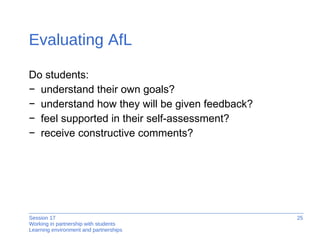
Evaluating AfL Do students: understand their own goals? understand how they will be given feedback? feel supported in their self-assessment? receive constructive comments?
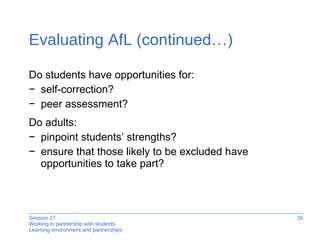
Evaluating AfL  (continued…) Do students have opportunities for: self-correction? peer assessment? Do adults: pinpoint students’ strengths? ensure that those likely to be excluded have opportunities to take part?
Learning outcome You will understand how to   support students with SEN and/or disabilities in setting their own targets and monitoring their own progress Activity 5
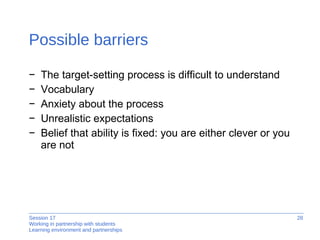
Possible barriers The target-setting process is difficult to understand Vocabulary  Anxiety about the process Unrealistic expectations Belief that ability is fixed: you are either clever or you are not
Possible barriers  (continued…) Time involved Progression path for those at lowest attainment levels Comparison with other students’ attainment Too many targets
Managing target setting Many schools have systems for recording targets Some students may need targets in pictorial form Some targets provided, some negotiated Some targets generic, some subject-related  Behaviour targets reviewed more often than  learning targets Targets should be challenging but achievable
Types of target to know… to be able to… to be aware of… to understand…
Using student self-assessment sheets Students can record their progress regularly  Students can write comments for themselves, someone can scribe for them or they can draw pictures  Sheets can be used in review meetings or incorporated  in the review of a statement of SEN Sheets can be used each term for all students in the group/class and kept in assessment files
Learning outcomes You will: reflect on key learning points from the session identify key points of action to consolidate and apply  your learning Activity 6

Working In Partnership With Students - Session Seventeen

  • 1.
    Learning environment andpartnerships Special educational needs and/or disabilities Training toolkit Working in partnership with students Session 17
  • 2.
    Learning outcomes Youwill understand: different types and degrees of student participation elements of effecti ve communication and how communication can be improved for students with SEN and/or disabilities the importance of a whole-school approach to increasing students’ participation in school life how students with SEN and/or disabilities can be included in assessment for learning how to support students with SEN and/or disabilities in setting and reviewing their ta rgets
  • 3.
    Learning outcome Youwill understand different types and degrees of student participation Activity 1
  • 4.
    United Nations Conventionon the Rights of the Child “ Children who are capable of forming views have a right to receive and make known information, to express an opinion, and to have that opinion taken into account in any matters affecting them” Article 12, United Nations Convention on the Rights of the Child
  • 5.
    Students and decisionmaking “ Children and young people with SEN have a unique knowledge of their own needs and circumstances and their own views about what sort of help they would like to help them make the most of their education. “ They should, where possible, participate in all the decision-making processes that occur in education.” DfES, 2001
  • 6.
    Principles of pupilparticipation Clear commitment to involving pupils Valuing their involvement Equality of opportunity to be involved Pupils’ involvement evaluated and reviewed DfES, 2003
  • 7.
    Student participation Formal happens at set times and for a reason, eg at the annual review of a statement of SEN Informal happens as part of daily interactions, eg in the corridor
  • 8.
    Making decisions Personal made by students, eg about their own learning goals Public students are involved in deciding about planning, policy or resources, eg about the development of the school’s disability equality scheme
  • 9.
    The Disability Discrimination Act 2005 Every school must now have a disability equality scheme (DES) Disabled people, including students, must be consulted on these schemes
  • 10.
    Principles of theSecondary National Strategy Expectations − setting high expectations and challenging targets for all students to achieve Progression − strengthening the transition from KS2 to KS3 and ensuring progression in teaching and learning across KS3 Engagement − promoting approaches to teaching and learning that engage and motivate students and require them to take an active part Transformation − strengthening teaching and learning through a programme of professional development and practical support
  • 11.
    Ofsted Encourages inspectorsto obtain students’ views about their learning, personal development and the school Talks to individuals, groups and school councils and issues questionnaires to students Their 2005 framework encourages the use of case studies of vulnerable students, which includes talking to those students
  • 12.
    Filsham Valley SchoolThe clip includes: eye contact listening skills strategies for making friends taking turns conventions for joining a discussion (put hands up)
  • 13.
    Learning outcomes Youwill understand: the elements of effective communication how communication can be improved for students with SEN and/or disabilities Activity 2
  • 14.
    Effective communication Studentswith SLCN may have difficulty expressing themselves Students with an ASD may find it hard to take turns in talking and to understand things from another person’s point of view Listening to students shows respect and builds their self-esteem
  • 15.
    Essential skills Tohelp students express themselves and talk about their feelings, teachers may need to model and teach the skills of: greeting people listening attentively speaking calmly taking turns refusing politely
  • 16.
    Essential skills (continued…) To help students express themselves and talk about their feelings, teachers may need to model and teach the skills of: asking questions responding to questions sustaining a conversation
  • 17.
    Social and academicskills in mathematics learning Students are to work in groups to explore a problem Group work is a challenge for the student with an ASD This student might: practise the new skill without the demands of group work take part in the group but with different learning outcomes, related to group work skills such as taking turns, listening to others or sharing equipment
  • 18.
    Active listening: setthe scene Find an appropriate time and place Sit next to, not opposite, the student Make eye contact Check that students with a hearing impairment or other communication needs can see your face
  • 19.
    Active listening techniquesGive the student time to respond Help them focus on the main issue (learning and/or behaviour) Reflect on what is said to check your understanding Keep suggestions brief and concrete; avoid passing judgement Use practical examples to aid understanding Write down key issues and commit to specific follow-up
  • 20.
    Effective communication Whymight some students with SEN and/or disabilities find it difficult to communicate with teachers/other students? How can teachers make sure that students with communication difficulties are clear about what to do next? How can teachers make sure students get the correct support? How can collaborative learning be encouraged, where students talk and listen to each other?
  • 21.
    Effective communication (continued…) How can teachers’ questions aid communication skills? How can the rule of ‘one person speaking at a time and the other one listening’ be taught to students who find this difficult? How can teachers make sure the views of students with SEN and/or disabilities are acted on?
  • 22.
    Learning outcome Youwill understand the importance of a whole-school approach to increasing students’ participation in school life Activity 3
  • 23.
    Key issues inplanning for student partnership School ethos Problems of school site Time for making reasonable adjustments Commitment of school support team Funding for building improvements Local authority involvement Medical problems
  • 24.
    Learning outcome Youwill understand how students with SEN and/or disabilities can be included in assessment for learning (AfL) Activity 4
  • 25.
    Evaluating AfL Dostudents: understand their own goals? understand how they will be given feedback? feel supported in their self-assessment? receive constructive comments?
  • 26.
    Evaluating AfL (continued…) Do students have opportunities for: self-correction? peer assessment? Do adults: pinpoint students’ strengths? ensure that those likely to be excluded have opportunities to take part?
  • 27.
    Learning outcome Youwill understand how to support students with SEN and/or disabilities in setting their own targets and monitoring their own progress Activity 5
  • 28.
    Possible barriers Thetarget-setting process is difficult to understand Vocabulary Anxiety about the process Unrealistic expectations Belief that ability is fixed: you are either clever or you are not
  • 29.
    Possible barriers (continued…) Time involved Progression path for those at lowest attainment levels Comparison with other students’ attainment Too many targets
  • 30.
    Managing target settingMany schools have systems for recording targets Some students may need targets in pictorial form Some targets provided, some negotiated Some targets generic, some subject-related Behaviour targets reviewed more often than learning targets Targets should be challenging but achievable
  • 31.
    Types of targetto know… to be able to… to be aware of… to understand…
  • 32.
    Using student self-assessmentsheets Students can record their progress regularly Students can write comments for themselves, someone can scribe for them or they can draw pictures Sheets can be used in review meetings or incorporated in the review of a statement of SEN Sheets can be used each term for all students in the group/class and kept in assessment files
  • 33.
    Learning outcomes Youwill: reflect on key learning points from the session identify key points of action to consolidate and apply your learning Activity 6