1.1  Patterns and Inductive Reasoning Goal 1:  Finding and Describing Patterns You will be able to find and describe _____ and ________ patterns. visual numerical
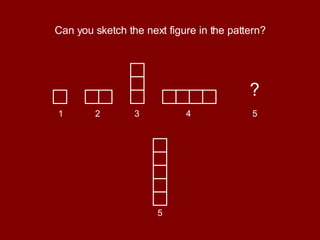
Can you sketch the next figure in the pattern? 5 ? 1   2  3  4  5
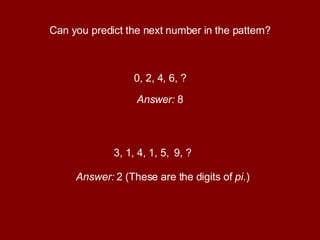
Can you predict the next number in the pattern? 0, 2, 4, 6, ? Answer:  8 3, 1, 4, 1, 5,  Answer:  2 (These are the digits of  pi .) 9, ?
Think and Discuss What are some other patterns you see around you?  What are some numerical patterns you use in your daily life?  What are other types of patterns (besides visual and numerical) you can identify?
1.1  Patterns and Inductive Reasoning Goal 2:  Using Inductive Reasoning You will learn to use inductive reasoning to predict future elements in a pattern.
Definition Inductive Reasoning  is the process of looking for _______ and making  __________. So what’s a conjecture? A  conjecture  is an unproven statement that is based on observations,  e.g.,  The sun is going to come up tomorrow. What are some other conjectures you make? patterns conjectures
3 Stages of Inductive Reasoning Look for a Pattern Look at as many examples as necessary to make a conclusion.  Be sure the conjecture fits all the examples you have. Tables, diagrams, lists, etc. can help you find a pattern. Make a Conjecture Share it with others.  Make changes as needed. Verify the Conjecture Use logical reasoning to verify it is true in all cases.  (This is called  deductive reasoning , and we’ll learn more about it in Chapter 2.
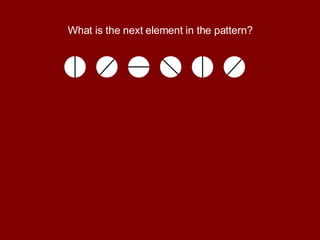
What is the next element in the pattern?
Proving a Conjecture is True or False To prove a conjecture is  true,  you must prove it is true in  all  cases.  To prove a conjecture is  false , you only need to give one example showing it is false.  This example is called a ______________. counterexample
Give a counterexample to the following conjecture: The difference of two positive numbers is always a positive number. Sample answer:  4 – 10 = -6. Remember:  You only need  one  counterexample to prove a conjecture is false.  If you want to show a conjecture is true, you must show it is true in  every  case. What do you think?  Is it easier to prove a conjecture is true or that it is false?  Why?
Goldbach’s Conjecture: Every even number greater than 2 can be written as the sum of two primes. Select an even number from 50 to 100 and show that Goldbach’s conjecture is true for that number. Think and Discuss Have you  proven  Goldbach’s conjecture? No.  You’ve shown it is true only for the number you selected.
Real-life application At a grocery store, Carlos bought 2 cans of soda for $1, Tina bought 4 cans for $2, and Pat bought 3 cans for $1.50.  Make a conjecture about the price of a can of soda.  Think and Discuss Why might your conjecture be false?  Can your conjecture be reasonable for the information you have and still be false?  Can you think of some conjectures which seemed reasonable at first but were later shown to be false?


Geo 1.1 Patterns And Inductive Reasoning

  • 1.
    1.1 Patternsand Inductive Reasoning Goal 1: Finding and Describing Patterns You will be able to find and describe _____ and ________ patterns. visual numerical
  • 2.
    Can you sketchthe next figure in the pattern? 5 ? 1 2 3 4 5
  • 3.
    Can you predictthe next number in the pattern? 0, 2, 4, 6, ? Answer: 8 3, 1, 4, 1, 5, Answer: 2 (These are the digits of pi .) 9, ?
  • 4.
    Think and DiscussWhat are some other patterns you see around you? What are some numerical patterns you use in your daily life? What are other types of patterns (besides visual and numerical) you can identify?
  • 5.
    1.1 Patternsand Inductive Reasoning Goal 2: Using Inductive Reasoning You will learn to use inductive reasoning to predict future elements in a pattern.
  • 6.
    Definition Inductive Reasoning is the process of looking for _______ and making __________. So what’s a conjecture? A conjecture is an unproven statement that is based on observations, e.g., The sun is going to come up tomorrow. What are some other conjectures you make? patterns conjectures
  • 7.
    3 Stages ofInductive Reasoning Look for a Pattern Look at as many examples as necessary to make a conclusion. Be sure the conjecture fits all the examples you have. Tables, diagrams, lists, etc. can help you find a pattern. Make a Conjecture Share it with others. Make changes as needed. Verify the Conjecture Use logical reasoning to verify it is true in all cases. (This is called deductive reasoning , and we’ll learn more about it in Chapter 2.
  • 8.
    What is thenext element in the pattern?
  • 9.
    Proving a Conjectureis True or False To prove a conjecture is true, you must prove it is true in all cases. To prove a conjecture is false , you only need to give one example showing it is false. This example is called a ______________. counterexample
  • 10.
    Give a counterexampleto the following conjecture: The difference of two positive numbers is always a positive number. Sample answer: 4 – 10 = -6. Remember: You only need one counterexample to prove a conjecture is false. If you want to show a conjecture is true, you must show it is true in every case. What do you think? Is it easier to prove a conjecture is true or that it is false? Why?
  • 11.
    Goldbach’s Conjecture: Everyeven number greater than 2 can be written as the sum of two primes. Select an even number from 50 to 100 and show that Goldbach’s conjecture is true for that number. Think and Discuss Have you proven Goldbach’s conjecture? No. You’ve shown it is true only for the number you selected.
  • 12.
    Real-life application Ata grocery store, Carlos bought 2 cans of soda for $1, Tina bought 4 cans for $2, and Pat bought 3 cans for $1.50. Make a conjecture about the price of a can of soda. Think and Discuss Why might your conjecture be false? Can your conjecture be reasonable for the information you have and still be false? Can you think of some conjectures which seemed reasonable at first but were later shown to be false?
  • 13.
  • 14.