INTRODUCTION
The waste produced in the course of health-care activities
carries a higher potential for infection and injury than any
other type of waste. Therefore, it is essential to have safe
and reliable method for handling. Inadequate and
inappropriate handling of health-care waste may have
serious public health consequences and a significant impact
on the environment…
Thus the appropriate management of health-care waste is
thus crucial component of environmental health protection,
and it should thus become an integral feature of health-care
services.
“Any solid, fluid or liquid waste, including its
 container & any intermediate product, which is
   generated during the diagnosis, treatment or
    immuzation of human beings or animals, in
research pertaining there or in the production or
   testing of biological & the animal waste from
         slaughter houses or any other like
                   establishments”
The institutions mainly involved in generation of Bio-Medical
wastes include:
~Government hospitals
~Nursing home
~Physicians office/clinics.
~Dentists office/clinics
~Dispensaries.
~Medical and research training center
~Mortuaries.
~Blood banks and Collection centers
~Slaughter houses
~Laboratories
~Bio-technology institutes and production units.
~Research organizations.

All these Health care establishments generate wastes and are therefore
covered under Bio-Medical wastes[BMW].
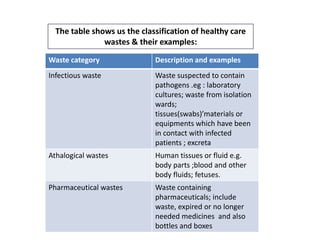
The table shows us the classification of healthy care
               wastes & their examples:

Waste category               Description and examples
Infectious waste             Waste suspected to contain
                             pathogens .eg : laboratory
                             cultures; waste from isolation
                             wards;
                             tissues(swabs)’materials or
                             equipments which have been
                             in contact with infected
                             patients ; excreta
Athalogical wastes           Human tissues or fluid e.g.
                             body parts ;blood and other
                             body fluids; fetuses.
Pharmaceutical wastes        Waste containing
                             pharmaceuticals; include
                             waste, expired or no longer
                             needed medicines and also
                             bottles and boxes
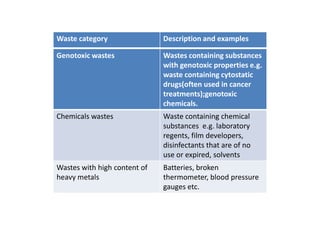
Waste category                Description and examples

Genotoxic wastes              Wastes containing substances
                              with genotoxic properties e.g.
                              waste containing cytostatic
                              drugs(often used in cancer
                              treatments);genotoxic
                              chemicals.
Chemicals wastes              Waste containing chemical
                              substances e.g. laboratory
                              regents, film developers,
                              disinfectants that are of no
                              use or expired, solvents
Wastes with high content of   Batteries, broken
heavy metals                  thermometer, blood pressure
                              gauges etc.
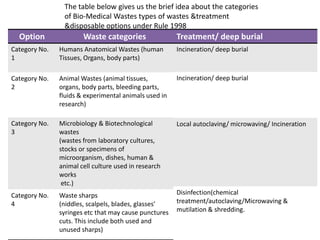
The table below gives us the brief idea about the categories
                of Bio-Medical Wastes types of wastes &treatment
                &disposable options under Rule 1998
  Option               Waste categories                Treatment/ deep burial
Category No.   Humans Anatomical Wastes (human         Incineration/ deep burial
1              Tissues, Organs, body parts)

Category No.   Animal Wastes (animal tissues,          Incineration/ deep burial
2              organs, body parts, bleeding parts,
               fluids & experimental animals used in
               research)

Category No.   Microbiology & Biotechnological         Local autoclaving/ microwaving/ Incineration
3              wastes
               (wastes from laboratory cultures,
               stocks or specimens of
               microorganism, dishes, human &
               animal cell culture used in research
               works
                etc.)
Category No.   Waste sharps                            Disinfection(chemical
4              (niddles, scalpels, blades, glasses’    treatment/autoclaving/Microwaving &
               syringes etc that may cause punctures   mutilation & shredding.
               cuts. This include both used and
               unused sharps)
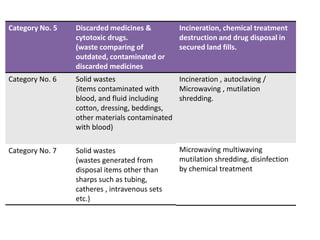
Category No. 5   Discarded medicines &          Incineration, chemical treatment
                 cytotoxic drugs.               destruction and drug disposal in
                 (waste comparing of            secured land fills.
                 outdated, contaminated or
                 discarded medicines
Category No. 6   Solid wastes                 Incineration , autoclaving /
                 (items contaminated with     Microwaving , mutilation
                 blood, and fluid including   shredding.
                 cotton, dressing, beddings,
                 other materials contaminated
                 with blood)

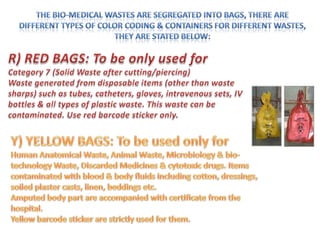
Category No. 7   Solid wastes                   Microwaving multiwaving
                 (wastes generated from         mutilation shredding, disinfection
                 disposal items other than      by chemical treatment
                 sharps such as tubing,
                 catheres , intravenous sets
                 etc.)
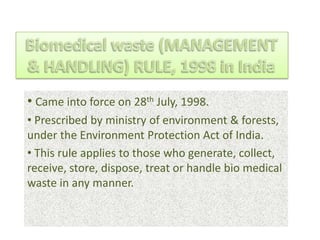
• Came into force on 28th July, 1998.
• Prescribed by ministry of environment & forests,
under the Environment Protection Act of India.
• This rule applies to those who generate, collect,
receive, store, dispose, treat or handle bio medical
waste in any manner.
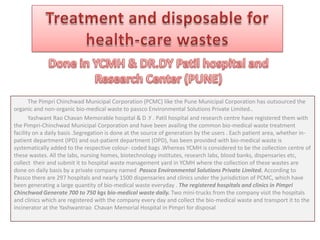
The Pimpri Chinchwad Municipal Corporation (PCMC) like the Pune Municipal Corporation has outsourced the
organic and non-organic bio-medical waste to passco Environmental Solutions Private Limited..
       Yashwant Rao Chavan Memorable hospital & D .Y . Patil hospital and research centre have registered them with
the Pimpri-Chinchwad Municipal Corporation and have been availing the common bio-medical waste treatment
facility on a daily basis .Segregation is done at the source of generation by the users . Each patient area, whether in-
patient department (IPD) and out-patient department (OPD), has been provided with bio-medical waste is
systematically added to the respective colour- coded bags .Whereas YCMH is considered to be the collection centre of
these wastes. All the labs, nursing homes, biotechnology institutes, research labs, blood banks, dispensaries etc,
collect their and submit it to hospital waste management yard in YCMH where the collection of these wastes are
done on daily basis by a private company named Passco Environmental Solutions Private Limited. According to
Passco there are 297 hospitals and nearly 1500 dispensaries and clinics under the jurisdiction of PCMC, which have
been generating a large quantity of bio-medical waste everyday . The registered hospitals and clinics in Pimpri
Chinchwad Generate 700 to 750 kgs bio-medical waste daily. Two mini-trucks from the company visit the hospitals
and clinics which are registered with the company every day and collect the bio-medical waste and transport it to the
incinerator at the Yashwantrao Chavan Memorial Hospital in Pimpri for disposal
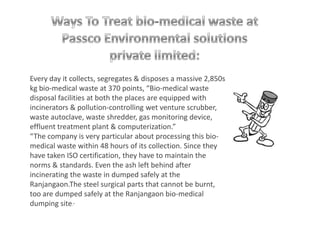
Every day it collects, segregates & disposes a massive 2,850s
kg bio-medical waste at 370 points, “Bio-medical waste
disposal facilities at both the places are equipped with
incinerators & pollution-controlling wet venture scrubber,
waste autoclave, waste shredder, gas monitoring device,
effluent treatment plant & computerization.”
“The company is very particular about processing this bio-
medical waste within 48 hours of its collection. Since they
have taken ISO certification, they have to maintain the
norms & standards. Even the ash left behind after
incinerating the waste in dumped safely at the
Ranjangaon.The steel surgical parts that cannot be burnt,
too are dumped safely at the Ranjangaon bio-medical
dumping site.”
• Other patients attending the health care facilities.
•Medical & paramedical person providing health care.
• Persons involved in collecting & disposing the waste
material.
• Those involved in clearing the instruments, floor
surfaces &washing of glass wares & linen.
• If potentially waste gets mixed with solid waste from
other activities the entire chain of workers/persons
involved in solid disposal.
Biomedical waste disposal

Biomedical waste disposal

  • 2.
    INTRODUCTION The waste producedin the course of health-care activities carries a higher potential for infection and injury than any other type of waste. Therefore, it is essential to have safe and reliable method for handling. Inadequate and inappropriate handling of health-care waste may have serious public health consequences and a significant impact on the environment… Thus the appropriate management of health-care waste is thus crucial component of environmental health protection, and it should thus become an integral feature of health-care services.
  • 3.
    “Any solid, fluidor liquid waste, including its container & any intermediate product, which is generated during the diagnosis, treatment or immuzation of human beings or animals, in research pertaining there or in the production or testing of biological & the animal waste from slaughter houses or any other like establishments”
  • 4.
    The institutions mainlyinvolved in generation of Bio-Medical wastes include: ~Government hospitals ~Nursing home ~Physicians office/clinics. ~Dentists office/clinics ~Dispensaries. ~Medical and research training center ~Mortuaries. ~Blood banks and Collection centers ~Slaughter houses ~Laboratories ~Bio-technology institutes and production units. ~Research organizations. All these Health care establishments generate wastes and are therefore covered under Bio-Medical wastes[BMW].
  • 5.
    The table showsus the classification of healthy care wastes & their examples: Waste category Description and examples Infectious waste Waste suspected to contain pathogens .eg : laboratory cultures; waste from isolation wards; tissues(swabs)’materials or equipments which have been in contact with infected patients ; excreta Athalogical wastes Human tissues or fluid e.g. body parts ;blood and other body fluids; fetuses. Pharmaceutical wastes Waste containing pharmaceuticals; include waste, expired or no longer needed medicines and also bottles and boxes
  • 6.
    Waste category Description and examples Genotoxic wastes Wastes containing substances with genotoxic properties e.g. waste containing cytostatic drugs(often used in cancer treatments);genotoxic chemicals. Chemicals wastes Waste containing chemical substances e.g. laboratory regents, film developers, disinfectants that are of no use or expired, solvents Wastes with high content of Batteries, broken heavy metals thermometer, blood pressure gauges etc.
  • 7.
    The table belowgives us the brief idea about the categories of Bio-Medical Wastes types of wastes &treatment &disposable options under Rule 1998 Option Waste categories Treatment/ deep burial Category No. Humans Anatomical Wastes (human Incineration/ deep burial 1 Tissues, Organs, body parts) Category No. Animal Wastes (animal tissues, Incineration/ deep burial 2 organs, body parts, bleeding parts, fluids & experimental animals used in research) Category No. Microbiology & Biotechnological Local autoclaving/ microwaving/ Incineration 3 wastes (wastes from laboratory cultures, stocks or specimens of microorganism, dishes, human & animal cell culture used in research works etc.) Category No. Waste sharps Disinfection(chemical 4 (niddles, scalpels, blades, glasses’ treatment/autoclaving/Microwaving & syringes etc that may cause punctures mutilation & shredding. cuts. This include both used and unused sharps)
  • 8.
    Category No. 5 Discarded medicines & Incineration, chemical treatment cytotoxic drugs. destruction and drug disposal in (waste comparing of secured land fills. outdated, contaminated or discarded medicines Category No. 6 Solid wastes Incineration , autoclaving / (items contaminated with Microwaving , mutilation blood, and fluid including shredding. cotton, dressing, beddings, other materials contaminated with blood) Category No. 7 Solid wastes Microwaving multiwaving (wastes generated from mutilation shredding, disinfection disposal items other than by chemical treatment sharps such as tubing, catheres , intravenous sets etc.)
  • 9.
    • Came intoforce on 28th July, 1998. • Prescribed by ministry of environment & forests, under the Environment Protection Act of India. • This rule applies to those who generate, collect, receive, store, dispose, treat or handle bio medical waste in any manner.
  • 11.
    The Pimpri ChinchwadMunicipal Corporation (PCMC) like the Pune Municipal Corporation has outsourced the organic and non-organic bio-medical waste to passco Environmental Solutions Private Limited.. Yashwant Rao Chavan Memorable hospital & D .Y . Patil hospital and research centre have registered them with the Pimpri-Chinchwad Municipal Corporation and have been availing the common bio-medical waste treatment facility on a daily basis .Segregation is done at the source of generation by the users . Each patient area, whether in- patient department (IPD) and out-patient department (OPD), has been provided with bio-medical waste is systematically added to the respective colour- coded bags .Whereas YCMH is considered to be the collection centre of these wastes. All the labs, nursing homes, biotechnology institutes, research labs, blood banks, dispensaries etc, collect their and submit it to hospital waste management yard in YCMH where the collection of these wastes are done on daily basis by a private company named Passco Environmental Solutions Private Limited. According to Passco there are 297 hospitals and nearly 1500 dispensaries and clinics under the jurisdiction of PCMC, which have been generating a large quantity of bio-medical waste everyday . The registered hospitals and clinics in Pimpri Chinchwad Generate 700 to 750 kgs bio-medical waste daily. Two mini-trucks from the company visit the hospitals and clinics which are registered with the company every day and collect the bio-medical waste and transport it to the incinerator at the Yashwantrao Chavan Memorial Hospital in Pimpri for disposal
  • 12.
    Every day itcollects, segregates & disposes a massive 2,850s kg bio-medical waste at 370 points, “Bio-medical waste disposal facilities at both the places are equipped with incinerators & pollution-controlling wet venture scrubber, waste autoclave, waste shredder, gas monitoring device, effluent treatment plant & computerization.” “The company is very particular about processing this bio- medical waste within 48 hours of its collection. Since they have taken ISO certification, they have to maintain the norms & standards. Even the ash left behind after incinerating the waste in dumped safely at the Ranjangaon.The steel surgical parts that cannot be burnt, too are dumped safely at the Ranjangaon bio-medical dumping site.”
  • 15.
    • Other patientsattending the health care facilities. •Medical & paramedical person providing health care. • Persons involved in collecting & disposing the waste material. • Those involved in clearing the instruments, floor surfaces &washing of glass wares & linen. • If potentially waste gets mixed with solid waste from other activities the entire chain of workers/persons involved in solid disposal.