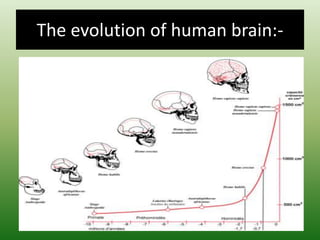
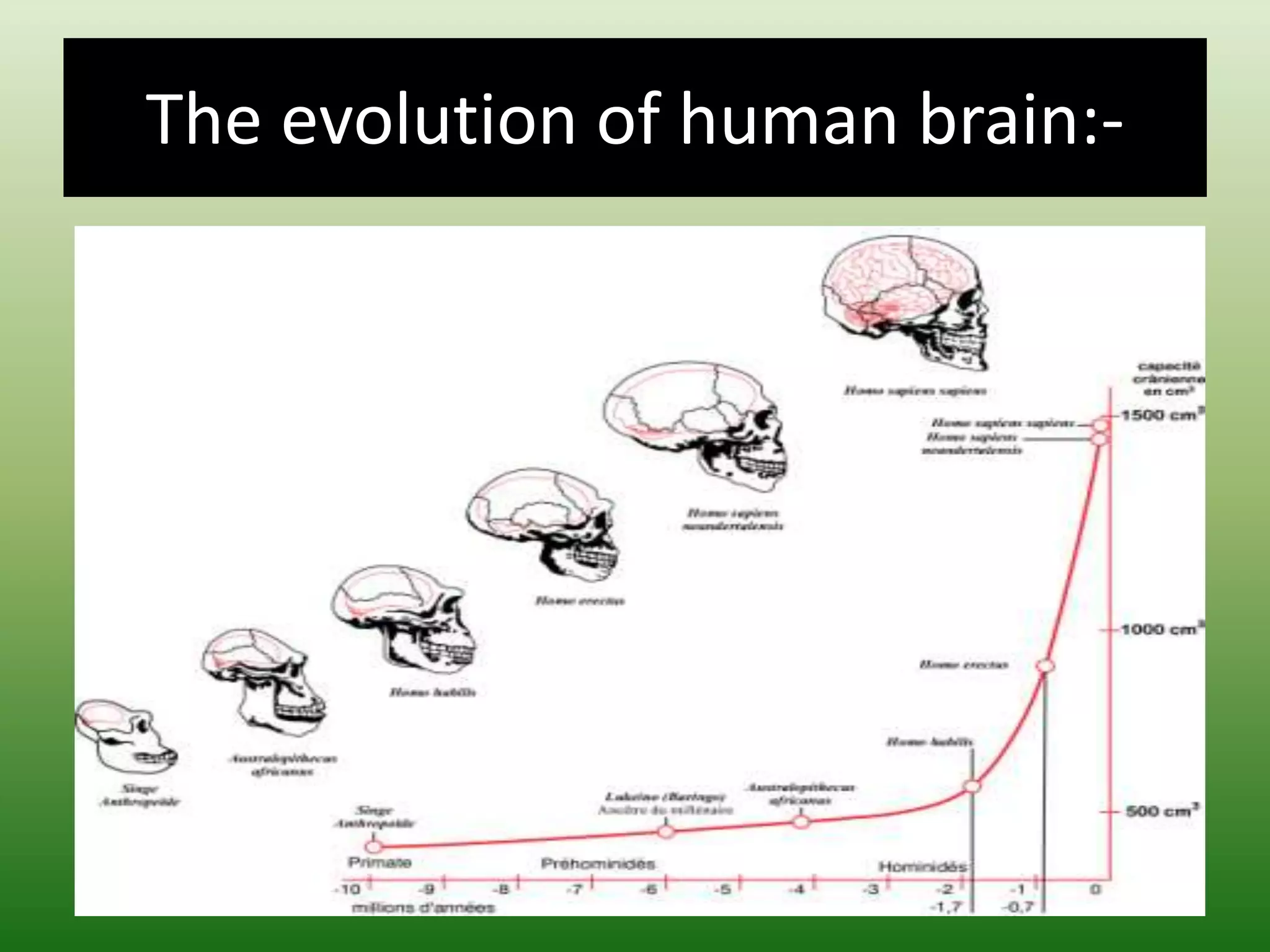
The evolution of human brain:-
Three hypothesis:-
*Epiphenomenal
*Ecological
*Social brain hypothesis
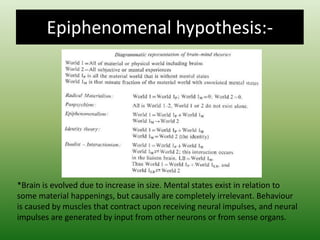
Epiphenomenal hypothesis:-
*Brain is evolved due to increase in size. Mental states exist in relation to
some material happenings, but causally are completely irrelevant. Behaviour
is caused by muscles that contract upon receiving neural impulses, and neural
impulses are generated by input from other neurons or from sense organs.
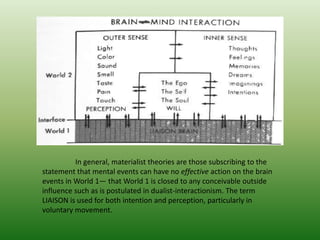
In general, materialist theories are those subscribing to the
statement that mental events can have no effective action on the brain
events in World 1— that World 1 is closed to any conceivable outside
influence such as is postulated in dualist-interactionism. The term
LIAISON is used for both intention and perception, particularly in
voluntary movement.
Ecological Hypothesis:-
*Environmental conditions bounds the brain for
evolution. Here to be considered two types of
consumers-
Folivorous- Leaf consumers.
Frugivorous- Fruit consumers.
*Fruit consumers are more likely to be having more
developed brain in terms of (a) Overall size of brain,
(b) Relative size & (c) Brain’s tendency to use
resources.
The evolution of human brain

The evolution of human brain

  • 1.
    The evolution ofhuman brain:-
  • 2.
  • 3.
    Epiphenomenal hypothesis:- *Brain isevolved due to increase in size. Mental states exist in relation to some material happenings, but causally are completely irrelevant. Behaviour is caused by muscles that contract upon receiving neural impulses, and neural impulses are generated by input from other neurons or from sense organs.
  • 4.
    In general, materialisttheories are those subscribing to the statement that mental events can have no effective action on the brain events in World 1— that World 1 is closed to any conceivable outside influence such as is postulated in dualist-interactionism. The term LIAISON is used for both intention and perception, particularly in voluntary movement.
  • 5.
    Ecological Hypothesis:- *Environmental conditionsbounds the brain for evolution. Here to be considered two types of consumers- Folivorous- Leaf consumers. Frugivorous- Fruit consumers. *Fruit consumers are more likely to be having more developed brain in terms of (a) Overall size of brain, (b) Relative size & (c) Brain’s tendency to use resources.